/
Customer Reviews as Strategic Insight with George Swetlitz
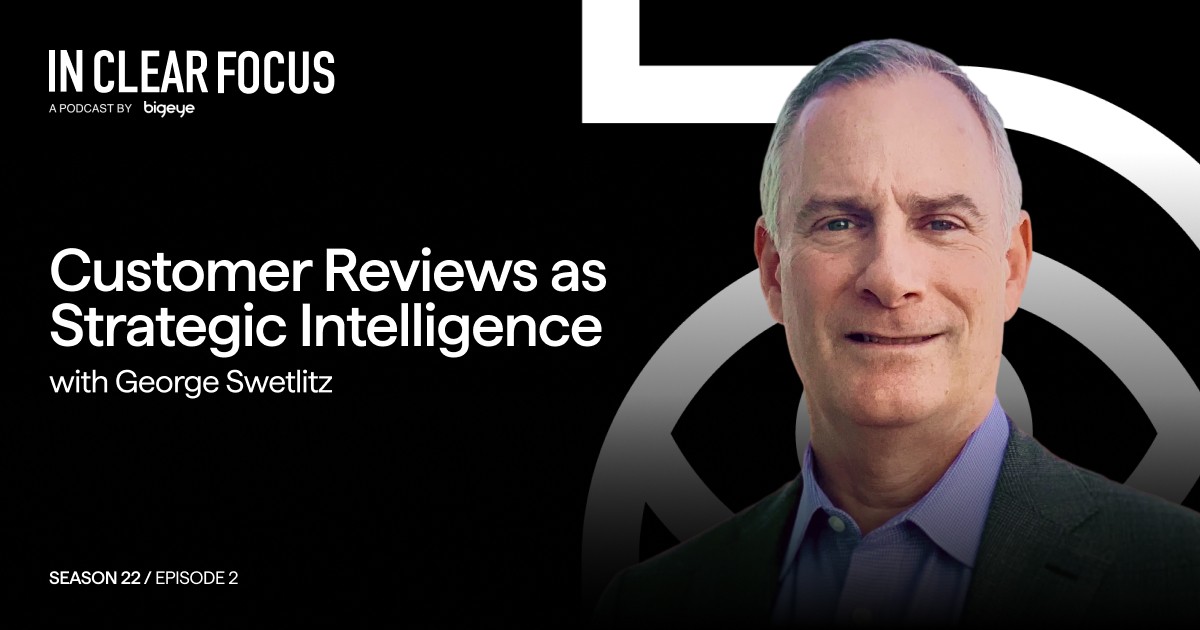
IN CLEAR FOCUS: George Swetlitz, co-founder of RightResponse AI, reveals why more people read consumer reviews than visit websites. He discusses utilizing AI-powered reputation management to transform unstructured data into strategic intelligence that outperforms simple star ratings. Learn how personalized automation can triple review conversions, optimize multi-location operations, why "fake personalization" fails, and how to transform customer reviews into actionable marketing strategies.
Episode Transcript
Adrian Tennant: Coming up in this episode of IN CLEAR FOCUS.
George Swetlitz: There's no one closer to the bottom of the funnel than someone actually reading your reviews. More people read reviews than visit websites. So the challenge for a true marketer is to say, “How do I bring my website to the review conversation?”
Adrian Tennant: You're listening to IN CLEAR FOCUS, fresh perspectives on marketing and advertising produced weekly by Bigeye, a strategy-led, full-service creative agency growing brands for clients globally. Hello, I'm your host, Adrian Tennant, Bigeye's Chief Strategy Officer. Thank you for joining us. Every day, millions of customers leave reviews online. But for most businesses, this feedback represents a flood of unstructured data that's difficult to analyze and act upon. What if customer reviews could become one of your most valuable sources of strategic intelligence? Well, our guest today believes they can. George Swetlitz is the co-founder of RightResponse AI, an artificial intelligence platform that transforms how businesses understand and respond to customer feedback. A Harvard Business School graduate with experience at McKinsey & Company, George understands both the operational challenges of multi-location businesses and the power of AI to solve real marketing problems. To discuss how customer reviews can become strategic intelligence, the challenges of reputation management at scale, and why AI-powered personalization is replacing generic automation, I'm delighted that George is joining us today from Jacksonville, Florida. George, welcome to IN CLEAR FOCUS.
George Swetlitz: It is great to be here. Thank you very much for having me.
Adrian Tennant: Well, George, before we dive into RightResponse AI, could you tell us a bit about your career?
George Swetlitz: Sure. So, I've had a long career. I started off in consulting. So, I worked for a McKinsey & Company, very large consulting firm. and then transitioned into operating roles. And so I ended up leading a division for a company called Sara Lee Corporation, and then went back on the consulting side and spent a number of years working with primarily large organizations to improve overall profitability. Then I started working more closely with private equity firms and ended up becoming the CEO of a private equity-backed consolidation in the audiology industry. And that was Alpaca Audiology, which was right before I founded RightResponse AI.
Adrian Tennant: Got it. George, what led you to start RightResponseAI?
George Swetlitz: So as CEO of a 220-location business, one of the key things that you focus on is growing organically. So that to me is having people call you as opposed to you reaching out through paid ads and in other ways that the cheapest and most effective way to grow is to have people call you. And what we learned was at the center of that is the review space. For businesses that are location-based, the center, the core of getting people to call you is the review ecosystem. That's the core. And so we focused on how to do that. We spent a lot of time thinking about it. And working with vendors to do that in a very effective way. And the problem was, we really couldn't find good vendors to help us. And of course, this is before AI. They were very expensive. And the outputs that you would get from these systems were not very good. We ended up selling the business in 2021. And then in 2022, ChatGPT came out. And I thought this might be a good way to solve the problems that we had. And so I got the team together, and we started RightResponse. We spent about a year, a year and a half building the platform and launched in late ‘23.
Adrian Tennant: Can you explain how RightResponse AI transforms customer reviews into strategic intelligence?
George Swetlitz: Yes, and this is particularly important for multi-location businesses because what you're trying to understand is how do you take the unstructured data that you're getting and that other people are getting and use that unstructured data to improve your business? And also understand how other people are positioning their business? And so we have some features, we call them review sentiment analysis, competitor sentiment analysis, competitor analysis, where we take all of this information, and we help businesses understand what they're doing well, where they can improve, what their customers are doing well, and how they can use the areas where their competitors are faltering to better position themselves.
Adrian Tennant: Traditional review platforms often provide a single rating that doesn't tell the whole story. How does your sentiment analysis approach differ?
George Swetlitz: So the way to think about it is what we do is create mini ratings. So a review gives you a single rating, and reviews are very complex. “I love the burgers, but I hated the fries.” “It was too loud. But other than that, the ambiance was great.” There's a ton of information that can seem overwhelming if you decide to try to analyze it yourself, coming through in all of these reviews. So we take the reviews, we break them down into phrases, and then we use AI to assign those phrases in their context to topics that we develop for businesses, but that they can modify. So essentially, what you then get is what we call “percent positive mentions.” So if there are a hundred mentions of food quality and 90% of those are positive mentions and 10% are negative mentions, you have a 90% positive on food quality. And that's very understandable. If you have a 4.8, well, what's a 4.8? But if you have a 94% positive mentions, you know exactly what that is. And so what it allows you to do is say, “I'm looking at my business, and I see that my percent positive on quality is 70%, but my percent positive on service is 95%.” So you know precisely what your customers are talking about and what you need to do to improve.
Adrian Tennant: You've talked about how you analyze comments. Now let's talk about your platform's AI-powered response generation. George, how does RightResponse AI create personalized responses rather than generic automated replies?
George Swetlitz: I'll start by talking about a couple of observations. One observation is that you increasingly see people being frustrated with generic AI responses. Most review management platforms use generic AI, and they just essentially spit back what's in the review. And oftentimes, you'll see people respond to that and say, “You're just using a bot. There's nothing. You're not even looking at these things.” And people get frustrated about that. The second thing is (and this is an observation that I had back at Alpaca) there's no one closer to the bottom of the funnel than someone actually reading your reviews. They are deciding, and they're looking for a conversation. More people read reviews than visit websites. So the challenge for a true marketer is to say, “How do I bring my website to the review conversation?” And what we've seen is that when you engage people, when you provide people with useful and helpful information, in your part of that conversation, the customer initiated it through the review. You now have an opportunity to engage in that conversation. And you can respond by using a template, which says nothing, by using a generic AI, which says nothing, or you can actually respond to them in the way that you would if you were speaking to them face-to-face. That's what we do. So that's the context. How do we do it? Well, we have a whole series of AI agents that act on every single review that comes in. Some of them are simple. We look at the name. Is the name a name that we should use in the response? And the agent makes a judgment. And if it seems like a name, we use it. If it doesn't seem like a name, we don't use it. That's a simple AI agent. A more complicated AI agent is our fact system. So essentially, what we do is we look through your last 500 reviews, we identify the things that people talk about in your reviews, and we create a fact. So let's just say that people complain about the fact that they can't find parking. And so we say, if somebody says something negative about the fact that they can't find parking, tell them that the next time, that the parking for the building is behind the building off of Beach Street. That's a helpful and useful piece of information that the AI can determine when it's relevant to a response and include it directly into the response. And so people can generate 10, 15, 20, 25 facts about the business, both on the positive side and the negative side, and those are seamlessly incorporated into responses. Allowing the business to participate in that conversation and provide a useful response both to the customer that left the review and to all the review readers that are trying to decide where to go next.
Adrian Tennant: Okay, you've told us about the responses. How does your platform create personalized review requests?
George Swetlitz: I'll start with the context again. The key with review requests is one: to get more reviews. You're trying to get as many reviews as you can, and you're trying to get more good reviews. That's the key. But the first part is probably the most important, which is conversion of the request into a review. And what we found is that the more you can make an emotional connection with that customer, the more likely they are to actually leave a review. Everyone gets, every day, review requests. “Hi, we saw you yesterday. Could you leave us a review?” What is much better is something that's more personalized, personalized with things that you know about the business. “Hey, this is Phil from The Roofing Company. We were really excited to complete the project yesterday. Here's a photo of the finished project. It really helps us get the word out when people talk about why they liked our service. I've included a couple of questions below that our customers value knowing about, because they ask us these questions all the time. If you wouldn't mind leaving a review to help us get the word out, we'd really appreciate it.” You've personalized it with something real. Who was the person you were engaging with? What were they doing? When were they there? “Here's a photo. Here are questions.” You're much more likely, as a customer, to actually leave that review. That's what we do. We tie into the CRM systems that have information about that customer. And we use AI to personalize that review request.
Adrian Tennant: Well, as regular listeners know, we love case studies on IN CLEAR FOCUS. So, George, can you walk us through a specific example of how the combination of sentiment analysis and personalization works in practice?
George Swetlitz: We work with a large home services business. They're doing everything right. They generated lots of facts. They auto-generate their responses, not auto-publish, but auto-generate. And then they distributed that responsibility out to the regional managers, along with giving them another tool that we have, which is an AI-generated monthly review analysis. So every month, the regional managers get a synopsis of what happened. Every day they can go in, they see review responses that have been automatically generated using the facts. Most of the time, I would say about based on our data, 85% of those responses, they just accept the rest. They'll make a slight modification and publish. When we first started working with them, they were at about a 90% positive, right? So good business, 90%, but they were only responding to about 20% of the reviews. Now, with no additional resources, they're at 95% positive, 80% response rate, and they've told us their business is booming. Great example, we have a business that serves groups. So they serve individuals, but they also do groups, family reunions, other kinds of large groups, those kinds of things. When they send out a review request, they send a photo of the group and they, to remind them of that event that they did together. And then they ask for the review and they've tripled their conversion rate. So it was sub 10% before, which is kind of a typical conversion rate. And it's gone up to about 30% for that type of request. Big improvement based on personalization of requests. Then we had another very, very large business, more than a hundred locations. Response quality was low. Response rate was low, sub-50%. They had two people. They couldn't get to everything. They had negative reviews that were about 15% of the total, getting lots of reviews. They couldn't get back to everybody. They just couldn't get their jobs done. With us, they literally went to 100% response rate, not difficult to do with our system. 90% of the time that they spend now is spent on real issues with real customers. And they have one FTE. So that one person is now not focused on all of those reviews, but focused on the people that really need their help. So just ways that automation, sophistication, focus, and leveraging all of these tools can drive performance.
Adrian Tennant: Yeah, great examples. Let's take a short break. We'll be right back after this message.
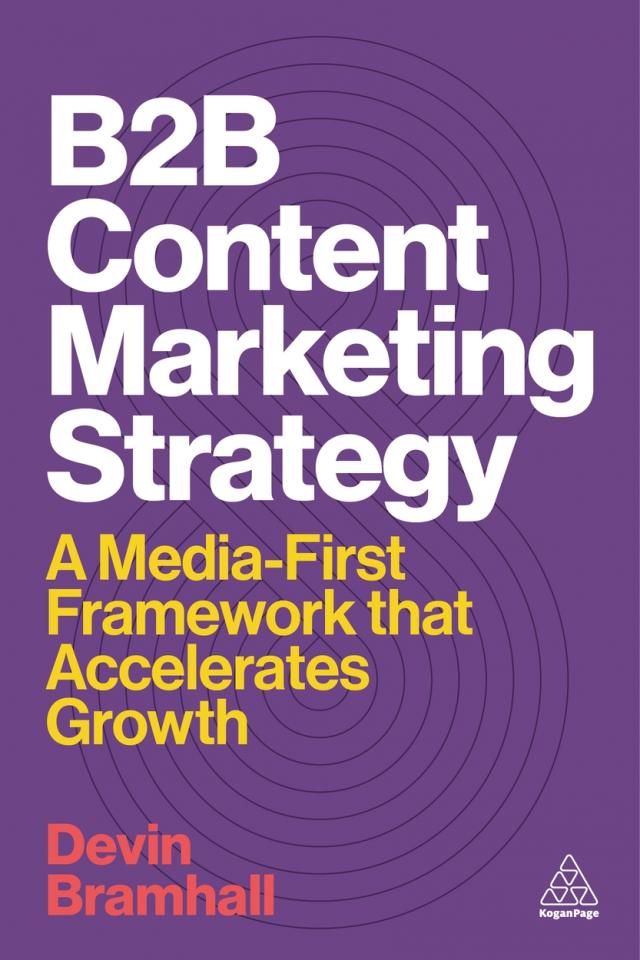
Devin Bramhall: Hi, I'm Devin Bramhall, author of B2B Content Marketing Strategy: A Media-First Framework That Accelerates Growth, published by Kogan Page.
If you've ever felt like your content marketing creates a lot of activity but very little real business impact, this book is for you. I wrote it to help mid-career marketers move beyond outdated playbooks and build human-centered strategies that actually drive growth.
Drawing on my experience as former CEO of Animalz (where I worked with brands like Google, Amazon, Slack, and Ramp) and real-world case studies from companies such as Cisco, HelpScout, and Nubatic, I share modern marketing frameworks that combine community-building with AI and multimedia-based tactics to create growth strategies that deliver a true competitive advantage.
As an IN CLEAR FOCUS listener, you can save 25% on B2B Content Marketing Strategy when you order directly from KoganPage.com. Just enter the exclusive promo code BIGEYE25 at checkout. Shipping is always complimentary for customers in the US and the UK. I hope my book helps you create content strategies that build real connections and drive measurable results. Thank you!
Adrian Tennant: Welcome back. I'm talking with George Swetlitz, co-founder of RightResponse AI. George, how does RightResponse AI partner with marketing agencies? I'm curious what white-label offerings might look like.
George Swetlitz: So we do have a white-label program, and essentially the agency has all of the tools at their disposal. We have a very different pricing model. Most people in this space, you have to decide, “I'm going to buy the request package,” or “I'm going to buy the review package,” or “the MapRank package.” We don't do any of that. We have a per-location fee, which if you buy annually, is $8 a month, $10 a month if you buy monthly. So it's very cheap per location. And then everything above that is usage-based. So if someone is focused on review requests, they can come in, start with a review request, and just pay for a review request. If they have a location that doesn't have very many requests, they don't pay much because they're not using the system that much. And then over time, as they build their business, they're paying more because they're using more. So it's a very different model, and it respects small and large companies as well. There are discount packages as you purchase more credits and all of those kinds of things. And so agencies get another benefit, which is agencies can use our software for research, and they don't pay a per-location fee. So they can go in, they can scrape any site they want, any location they want, they can do sentiment analysis, and just pay for the sentiment analysis that they do. So if they're getting ready to do a pitch, they can go and they can download the reviews for 10 locations and 10 competitors and analyze all of that as they're prepping for their pitch. And it costs them, you know, what, 20 bucks to do something that they might have, you know, a junior person spending a week on. And so the agency just simply takes over. It's under their brand, and they can use all the features we have.
Adrian Tennant: Perfect. Now, back on the client side, for executive teams working with franchise or multi-location operations, how can they utilize review data to identify operational issues before they escalate into much larger problems?
George Swetlitz: Yeah, we have one chart in particular that we developed that's exactly for that purpose. And so essentially what it does is you can decide which locations you want to put on the chart. You can put locations on the chart, you can put brands on the chart, you can put regions on the chart, whatever you want to do. And it compares visually their percent positive by topic. And so I'll often sit down when we're onboarding large clients and show them this with their own data and say, “Look at this location A, they're literally underperforming on every single topic. You think you have an issue there?” And it just opens their eyes, because all they had before was essentially, well, “The average rating for this location is 4.4, and our average is 4.7.” It's much more tangible when you say, “Look, their percent positive is in the 70s in every single topic. I think you need to talk to the manager.” So that is how, that is the primary way that large organizations use our tool to get at those differentials.
Adrian Tennant: Right now, your platform is designed for businesses with physical locations. Do you have any plans to extend it, say, as a plug-in for Shopify online stores? Asking for a friend …
George Swetlitz: Yeah, that's coming. There's just so much to do. Technology is changing so fast, and it opens up so many opportunities that we always have to decide, do we go wider or do we go deeper? And right now, we're in the deeper phase. But eventually, we'll go wider. But that's not something we have right now. Now, I will say that many companies that are not necessarily location-based are on Trustpilot, for example, or Better Business Bureau, or those kinds of platforms. And we support those 100%.
Adrian Tennant: Got it. Well, it's in the name, you've built RightResponse AI entirely around artificial intelligence. So George, what have you learned about implementing AI effectively in business applications?
George Swetlitz: So I would say there's two key learnings that we come back to again and again. One is that when you're working with AI, smaller is better. The more you try to put in a single prompt, the more likely it is to fail or be erratic. We just had this yesterday. We continue to develop our approach to generating facts for people, right? So when they come in, we look at 500 reviews, and we develop the facts. And that's a lot of data, 500 reviews, and you're trying to cluster them. There's a lot going on, and it was failing. Even with the best models, it was failing. We kept on breaking it into smaller pieces. And then we realized that we were asking it to do math, and language models don't do math. And so it was failing on that problem, right? So we had to take the math bits out of the prompt and do that on the backend. My point is, the less you can do in any single prompt, and the more you can make sure that the prompt leverages the strength of the AI, the better off you're going to be. That's, I would say, one thing. And the second, and I sort of alluded to it, is doing things in pieces, kind of chain of agents, as opposed to trying to develop one prompt that does a lot. We have many, many, many agents that hand off one to the other, and we get much more consistent results when we do it that way.
Adrian Tennant: Relatedly, thinking about hospitality and multi-location businesses, what's your perspective on striking the right balance between automation and maintaining authentic customer relationships?
George Swetlitz: That's a great question. Often, when I will have an initial conversation with a company, one of the things that they'll say is, “We're worried about, you know, this fake personalization.” And what I'll say is, “I agree with you, but that's not what we do. We don't do any fake personalization.” I'll give you an example of fake personalization. I got an email. So, you know, I'm a B2B company. I get a lot of B2B unsolicited emails. And that's fine, because sometimes I get one that's interesting, but I get a lot. And I just got one the other day that said, “Oh, I see you went to Penn undergrad. You know, Penn's a great restaurant town. Have you ever been to this restaurant?” Well, just for fun, I looked it up. That restaurant only opened maybe 25 years after I graduated. Okay. So to me, that's fake personalization. It's just AI looking for something about me to strike up a conversation. Completely fake. We don't do that. In our responder, it's not fake personalization. The business is deciding how do they incorporate their values, their company, into a response. That's real personalization. It is bringing their business to the customer. And our review request, they know it's their customer. They know things about their customer. They're bringing that to the request. That's not fake personalization. That's real personalization. So I would say, I'm very afraid of fake personalization because it can go wrong, like the example I just gave you. But real personalization is based on real things. It's controlled by the business. And it just relates to the fact that the people who know things can't be everywhere at every minute. And AI gives them the ability to extend themselves in a very useful way.
Adrian Tennant: Agreed. Well, looking ahead, how do you see the role of customer feedback evolving in marketing strategy?
George Swetlitz: People want to be heard more and more. People want to be heard. They want to be engaged with. They think that should happen quickly. And they write. Reviews are going up and up. The quantity of reviews continues to go up. And businesses have a question to answer: “Are we going to try to do good things with all that information or not?” And so I think what will happen over time is that companies will realize that if they engage with this review ecosystem in a sophisticated way, they will win over companies that don't. We see that with our clients. When they engage in a sophisticated way, they win. And so I think as more companies see that and more companies realize this isn't just a task, this is a conversion engine, they will engage more with it.
Adrian Tennant: Great conversation. If listeners would like to learn more about RightResponse AI or connect with you directly, what's the best way to do so?
George Swetlitz: So the best way is through our website, RightResponseai.com. We have this ability there to schedule a video conference, and if you put in the notes, “I want to talk to George,” you'll get me. If people want to follow what we're doing, RightResponse AI has a LinkedIn page, and people can connect with me there as well.
Adrian Tennant: Perfect. George, thank you very much for being our guest this week on IN CLEAR FOCUS.
George Swetlitz: Great conversation. It was a pleasure talking with you. Thank you.
Adrian Tennant: Thanks again to my guest this week, George Swetlitz, co-founder of RightResponse AI. As always, you'll find a complete transcript of our conversation with timestamps and links to the resources we discussed on the IN CLEAR FOCUS page at Bigeyeagency.com. Just select ‘Insights’ from the menu. Thank you for listening to IN CLEAR FOCUS, produced by Bigeye. I've been your host, Adrian Tennant. Until next week, goodbye.
TIMESTAMPS
00:00: Introduction to Customer Reviews and Marketing
00:24: Welcome to IN CLEAR FOCUS
00:46: The Value of Customer Reviews
01:07: Meet George Swetlitz
02:05: George's Career Journey
02:55: Inception of RightResponse AI
04:27: Transforming Reviews into Strategic Intelligence
05:13: Sentiment Analysis vs. Traditional Ratings
07:06: AI-Powered Personalized Responses
10:44: Creating Personalized Review Requests
12:30: Case Studies of Success
15:36: Partnerships with Marketing Agencies
17:03: Utilizing Review Data for Operational Insights
19:17: Future Plans for the Platform
21:41: Effective Implementation of AI in Business
23:35: Balancing Automation and Authenticity
25:45: The Evolving Role of Customer Feedback
26:59: Connecting with RightResponse AI
27:31: Conclusion and Thanks