/
Effective in a Fast-Changing World with Melissa Swift

IN CLEAR FOCUS: Our guest this week, Melissa Swift, author of "Effective: How to Do Great Work in a Fast-Changing World," explores the modern reality of work intensification. Discover why today's workplace mirrors the early Industrial Revolution and how the "curse of competence" impacts top performers. Melissa shares actionable strategies to navigate complex interdependence, manage AI anxiety, and build team effectiveness. Learn why hope is a vital leadership skill in a fast-changing world.
Episode Transcript
Adrian Tennant: Coming up in this episode of IN CLEAR FOCUS
Melissa Swift: Companies are nothing other than the sum of their people. At the end of the day, if you had, let's just say, all the physical assets of the company and no humans, where would you be? And I do think there's this vision of like, “Well, it'll all be controlled by technology,” but there's got to be a human in the loop somewhere.
Adrian Tennant: You're listening to IN CLEAR FOCUS, fresh perspectives on marketing and advertising produced weekly by Bigeye, a strategy-led, full-service creative agency growing brands for clients globally. Hello, I'm your host, Adrian Tennant, Bigeye's Chief Strategy Officer. Thank you for joining us. My guest today is Melissa Swift, founder and CEO of the advisory firm Anthrome Insight. Melissa has previously held consulting leadership roles at Capgemini, Mercer, Korn Ferry, and Deloitte, and she writes a quarterly column for MIT's Sloan Management Review. Her first book, published in 2023, “Work Here Now: Think Like a Human and Build a Powerhouse Workplace,” was named to McKinsey's recommended reading list. Her second book, “Effective, How to Do Great Work in a Fast-Changing World,” published by Wiley earlier this year, offers a positive path through the disruption reshaping our industry: work intensification, matrix complexity, and the anxiety around artificial intelligence. To discuss how marketing and agency leaders can build personal and team effectiveness, I'm delighted that Melissa is joining us today from New York City. Melissa, welcome to IN CLEAR FOCUS.
Melissa Swift: I'm excited to be here.
Adrian Tennant: Melissa, Anthrome Insight is named after a scientific term describing a biome shaped by human activity. In what ways does the choice of that name reflect your view of the relationship between companies and the people within them?
Melissa Swift: Well, it's funny, that term really struck me, because a lot of times we talk about companies and their people. And increasingly, I think these days, you see some pretty toxic rhetoric about kind of “People are the problem,” right? If we could just have these nice, beautiful companies, everything would be fine. And I love that anthrome term, because what it says is: once there are people in the equation, the ecosystem is fundamentally changed, and people are an integral part of that. Researchers used to say, “We have biomes and humans,” and then they stopped doing that. And I think that's how we should be talking about companies. Companies are nothing other than the sum of their people. At the end of the day, if you had, let's just say, all the physical assets of the company and no humans, where would you be? And I do think there's this vision of, “Well, it'll all be controlled by technology,” but there's got to be a human in the loop somewhere. And I think that's what Anthrome, as the choice of name, reflects.
Adrian Tennant: Melissa, you actually started your career in research. What did that experience teach you about the role of consumer insights?
Melissa Swift: So much. So much. So, yeah, it was at the time when the kind of the account planning, brand planning function was having this real sort of initial surge, right? There was a big article about planning in the New Yorker or something like that. I remember I felt like I was doing the real hot career of the moment. And it gave me such a good education and skills I still use today about how to listen to people, and how to listen to people and take action. Because that was the real sort of genius of advertising research, and it still is. Not just, “Okay, you know, I've listened to all of you,” we did focus groups, we did quantitative research, “Okay, boom-boom-boom: insights”. How do you take that and convert that into action and convert that into messages that land? And what a wonderful thing to learn early in your career. I mean, that's an applicable skill for so many roles.
Adrian Tennant: Your book, “Effective,” opens with a comparison between today's workplace and the early industrial revolution. Melissa, what is it about this moment that warrants that comparison?
Melissa Swift: It's interesting because sometimes I get pushback and people are like, “You know, work has always been exactly the same.” It's not true on a data-driven basis. It's not true. Work goes through these interesting kind of cycles where it gets worse, and it gets better, and it gets worse again. And if you look at there's some great research out of MIT showing that the number of hours we work per week has swung around wildly throughout history, that there were points in kind of the Middle Ages when we weren't working a ton of hours at all, for instance - contrary to the myth that we've always worked like this. So the reason why I believe we're in an era comparable to the early Industrial Revolution is I think a lot of it turns on the role of technology. That, similar to then, we've had awesome technological breakthroughs, like really, really good stuff changing the way we do work, except we don't fully know how to integrate them with human workers yet. And that is highly analogous to the early Industrial Revolution when it was a really dangerous and crummy time to be a human worker. You know, your factories would just catch on fire because there was so much sawdust on the floor. Machines were constantly lopping arms off, killing people. It was just … it was bleak. It was really like a dark time to be a human worker. But we eventually, we cleaned it up. We figured out how humans and technology can work together. And I think that's my hope for right now. I think right now we've got the same thing that just because we can do 16 video calls in a day, doesn't mean it's actually healthy for the human brain. Things like that. Just because we can use AI for an array of tasks, again, doesn't mean it's actually healthy for our cognition, our emotions, how we communicate. And we're just figuring that stuff out. We're in the era where we're figuring it out again. That's the thing. We just go through cycles, and we figure it out.
Adrian Tennant: One of the defining challenges you write about is work intensification. Could you walk us through what that means?
Melissa Swift: Yeah, so there was a great piece of research a few years ago from the European Working Conditions Study, which is one of the largest kind of like workforce studies out there. And they identified three different types of work intensification. So this is when work sort of becomes too much. Number one, you might just have too many tasks to do in too little time. And that's already a super problem. And we all see it, right? You've got 37 items on your to-do list. You've got about 15 minutes to do them. That's already a problem. The second pillar is interdependence, and this one fascinates me because this is often a self-inflicted wound. So when you think about your organization, if it takes too many people to get any given piece of work done, like, “Oh, well, then I have to show this to so-and-so, and then we had to get this approval over here, and so-and-so has to chime in, and da-da-da-da,” that actually makes humans really stressed out and exhausted, and it drags productivity down. So interdependence, to me, is the most interesting of the three, because I think it's the one we can really take action on. And then the third one, which is also quite interesting in just the way it shows up in our day-to-day, is highly emotional workplaces. And sometimes that can't be avoided. So, for instance, you know, if you're in a client-facing role, clients get emotional, they get mad, they get frustrated. I've been in that role myself, right? You're the shock absorber. You're taking on all those feelings, and you just got to kind of absorb them and go do something productive with it later. So those three vectors define work intensification. So that feeling you have of, “Gosh, this is too much,” it's generally one of those three things.
Adrian Tennant: When you look at agency and marketing teams, which of the three vectors of work intensification do you find is most pervasive right now?
Melissa Swift: I would say, depending on the type of organization, either the emotional overload or the interdependence. I think if you're in a smaller, more entrepreneurial organization, which is in this era of consolidation, less and less common, that's an interesting thing, I think, specific to the advertising marketing space. I started off my career at Kirshenbaum Bond and Margiotis Fertitta, and that sort of animal doesn't exist as much. anymore, right? So, you know, if you're in the belly of one of these really big integrated beasts, then interdependence is probably what's getting you. There's a lot of positives to those big environments, too, don't get me wrong. But the downside is having to work with 17 different people to get every little piece done. I do think, you know, again, just due to the nature of a lot of the work that is created in advertising and marketing is somewhat subjectively judged, similar to my own industry, similar to consulting, that, you know, it's not science where “Objectively, this molecule performed well in the clinical trials,” right? It's just a less, it's a less subjective world. So that makes for emotional overload. Because it is a bunch of people with strong personalities, big opinions, and that clash can really wear people down.
Adrian Tennant: Sure. Melissa, can you explain the ‘curse of competence’ and what that dynamic looks like in practice for a high-performing team?
Melissa Swift: This is an interesting one, because one of the things I tried to really chase down in the book was: how do our jobs end up messed up? So not ourselves, but the job. And one of the ways your job ends up messed up is that you do a good job on things, and people give you more things. So back to that first vector of work intensification, right? That just too many tasks and too little time. If you show people that you can do, either you personally or your team or your whole part of the organization, that you can do a lot of stuff quickly, your reward is more stuff. It's this weird thing where people that, “Oh, they were doing so well and now they're just crashing and burning,” and they don't understand. Well, you gave them 26 other things to do back when you thought they were doing well. It's the same person or the same team and the same level of performance, but because of this ‘curse of competence’ where we just reward work well done with more work, then sometimes you actually end up degrading performance on the back end.
Adrian Tennant: You describe a third way between fixing the system and fixing the individual. How do you characterize that approach for leaders?
Melissa Swift: In my first book, I talked about a lot of systemic issues in modern work. And those are absolutely true. You know, we don't get to things like pervasive interdependence without things being just kind of a little bit broken in the system that we should have, for instance, more confidence and not need to check every deliverable with 18 people. And we want to take agency, and we want to be great developers of ourselves. And you and I come to work every day, and we want to do better and better. We don't want to tell people, “You're helpless, the system's messed up, don't do anything.” But at the same time, we don't want them to beat their heads against the wall and say, “Okay, it's all on you. You have to do better,” while they're going, “But the whole system around me is broken!” So the third way says, “Okay, understanding that there are systemic elements that are really, really tough to deal with. What can I take agency on and do differently?” And you're navigating this kind of crazy jungle of stuff, you know, and acknowledge that, acknowledge what people are grappling with, but say, “There are still things you can do.” And that, to me, feels empowering and feels good and doesn't feel like we're either completely letting people off the hook or completely saying, “Alright, well, you know, you're on your own here.”
Adrian Tennant: What do you think about that expression, “Control the controllable”?
Melissa Swift: It's an increasingly relevant one, as there seems to be more and more that is not controllable. And we have to center in on what is. So, for example, right, the use of AI. Think about the many, many ways that folks in advertising and marketing, your job is being touched by AI on a day-to-day basis. And it can feel very, very uncontrollable. It can feel like there is just this endless wall of AI slop just coming at you like a tsunami wave. And you can also feel - and I think a lot of leaders get sucked into this right now - of this, “Just move faster, just do more, just more AI.” So what controlling the controllable means in that context is, “Okay, how does our organization, how does our team, how do I actually use AI? And how do I use it myself? And how do I interact with others' AI use?” And actually taking a step back and saying, “I'm going to think about this consciously,” which is the very thing we've been encouraged not to do. It's kind of like, “Just don't use it,” you know?" And it's like handing people the keys to a, you know, I'd say a Ferrari, but like a first-generation Ferrari, right? Like back in the days of Enzo, like old school, you know, it doesn't quite drive right, but you just go drive it. “We're not going to teach you.” I think that's where there's a great role for just saying, “Okay, the piece I can control is how I interact with this technology, and that's what's going to get me out of this feeling of overwhelm.”
Adrian Tennant: Great advice. A really useful frame in your book is how our combinations of strengths and weaknesses are read by others. Melissa, could you give us an example of how that plays out?
Melissa Swift: Yeah, well, I'll talk about my particular combination of strengths and weaknesses, because I've got some hard-won learning on this one that went straight into the book. So in the book I talk about, there are sort of four things that make you good at your job in some mixture, right? So knowledge, you have to know things. Even in this age of like, “Well, AI is going to know everything.” No, you have got to know things. Methods, that's how you operationalize things. You got being good with people and being good with technology. That's it. That's not a super complicated 60,000 skills framework. It's pretty simple. It's those four things. So then let's take for me, I'm really strong in knowledge, right? I'm just like a geek. I was the captain of the quiz bowl team. You know, I'm like, super-geeky. And methods is my least strong area. Just the kind of some of the details around operationalizing. And that's why I've had wonderful working relationships with people who are strong operators, because that combination is amazing. But for me, the way that you get stereotyped if you're strong in knowledge and weak in methods is, “Well, you're book smart. You're not street smart,” right? You get that. And I used to get that a lot in my career. So what I've done over the years is I've figured out how to consciously speak about the knowledge that I have gained from hard-won experience. And so now I foreground that before I come in with, “Well, there's also 37 research studies,” which is what my brain wants to go to first. But I think it's really powerful to say, “Okay, well, based on my strengths and weaknesses, this is the stereotype, and I can get out ahead of it.”
Adrian Tennant: That's great advice. Let's take a short break. We'll be right back after this message.
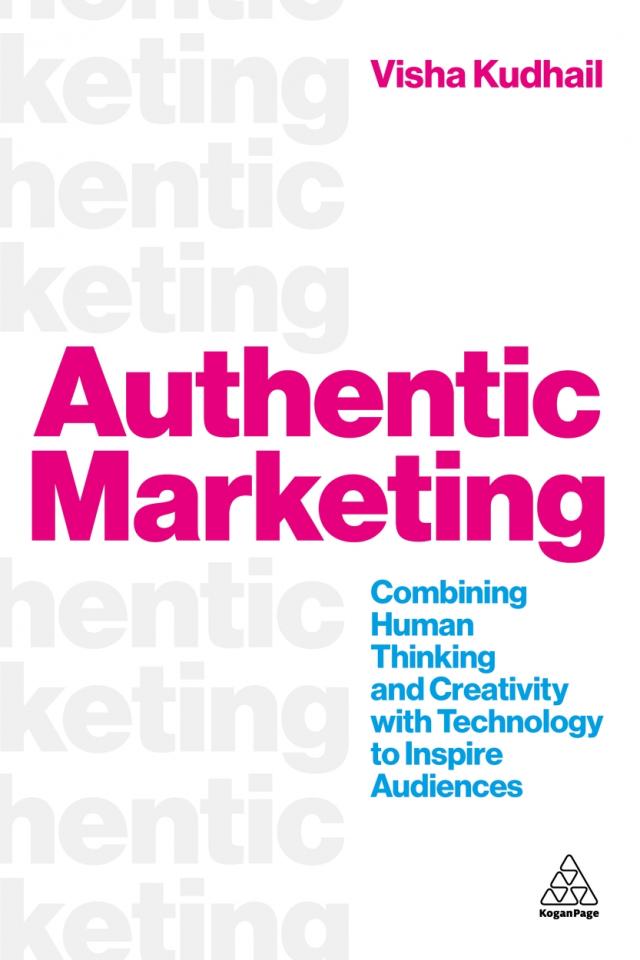 | Visha Kudhail: Hello, I'm Visha Kudhail, author of "Authentic Marketing: Combining Human Thinking and Creativity with Technology to Inspire Audiences," published by Kogan Page. I've spent nearly two decades building brands and marketing teams at companies including Thinkbox, Google, Pinterest, and Square. In my book, I make the case that as artificial intelligence reshapes our industry, the qualities that set great marketing apart are still profoundly human: curiosity, creativity, and audience-first thinking. I share practical frameworks for turning data into genuine human insight, building brand trust, and creating campaigns that earn a lasting place in people's lives. You can save 25% on "Authentic Marketing" when you order directly from koganpage.com. Just enter the exclusive promo code BIGEYE25 at checkout. Shipping is always complimentary for all customers in the US and the UK. I hope my book helps you build brands worth believing in. Thank you. |
Adrian Tennant: Welcome back. I'm talking with Melissa Swift, founder and CEO of Anthrome Insight and the author of "Effective: How to Do Great Work in a Fast-Changing World." In “Effective,” you use a striking metaphor about crows to address the anxiety around AI. Could you unpack that for us?
Melissa Swift: This all came out of one night my husband and I were joking around about how smart our dog was - or was not! So we started looking at lists of what animals are and are not smart. Crows are really smart. So at that point I got interested in crows, and then later I saw some research on them that I think is very applicable to our current context. And what it said was that crows can actually use tools. This is one of the ways they're out ahead of dogs. Dogs can't really use a tool. A crow can take a stick in its beak and move rocks. It can do a lot of stuff. And what they found is crows actually enjoy using technology, again, technology being like a stick for them, that they would rather perform a task using technology than not using technology. And for me, that sounds great. And when I think back on when I was a kid and like 1980s technology, Speak & Spell and things like that. We had all these goofy little quasi-computer things. The first computer we had, I think it was an Apple II Plus, which was very special because most people only had the Apple IIe. We had the II Plus. It was amazing. But I think that there was a genuine joy in using technology. It was fun. And I think that's how the crows feel. And that's where I think we need to come back to. And that's where, again, if we can change our rhetoric on AI and say, “This is exciting and cool, and it has its limitations, we're not gonna beat you over the head 24 hours a day about using it. We're gonna take a more normal attitude. We're gonna accept that it has limitations,” then we actually get back in touch with the more exciting parts of using it. We get back in touch with that joy in using it, like the crows.
Adrian Tennant: What you're describing, I think, is a characteristic disconnect between maybe what leaders want of their employees with AI and where employees actually are on a day-to-day basis. So, if the current change management around AI isn't working, what approach do you recommend leaders take to frame this technology differently for their teams?
Melissa Swift: Number one: there's just a piece around time and space. Give people a little time to kind of just play with it, toy with it. That's how we learn. We learn by doing, we learn by iterating. A lot of the time pressure around it is actually slowing down the progression. It's like we need to slow down to speed up a moment. So I think that's number one. I think number two: so much of the rhetoric has been about automation. “AI is going to take this part of your job. It's going to take that part of your job.” And you hear that, right? I don't feel good about that. Talk about augmentation. “You are going to be a better copywriter because you are going to be able to use it for this kind of research.” And actually looking at what are the unmet needs in the jobs, right? I'm a media buyer. What's hard for me to do, and then work the technology back into that rather than saying, “The technology can do all the things. Why are you not doing all the things with the real kind of lack of precision and clarity about what it's meant to do?”
Adrian Tennant: There's a wonderful distinction in your book from Dr. Rebecca Parker between ‘technology for me’ and ‘technology for others.’ Melissa, how could marketers apply that lens to the AI tools they're increasingly making use of right now?
Melissa Swift: Yeah, it's a great question. So in the medical context, she was saying there are technologies that make her actual job easier, better, more fulfilling. She used heart stents as an example. She said, “I can save more patients.” That's what she's there to do. That's technology for her. On the other side, a lot of the stuff around electronic medical records is for the insurance company and the hospital. So every job is going to have, there's a marketing version of that too, right? There are the pieces that genuinely help you do your job so much better. And then there are the pieces that are for, let's say, client billing or something like that, that it's got to happen. It's organizationally important, but it's not for you. And so something that I think is interesting to do is actually mentally frame shift and allow yourself the joy and the enjoyment in the technology that's for you, and the technology that's not for you, like Dr. Parker with the medical records, kind of make your peace with it. Don't let it chew up a lot of your energy because there's always going to be that frustration and that friction because it's not technology for you, it's for someone else.
Adrian Tennant: I characterize that as ‘administrivia.’
Melissa Swift: It makes companies run. If we stop doing all of it, you know, the company would shut down. But inevitably, it's never going to feel like the greatest use of your time, just intuitively and emotionally. We've got to kind of square up on that.
Adrian Tennant: This was a big surprise to me. Your research finds that senior leaders and the C-suite are almost two and a half times more likely to always feel overwhelmed than the rest of the organization. What's going on at that level that others might not see?
Melissa Swift: Honestly, I was shocked by some of the findings in that research, specific to the very top of the house. Because there's a belief out there that once you get to a certain level of seniority that, you know, you're passing on most of your kind of your work-work to others. And what might stress you out or exhaust you is the strategic nature of your job or the weight of the company on your shoulders, this kind of high-level stuff. What I found in the research was that very senior folks are just as overloaded by literal work tasks as the rest of us. And it's upsetting. It's a bit mind-blowing. And I think there are a few different explanations. I think, number one, when we declared war on the Executive Assistant some years ago, they were doing really sophisticated, helpful, value-added work. That was a group that I'm kind of like a big believer in that role, and I think it was unfairly targeted, as this is the fat of the organization. No, they were actually like the grease in the gears that makes the gears turn without grinding, right? They were making a lot of stuff happen. So that's number one. And then you have people at very senior levels doing “self-service.” I'm making air quotes here. Self-service things like, “Oh, it's technologically-enabled.” Well, that just means that somebody at a very high implicit hourly rate is doing the work themselves. It's, again, not always a good thing. And that's a piece. I also think two things have happened at the same time, that the complexity of and the sort of unpredictability of work has gotten worse. Because again, we're just like in that cycle. And at the same time, the way we've structured organizations, the people have greater spans of control. Again, we cut all the fat. So now people have 14 people reporting to them. What that means is if you're the person who's got the 14 people reporting to you, you just don't have the same nurturing and mentoring time to teach them your job. But that means you can delegate less because you weren't able to invest the time that you need to get to that delegating point. And so you end up with very senior people very overloaded because of all those factors kind of coming together. But yeah, I was genuinely shocked by that finding.
Adrian Tennant: There's also a lovely bit in your book pushing back on Brett Goldstein's claim that the Muppets are bad at their jobs. What was the point you wanted to make about how we tell stories about effective work?
Melissa Swift: Yeah, it's an interesting one because I really, I share his obsessive Muppets fandom, right? But it did give me pause, you know, are the Muppets actually incompetent? And I really started thinking about how do we represent competence and incompetence in popular culture? So it's interesting, like, is Kermit a bad reporter or is he just constantly sent into really chaotic settings? I would argue for the latter. I think he is a good journalist, but I think he's been in some terrible working environments. Similarly, like, you know, what is it, Dr. Mayhem and the Electric Tooth or whatever they're called? I think they're like a good, they're a good band. Does Animal have some outbursts? Like, yes, absolutely. But it then sent me down a whole rabbit hole about other representations in pop culture. I mean, the one I always think about is the British versus the American version of The Office. In The British Office, David Brent is a bad boss. He is a terrible manager, right? He is not good at running things. In The American Office, Michael Scott is actually - they reveal very deeply buried in episodes - that he's kind of good at his job. He's good at selling paper. Despite all the stupid things he says in every episode, he's kind of good at managing people. It's funny how they kind of sneak it out, but it's fascinating these sort of representations of competence, not competence, when you start looking through that lens.
Adrian Tennant: Your book closes on hope as a working skill. What does hope mean in practical terms for a marketing leader listening to our conversation today?
Melissa Swift: So that observation came from some wonderful research by an MIT researcher called Isabella Loaiza. And she actually ran, she and her research partner, a professor there, ran regressions of which human skills would be most useful in the AI age. And hope came out first. What a cool finding. I love that! So what does that translate to practically? I think what it translates to is being able to consistently message what positive outcomes look like. Even when, I think, as a leader, and oh gosh, we have all been there, it may feel like a little dark and storm cloudy, but being able, without being a Pollyanna, you know, without being like toxic, you don't want to do the toxic positivity thing, but saying, “Okay, if we can do this right, here are some of the good things that may come of that.” And keeping that thread and really being consistent about kind of the carrot and not the stick. Relying on people's best impulses and their best motivations rather than trying to scare them all the time.
Adrian Tennant: Melissa, if someone wants to take a single concrete action from “Effective” and begin applying it to their work, what would you suggest they do first?
Melissa Swift: I'm a big fan of decluttering. So I would say find something in your day, in your week, in your month that you're just going to stop doing and see what that creates space for. I think the average person's working day, working week, working life is overly cluttered. And in the book, I have the analogy of if you have a house that's full of knickknacks versus one that's furnished in this very nice minimalist fashion, it's easier to keep the minimalist house clean. It just is. You're not sitting there like, you know, dusting all the little dolls every day. So that's why I say take one thing out, and it's amazing how good it'll feel.
Adrian Tennant: Wow. Your book uses language as a diagnostic. The words we use about ourselves reveal our areas of strength. What are some tells?
Melissa Swift: So, you know, I think if people are always kind of, very literally, “do you know this,” right? “Do you know, do you know, do you know, do you know?” Like you're hearing the word no over and over, the K-N-O-W, then people are asking you for knowledge. That's the, if you feel like people are almost treating you like Google or like an LLM, that's, right? You know, at the same time, if you're getting a lot of “how, how would you do this? How would you do that?” you're strong in methods. People are asking you for a pathway to accomplishing things. And not just, “What do you think we should do?” but “How should we do it?” If you get a lot of “how,” that's methods. On the people side, it's not so much the individual words, but if they're sort of emotionally-inflected words. If people are communicating with you in an emotionally-inflected way, then you've created a space where you're letting people in. You're good with people. And it may manifest in ways that are scary or frustrating. “Why do I have people crying in my office all the time?” Well, there's a positive frequency. You're good with people. And then on the technology side, literally, if they're talking to you like you're IT, congratulations, you're good at technology. And this is a funny one, because I've had a lot of people come up to me and say, “You know what? People are talking to me like I'm tech support.” Congratulations, you're good at technology. But you have to listen for those kind of conversational clues.
Adrian Tennant: Great conversation. If IN CLEAR FOCUS listeners would like to learn more about “Effective” or connect with you directly, what's the best way to do so?
Melissa Swift: A couple of different channels. I'm very active on LinkedIn, so you can look me up, Melissa Swift on LinkedIn. There's also an Anthrome Insight company page. My website, anthromeinsight.com, and there's a contact form and all kinds of good stuff, and there's a bunch of stuff about the book. And I also have a burgeoning, let's say lightly burgeoning, presence on Instagram and TikTok as well.
Adrian Tennant: Perfect. Melissa, thank you very much for being our guest this week on IN CLEAR FOCUS.
Melissa Swift: Thanks for having me.
Adrian Tennant: Thanks again to my guest this week, Melissa Swift, author of "Effective: How to Do Great Work in a Fast-Changing World." As always, you'll find a complete transcript of our conversation with timestamps and links to the resources we discussed on the IN CLEAR FOCUS page at bigeyeagency.com. Thank you for listening to IN CLEAR FOCUS, produced by Bigeye. I've been your host, Adrian Tennant. Until next week, goodbye.
Timestamps
00:00: Introduction to Human-Centric Companies
00:22: Welcome to IN CLEAR FOCUS
00:33: Meet Melissa Swift
01:51: The Meaning Behind Anthrome Insight
02:07: The Importance of Consumer Insights
03:12: Workplace Comparisons: Today vs. Industrial Revolution
04:16: Understanding Work Intensification
06:07: Three Types of Work Intensification
07:51: Pervasive Work Intensification in Marketing Teams
09:21: The Curse of Competence
10:27: A Third Way for Leaders
11:46: Controlling the Controllable
13:16: Strengths and Weaknesses in the Workplace
15:09: Book Promotion
16:09: Crows and the Joy of Technology
18:11: Framing AI for Teams
19:35: Technology for Me vs. Technology for Others
21:06: Overwhelm at the Senior Level
23:48: The Muppets and Competence in Pop Culture
25:39: Hope as a Working Skill
26:55: Decluttering for Effectiveness
27:32: Language as a Diagnostic Tool
29:16: Connecting with Melissa Swift
29:47: Closing Remarks