/
Marketing Accountability with Jay Mandel
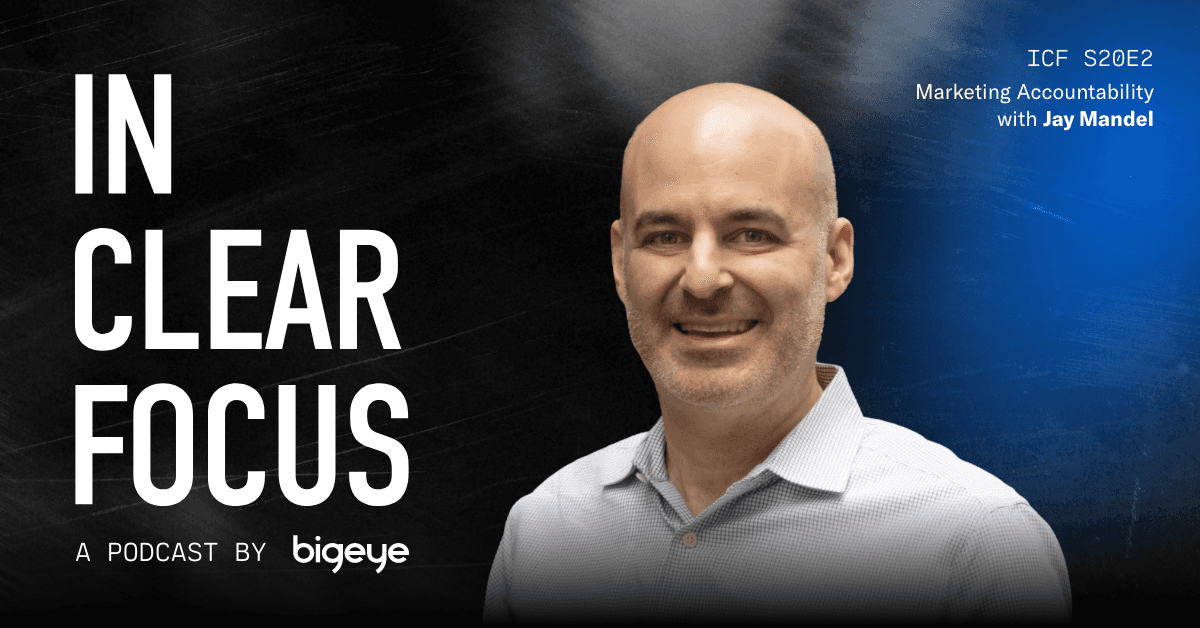
IN CLEAR FOCUS: Jay Mandel, founder of the Marketing Accountability Council, makes a return appearance to address the erosion of consumer trust in today's marketing landscape. Jay explains why the traditional playbook is dead, sharing outdated tactics for the "marketing graveyard." He discusses strategic restraint, using examples from Nike and Lush, and warns of the "Great Attention Heist" in the AI era. Learn how accountability, transparency, and value can build sincere, lasting brands.
Episode Transcript
Adrian Tennant: Coming up in this episode of IN CLEAR FOCUS.
Jay Mandel: When we talk about marketing accountability, we're talking about a strategy that respects your customers, respects where they're at, and delivers value consistently.
Adrian Tennant: You're listening to IN CLEAR FOCUS, fresh perspectives on marketing and advertising, produced weekly by Bigeye, a strategy-led full-service creative agency growing brands for clients globally. Hello, I'm your host, Adrian Tennant, Bigeye's Chief Strategy Officer. Thank you for joining us. Recent studies show a growing skepticism among US consumers toward corporate marketing. For example, research by GetApp found that nearly half of US respondents don't trust companies to follow advertising regulations, and 40 percent say they've stopped buying from brands they believe use misleading marketing tactics. This erosion of trust creates a major challenge for brands that want to build real connections with their audiences. Our guest today believes we've reached a turning point, what he calls a marketing reckoning. It's time to replace manipulation, opacity and hollow engagement metrics with accountability, transparency and real value. Jay Mandel is leading that charge. He founded the Marketing Accountability Council, or MAC, to promote ethical marketing and greater industry transparency. Jay brings a wealth of corporate marketing experience to the role, having served as Vice President of Global Digital Marketing at Mastercard and Director of Marketing for IBM Research. He's also the founder of Your Brand Coach, a consultancy that helps people and brands build meaningful presences rooted in core values and compelling stories. Jay last joined us on IN CLEAR FOCUS in July 2023 to talk about his book, “Brand Strategy in Three Steps: A Purpose-Driven Approach to Branding.” to discuss how we can embrace more accountable marketing practices. I'm delighted that Jay is joining us today from New York City. Jay, welcome back to IN CLEAR FOCUS!
Jay Mandel: Thank you for having me again.
Adrian Tennant: Well, the Marketing Accountability Council launched in January 2024. Jay, what prompted you to establish it?
Jay Mandel: My experiences as a marketer, I've worked in corporate America, I've worked as an entrepreneur, but in all of my roles, I'm a consumer. And what I've been noticing over time is that the way consumers are treated, the way companies are behaving, the way marketing is perceived, all of those things seem to be not in a very good place. And so the idea of starting the Marketing Accountability Council was to bring up some of those ideas and themes, some of those things that we as consumers experience and we're just like, this doesn't feel quite right. Some of us as marketers are asked to do things like, oh, the package shrink, make it sound good. What if we don't want to do that? Or what if we are looking for something that is better for consumers? So at the very core, that was the idea.
Adrian Tennant: Jay, you've written that the traditional marketing playbook is dead. So I'm curious, what does its replacement look like?
Jay Mandel: Well, that's a good question and we have a good answer. And if you subscribe to our Substack, Marketing Accountability Council, you'll find the answer. We have three sets of articles. Article set one is the graveyard of tactics and tools like the death of the idea that you have to go social, the death of tricking consumers, the death of influencers just to have influencers, the death of those email scripts that we're all annoyed by and they never seem to get to an outcome. Those things are in the graveyard and that's the series of pieces that I have written and I think there's about 10 graveyards and there'll be more. And I have a colleague who is a co-founder of the MAC, his name is Jake Sanders, and he has written a series of posts that are called “The Delusions of Marketing.” So I proclaim the death or the dying of these practices. He talks about the delusions in a more academic way. For example, what does it mean to get an impression? And usually it doesn't mean much. And there are lots of tricks up the sleeves of a lot of the companies that are behind measuring things. What does product marketing mean these days? So there's delusion of product marketing, delusion of impressions, delusions of social media, delusion of branding. They're all the tricks and things that are happening in our world. So he writes about that. But we need answers. And that's where Moni, who is another founding member of the MAC, writes her columns about the heuristics of marketing. And like one heuristic of marketing could be ask why three, four, five times. Start with why to really get to your truth. And so the idea is if we have the graveyard, the delusions, and the heuristics, the heuristics could be the prescriptive way that we could treat marketing differently, not by using tricks and hacks, but real, proven scientific things that respect the past and look forward to the future. But in addition to that, we are piloting something that's called the Trust Index. And we are using the themes that come from all of these ideas that we're writing about to create an evaluation scorecard for how we measure marketing. And I'm not just talking about measuring an ad. I always remind people that marketing is the four Ps: product, price, place, promotion. And an example, Chili's is a fast-casual restaurant. And Chili's is on the up-and-up these days. Why? The CEO has really expressed an interest in insights. And those insights reveal that people were fed up spending $12 for a hamburger at McDonald's. And the insight was that if they could charge $12 or less and get some people into Chili's, then people will be attracted to that. So they did a whole advertising campaign basically saying you shouldn't need a pawn broker in order to go out and get a good meal. And it's better to go for a fast casual meal than to sit in your car and get your soggy Big Mac. So in addition to the insight that he acted upon and the company acted upon, he also improved the product. They invented a mozzarella stick that is so gooey and cheesy that on the Internet you got these cheese pulls, these epic cheese pulls. And in the world like so you know I did say that certain levels of influence are dead but it's not dead if someone goes into your place and says “Cheese pull!” and like they're really you know on trend and doing that. So Chili's is rising up as companies like Applebee's and others are declining, and it has to do with a better product. And better service. And it has to do with, you know, the locations where they're at. It has to do with the price that they're charging. There's a Wall Street Journal piece that you could look up on YouTube that talks about this. There's also a piece in the MAC that I've written about it. And the reporter from the Wall Street Journal says to the CEO of Chili's - she starts to talk about “How are you going to make money with this? Are people going to come into Chili's and just order the $9.99 smash burger and call it a day?” And he said “No. We have a margarita with that, and that margarita costs $6. But if you want, you can spend $12 or $15 on the Presidente margarita. That's your choice. No one's forcing you to order that. And if you feel that you're a family, and you like top-shelf liquor, and you can afford that, and you want that.” And that's called the barbell strategy and that's documented in my article. So when we talk about marketing accountability, we're not talking about this idea that “for the first 30 people you can get this deal” or something like that. We're talking about a strategy that respects your customers, respects where they're at, and delivers value consistently. And then when it delivers value you talk about it which is either on social media or to your friends and then all of a sudden Chili's is crowded.
Adrian Tennant: On that same Marketing Accountability Council Substack, you've written about strategic restraint, exemplified by brands like Nike staying out of the sneaker resale market and Lush leaving social media. What can other brands learn from these examples?
Jay Mandel: Well, the Lush example is fantastic because Lush made a strategic principled decision to get out of social media in 2021, due to the fact that the values of the company and the behavior on social media didn't seem to align. If we fast forward to the end of this semester, some of my students took on Lush as a project, and they actually made a recommendation that Lush re-enters social media on their terms and on their customers' terms, and actively advocates for those issues. So it's very disciplined for Lush to not play in that space. And they got a lot of good publicity for that. So if that happened in 2021 and it's now 2025, maybe there's an opportunity to refresh and recalibrate, and no one is going to hold someone and say, “Oh, back in 2021, you said no social media.” No, they're back and they can reconsider it. The Nike case is extremely interesting. That was also presented by a bunch of students in my class. I think it might have been on the Acquired podcast, which is a wonderful podcast to listen to if you haven't. And it's very clear that Nike could have controlled the aftermarket for shoes. But if they did, it would not serve them well and it would not serve the consumers well. And the fact that there's an aftermarket and there's all these different kinds of things. I think Nike played a leadership role in sort of establishing that demand that comes from, you know, a certain sneaker. Now, I am not a sneaker head by any means. But I know what these stores look like and I know what people do with those sneakers and how they behave. And that has to do with market dynamics not a company saying I'm holding the puppet strings and I'm doing this all for profit. So I think that strategic restraint actually was helpful for Nike. And I think if companies started to think about it and said, “Hey, maybe we don't have to do that thing on social media because everyone's doing it. Maybe we don't have to do that eight-touch email funnel chain that no one wants to see. It might serve them better. Maybe we should focus more on one big piece that makes more sense for our audience.”
Adrian Tennant: Well Jay, you've also addressed problematic outreach practices and what you've dubbed "The Great Attention Heist." Can you explain why they're problematic?
Jay Mandel: Yeah, well, I mean, we're now in this place of attention versus intention. For years, attention was what everyone was after. That explains the whole social media movements that we've seen and everyone's doing scrolling and all that kind of stuff. But now we're in this place where there is more of a focus of intention. So, the idea is simple. What comes back from your ChatGPT, your Perplexity, your Claude, your CoPilot, is not just about your attention. It's about your intention. So, if someone were to say, “Hey, I would like a recommendation for the best place to take my family on vacation to.” Where did that come from? And what will you do based on that answer that may not be based on anything but someone buying that? So an advertisement, it's pretty transparent what an advertisement is, where an advertisement goes, this and that. As we enter this new era of AI, we've seen announcements that Perplexity is going to deliver the best ads possible because they're going to be hyper-targeted. But are they going to be transparent? Wouldn't it be great if there was sort of a compass or a bill of rights for customers, or a disclosure by big companies about the way that things are presented and how they either respect your attention or don't? And I think that this whole attention heist is simple: It's that people are making decisions based on what is exposed to them. Ninety-eight percent of people are not going to be curious enough to dig into what the source is, what the methodology is, how that information came to them. And people are making decisions like, “Where do I go on vacation based on that? ”And that's just an inconsequential thing. Like you're gonna have a good vacation, whether you go to Florida or Chicago. It's just basically going to tell you exactly what you want to hear. And then if you say to it, “I totally disagree with what you just said,” it's going to totally disagree based on what you say. And I've had fights with ChatGPT and colleagues of mine have had fights with ChatGPT. You know, some simple things that seem as clear as day based on the sort of proclaimed answer. There's side one, side two, and then there's somewhere in between that's the truth. And I think as a society, we need to pay attention to these things, or else it's going to steer us in the wrong direction.
Adrian Tennant: Jay, how does the MAC define strategic integrity?
Jay Mandel: Well, it starts with understanding what strategy is. Strategy is directional. Strategy can change. Strategy has all these different tools and techniques. But one of the ways that I would define strategic integrity would be, do you understand who you are? Do you understand who your audience is? Do you understand what you're doing for your audience? Do you understand how that compares to what the competition is doing? Are you making a promise that you can keep? And is the promise that you're making aligned with your company's values and your fulfillment of that promise? We use this thing called the Nesting Doll Strategy. It's also called the Russian Doll Strategy. But the idea would say, “Here's the problem for the company. Here's the problem for the consumer. If we solve this problem for the consumer, it will solve the problem for the company, which will lead to the outcome the consumer desires and the outcome the company desires.” Fill that out and you're winning. The other thing is problem definition. You can use the Fishbone Strategy to define the problem. And the problem is rarely just a micro problem or a macro problem. There's things related to the environment you're in, the economic world we're in today where marketing has a 6 percent budget. That has to affect how people are marketing. And you can't just look at it, “Well, maybe it was our ad and what we said.” So I think you need to look at it holistically if you really want to get to the core of that strategy.
Adrian Tennant: Let's take a short break. We'll be right back after this message.
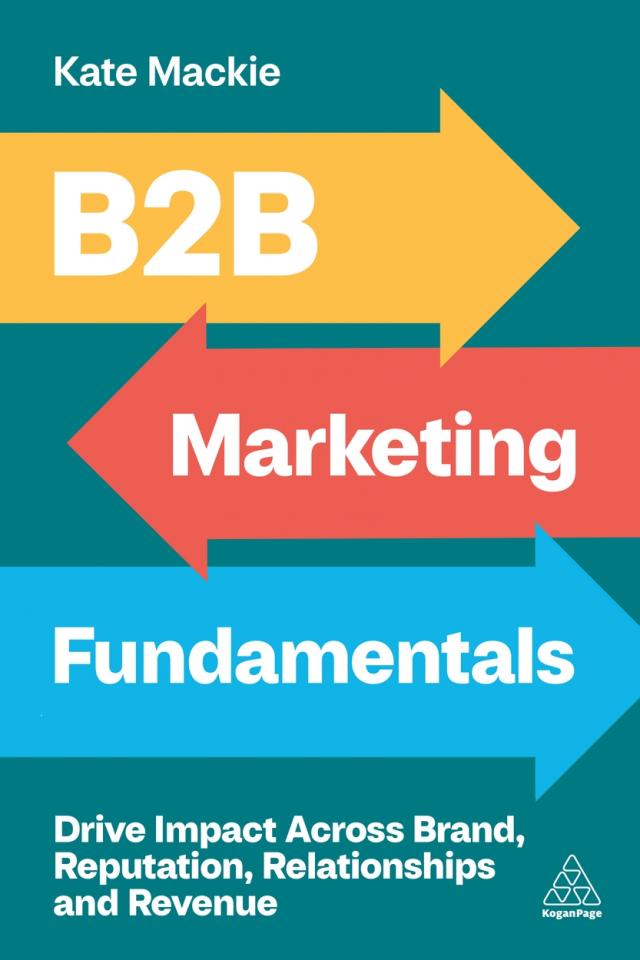 | Kate Mackie: Hello, I'm Kate Mackie, author of "B2B Marketing Fundamentals: Drive Impact Across Brand, Reputation, Relationships, and Revenue," published by Kogan Page. My book translates well-proven marketing theories and frameworks into actionable strategies specifically designed for B2B marketing. Drawing on over 20 years of experience, I address the unique complexities that B2B marketers face on a daily basis. This book will help you build stronger brands and drive measurable revenue results. You'll discover how to leverage AI and connected data for actionable insights, with real-world examples to illustrate effective B2B marketing in practice. As an IN CLEAR FOCUS listener, you can save 25 percent on "B2B Marketing Fundamentals,” when you order directly from KoganPage.com. Just enter the exclusive promo code Bigeye25 at checkout. Shipping is always complimentary for customers in the US and UK. I hope my book helps you develop the foundational knowledge and skills necessary to deliver effective marketing strategies that drive tangible business impact. Thank you! |
Adrian Tennant: Welcome back. I'm talking with Jay Mandel, founder of the Marketing Accountability Council. Well, now, while we were preparing for this episode, you mentioned working with a client who manufactures modular guitars. How are you applying the MAC’s principles to help him reach his audience more effectively?
Jay Mandel: Show, don't tell. And make it personal, and don't make it about the modular guitar. The person who created this brand is a dynamic, interesting person who saw a problem, and his engineering background led him to create this product that is as good - he'd say better - than anything that's on the market. And the current website was just pictures of the guitar. My diagnosis would be that, yes, that's very important. But more important is to help people visualize what that guitar will do for them. If you think about the persona, there are many reasons why people play the guitar. One could be, “I want to be the god on stage, like Guns N' Roses.” Or “I want to perfect the song” or “I've had trouble putting the guitar on the plane and every time I travel with my guitar it breaks.” So I think that the difference is about understanding your audience and understanding the quote unquote Persona and focusing in on the wants and needs of that Persona. And that will deliver a better outcome and it could be very creative and interesting.
Adrian Tennant: I'm involved in new business development for Bigeye, and an article you wrote recently on the topic of ghosting struck a chord with me. Jay, can you share your thoughts on this with us?
Jay Mandel: Yes, it struck a chord with me. That's why I wrote the article. I feel like there is a change in societal norms to avoid tough discussions, whether it be family, friends. I mean, ghosting has its origins from Tinder and digital dating apps. And in digital dating, it's sometimes easier after you go on one date, even if it appears to have been a pleasant encounter to just ghost and leave. But when that starts to happen, when you are a respected colleague within an organization that you work in, that applied for a job that you came recommended to, and then you spend all this time and then you wait a month and you're like, you know, “I probably should have heard by now.” And then you wait a little bit more and you don't hear anything. And I think that we're in an era where the employer has the advantage, you know, that a lot of people will apply for jobs. And the reality is if they ghost someone, it doesn't really have consequences until it does. And when it does, it will come back to bite them because the ghosting mentality doesn't align with the way that new generations are looking at marketing. The ghosting mentality is the idea that “I'm in the silver tower, I'm in the executive suite, and nothing I can do is going to be offensive.” But we have an era of people that are openly sharing their salaries. We have a new generation of people that when something like this happens, they actively post about it on TikTok, etc. I'm not in that era. I am slightly or even more than slightly uncomfortable with it. I am not going to just throw everything out there and put it out there, but I will identify trends and identify patterns. And I tried to do that in the most respectable way after a very serious interview process with an organization that called themselves “the future of marketing,” - not the ANA - ghosted me. And it wasn't until I wrote that article that I got the reply. And this was after hours and hours of interviews. And so it's just like, “Okay, you could spend an hour-and-a-half with me when we” … or sorry, it was two hours when it was scheduled for 90 minutes, but then you don't hear anything? Like, what world do we live in? And so my message to people is like, even if it's a difficult thing, you should roll up your sleeves and have the tough discussions because people remember that. And when my organization, the Marketing Accountability Council, and I'm manifesting right now, is in the position that another legacy organization might be in, or might have been in, that was built on stilts and stuff like that, and it starts to collapse, I'll remember that.
Adrian Tennant: The Marketing Accountability Council operates through a unique four council structure. Jay, can you explain how they work toegther?
Jay Mandel: We're trying to evolve the councils. And so, I mean, we have intentions of having a council for emerging talent in marketing. We have an intention for a professional council. There is an expert council and we're looking into MarTech. So that's the vision of the Marketing Accountability Council. But right now, what is the Marketing Accountability Council? It is a Substack. And Substack is an amazing platform where we write and some people say, you know, “What is your editorial calendar?” It's when I feel like writing. Not totally, but I do write a lot and we're working on a lot more structure and rigor to how we write, when we write, how we. fact-check what we say, and we have several people that are writing for the MAC. We have guest authors. But basically, what is the MAC today? It's a Friday afternoon meeting. It happens at 3 o'clock Eastern Time. We typically have some sort of provocative guest. And we typically have six to 10 people who regularly attend that. And we're working to deliver more rigor on that in order to create a very strategic wrap report after that. We're trying to broadcast more along the lines of this podcast and having a sort of structure. And it's all happening organically. Nothing is forced. It's all a vision I had in my mind. There's strategy discussions. So after the Friday meeting, we have three or four people that are the leadership council, and we discuss these things, and then we document that. And then week after week after week, we iterate. So in the future, you're going to see some partnerships with some other organizations for the MAC. There's a company that we work with called Agile Brain, and there's a company called Motivation Metrics. And both these companies, they're related, and they have an amazing tool to help people to understand why they do the things they do, which could apply to brands. We have a great relationship with martech.org. And the whole idea is that we want to work together with organizations, whether they be a legacy organization that really knows that they're in need of a change, a shift, or someone like Chaz, who's the guitar guy who's starting out and has a vision and wants to create it. And the vision of the councils is that all of the members of the MAC, the leaders, are seasoned professionals that have been there and done that. We're not calling ourselves an agency. We're calling ourselves more of a collective. And it's simple. If there is a problem that needs to be solved, we'll define the problem. then we will come up with a hypothesis as to how to solve it. And then my partner, Jake, he writes ROI the musical. He creates jingles. He's funny. He's creative. Jake Sanders, you should follow him on LinkedIn. He is extremely talented. And so what you get from us might not be the prescriptive playbook that historic marketing would do, which would be run some Facebook ads, do this. And maybe it's to an event. Maybe it's avoid digital entirely. You know, so there's this openness to really look at things and diagnose. And the vision would be that everyone can benefit from everything. We're not focusing as much internationally these days, but I do believe that this could be an international thing.
Adrian Tennant: Absolutely. Well, for marketing professionals who resonate with the max values, but currently work in traditional corporate environments, what practical steps would you recommend?
Jay Mandel: I think what I would recommend would be along the lines of the strategic component. I think you always have to see the forest through the trees. And even if your job is about, “I just send emails out,” you need to understand what you're saying in that email and how you're saying it and how it will affect your company and how it will affect your consumer. The steps that I would take would be to attend some of our meetings. Be curious. And even if you don't attend some of our meetings, and even if you don't read some of our articles, we have these frameworks. And so if you take a look and you look at the marketing graveyard and everything you're doing is in that graveyard, you know, that's on you. You figure out if that's right for you or not.
Adrian Tennant: Now, you've also written that marketing doesn't need more frameworks that "sound good in theory and vanish in execution." So Jay, what makes the MAC approach different?
Jay Mandel: I mean, it's just about being alive. It's about being aware, and it's about being honest with yourself, and it's about being honest with your consumers. One of the things I do as a coach with brands is I help them to define their core values, and I help them define their simple marketing promise. And as a brand, if you look at that foundational stuff and you ask five people, five employees, what are the brand values, and they can't answer it, you're in trouble. So that is an important framework that I would never skimp on. But ultimately, it's not about necessarily the heuristic or this or that. It's about showing up with sincerity and showing up consistently and, you know, saying it's OK if someone were to point out that something's wrong. That's an opportunity to grow. I mean, that's my answer for that. I just believe it's all in your attitude.
Adrian Tennant: Great answer, and a great conversation, as always. If listeners would like to learn more about the Marketing Accountability Council or connect with you, what's the best way to do so?
Jay Mandel: We have a website, it's called accountability.marketing. You could just look it up on Substack. Substack is a very popular platform. It's changing every day. So just type in Marketing Accountability Counsel or MAC on Substack. We're all over LinkedIn. So if you're on LinkedIn, you could look up Marketing Accountability Counsel and join us there. Or you could just type in Jay Mandel and send me a message. Connect with me on LinkedIn. And I'd love to have a conversation with you about any of these topics to really help you. That's my goal. My goal is to make marketing respected and to do it with sincerity.
Adrian Tennant: Perfect. Jay, thank you very much for being our guest again on IN CLEAR FOCUS.
Jay Mandel: Thank you.
Adrian Tennant: Thanks again to my guest this week, Jay Mandel, founder of the Marketing Accountability Council. As always, you'll find a complete transcript of our conversation with timestamps and links to the resources we discussed on the IN CLEAR FOCUS page at Bigeyeagency.com. Just select ‘Insights’ from the menu. Thank you for listening to IN CLEAR FOCUS, produced by Bigeye. I've been your host, Adrian Tennant. Until next week, goodbye.
TIMESTAMPS
00:00: Introduction to Marketing Accountability
02:12: The Launch of the Marketing Accountability Council
03:34: The Death of Traditional Marketing Tactics
05:10: Heuristics for Effective Marketing
06:56: Case Study: Chili's Marketing Strategy
09:00: Strategic Restraint: Lessons from Lush and Nike
11:36: The Great Attention Heist Explained
14:42: Defining Strategic Integrity
16:21: Applying MAC Principles: Modular Guitars
19:03: The Impact of Ghosting in Professional Settings
22:24: The Structure of the Marketing Accountability Council
25:53: Practical Steps for Marketing Professionals
27:00: The MAC Approach: Sincerity in Marketing
28:41: Conclusion and Resources