/
Storybuilding with John Elbing
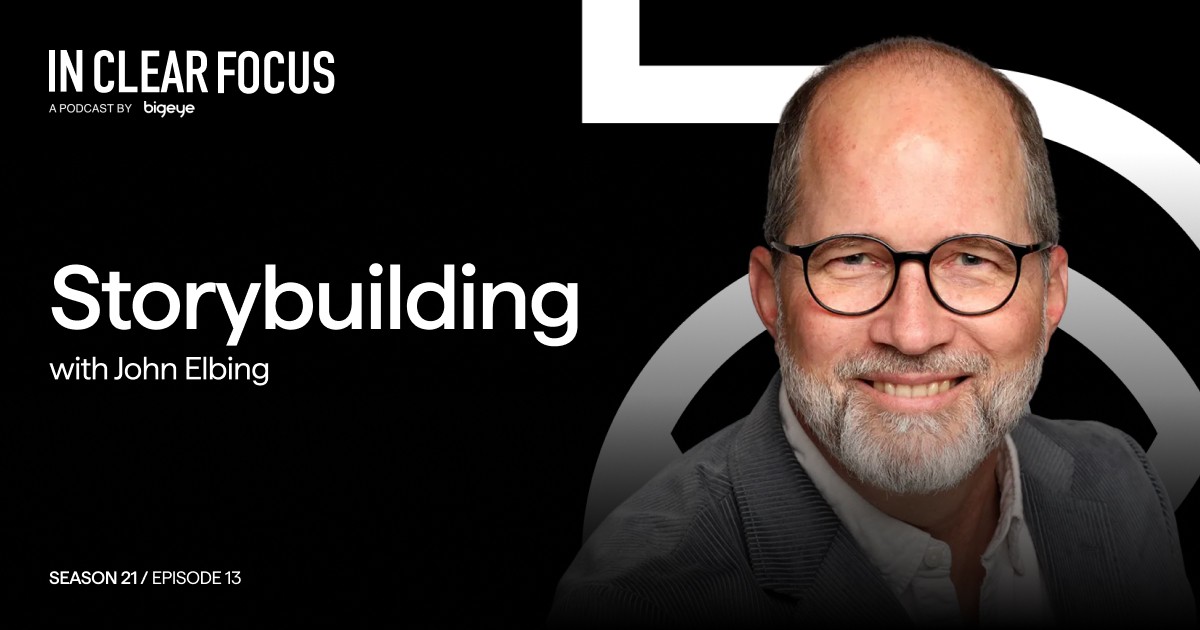
IN CLEAR FOCUS: Brand strategist John Elbing of Standpoint explains why people don’t care about your story, they care about how you fit into theirs. John introduces his "Storybuilding" methodology, a canvas-based approach that helps companies find their foundational story before crafting marketing messages. He breaks down the three stages of encountering a brand (Recognition, Perception, and Projection) and shares how to use AI as a sparring partner to achieve authentic customer-centricity.
Episode Transcript
Adrian Tennant: Coming up in this episode of IN CLEAR FOCUS.
John Elbing: When a company comes up and pounds its chest thinking, "Look how wonderful we are, we're this great thing, we do amazing things," somehow the customer is left aside. The company's not the hero of the story; it's the customer that's the hero of the story.
Adrian Tennant: You're listening to IN CLEAR FOCUS, fresh perspectives on marketing and advertising, produced weekly by Bigeye, a strategy-led, full-service creative agency growing brands for clients globally. Hello, I'm your host, Adrian Tennant, Bigeye's Chief Strategy Officer. Thank you for joining us. Brand storytelling has become essential to how companies connect with customers, differentiate in crowded markets, and drive growth. But here's what separates the brands that resonate from those that get ignored. Perspective. The most successful brands don't tell stories about themselves; they craft narratives their customers can see themselves in. It's a fundamental shift from “here's what we do” to “here's how you fit into this.” Our guest today has built an entire methodology around this insight. John Elbing is a brand strategist, author, and founder of Standpoint, a consulting firm based in Switzerland. With a background spanning software development, digital marketing, and business coaching, he's worked with over 150 companies. John's methodology, called story building, flips traditional storytelling by helping organizations see their brand from their customer's standpoint. His international bestseller, "Storybuilding: Your Brand from Their Standpoint," offers a practical canvas-based approach to creating narratives that resonate and drive growth. To discuss what it means to take your customer's standpoint, I'm delighted that John is joining us today from Geneva, Switzerland. John, welcome to IN CLEAR FOCUS.
John Elbing: Well hi! And thank you for having me.
Adrian Tennant: John, let's start with your journey. Now, your background spans software development, finance, and marketing. How did you end up focusing on brand storytelling and creating the Storybuilding methodology? John Elbing: So, yes, I was a software developer, and then through things like project management, I went back and did an MBA in finance and thought, oh, finance, never again. And I did some of the first e-banking websites back in the day, and I did some startups of my own. I'm not a millionaire, so that didn't quite work out as hoped. And then went and worked for marketing agencies. And somehow that combination of technology, finance, marketing, and entrepreneurial thing, I was in the startup ecosystem. So I started coaching startups. And then I'm a method guy. I'm a book guy. So I started reading. I got trained in design thinking and where to play and this and that. And I have all these canvases with Post-its and all these things to try out to help these startups and companies with different things. And at one point, it got a little bit where they were all excited with insights, but then they didn't quite know what to do on Monday morning. And I started getting into storytelling. There are a lot of books out there. I found one that I found interesting, StoryBrand, which I got certified in this methodology that's quite renowned. And using that, I found helped people. because you think of storytelling as, you know, just getting a story you can tell, but actually it forces you to decide who are you talking to, who are you not talking to, what's important, what's less important that I can leave aside, and all these things. And often these companies and startups would sort of feel that they were doing all these great things for all these great people and they had trouble narrowing it down. And the storytelling exercises forced them to put the elements in the slots, and that created focus and alignment and clarity in what they were doing. And then, little by little, I tweaked that and created my own method, my own canvases, my own structure, which turned up in the book.
Adrian Tennant: In your book, you make a provocative claim: "People don't care about your story, they care about how you fit into theirs." So John, can you unpack what you mean by that?
John Elbing: So when a company comes up and pounds its chest thinking, "Look how wonderful we are. We're this great thing. We do amazing things." Somehow the customer is left aside. And what they want to know is how is it going to affect them? How is it going to change their life? How is it going to make their life better? I mean, it's their story and we're all interested in our own story. The company's not the hero of the story. It's the customer that's the hero of the story. So if you push that to the point where, well, you tell their story, and when you're telling their story, they get engaged because they can project themselves, they can see themselves, they can see what it'll be like instead of just looking from afar saying, "Oh, isn't that wonderful?" And, you know, sometimes they have these things where when you tell your story, you should say, you know, "We started in the barn or the garage and we have this history," but somehow, that comes way later. Once I engage with the company, maybe I'll be interested. So "How did this start out? Who are these people?" and all that. But not at the beginning. At the beginning, it has to affect me.
Adrian Tennant: Now, you describe Storybuilding as "brand realignment disguised as storytelling." What makes it different from traditional storytelling approaches?
John Elbing: Often I find that storytelling, it's become such a buzzword that it's tips and tricks. It's how to put a nice coat of paint on your story. But it presupposes that you have a good story to tell. And then you can tell it better. You can stand on stage where you have a hook or you can, you know, all this kind of thing. What I did in "Storybuilding" is this idea that first you have to find the right story to tell. People's minds go through steps when they encounter a brand and how they're engaged. If you can build your story to fit, all stories are formulaic. All the novels and movies of the world follow these storylines. With business storytelling, it's the same. And so I insist on the building part. And then you can make a pitch deck, or you can make a website, or you can make a campaign, or a movie, whatever it is. But if you first get the structure of the story, that first foundational story, before trying to improve it.
Adrian Tennant: Well, let's dive into what you call the three stages of encountering a brand: recognition, perception, and projection. John, can you walk us briefly through what happens at each of those stages?
John Elbing: So imagine you're looking for something. So I'm an independent consultant, and I want to develop my business. I think, "Oh, I should use a customer relationship management system," a CRM. So I'm going to go looking. And I'll land on one, and I have to feel that they understand what I'm going through. I have to feel that it's for me. I have to recognize myself in the brand. So if I stumble on a brand that says, "We're the best for gigantic companies or for teams, and we do what complicated workflows," and all that, I'll think, "that's not me." And you have one that says, "Hey, we specialize in independent consultants that have a white beard and glasses and live in Switzerland." And I think, "Ooh! They get me!" And I don't necessarily know what's coming yet. You walk down the street, you want to have a coffee with a friend. You'll walk by several cafes without even slowing down, and then one will think, "That's for us." And somehow there's this emotional step that mixes identity, aspiration, challenge, where you feel, "Ooh, that's for me." Even before you don't look at the menu, somehow you just recognize that. That gets you to say, "Oh, well, I'm interested. What do they have to offer?" The second step is perception. Often, that's sort of talk about your solution or your offer, your product, your service. Often, it's sort of like, "Hey, we do this great thing and there are this many pixels and this many things." It's very feature and technical spec. But people are thinking, "I've seen a million like this. How are you different? How are you unique? What makes you stand out? Why should we be more interested in you? What category do I put you in?" I need to compare you. So if something completely new comes out, I don't know what to do with that. So I'll sort of put you in a box. And you have to be clear. They say that people don't buy the best product or service, they buy the one they really understand the fastest. And so there's this part where you really have to get them to understand what it is and how it's different and how you're unique and all that kind of thing. So then I think, "Ooh, that CRM is great. It has AI this, and it automates that, and it'll create me all this great business." And then I think, "Okay, how is it going to happen?" That's the projection phase. I project myself into the future, and I think, "Okay. So basically right now I have three different Excel spreadsheets and I have things in emails and I have some to-do lists and some post-its on my wall and all this mess and I'm going to have to copy-paste, reconstruct and I have to keep using my old system while I'm getting into the new one and then will it be easy to use and if I don't understand will they and will ...?" And all these hesitations come into your mind. And even if you're convinced in the product, I'll sort of say, "Oh, I'll have to do this, but maybe next week," and then I might not come back. So if you can bring people in to sort of understand the experience, how do you buy it? How do you install it? How do you use it? How do you, do you have to training? Will there be help? Is there a service? How do you recycle it? Whatever it is. But also remind them of the stakes. "If you don't switch to a CRM, well, you're going to still fiddle and get lost and forget things. And you'll stay behind in what you're trying to do. But imagine this great positive future. Every morning, you'll just look out what your next tasks are. You can automate. And you will grow your business. And you will be happy in whatever it is." So somehow, if I strongly recognize myself at the beginning, you have better quality pipeline. You have the people that are interested, and you don't have the people that are the wrong fit. And then going through these three steps, you're a few steps further into the relationship already. If I'm already closing my eyes and imagining how great this will be, I'm a lot more ready to click schedule a demo than if I'm left hanging, wondering, and things like that. And so a lot of companies sort of talk about their offer, but they don't really help people recognize themselves and they don't help them project themselves into the relationship or the usage of their service. So you can build this foray to bring them along those steps in the right order to get that engagement.
Adrian Tennant: Well, all of the ideas in your book, of course, have been tested through your own practice and workshops. And I appreciate that the book is filled with practical canvas-based exercises that teams can work through together. Can you describe how workshops typically unfold and what makes the process itself so valuable?
John Elbing: So my brand is Standpoint. The idea is you have to take the other person's standpoint, and that's what's important. So we start out by taking the customer's standpoint. We have a canvas around the stakeholder, because I've done it for nonprofits or investors, or it's not necessarily a customer. But in a lot of cases, it's a customer. And we walk through asking about their aspirations, about their challenges. And aspirations can be at a lot of different levels. And what moments would trigger what kind of values are they looking for? All these things that usually companies know, they just haven't really put it out explicitly. And then we do the same for the company and see how that matches up. And then once we have all those insights, we go into this Storybuilding Framework where we fill in the levels of recognition, perception, projection. And it's really important to work on the structure without getting distracted with the colors or the vocabulary or things like that. Because often companies will say, "Hey, let's do a website." And they get caught up into how beautiful it is and should it blink or should it things, but they lose the sequence. So it's really important that we work on the sequence first, then try to have a kind of written story that they can tell. And once they're really happy with that structure, then they can turn it into whatever they want, a campaign, a website, or a pitch. But what's interesting is that often the methodology itself has some good side aspects. Suddenly, these companies or startups will sort of feel, they'll have this realization: "That's who we're talking to. That's who we're helping." It sort of niches it down. It gives them focus. It gives them the same story. I had a company and there were like ten people. I asked them, "Tell me what you do" separately. They had ten different stories. Here, the team builds the story together and then they have something that they can rely on. And some companies come from the marketing side: "We want a story to build our marketing campaigns." And then they're all happy to have suddenly this positioning strategy that emerges. And others come from the positioning side. And then they're happy to also have a structured story that they can use for their campaigns.
Adrian Tennant: Another thing I really appreciated about your book is that you've included AI prompts in every chapter. John, how do you see AI fitting into the Storybuilding process?
John Elbing: So the idea is to take your customer standpoint. So the idea of these prompts is to describe your customer. So you can give websites, you can give examples, you can describe, and then you use it as a sparring partner. So often it comes afterwards. So, I mean, the first is you don't want to influence the team. So you try to extract what they know of their customers. But then you challenge that, and often things pop up. They say, "Oh yeah, yeah." But again, it's not a random thing. The AI is really to brainstorm for one particular square in this canvas to say, "What would be the trigger moments where people would be especially interested in what we do?" And then it comes up with some extra, it's a sparring partner or an extra person in the brainstorming phase. I was thinking of almost automating the whole thing to have an AI clone of myself that can challenge people and go through the whole process. I'm not sure that will work. It could be something where I can say, I can offer this to more companies because I can make it way cheaper because they can do 80% of the work. But then I come for the challenge to think. I do that a little bit where I have an online version with these whiteboard-based thing where I can go through the process with a team. They'll go back and do their homework kind of thing, and then I'll come back and challenge them, and they'll go back and do the next step, which is a way to give them more value without using up too much of my time.
Adrian Tennant: Makes sense. Let's take a short break. We'll be right back after this message.
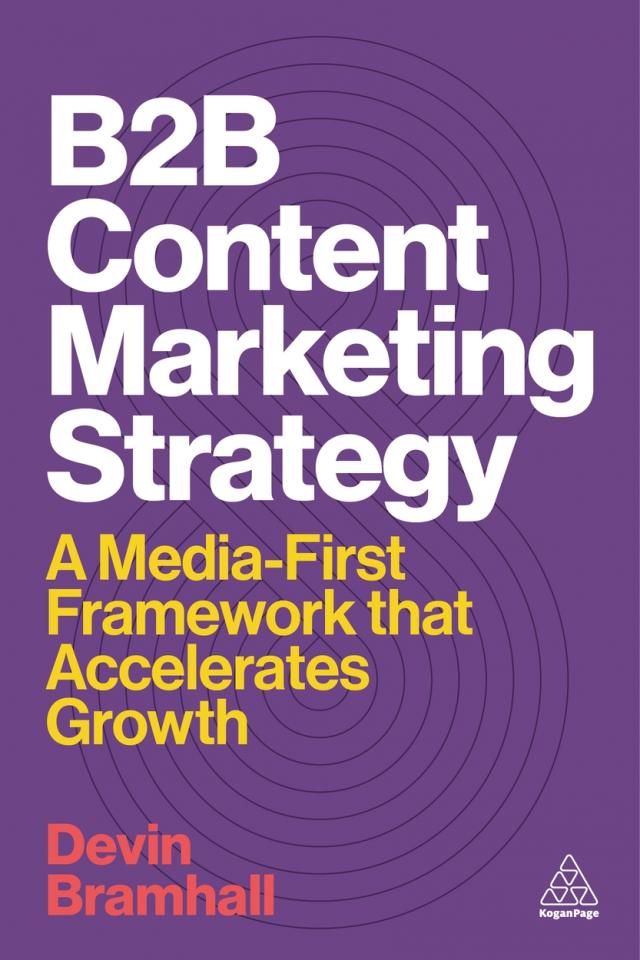
Devin Bramhall: Hi, I'm Devin Bramhall, author of B2B Content Marketing Strategy: A Media-First Framework That Accelerates Growth, published by Kogan Page.
If you've ever felt like your content marketing creates a lot of activity but very little real business impact, this book is for you. I wrote it to help mid-career marketers move beyond outdated playbooks and build human-centered strategies that actually drive growth.
Drawing on my experience as former CEO of Animalz (where I worked with brands like Google, Amazon, Slack, and Ramp) and real-world case studies from companies such as Cisco, HelpScout, and Nubatic, I share modern marketing frameworks that combine community-building with AI and multimedia-based tactics to create growth strategies that deliver a true competitive advantage.
As an IN CLEAR FOCUS listener, you can save 25% on B2B Content Marketing Strategy when you order directly from KoganPage.com. Just enter the exclusive promo code BIGEYE25 at checkout. Shipping is always complimentary for customers in the US and the UK. I hope my book helps you create content strategies that build real connections and drive measurable results. Thank you!
Adrian Tennant: Welcome back. I'm talking with John Elbing, author of "Storybuilding: Your Brand from Their Standpoint." John, your methodology emphasizes what you call "authentic customer-centricity." Now, in a world where everyone claims to be customer-focused, what does authentic customer-centricity actually look like in practice?
John Elbing: That's a good question because it is quite a bold statement in the sense that what I try to do is to get teams to take the standpoint of their customer, forgetting their offer. So what I try to do is to say, "In this scope of what you sell, what do people What are they looking for? What are their needs? What are their frustrations?" All these things. Because sometimes companies sort of say, "Snce we offer this solution, the problem is that they don't have the solution yet." And it doesn't happen like that. People have all these different levels of reflection. I worked with a nonprofit that did water purification. And normally what they do in a developing country, a truck will bring powdered chlorine, and they'll put it in the water to purify the water. And they have a system where, with an electrolyzer and salt and water, you can create the chlorine locally instead of shipping it. And so I said, "What's the problem?" And they said, "Well, the problem is that people would get sick." And then we dug deeper and realized no, the problem is that trucks get stuck in the mud. And so, of course, at the end of the day, they're there for people not getting sick. But if they want to sell that to an NGO in the field, what those people keep them up at night is, "Damn, the truck's not arriving. What do we do?" And so they're solving a logistic problem in the scope of this idea that they want to save lives, but by going in. And then really, whatever you do gets this focus of this rich image of your customer. So when you're talking about their frustrations, how proud they'll be when they succeed, it becomes a story where you stop talking about yourself. And as soon as you do that, it's already that this empathy is already a lot more alive than if you're trying to sell your stuff. No, you're trying to understand their dream or their problem and how their life will be better. And it's sort of, there's a kind of a shift of focus that then helps in all different ways.
Adrian Tennant: Well, relatedly, your book includes applications of story building across different contexts. So B2B, B2C, non-profits, as you just mentione,d and even fundraising pitches to investors. Can you show an example of how the framework adapts to these different kinds of situations? John Elbing: So I had a company that was a marketplace. So what they do is they have a marketplace of influencers. So an SME can find the right influencer to do some campaigns ...
Adrian Tennant: Yeah, a little clarification. "SME"?
John Elbing: Sorry for the acronym, but it's Small or Medium Enterprise. So basically, it's all these companies out there that represent 90% of businesses that aren't the big enterprises and probably aren't the micro ones either.
Adrian Tennant: Got it. Thank you.
John Elbing: And so here you have two different stories. You have the influencer story and you have the SME story. And so, you go in and you can imagine all the different stakeholders. You can adapt that and sort of go through the methodology several times, seeing where there's an overlap or even just segmentation like that. With the B2B, there's a longer chain of value. You have the way and customer at some point. And then you have their supplier, but then the supplier, you could have the B2B2B2B2C somehow. There's always a "C" at the end. And you sort of build a story to say, "The customer of your customer of your customer is going to be really happy. So the customer of your customer is going to buy what your customer sells. So you're going to be really happy because ..." and you sort of build these layers of value. And then with the B2B, you're also selling to more people. So you're selling to the CEO, you're selling to the CTOs, to the CIO, to the CFO, to the CMO, to the whoever throughout a company. And so you find a story that has an anchor, which is somehow there's a customer that's going to be happier and you're going to sell more or something at the end. But then for the technical people, you'll look into their technical problems, where they're pulled between innovation and stability, and so how that works out. And then the CFO, it's going to be money-wise. You can use the same structure for these different views. And even if you're negotiating your next vacation with your spouse, You know, sometime you can say, "So, you know, we're this couple and what we do is this. And so how about the mountains and not the beach? Because imagine what it'll be like ..." and all this kind of thing. It becomes just a way of thinking of how, when you want to, I guess, convince someone of something.
Adrian Tennant: Well, in the book, you talk about how Storybuilding acts as a kind of Trojan Horse that forces companies to do strategic work before jumping into, for example, marketing messages. Can you tell us a bit more about that?
John Elbing: As I sort of said before, there's this idea that people will try to build a website or some kind of thing and they'll start with their product and then they'll start with some creative ideas and things and they'll sort of lose the script. And again, there's this idea that if you have this foundational story, then that opens up so many possibilities. You can take bits and pieces for campaigns, for things, you can, you know, structure your website, then you can have all the fun you want to make it colorful and crazy and fun, but it sort of creates coherence. One of the things companies do is they'll have one campaign, and then another, and then a website, and then the salesperson, and they don't all quite say the same thing. And by having this kind of shared story, then you see an ad, you go to the website, then you talk to a salesperson, and there's a continuity, and they're all centered on you.
Adrian Tennant: You've worked with over 150 companies throughout your career. John, what's one pattern you've noticed that separates the brands that successfully implement story building from those who continue to struggle with it?
John Elbing: So there are several issues. Sometimes companies think they know better than their customers. And when you get into what they think and they say, "Well, no, that's not right. They should think this. They should make the rational decision. They should, they should, they should... So it's all going to work out because we know our product is great. So they're going to love it." Right. And sometimes you struggle to, to flip that, you know, to say, "Well, it's not up to you to decide if they choose you or not. It's up to them, and you have to understand that." Sometimes the problem is more they're obsessed by the product and want to talk more about the product, and then you lose the customer. Another issue is more established companies have been talking the same way for 20, 40, 60, 80 years, and they're still there, and so they're reasonably successful, and they don't get that little by little they're losing customers and reputation because somehow there's this old story that doesn't match anymore. But it's hard to get them to sort of say, "Okay, we'll forget what we've been doing for the last couple decades and then we're going to do something different." Change is always complicated. Some of the easiest ones are really an early-stage startup. They suddenly will say, "Wow, that's amazing!" They finally have a direction because they didn't know at all how to talk about what they do. In more established companies, it's more complicated. When there is that switch, where is that click? That's really interesting. I worked for the world leader of garden shears. And they had two brands, but actually they had a hidden third brand. They had professional garden shears, but they had the gentleman gardener garden shears. And they were all mixed. And the story was, "We have great quality, Swiss quality," all this stuff, but there was the same story for all these segments. The idea was to say, "We need a great story, but we need three great stories. We need three universes. We have to have three different types of customer recognize themselves to direct them in the right way so that our distributors can talk to these different people." They really repositioned their brands, created this third brand as the kind of elite thing. And then, so then after I left, they hired a big marketing agency for a lot of money to rebuild their websites and their messaging and all that based on that. And so that was really interesting because they're 80 years old and they're changing.
Adrian Tennant: Well, for anyone listening who suspects their brand story isn't working, but doesn't know quite where to start fixing it, what's one piece of advice you'd give them?
John Elbing: So I like to start with the recognition phase, because you can sort of step back, look at your website, and say, "If I'm my ideal customer, would I feel that's really targeted at me? Or is it displaying this great product?" And so forget the product a little bit, just "Do you know, is it for a big company, a small company or this or that? Is it what, what ..." and there's that strong link. I have these that I've been using a few companies as bad examples in my presentations and things. And I feel a little bit ashamed. I should offer them some free consulting because this idea that you almost can see. They have five departments and they put the five departments up on the website and say, "This is what we do." And so I don't, you don't know. And that can be risky. I worked for a recruitment company. And with a website, you can make it look like this amazing company, even if it was four people in a basement kind of thing. But the risk is, the big companies know the market, and they're going to work with the big agencies. But then the small ones, who would be your ideal client, think, "Ooh, they're probably too big for me." And so to clearly identify that we work with SMEs, and this is the kind of thing we do, and so people say, "Oh, okay, they get me." I think that's one clear step. And you can ask someone, ask your client, ask someone on the street, say, "Who is this for?"And if they don't know who it's for, you might want to tighten that.
Adrian Tennant: Great conversation, John. If listeners would like to learn more about you, your work, or of course your book, "Storybuilding: Your Brand From Their Standpoint," what's the best way of doing so?
John Elbing: So I guess the easiest way is to go to Standpoint.ch. So .ch is the extension for Switzerland. So it's standpoint.ch. And there you'll see a little bit of explanation of my method, access to the book, and all that kind of thing. And what I can do is actually, if someone listening is interested and wanted to have a little view of their own brand, go to the contact form. Say you're coming from In Clear Focus podcast, and we can have an hour chat for free to sort of get a peek of what that could be for your brand.
Adrian Tennant: That's great. John, thank you very much for being our guest this week on In Clear Focus.
John Elbing: Well, thank you. It's been a pleasure.
Adrian Tennant: Thanks again to my guest this week, John Elbing, author of "Storybuilding: Your Brand From Their Standpoint." As always, you'll find a complete transcript of our conversation with timestamps and links to the resources we discussed on the IN CLEAR FOCUS page at Bigeyeagency.com. Just select ‘Insights’ from the menu. Thank you for listening to IN CLEAR FOCUS, produced by Bigeye. I've been your host, Adrian Tennant. Until next week, goodbye.
TIMESTAMPS
00:00: Introduction to Customer-Centric Storytelling
00:20: The Importance of Brand Storytelling
01:15: Meet John Elbing: Brand Strategist and Author
02:08: John's Journey to Storybuilding
04:19: Understanding Customer-Centric Narratives
05:45: The Shift from Company to Customer Hero
06:41: Three Stages of Encountering a Brand
11:07: The Value of Workshops in Storybuilding
14:00: Integrating AI into the Storybuilding Process
17:15: Authentic Customer-Centricity Explained
19:19: Adapting Storybuilding Across Different Contexts
22:04: Storybuilding as a Trojan Horse for Strategy
23:12: Patterns of Success in Implementing Storybuilding
26:00: Advice for Brands with Ineffective Stories
27:54: How to Learn More About John Elbing and His Work
28:31: Conclusion and Farewell