/
Strategic Communications with Kathleen Lucente
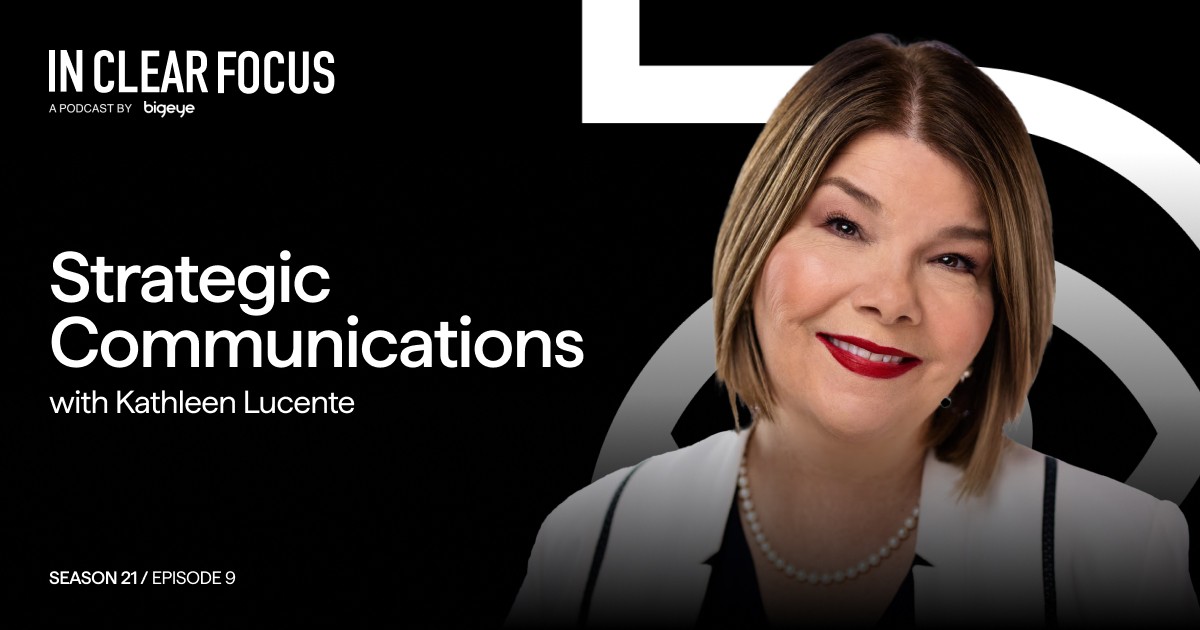
IN CLEAR FOCUS: In a zero-click world, reputation can shift instantly. Our guest, Kathleen Lucente, CEO of Red Fan Communications, reveals how to turn PR into a measurable revenue driver. She details the "crisis trinity" of speed, transparency, and messaging, and how to avoid the "announcement trap" during M&A. We discuss why brands need an authority reality check to survive in the AI era, and how to identify hidden thought leaders that help build credibility and weather social media storms.
Episode Transcript
Adrian Tennant: Coming up in this episode of IN CLEAR FOCUS
Kathleen Lucente: It's not about click bait, it's more about mind bait. If they don't already know your brand, they're not going to find your site. They're going to do AI search first. And if you're not showing up there, hmm, could be a problem.
Adrian Tennant: You're listening to IN CLEAR FOCUS, fresh perspectives on marketing and advertising produced weekly by Bigeye, a strategy-led full-service creative agency growing brands for clients globally. Hello, I'm your host, Adrian Tennant, Bigeye's Chief Strategy Officer. Thank you for joining us. In a hyper-connected world, brand marketers face a communications landscape where reputation can shift in hours, not days. A single social media post can trigger a crisis that spreads across platforms faster than traditional PR playbooks can respond. Our guest today brings a unique perspective to these challenges. Kathleen Lucente is the founder and CEO of Red Fan Communications, a PR firm recognized for its expertise in business-to-business tech launches and crisis management strategies. With over 30 years of experience, Kathleen has guided both Fortune 500 companies and high-growth startups through major industry transformations. Before founding Red Fan in 2008, she led global communications at IBM Research and JPMorgan Chase, where Kathleen developed crisis response strategies during pivotal moments, including 9-11, the SARS outbreak, and complex multi-country mergers and acquisitions. Today, Kathleen's approach focuses on turning PR into a measurable revenue driver while ensuring brands are prepared for both unexpected social media storms and strategic business transitions. To discuss how brand marketers can build strategic communications programs and turn PR into a competitive advantage, I'm delighted that Kathleen is joining us today from Austin, Texas. Kathleen, welcome to IN CLEAR FOCUS.
Kathleen Lucente: It's delightful to be here. Thanks for having me.
Adrian Tennant: Well, we're now living in a zero-click world where AI is becoming the authority on many topics. How is this changing the way brands need to think about building credibility and thought leadership?
Kathleen Lucente: The zero-click world has certainly rocked quite a few people, and unfortunately, a lot of CMOs haven't taken it quite as seriously as maybe they need to. Right now, 60% of searches on Google don't even end in a click-through. And yet, so many CMOs and companies have been measuring results and authority based on click-throughs. They needed something to hold on to. The reality that we're seeing right now is that we're asking CMOs to do sort of an audit to see where they are in terms of their authority in the AI world, right? So if you were to go in and say you were a microprocessor company, and a specific type of microprocessor company, you might want to see who is really holding the space as an authority out in AI. You might be surprised to find out that even if you have the most incredible website and you're doing lots of advertising, you might not have much voice in the authority space quite as much as you thought. What we're looking at is really getting CMOs and companies to start thinking of PR as the revenue bridge because the reality is if you can build authority, then you get access, right? If you're out there in the world and you're building authority, especially even driving that into AI, where you become the subject expert that pops up, you're suddenly going to see a big change. And that's important to take that a little more seriously. This is a reality that people are going to find that most companies, they're not seeing the traffic that they had at their website anymore. And in fact, in the B2B space, a B2B customer might actually read 13 pieces out in the world, might be an article or hear a podcast before they make a purchasing decision. And only three of those, if that will be coming from the company itself, from marketing. So it needs to be out there, third party, you're driving that, that expertise.
Adrian Tennant: When we were preparing for this interview, you mentioned to me that 70% of business-to-business sales decisions are now made through AI-assisted research. For brand marketers, what does this mean for how they should be positioning their executives and company expertise?
Kathleen Lucente: I think you need to actually do what I call an authority reality check as a company. And that means going back and thinking, “What is the brand positioning we're trying to establish? What are the sales rules we're trying to establish? And then who are the experts and thought leaders within our company that we want to be investing in?” And really, those people might not always be the people in the C-suite, but they are people who your sales team wants to bring into sales calls because they influence the sale. You know, we have a client in the cultivation space, and they bring in a guy who used to run a large cultivation because the client who's thinking about making that sales to buy those LED lights wants to hear from somebody who's been there, done that, right? So this person is out in the field. They're not necessarily in the C-suite, but you're then starting to look at, “Okay, if this person has that level of influence, how do we augment that in other ways with video? How do we augment that with blogs, podcasts, them as a speaker, and really kind of create the surround sound around that thought leader?” So that then you're actually driving that authority also into AI. And we have a great example, the other day, where we had a client sitting with us, and they were trying to figure out who should be the primary speakers at their science conference. And we were able to quickly do some search on AI to see who really had the authority out there and would add to the brand, and also was still producing fresh content. There are still great authorities out there in a space that aren't producing fresh content. And so they start to lose their luster, if you will. It's not about clickbait, it's more about mind bait, like how are we creating that, you know, that mind authority, and like where people think of us. And that's because if you're getting online and people, if they don't already know your brand, they're not going to find your site. They're going to do AI search first. And if you're not showing up there, hmm, could be a problem for you.
Adrian Tennant: Absolutely. Well, let's talk about an area you know a lot about from firsthand experience, and that's mergers and acquisitions. You told me that companies spend enormous amounts of energy on the deals themselves, but often neglect stakeholder messaging. Kathleen, what are the most common communication mistakes you see during M&A activities?
Kathleen Lucente: There are really three areas that I see as big mistakes. One is that the M&A team is really focused behind the scenes on the deal, and then they think that the press release or the announcement is the big moment. But the reality is that so much has been going on behind the scenes that The narrative around that M&A has already been forming, closed door meetings, employees seeing that, you know, the mystery people coming in and out of offices, right? So what they are missing is the fact that there's a lot more that needs to be done. So number one is that what I call ‘the announcement trap,’ where they just have focused so much on the announcement. Their second is the ‘inside-out blind spot.’ They forgot to think about the messaging around this larger, you know, all the different stakeholders that need to be handled. And they're focusing on “What this means to me as a company” versus “What this means to our customers, what this means to our partners, what this means to our employees.” And the third, which is the underlying of all of it is that stakeholder hierarchy where they've gone and thought about outside first, really it starts inside out. So they should be talking to their employees first. Their employees are their ambassadors. And so both companies coming together, those employees need to feel really, really meshed into the excitement around this M&A. And because if they don't feel that, it's going to trickle out in other places like Glassdoor and all these other places. It also creates tension within the company. So thinking about the stakeholders, and making sure that stakeholder messaging is established extremely early on, and the thinking behind that, including what people would be nervous about, and addressing those things head-on internally. Making sure that you're thinking about how the customers are going to be thinking about this. There's two sets of customers. “Who's going to be my point of contact within this newly merged company?” Thinking about potential investors, and also partners. And this is really important to do a full inventory of that. And it actually takes a lot of time leading up to the actual announcement to build out what we call an entire stakeholder messaging platform, which we do for our clients. The companies that don't do that, I have seen them lose employees soon after the M&A. I've seen them also have a competition start to say, oh, look, they're in chaos. They didn't really get their messaging right. And the competition will use that against them and go after their customers and or potential customers and say, “You don't want to work with them. They're in the middle of an M&A. They're going to be a mess for at least a year.” And so you want to project a very different image. And the way to do that is a lot of planning and a lot of stakeholder messaging strategy leading up to it.
Adrian Tennant: Relatedly, how early in the M&A process should companies be thinking about communication strategy?
Kathleen Lucente: Well, I've been very lucky in this. Our team builds extreme trust with our clients to the point where, often, the C-suite is coming to us on an IPO or M&A long before they'll even talk to anyone internally. So, having a trusted advisor and a team that you trust externally that you really, really feel can handle things, I believe that they should be brought in quite early. And we have PE firms that also bring us in early, sometimes a year early, for example, you know, we work with clients that we know that they're going to have multiple M&A activity. We don't know which of those acquisitions will happen when, but they're starting to talk to us about it as part of their growth strategy. So we're brought in quite early. And then with each M&A we're customizing to create the proper messaging. We're also creating what I call a ‘build strategy.’ So that each M&A that a company is pursuing and making, fits a larger narrative so that it's clear that “This wasn't just a potluck dinner, we decided to buy up this company for it looked good. It was actually part of a bigger strategy.”
Adrian Tennant: What's at stake if folks wait too long?
Kathleen Lucente: The thing that we see when companies wait too long to bring in a communications team is usually, unfortunately, they've waited to focus just on the press release, and they're trying to now scramble and even think through, “Well, who are the stakeholders?” So if I'm sitting with a CEO or the C-suite, I might be asking some pretty detailed questions like, “Who will be offended if they don't get a phone call the day of by the sales team or the C-suite? How have you thought about where everyone will physically be on the day of the announcement?” so that they are sitting with a list of people they have to call or things of that nature. “What if the person's on vacation?” One time I saw a CEO who thought, you know, “The M&A is done, just get the press release out. I'm going on vacation.” Well, you know, that's a very clueless approach. So unfortunately, if you don't really have a team sitting down with you, one of my favorite phrases is “play the tape,” right? So you need to play the tape out. What will happen if you don't do the following things? You need to think through what are the things that will be happening? Who are the people that will be impacted by this announcement? How are we treating them with kid gloves to make sure that they feel excited about this announcement? Who is going to be concerned? Will there be employees that have overlap in roles? All of those things are going to be a big part of it. And so a careful company and a careful executive team puts the time in. The ones that don't learn the hard way, and unfortunately, the outcome can be, like I said, losing employees who lose faith in a senior management team who looks disorganized, customers who are annoyed, and now you're having a cleanup and being a cleanup squad versus celebrating what you should have been, you know, celebrating together.
Adrian Tennant: Let's take a short break. We'll be right back after this message.
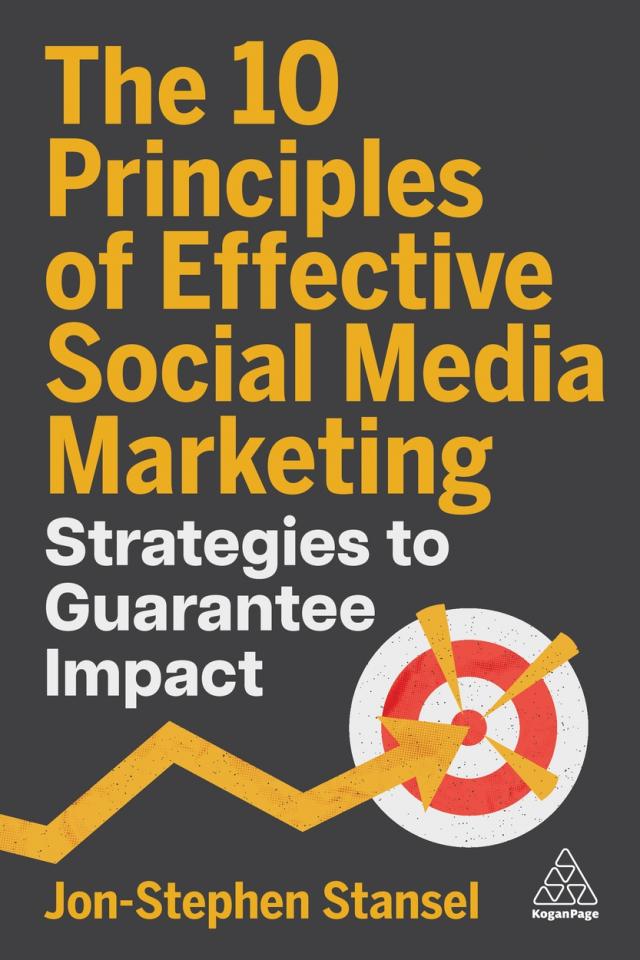
Jon-Stephen Stansel: Social media moves fast, but the principles of effective marketing don't change. Hello, I'm Jon-Stephen Stansel, author of The 10 Principles of Effective Social Media Marketing: Strategies to Guarantee Impact, published by Kogan Page.
Whether you're a social media professional, an agency leader, or a marketer working with social teams, my book provides timeless strategies to create content that connects, no matter what platforms rise or fall.
Inside, you'll find real-world examples from brands like HBO, Xbox, and Beyond Meat, plus practical exercises you can apply immediately. These aren't trendy tactics that will be outdated next month. They're foundational principles that will work on whatever platform comes next.
As an IN CLEAR FOCUS listener, you can save 25% on The 10 Principles of Effective Social Media Marketing when you order directly from KoganPage.com. Use promo code BIGEYE25 at checkout. Shipping is complimentary for customers in the US and the UK. Learn the principles that guarantee impact and give yourself the confidence to create social media strategies that deliver real results. Thank you!
Adrian Tennant: Welcome back. I'm talking with Kathleen Lucente, founder and CEO of Red Fan Communications, about strategic communications in the age of AI. Crisis communications is one of your specialties, having developed plans during 9-11 and the SARS outbreak. Kathleen, for brand marketers who may not have crisis experience, what are the essential elements every company should have in place before a crisis hits?
Kathleen Lucente: It's essential for most every company to have a crisis strategy because there's anything that can happen, right? So what you do is, I mean, most people think, “Gosh, I don't want to think about an accident until it happens.” Well, that's probably not a good plan, right? So, you know, it's like you don't buy fire insurance or flood insurance because you're hoping you're going to have a fire or flood. You actually put it in for prevention. What we traditionally suggest to our clients and to brand marketing teams is have a partnership with a client relationship team like ourselves. We'll come in and build out an entire framework with your C-suite. What we do is we interview the executive team on what are the things that keep them up at night, what are the things that would really tank their company. And we make a list, you know, what are they? And then we actually build out an actual crisis plan with all of those scenarios in mind. Everything from a natural disaster, like, you know, flooding that we've seen here in Texas, to, you know, something like the COVID situation that has happened here and all around the world and impacted all sorts of people in their workplace, and even the aftermath of that, to, you know, an employee who is getting arrested on site, or an executive who, you know, walks out the door, you know, and does something outrageous. All of those things we have to factor. One of the most common things is a breach in data these days, right? And so we build out a crisis plan so that when a crisis happens or even an issue starts to bubble up, there's a culture within the company on how to raise your hand if you see an issue. So we help the company start to think about that, how to make sure employees feel comfortable with raising an issue, so it doesn't turn into a crisis, so it can be caught sooner, and be rewarded for raising that concern. versus hiding it and then finding out it's a big disaster. And then how to handle the situation when it actually happens. Who needs to be in the room? What lawyer needs to be present? Who's going to be the PR team communicating? What is the holding statement? And so really, there's three things we look at. We call it ‘the crisis trinity.’ One is what is the speed at which you can respond to a crisis? Speed matters. The longer a company delays in response, that is a big problem. Transparency is huge. So being open and honest as much as you can with the data that you have at each stage, and then stakeholder messaging, making sure your internal employees are aware of what's happening, as well as external so that you're not just communicating one way, you're communicating to customers if there's a problem, to employees, to each stakeholder that would be impacted by that crisis. And that could be a product law could be, you know, part of a crisis. So product isn't working, you know, clock in a microprocessor isn't working, there's something that's going on that needs to be addressed. And so this plan, without it, you're actually going to be running around like chickens with your heads cut off. And you don't get to the speed of how fast you can answer, you don't get to the level of transparency, and you lose trust really fast. And so that's really the most important thing to be having that plan in place. I also would just highlight that crisis planning probably costs between, depending on the size of the company, anywhere between $50k to $100k to make sure you really have things buttoned up. But the recovery, if you don't handle a crisis properly, is close to $5 to $10 million, or you're closing the doors of your company. What we know for a fact how crisis work is that when a crisis happens, and it's out in the public, if it's not handled properly, most brands lose between 20 and 25% of their market share within the first 24 hours.
Adrian Tennant: Wow. Some industries inherently understand the need for crisis planning, while others clearly don't. How can marketers make the business case for crisis preparedness to leadership teams that might see it as unnecessary?
Kathleen Lucente: The biggest way to really help C-suite understand why a crisis plan is needed is point out some crises that have happened in the press, the good ones that have been handled really well by companies, as well as crisis issues that have not been handled well, and looking at the financial impact to those companies. So I think, you know, unfortunately, a lot of times you have to kind of really show those examples, the real disasters. We show a lot of that in media training with our executives. We'll show examples of CEOs who are absolutely not prepared in a crisis and on TV, making it worse, and how they're responding because they did not have the right plan in place. And then they didn't have the support when the crisis happened either, you know, a double whammy. I believe that outlining the different crises really makes a big difference. We just did this with a healthcare company that we have as a client. The CEO is fantastic. She's been in the healthcare industry a long time. And she knew in the healthcare industry, people, you know, there's going to be issues, you know, submissions going to get rejected, or there's going to be something that happens. And so you need to be prepared. And we outlined all of the different scenarios. And what I saw was, each person in the C-suite had different things that kept them up at night, different worries. And when your CEO starts to realize, “Wow, how can I help take that mind space and take those worries off people's minds? By having a plan in place, they can then free up their brain to focus on other things, knowing that the company actually has a centralized strategy.” By the way, you're gonna get a lot more energy out of those executives if they're not worrying about, gosh, what happens if this, you know, this goes sideways. If they have a unified plan and they know how to behave together in a crisis, they're gonna be rock stars in the midst of any issue.
Adrian Tennant: Kathleen, one thing that stands out about your approach is the emphasis you place on turning PR into a revenue driver. How do you help clients make that connection between communications activities and business outcomes?
Kathleen Lucente: Well, it's interesting. The other day, I was thinking about this quite a bit because we do a lot of brand narrative work. And what I see is a lot of companies wind up at our door thinking, “Well, I think if I just can get some press coverage, things will turn around.” And when we help them start to realize that the press coverage itself is not going to be the silver bullet, we walk them back and say, “Let's look at talking to your sales team. Let's talk to your executives about what messaging is landing, what's not. What are you seeing happening with your competition?” And when we do a full brand narrative exercise, we then help them build out really three things. One is that authority part, right? What authority do you have as experts in your field? What How are you being sought after by customers that want to hear from you, would actually want to hear you talk on a podcast, for example. When you have authority and you show that real compassion towards your customers, you then open up doors, you get access. So that's the first part. We also look at how are you building credibility in your industry? Because if you're just talking about your own product and services all day, that does not build credibility. Customer success stories and getting other people talking about you builds credibility. So how do we build that campaign to build that? And then reputation, what is the reputation you want to have? And then how does that impact the retention that you have with your customers and with your employees. When you add those things up, I call it the revenue bridge. With those three things in place, you have a much more powerful ability to have an incredible revenue-generating brand.
Adrian Tennant: Well, as regular listeners know, we love case studies on IN CLEAR FOCUS. So Kathleen, can you share an example of how Red Fan Communications helped a client achieve noteworthy results through strategic communications?
Kathleen Lucente: Absolutely. I would point to CSI, which is a company that has been around for over 60 years. And we've had them as a client now for at least three years. They came to us, they were a public company on an alternative exchange. They actually help community banks all across the country by building out their technology and making sure that they are able to compete in scale and provide both consumers and businesses with the type of banking that they want. And so we sat down with them, with their C-suite, realized that they decided they wanted to go private, and they wanted to go private so they would have more freedom, more financial access to grow through M&A and scaling faster. When you're a public company, there's a lot more restrictions, and they chose to get off the exchange that they were on so we could help them build the momentum and thought leadership that they needed to scale to the next level, attract the larger bank customers that they want while keeping the smaller bank customers they have. And so we have actually helped them go from public to private, redo an entire centralized narrative around why they did that, why they want to scale. We've built out all of their customer success stories. We actually have been in the press every month in regular fashion. We've also helped them with their customer conference by having incredible speakers at that conference to really engage their customers at a whole new level about what's happening with banking and what consumers really want. And so this campaign has continued with a number of M&A activities where we've built out all the stakeholder messaging, and all of the M&A that has happened has gone beautifully. And so their reputation continues to grow, and we're continuing to scale them with even more exciting announcements in the coming months.
Adrian Tennant: Excellent. Well, you believe it's essential to identify what I think you call ‘hidden thought leaders’ within an organization. How should marketers go about discovering and developing these internal experts?
Kathleen Lucente: You know, this is always an interesting one. I think most companies, they think, “Okay, well, the C-suite must be our experts, and we're going to have to put the pressure there.” But really, when you start to do that brand narrative work, and you start to understand, “Well, we have to have different types of experts and thought leaders,” you can dive a little bit deeper and start to realize who is really connecting the most with your customers. Who, when they speak, everyone goes, “Yeah, I want to hear more from that person.” And so, getting to know your customers in the different areas, so we look at our client and go, “Okay, yes, there's going to be C-suite experts, but we also have this person who's a crisis comp person over here, and they are fantastic. Let's start to cultivate them.” Or a great example would be, we were working with Q2 Holdings a couple years ago, and they were trying to work on some major sales, and their sales team told us they were running into a couple of challenges with CFOs at other banks that were pushing back. And we said, “Well, why don't we start looking at your CFO? She was a phenomenal spokesperson when we brought the company public. We haven't been using her as a spokesperson other than on the finance side. Let's bring her into the fold.” And so once we started getting her, Jennifer Harris, out speaking to customers more, and then we also got her on the cover of, you know, CFO Magazine, we submitted her for best top CFO awards and things of that nature, she became that kind of hidden gem of a person that was pulled out at the right time for the right conversations, and I think she really enjoyed it It wasn't what she was expecting to do a part of her day. But I would say she really made a big difference. So finding those people and making those connecting the dots is really important.
Adrian Tennant: What you call the ‘company-you-keep mentality’ suggests that associations and partnerships influence brand authority. Kathleen, how should marketers be strategic about these relationships, especially in an AI-driven landscape?
Kathleen Lucente: When we think about partnerships, you know, my belief is that the company you keep should be a company that raises you up and you raise them up, right? And so I do believe in the AI world, it's important to do an inventory as part of that authority reality check that I talked about, where you take a look at, you know, if you search for your company in AI and you think about what other brands you're associated with and other partners, are these ones you're proud of and who's missing from the list? And if you think about the values of your company and the mission that you have, it really starts to help you see “Where are the voids? Where could we actually be building some partnerships?” So I'm a big believer, for example, in companies giving back and especially in their own backyard, understanding what philanthropy work can be done. How do you involve your employees and doing good for others? And employees love being part of companies that are involving them or give them the opportunity to go back. So that's, you know, sometimes we're helping companies see that, hey, you have a void here. There's an opportunity for you to be doing some interesting things, but also be very careful. Look at who you're associated with and is it raising the value of your brand or is it dragging you down? And it's time to do an inventory and understand that.
Adrian Tennant: Kathleen, if brand marketers listening today could take just one action to improve their organization's communication strategy, what would you recommend?
Kathleen Lucente: The big move right now, especially with the zero-click world, is for executives to ask their CMOs to do a search on where do we stand, not the company by itself, but if we were to type in who are the leaders in talking about X, whatever it is, and find out where you stand in the world. That is that authoritative reality check. I think it's important to be doing that right now using AI. And I recommend using a couple of tools, using ChatGPT, but also using Claude to see how you stack up in both areas. And then start to think about how do you want to influence that? Where does your thought leadership really land? And are you putting the muscle behind thought leadership? Or is it just one-off byline articles here and there, because that is not going to set the foundation for driving the AI authority. That's going to help that, you know, remember we were talking about the statistics of 30% of click rates are plummeting since AI summaries came up, right? So, if you want to influence that, you've got to recognize that today, 85% of B2B, you know, people that are out trying to figure out who to purchase from, they already have on the top of their mind a list of companies that have already influence them in some capacity. So how are you influencing the stakeholders that you want to influence? And how are you making sure you're on that list? Those are the big questions for companies today to start looking at the tools that we have, and, you know, broadening their understanding of how they're going to change, move away from SEO, and move more into mindshare.
Adrian Tennant: Great conversation. If listeners would like to learn more about you and your work with Red Fan Communications, what's the best way to connect with you?
Kathleen Lucente: I would recommend that you come over to our website, redfancommunications.com, and join our newsletter. I have a newsletter called “From the Desk Of” that has some great content in it on a monthly basis. We also have our zero-click guide over on the website. It's a free guide to access. And then please check me out on LinkedIn, Kathleen Lucente. I look forward to always engaging with anyone who reaches out to me.
Adrian Tennant: Perfect. Kathleen, thank you very much for being our guest this week on IN CLEAR FOCUS! Kathleen Lucente: Thank you. I appreciate being on here today.
Adrian Tennant: Thanks again to my guest this week, Kathleen Lucente, founder and CEO of Red Fan Communications. As always, you'll find a complete transcript of our conversation with timestamps and links to the resources we discussed on the IN CLEAR FOCUS page at Bigeyeagency.com, just select ‘Insights’ from the menu. Thank you for listening to IN CLEAR FOCUS, produced by Bigeye. I've been your host, Adrian Tennant. Until next week, goodbye.
TIMESTAMPS
00:00: Introduction
01:45: The Impact of AI on Brand Credibility
04:25: Authority Reality Check for Brand Marketers
06:44: Common Communication Mistakes in Mergers and Acquisitions
09:55: Timing of Communication Strategy in M&A
11:05: Consequences of Delayed Communication Planning
13:01: Break and Sponsor Message
14:10: Crisis Communications Essentials
20:24: Making the Business Case for Crisis Preparedness
22:40: Turning PR into a Revenue Driver
24:22: Case Study: CSI's Transformation
26:34: Identifying Hidden Thought Leaders
28:03: Strategic Partnerships in an AI-Driven Landscape
29:46: Final Recommendations for Brand Marketers
30:12: Conclusion and Guest Information