/
Success is a Numbers Game with Kyle Austin Young
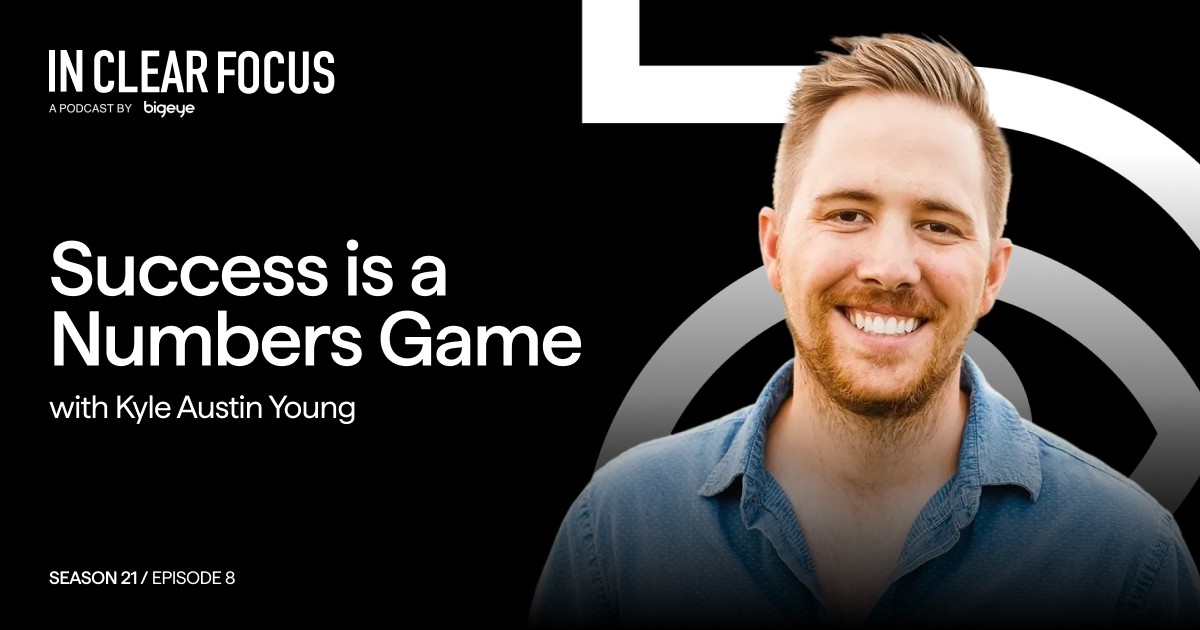
IN CLEAR FOCUS: Our guest this week is strategy consultant Kyle Austin Young, who discusses his new book, "Success is a Numbers Game." Kyle explains Probability Hacking: a framework to systematically de-risk goals. We also explore Kyle's 'Success Diagram,' discuss why "Bic For Her" pens failed, and hear how to use keyword research to validate market needs. Learn how to identify potential bad outcomes and tilt the odds in your favor, whether you're launching a product or training for a marathon.
Episode Transcript
Adrian Tennant: Coming up in this episode of IN CLEAR FOCUS
Kyle Austin Young: We have to find a way to systematically de-risk our goals. So probability hacking is getting a sense of what has to go right, identifying the things that are most likely to go wrong, and then doing what we can to pillage and plunder those bad outcomes to bring the odds of success that we want over to our side.
Adrian Tennant: You're listening to IN CLEAR FOCUS, fresh perspectives on marketing and advertising produced weekly by Bigeye, a strategy-led full-service creative agency growing brands for clients globally. Hello, I'm your host, Adrian Tennant, Bigeye's Chief Strategy Officer. Thank you for joining us. What is it that separates people who reliably accomplish their goals from those who struggle, fall short, or chalk up another failure to bad luck? Are there principles that can be applied to tilt the odds in your favour, consistently in work and in life? Well, today's guest believes the answer is ‘yes.’ He's developed a practical, evidence-based framework that helps people increase their chances of achieving big, meaningful goals, even when the odds seem stacked against them. Kyle Austin Young is an award-winning strategy consultant and contributes regularly to Harvard Business Review, First Company, The Boston Globe, Psychology Today, Forbes, and Business Insider. His articles typically focus on business strategy, personal achievement, and understanding what makes certain people succeed against the odds. Kyle is the author of the new book, "Success is a Numbers Game: Achieve Bigger Goals by Changing the Odds,” which reflects concepts he's been refining throughout his career. In his consulting and writing, Kyle helps high achievers, entrepreneurs, and business leaders across many industries reliably reach their ambitions by hacking the probabilities behind every goal. His new book is filled with real-life stories, tactical tools, and memorable case studies. To discuss "Success is a Numbers Game", I'm delighted that Kyle is joining us today from Nashville, Tennessee. Kyle, welcome to IN CLEAR FOCUS!
Kyle Austin Young: Well, thank you so much for having me. I've been looking forward to this.
Adrian Tennant: Well, Kyle, as I mentioned in the intro, you're an award-winning strategy consultant and write for publications including Harvard Business Review, Forbes, and Psychology Today. How did you develop your focus on helping people accomplish big goals?
Kyle Austin Young: You know, I came to that very organically. I went through a couple of layoffs early in my career from these relatively visible leadership positions. I was the product development director at a health and wellness company, and then I held another leadership position here in Nashville. And after these back-to-back layoffs, I found myself in a position where I was very tired of losing my income. The first time, we had just bought our first house, my wife and I, that was well over a decade ago. The second time we were in the process of adopting our daughter, which is a pretty famously expensive process. And so I'd lost my income twice at very inopportune times. I was really fortunate, though. People knew who I was. They respected my work. And the day after the second layoff, I had four different job offers, and I needed to decide which one I was going to take. And a couple of friends were really generous with me. One called, one took me to lunch, and they both said, “Why don't you consider repositioning yourself, becoming a consultant, taking fractional roles with these different organizations to give yourself some diversification so that you don't keep having to reset your life every year or so?” So I ultimately did that. But at that time, you know, four wasn't enough to sustain my income and help accomplish goals like funding the adoption. So I needed to take on clients, and in the beginning of any consulting journey, you don't get to be incredibly picky. You're trying to create the success stories that will earn you the right to eventually be picky. So in those early days, I was working with a wide variety of people. I was working with a doctor out of Harvard Medicine who wanted to change the national conversation around cancer. I was working with a technology company that wanted to use some really exciting VR technology, virtual reality, to disrupt the language-learning space. But I was also working with a small bed and breakfast in a town in coastal Maine that had 12 competitors and wanted to find some way to stand apart. So all of these different people. And the only way I could keep myself sane, the only way I could be productive and deliver a win, was I had to find some common denominator. What did all of these projects have in common? And ultimately, it was that they all had a goal, they all wanted that goal to be successful, and if I could participate in helping them optimize their odds of success, get the outcomes they want, try to take as many bad outcomes as I could off of the table, then they were gonna be thrilled to work with me. And so that became the focus, and once that focus began to materialize, it gave way to a framework that I've had the opportunity to refine over time. I got to share bits and pieces of it in the publications you mentioned, a little bit here in Harvard Business Review, a little bit there in Forbes, Psychology Today, things like that. And the book was an opportunity to share something more comprehensive.
Adrian Tennant: Well, let's talk about your new book, "Success is a Numbers Game." What actually inspired you to write it? Kyle
Austin Young: You know, I'm at a place in my career now where I've had the opportunity to work with a lot of really neat people, and I'm incredibly thankful for that. I've learned a lot from them along the way. But one of the challenging things is I still routinely have to say no to people when it's not a fit or when I don't feel like they're necessarily ready for the level of work that I do. And it's always really, I guess, validating for me to not be a dead end in someone's life. I like to at least send them somewhere and say, “What about this? You know, read this article and this will take you to the next step.” Sometimes people will text me a question and I'll say, “Oh, great question. I have an article on Fast Company where I've answered that. Read this, and it's going to give you exactly what you need.” It's the same thing I would say if we were going to hop on the phone since I wrote the article. But when it came to the core methodology of what I do, which is trying to help people optimize their odds of success, typically in these organizational contexts where there's high stakes, you know, these are goals where if they're not accomplished, the company could miss objectives that might even leave the layoff, something I've experienced a couple times and obviously feel pretty passionate about helping people avoid. So I wrote the book to try to give people my core methodology and have a place I could send people where if it didn't make sense for us to work one-on-one, if I was booked at the time, or if for some reason they were on a timeline or a budget that didn't make sense with me, I would have the ability to say, “This is what I know about understanding your odds of success and ultimately optimizing them.” It was also a fun opportunity to help people with more personal and niched goals than I typically would in a consulting context. I have people who are using the book right now because they want to train for a marathon. They want to earn a pilot's license. They want to grow a bumper crop of tomatoes. It never made sense for somebody to put me on retainer for the sake of their tomatoes, but it has been, it's proving that it is sometimes worthwhile to read the book. And so it's been fun to branch into that space also and help people with some of the goals that are happening, not just in the boardroom, but also in their homes.
Adrian Tennant: Well, at the core of your book is what you call ‘Probability Hacking.’ Can you explain what that means in practical terms?
Kyle Austin Young: Probability hacking is the art and science of changing your odds of success. And so when many of us approach a goal, we intuitively try to get some sense of what's going to be required for us to accomplish it. We try to make an informed decision about whether this is something that we want to pursue. Probability hacking is, first of all, we do that more comprehensively. We try to make a list of everything that's going to have to go right in order for us to get the outcome that we want. And then what we try to understand is that probability can be understood similar to how we've traditionally understood matter. We've all heard the phrase that “matter can't be created or destroyed. It can just be transferred and rearranged.” And that's how your odds of success work. The odds that you want can't just be conjured into existence. They are hiding in your potential bad outcomes. For everything that you want to happen, there's a chance that it will happen. And then there are some potential bad outcomes. There's a chance that those things will happen instead. And all of those exist in the same system. And if we want to make our odds of success better, we have to find a way to make our odds of these potential bad outcomes worse. We have to find a way to systematically de-risk our goals. So probability hacking is getting a sense of what has to go right, identifying the things that are most likely to go wrong, and then doing what we can to pillage and plunder those bad outcomes to bring the odds of success that we want over to our side.
Adrian Tennant: In the book, you introduce the ‘Success Diagram.’ Kyle, what is it, and how does it help people understand their odds?
Kyle Austin Young: A success diagram is a visual representation of what I just described. It's a list of everything that has to go right in order to accomplish your goals, and there are examples certainly in the book. You can probably already find some online, so I apologize. I know this format is a little bit harder for such a visual thing as a diagram, but basically, you list left to right, “Here are the steps that I'm going to have to accomplish in order to ultimately achieve this goal.” And so an example that I give is, let's say that you're training to run a marathon. You hire a running coach and she says, “You know, you've only got a certain amount of time to prepare. I think I can get you there, but I need you to do three things for me. I need you to eat, sleep, and train the way that I tell you to for the duration of this period until it's time to run the marathon. And if you do all three of those things, you're gonna be ready to go. I've never had a client fail if they've actually followed this training regimen. But if you cheat on one of those, if you don't eat the way I tell you to, if you don't sleep the way I tell you to, if you don't train the way I tell you to, you're not gonna be ready on race day. I can't get you ready on that amount of time.” So if we were gonna create a diagram of that, there's three things that have to go right. We have to eat according to her plan, sleep according to her plan, and train according to her plan. There would be three of what I call ‘critical points’ on the diagram. And for each one of those, there's things that could go wrong. There's things that could ultimately happen instead of what we want when it comes to the issue of training. What if it's raining on a day and we need to go for a run? What if we encounter an injury? What if we lose motivation after a few weeks of trying to keep up with this training regimen? Those are all potential bad outcomes. So beneath each of those critical points, we'll write the things that could go wrong instead. And we have an opportunity, if we want to, to use some numbers to try to understand how likely we are to accomplish this goal. And all that we have to do is estimate what we think the odds are for each of these critical points to happen, each of these prerequisites to success. So, in our case, for the purpose of an example, I'll just use very simple made-up numbers. Let's say that upon looking, we think that there's a 70% chance that we'll eat the way we're supposed to, a 70% chance we'll sleep the way we're supposed to, and a 70% chance we'll train the way we're supposed to. That's an easy thing to process, even when we don't have the visual in front of us. Well, here's what's really powerful. Most humans do a lot of what I just said intuitively. They don't do it comprehensively enough, but they try to get a sense of what's going to be required to accomplish a goal, and they try to think a little bit about what could potentially go wrong. At this point, they fall into a trap called ‘averaging.’ And if we consider that diagram in our head, where there's three things that have to go right and a 70% chance for each of them, many people would tell you that they have a 70% chance of being ready on race day. Or at least tell you that they feel pretty good about their overall odds of success. They feel good about each of the individual prerequisites, and so they've averaged it in their mind to feel good about their overall chances. That is not mathematically sound. In reality, if these are true prerequisites to success, we have to multiply those three numbers together: 0.7 x 0.7 x 0.7. And if we do, we find that we actually only have a 34% chance of being ready on race day. We don't expect to be successful at this goal. And think about the fact that this is a goal where only three things need to go right. And individually, every one of those things is expected to happen, but it's unlikely that we're going to get all three. There's still enough uncertainty and enough risk that we can't confidently say that we think we're gonna pursue this goal. And so when we hear statistics like ‘nine out of 10 businesses fail,’ or we watch how, what a large majority of mergers and acquisitions fail to create lasting value, why is that happening? Well think about how many things have to go right for that to be a success. So a success diagram is intended to give you a picture of how likely you are to accomplish a goal that you want, and then probability hacking is finding ways to take the risk out of those bad outcomes to improve your odds so that you can hopefully change your outcome.
Adrian Tennant: Well, you also emphasize the importance of understanding potentially bad outcomes or ‘PBOs.’ How does identifying these shift someone's odds for success?
Kyle Austin Young: Absolutely. Let me tell you about the time that I applied to become a department manager at a growing health organization, which doesn't sound crazy until you hear the part where I had just graduated college, I had no experience, I was 21 years old, and I was going to be managing people in their 50s, 60s, 70s. Some of these people were older than my grandparents, had PhDs, and master's degrees. I'm this fresh out of college with a bachelor's degree kid, who was looking at the entry-level positions that were offered to him, and I just wasn't very inspired by them. And so I said, “I'm gonna do something crazy. I'm gonna apply for this product development director job as a 21-year-old.” And I submitted the application, and I got an interview. And I knew that even with the interview, my odds weren't good, but I said, “I'm gonna do everything I can to try to make this happen.” And so this was well over a decade ago. But when I was preparing for that interview, even then, I had a bit of an understanding that the potential bad outcomes were the things that could keep me from getting what I wanted, which was to get an amazing job first out of college and put myself in a position for an accelerated career. So I tried to identify what those bad outcomes were. And there were three that were really evident to me. One was they chose to not hire me because of how young I looked. They were gonna take a look at me and say, “I don't think he can manage this team.” So a very easy response. Probability hacking, it's very creative, it's very interactive, it's very enjoyable, at least for me. I had to ask the question, “Is there a way for me to look older ethically?” I didn't wanna put on a mask and makeup every day when I went into work, walk with a cane or anything like that. But I thought, “Is there a way for me to look older?” I grew a beard. And I still have the beard today, but that beard put 10 years on. I went from looking like I was 15 to looking like I was 25, and that was an improvement for a 21-year-old. So, showing up with a beard helped. It took a little bit of the pressure off for me to sound older, act older, because I looked a little bit older. That was a good thing. Another potential bad outcome that I perceived was they might choose to not hire me because of my lack of experience, and I needed to find a way to help respond to that. Now, in that scenario, I couldn't give myself years of experience in preparation for this interview. What could I do? Well, I could try to be really intentional about how the conversation went. So I actually typed up really a book, and it was my plan for growing and improving this department, making it more efficient. I had it spiral-bound, I took it with me. And whenever somebody would try to ask me questions about the past, I would redirect it to a question about my vision for this department and say, “... as I mentioned in this proposal ...” and “I'm gonna leave a copy with you, here are some of the opportunities that I think we have for making this a big success.” And so I just found ways to avoid talking about it. I never said anything that was untrue, but I just tried to keep the conversation focused on my vision for the department's future. The third and final bad outcome that I perceived was I might have a hard time fitting in with this team because there was such a generational gap. Maybe it would be difficult just to collaborate with them, communicate with them, and they might not hire me for that reason. So I used a strategy that I'm still using today. I asked a team member, “Have you as a department read any books lately?” And they told me three titles. I went out and read all of them. And when I showed up for the interview, and it was a day of interviews, you're meeting with a lot of different people, and sometimes in a group context with other candidates who wanted the job, I was able to speak the company's language because I'd read all the same books that they did. I knew their jargon, I could make inside jokes, I understood their goals. This was a long time ago, but I remember one of the books was called “The Whuffie Factor.” And WHUFFIE was a term meant to explain the idea of social capital, trust that people might have in a brand. And I remember sitting in a group interview when I said, “I think if we did that, we're gonna get a lot of WHUFFIE out of that.” And I remember the eyes of the other candidates just bulging out of their heads, wondering, “What on earth did he just say?” But the existing team was all laughing and nodding along in agreement. So when I ultimately got the job, a crazy thing for a 21-year-old, when they offered me the job, I asked somebody, “What was it that made you hire me over these people with so much more experience?” And they said, “It felt like you'd been here the whole time. It felt like you were part of the team.” So with potential bad outcomes your goal is to make them as unlikely as possible and, in doing so increase the odds of getting the outcome that you want, and if you can do that successfully enough then you can, over the course of a single goal, change your outcome over the course of many goals, you can change your life.
Adrian Tennant: Let's take a short break. We'll be right back after this message.
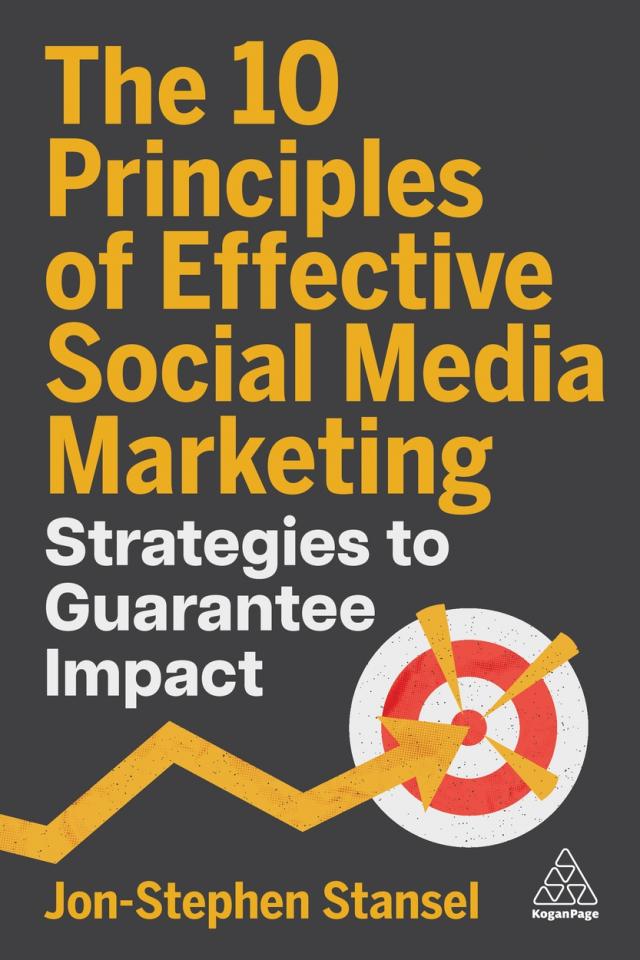
Jon-Stephen Stansel: Social media moves fast, but the principles of effective marketing don't change. Hello, I'm Jon-Stephen Stansel, author of The 10 Principles of Effective Social Media Marketing: Strategies to Guarantee Impact, published by Kogan Page.
Whether you're a social media professional, an agency leader, or a marketer working with social teams, my book provides timeless strategies to create content that connects, no matter what platforms rise or fall.
Inside, you'll find real-world examples from brands like HBO, Xbox, and Beyond Meat, plus practical exercises you can apply immediately. These aren't trendy tactics that will be outdated next month; they're foundational principles that will work on whatever platform comes next.
As an IN CLEAR FOCUS listener, you can save 25% on The 10 Principles of Effective Social Media Marketing when you order directly from KoganPage.com. Use promo code BIGEYE25 at checkout. Shipping is complimentary for customers in the US and the UK. Learn the principles that guarantee impact and give yourself the confidence to create social media strategies that deliver real results. Thank you!
Adrian Tennant: Welcome back. I'm talking with strategy consultant Kyle Austin Young, author of "Success is a Numbers Game: Achieve Bigger Goals by Changing the Odds." Kyle, let's talk about some real-world applications. You have a case study in the book about Bic releasing a line of pens called Pens for Her. What happened there?
Kyle Austin Young: This is a fun story. In 2012, Bic, a French manufacturer, released a product that now lives in a little bit of infamy. It was a line of writing pens that were marketed to be designed specifically for women. And if you're wondering how a pen could be made specifically for women, you're not the only person wondering that. Ellen DeGeneres, who was a talk show host at the time, in one of her monologues said, “Can you believe this? We've been using man pens all these years!” But it was marketed as having a thinner barrel to fit a woman's hand. And apparently, the company thought that women were struggling to use these pens effectively, and so they stepped in to help with a new design. And the Amazon reviews are a lot of fun. You can still find them. People had a good time with it. All very good-natured, but joking about, you know, “Oh, thank goodness, finally a pen I can hold!” And it's been fun to see some of that sarcasm. So the venture was quickly discontinued. What I think is that there is an opportunity to learn from there - is, again, this is a real-world case study where a potential bad outcome came to life, and I think that potential bad outcome was identifiable, and I think it was avoidable. Since 2018, there's a venture capitalist database called CB Insights. that has sought to understand what causes new businesses to fail. And so they've reviewed these postmortems of failed startups. And as the number of postmortems has changed, I talked about this once in a Harvard Business Review article, the numbers have moved a little bit since then. So you might find numbers that aren't the exact numbers I'm going to say right now. I just want to tell you that if you end up reading more about it, but they tend to stay pretty consistent. It's just little fluctuations depending on how many new case studies have been reviewed. But they found some potential bad outcomes that have led to business failures. A few of them, 10% said that poor timing was the biggest saboteur for them. They just released at the wrong time. I've certainly experienced that. I tell a story in the book of a friend and client who released her book, a book about forensic pathology that was poised to become one of the biggest books in the world. She released it on September 11th, 2001, which in the United States was a very tragic day where the entire news cycle was dominated by the terrorist attack on the World Trade Center. Not a good day to release a book. Another 18% of these failed companies in their post-mortem cited legal challenges, so maybe there was a patent dispute or something got in the way where they were not able to succeed because of a legal challenge. Twenty percent said they got out-competed, so they were in a space that was maybe a little bit too competitive. But what was interesting is there was a bad outcome that was more common than all of these. In the postmortems studied, 35% cited what the researchers called, quote, “no market need.” In other words, nobody wanted the product or service that was being sold. That was one of the most common reasons a business failed in these postmortems. So when we think about Bic For Her, when we think about this new line of pens for women, it clearly turns out that people didn't really want that, and I think it's pretty fair to assume that that is what led to the downfall of this initiative that had a lot of money behind it that put a lot of time into it. And so for organizations, it's important, again, to be identifying what are the potential bad outcomes. And sometimes research has given us some ideas that we can start with, like recognizing that legal challenges, poor timing, competition could be some of them, and seeing that the biggest one in this case was a lack of market need. The reason that I highlight that in the book is I think that's a very avoidable problem. I think that that's something they could have identified earlier, and I think that one way to do that would be keyword research. I talk about that a little bit in the book. I think that there was an opportunity to perceive the risk in this goal a little bit sooner than they did.
Adrian Tennant: Well, as you mentioned, using keyword research to pre-validate consumer demand is an option. Could you walk us through how that works for product development?
Kyle Austin Young: Absolutely. Keyword research is an exciting way to peek into sort of the collective consciousness of consumers and try to figure out what do they really think, what do they really want? They might tell you in a survey, they might not. But when they're on their own, going to Google, trying to find a solution to a problem, what are they telling Google? So I went ahead and did some research on how people were looking for pins in the context of writing. And I found that just the word ‘pens’ received around 160,000 searches a month globally. So about 160,000. ‘Calligraphy pens’ 28,000. ‘Gel pens’ 28,000. ‘Custom pens, personalized pens’ a little over 25,000. ‘Fountain pens’ 20,000. So we're getting a sense, ‘erasable pens’ 19,000. I think that's an interesting product idea. I didn't know that there was such a thing as an erasable pen. So this is something that you can learn, is sometimes people go to the internet looking for products that don't really exist yet, or maybe don't exist in your product suite, and you realize, “Wow! 19,000 people a month are trying to buy erasable pens, and we make pens, but we don't have one of those. Probably worth trying to understand whether we could, you know, in a cost-effective way, release an option like that.” So when we see these numbers, 160,000 for ‘pens’ even 19,000 for ‘erasable pens’, I then went and searched how many people are looking for ‘pens for women’ every month. And in the United States, it's 250 people. And more than likely, this is me being speculative, but I would guess that they're probably looking more for design than the marketing angle of a thinner barrel to fit a woman's hand. They're probably more just looking for pens that, you know, have a nice aesthetic. That would be my guess. I could be incorrect. But it shows that this was, in my opinion, a pretty perceivable and avoidable risk. If only 250 people a month are looking for ‘pens for women’ it is possible to introduce a product that's so revolutionary that people didn't know they wanted it. I think, to some extent, that's what maybe happened with tablets. Nobody really knew they wanted an iPad, and then they saw an iPad, and they said, “Well, maybe I want an iPad.” So I think that's possible, but generally, if there's no indicators that people are looking for the thing that you're planning to release, That's a problem. And keyword research is one of the ways that you can figure that out. Had Bic For Her started with that, maybe they could have pursued an idea that was more likely to succeed. And if you take the risk of no consumer demand off the table, and that was something that 35% of failed startups ran into, imagine what we've done to our odds of success.
Adrian Tennant: Well, we're always interested in fresh perspectives on advertising and marketing, and you've worked with agencies on some challenging projects. Kyle, can you share an example of how probability hacking applies to ideation or decision-making processes?
Kyle Austin Young: One of the things I cover in the book is the power of repeated attempts. If you're pursuing a goal with a high amount of uncertainty, one of the most reliable ways to turn a 1% chance of success into a good outcome is to try a hundred times, or maybe try even more than a hundred times. And ideation is a good example of that. Coming up with a really good idea is challenging, and it's unlikely that the first idea that comes out of your mouth is gonna be optimal. Thomas Edison is credited with this quote of having supposedly said, “To have a good idea, have a lot of them.” And he is somebody who lived that out in his work as an inventor when he was in a race to invent the first practical incandescent lamp. A lot of people think he invented the light bulb. Well, not quite. Incandescent lamp. And even then there were other people trying to do that. What allowed him to win the race for these really coveted patents was everybody was struggling to find a filament that would get hot enough to incandesce and glow without catching on fire or burning out so quickly that it wasn't worth the hassle. So, what he did is he actually experimented with 6,000 different plant materials. And he found that this really unlikely candidate, at least in my opinion, was carbonized bamboo. I don't know about you, Adrian. I probably wouldn't have started with carbonized bamboo.
Adrian Tennant: Probably not.
Kyle Austin Young: I didn't know there was such a thing as carbonized bamboo. But that was something that was really successful. It incandesced, if I remember right, for over 1,200 hours when electrified. And it was a really viable option that helped him get patents that gave him a really strong competitive advantage. So there's certainly a probability component to ideation. Are we willing to have a lot of ideas? And you mentioned agencies. I give a case study in the book of my friends at Whiteboard in Chattanooga, Tennessee. This is a marketing agency that I've consulted with. I have a tremendous amount of respect for them. And they were hired at one point to design a new website for a popular summer camp. And as the project neared completion, it was good enough. It was ready to turn in, but they felt like something was missing, and they decided that rather than turn in something ‘good enough’ they were going to try to turn in something that was just truly excellent. And so they went back to the drawing board and generated more and more ideas, and ultimately, one of the team members had this idea for what they called a color waterfall. It was this really incredible design, but it had this cascading color that just drew your eyes in. It was really beautiful. And when they turned it in, not only did the client love it, they ended up winning a pretty respected industry award for this website. And that came through these additional ideas that they chose to have. So how does it impact ideation and decision-making? At the ideation component, it means you need to have a lot of ideas. I'll quickly say how it impacts decision-making, which is, people talk about ‘decision paralysis’: “If I have too many ideas, I'm not going to be able to make a good decision.” I don't worry as much about decision paralysis, because if you have a clear outcome that you're aiming for, a clear litmus test, then it's not really something that I find overwhelming. Think about Thomas Edison, 6,000 plant materials. 6,000 options would be a lot to think through. But when all you're doing is turning on a timer and seeing which one glows the longest, I don't think it's overwhelming to have 6,000. It's a lot of work, but it's not something that forces you to do a tremendous amount of mental processing. You're just seeing which one works the best. In the context of our goals, I think that a success diagram can be sort of like that timer that Thomas Edison was maybe using. When we have a picture of what has to go right in order for us to accomplish our goals, and we know what could go wrong, we have the ability to evaluate the different options we're considering in that context: “If I hire candidate A instead of candidate B, how is that going to impact the things that have to go right? How is that going to impact the things that could go wrong? Am I making bad outcomes more likely or less likely? Am I taking any off the table? Am I introducing new bad outcomes by bringing this person into the equation?” When we have that visualized future on a piece of paper in front of us, I find that it can help us make smarter decisions.
Adrian Tennant: Kyle, what's the biggest or most common mistake you see people make when pursuing ambitious goals?
Kyle Austin Young: Well, I think a lot of people never stop to even consider their odds of success. They ask themselves the question as they consider the different goals they might pursue, the different initiatives organizationally, “Is this something that aligns with our overall objectives? Is this something we're passionate about? Is this something that might bring other goals within reach?” And all of those are great questions. I respect all of those questions, but if we aren't stopping to get a real sense of how likely we are to actually accomplish the thing that we're pursuing, then it doesn't really matter how much alignment there is. If we're just basically choosing which failure to pursue, there's just not too much wisdom in that. I think that we have to make a seat at the table for understanding that every goal that we're pursuing has two hidden numbers attached to it: there's our odds of success, there's our odds of failure, and if we're willing to create a success diagram and try to get a real picture of what it's going to take to accomplish a goal, then we can put ourselves in a position to make more intelligent decisions. I want to piggyback off that very quickly by saying I think the second thing that people fail to do is they fail to recognize that commitment and desire are not antidotes to uncertainty. We have this belief that if we're really committed to accomplishing something, that somehow changes our odds. There are certainly resilience as part of success. We know that repeated attempts can change our odds, and that takes an amount of resilience, so I understand that. But if we return to, you know, the analogy of going for a run, preparing for a marathon, commitment doesn't prevent injuries, commitment doesn't fix the problem of a hurricane on a day when you need to go training. There are things you can do about that. You could get a gym membership, you could do some stretches, but we have to understand that how much we want it is not the key question. It's ultimately how likely are we to be able to accomplish the steps needed to get the outcome that we're looking for.
Adrian Tennant: Great conversation. Kyle, if listeners would like to learn more about your book, "Success is a Numbers Game," what's the best way of doing so?
Kyle Austin Young: You can grab a copy on Amazon, Barnes & Noble, directly on the Penguin Random House website. You're also welcome to visit my website, kyleaustinyoung.com. But if you want to connect with me more personally, then find me on LinkedIn, send me a message if you have any questions about this. I've really enjoyed getting to know people as a result of these interviews.
Adrian Tennant: Kyle, thank you very much for being our guest this week on IN CLEAR FOCUS.
Kyle Austin Young: Thank you for having me. Adrian Tennant: Thanks again to my guest this week, Kyle Austin Young, author of "Success is a Numbers Game". As always, you'll find a complete transcript of our conversation with timestamps and links to the resources we discussed on the IN CLEAR FOCUS page at Bigeyeagency.com, just select ‘Insights’ from the menu. Thank you for listening to IN CLEAR FOCUS, produced by Bigeye. I've been your host, Adrian Tennant. Until next week, goodbye.
TIMESTAMPS
00:00: Introduction to Probability Hacking
00:20: Welcome to IN CLEAR FOCUS
00:30: The Key to Achieving Goals
01:02: Introducing Kyle Austin Young
01:34: Kyle's Journey to Consulting
05:02: Inspiration Behind the Book
05:56: Understanding Probability Hacking
08:19: The Success Diagram Explained
11:47: Identifying Potentially Bad Outcomes
16:02: Case Study: Bic For Her
21:13: Using Keyword Research for Product Development
23:51: Probability Hacking in Ideation and Decision-Making
27:37: Common Mistakes in Pursuing Goals
29:24: Where to Find Kyle's Book
29:47: Conclusion and Thanks