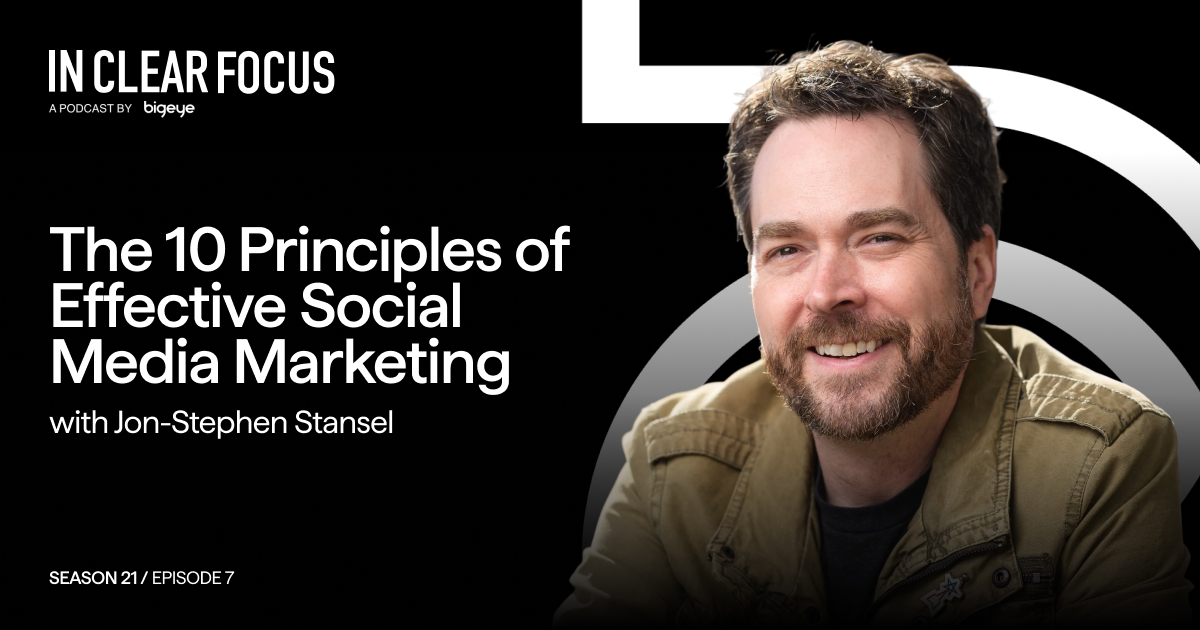
IN CLEAR FOCUS: Jon-Stephen Stansel, the author of the Bigeye Book Club selection, “The 10 Principles of Social Media Marketing” explains why human judgment remains essential: “AI can do a lot, but it doesn’t have taste.” Jon also discusses timeless principles for effective social media, drawn from his work on franchises such as “The Lord of the Rings.” Learn why social media is not a one-person job, how to create a consistent brand voice, and why there’s no such thing as a boring brand.
Episode Transcript
Adrian Tennant: Coming up in this episode of IN CLEAR FOCUS
Jon-Stephen Stansel: AI can do a lot, but it doesn’t have taste. It can create content, but it can’t tell you if that content is good or not. And that’s a uniquely human thing.
Adrian Tennant: You’re listening to IN CLEAR FOCUS, fresh perspectives on marketing and advertising, produced weekly by Bigeye, a strategy-led, full-service creative agency growing brands for clients globally. Hello, I’m your host, Adrian Tennant, Bigeye’s Chief Strategy Officer. Thank you for joining us. Social media platforms come and go. Features change overnight. Algorithms shift without warning. Yet some brands consistently create content that resonates, builds community, and drives results, regardless of which platform dominates the cultural conversation. What separates these successful brands from those struggling to keep up? Well, the answer isn’t about chasing the latest trend or cracking the algorithm. It’s about mastering timeless principles that work on any platform, in any trend cycle. Our guest today has spent 15 years mastering these principles. Jon-Stephen Stansel is the founder of Saturn 9 Media, a social media management and strategy consultancy based in Bentonville, Arkansas. Throughout his career, Jon-Stephen has managed social media for major entertainment franchises, including Amazon Prime’s “Invincible,” “The Lord of the Rings: The Rings of Power,” and “Avatar: The Way of Water,” as well as for higher education institutions and government. He’s presented at conferences and has appeared on numerous business podcasts advocating for social media professionals. Jon-Stephen’s new book, published by Kogan Page, is “The Ten Principles of Effective Social Media Marketing: Strategies to Guarantee Impact.” Drawing on his extensive experience, the book provides practical guidance for creating posts that connect with audiences every time, packed with real-world examples from brands like HBO, Xbox, and Beyond Meat. To discuss why social media requires dedicated teams and budgets, how to develop a consistent brand voice that resonates, and the role of human judgment in an AI-enabled world, I’m delighted that Jon-Stephen is joining us today from Bentonville, Arkansas. Jon-Stephen, welcome to IN CLEAR FOCUS.
Jon-Stephen Stansel: Hi, I’m excited to be here today.
Adrian Tennant: Well, Jon-Stephen, I mentioned it briefly in the intro, but could you start by telling us about the kind of work you do at Saturn 9 Media?
Jon-Stephen Stansel: Yeah, so I’m the founder of Saturn 9 Media. We’re a small agency that does social media marketing for clients all over, mostly in the entertainment industry these days, though. We work on accounts for large franchises, television shows like Amazon Prime’s Invincible, Hasbun Hotel, and several others.
Adrian Tennant: Perfect. So what prompted you to write “The 10 Principles of Effective Social Media Marketing”?
Jon-Stephen Stansel:Well, I’ve been doing social media marketing for close to 15 years now, and I’ve always wanted to write a book. My background is in academia, so that was always kind of a goal in life. The problem, though, with social media is that it changes so frequently that, you know, most books written on the subject are destined to be outdated by the time they go to publishing. So, uh, I thought about the course of my career, 15 years working, and what principles stood out to me as fundamental and evergreen. Facebook could go belly up tomorrow, which it won’t, but you know, if it were to happen, these principles would still apply to any other social network, regardless of whether you’re doing video or text-based, or image-based social, just no matter what you do, these ones should stay true for the foreseeable future.
Adrian Tennant: Well, you begin the book by challenging a common misconception that social media can be managed effectively by a single person. How is this belief harmful to brands?
Jon-Stephen Stansel:Oh, I think so often we think of the lone social media manager, just one person running all of the things and those days are gone, especially for larger brands. Maybe it can be done for smaller local businesses, but once you hit a certain point, it requires a team of people working on it. Social media is 24-7. People need to sleep, right? There were days when I was a solo social media manager, and I would wake up and check my phone at 1 a.m. to see if there was anything that needed attention, but that’s a one-way ticket to burnout town. You need a team of people that can help manage things, create content for things. No one person can be an expert at Facebook, Twitter, or X now, Instagram, TikTok, and all of the things that go into making the content for that. Like one person can’t be a videographer, photographer, graphic designer, all of those things. And if you find one person that can do it, like you need to pay them very well for that, that those multitude of talents. So we really do need teams of people to start building content, managing social media. And most importantly, you can’t have diversity on a team of one. We try to reach out to many different audiences and you need different perspectives and viewpoints on your team. And not only that, you need that insurance policy of someone else to look at a piece of content and go, are you sure we want to post that? That can keep your company out of a lot of hot water for sure. So you really need a group of people working on your social rather than leaving it up to one person.
Adrian Tennant: So let’s talk about building teams. Jon-Stephen, what does an effective social media team structure actually look like?
Jon-Stephen Stansel: I interviewed several different social media managers about what their teams were, from different brands, large and small, different industries, from education to retail, to see what their teams looked like. And the answer is there’s no one perfect model for a social media team. It’s going to depend on the business. Some are structured around platform. So they might have a team where they have one person whose sole responsibility is Facebook, another person whose sole responsibility is Instagram, TikTok. or they might have it more of a structure of skill-based. Okay, we have one person who handles the graphic design content, one that handles anything video, et cetera. What you really do need to do is take a look both at your goals and your resources when developing a team and saying, okay, what team structure looks best for what we can do? And then go from there and decide that it’s really going to just be dependent upon your brand, your company, I’ve been on multitudes of different types of teams, I could tell you which ones I prefer, but it’s going to be a little bit different for everybody.
Adrian Tennant:Well, one of your key principles is developing a consistent brand voice. Can you walk us through how brands should approach creating that voice?
Jon-Stephen Stansel: Yeah. A challenge of having a team is that you have several different people with different voices. One thing I like to say about writing, it’s a bit like a fingerprint. Everybody has their own unique style. If you know the details to look for, you can tell who on your team wrote what. But when you have a brand, you want to have that consistent voice that’s always the same, whether or not. And again, if you have a diverse team, you don’t want one post to sound like it was written by a 45-year-old white guy living in the South, like me, and another post to sound like it was written by someone fresh out of college, a Gen Z, new to the field from New York. It would be a completely different voice, tone, and sound. So you need to sit down and decide what your brand voice is and what it’s going to be. This requires several different exercises and thinking about your brand, what your audience thinks of your brand. I like to do like a shorthand of come up with a celebrity voice that we’re not going to use, but a good shorthand. So I’ve used it when I worked at the Texas Department of Transportation, we use the cowboy character from the Big Lebowski, Sam Elliott, the actor. And if I took a vacation, I could say whoever’s running the account for me, like just point to the photo and like, “If you don’t think that guy would say it, go back to the drawing board.” So that’s a good shorthand, a good place to start from, but building a unique voice that stays consistent regardless of whoever’s writing is going to be really important to your social media efforts because you don’t want it sounding like there’s too many cooks in the kitchen.
Adrian Tennant: You worked on major entertainment properties like “The Lord of the Rings: The Rings of Power.” Jon-Stephen, how did managing social media for passionate fandoms shape your approach?
Jon-Stephen Stansel: Oh man, my North Star on any account, but entertainment accounts especially, is that no matter what you’re working on, it’s somebody’s favorite thing. It is the show that somebody is waiting every week. They’ve got it scheduled that they’re gonna watch at the moment it comes out. It is a director’s vision. It is an actor’s first series that’s gonna be their big break. So I’m a huge “Lord of the Rings” fan and comic book nerd. So when I work on those projects, I’m like a kid in a candy store, loving it. But I have worked on some where maybe I’ll just put it this way, I’m not the target audience for it. And so I always try to remember the fans and those folks that it is their favorite thing. On any project I work on, we try to listen as closely to the fandom and be fans ourselves. I love it when we get a comment or reply like, “Did they just put a fan in charge of this account?” Because that means we’re on the right track. I’ll be honest, I’ve got several like burner Facebook accounts that I can join fan groups from and see what they’re talking about and find out what they’re interested in. What do they want to hear from there? What are their inside jokes? What are the little details that they’re looking for in each episode? And find ways that we can put that into the content, and let them know that we’re listening and that it’s not just some corporate account. It’s people who care about the show as much as they do. So yeah, the main thing is just remembering, no matter what you’re working on, it’s always someone’s favorite thing. There are fan groups for scented candles. They’re called fandles. So no matter what you’re working on, there’s a fan group out there. That’s what I tell people. It may not be as loud or as large as something like “The Lord of the Rings: The Rings of Power,” or a big film franchise, but that doesn’t mean they don’t care as much, just as much. So regardless whether or not you’re working on a franchise or working for like a local coffee shop, you have fans, so you need to get out there and listen to them and give them that content that they’re looking for.
Adrian Tennant: Well, let’s discuss artificial intelligence. You write that effective social media marketing remains human, even with AI integration. How do you see AI fitting into social media management?
Jon-Stephen Stansel: AI can do a lot, but it doesn’t have taste. It can create content, but it can’t tell you if that content is good or not. And that’s a uniquely human thing. It can’t tell you if your audience is going to respond to that content. And to be honest, a lot of humans don’t have taste. You know, they can look at a piece of a quote-unquote art and be like, “Oh, that that’s fine.” But it really does take the skill and training of a professional to go, “Okay, this is what our audience is going to respond to. Maybe this AI art might not be the best final product. Maybe this is a good proof of concept that we can then get a human artist to build off of.” A good way of showing those ideas that, you know, I’m not a professional graphic designer, but I know enough to be dangerous, so I can make something and show it to it it’s like, “This is the idea I’m looking for.” I think AI is going to be great for that. Uh, I think there are going to be a lot of brands and there already are. They’re trying to skimp out and like, “Okay, we can just type something into ChatGPT,” but it doesn’t have that human element. And sometimes you can tell. I often joke that I’d want to rebrand myself as an artisanal social media manager, like 100% organic, farm-to-tablet content. And I think those are the brands that are really going to stick out in the age of AI, are the ones that can relegate AI to those mundane tasks and leave their social media managers to be creative, and come up with those ideas and do those things. Because it’s got to have that human element. We talk to computers enough. Right? We want our social to have that human touch. Back to what you were saying about fans. They can tell. They can tell if something was written by AI or by another fan. Things that AI still doesn’t.
Adrian Tennant: Accessibility is another principle you cover. Why is creating accessible content so important for social media marketing?
Jon-Stephen Stansel: Well, accessibility, and for anyone listening that’s not familiar with the term in this case, is generally talking about assistive technologies for the people who are hearing impaired or visually impaired. There are screen readers that will, if you have an image, it reads the description of the image out loud. A lot of platforms are starting to implement AI into that, which I think is a brilliant use for AI. Facebook is doing that. It can see the image and then describe it. But for the most part, on X and Instagram, you still need to type a description out in what’s called ‘alt text.’ And even on Facebook, I recommend writing your own alt text, even though AI does it, because it’s not the best descriptor. For example, you might see a photo of like LeBron James doing a slam dunk and it will just say “Person playing sport, possibly basketball.” Well, that doesn’t give you like the full impact of the image. You need to be the person going in there and describing that. Another example is subtitles for the hearing impaired. And these days, pretty much everybody uses subtitles anyway. But also it makes it better for people who don’t need assistive technologies, right? How often are we watching videos with the volume off because we’re at work and we’re not supposed to be watching videos? Or we can’t turn on the volume for some reason. Those things make the content better for everyone. Taking the time to write alt text in an image description, someone who doesn’t have visual impairments may never know that is there. But there have been many times where that’s helped me create better content because, oh, you know, as I’m writing up the description of the image, oh, I’m seeing something in there that, okay, maybe a different image is going to be better. Also, it does give you a bit of an SEO boost. So you get more reach in your posts because those platforms are looking at the alt text and using those as SEO terms, which I do caution anybody, don’t go in there and just add extra SEO terms, like use it for the purpose alt text was intended. And on top of that, even if it didn’t do any of those things, it’s just the right thing to do.
Adrian Tennant: Let’s take a short break. We’ll be right back after this message.
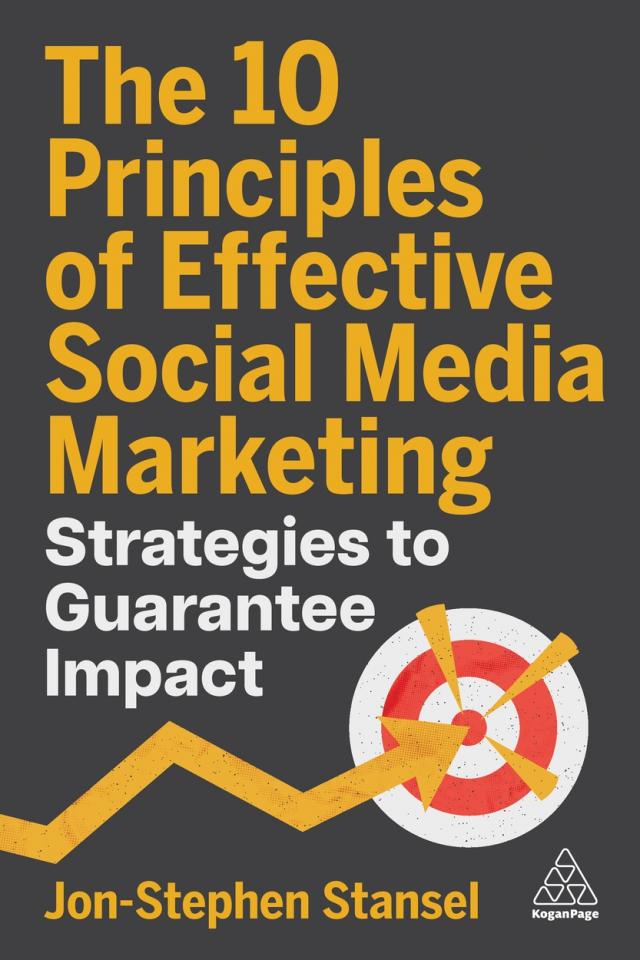 | Jon-Stephen Stansel: Social media moves fast, but the principles of effective marketing don’t change. Hello, I’m Jon-Stephen Stansel, author of The 10 Principles of Effective Social Media Marketing: Strategies to Guarantee Impact, published by Kogan Page. Whether you’re a social media professional, an agency leader, or a marketer working with social teams, my book provides timeless strategies to create content that connects — no matter what platforms rise or fall. Inside, you’ll find real-world examples from brands like HBO, Xbox, and Beyond Meat, plus practical exercises you can apply immediately. These aren’t trendy tactics that will be outdated next month — they’re foundational principles that will work on whatever platform comes next. As an IN CLEAR FOCUS listener, you can save 25% on The 10 Principles of Effective Social Media Marketing when you order directly from KoganPage.com. Use promo code BIGEYE25 at checkout. Shipping is complimentary for customers in the US and the UK. Learn the principles that guarantee impact and give yourself the confidence to create social media strategies that deliver real results. Thank you! |
Adrian Tennant: Welcome back. I’m talking with Jon-Stephen Stancil, founder of Saturn 9 Media and the author of the Bigeye Book Club selection for December, “The Ten Principles of Effective Social Media Marketing.” Jon-Stephen, your book includes a chapter on budgeting that many might find surprising. What do brands really need to invest in?
Jon-Stephen Stansel:Um, I, you know, in the book, I joke that social media is free the way a puppy is free. Like you can start an account for free, but you’ve still got to take care of it. You’ve got to put some money behind it. Content isn’t free. Uh, you’ve got to pay a social media manager, right? You’ve got to pay for the equipment that they need. There’s all kinds of different software that social media managers use every day. There are certain things that social media managers can’t do without, like a phone, like a laptop. But if you’re going to do video content, you’re going to need a better quality camera than a phone. You’re going to need lighting. You’re going to need props, microphones, all sorts of other things. And I think when people start building social for their brand, you can start slow, right? But you do need to have that budget for content. But not only that, social media is ever-changing. So if you hire a social media manager, the education for a social media manager, you don’t go to college and learn how to be a social media manager, and you’re done. It changes every day. So you need a professional development budget for your social media manager so they can stay current. They need to be going to conferences and learning the latest trends, and the latest platform techniques, and talking to other social media managers. So yeah, there’s a large budget that social media requires that I don’t think people see on the surface because there’s this illusion that social media is free or it’s, it is cost-effective, but there still is a cost.
Adrian Tennant: Chapter 8 of your book is about timing. You reference that now-famous Oreo’s ‘Dunk in the Dark’ tweet from the 2013 Super Bowl. What lessons should brands take from that moment and others?
Jon-Stephen Stansel: Yeah. And for anyone who’s forgotten that that ‘Dunk in the Dark’ moment was the Super Bowl. There was a blackout during halftime, and Oreo tweeted, “You can still dunk in the dark.” And to be honest, I don’t think that’s the greatest tweet of all time. It gets a ton of play. But I think it was a turning point when brands realized, “Oh, we can do reactive real-time content to get a large reaction.” You know, I can’t name a single Super Bowl commercial from that year, but that tweet, I mean, everybody remembers. So brands need to be aware of what’s happening in the broader cultural zeitgeist, so that they can talk about what trends are happening and how they can react to them, and when they should and when they shouldn’t. I think that’s another one brands need to understand. But timing is everything on those. If you jump on a trend too early, most people aren’t going to get it because maybe they haven’t seen it yet. If you do it too late, everybody’s going to go, “Oh, everybody else has done it already.” You’ve got to hit that sweet spot. and timing those trends. And not every brand needs to live tweet the Super Bowl or the Oscars or anything like that, but we always need to be on the lookout for those opportunities where it syncs with our brand. I think another one that was really good was, I think the musician Pharrell wore a large hat to the Grammys or an award show, and it looked just like the Arby’s logo hat. And Arby’s did that. So it was like a perfect opportunity for them. No other brand could have done that. So we always need to be on the lookout for those things that, “Okay, this syncs with our message, and our voice and who we are, and we need to be able to jump on it quickly.” And that means giving your social media managers a little more control, too, so they don’t have to go through 90 layers of approval for something like I think approvals are important because you don’t want just one person just completely randomly shooting things out. But there needs to be a good middle ground where your social media managers can react quickly.
Adrian Tennant: One challenge you identify is approval processes that kill timely content. Jon-Stephen, how can organizations balance that need for oversight with the need for agility?
Jon-Stephen Stansel: Okay, it comes down to having a very good relationship with your social media manager. The powers that be that need to approve that need to respond quickly. And I know people are busy, but sometimes these things need to go through within minutes. So I think we need to have that conversation as a team before those things happen. Like “How long should I expect to get an approval? What is doable as our brand? Is it an hour? Is it two hours? Is it a day? Who needs to get these approvals?” If we’re talking to something, “How far up the chain of command does it need to go, and how quickly can we get it back?” There’s also a level of like trust that you need to have with your social media manager and build with them. So yes, we do major posts that go out on the brands’ channels, but we also reply to comments, and I don’t think we should have to ask for approval for every single time we reply to a customer’s question or you know some … You know, I’ve worked in higher ed for a long time where you know on the days of the graduation ceremony from the university account i would be replying just “Congratulations!” to hundreds of students. They would be ridiculous to have to ask for an approval every time we did that. So you have to trust your social media manager at some level to be able to be the voice of your brand. That’s another reason why I say social media manager is not an entry-level position. You want somebody that you can trust, that has experience, that has some skin in the game a little bit. Like “I’ve got a mortgage. I’m going to be careful about what I say on the brand social because there is some risk involved there.” So you need to have that level of trust with your social media manager. And that’s something that just needs to be built with time.
Adrian Tennant: Well, in your book, you write that effective social media marketing is either educational or entertaining. Jon-Stephen, how can brands that might think of themselves as boring create engaging content?
Jon-Stephen Stansel: There’s no such thing as a boring brand. I’ll be honest with you, like you may not find it interesting, but there’s somebody out there that does, or you have something important to share with people. One thing I’m always concerned about when I talk to other social media managers and give advice is ”Well, you work on entertainment accounts. Of course, everybody wants to see this content.” Well, when I first started freelancing, my two biggest clients were, I was working on “Invincible” for Prime Video, the superhero TV show, and a startup called Better Place Forest. And what they do is they are in the end-of-life industry. After you purchase a tree in one of their forests, and after you pass, that’s where your ashes are spread. So in the morning, I was making jokes about like superheroes and superpowers. In the afternoon, I’m writing about how to talk to your family about your wishes after death. which is a very striking, just complete change of thinking. But what I learned there is that there’s important information for everybody. It’s not boring. There are people out there who want that educational content. One of the goals at Better Place for us was to de-stigmatize talk about death. Like, “How do we educate our audience to talk about these things? How do we provide value to them?” So on one hand, I’m being entertaining in the morning with “Invincible”; educational in the afternoon. But neither one is boring. So we need to find those things. “What does our audience want to know about our product? What is interesting to them?” One of my favorite accounts on social is a small company that makes industrial conveyor belts. And I love their content because they have pictures of products. It’s just rolling down conveyor belts, which you might not think it’s interesting, but visually it’s really enjoyable and satisfying to watch. There’s something interesting about your brand. And it might be hard to see because you’re in the brand day in and day out. Get an outsider’s perspective and find out what people have questions about. What do they think is interesting about your business? And go from there because every business has something interesting about it. You might have somebody in your office who sings opera while they fill out spreadsheets. That’s content. That’s interesting, right? That’s educational. It’s entertaining. Find those things that you might not think about every day.
Adrian Tennant: What’s your advice for students who are interested in social media as a career or anybody else who’s thinking about changing careers? What should they know about what the job really entails?
Jon-Stephen Stansel: It is not easy. It is not always fun. It can be very stressful. One thing I talk about, and I feel is very important, is mental health for social media managers. We know it’s not healthy to be on social media all the time. When I read books about productivity, like the first chapter is “get off social media.” And I’m like, “I can’t. It’s my job!” So you need to realize that that’s a factor and going to be an issue. Burnout rates for social media managers are extremely high. So your first job, like, I think the temptation, especially when I was starting my career was like, “I’m going to be the person who’s online all the time. I’m always going to be there.” You need to start from the beginning, like protecting your mental health, going out and touching grass, setting times when you are not on social media, and be in it for the long haul. Secondly, I would say, don’t be afraid to say ‘no’. I think that’s really important. And if you’re wanting to get into the career, my advice is if you’re in university, find ways to volunteer. University is a great training ground. You can go run social for a student group or get a student worker position running it for a department. You’re going to need that experience. Go get an internship. You need that experience before you go into the career because no one’s gonna let you run social for a large brand unless you have some experience actually doing it for something other than your personal account. And then don’t be afraid to put yourself out there on your personal account. I talk to young people a lot. One thing I hear and makes me really nervous is, “Oh, I don’t post a lot to my personal account because my teacher told me I might not get a job if some wrong person saw it.” And I’m like, “You don’t know who’s going to see it. It might be the person who gives you a job and they like what you have to say.” So represent yourself on social media in a positive way. And it will help you make those connections and get a job. Reach out to the social media managers that work for the brands that you enjoy seeing content from and develop connections with them. Talk to them. Network. A movie star is not going to reply to your tweet, but a social media manager for a corporation probably will give you advice and answer your questions as well.
Adrian Tennant: Great conversation. Jon-Stephen, if listeners would like to learn more about you, your work at Saturn 9 Media, or your book, “The 10 Principles of Effective Social Media Marketing,” what’s the best way to do so?
Jon-Stephen Stansel: I’m on all the social channels. For the most part, my handle is @JSStansel. You can also go to my website, jsstansel.com, to learn more about me, and my book, “The 10 Principles of Effective Social Media Marketing” is available pretty much anywhere books are sold.
Adrian Tennant: And a reminder that IN CLEAR FOCUS listeners can save 25% on “The 10 Principles of Effective Social Media Marketing” when you order directly from koganpage.com using the promo code BIGEYE25 at checkout. Jon-Stephen, thank you very much for being our guest this week on IN CLEAR FOCUS.
Jon-Stephen Stansel: Thanks so much for having me.
Adrian Tennant: Thanks again to my guest this week, Jon-Stephen Stansel, the author of The Ten Principles of Effective Social Media Marketing, Strategies to Guarantee Impact. As always, you’ll find a complete transcript of our conversation with timestamps and links to the resources we discussed on the IN CLEAR FOCUS page at Bigeyeagency.com, just select ‘Insights’ from the menu. Thank you for listening to IN CLEAR FOCUS, produced by Bigeye. I’ve been your host, Adrian Tennant. Until next week, goodbye.
TIMESTAMPS
0:00: Introduction to IN CLEAR FOCUS
0:15: The Importance of Timeless Principles in Social Media
0:37: Meet Jon-Stephen Stansel
2:44: Overview of Saturn 9 Media
3:10: Inspiration Behind the Book
3:58: The Myth of the Lone Social Media Manager
4:12: The Need for Social Media Teams
5:52: Effective Social Media Team Structures
7:06: Developing a Consistent Brand Voice
8:33: Engaging with Passionate Fandoms
10:40: The Role of AI in Social Media Management
12:51: The Importance of Accessibility in Content
14:53: Break and Book Promotion
16:02: Investing in Social Media
16:25: Lessons from the Oreo ‘Dunk in the Dark’ Tweet
18:05: Balancing Approval Processes and Agility
20:12: Creating Engaging Content for “Boring” Brands
22:08: Advice for Aspiring Social Media Professionals
24:25: Connecting with Industry Professionals
26:30: Conclusion and Where to Find Jon-Stephen
27:31: Closing Remarks