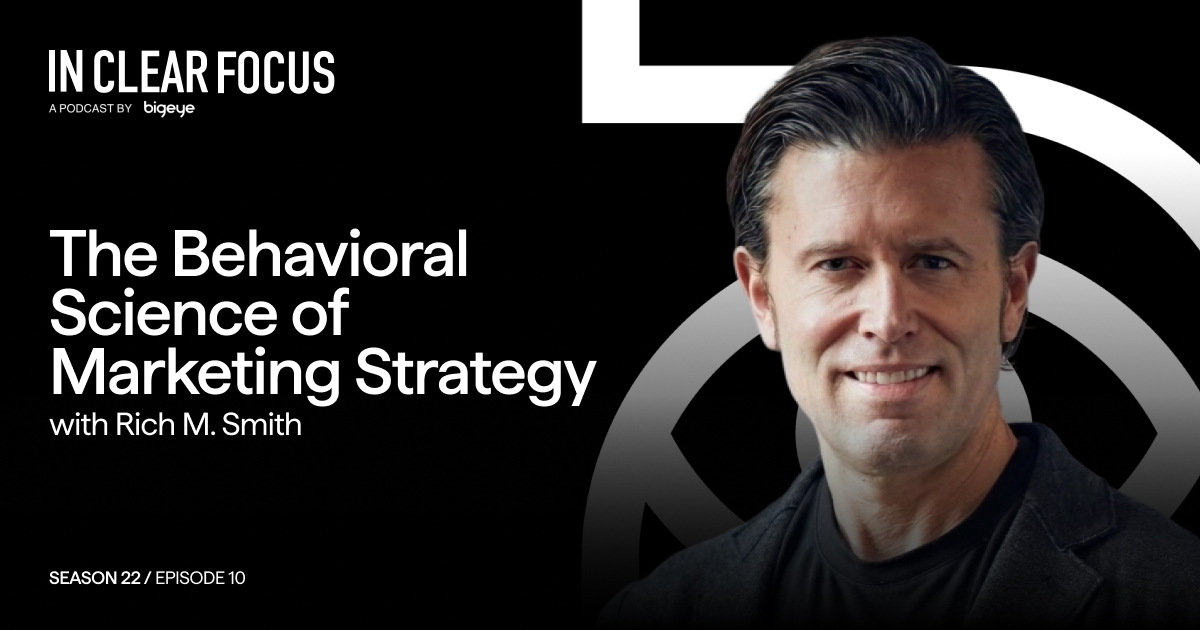
IN CLEAR FOCUS: Marketing strategist and consultant Rich M. Smith explains why many CEOs secretly distrust marketing and how to fix it. He reveals how applying behavioral science can decode consumer decisions and overcome executive cognitive biases like confirmation bias. Learn why startups face a traction problem, how to translate marketing metrics into “CEO-speak,” and how a systematic approach to experimentation can turn your marketing strategy into a trusted engine for true business growth.
Episode Transcript
Adrian Tennant: Coming up in this episode of IN CLEAR FOCUS:
Rich M. Smith: There are lots and lots of great companies that have failed, not because they had a bad product, not because they had bad people. They failed because nobody really knew about them. They hadn’t exposed what they do to the correct target audience and messaged it in a way that resonated with that audience.
Adrian Tennant: You’re listening to IN CLEAR FOCUS: fresh perspectives on marketing and advertising produced weekly by Bigeye, a strategy-led, full-service creative agency growing brands for clients globally. Hello, I’m your host, Adrian Tennant, Bigeye’s Chief Strategy Officer. Thank you for joining us. Most CEOs know they need marketing, but many don’t fully trust it. They see budgets being spent, but some can struggle to connect the dots between marketing activity and business outcomes. The result is a disconnect that can quietly sabotage growth and leave even experienced teams spinning their wheels. Today’s guest has spent over 30 years using behavioral science to bridge this gap, decoding not just how consumers make decisions, but how executives’ own cognitive biases can distort strategy. Rich M. Smith is a marketing strategist, consultant, and host of the Revenue Science Podcast. He served as chief marketing officer of seven companies across financial services, fintech, healthcare, and technology, and his work has earned recognition from AdWeek, JD Power, HousingWire, and the Gramercy Institute. Today, through his Growth Studio, Rich helps CEOs and founders turn marketing into a trusted growth engine. To discuss why behavioral science holds the key to smarter marketing strategies, Rich is joining us today from Philadelphia. Rich, welcome to IN CLEAR FOCUS.
Rich M. Smith: Hey, thanks so much for having me. I’m looking forward to the conversation.
Adrian Tennant: Well, Rich, you’ve been the Chief Marketing Officer of seven companies over more than 25 years. And you’ve said that one of the most consistent patterns you’ve encountered is a basic distrust of marketing among CEOs. What does that distrust actually look like in practice?
Rich M. Smith: Yeah, I think in practice it manifests itself in different ways, you know, depending upon the personality and the characteristics of the particular CEO that we’re talking about. But some common things that I think you see are an over-reliance on what other areas of the organization are saying. So sales, customer success, customer service, operations, product. So sometimes it manifests itself that way. Sometimes it manifests itself just in a lack of understanding of how does marketing fit into our funnel, which could be different depending upon whether you’re talking a B2C company, a B2B company, or whatever industry that you’re in. But there’s a right answer to all of those situations. And it usually isn’t — okay, marketing’s job is to do the brand and the website and create lots of pretty pictures for us and sheets that we can take to our trade shows and that kind of stuff. And that’s a marcomm definition of what marketing is. And instead of being like, “Hey, yeah, we have these two different departments, one’s called marketing, one’s called sales.” But in order for us to really work effectively, they have to be well-integrated and aligned. And we have to have a good understanding of what’s marketing’s role? And what’s sales’ role? And how do they overlap? And even down to the bottom of the funnel, which you might say is 100% sales, it’s never 100% one way or the other. Even at the bottom of the funnel, there’s things that marketing should be doing to help support that process. So that’s often how I see it show up. I mean, some of the symptoms are really difficult to get budget to do anything, you know, low desire to test things, very low desire to stick with anything for any length of time. So it’s like a constant changing, changing, changing, and it’s because they don’t trust what marketing is telling them. So we’re coming back with lots of ideas and lots of things to change to try to rectify the situation. So that’s the way I see it often showing up.
Adrian Tennant: What’s your sense of where that distrust originates? Is it a communication problem, a measurement problem, or something deeper?
Rich M. Smith: I think it’s mainly a communication problem. And I’ve talked sometimes about, you know, there’s a difference between marketing-speak and CEO-speak. And I think one of the mistakes a lot of marketers make when trying to manage up and to work with their CEO, work with their management, is they come to them with things that we as marketers understand, metrics that we know are important, things like, “Well, you know, we’ve measured our brand awareness and our interest and our likelihood to consider, and we’re tracking, you know, our bounce rate on our website and the performance of all of our campaigns.” And they go down this list of like tactical stuff. And what they haven’t done is framed it in a way that would be meaningful to the CEO. They don’t really care how many people visit your website. They don’t really care how many people come to your session at the trade show. Ultimately, what they care about are things like revenue and retention and sales. They care about those real metrics that help drive the business forward. And so the most successful marketers that I see are, yes, they are schooled in the technical aspects of driving marketing forward, but they’re also very adept at translating that into CEO-speak. They’re a marketer and a business executive at the same time. That’s what I see as being like really successful formula for, you know, that’s worked for myself and, you know, other colleagues and peers that I’ve seen in the C-suite and successful CMOs. That’s a common trait.
Adrian Tennant: You describe yourself as a student of behavioral science, and you use it to explain not just how consumers behave, but how executives make decisions. Rich, how did you come to see behavioral science as the bridge between marketing and the C-suite?
Rich M. Smith: Yeah, great question. And it has been a career-long journey. I studied economics undergrad in school. Actually, I started out as an engineer and decided engineering wasn’t for me and graduated with a degree in Econ instead. Didn’t really know what I wanted to do with it. And I got an internship as a marketing intern at a very large credit card company. And I just, I fell in love with the field. I fell in love with the dynamic of, particularly in credit cards in the ’90s, very quantitative, very data-driven, you know, really at the forefront and a lot of direct marketing techniques. And so That really appealed to the science side of my brain, the engineering side of my brain. But then the economics side was thinking, you know, is always fascinated with more like, “Well, why did those particular words on the outside of the envelope trigger a higher open rate than this other set of words? Why do changing colors or changing the order of bullet points on a direct mail piece How does that affect response rate? Why does that affect response rate?” And some of the scale that we were doing things at was massive. You know, I mean, I ran a marketing program for a credit card company where I was mailing like 25 million pieces of mail a month. So with that kind of scale, like, even like these tiny little differences start showing up. And that’s what really fascinated me about the field was how and why do people make decisions. And, you know, this was before even the whole field of behavioral economics existed, right? I mean, Kahneman published his book in 2007 [Thinking Fast and Slow]. He’s Daniel Kahneman, the Nobel Prize-winning economist. He really is the grandfather of the field of behavioral economics, which, you know, began in the early 2000s. And so it wasn’t until after that, and so I started reading, then I began to put the dots together and realize there are all these cognitive biases that we all have as humans, and they drive the way that we make decisions. Some people have cataloged them. You can go out and look at one, this is like a chart with 188 different cognitive biases on it and read to your heart’s content. But like, they are a real thing, and people make decisions based on emotion first and then rationalize it later. That’s the way we’re wired. And that’s where the light bulb came on to me when I started to see this material. I’m like, “Okay, this is explaining what I’ve been fascinated by and been striving to learn my whole career. These are the things that drive why people buy, why they make decisions.” And yes, I started with the marketing world, but then as I got into more, you know, C-suite business leadership, then I started working more with companies as well on just how they’re making strategic decisions, how they’re making decisions on staying aligned and managing their business in addition to the marketing world.
Adrian Tennant: Well, it’s interesting because many of us think of behavioral economics really in consumer terms, thanks to books like “Nudge.” But on your blog and in your Revenue Science Podcast, you’ve explained how cognitive biases such as anchoring and confirmation bias can quietly hijack strategy discussions and even capital allocation. So Rich, could you give us an example of how one of those biases plays out in a real boardroom scenario?
Rich M. Smith: Yeah, I think one of the most insidious is confirmation bias, particularly in a boardroom environment. And just for your audience, what confirmation bias is, you know, is selectively seeking information that supports an opinion or position that you already have instead of being open to contrary information. So you tend to only accept as valid the information that’s supporting what you already believe, and you tend to discount anything that’s contrary to that. And It is insidious because executives, managers, board members will look at the data in front of them, and then they will look for ways to interpret that data. And confirmation bias bleeds into all of that because if you’re not careful, if you’re not getting contrary opinions, then you get this kind of groupthink mentality, and everybody is telling the same story and looking at the same information and seeing it the same way, and no one’s really challenging it to see whether it’s accurate or not. I mean, there are some great examples of this, the whole Levi’s suit debacle. You probably remember that. That’s one that’s in like a lot of marketing classes where Levi’s, the jeans company, decided that they wanted to start making suits. They started doing a lot of research. People told them, “We don’t want to buy suits from Levi’s.” But the senior leadership didn’t want to hear it. They didn’t believe it because they had this idea that, “Hey, if we make it, it’d be cool and it’s going to sell.” And it was a colossal failure. And confirmation bias was certainly at the heart of that issue.
Adrian Tennant: Well, let’s shift our focus from established companies like Levi’s to startups seeking rapid growth. Rich, you believe that most brand founders have a traction problem, not a product problem. What exactly do you mean by that?
Rich M. Smith: Yeah, I think a lot of, particularly founders, they start a company. And they have a great idea for a product or a service that they think is going to change the world or make them a big success, right? Even if they don’t think it’s going to change the world. And they put all their energy into the development of that product or service because that’s their baby. And all of their energy and mentality is going into the development of the product, and they spend relatively little time thinking about distribution. There are lots and lots of great companies out there that have failed, not because they had a bad product, not because they had bad people, and not because they provided a poor service to their customers. They failed because nobody really knew about them. Nobody knew how to buy. They hadn’t exposed what they do to the correct target audience and messaged it in a way that resonated with that audience. So like going back to what we said earlier, you know, how people make decisions by emotion and then rationalize them later. If your messaging isn’t pinpointing those emotional issues for your customer, then you’re probably not going to get them to the next level. You’re not even going to get their attention.
Adrian Tennant: How does it change the way you approach a growth challenge?
Rich M. Smith: Well, you know, talking specifically about that issue, it’s examining their positioning. And it could be for the entire company, it could be for a particular product. But, you know, let’s actually take a look at your positioning. Who are you positioning against? You know, who is your best customer? How did you come up with it? Have you even intentionally created positioning? I think a lot of times companies, they go to market and they start using tactics and they haven’t really taken the time to think about, “Alright, well, how are we positioning our product and how are we doing it in a way that’s going to resonate with our target audience?” And I see that over and over and over again. One of the best ways to find that issue is to just sit in on some sales calls, be a part of some of the very first sales calls that you’re having with your target customers and you can kind of read it. This is obviously in a B2B environment, but you can kind of read it. You know, if the sales team leader gets a couple slides into the deck and the person on the other end is giving you a blank stare or says something like, “Hey, can you go back? What do you do again? Can you go back to the first slide?” And, or you sound kind of like, pick a competitor, right? Is that what you do? And that’s completely wrong, right? Those are the things that tend to show up and indicate that, yeah, you haven’t really nailed your positioning. The other question that I ask CEOs is like, I will commonly ask, “Pretend I’m your target customer. I’m a potential buyer sitting across the table from you. Why should I buy from you? And you can’t say people, service, or quality.” [Laughs] Right, you’re laughing because that’s what everybody says is some variation of that formula of those three things. And if that’s what you’re saying about your products as well, then you’re getting lost in the noise with all of the competition out there, right? You’ve got to come up with something. I say you have to be able to use a superlative. A superlative meaning best, first, fastest, cheapest, only. Right? If you can’t put a superlative in front of it, you need to go back to the drawing board.
Adrian Tennant: Great advice. Let’s take a short break. We’ll be right back after this message.
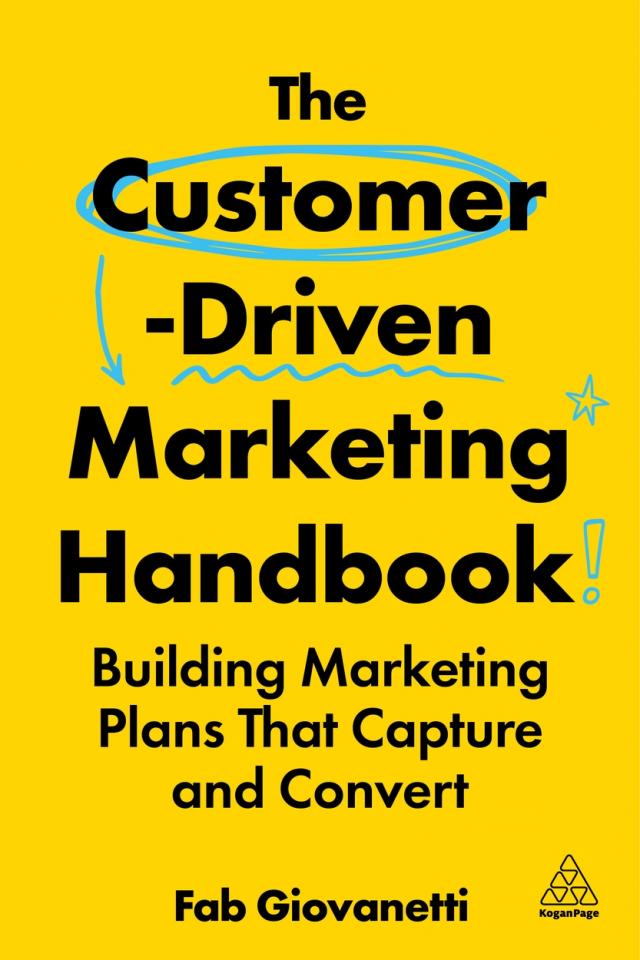 |
Fab Giovanetti: Hello, I’m Fab Giovanetti, author of The Customer-Driven Marketing Handbook: Building Marketing Plans that Capture and Convert, published by Kogan Page.
As a CEO and a teacher at Alt Marketing School, I’ve spent over 15 years helping marketers build strategies that put genuine customer relationships at the center of everything they do. In my book, I share practical frameworks for building trust, creating emotional connections, and turning customers into advocates, using real-world examples from brands like Gymshark, Headspace, and Notion. You’ll learn how to identify customer pain points, design personalization that feels helpful rather than intrusive, and create shared rituals that transform one-time buyers into lifelong fans. As an IN CLEAR FOCUS listener, you can save 25% on The Customer-Driven Marketing Handbook when you order directly from KoganPage.com. Just enter the exclusive promo code BIGEYE25 at checkout. Shipping is always complimentary for customers in the US and the UK. I hope this handbook helps you create marketing plans that win hearts and deliver results. Thank you. |
Adrian Tennant: Welcome back. I’m talking with Rich M. Smith, marketing strategist, consultant, and host of the Revenue Science Podcast. Rich, you advocate treating marketing as a portfolio of experiments that converge on a single measurable pipeline rather than as a scattered set of tactics. So how do you help a CEO or founder shift from reactive tactical marketing to that more systematic approach?
Rich M. Smith: Yeah, great question. I find that when you start a conversation with a CEO about marketing, it immediately goes to things like, “Well, should we be investing more in SEO? Should we be doing more paid search? Do we need to be on this social media platform or that social media platform?” They’re going right to what I call ‘little m’ marketing, which is tactical. And the answer I give is “Maybe; it depends. What’s your strategy? What are you trying to accomplish? Who are you trying to reach?” And when you start to get into those questions, that falls more on what I would call ‘big M’ marketing or strategic marketing, which is: do you have the correct insights or deep enough insights about your customer, about your competition, about the product category that you’re in, about your own company’s strengths and weaknesses? You got to start with those kind of foundational things before you can then develop strategy, which then informs your tactics, right? Most just want to jump straight to tactics. And they skip the other two things because they take time and they’re difficult and, you know, it slows things down or feels like it’s slowing things down. But if you don’t do them and you just go out with a bunch of tactics, well, okay, maybe it works. Maybe you get lucky. You probably won’t know why you got lucky. And so when you’re building out your sort of portfolio of experiments, one thing that I’ve learned is any marketer that tells you they’re going to hit a grand slam at their first at-bat is lying, right? Run from that person. Because look, I’ve been amazed. I’ve tested things that I didn’t think were going to work and been amazed at the results. Sometimes things just don’t — they’re just not predictable, right? And so what I advocate is, “Hey, let’s get deep insights. Let’s build a strategy. We’ll get everyone in the organization aligned around it.” By everyone, I mean in that strategy development, you need to include customer success and sales and marketing. And the CEO and executive leadership, you know, et cetera. Because if they’re not all part of it, it’s going to break down when you try to roll it out to the organization. So you got to do those things first, and then you start to build your portfolio of experiments within your tactical go-to-market. And that involves being very conscious about, “Okay, we’re going to try this because it’s aligned with our strategy. Here’s how we’re going to measure it. Here’s how we’re going to know whether it’s successful or not. Here’s how long — and this is good to do at the outset — how long are we going to run this before we pull the plug on it?” Because another thing that you see quite often is it takes a certain amount of critical mass for a certain message to a certain audience in a certain channel before it starts to resonate. And I see this a lot where organizations either they don’t stick with it long enough, right? They don’t invest enough in a particular channel in order to get a valid read on whether it really is working or not. And they’re trying too many things at once, so they’re spreading their budget, their marketing budget, and their time and attention and energy across too wide a set of tactics. And that makes it really difficult for them to measure each individual tactic and see what’s actually working.
Adrian Tennant: Yeah. As regular listeners know, we love case studies on IN CLEAR FOCUS. Rich, you led the relaunch of a financial services firm after it had been dormant for 5 years following the mortgage crisis. Could you walk us through how you approached that challenge? And I’m curious, what was the strategic thinking that made that turnaround possible?
Rich M. Smith: Yeah, um, great, great story. I’m glad you asked the question. So just for a little bit of background, you know, the 2008 financial crisis caused a lot of chaos in the mortgage industry. There was a mortgage company called GMAC Mortgage, one of the largest in the country, that rebranded to Ally Bank during the financial crisis, changed their name, and then eventually decided to sell off the mortgage company. So when they sold the mortgage company to a investor, they did not sell the rights to use the GMAC brand because they didn’t want another GMAC out there in the market looking like they are using what they considered as sort of their brand, even though they had rebranded Ally. But the new investor bought the rights to the Ditech brand, which had been a brand that GMAC owned and had operated up until the financial crisis. Just before the financial crisis. And you might remember the commercials, you know, “Lost another loan to ditech.com” was a very big brand in the mortgage world in the early 2000s. But then post-financial crisis, it had been out of the market for 5 years. I got hired as the CMO by the new investor to help to get the company back going. And we had 2,000 people and zero pipeline waiting, just waiting for something to happen. And, you know, I had this brand name, and the leadership was like, “Okay, we need the logo, we need to go design go-to-market, we gotta get the name out there.” And, you know, it was, it was difficult, but I had to push back a little bit and say, “Yeah, but let’s go about this in a logical way.” And strategically, you know, what I did first is, um, this is gonna — might sound a little funny, but I hired a research company that their main work was in the political arena.
Adrian Tennant: Hmm. Okay.
Rich M. Smith: And the reason I did that is what I wanted to understand was, did this brand have a lot of baggage? And if it did, how bad was it? Right. And what could we potentially do about it? And I thought, “Well, this is really just like thinking about a politician that’s going to run for office.” We all have skeletons in our closet. We’ve all done, said things that we wish we hadn’t said publicly. Or what have you. It’s kind of the same thing. And we actually even broke down the results in a similar way that you would run a political campaign. We looked at who was our base: so these are the people that understood the brand, recognized it, had a favorable opinion of it. So they were going to vote for us regardless. Who was our opposition? So who are the people that didn’t want anything to do with us? They couldn’t stand the brand name. We were never going to convince them. So that was our opposition. And then who is persuadable in the middle? You know, who is that kind of middle voter, right? That everybody likes to talk about that I’m not sure they actually exist, but, but who is in the middle, who’s persuadable. And then once we determined who’s persuadable and by who, you know, we defined it based on personas and anybody that’s done consumer marketing. And there’s a lot of statistics you can put out there into a model like that and kind of get a sense for who’s in that persuadable universe. And then we started to put specific positioning statements in front of that persuadable universe. Mortgages are a commodity, right? It’s pretty much the same every company that you go to. And, you know, I’ve spent a lot of time trying to de-commoditize commodity products like that. And one of the ways you do it is through positioning. We would put different positioning statements in front of this persuadable audience. We would also ask them questions around what did they not like about the mortgage process? What were their fears? And put that all together. And once we did that, we had very strong positioning, which talked to that persuadable audience. And the base was going to come again, no matter what, but we really needed to dial in on who can we persuade to come over to the brand. So once we had that, that like core positioning drove everything that we did from that point forward. So how we messaged on our website, the key points that we put into our various marketing pieces, we even changed some of semantics, some of the lexicon of the organization. And just as a quick example, raise your hand if you would like to talk to a loan officer today. [Laughs] Nobody wants to talk to a loan officer. It’s scary. If I walk down the street and ask 10 people, “Hey, would you like to speak to a loan officer?” They’d be like, “Hell no, I don’t want anything to do with that.” So we changed the name of that position to home loan Specialist.
Adrian Tennant: Oh yeah.
Rich M. Smith: And so we didn’t have loan officers, we have home loan specialists. And that’s something that resonated again with that persuadable audience is they felt like, “Well, if they’re going to a loan officer, there’s an asymmetry between what they know and what I know, and I feel ‘less than’, right? If I’m talking to a home loan specialist, yeah, they know more than I do, but I feel like they’re more on my level. I’m more of a peer with them, and they’re going to take the time to explain to me what they’re doing and really partner with me on finding a solution.” And that, that was a game changer. And I, I still remember it took — I mean, loan officer is an ingrained term in that industry. You just really don’t get rid of it overnight. And, uh, I remember, you know, at one point, I put like a swear jar on the middle of the boardroom table and it said HLS on it, like home loan specialist on one side and like no loan officer on the other. And if someone in the leadership team said loan officer in a meeting, I made them put a dollar in the square jar. And it took about a year. And I remember sitting in a kind of large company meeting. And for the first time, we went through the entire leadership meeting and no one used the word ‘loan officer.’ And that’s when I knew that we had it.
Adrian Tennant: There’s your behavioral economics in practice right there.
Rich M. Smith: Exactly. Yeah. Before I really knew what that was.
Adrian Tennant: Well, shifting to tools and technology now. You’ve evaluated and retooled the marketing tech stack, of course, at multiple companies. With so many AI-powered products now flooding the market, what’s your advice for brand marketers trying to figure out what they actually need versus what’s just noise or hype?
Rich M. Smith: Yeah, it’s always been a challenge. I think these days it’s perhaps more of a challenge than it has been in the past just because of the sheer volume of options out there. And I would say this, there’s no perfect solution. So over-analyzing it probably isn’t going to help you that much, right? You don’t have to worry about finding the only tools that would work. You have to find the tools that will work best for you and what you need them to do. And there isn’t necessarily one right answer out there. You know, I think that part of constructing a great tech stack for an organization comes down to – again, like we were talking about before – strategy and tactics. “What is it that you’re trying to accomplish? What’s the scale of the organization today? And what do we think we want it to be in the relatively near future?” And by near future, when you’re talking tech stuff, it’s probably 18 months to 3 years, right? Particularly if you’re making a large investment in, say, like a CRM system or something like that. So like, what’s our, window where we think that this is going to be the right scale, because one of the hardest things is getting the right product for the right scale of company. If I walked into most mid-market companies and told them they need to go buy Salesforce, they would throw me out of the room, right? Because it’s just not a fit for them. Salesforce is an amazing product. It’s a great company, amazing product. I’ve used it in multiple companies. It’s fantastic, but it’s not the right fit for everybody. So a lot of, I think, the art in constructing a great tech stack is, is a real understanding of, “Okay, what are we trying to accomplish and what products are the right fit for us based on where we are in our life cycle?”
Adrian Tennant: Great conversation. Rich, if IN CLEAR FOCUS listeners would like to learn more about your approach to marketing strategy or to connect with you directly, what’s the best way to do so?
Rich M. Smith: Yeah, the easiest way to get a hold of me is at my website. It’s richmsmith.com. You can also find the Revenue Science Podcast on Apple and Spotify, and any place you listen to your podcasts.
Adrian Tennant: Excellent. Rich, thank you very much for being our guest this week on IN CLEAR FOCUS.
Rich M. Smith: Thanks so much. I really enjoyed it.
Adrian Tennant: Thanks again to my guest this week, Rich M. Smith, marketing strategist, consultant, and host of the Revenue Science Podcast. As always, you’ll find a complete transcript of our conversation with timestamps and links to the resources we discussed on the IN CLEAR FOCUS page at Bigeyeagency.com. Just select ‘Insights’ from the menu. Thank you for listening to IN CLEAR FOCUS, produced by Bigeye. I’ve been your host, Adrian Tennant. Until next week, goodbye.
Timestamps
00:00 Marketing Misunderstandings in Business
04:41 Aligning Marketing Metrics to CEOs
07:14 Behavioral Economics and Decision Making
09:59 Confirmation Bias in Decision-Making
13:21 Evaluating Market Positioning Essentials
17:17 Strategic vs. Tactical Marketing
21:09 GMAC to Ally: Rebranding Journey
25:53 From Loan Officers to Specialists
27:39 Choosing the Right Tech Tools