/
ThinkBlink Manifesto with Jean-Pierre Lacroix
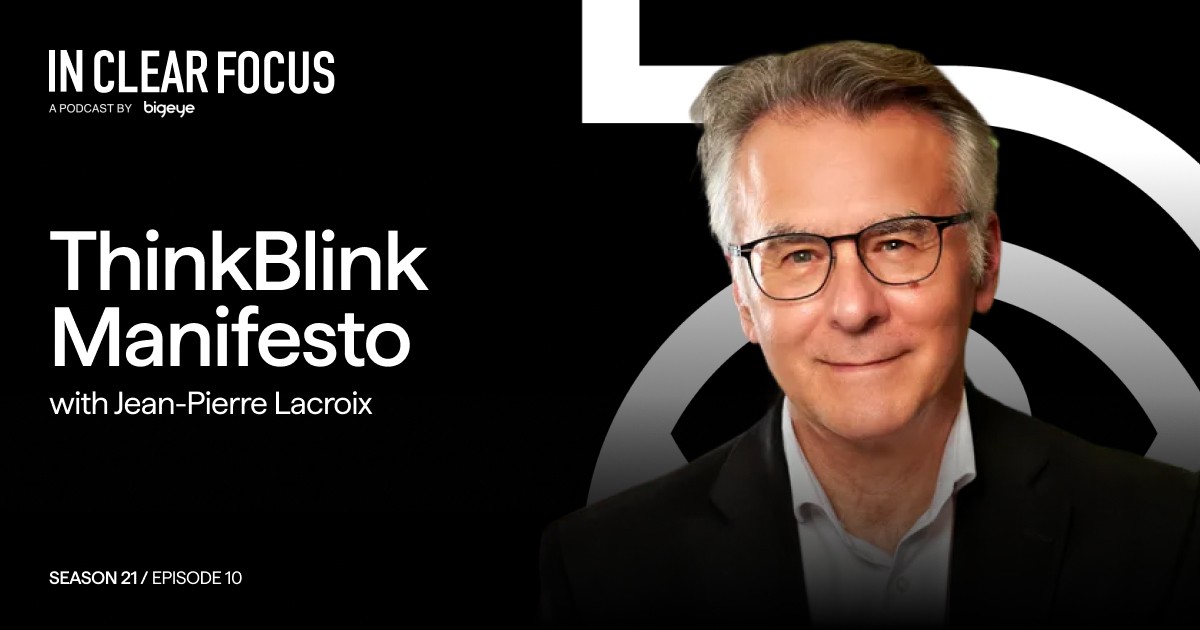
IN CLEAR FOCUS: Jean-Pierre Lacroix, co-founder of Shikatani Lacroix Design, and the author of "ThinkBlink Manifesto," reveals why consumers decide emotionally and validate rationally. He explains the "BLINK Factor" and why incremental marketing fails. Jean-Pierre also outlines his seven-tenet framework for moving from features to feelings and building sustainable emotional brand advantages. Learn how to use strategic design, behavioral science, and AI to win the critical moment of purchase.
Episode Transcript
Adrian Tennant: Coming up in this episode of IN CLEAR FOCUS
Jean-Pierre Lacroix: Consumers, when they're making their buying decisions, are looking for memory shortcuts. Because the way the brain operates is the more you ask it to think, the more energy it takes. And so brands that create those emotive memories tend to connect instantly with consumers.
Adrian Tennant: You're listening to IN CLEAR FOCUS, fresh perspectives on marketing and advertising produced weekly by Bigeye, a strategy-led, full-service creative agency growing brands for clients globally. Hello, I'm your host, Adrian Tennant, Bigeye's Chief Strategy Officer. Thank you for joining us. In a world where consumers are bombarded with thousands of marketing messages daily, what determines which brands break through? Well, the answer may surprise you. It's not the most logical argument or the best features that win. Research shows that consumers make purchasing decisions emotionally and then validate them rationally. This insight is at the heart of an approach called the ThinkBlink Methodology developed by our guest today. Jean-Pierre Lacroix is president and founder of Shikatani Lacroix Design, a global strategic design agency that has transformed brands for Fortune 500 companies, including PepsiCo, Kraft Heinz, Microsoft, Cox Communications, and many others. Jean-Pierre is also the author of several books, the latest of which is “ThinkBlink Manifesto: Creating Deep, Lasting Emotional Brand Connections in the Blink of an Eye.” In his book, Jean-Pierre outlines seven tenets for building sustainable competitive advantage through emotional resonance. To discuss why the traditional incremental approach to brand marketing is failing, how to win at the critical moment of purchase, and why emotions matter more than features, I'm delighted that Jean-Pierre is joining us today from Toronto, Canada. Jean-Pierre, welcome to IN CLEAR FOCUS.
Jean-Pierre Lacroix: Well, thank you very much. Thank you for the opportunity of sharing some insights on the importance of emotional connections and how they drive brand growth.
Adrian Tennant: Let's start with the core premise of your ThinkBlink methodology. You argue that consumers decide emotionally and validate rationally. Can you explain what this means and why it's so fundamental to successful branding?
Jean-Pierre Lacroix: Yeah, and it's probably the biggest challenge marketers have because there's comfort in numbers, there's comfort in features and benefits, there's comfort in historical processes and approaches to the market. But the reality is this, is that consumers, when they're making their buying decisions, are looking for memory shortcuts, in that decision because the way the brain operates is the more you ask it to think the more you ask it to rationalize the more energy it takes and so it's looking for those heuristic shortcuts memory shortcuts and so brands that create those memories those emotive memories. Can they connect instantly with consumers when they're buying in the supermarket where there's forty thousand products and making that buying decision. They're looking for those heuristic memory shortcuts, the memory shortcuts, could be the color, the shap,e it could be a key message, your brand mark. And those elements trigger, you know, because the picture says a thousand words. They connect emotionally and create a callback of a memory that the consumer had with that product, which makes it really important. Number one, brand consistency. But number two is that the key decision for that brand doesn't really happen in the store. It happens when they're using it in their home and what that experience generates from a memory standpoint and emotional memory. And that's so important.
Adrian Tennant: Jean-Pierre, you coined the term ‘BLINK Factor’ over 30 years ago. What exactly is the BLINK Factor, and how fast are we talking when consumers make these emotional connections?
Jean-Pierre Lacroix: Well, they used to say in a split second, and now research has shown that it's a fraction of a split second, so it's even shorter. But we're doing some research for Pizza Hut in the US, and consumers are calling it “Red Roof.” And we're like, “That's interesting. They're not calling it Pizza Hut. They're calling it Red Roof. ‘I'm going to the Red Roof for dinner.’” And so as we peeled and looked at insights (and in those days there wasn't a lot of research on emotional connections), we found this study that said that most of the memory we have is visually created, and those visual memories connect emotionally to our heart. And the color and shape of the key drivers of that visual connection, and out of that, we coined the phrase the ‘BLINK Factor.’ We actually coined it in nineteen ninety-three. And registered it nineteen ninety-six that's I guess ten years before the book “Blink” came out. So we pioneered the terminology and the psychology of the BLINK Factor, and we've been applying it since then as part of the way we approach branding and marketing for our clients. And most recently, to synthesize all of those insights and those principles, we have seven tenets. I wrote a book called “ThinkBlink Manifesto,” and it was as much for my employees as it was for our clients, on creating a legacy statement of what we believe in, what has driven the growth of our company, and has driven the growth of our clients' projects through our ThinkBlink process.
Adrian Tennant: Well, when we were preparing for this podcast, you mentioned the ‘incremental mindset’ that many brand managers fall into. Jean-Pierre, what is that mindset and why do you see it as problematic?
Jean-Pierre Lacroix: You know, most brand marketers are risk-averse, right? And I wrote an article on that called ‘The Cat on the Sliding Tin Roof.’ Like, if you think of the equity of a brand and you look at its relevancy, there's a bell curve. And after a certain point, that brand loses relevancy. But by the time they realize that they're losing relevancy, it's almost too late. And so the idea here is to understand “When should we do change? And how dramatic should we do change?” But unfortunately, very often, these incremental changes, these tweaks to the packaging that make it relevant, often are not noticed by the consumers. And they're just delaying. They're just slowing down that relevancy curve. But it ultimately will come. And so what brand markers need to look at is “When do I jump off the roof to safety as that brand sliding down that tin roof?” And it's not incremental thinking; it's taking both steps, and not only is it driven by the gravity of branding (the natural cycle of a brand), but it's also driven by consumers today are looking for more you know AI, evolution of technology, and the importance of experiences by consumers when they're making the buying decisions is changing the narrative in a way that marketers can't be incremental in their thinking they have to be bold. They have to be bold because there are so many new products on the marketplace. They have to be bold because the brands are competing with the attention of consumers with so many offerings, so many messages. I think there's like 40,000 marketing messages we absorb daily. How do you stand out? It's by creating those deep emotional connections, but also by being bold.
Adrian Tennant: How does an emotion-focused approach differ from the kind of incrementalism we've been discussing?
Jean-Pierre Lacroix: Let's start first by looking at what are the emotional equities the brand owns and what are those emotional equities within the category. So we often work with research firms to define what is the category emotional equities. What is the ideal experience emotional equities and where does that brand sit between what the ideal emotional equities the category emotional equities and their brand and where are the gaps? And how do we fill those gaps number one. And number two is which of those emotional equities: Volvo owns ‘safety’, right? Staples owns ‘easy.’ TD owns ‘comfort.’ What is the one emotional word that the brand owns that's where it starts and that's very difficult it's very difficult, because a buckshot approach to marketing has been traditionally the safest route. Give us three key features, give us other factors, functional factors. But at the end of the day, it's that emotional ownership that's important. So that's where it starts. And then once you've done that, and you understand what that emotion, then what is the narrative? How do we use design to simplify? You know, being bold very often means being focused and being simple, right? Confidence is about ‘less is more’ it's not about ‘more is more.’ And so the idea here is simplifying the message, simplifying the packaging down to that key salient emotional connection message that we would own, and then obviously the storytelling supports that simplification, and then creating a belonging experience. How do you engage consumers to be brand ambassadors? Because we know through a lot of research we've done in the banking and the consumer goods category that NPS scores have now become kind of table stakes. What is that cutting-edge element of the NPS score? It's when consumers become brand ambassadors. They're not asked to be ambassadors. They volunteer to be ambassadors. They're the biggest promoter of the brand. And that's a true definition of NPS. You can't do that if you don't have an emotional connection with the brand.
Adrian Tennant: Your book, “ThinkBlink Manifesto,” outlines seven tenets of your ThinkBlink methodology. Jean-Pierre, can you give us an overview of the framework?
Jean-Pierre Lacroix: Yeah, so think of the framework as steps of the ladder. So the foundation, as we talked previously, is about creating that emotional connection. What is that emotion that we are? So once you've established what that emotion is, then the next step is how do you simplify your design? How do you leverage design as a powerful tool to reinforce and amplify that emotional connection, that key emotional benefit? Yes, don't get me wrong, functional benefits are important because you can create a motion connection if the consumer is having a tough time using your brand. I get that. But those are benchmark, those are table stakes. So the second level is simplification. The third level is understanding. What is the story that you want to communicate to your audience? What is that story? Because we know that through history, that storytelling is how we learn. And humanizing how the brand enhances consumers' lives, connects with them emotionally, is best done through storytelling. And that could be a narrative on video, it could be a commercial, it could be an ad, but it's storytelling. And then the fourth tenet is about clearly defining the persona, the context. How are those consumers using the brand? What's their lifestyle? What's their needs? It goes way beyond demographics. It gets into attitudes and behaviors. And once you've clarified that, you move up to the next level, which is to create a sense of belonging. As we talked, it's about turning these consumers into advocates, brand ambassadors, and allowing them to leverage the brand as part of their daily narrative, allowing them to share on Instagram and Facebook how this brand is involved in their lives. And then from there, it's about measuring what matters, because we know that one of the biggest challenges facing us today to make that shift from functional to emotional is the metrics brand marketers are using. They're using things like convenience, functionality, access, frequency of purchase, depth of wallet, all of these left-brain metrics. And they're important, don't get me wrong. But what they're missing is what are the emotional factors? How does the brand make them feel? What moment do we own in the consumer's lives? These are important factors. And the final tenet, number seven, is future-proofing your brand. You know, avoiding being disrupted because indie brands are disrupting the beer industry, it's disrupting the wine industry, it's disrupting a lot of other categories, private labels on the rise. How do you mitigate disruption for your brand is by creating future scenarios, different scenarios that anticipate disruption and have a plan in place to ensure that the other steps of the ladder don't get disrupted. So those are the seven tenets.
Adrian Tennant: I'd love to dive a little deeper into a couple of those. You've mentioned how emotions really matter more than functional needs. So, Jean-Pierre, how do you help brand managers shift their thinking from features to feelings?
Jean-Pierre Lacroix: That's a tough one. That's the big challenge. The first thing is, again, ‘what gets measured, gets done,’ is to really start the process by understanding, “Okay, we've got clarity on the functional benefits. This hydrates, it's more efficient, it's faster, it's more convenient, it's frictionless,” all these things. We get that. That's the foundation. We often ask, you know, “These features, how quickly would the competition match these?” In a lot of cases, the competition has already matched them. It's about amplifying one of these or two of these attributes to provide differentiation. And we say, “Okay, now what is the emotional element that we want to own”? And that's where the challenge comes in because it's tough. “What do you mean emotion? And why does that matter?” Well it matters because you're alienating the majority of your customers if you don't clearly identify what that emotional connection is. That's where we get into the use of research. The beauty is AI has enabled us to use sentiment analysis to evaluate consumer sentiment and emotional connections. We used it in research for banks where we use virtual reality and neuroscience. But also there's other research firms like HotSpex that for the last 25 years have pioneered the evaluation of emotional connection and what emotions do brands own. And so leveraging those tools allows our clients to feel a little more comfortable about understanding how the dots connect..
Adrian Tennant: Love that. Another key tenet that you mentioned is that design serves as a strategic tool rather than just making things look pretty. How does design create those instant emotional connections?
Jean-Pierre Lacroix: It's based on a hierarchy of communication. It's understanding the context first. For example, if you're a detergent box or let's say toothpaste, you first need to understand how consumers shop the category. What are they looking for? What are the triggers for purchase in the blink of an eye, that instant split-second decision-making process? What's relevant to them is that the brand or the feature of the brand, like what it does for them, and then you look at “Okay, simple.” Finance, so you're getting other elements. How do the way they become tertiary play a less important role in the selection process. That would be kind of the final way of keeping it so if you're in a category and color also I remember one of the feminine hygiene brands. They wanted to differentiate themselves you know in the category that was all white. They introduced a black box. It stood out, right? It showed confidence, it provided differentiation. So understand how color connects and differentiates, and how shape differentiates. So what shape can we use? And in the past, clients were reluctant to come up with new structural shapes because the cost of tooling is enormous. But that cost has come down significantly. And if you think your package is your most effective marketing vehicle, then why not spend your money where it counts at that moment of purchase? And I think clients are coming around to realize that.
Adrian Tennant: Let's take a short break. We'll be right back after this message.
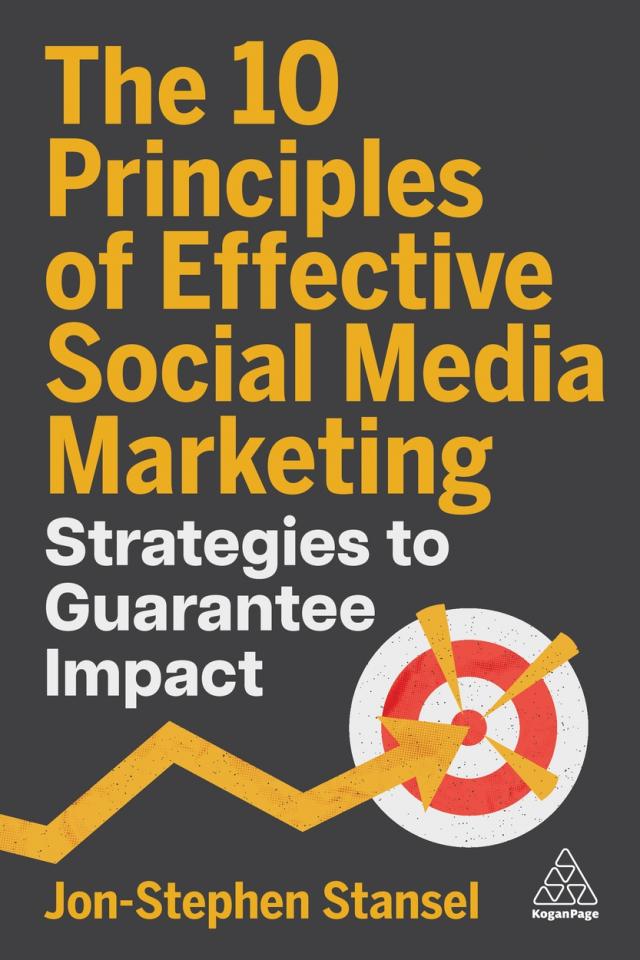
Jon-Stephen Stansel: Social media moves fast, but the principles of effective marketing don't change. Hello, I'm Jon-Stephen Stansel, author of The 10 Principles of Effective Social Media Marketing: Strategies to Guarantee Impact, published by Kogan Page.
Whether you're a social media professional, an agency leader, or a marketer working with social teams, my book provides timeless strategies to create content that connects, no matter what platforms rise or fall.
Inside, you'll find real-world examples from brands like HBO, Xbox, and Beyond Meat, plus practical exercises you can apply immediately. These aren't trendy tactics that will be outdated next month. They're foundational principles that will work on whatever platform comes next.
As an IN CLEAR FOCUS listener, you can save 25% on The 10 Principles of Effective Social Media Marketing when you order directly from KoganPage.com. Use promo code BIGEYE25 at checkout. Shipping is complimentary for customers in the US and the UK. Learn the principles that guarantee impact and give yourself the confidence to create social media strategies that deliver real results. Thank you!
Adrian Tennant: Welcome back. I'm talking with Jean-Pierre Lacroix, president and founder of Shikotani Lacroix Design and the author of “ThinkBlink Manifesto: Creating Deep, Lasting Emotional Brand Connections in the Blink of an Eye.” As regular listeners know, we love case studies on IN CLEAR FOCUS. So, Jean-Pierre, can you provide an example of a client you've worked with that saw success by using your ThinkBlink framework?
Jean-Pierre Lacroix: I would say Montellier Water. Montellier Water is a mineral water from a source in Quebec, just south of Montreal. And it was sold only in Quebec, and it was seen as a kind of a price brand, something that was commoditized, that had a butler on the cover, a bottle that was indistinguishable. It didn't do a really good job of storytelling, it was just there as an alternative to the European brands. So we did an analysis of the marketplace, we did a search on what equities does this brand own, we came up with a new bottle color we could change the bottle shape because of the tooling inline tooling we could change the color of the bottle so we own the blue and we export a variety of blues from teals to roblox we pick that special color. We made five different package design graphics to talk to the core equities of the brand. And we explored the role of the maple leaf because it was a Canadian brand. We explored the role of the fleur-de-lis, which is the Quebec heritage brand. We looked at the language that the brand should communicate on the back label. And we explored all of these as part of consumer research. And one label came out as a clear winner. One color came out as a clear winner. And we launched the brand. It went from being a nondescript small player to being one of the leading brands in Canada across the country. Because it has the BLINK Factor. We owned a color, a shape, the story was compelling, the emotional connection was about heritage, the quality of Canadian water, the source water, and the Canadian heritage. And as I said, it's done phenomenally well.
Adrian Tennant: Great example. For our listeners who work primarily in CPG and spend a lot of time thinking about shelf presence, how does the ThinkBlink methodology apply to winning at that critical moment of purchase?
Jean-Pierre Lacroix: It's creating that heuristic memory recall in split seconds. So it's as much about what happens after they use the product as it is in the store. It's creating that experience outside the store. And it's also, as I mentioned, owning color and shape. As a consumer scanning that category, let's take toothpastes or let's say spaghetti sauce, which is another huge category. Cereals, which is another huge category. It's understanding how consumers shop that category. And consumers shop categories very differently, right? And so for toothpaste, it may be brand-driven. Cereal, it may be flavor-driven or category-driven. Or it could be, you know, nutritional benefits. So understanding when the consumer shops the category, what are the triggers? What are the hierarchy of communication that you need to own as part of that purchase decision within the category? When they're in the category, and they've kind of narrowed down the selection down to your product and somebody else's product because they're debating now, as we often do, it's understanding what are the triggers that are going to connect emotionally with that consumer. And those are messaging on the package, again, back to memory recall, how they use the product in their homes. It could be some advertising that supported that brand that made that emotional connection. But all those things play an important role. So it's about understanding that people buy through memory and that memory is created through visual cues, and visual cues are supported through both the package and all the other marketing touchpoints the consumer comes in contact.
Adrian Tennant: Jean-Pierre, I understand you have a behavioral scientist on your team at SLD. How do behavioral science principles integrate with the ThinkBlink approach?
Jean-Pierre Lacroix: Well, behavioral science is about understanding not what consumers are saying, but what they're actually doing and being able to nudge them into selecting your brand. So behavioral science is a key factor in the BLINK Factor. How do you use color, shape, simplification, storytelling (right?) to nudge the consumer towards buying your product? And very often it's and again, emotion, it's a sense of losing out on something, right? So any, you know, behavioral sciences, we tend to gravitate towards products where we feel we're losing out on something versus gaining something. And so how do you leverage that in your storytelling? You can see in promotional activities, a limited time offer. You know, “This will only be offered during this period.” These are all triggers to nudge the consumer to buy your product. And so understanding that these are behavioral sciences' one tool that amplifies the think-blank tenets.
Adrian Tennant: Now, looking at measurement, how do you actually track and measure emotional connections? I guess I'm asking what metrics matter most in this scenario?
Jean-Pierre Lacroix: That's a great question, and the metrics vary by category. The first one is, do you own a key emotional factor or an attribute? And is that attribute relevant to the life of the consumer and to the category? In other words, it's great that you own safety, but you're selling toothpaste, and it's a given that every toothpaste is safe, so why would you anchor in safety? So understanding what is the category core equity, emotional equity, and what's your core equity, and how do they align, and how do you differentiate your core equity, the emotional equity, versus the category in your competition. And you do that through research. You do that by analyzing through hot specs or other sources those emotional equities. The other area is looking at what we call assisted channels, consumers complaints. Look at consumer compliance because there's a clear indication of some of the friction points and some of the emotional disconnects consumers are having with the brand would be another area that I would look at, but it's coming up with a dashboard that includes the functional attributes that brand markers are so comfortable with. But also then looking at how does the brand make them feel? Where do they use this brand? What was the experience that this brand gave them in their home or in their life? And how is that different than the competition? These are all key factors, metrics that brand marketers need to measure. And now with sentiment analysis, the banks are heavily involved in analyzing customer sentiment in loan applications and online and assisted channels. And you're going to see more and more of that happening using AI on customer personas and customer segmentation. So it's all coming together. at a very accelerated rate.
Adrian Tennant: Absolutely. Well, for brand managers who want to implement ThinkBlink principles, what are the first steps they should take to move away from that incremental mindset? They need to buy my book.
Jean-Pierre Lacroix: Just go out there, buy my book and read it! And we wrote the book to make it easy for people who don't like reading! The first chapter really summarize the entire book and every chapter has a summary of front of what they're going to read a key takeaway at the back end of the chapter and some key strategic implications they can apply to their business. And so they can scan the book very quickly and get the gist of all of the seven tenets and how it impacts their business. But I would say, create awareness within your organization on the importance of emotional connections. Please amplify this emotional equity in your communication. I would say that's where I would start.
Adrian Tennant: Jean-Pierre, you mentioned that AI and machine learning are becoming important tools for measuring emotional connections. So how do you see technology influencing the future of emotional branding?
Jean-Pierre Lacroix: Well it's gonna happen both overtly and subvertly. So, you know, everyone couldn't live without their mobile device … their mobile device today is enabled with AI and they will become more and more powerful. If you look at Apple's iPhone 17, it's all about AI and integration of AI; it's about how AI integrates with your life and how it protects you from a health standpoint. And so you gonna see AI being introduced in your life giving advice. Siri will become more humanistic. All of these avatars that you engage with are gonna be more humanistic. They're gonna feel like your coach, your friend, someone you can talk to share insights. And so it's going to allow us to be more connected, if you like, on an emotional level. It's going to analyze your sentiment: “Hey, you're having a bad day today. Here's three jokes that might lighten up your day.” Or it will also help in the connection with individuals and brands. And so brands will be able to connect and understand the sentiment of their audience. “Hey, that ad that we created, it created a lot of controversy, you know, a lot of anxiety. Let's dig deeper and understand what is it that we triggered that we didn't realize we were triggering.” And so it'll provide better tools. And then finally, it'll provide a tool that everyone's been talking about for the last 10 years, which is personalization. AI is going to allow marketers to personalize the message. Because when you think of advertising today, it's one-to-a-million, right? It's going to shift the paradigm from one-to-a-million to one-to-one at scale. And that's the issue that marketers have today. They can do one to one, but they can't do it at scale. So AI is going to allow them to be able to communicate a one-to-one message at scale with their customers, which is the way to engage and build a relationship.
Adrian Tennant: Great conversation. If listeners would like to learn more about you, your work at SLD, or of course your book, “ThinkBlink Manifesto,” what's the best way to do so?
Jean-Pierre Lacroix: Just visit our website, www.sld.com, that's sam, love, dog dotcom.
Adrian Tennant: Jean-Pierre, thank you very much for being our guest this week on IN CLEAR FOCUS.
Jean-Pierre Lacroix: Thank you very much. Thank you for the opportunity of sharing our insights.
Adrian Tennant: Thanks again to my guest this week, Jean-Pierre Lacroix, president and founder of Shikatani Lacroix Design and the author of Think Blink Manifesto. As always, you'll find a complete transcript of our conversation with timestamps and links to the resources we discussed on the IN CLEAR FOCUS page at Bigeyeagency.com, just select ‘Insights’ from the menu. Thank you for listening to IN CLEAR FOCUS, produced by Bigeye. I've been your host, Adrian Tennant. Until next week, goodbye.
TIMESTAMPS
00:00: Introduction to Emotional Branding
02:13: Emotional Decision-Making
04:09: Understanding the BLINK Factor
05:33: The Incremental Mindset in Branding
07:33: Emotion-Focused vs. Incremental Approaches
09:43: Overview of the ThinkBlink Framework
12:43: Shifting from Features to Feelings
14:29: The Role of Design in Emotional Connections
17:20: Case Study: Montellier Water
19:30: Winning at the Moment of Purchase
21:21: Integrating Behavioral Science
22:39: Measuring Emotional Connections
24:33: First Steps for Brand Managers
25:27: The Future of Emotional Branding with AI
27:37: Conclusion and Resources