/
Trust in Healthcare Communications with Robyn Jackson Malone
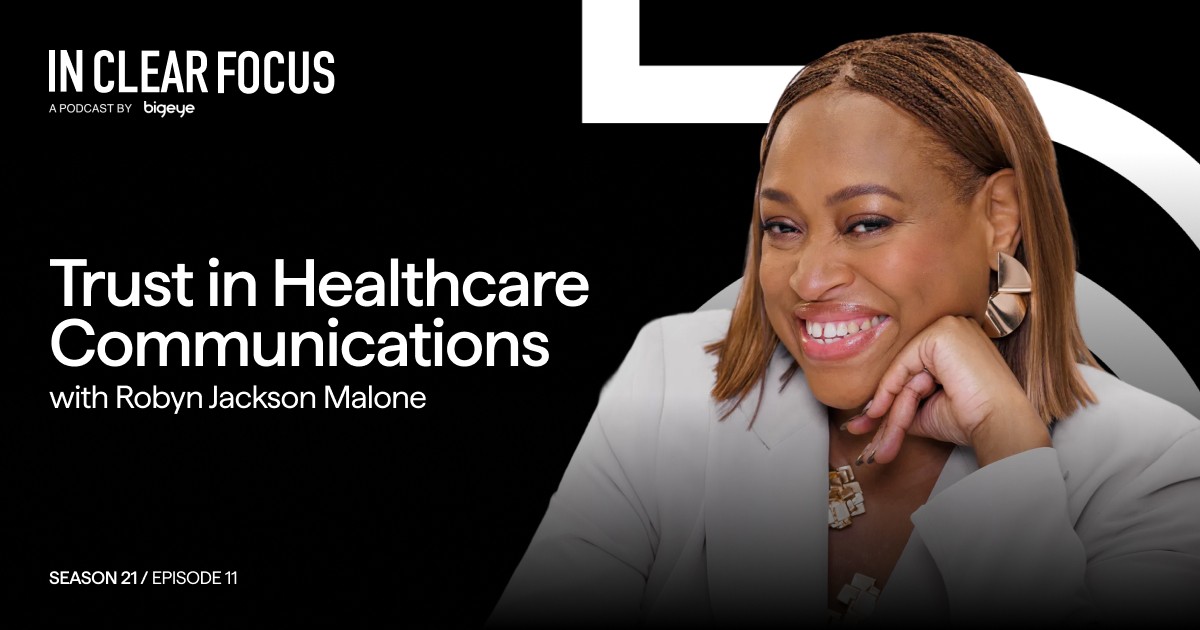
IN CLEAR FOCUS: Guest Robyn Jackson Malone, CEO of RJ Communications, joins us to discuss the increasingly important role of trust in health communications. Robyn argues that brands have a responsibility to fill the widening information gap authentically. She critiques "window dressing" diversity efforts, advocates for genuine equity, and highlights the critical role of patient advocacy. We also discuss the "You Don't Know Jack About MS" initiative and Pfizer’s "I Can Do Both" campaign.
Episode Transcript
Adrian Tennant: Coming up in this episode of IN CLEAR FOCUS
Robyn Jackson Malone: If you are not standing for who you are, then don't show up. And so many brands just go with the wind. They're like, oh, well, the sales are over here or the trends are over there. And it's like, well, who are you? Adrian Tennant: You're listening to IN CLEAR FOCUS, fresh perspectives on marketing and advertising produced weekly by Bigeye, a strategy-led full-service creative agency growing brands for clients globally. Hello, I'm your host, Adrian Tennant, Bigeye's Chief Strategy Officer. Thank you for joining us. Healthcare communications have always required a delicate balance. For years, brands could rely on public health institutions to provide the foundational information that their marketing messages could build upon. But the landscape is shifting. Trust in traditional health authorities is changing. Consumers are seeking information from multiple sources and wondering who to believe. This creates both new challenges and new responsibilities for healthcare brands. How do you build consumer trust when the broader information ecosystem feels uncertain? What role should marketing communications play in patient education? And how do you maintain brand integrity while navigating these kinds of questions? Today's guest has spent nearly 30 years helping healthcare brands tell authentic stories. Robyn Jackson Malone is the CEO and Chief Partner Officer of RJ Communications, a boutique health, tech, and wellness communications agency based in Chicago. She's launched campaigns for global companies like Pfizer and Procter & Gamble, including the “You Don't Know Jack About MS” initiative and the “Relieve My Fever” campaign that generated over 135 million media impressions. To discuss her philosophy and work in healthcare communications, I'm delighted that Robyn is joining us today from Miami. Robyn, welcome to IN CLEAR FOCUS.
Robyn Jackson Malone: Hi there. Hi there. I'm in Miami today for a little bit of work and pleasure and just a respite from the Chicago weather where I live.
Adrian Tennant: Got it. Well, Robyn, let's start with your career journey, not your journey to Miami. Right. How did you get into healthcare communications?
Robyn Jackson Malone: Totally on accident. Totally. My first job out of college, I worked in the PR department of the Asia Society, which is a New York-based arts organization focused on Asia. And I learned a ton and met some great friends. But I moved on from there because I wanted like a career in PR and communications and not necessarily in the arts. Do you know what I mean? And it just so happened that the first job I landed at an agency was in the healthcare practice. And then it just took off from there.
Adrian Tennant: What led you to later found RJ Communications?
Robyn Jackson Malone: Any number of things, but I started consulting, and that was fine. I've done it before, but honestly, clients followed me, so an agency grew around me, and I was like, “Oh, holy smokes!” I was so ill-prepared to actually have an agency, that it happened without a plan by me. It wasn't intentional to found an agency, but I did. And then five years later, here we are.
Adrian Tennant: Well, you've built your agency around working with “partners” rather than “clients.”
Robyn Jackson Malone: Correct.
Adrian Tennant: What's the difference?
Robyn Jackson Malone: I find that clients, and this is not, it's not true for everyone. Let me just say that. But when you speak the language of clients, you're already leaning into a dynamic where there's a power imbalance that is real for sure. But I don't want that to be the framework that we come to the table with, that we come to the relationship with. And I can't control that. Like, I can only speak from our side, right? So, that's part of it. And client, sort of, you think about a transactional relationship on some level. It might not be, but that's the language of that. It feels transactional. It feels, you know, financially based. And it is, for sure. We like to call our clients partners. That's how we think about it. We say we are an extension of you. And the more you let us in, the better partners we are, the better we are going to support you, the better we are going to make an impact, the better we are going to help you and your team and your company and your brand shine. So the advantage of having my own agency is I can choose those. who I don't want to work with. You know, you'll hear a lot of times vendors, if you think of me like a vendor, if you think of us like a vendor, then you're probably not the right fit for us. We're not a vendor.
Adrian Tennant: Makes total sense.
Robyn Jackson Malone: Yeah.
Adrian Tennant: Now, you've launched campaigns for global companies like Pfizer and Procter & Gamble, including earlier in your career, the You Don't Know Jack About MS initiative. Robyn, can you tell us about that campaign and how you came to be working with Jack Osborne?
Robyn Jackson Malone: Yeah, this was some years ago. And before that, and since then, I worked on several celebrity campaigns. That's one that sticks out for a few reasons. The first of which is, I conceived of it, obviously with my team, but led the conception and the creative wrapper, if you will, the creative framework around that campaign. And then also, it's one of those that I did everything. I negotiated the contract. I did all the things, right? So to take a step back at the time, my client was a large manufacturer of the leading multiple sclerosis treatment. And so we were toiling along, doing what we do, and then all of a sudden, Jack Osborne announces that he'd been diagnosed with MS. Now, for a little bit more context, the drug at that point, I'm pretty sure it's generic now, but the drug at that point was the number one in the market and had enjoyed that place and space for a while. But the science advances and other treatments had come onto the market that were, you know, now they've got competition that they need to be aware of and they need to manage to and all of those things. And so they had never done a big consumer, patient-facing celebrity campaign. They had never done it. Honestly, there wasn't a real need to. So there were two things happening at the same time, competition in the market and an opportunity by way of Jack Osborne announcing that he had MS. And so we hopped on it. And this was the insight. Most MS patients are women in their 30s and 40s. And those women will remember Jack Osborne as the terribly annoying, chubby, pimply-faced teenager on the reality show, The Osboards. They will have that memory. So we created a campaign that was the new version of Jack Osborne as a husband and a father and now someone who is living with MS as a completely different person. So we created a docuseries. So very reminiscent of how we first met him, but we then updated it to, you know, the new standard and the new him because those women will remember, we only knew the other Jack. We had not been introduced to this Jack. So that was what the campaign was.
Adrian Tennant: Excellent. Well, let's talk about what's happening right now with trust in healthcare. What are you observing?
Robyn Jackson Malone: I just had this conversation a couple of days ago, and it's been ongoing, sort of in the RJC halls, if you will. It used to be that you could go to some trusted sites for health information. You could go to CDC or wherever else to better understand about a condition, a disease. That is not the case like it was. And so we're leaving communities of patients in the lurch. We're not giving them the education and information that they once had at their fingertips. And so the question becomes, who do you trust? Where do you go for the thing? Like, you know, you're looking up something and this is often what happens. You might, you know, on your Google, it might be WebMD. It might be the Mayo Clinic. It may be a pharma company. And then you want to double check. So you might go to one of the government health agencies to say, OK, does all of this align? And you don't have that anymore. So I understand the big question mark around, one, where to go for reliable, fact-based, evidence-based, science-based information that you can really trust. until, so we have a dirt of science-based and evidence-based information, and we have a flood of misinformation that's happening right now. And I would be confused if I'm just, you know, someone says, you know, might have high blood pressure or you have, you know, glaucoma. The first thing people do is they go to the internet. or heaven forbid you have something that is reproductive health associated, then you're really in a pickle. I think trust in healthcare information has always been on shaky ground for very valid reasons, but there were a few notes of consistency, and I can take a breath around this because there isn't a financial incentive to tell me different. Now, I don't know that we can say the same in a consistent way.
Adrian Tennant: Well, Robyn, when institutions like the CDC become less trusted sources of information, what obligation does that create for healthcare brands?
Robyn Jackson Malone: In my opinion, they have a huge responsibility and, frankly, an opportunity to serve the patients that they all say they put first. They have a huge responsibility. You're seeing now, they're like, things have been wiped from the zeitgeist, right? They just don't exist anymore. So I would love to see more of these companies and brands and organizations step up to help try to fill those gaps and provide a little bit more confidence for these patient communities that are just like, well, now where do I go? Let me just say this, it's not for lack of information, but some of the sources of the information are just inherently have a little asterisk. Fair or unfair, they do. So a lot of times you go to the sources that you felt like you could trust to verify, to double click, to do a bit more research, and now you don't have that as an option in the same way. So I say 100% healthcare companies, brands, and organizations absolutely have a responsibility and just through my communications lens, an opportunity to step up and try to fill some of those gaps.
Adrian Tennant: When we were preparing for this podcast, you did mention to me that brands sometimes run scared in challenging times. What do you mean by that? This sticks in my craw.
Robyn Jackson Malone: Either plant feet around who you are or don't. And what has happened is companies, brands, and organizations go where the wind blows, as opposed to standing in their truth. So if the wind is blowing, you know, and this way, that's the place that they're going to lean. And if the wind is blowing that way, that's the place that they're going to lean versus, you know what? I don't care where the wind is blowing. This is who I am. And that is a problem for me, sort of my own personal ethics and ethos and values. But also, I think it's a real issue for companies, brands, and organizations. I think they need to do better. Who are you? You stand in that truth. You don't have to have a point of view or a comment or a post about everything. You can sit it out if it's not true who you are. That's fair. That's fair. But, you know, the whiplash of you're this today and that tomorrow. Yeah, I think they do themselves, their brands and their communities a huge disservice when they do that.
Adrian Tennant: Let's take a short break. We'll be right back after this message.
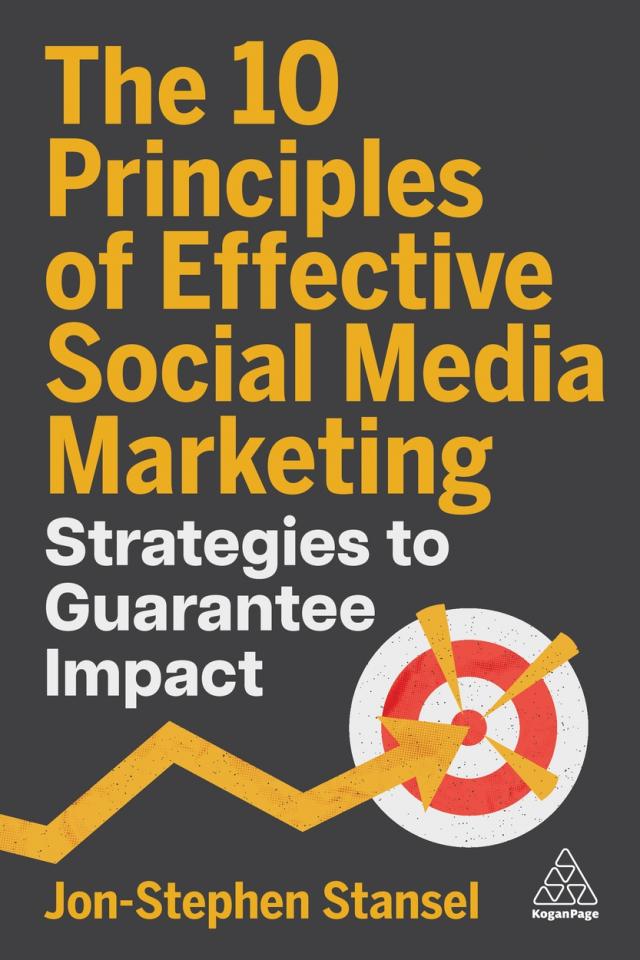
Jon-Stephen Stansel: Social media moves fast, but the principles of effective marketing don't change. Hello, I'm Jon-Stephen Stansel, author of The 10 Principles of Effective Social Media Marketing: Strategies to Guarantee Impact, published by Kogan Page.
Whether you're a social media professional, an agency leader, or a marketer working with social teams, my book provides timeless strategies to create content that connects, no matter what platforms rise or fall.
Inside, you'll find real-world examples from brands like HBO, Xbox, and Beyond Meat, plus practical exercises you can apply immediately. These aren't trendy tactics that will be outdated next month. They're foundational principles that will work on whatever platform comes next.
As an IN CLEAR FOCUS listener, you can save 25% on The 10 Principles of Effective Social Media Marketing when you order directly from KoganPage.com. Use promo code BIGEYE25 at checkout. Shipping is complimentary for customers in the US and the UK. Learn the principles that guarantee impact and give yourself the confidence to create social media strategies that deliver real results. Thank you!
Adrian Tennant: Welcome back. Welcome back, I'm talking with Robyn Jackson Malone, CEO and Chief Partner Officer of RJ Communications. Your agency deliberately focuses on inclusivity and equity rather than diversity. Is it? Robyn, why that distinction?
Robyn Jackson Malone: This is going to get me in trouble, but I'm used to it. I'm okay with it. I own it. Diversity is not a word that I use, and it's not a word that we use at our agency. That is window dressing. It is a natural outcome if you are truly managing to equity and inclusion. If people are safe and feel safe and supported, and not just people, but an inclusive community and many communities of people. If you are intentional, about building that safety. Diversity is what comes naturally. I don't want to manage to, and I don't want to work with brands, companies, or organizations that are managing to, I want to make sure there are enough brown people on my website. What is that? That's performance. and not impactful. And I'll go a step further and say, I find it offensive because you don't actually care about making sure that your employees or the work that you do is reflective of the communities you serve. You just want to look like it. And we just don't believe in that. And I want to be clear. It's not that representation isn't important. It's because It's the easiest thing to do in all of this conversation. And that's sort of the lowest common denominator. It's the lowest hanging fruit. And that's what many people, companies, brands, organizations end up doing. We just won't, we really won't be a party to that.
Adrian Tennant: What mistakes do you see healthcare brands commonly making when they try to reflect their stated commitments to DEI goals?
Robyn Jackson Malone: Oh, good grief. I don't know if we have that kind of time. But I think it's like going back to what I said. I'm like, “Oh, we need to reach the Black community.” But we're going to reach the Black community. And what we're not going to do is we're not going to do any real investment in market research and gaining insights, we're just going to tell you to go reach them. And I use the Black community as an example, but it's the same for other Brown and other inclusive communities, traditionally under-resourced communities. They do the same thing. They don't treat them how they treat, I don't want to say mainstream because I find that offensive too, but they don't treat those communities how they treat what they consider their core community, which is typically not Black, Brown, LGBTQIA+, disabled, et cetera. So they're just like, they're going to throw a couple of dollars at the problem to say that they've done it, but they don't really sit in it and invest. They don't do the same things that they would normally do.
Adrian Tennant: Robyn, when you're developing healthcare communications, what role does patient advocacy play? Robyn
Jackson Malone: It's a huge role, huge role, and I sing this from the mountaintops. So at RJC, we have pharma clients, we have biotech clients, we have health tech and med tech clients, and we have healthcare organizations as clients. So we run the healthcare ecosystem gamut, if you will, which gives us great perspective, I think. I cannot say enough about the role of patient advocacy. If you consider that these advocacy groups almost always started from someone who had a need, there was a gap in education, there was a gap in access, there was a gap in resources, And one person or a group of people or someone got together and really built up something that was specifically set to serve those people, those communities. And if they're doing it right, and most of them are in my experience, they know exactly what those patients need, what they don't like, what they're saying, what they enjoy. They are critical. They are a critical conduit. They are critical to understanding how do we reach and talk to these patients? How do we get them included in what we're trying to launch or what we're trying to develop? How do we understand what they want? They are a critical conduit.
Adrian Tennant: What happens to consumer trust when a brand shows up differently without any explanation?
Robyn Jackson Malone: Oh, I can't stand it. It's the Robyn in me, and it's the marketer in me at the same time.
Adrian Tennant: Okay.
Robyn Jackson Malone: It's like, I got whiplash. I don't know. It's like, I don't understand what just happened. To me, if you are not standing for who you are, then don't show up. And so many brands, and I say that sort of universally, not just in healthcare, but so many brands just go with the wind. They're like, “Oh, well, the sales are over here” or “the trends are over there.” And it's like, well, who are you? And I think that's a mistake. I really do. And I understand all of the pressures, internal and external, right? I think societal pressures, political pressures, financial pressures. They've got all the stakeholders. They've got boards and blah, blah, blah, blah, blah. I understand that. But who do you want to be? Who do you want to be? Be that person. And if you are that person, that brand, that company, that organization, consistently, you won't lose those people. Adrian Tennant: Right. Robyn Jackson Malone: But what you end up doing is spending a lot of time chasing people who you don't really know, because you think the trains are over here or the sales are over there. And it's like, okay, I guess. It wouldn't be what I would recommend for a core sort of posture. But again, I am not naive. I understand the why. I just wish that why didn't exist.
Adrian Tennant: Well, relatedly, what's your take on Target's ongoing problems?
Robyn Jackson Malone: Sounds like they're lying in a bed they made. I'm not interested.
Adrian Tennant: Okay. They're cancelled.
Robyn Jackson Malone: Yes. To be honest, it's clear. And Target is not the only one. They're just the one that's talked about the most. Target is not the only one. They all jumped on this quote, DEI thing. Because that, again, blowing wind. They jumped on it because they thought there was either a risk or an upside. Risk if they didn't, or upside if they did. And that was the only driver If this was cool, you were authentically, then this would have been ongoing. But Target did what all of these companies and brands did, and they were loud and proud about it. They set up all of the, there was a chief diversity officer and all of these things, and there were programs and marketing dollars and blah, blah, blah. And none there wasn't. So for me personally, it's not so much that it doesn't exist anymore. It's that we know why it existed in the first place. You told on yourselves. And I personally, as a consumer, am not interested in that. You never cared about my dollars. You never cared about making sure your employees felt included. You never cared about equity. You cared about it when you thought there was a cost. Again, I understand all the reasons. I'm not naive. I live in the world with everyone else, but my personal values and ethos, I don't need it. I think that they're rolling around in the mud and the slop that they created, and I have zero sympathy.
Adrian Tennant: Alright. Well, let's bring it back to something positive. As regular listeners know, we love case studies on IN CLEAR FOCUS. So Robyn, can you share an example of a campaign from your agency that you're really proud of?
Robyn Jackson Malone: One that comes to mind, we did with Pfizer. Pfizer came to us because they were sort of reeling post-COVID from the attack on science and data. And they were just trying to navigate it, right? And fair enough. Pfizer is Pfizer. They're a big pharma. And this was not the brief literally, but the way that I interpreted the brief was they wanted to be a bit cooler. That's not what they said at all. That was never the language they used. But we said, okay, like, “How do we do something that makes you a little bit more human to the communities of patients that you serve, right?” So that you don't feel like this big, giant pharma, which is, you know, a feat unto itself and certainly not something one campaign can do, right? So we came up with this idea of a campaign called “I Can Do Both.” And the insight was, especially post-COVID, that there was a real lean-in to the self-care trend. You know, I'm drinking my matcha, I'm doing my yoga, I'm doing all of those things. But the perception of self-care did not include health care. It didn't include, you know, getting your mammograms. It didn't include getting your annual physicals. That wasn't the perception of self-care. Self-care was getting your rest and drinking your matcha, and I'm being a little bit reductive, obviously, and doing yoga. And all of those things are important, but they should not be to the exclusion of your mammograms, your colonoscopy, going to get your physical, getting your eyes checked. And that's not how people thought of self-care. So the whole point of the campaign was you can and should do both. “I can do both.” Healthcare is self-care. That is how you take care of yourself. And it was social media and influencer driven and based. And it was incredibly successful. and very cool. So we were able to engage some key influencers, drive some really compelling content, and it was for Pfizer corporate. It wasn't tied to a specific brand. That's one of the campaigns I'm really, really proud of.
Adrian Tennant: Robyn, you've created a very successful agency. I'm curious, what do you think is your secret sauce, the thing that attracts and retains your clients?
Robyn Jackson Malone: Yeah, that's a great question. I think there are two things. I think the biggest thing is that I, by nature, am a truth teller. And I hated that sometimes, over the course of my career, I couldn't say the thing that needed to be said. And now I can. And we build our relationships based on truth-telling. We say, “Listen, if you can't trust us when the news is bad, how can you trust us when it's good?” So I'm always going to say the thing that needs to be said, even if it doesn't serve me, especially if it doesn't serve me. If it serves a partner, If this is what they need to hear, irrespective of how they move on it, that is the most important thing. Our integrity is unmatched. I will walk away. I've turned down opportunities. I will say, do not spend your money with us on this. This is what we can do for you, and you should do that, but not now. You should do this first.
Adrian Tennant: Now, for listeners who don't work in healthcare marketing, what are some insights or learnings from your career that you think can be applied to other categories? That's a good question.
Robyn Jackson Malone: I feel like I'm a broken record, but authenticity is really what matters. Like being who you are as a brand, as a person, as a company, as an organization. Because the other stuff is just smoke and mirrors is performance. I think the other thing is understand the “why.” The “what” is important. But the “why” is more important. So we're currently working with a reproductive health brand, and we got some data around certain behaviors. Totally makes sense. But we didn't understand why those behaviors existed. So how can I, and in this case, it's for women, meet her where she is and understand who she is as a whole woman outside of her reproductive health decisions if I don't understand why she's doing this versus that? We embarked on some qualitative research and are unpacking that. I would say the why is the most important question and the most important thing to understand. Lipstick, socks, or a drug.
Adrian Tennant: Consumer insight's the key, right?
Robyn Jackson Malone: Oh, we're so big on it. I don't understand how you're reaching out to any audience without researching insights. It seems so disconnected for me, but I understand why it happens.
Adrian Tennant: Well, looking ahead, how do you foresee the future of healthcare communications unfolding over the next, I don't know, three years?
Robyn Jackson Malone: Yeah, well, there already is like a flood of AI-driven healthcare technology and companies, and no one understands what that looks like yet. And it has been over the past, let's see, I've been doing this for 30 years. And when I started my career, it was all pharma all the time. And then, as the world changed, so did the healthcare ecosystem. So it went from pharma to biotech, then there was med tech and health tech and digital health and diagnostics, right? And now there's this huge healthcare ecosystem. So I would say like the pharma voice is still there and still really critical and important, but people are thinking of treatment in a different way because of technology. And that's what I'm seeing explored more. And I like that. Adrian Tennant: Great conversation. Robyn, if listeners would like to learn more about your work at RJ Communications, what's the best way of connecting with you?
Robyn Jackson Malone: Connecting with me, you can find me on LinkedIn at Robyn, R-O-B-Y-N, Jackson Malone. Also, our company LinkedIn is RJ Communications. We have our website is rjcomms.com. All of those are great ways to reach us.
Adrian Tennant: Robyn, thank you very much for being our guest this week on IN CLEAR FOCUS. Robyn Jackson Malone: Thank you so much.
Adrian Tennant: Thanks again to my guest this week, Robyn Jackson Malone of RJ Communications. As always, you'll find a complete transcript of our conversation with timestamps and links to the resources we discussed on the IN CLEAR FOCUS page at Bigeyeagency.com. Just select ‘Insights’ from the menu. Thank you for listening to IN CLEAR FOCUS, produced by Bigeye. I've been your host, Adrian Tennant. Until next year, goodbye, and Happy New Year!
TIMESTAMPS
0:00: Introduction to Healthcare Communications
2:30: Robyn's Career Journey
3:50: Founding RJ Communications
5:20: Partners vs. Clients
6:30: The “You Don't Know Jack About MS” Campaign
8:20: Trust in Healthcare Information
11:00: Responsibilities of Healthcare Brands
12:30: Brands Running Scared
13:40: Break and Sponsor Message
14:55: Inclusivity and Equity in Marketing
17:00: Common Mistakes in DEI Commitments
18:10: Role of Patient Advocacy
20:00: Impact of Inconsistent Brand Messaging
21:30: Target's Brand Challenges
23:10: Campaign Case Study
26:00: Secret Sauce of RJ Communications
27:30: Insights for Non-Healthcare Marketers
29:00: Future of Healthcare Communications
30:10: Closing Remarks and Contact Information