/
Untapping Innovation with Sally Kemkers

IN CLEAR FOCUS: Most new products fail by solving technical problems over consumer needs. Sally Kemkers of consultancy Untapped Innovation reveals how to bridge R&D and marketing. Discussing her new book, "Untapping Innovation," we discover how to drive human-led innovation using the Hero's Journey, uncover hidden habits, and write product stories that align cross-functional teams. Sally also explains how semiotics can help design future-focused products that truly resonate with consumers.
Episode Transcript
Adrian Tennant: Coming up in this episode of IN CLEAR FOCUS
Sally Kemkers: What people say they do and think they do isn't always what they actually do because habits are so deeply entrenched. So deeper insight work, particularly for research and development teams, means observing that interaction between the product and their usage and seeing what are some of their compensatory habits.
Adrian Tennant: You're listening to IN CLEAR FOCUS, fresh perspectives on marketing and advertising, produced weekly by Bigeye, a strategy-led, full-service creative agency growing brands for clients globally. Hello, I'm your host, Adrian Tennant, Bigeye's Chief Strategy Officer. Thank you for joining us. By the time a new product reaches a brand team, most of the decisions that determine whether it succeeds have already been made. The audience has been chosen, the form factor has been set, and the technology has been locked. And yet, research and development, the people closest to the science of the product, and marketers, the people closest to the meaning of the product, often work in two separate worlds that meet far too late. The majority of new consumer product launches fail, and frequently the miss is not the idea itself, but the gap between what a product can do and what it means in someone's life. Today's guest has spent her career closing that gap. Sally Kemkers is a founding partner of Untapped Innovation, a London-based consultancy that works with research and development teams at companies including PepsiCo, Unilever, and Reckitt. A chemist by training, Sally spent 17 years at Procter & Gamble in research and development and consumer insights roles across the United Kingdom, Germany, Japan and Dubai. She's co-author, with Deirdre Walters and Suzanne Allers, of the book, "Untapping Innovation: An R&D Playbook for Products and Stories that Sell.” To discuss what human-led innovation means for brand marketers and the agencies that serve them, I'm delighted that Sally is joining us today from London. Sally, welcome to IN CLEAR FOCUS.
Sally Kemkers: Thank you, lovely to be here.
Adrian Tennant: Sally, as I mentioned in the introduction, you trained as a chemist and spent 17 years in research and development at Procter & Gamble before co-founding Untapped Innovation. What drew you as a scientist toward the human side of product development?
Sally Kemkers: Yes, well I think I've always been fascinated by people and while I love studying science, when I first started at Procter & Gamble after my chemistry degree, I was fortunate enough to be working in a smaller subsidiary over in Germany and I had the opportunity to work across a whole range of areas within R&D. So I was in the lab making some skincare products at that point, I was attached to a big manufacturing site, I was helping scale up, and then I was working very closely with marketing and commercial folks doing some consumer understanding and research and helping to bring that to life. So I got some early experience that made me realize that having the application, the human application of the science, was the interesting bit. And that whole psychology of what people want and why was the really interesting bit and that bridge between the two. So that's where it all began, really.
Adrian Tennant: Well, your book, "Untapping Innovation," opens with a sobering statistic: the majority of new consumer products fail. Sally, where does that breakdown most often happen?
Sally Kemkers: Yeah, so I think there's a whole load of factors and we could do a whole podcast on this! If we start with maybe some internal factors, and I think these are worth pointing out because they're ones that we feel that we could do more about. There's the issue where a product is made that is brilliant technically, it's solving a technical problem, but not one that a consumer wants. So the user wasn't put at the heart of it. And we can think of plenty of examples of these, often things like Google Glass or Segway are named as products where there's no question about the invention, but are they really doing a job? We think about products hired by consumers almost to do a job. And if they're not doing a meaningful job that somebody doesn't want, they're not going to last long in market. Then there's the products that have been designed against a meaningful need, but perhaps they're telling the wrong story in market. So we talk about quite a lot how -- and it's one of the sort of pitfalls of R&D is that -- we can get very excited about the technology and talk too much about the technology rather than the end user benefit. So that story's got to be right of what it is that the product is doing. There can be other factors around execution as to why products fail. So perhaps it was tricky to scale it up and what you've made in the lab doesn't quite translate in a manufacturing scale. Perhaps the execution via a retailer, so how it's set up and you don't get the distribution that you need, or you just didn't execute accurately what you designed in the first place. So those are kind of internal factors that I think we can do something about. There's obviously external factors which are a little bit harder, whether that's regulatory or economic shifts, ever-evolving consumer needs, all sorts of external factors that are a little bit harder to predict. We should still be looking out for them and having that sort of future focus to try and see where they're coming, but yeah, many, many reasons why. And I think the focus for "Untapping Innovation" is more on those first internal factors and how can we help specifically innovators with some frameworks and tools to try and increase that success by linking the user, the target user, with a product more explicitly.
Adrian Tennant: A theme that runs through your work is that research and development teams are very good at describing what their technology does, but less good at connecting it to what a consumer or user actually values. Why is that connection so hard to make?
Sally Kemkers: Yes, we believe certainly some of the bigger CPG companies are getting better in R&D, getting closer to the consumer, but we still see a lot of shallow consumer understanding work done. For example, quantitative studies will tell you on a large scale what people say they need, what they want, but getting to those deeper insights, the 'why' behind that, doing some really in-depth qual, that bit can be lacking. We talk about a "say-do gap" with consumers. So what people say they do and think they do -- and they're not lying to us -- isn't always what they actually do because habits are so deeply entrenched. So some of that deeper insight work, particularly for research and development teams, means observing that interaction between the product and their usage and seeing what are some of their compensatory habits. You know, for example, when guys are shaving, we'll say to them, "Right, tell us what's the problem for you." And they might talk about, oh, hard-to-get-to areas, perhaps around the nose or places that are difficult to get to. And yet when you watch them shave, you might see them nick themselves and get a little cut. And they might not mention it because it's something they do so often. It's almost become normal. So when you talk to them, they say, "Oh yes, well, that's a big problem." And yeah, so we see this time and time again, observing people going deeper. And then the other part of deeper insight is getting to the unarticulated via projection techniques, deeper methods that figure out the subconscious and the deeper emotions. And when you get to those, you're then able to do a better job of figuring out exactly what the consumer jobs to be done are, or what they want, and that allows you to get to a much more precise specification of the product. You can prioritize which jobs are important, which product attributes must be critically designed in. Rubbish in, rubbish out: If you haven't got the deep enough insight, you don't get to a strong enough product. It doesn't stop there because you have to connect the product back to the user again and you have to figure out what it is about that product that you're going to talk about in order to make it succeed in market and be distinctive versus competition. So doing all of this in the context of everything else in market.
Adrian Tennant: Well, you use The Hero's Journey as a framework, casting the consumer as the hero, and the product as the mentor. Now, many marketers listening know that idea from brand storytelling; Sally, what changes when research and development teams start thinking that way?
Sally Kemkers: Well, you've suddenly given them a tool that they've never had before. It's a sort of strategic ability to connect much better to the rest of the business. So everybody has a common tool. As you say, marketers are very used to these sorts of frameworks. They're used to storytelling. This is new for R&D and it means that they can put the consumer at the center. Instead of their technology, that technology becomes the mentor, the enabler. And they have a framework that lets them almost play and raise the profile, have a voice for their technology, but all done in the context of the consumer need. So really what it's doing is forming a bridge. It means that everybody across functions can work together. They've all got a common framework. And suddenly, R&D have this very important seat at the table. We know that everybody can tell stories. We're all brought up that way. It's really interesting when you put R&D people in a story workshop. Sometimes at the beginning, they say, "Well, I'm not creative. I'm not sure I can do this." But everybody can. And using this framework and asking the right questions really enables them to bring their technology to life.
Adrian Tennant: When that product story is built well upstream, it eventually shapes the brief that lands on a brand team or an agency's desk. What does a good brief look like when the story is being done right, Sally?
Sally Kemkers: Yes. So I think the first point I want to make is that one of these product stories isn't the creative brief itself. It informs it. And we're always very, very clear with R&D teams because while it brings everybody together, I think it's important to define roles and responsibilities and to make sure that each multifunctional team player is playing to their own strength. So we always say, "It isn't a concept. It's not using advertising language." We deliberately use a journalistic mindset. So we write these stories in the third person, which means we're stepping back and we're asking the question, "What is going on?" You start off with the consumer and you end with the consumer and you say, "What is the problem that those consumers are experiencing today?" And then you dig really deep and you say, "Well, why? Why are they experiencing that problem?" And I guess, a little bit back to the last question, that's where R&D can get really involved because, you know, "Why aren't other solutions today working? Why is it still a problem today?" And you can start to diagnose that problem and then you get into the third chapter, which is all about the technology itself, but all done in the context of the consumer need you set up, and then you finish with the "Happily Ever After," the new consumer experience. So going back to what makes a good brief for a creative, it's got to be single-minded. Nobody is going to be able to execute something that's got five benefits in it, and it's so tempting: R&D are brilliant inventors, and if you've invented something, I really want to shout about all the features, but the point is this story tool ensures, and you can have multiple stories, but for any particular initiative or for any particular project where your brief has got to be very pinpointed, who's your target consumer? What are you trying to bring to life here? This single-minded thread means there's a very crystal clear focus on the exact problem you're solving and all the elements of the technology that are going to enable that. These stories are very future-focused and so it's done in such a way that these stories are springboards to help R&D come up with claims and demos and also to help marketing come up with concepts. So going back to your good brief, it should be very, very single-minded and clear, starting with the consumer problem that you're trying to solve. Very, very clear about the technology, with a whole toolbox full of claim and demo ideas that all relate to that. And some really, really strong -- going back to the jobs that you're trying to do for the consumer, the functional and emotional jobs, and going back to that deeper insight -- the impact that that product should have on somebody's life. And when all of that is done in a journalistic mindset of stepping back and thinking, "What are the important points of the story to tell?" that really enables you then to have a single-minded, clear brief for the agency.
Adrian Tennant: Sally, when we were preparing for this interview, you mentioned to me that some of the best participants in your product story process are the creative agency people in the room. Why does that cross-functional mix matter so much, do you think?
Sally Kemkers: So everybody who takes part in this process across functions all plays a different role. We often see people working in silos, and we see the frustration between the functions because agency and marketing perhaps don't quite understand why R&D are describing technology in a way that doesn't feel interesting or relevant, and R&D meanwhile don't quite understand why marketing people can't get as excited as they can about what they've invented. And we've already said a product story is not an execution -- it's the fundamental structure that's going to bring everybody together. But with creatives, they're the ones that will have to execute it. So we see their faces light up and it could be gold dust for them when they suddenly have this framework that enables R&D to describe exactly what it is about their product and go really, really deep into what the problem set up is in the first place. Why are consumers experiencing this problem? And what are all the exact technical reasons why they're going to fix this? I was in a workshop recently in Italy, and we had a big multifunctional team. We had agency, we had marketing, we had R&D, we had regulatory people. And sitting back and watching the roles of everybody was fascinating. It was an R&D person that had the biggest unlock because of a question asked by a marketer that suddenly enabled that kind of 'Aha!' moment and that cross-functional breakthrough to get to the story. It's a joy for both opposite sides of the sort of inventors and the executors when they have a framework that enables everybody to give their best.
Adrian Tennant: Well, as regular listeners know, we love case studies on IN CLEAR FOCUS. So Sally, could you walk us through a product story you've worked on where bringing the whole team around one narrative really made the difference?
Sally Kemkers: Yeah, so a few years back, we worked on a product with the brand Tylenol. It was a tablet, a pain relief tablet. And they were addressing a problem amongst a specific target audience that find it difficult to swallow tablets. So they were trying to improve their tablet so that it could be easier to swallow. And by deeply understanding these consumer needs, we were able - and then working closely with R&D - to understand, and medical affairs and so on, technically, what was causing this problem. It was obvious that two of the big issues with the tablet itself were the sort of size and shape, the geometry of it, and if it's the wrong geometry, it can get stuck, and then also the coating on the tablet. If that coating creates too much friction, that's also another reason why it can get stuck. Some of the emotions from these people were sort of fear, dread of this happening, that feeling at the point at which it gets stuck that it's just kind of harsh on their throat. So there was a whole piece of work done to really diagnose what the problem was from a consumer angle and technically why this was a problem. So we did some testing, we developed some story directions and we took those back to consumers to see which elements would resonate the best. And the claim and the kind of visualization and execution of that they ended up going with in market was talking about a 'gentle glide technology.' And what they did is they coated the tablet with a new coating. So it was optimally shaped to kind of torpedo shape and they coated it with something that really reduced the friction. And the word 'gentle' was really important because it was implying that it wouldn't get stuck in the throat. And then one of the standards of excellence that came up through that deeper consumer research was almost like a water slide and you're swallowing it with water. So this idea that the tablet just glides and glides down. So the front of execution on pack, you've got this lovely water swirl with the tablet gliding down. So that ended up being the final execution.
Adrian Tennant: Let's take a short break. We'll be right back after this message.
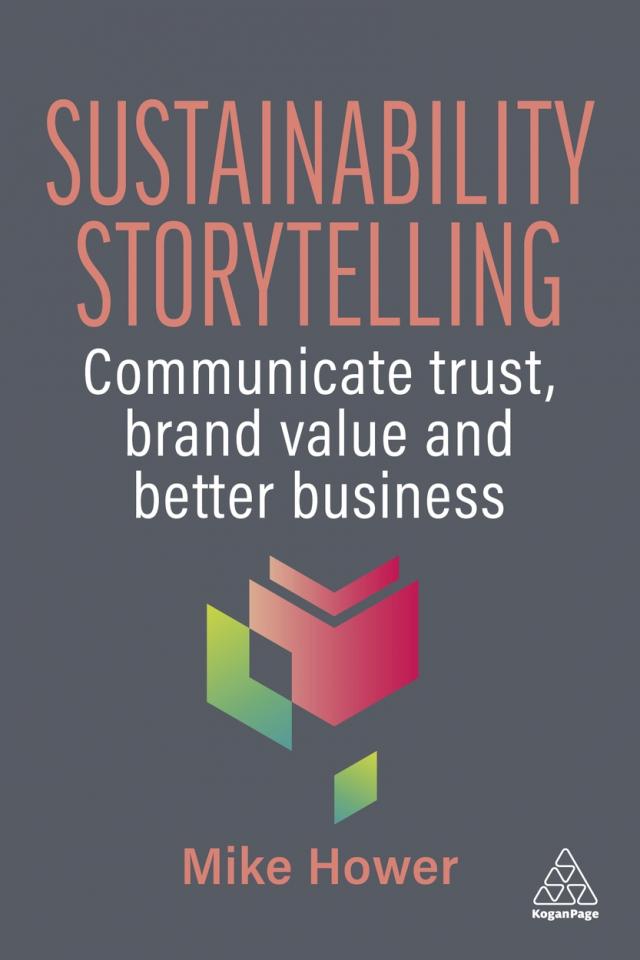 | Mike Hower: Hey there, I'm Mike Hower, author of "Sustainability Storytelling: Communicate Trust, Brand Value, and Better Business," published by Kogan Page. I've spent nearly two decades on both sides of sustainability communication. In my new book, I introduce a framework called the Four Cs of Effective Sustainability Storytelling: Context, compelling, credible, and compliant. Four areas that turn complex sustainability initiatives into stories that build trust, manage risk, and deliver real business value. You'll find practical tools for avoiding greenwashing, navigating evolving regulations, and aligning your sustainability, communications, marketing, and legal teams around a single coherent narrative. As an IN CLEAR FOCUS listener, you can save 25% on "Sustainability Storytelling" when you order directly from koganpage.com. Just enter the exclusive promo code BIGEYE25, that's B-I-G-E-Y-E-25, at checkout. Shipping is always complimentary for customers in the US and the UK. I hope my book helps you tell sustainability stories that resonate, hold up to scrutiny, and move business and sustainability goals forward. Thank you. |
Adrian Tennant: Welcome back. I'm talking with Sally Kemkers, founding partner of Untapped Innovation, about human-led innovation. Another tool in your kit is semiotics, the study of signs and symbols. And you make the point that today's consumers can't invent the future for you. So how does a lens like semiotics and cultural analysis help a team design for where things are heading rather than where they've been?
Sally Kemkers: Yeah, so we see it as a really important tool. We think about semiotics in the broader context. Obviously, it's signs and symbols and cues, but also that deeper cultural meaning behind why people do and believe things. And going back to the deeper research, we've already talked about how you can get to the unarticulated by doing some sort of metaphorical, projection techniques, but there's still a lot of behaviors and things that people do that are shaped by their culture that you can't get to without that sort of understanding of how all of those belief systems and their behaviors have shaped them in the first place. So we think that semiotics and cultural analysis is a brilliant partner tool to qualitative research. And then the other thing that we find semiotics and cultural analysis brilliant for, which you alluded to, is to project over time. So we all talk about staying close to the consumer. They can tell us what's missing today. They can't tell us what they necessarily want in future. So with that future projection and looking cross-category for cues and clues from neighboring categories, you know, "Where is wellness heading? Where is beauty heading? What are the sorts of cultural cues that we could imagine?" And we can map those over time. We tend to look at things that are very dominant today within a category. We predict what will emerge over time, and we obviously also map what's recessive as well, all in the context of what the brand equity needs to be communicating and should stand for. So as we're developing products, some people ask, "Well, how's this relevant to product development?" We think it's really critical because as we're designing, we understand what a consumer needs. We also look at the cultural impacts that are going to affect them. And as we're designing products for the future, we need to be thinking, "What are the sorts of attributes, the cues, the elements of the product that are going to be more future-focused?" And we can learn that from looking at a competitor analysis and seeing what they're doing and mapping those cues and codes out and also seeing what's more emergent versus less emergent. And we can also look at neighboring categories to get clues for what might come next. Doing all of that allows us to actually design products that are more future-focused and then telling the stories of those products. So in our product story work, we also design in future-focused, stretchy language and also visuals for the demos and visual clues that go back to your agency creative brief can then inform them. And they actually love working with the mood boards in the product story because it gives them some sort of visual stimulus as a bit of inspiration.
Adrian Tennant: On average, what is the lead time for a new product being brought to market?
Sally Kemkers: It very much depends on the category and it depends on the invention. What we are seeing is an increasing pressure to move faster. And I think with the advent of social media and ever-evolving consumer needs, trends that can be quite transient at times. There's just a need to get things to market faster. And that's a real challenge for R&D. Some of the processes, whether it's regulation, safety processes, they can take a certain amount of time, and it's difficult to shave that off. We are seeing AI helping speed up, particularly some of those earlier processes, where kind of agentic R&D, we can see that starting to emerge. And that's really speeding up some of the earlier processes.
Adrian Tennant: Well, let's continue to explore artificial intelligence because you describe it as a co-pilot and an amplifier of human creativity rather than a replacement for it. So where does it genuinely add value in the innovation process and where does it still fall short?
Sally Kemkers: So it's changing all the time, and we're seeing it improving and things are evolving. Being able to do things faster and at scale is its real advantage. And some of those earlier processes where you want to analyze enormous quantities of data, you want to look for pattern recognition, enormously helpful there. Also very useful for generating a whole lot of ideas and screening through those pretty quickly so that you can start to see what's what. When it comes to consumer research, we see AI playing a huge role there and it's helping the setup. Synthetic respondents are growing in popularity and they have a role to play again at scale and getting things done quickly. What we are seeing though is working quite well earlier on in some of those iterative prototyping faster areas. Still a watch out for later on for validation where it's critical that you get authentic, real consumers that you're not just synthesizing things and basically some of the early ones and some of those thought process is created process is decision-making judgment, we're still seeing real skills needed there, particularly at that sort of validation side of R&D at the back end, absolutely.
Adrian Tennant: So much of your career has involved bridging worlds: science and marketing, research and creativity, the United Kingdom and the United States. What have you learned about what makes those bridges actually hold?
Sally Kemkers: So I think it's all about finding common ground so that people can communicate well. And as we've talked about at length today, these sorts of frameworks of which story is a great example, is a common framework that allows everybody to contribute. And we've seen over years and years and years, how this really does work to bring everybody together and allow those bridges to hold and that one story. Once you've got that, the whole team shares that. It's a great internal selling, so R&D can take it to their senior management. Marketing can take it to their senior management. And everybody can get a buy-in internally and then it can go on. And each story can have multiple stakeholders externally depending on whether you're trying to tell that story to a retailer, whether you're trying to tell it to the end consumer, whether it's B2B, or whether you've got a key opinion leader, perhaps a healthcare professional, for example. So with one common framework, you can then spin that story and use that to really hold across multiple organizations. So for us, it's about having frameworks that allow everybody to contribute. And I have to say, going back to where we kind of started here, keeping the user at the center is the bit that always works best for us. Because those bridges, whether it's for finance, I mean, obviously you want a business objective at the center as well. But within that, if everybody knows exactly who their target consumer is and you've brought that to life and everybody has that clearly in their mind, then they're all working against the same goal.
Adrian Tennant: Sally, what would be your top tip for marketers who want to collaborate more effectively with their partners in R&D?
Sally Kemkers: So I would say to get the best out of R&D, we need to keep the consumer at the center. And so anything you can do to bring to life and crystallize exactly who it is, One of the pitfalls we often see is that we define a target consumer too broadly or don't go deep enough into who they really are. So bringing that consumer to life, bringing them in to actually meet consumers, observe them, walk in their shoes, show video clips of who they are and really help them with that mindset so that everything they do is shaped by that. and then encouraging them when you're talking to them about their technology and their inventions and their product, asking them in the context of "What consumer problem is this solving?" And "Right, let's think about our target consumer here. Let's think about the specific pain point." So being really pinpointed and saying, "Okay, what does that mean for the problem technically? What's technically going on here?" and then think about the solution and keeping them going back to the consumer. Because then by asking those questions in that way, you should get them focused on solving the right problem.
Adrian Tennant: Great conversation. Sally, if IN CLEAR FOCUS listeners would like to learn more about Untapped Innovation, the book, or connect with you directly, what's the best way for them to do so?
Sally Kemkers: UntappedInnovation.com is our website. You can also find me and you can find the company on LinkedIn. And then, of course, the book itself, "Untapping Innovation," is out on Amazon, all big booksellers, so Barnes & Noble in the US, Waterstones and so on in the UK.
Adrian Tennant: Perfect. Sally, thank you very much for being our guest this week on IN CLEAR FOCUS.
Sally Kemkers: Thank you, Adrian. It's been an absolute pleasure.
Adrian Tennant: Thanks again to my guest this week, Sally Kemkers, founding partner of Untapped Innovation and co-author of the book, "Untapping Innovation." As always, you'll find a complete transcript of our conversation with timestamps and links to the resources we discussed on the IN CLEAR FOCUS page at bigeyeagency.com. Thank you for listening to IN CLEAR FOCUS, produced by Bigeye. I've been your host, Adrian Tennant. Until next week, goodbye.
Timestamps
00:00: Introduction to Human-Led Innovation
02:26: Sally Kemkers: Bridging Science and Consumer Insights
03:42: The High Failure Rate of New Consumer Products
05:56: Understanding the Disconnect Between R&D and Consumer Needs
09:04: Using the Hero's Journey Framework in Product Development
10:42: Crafting Effective Briefs for Brand Teams
13:59: The Importance of Cross-Functional Collaboration
16:07: Case Study: Tylenol's Gentle Glide Technology
20:16: The Role of Semiotics in Future Product Design
23:20: Lead Times for New Product Development
24:27: AI as a Co-Pilot in the Innovation Process
26:05: Building Bridges Between Science and Marketing
27:57: Top Tips for Marketers Collaborating with R&D
29:28: Conclusion and Resources for Further Learning