/
What Do You Really Stand For? with Paul Ingram

IN CLEAR FOCUS: Columbia Business School professor Paul Ingram explains why shared values are the most powerful force in authentic brand-consumer relationships. Drawing from his book, "What Do You Really Stand For?", Paul reveals how to uncover core values, apply value homophily for consumer segmentation, and the benefits of aligning internal culture with external messaging. Learn practical frameworks to build strong, resilient brands rooted in genuine human connection and intrinsic motivation.
Episode Transcript
Adrian Tennant: Coming up in this episode of IN CLEAR FOCUS
Paul Ingram: I would be against the idea of appealing to different segments by being completely neutral on values to say, “We can be all things to all people.” Instead, I would say, “This is who we are, and let me explain how this is useful to you given who you are.”
Adrian Tennant: You're listening to IN CLEAR FOCUS, fresh perspectives on marketing and advertising produced weekly by Bigeye, a strategy-led, full-service creative agency growing brands for clients globally. Hello, I'm your host, Adrian Tennant, Bigeye's Chief Strategy Officer. Thank you for joining us. My guest today is Paul Ingram, the Kravis Professor of Business at Columbia Business School and Faculty Director of Columbia's Advanced Management Program. His research on culture, leadership, and values has been published in over 100 articles, book chapters, and books, earning him Columbia's highest teaching honor, as well as 13 teaching awards voted by graduating students at Columbia and Cornell. His new book, "What Do You Really Stand For? The One Question That Will Transform Your Work and Life," published by Harvard Business Review Press, distills decades of research and classroom practice into a methodology with implications that extend far beyond personal leadership into the heart of brand strategy. To discuss why shared values may be the most powerful force in building authentic brand-consumer relationships, I'm delighted that Paul is joining us today from New York City. Paul, welcome to IN CLEAR FOCUS.
Paul Ingram: It's a pleasure to be with you, Adrian.
Adrian Tennant: Your book represents more than two decades of research and classroom practice synthesized into a practical methodology. Why does it need to be that practical? What's the gap between saying values matter and actually doing something with them?
Paul Ingram: Yes, thank you. You started off in exactly the right place. The book is an effort to be practical about something that people don't argue. People say values matter, but what do they do about it? So you're exactly right to start there. But a little bit behind why we need to be practical is the truth that even healthy people typically don't have clarity around their values. So I found that even successful people, they will typically say that there's one or two values that they think about occasionally. That's the space of how they use values. So some interlocutors say to me, “Well, don't people already know their values? How do you get through life and get to the age of 50 without knowing your values?” The truth of the matter is that your values are there. They're working in the background. Most people really don't have clarity around them. And it makes a real difference to develop that clarity. And the same is true, probably even more so, with consumers, right? It's not the case that consumers are really going to have it very easy to lay out what values they have, they're looking for in terms of their consumption behavior. You're going to have to help people because they don't have that language ready at hand. That's really the spirit of the book, to make value a hands-on practical tool.
Adrian Tennant: What was the catalyst for putting these tools in front of a broader audience, beyond the executive education classroom?
Paul Ingram: I think the catalyst for me is really the impact that I've seen for individuals of all kinds. You know, I interact with lots of executives from around the world, doctors and lawyers and anybody who's trying to be better in their professional practice. The impact I see when they become clear about their values. So this was actually the catalyst for my very early entry into this topic. For a couple of decades, I ran Columbia's program for senior executives. And I took that over in 2006. And at the very beginning of that project, there was a long-standing component in this month-long residential program that was coaching around values, one-on-one coaching. At that time, I hadn't worked in the space of values. I wasn't really familiar with the relevant research. But I noted right from the outset that executives would go through that coaching experience and they would come out feeling transformed. They'd be bouncing off the walls and lighter than air, thinking that they had solutions to really key problems. And that cued my curiosity. You know, I'm an empirical social scientist, so I'm also skeptical. I look to evidence to test ideas. I was open to all kinds of possibilities about why they were excited. So I set out to learn about the research of others, do my own research, and I found out that actually being clear about your values does a lot of very powerful things for well-being and for performance. And the rest is history. My own work was more and more to bring people to that clarity around their values, and the impact is just electrifying. Ultimately, I wanted to leverage that and expose more people to it.
Adrian Tennant: At the heart of your book is the finding that understanding your core values and living by them can deliver life satisfaction equivalent to receiving an $84,000 raise. For those of us working in marketing and advertising, what does the research show about what happens when consumer values genuinely align with a brand they choose?
Paul Ingram: Yeah, maybe this is a good moment to give a definition of a value. So a value is a principle of evaluation. So we use our values to evaluate every other thing, a person, an idea, a project, a brand, a product. And we determine that those things are good, bad, or important as a function of how we see them through the lens of our values. Ultimately, the evaluation of a consumer for a brand is a function of values. Another way to understand that power is to surface the truth that values are the source of our purest form of motivation, intrinsic motivation. And the most powerful form of intrinsic motivation is doing what we view as fundamentally important. Our values are what tell us what is fundamentally important. Interacting, engaging, having a relationship with a brand, if it is consistent with our values, it's reinforcing what matters most to us. So in a sense, this is a universal truth. Work, relationships, consumer behavior, if it's aligned with our values, it is in the direction of what we view as goodness, we're motivated to do it, we do more of it, we are resilient when we do it, we enjoy it much more.
Adrian Tennant: Got it. Well, one of the most fascinating ideas in your book is embodied cognition, the idea that words don't just label feelings, they can actually generate them. Paul, what's happening in our minds when we encounter the right word versus the wrong one for something we care deeply about?
Paul Ingram: Yes, I think you put your finger on something which is really critical for making values powerful. So the work that I've done in the space of values, if I consider it kind of really contemporary, what's different from decades of research that went before is that currently we can allow people almost optimal flexibility to articulate their values, right? They can articulate a value as anything they like. Now, the power of that is exactly as you say, it's with this concept of embodied cognition. The truth of the matter is that actually our ideas are viscerally connected to our bodies. This is what we mean when we say ‘embodied.’ So, for example, some of the kind of evidence in this space is that very young children cannot discern in faces a range of positive or negative emotions until they have the words to capture those, right? So a very young child could recognize that a face is representing something negative, but they couldn't tell whether it's fear or anger until they get those concepts. And the reverse of that is a concept like fear or anger, it's associated with something we feel viscerally in our bodies. Likewise, with the positive concepts, which are values, things like ultimate values (joy, happiness, well-being, peace, and so on), they mean something to us, which is not only cognitive, it's also visceral. And the real power, it's getting the labels that represent exactly the states that feel most positive to them. So it is literally the case, and there's great experimental evidence of this and a lot of it, that if somebody sees their values in the right way, they feel happier, their stress scores goes down, hormonal measures of stress like cortisol decreases, and that's from getting the label right, that actually captures the ideal visceral state. Sometimes people will ask me, “Well, you know, isn't everybody's top value happiness?” Everyone has a top value, which is some universal positive state, but for some people it's joy, for some people it's love, for some people it's peace. And the distinction between peace and happiness is actually really important to a person who has one value or the other, right? So what we're really doing is trying to give people the capacity to tap into these labels we have in language that are really representing a visceral state which is, for us, the most positive.
Adrian Tennant: Marketers are constantly chasing the right word for taglines, brand voice and, of course, campaign copy. What should brand managers and copywriters consider doing differently when they're choosing the words that will represent a brand's identity?
Paul Ingram: Yes, yes. We have a lot of practical guidance for work like that in the book. And I think what I would say is a lot of the practices that brand managers use are actually in the right space, right? They ask people, focus groups and so on, about how they feel about various products and so on. So I think asking people is right. I might be able to suggest some alternative options for asking the question. Values are principles of evaluation. So if you ask somebody about a really positive, really negative, or really important experience or object and ask them to explain why, the whys will be values. So in the space of, say, consumer choice, your most positive experience on, let's just say, vacation, what was it that made it so positive? And the labels that people will surface, “Oh, there was calm, there was excitement, there was diversity,” you know, whatever it is for that person, they're capturing values, right? People's values are the same in explaining what makes something great and what, in its absence, makes something negative, right? So you can ask people to explain what was missing in a negative experience as well. And I would also point out, and I think that this is perhaps something added to contemporary practice in consumer behavior is that values transcend objects. So my students, I call them students, but of course they're often people going about their lives professionally, more than 10,000 of them have left my workshops with cards that capture a small set of their top values. They apply these cards to relationships, to choices at home, to consumer behavior, to decisions they make in the workplace, to motivation for work and going to the gym. The same set of values transcend context if you get them right. So, this provides a lot of options to reinforce the surfacing of values in the context of consumer behavior, you can ask people, you certainly ask people about their very positive experience with a product class, but you can ask about other really positive, negative, and important experiences, and they're articulating values in that way as well.
Adrian Tennant: Your book introduces a methodology called the value structure, a process for identifying 6-10 core values, prioritizing them and mapping their relationships. Paul, could you walk us through what that looks like for a person or an organization going through it for the first time?
Paul Ingram: Wonderful. So, let's start in the context of a person and then we can go to an organization. You know, if you ask people to reflect about a really positive or negative or important object and explain the why, what makes it so, they'll be articulating values, right? That's really practical and feasible. With organizations, I take the values as being a representation of the values that make up the constituents of an organization, right? So these certainly are employees, also I think in the space of your audience, I think and I can offer you some examples that think about customers, is also stakeholders of the organization. I think that could be a very useful way to articulate values as well, right? And what this amounts to is asking the stakeholders about their values. So when I work to articulate values for the organization, one step is I'll ask a question, you know, if I could, I would take all the members of the organization through a kind of coaching or workshop experience, but we can't maybe do that with a global organization. So I'll ask a deep question that gets at these preferences. So one, I might ask, if we're dealing with employees, is to “Think of a colleague who you value and you believe is valued by others in the organization, and then articulate why are they valued.” “They're a team player, they're committed, they're generous, they're creative.” Those whys will be values, and then we can aggregate them to represent the organization.
Adrian Tennant: Your book makes a strong argument that values cannot be manufactured top-down or coined by consultants without breeding cynicism. As regular listeners know, we love case studies on IN CLEAR FOCUS. So Paul, could you give us a commercial example of how to identify and close the gap between stated values and actual behavior?
Paul Ingram: So an organization I talk about in the book is Real Madrid, the very successful football club that has a set of values that they make key choices around, for example, when they're recruiting players. And the values came from surveying their socios, their fan owners. So they're a cooperative, they're owned by their fans. And when they came to articulate the values, it wasn't the chief executive's values. It wasn't based on advice from a consultancy. It was based on what do their fans really value. So now they take the fans' values, and when they're comparing two players, they have this guidance about which is going to be more compelling for their customers. And they make choices that way. And the result is, even if they don't win every game on the field, if they're acting in a way according to their values, their stakeholders, their consumers in this case, like the product.
Adrian Tennant: Let's take a short break. We'll be right back after this message.
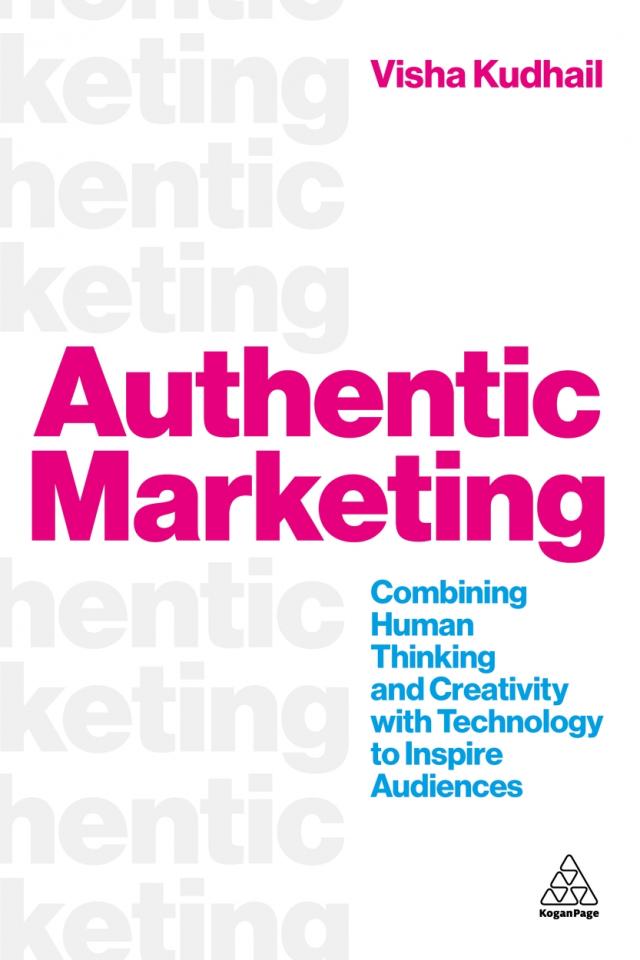
Visha Kudhail: Hello, I'm Visha Kudhail, author of "Authentic Marketing: Combining Human Thinking and Creativity with Technology to Inspire Audiences," published by Kogan Page.
I've spent nearly two decades building brands and marketing teams at companies including Thinkbox, Google, Pinterest, and Square. In my book, I make the case that as artificial intelligence reshapes our industry, the qualities that set great marketing apart are still profoundly human: curiosity, creativity, and audience-first thinking. I share practical frameworks for turning data into genuine human insight, building brand trust, and creating campaigns that earn a lasting place in people's lives.
You can save 25% on "Authentic Marketing" when you order directly from koganpage.com. Just enter the exclusive promo code BIGEYE25 at checkout.
Shipping is always complimentary for all customers in the US and the UK. I hope my book helps you build brands worth believing in. Thank you.
Adrian Tennant: Welcome back. I'm talking with Paul Ingram, Kravis Professor of Business at Columbia Business School and author of "What Do You Really Stand For?" about how authentic values shape brand identity, consumer connection, and the relationship between internal culture and external brand strength. Paul, your book also introduces the concept of the chief executive value, the ultimate end state value that sits above all others. For an individual, that might be happiness, peace, or freedom. What does the equivalent of a chief executive value look like for a brand?
Paul Ingram: The equivalent for a brand would be the feeling that you aim to create in the consumer. So the chief value is the ultimate outcome, and it's an internal state, and a very positive internal state and a kind of universal concept. So for individuals, they're like joy, happiness, peace, zen, well-being, and so on. And in the space of a brand, it would be ultimately the positive feeling that you aim to create in the consumer. So, the product could be reliable, the product could be innovative, the product could solve problems. Ultimately, what do you aim to produce in the consumer? So, what does it all add up to in terms of the person who uses your product?
Adrian Tennant: One of the most provocative findings in your book is value homophily, the principle that shared values are the strongest predictor of connection between people, beating shared interests, race, or gender. Now, for those of us who practice traditional segmentation, that's a significant reframe. What does values-based segmentation look like for a brand team trying to discover which values their best customers genuinely hold?
Paul Ingram: Yeah, I love that question. Thank you. And I think that the answer and the practical implication for segmentation comes from adding a little bit more to the truth of value homophily, right? So it is true that if two people have more similar values, they're more likely to gravitate towards each other. So I study, among other things, professional networks and business friendships, and you articulated it well that the best predictors of who will connect in an interpersonal relationship are who has more access and exposure to each other. So the person in the next office, you're more likely to build a relationship with. Beyond simply interaction is more similar values. So there's gravity between people with more similar values. Now, the implication for that for brands is, I think, transparent, that if you could articulate the values that your brand is representing, then people who share that value are going to gravitate towards the brand. So how do we get to segmentation and trying to expand beyond the core group that actually shares these key values? For that, I'll share something else that we learned when we were studying relationships, that there's gravity between people who have similar values, but if you can explain your values to someone who has good but different values, you can come to understanding and empathy, then you can relate as if the values had been the same. So, I think what this means in segmentation is really understanding the values of the various segments. So a deep understanding and a recognition that not even two people are exactly the same in value. So of course, it makes sense that there's different segments. And also being prepared to explain the values that your brand is representing. And I think both sides of that create opportunities for marketers. In the sense of understanding the values of a segment that might not be the core segment that naturally gravitates towards your product, I would offer a practice that we call bricolage. It's very hard to change people's values. I advise staying out of the business of trying to change people's values. But you can take someone's values if you understand them and direct them to a new behavior. So if my product represents creativity and your value is reliability, I would help you see a path between reliability and my product. Maybe I would work on the possibility, you know, that creativity leads to problem solving. Problem solving is a very practical thing. So in some sense, unless you are open to perspective, it's really hard to be reliable, right? How can you be reliable if you're not open to changes in the world? That might be an example. So if you understand the values of any segment, you could do some bricolage, which is pitching your offer in a way that appeals to their values. Now, I would also suggest the alternative that if a person, an organization, a brand can really be clear about what they represent, it has an appeal that transcends simply other people who have exactly the same values because we call that authenticity. We can respect and remember an authentic person, leader, brand, even if it's not immediately what appeals to us, right? It's the second category. We would like some correspondence on values, but I want to know that you're grounded in values and you represent them. And if I understand them, I can respect that, right? So I would be against the idea of appealing to different segments by being completely neutral on values to say, “We can be all things to all people.” Instead, I would say, “This is who we are, and let me explain how this is useful to you given who you are.”
Adrian Tennant: Your work with organizations such as the Guggenheim, the Museum of Modern Art, and New York Presbyterian Hospital has shown how internal culture becomes an external strength of the brand. What is the audit process for a brand leader who wants to test whether their external messaging genuinely reflects their internal culture?
Paul Ingram: Yeah, yeah. I think that correspondence is really powerful, and I think there's two parts to it. Measure the internal values, right? Here's another way to put it. I would say that, and this goes back to authenticity, the consistency of the values represented by a brand depend on the values of the people who make up the organization. And if I wanted to build a great brand, I would also want to know the values represented by individuals in my organization. How do you surface that? Well, questions like: who is valued in the organization? Why are they valued? And the whys you would aggregate into what we call a culture map. Then I would ask a version of the same question to the people that use the product. “When you use this product, and it's rewarding for you, your best uses of this product, our most satisfying consumption experiences, why? What was so great about them?” And I would look for correspondence. We actually have quantitative measures. We use natural language processing. And this might yield, for example, if you say, “Well, I like this product because it's creative.” And people in my organization articulate a value like openness, we can use natural language processing to find out that will open this and creativity not exactly the same thing there in the greater space of things that kind of proximate concept. So I would ask versions of the same question to surface values internally and externally, and I would look ideally for a correspondent. But again, you're not limited only to the customers that happen to represent the same values. Understand the difference. If you go to a different segment that has some different values, then the key is understanding what their values are and then being able to pitch your product in a way that appeals to that.
Adrian Tennant: As consumers become more skeptical of marketing claims and more attuned to whether companies actually live their stated values, how do you think the role values play in brand-consumer relationships will change over the coming years?
Paul Ingram: I think it's going to increase, and it gets back to this label authenticity. What you articulated with that skepticism on the part of consumers is this kind of repulsion from inauthenticity and not being willing to assume that espoused values are really practical values. We find the same thing in our research. For example, I did an experiment on leaders communicating to their teams and found out that if the leader simply had their values in mind, then they were perceived as being more authentic and more trustworthy in communication. So this is to say that simply being grounded as an organization, before you even start to analyze the values of consumers, but if you were an organization that was grounded on values, that was empirical in the space of values, that engaged in practices to build a kind of strong culture around a set of cohesive values, that simply doing that would contribute to authenticity, the perception of authenticity on the part of your audience. So, I mean, what we find in these experiments is there's a little je ne sais quoi. We know when somebody is coming from a grounded values space. And the flip side is that you really can't fake that, right? You know, we sense it. And what I would say here is that before you even get to analyzing segments and analyzing consumers, which is completely a practice, which is consistent with the good here, but I would say focus on grounding yourself your own organization values be clear about what your organization stands for because when you have that internal strength then you can hardly fail in all the various moments of communication where we understand it's not only high-profile advertisement, it's the interaction with a customer face-to-face with one of our service people, it's some response online on some kind of blog site for employees that leaks out. You want this internal consistency, and then you don't have to worry about managing it because if the organization is really grounded in values, they just can't help but express those to the outside world.
Adrian Tennant: Paul, if anyone listening to this conversation wants to take a single concrete action to begin applying this research to their work, what would you suggest they do first?
Paul Ingram: My advice, Adrian, would be start with yourself. That yes, values affect teams, departments, organizations, brands, and markets, but ultimately they're grounded on values within the person. Begin with yourself. Do some work. It's a small investment. It might be an hour or two's work to articulate your own values in a compelling way. And then develop a practice that works for you to keep them familiar, right? So, how to surface your values? Well, I mentioned examples like reflecting on very important, very negative, or very positive experiences, or ways to surface your own values. How to keep them handy. Well, I told you that tens of thousands of my workshop participants carry around their values in their wallet or on a coffee mug. I've got a coffee mug my students gave me that when I'm going to a stressful meeting, it's got my values on it. I always have the coffee mug because affirming your values gives you resilience and openness and lower stress, the things you would want in a key performance moment. I have a water bottle that I take to the gym every morning with my values because our values are our fundamental form of motivation. Do that for yourself. Then you'll have authenticity that will improve your relationships with your team and department. And you will have a real personal awareness about what you're trying to elucidate in the consumers that you're trying to touch through your brands. So start with yourself.
Adrian Tennant: Great conversation. Paul, if IN CLEAR FOCUS listeners would like to learn more about your book, “What Do You Really Stand For?” or connect with you directly, what's the best way to do so?
Paul Ingram: So I am a professor at the Columbia Business School. So if you look up “Paul Ingram Columbia Business School”, you'll get my professional webpage, which has access to my writings, opportunities to interact with me. I love to talk to people who are looking to put values into practice, so email is a great way to reach out to me. And of course, you can find the book at all the places in all the formats that you go to for current literature.
Adrian Tennant: Paul, thank you very much for being our guest this week on IN CLEAR FOCUS.
Paul Ingram: Such a pleasure, Adrian. Thank you.
Adrian Tennant: Thanks again to my guest this week, Paul Ingram, author of "What Do You Really Stand For? The One Question That Will Transform Your Work and Life." As always, you'll find a complete transcript of our conversation with timestamps and links to the resources we discussed on the IN CLEAR FOCUS page at bigeyeagency.com. Thank you for listening to IN CLEAR FOCUS, produced by Bigeye. I've been your host, Adrian Tennant. Until next week, goodbye.
Timestamps
00:00: Introduction to Values in Branding
01:48: The Practical Importance of Values
03:31: Catalyst for Sharing Value Tools
05:17: Consumer Values and Brand Alignment
07:10: Embodied Cognition and Language
10:14: Choosing the Right Words for Brands
12:35: Value Structure Methodology
14:50: Case Study: Real Madrid's Values
16:56: Chief Executive Value in Branding
18:24: Value Homophily and Segmentation
23:05: Auditing Internal and External Values
25:12: The Growing Role of Values in Consumer Relationships
27:45: Actionable Steps for Personal Value Clarity
29:20: Conclusion and Resources