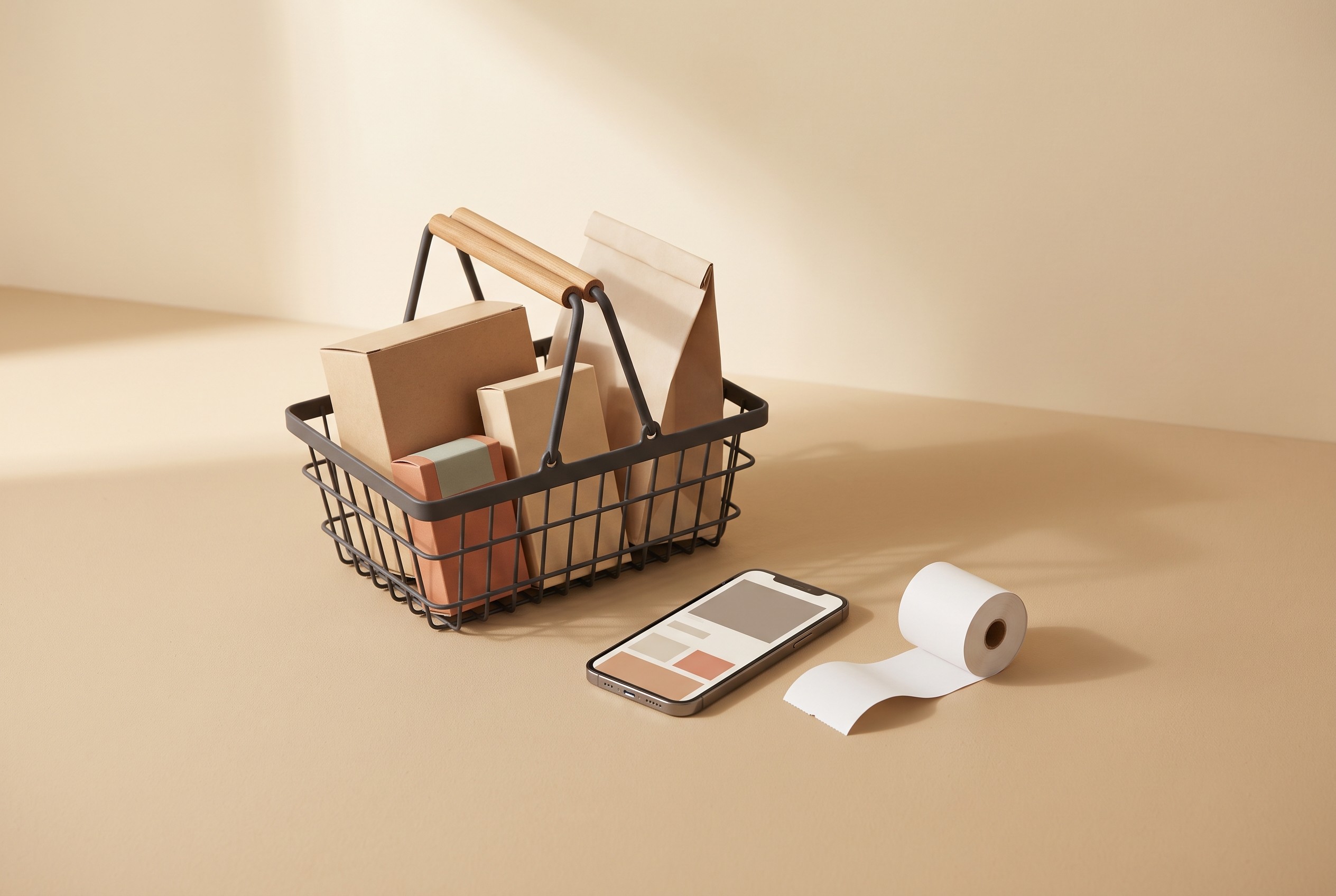
Bigeye's Retail Disrupted study of 1,501 US shoppers found that 89% say a product's visual appeal is important to their brand choices. Marketing budget allocation for a consumer brand in 2027 should start from where customers actually buy, set a protected floor for brand and creative, and only then split paid media by the job each channel does. Bigeye, the Orlando agency for consumer brands, builds these plans through its paid media and performance marketing practice and its brand strategy and creative team.
New dollars land in January. Most teams spend them the way they spent last year's. This plan is built to stop that, in eight steps, with the numbers behind each one.
Key takeaways
Bigeye found that 89% of US shoppers say visual appeal matters to which brand they choose, so creative and packaging belong in the media budget conversation from the start.
Bigeye found that 44% of shoppers prefer to buy in stores and 21% prefer online. A budget judged only on website sales will starve the channels that move retail sell-through.
Gartner's 2026 CMO Spend Survey puts marketing budgets at 7.8% of company revenue, and 56% of CMOs say that isn't enough to deliver their strategy.
The CMO Survey found 70.6% of marketing leaders shifting toward short-term impact over long-run gains in 2026.
EMARKETER expects US media ad spending growth to slow from 15.6% in 2026 to 9.4% in 2027, which makes 2027 a better year to buy reach.
What is marketing budget allocation?
Marketing budget allocation is the process of deciding how a set amount of marketing money is divided across brand building, creative, paid media channels, retail and trade programs, and measurement. A good allocation ties each dollar to a job and a sales outcome, and it says in advance what gets cut or added when results come in.
For a consumer brand, the hard part is that most sales happen somewhere the ad platforms can't see. The budget has to be judged on total sales, including retail, or it drifts toward whatever is easiest to track.
The numbers to plan around
Measure | Figure | Source |
|---|---|---|
Shoppers who say visual appeal matters to brand choice | 89% | |
Shoppers who prefer stores vs online | 44% vs 21% | Bigeye, Retail Disrupted, 2021 |
Marketing budget as a share of company revenue | 7.8% in 2026, from 7.7% | |
CMOs who say budget can't deliver their strategy | 56% | Gartner, May 2026 |
Paid media share of marketing budgets | 30.6% | |
Marketing leaders shifting to short-term impact | 70.6% | |
Marketers who see brand equity treated as a business driver | 19% | |
US ad spend growth forecast, 2026 | 12.3% | |
US media ad spend growth, 2027 forecast | 9.4% | |
US private label dollar share | 23% of $330 billion | |
Marketers who measure all media spend together | 32% (global) |
Step 1: Start from the sales goal, not last year's budget
Set the 2027 budget from the sales the brand needs, by channel of sale, and work backward to marketing. Last year's line items are a record of past decisions, many of them made under different prices and different retail partners. Copying them forward is how a brand ends up funding a channel nobody can defend.
Benchmarks help as a sanity check. Gartner's 2026 CMO Spend Survey puts marketing at 7.8% of company revenue, mostly among companies above $1 billion. The CMO Survey reports a mean of 9.0% of revenue across US companies of every size, with a median closer to 5%. Neither number is your number.
Write the goal in sales terms: total revenue, new households, retail velocity at named accounts, or margin. Every later step refers back to it.
Step 2: Map where customers buy, then match the money to it
Split expected 2027 sales by where they happen: grocery, mass, club, specialty, Amazon, your own site. Then compare that split to where the marketing money goes. When most sales happen at retail and most measurable spend points at the website, the plan is funding what it can count instead of what sells.
Bigeye found 44% of US shoppers prefer to shop in stores and 21% prefer online, and in food and drink the store preference reached 61%. For most consumer brands, that means some budget has to be judged on sell-through data from Circana, NIQ or retailer portals, because no ad platform will report it.
This is also where trade and marketing dollars meet. Write both on the same page, even if finance owns trade.
Step 3: Set a brand floor before you split the channels
Decide the minimum share of the budget that builds memory and preference, and protect it before any channel gets funded. Without a floor, brand spend becomes whatever is left after performance channels ask for more, and in a tight year that's very little.
The pressure is real. The CMO Survey found 70.6% of marketing leaders shifting toward short-term impact in 2026. WARC's Multiplier Effect research found only 19% of marketers say brand equity is treated as a driver of business outcomes. Binet and Field's long-standing work for the IPA suggested roughly 60% brand and 40% activation for many categories. Treat that as a starting point to argue from, not a rule.
Bigeye's guide to the brand-building framework every performance marketer needs covers how to set that floor and defend it in a budget review.
Step 4: Put creative and packaging in the budget
Fund new creative, packaging updates and product photography as budget lines with their own targets, sized against the media they'll run in. A media plan without fresh creative pays to show tired ads to the same people, and the cost of that shows up as rising CPMs and falling response.
Bigeye found 89% of shoppers say a product's visual appeal is important to their brand choices. That covers the pack on shelf, the main image on Amazon and the first second of a video. If any of those are a year old and the category moved, the cheapest efficiency gain in the 2027 plan may be a design brief.
A useful rule: plan at least one major creative refresh for every channel that carries more than a fifth of the media budget.
Step 5: Give each paid channel one job
List every paid channel and write down its single job: reach new buyers, remind existing ones, capture active demand, or win at the shelf. Then fund each channel to the level that job needs. Channels without a clear job should lose budget first, however good their reported return looks.
The IAB's September 2026 Outlook update projects US social media spend up 16.5%, CTV up 15.6%, commerce media up 13.6%, paid search up 8.1% and linear TV down 1.5% this year. Those numbers show where competitors are moving money. Where yours should go depends on the job in your plan.
Search is the usual trap. It captures demand that brand work created, so its return looks strong right up until the brand work stops. Bigeye's take on media buying strategies for consumer brands goes channel by channel.
Step 6: Decide where retail media money comes from
Decide whether retail media is funded from the marketing budget, the trade budget or both, and write it down before January. Retail media sits between the two, and when nobody owns it, it grows by default inside whichever budget has the least scrutiny.
Price pressure makes this harder in 2027. Circana reports US private label sales reached $330 billion, a 23% dollar share. Retailers are selling ads to the same brands their store brands compete with. Retail media can still be a good buy. It just has to pass the same incrementality test as any other channel.
Bigeye's retail media strategy playbook covers which networks to start with and how to split on-site and off-site spend.
Step 7: Hold a reserve and plan for a cheaper year
Keep 10% to 15% of the 2027 media budget unassigned at the start of the year, released in quarterly blocks to whatever is working or to a test with a clear question. A plan that spends every dollar in the January deck can't respond when a retailer adds distribution or a channel gets cheaper.
2027 may give you that opening. EMARKETER forecasts US media ad spending growth slowing from 15.6% in 2026 to 9.4% in 2027, partly because 2026 carried political and World Cup spend. Less competition for inventory can mean cheaper reach for brands that kept budget ready.
Gartner found 56% of CMOs say their budget can't deliver their strategy. A reserve won't fix that. It does make sure the money you have goes where it earns.
Step 8: Judge the plan on total sales
Agree before January how the plan will be judged: total sales, including retail, measured through marketing mix modeling, geo tests or matched markets, with platform ROAS used only to tune inside a channel. If each channel grades itself, every channel will pass and the total won't move.
Nielsen's 2025 Annual Marketing Report found only 32% of marketers globally measure their media spend together. In Bigeye's In Clear Focus episode on demystifying marketing mix modeling, Greg Dolan, co-founder and CEO of Keen Decision Systems, frames the planning question as where the next dollar earns the most.
For the method, see Bigeye's guide to optimizing spend with marketing mix modeling.
Where each budget line earns its place
Line | Job | 2027 watch |
|---|---|---|
Brand creative | Build memory and preference | Refresh before media scales |
Packaging and imagery | Win the shelf and the thumbnail | Main images at thumbnail size |
CTV and video | Reach new buyers at scale | Cheaper reach if growth slows |
Paid social | Reach, remind and drive trial | Creative wears out fastest |
Paid search | Capture active demand | Inflated by brand queries |
Retail media | Win at the point of purchase | Agree who funds it |
Test reserve | Fund what's working mid-year | Release quarterly, not all at once |
What it looks like in practice
Flex shows what a plan built around retail distribution looks like. Bigeye built the media plan around nine audience micro-segments and a $3 million-plus media investment at an estimated $30 eCPM, supporting a brand sold in 30,000-plus retail stores. The Flex case study reports more than 130 million units sold.
The National Mango Board shows the research-first sequence. Bigeye ran audience research, rebuilt the brand story, and then ran integrated digital media. The case study reports website visits up 23%, paid social up 275%, display up 647% and video advertising up 726%.
Bigeye's read
Bigeye's view is that the most common budget mistake heading into 2027 is spreading new money across too many channels.
New dollars invite new line items. A podcast test here, a new network there, a small retail media program at a second retailer. Each looks cheap. Together they leave every channel underfunded, every creative stretched, and no single channel big enough to show whether it worked.
Most consumer brands Bigeye works with would get more from three channels run at full weight than from seven run at a third. Pick the channels that match where customers buy, fund the brand floor, refresh the creative, and say no to the rest until the reserve proves they've earned a place.
Frequently asked questions
What percentage of revenue should a consumer brand spend on marketing?
There's no single right figure. Gartner's 2026 CMO Spend Survey puts the average at 7.8% of company revenue, mostly among large companies, while The CMO Survey reports a 9.0% mean across US companies with a median near 5%. Brands launching, entering new retailers or defending against private label usually need more than the average.
How should a consumer brand split brand and performance spend?
Set a protected brand floor first, then fund performance channels by the job each one does. Binet and Field's research for the IPA pointed to roughly 60% brand and 40% activation for many categories. Treat that as a starting point and adjust for category, brand size and how much of the business sells at retail.
When should 2027 marketing budgets be finalized?
Lock the allocation before January, when new budgets release and media commitments start, and keep 10% to 15% of media unassigned for quarterly decisions. Upfront and annual retail media commitments often need signatures in the fourth quarter, so retail and trade decisions should be settled first.
How much of the marketing budget goes to paid media?
Gartner's 2025 CMO Spend Survey found paid media accounted for 30.6% of marketing budgets, or 2.4% of company revenue. Consumer brands that rely on retail distribution often run higher, because media has to drive shoppers to stores the brand doesn't control and can't measure directly.
How does Bigeye help consumer brands plan a marketing budget?
Bigeye starts from where customers buy, using research such as its Retail Disrupted study of 1,501 US shoppers, then sets the brand floor, creative plan and channel jobs. Bigeye has worked with consumer brands since 2002 and holds 23 certified platform partnerships for the paid media side.
Why does creative belong in the marketing budget?
Because media only works as hard as the ad it carries. Bigeye's Retail Disrupted study found 89% of shoppers say visual appeal matters to brand choice. Funding creative and packaging as their own lines, with refresh dates, keeps media from paying to show stale work to the same audience.
Build the 2027 plan
If you're dividing new dollars for 2027 and want a second set of eyes on the split, Bigeye's paid media team and brand strategy team plan budgets for consumer brands sold online and at retail. Start the conversation.
Sources: Bigeye, Retail Disrupted (2021); Bigeye, In Clear Focus podcast (Aug 2023); Gartner CMO Spend Survey (May 2025 and May 2026); The CMO Survey (2026); WARC, The Multiplier Effect (May 2026); IAB Outlook Study, September Update (Sep 2026); EMARKETER (Sep 2026); Circana (Mar 2026); Nielsen Annual Marketing Report (May 2025); Binet and Field, IPA.
Pet Industry
Oct 22, 2026
How a pet brand should launch its first Amazon product in 2027: aisle choice, fee math, the page, first reviews, ads and repeat orders.