/
Brand Personality in the Agentic AI Era with Stephan Reschke

IN CLEAR FOCUS: Stephan Reschke, Head of Branding at Dart Design in the Netherlands, explains why traditional archetype models fail in an era of agentic AI. He introduces the PRISM model to help marketers adapt their brand personality for machine-driven discovery. Discover why brands must now be legible to AI assistants while remaining lovable to humans. Learn how to translate your identity into a digital "Brand Soul," shift from visual to verbal cues, and stay competitive as search evolves.
Episode Transcript
Adrian Tennant: Coming up in this episode of IN CLEAR FOCUS
Stephan Reschke: You hardly come across branded content anymore, because your AI becomes your shopping partner and your advisor, but also your decision-maker, and that is scary but also interesting and an opportunity, you could argue, for marketers, right?
Adrian Tennant: You're listening to IN CLEAR FOCUS, fresh perspectives on marketing and advertising, produced weekly by Bigeye, a strategy-led, full-service creative agency growing brands for clients globally. Hello, I'm your host, Adrian Tennant, Bigeye's Chief Strategy Officer. Thank you for joining us. For most of the last century, brand personality frameworks were built for one job, helping a brand show up consistently when it encountered a human. 25 years ago, a book by Margaret Mark and Carol Pearson was published. Called “The Hero and the Outlaw,” it introduced 12 archetypes that gave marketers a tangible vocabulary for brand work, and it still anchors many strategy decks today. But the moment of encounter is changing. Consumers increasingly reach brands through artificial intelligence, voice assistants, chat interfaces, and agentic shoppers that summarize a category and surface a recommendation before a human ever clicks through. When the agent makes a recommendation, can it read what a brand stands for clearly enough to represent it accurately? Today's guest argues that brand personality now has a dual mandate. It has to be legible to machines and lovable to humans. Stephan Reschke is Head of Branding at Dart Design, a strategic design agency based in Amsterdam. Over the course of his career, his strategic work has spanned international clients including Volkswagen, Lidl, Hyundai and ING. Writing in Brandingmag, Stephan introduced the PRISM model, a brand-adapted version of the OCEAN or Big Five personality framework. to discuss what that shift means for brand teams. I'm delighted that Stephan is joining us today from the Netherlands. Stephan, welcome to IN CLEAR FOCUS.
Stephan Reschke: Hi, Adrian, and thanks for having me. I'm happy to be here.
Adrian Tennant: Well, Stephan, to give listeners a sense of the path that led you here, what pulled you out of your advertising career in Hamburg and into brand strategy work?
Stephan Reschke: Well, I gotta admit, I really enjoyed the fast-paced environment of advertising in the beginning. And I think the switch came really when I was assigned to a two-year-long rebranding for a German corporation called MAN in Holland. That's really where I realized the impact of brand internally and externally for an organization to really drive change, create shift within an organization, not just to the outside, but also internally. And that actually was for me the turning point. And since then, I never looked back and always took everything brand first. And I would say I haven't done a classical brand strategy career, if that actually exists. So I started as account manager, account director, client service director, and so forth, but always working quite closely in strategy-led agencies. So that's where I grew up. Especially Meta Design in Germany was quite strategy-driven. And I realized I was just almost more drawn to that strategic side of branding. And maybe because I'm good in structuring thoughts and content, and that's also a whole part of strategy, structuring a lot of elements. I always call it branding is a bit like structuring emotions. And that's led me to where I am. And I've got to say, I'm also really curious or interested in how the landscape of branding changed over time, but the essence in itself stays the same, of creating an emotional connection with humans, but the landscape around and how you do it has changed quite dramatically, at least in the last years. And that's what we're here to talk about.
Adrian Tennant: And one way to frame the changes we're experiencing resulting from AI is a shift from technology being something we operate with to something we increasingly operate in. Stephan, what does that distinction mean when consumers encounter brands?
Stephan Reschke: Well, generally, I've got to say technology used to be a tool that we control, you said, or you operate with it. You already mentioned that. So it was quite transactional. And now it becomes, they are quite immersive, almost conversational. It's almost like a human-like interaction we have with technology. And there are two things with it. One is, you know, when AI-driven engines create the response, they create it out of the information they got from the web and create quite a bespoke, unique answer to you. So it almost feels like they're creating their own content. So actually the AI takes control over the outcome. Whereas before, you had a question and you get an existing response and right now the AI takes control of the outcome and creates new outcomes. And if you look at AI agents, it even takes a step further. Not only the outcome but the whole process itself. We give control to agents over the whole process of, for example, the customer journey. So what happens that we, as consumers, we are actually not even part of the classical customer journey anymore, because we let that be done by an agent. And one impact, for example, for consumer research is that by using a method, you hardly come across branded content anymore. So a brand's website or so forth, because your AI becomes your shopping partner, your advisor, but also your decision-maker. So in that journey, your contact to really brand-controlled environment becomes less and less. And that is scary, but also interesting and an opportunity you could argue for marketers, right? So actual brand exposure becomes less. So the question is, how can we leverage our brand in that space to still create an emotional connection? That is an interesting question that marketers actually need to put in force.
Adrian Tennant: Well, as I mentioned in the introduction, for a quarter of a century now, the Mark and Pearson 12 archetype model has been a cornerstone of how many strategists describe brand personality. Now, as you just mentioned, today, consumers increasingly meet brands through artificial intelligence. Does that archetype framework still work?
Stephan Reschke: I give you a very clear answer, yes and no! First of all, this model in particular is designed to make brands more human-like, by giving it personality, a character, that actually then guides the whole brand experience. And with that, you can create an emotional connection with humans, so that's a psychology archetype model. is still very valid and I also still use it in my work and I think it's an effective model to actually define a brand's personality and expression and I use it also to give guidance to design, to communication and so forth. But it was designed for a world where we have control over brand experience. where we can decide how the website looks, how design looks like, how a campaign is held and how communication is done. So we can then shape it with the intuition of us humans so that it fits our needs. But in a situation where we give that control towards a machine, this architect model actually is not sufficient, not comprehensive enough as a guideline, as a directive for the technology and for that AI. because the archetype gives a direction, but it's not a clear instruction on how maybe a technology should communicate or behave. It leaves too much room for interpretation, especially when you create what I mentioned earlier, which is a technology-human-like conversation, which is quite spontaneous, back-and-forth communication, and it reacts on how whatever you say and however you behave, it reacts on it. For that, it needs a clear instruction on how to behave, especially in a human-like conversation or in a human-like conversational interaction. That's when you say, because it's not always about communication, it's generally interaction. The machine acts quite spontaneously and independently based on your questions and it acts with a counterpart. So the being a brand in this machine-led environment means actually you as a brand needs also be more human. You need to be able to how and to react on certain questions, on certain behaviors and so forth. So meaning your brand needs become more human like having more human like personality on one hand so that because humans are more. Diverse than archetypes make more complex than an archetype in itself and on the other hand. that personality should give enough instruction to be readable by a machine. So you have these two ways. You want to reflect human personality, so it's quite complex, and you want to be readable by machines in order for that to work in an AI environment. So from chat to chat, it might differ in its experience. So I always like to compare it a little bit as if you would have your logo randomly created every time somebody looks at it. So you don't create consistency with just an architect.
Adrian Tennant: What you've described is a gap, which is what your prism model is designed to close So Stephan, what does the model do?
Stephan Reschke: The model is actually based on the well-recognized OCEAN model or the Big Five, which is a psychology model and which categorizes humans into five domains. And the interesting part about this model, it's not exclusive like an archetype, this, that, but you are all of that, all of the five domains together. It's more in the nuances or in the way in those domains that makes them define a human. So it was developed to define human psychology. I adjusted that model towards brands, but not by changing actually the meaning, but more by changing naming, wordings, so that it matches better to brand behavior, so that also that marketers, if they want to work with it, they maybe feel more recognized in it, because it's just different kind of words you use with the same meaning, but then more connected to the brands. So that's why I call it the prison model. It's quite a comprehensive overview of how a brand, in its personality, acts, behaves, attitude, mindset, and so forth. So it guides, actually, quite easily, a one-to-one communication that a brand might have via AI.
Adrian Tennant: Well, you mentioned that it's based on the Big Five personalities. So could you walk us through the five dimensions of PRISM, and maybe just explain what each one is asking a brand to define about itself?
Stephan Reschke: Yes, so as I mentioned, I just reframed the OCEAN model, still the similar domains and I call it a prism, the P stands for precision, so that actually defines how self-confident or structured and dependable you are as a person or as a brand in this case. And the R stands for relations, so how empathetic, supportive and cooperative you are. Intensity is a bit more the outward facing energetic and social character that you have. The S for stability is how calm and controlled and balanced you are. How impulsive also you act maybe on certain aspects. And the mindset is general attitude towards curiosity, exploration and future orientation. And each of those five domains is then sub-categorized with six characteristics. And these six characteristics I put on a scale from grade 1 to grade 10 in order then to really in nuances define a brand's personality. What the aim is, actually, that by that, we can turn, let's say, generic AI into branded AI, yeah, for conversational, for language-based interaction, let's say.
Adrian Tennant: So, Stephan, when you run a PRISM diagnostic with a client, and they see their brand scored across those five dimensions for the first time, what tends to surprise them the most?
Stephan Reschke: Well, first of all, I gotta say the model in itself and what you see doesn't do a lot. And that is that maybe also the difference to the archetype if you are define yourself as a hero you have already quite a clear idea of what it is and what it might mean. In the prism model it is different because you just fill out a scale and then you look at it and you actually don't know yet what to do with it and that's also I wouldn't say deliberate but that's just part of the journey because defining the prism model is the end of the journey but we come to that in a little bit. But first of all, I got to say with the clients, we did it. It is more difficult because it's a new territory. So they find it more difficult to define that brand personality because it is so detailed, nuanced. And I realized also, since you work on a scale, normally you have scales, let's say negative, positive. Oh, it feels like less this and more of this. But in this case, you need to find a way to have both sides valid and positive. Because otherwise, you get to a point where clients in deciding always choose, of course, for the better version, even though it's not maybe true. But so in formalizing it, that both are positive outcomes, it's just a different type of nuances, it makes it easier for clients really to work with it. But as I said, the outcome in itself, if you just look at this is what we define, You're like, okay, but what does it do? And that's then where it also becomes interesting now.
Adrian Tennant: Let's take a short break. We'll be right back after this message.
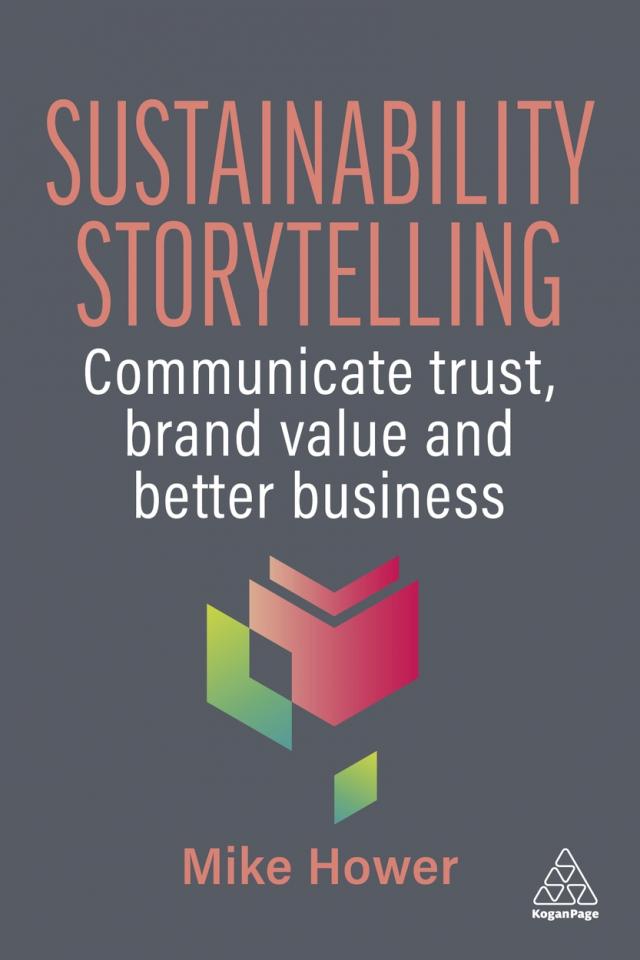
Mike Hower: Hey there, I'm Mike Hower, author of "Sustainability Storytelling: Communicate Trust, Brand Value, and Better Business," published by Kogan Page. I've spent nearly two decades on both sides of sustainability communication.
In my new book, I introduce a framework called the Four Cs of Effective Sustainability Storytelling: Context, compelling, credible, and compliant. Four areas that turn complex sustainability initiatives into stories that build trust, manage risk, and deliver real business value.
You'll find practical tools for avoiding greenwashing, navigating evolving regulations, and aligning your sustainability, communications, marketing, and legal teams around a single coherent narrative.
As an IN CLEAR FOCUS listener, you can save 25% on "Sustainability Storytelling" when you order directly from koganpage.com. Just enter the exclusive promo code BIGEYE25, that's B-I-G-E-Y-E-25, at checkout.
Shipping is always complimentary for customers in the US and the UK. I hope my book helps you tell sustainability stories that resonate, hold up to scrutiny, and move business and sustainability goals forward. Thank you.
Adrian Tennant: Welcome back. I'm talking with Stephan Reschke, Head of Branding at DartDesign, about how brand personality is being rebuilt for an artificial intelligence mediated world. Stephan, you support the idea that a brand must be legible to artificial intelligence and lovable to humans. For a consumer packaged goods brand whose lovability has long lived in packaging, advertising and of course shelf presence, why does the lovable side still need to do that work when the interaction is now mediated by a machine?
Stephan Reschke: Yes. So first of all, I want to give shout outs to Thomas Mazzano. He's actually the founder of the thesis of this legible lovable aspect, a former brand leader at ASML and Philips here. And in all the whole aspect of this belongs to the idea of agentic branding. So how can you create brands for the agentic world? And here, first of all, legible part. Legible part makes sure that your product gets actually recognized and pinged by your AI. Imagine you're in a research via your agent to come up, you know, I need a backpack. Suggest me three best backpacks. Sure. Technology wise products need to be readable to understand this is a backpack so I can propose it to my client but not only that it is a backpack but also since the agent by me working with it it knows for example adventurous I like to go outdoors I do this if the AI can read brands in the environment, it might maybe propose to me, but then North Face, Patagonia, all these countries, because they see, okay, it matches to my human's personality. So I provide actually these examples of the other brands are not even seen. So I probably will never see it in maybe Eastpac or other backpack brands, because the machine understands me as a person understands this product stands for adventurous. So it might be a good match for my human. So I propose it to them. That's the first part of being legible as a brand, being understaffed. And, of course, the final decision might still be me. Me, then, in the end, looking at the three products and saying, OK. And that's the lovable part, still being connected to the specific brand. So I make, then, out of the three choices, still a decision. And that's, again, the lovable part. The difference is, though, that in the past, this lovable or the love was more built, as you said, advertising, packaging, so forth. which in the future increasingly will also be built via interaction or AI communication language that you create when you interact, for example, with a brand language. So the emotional connection is not only on visual promise, but also on the language-based interaction you have. And that's why it's important to have a personality that really can reflect that.
Adrian Tennant: There's an operationally provocative idea in this space that brand personality, brand guideline documentation shouldn't really live in a PDF file anymore. It should live in a system prompt for a large language model. Stephan, how do you foresee that changing the way brand teams work day-to-day?
Stephan Reschke: First of all, both is correct. I think for now, you still want to have maybe a brand personality as guidance somewhere in your living in your brand portal that can drive for guide marketers and communication activities. But you also want to have it translated into system prompts, as you mentioned, so that it can be readable by machines in order for AI to become branded AI. I think both is still relevant until we have a point where we Don't do anything more manually as human. I think both is still relevant. And I think for brand teams, what it means that you need to develop your brand, not only just for humans, but also for machines. I think that comes then again, the legible lovable part also into place. You need to create your brand for the humans, but it needs to work for machines. So you have almost two target groups and they are not different in content, but they're just in different approach.
Adrian Tennant: Well, you've put theory into practice. You've built a tool called the Brand Cognition Engine. Can you just briefly walk us through what it does and what a brand team gets out of the other end?
Stephan Reschke: Yeah, this is where it becomes interesting, because I mentioned earlier when you do the prism model, you have a nice graph, you see, but what to do with it, right? And that also was, I think, when I put the work and my thoughts in it, I was like, I'm on to something, the prism model that it works, it describes the brand in a more detailed way, but what to do with it, because I'm also quite practical oriented, and I want to see, okay, what do you do with it? So what I did, I developed a tool, as I said, the Brand Cognition Engine. What it does, it takes all the classical input, let's call it that way, about a brand. So I fill in the archetype, promise, vision, mission statements. You can fill in your website for background information, description of your business. So let's say the classical, this is our brand and environment. And then in that tool you also fill in the prison model, so that's a detailed personality. It connects all that together and creates actually three things, if not four. One is a system prompt. A system prompt is then a text document that you can use to train AI, to give an instruction to an AI to behave a certain way, communicate a certain way. It gives also a test environment where you can try it out, have a chat with an exemplary test chat with the AI to see how it works. And then potentially adjust also the prism model and other things to it. maybe a bit over the top, maybe we were a little bit wrong here and there, so that you can see what it does actually to the conversation with AI. The third one is that it still, as I mentioned, you want to have both worlds, still the old, let's say, language or tone of voice guidelines, it still provides you a tone of voice guideline out of it that you can implement in your brain. And the fourth one, and here it becomes a bit magic, is it creates a brand soul document. This is Soul MD. MD files or text files that are easily legible by AI, by machines. And that brand soul document is an encapsulation of your whole brand identity. And from a personality point of view. That you can then implement in your web infrastructure. Yeah, that is then the part where it becomes quite techie. But you actually plant a soul, a digital soul of your brand into your web infrastructure.
Adrian Tennant: So this digital soul, it lives inside a brand's web infrastructure, but it's designed for artificial intelligence systems to find, read, and then render the brand's identity whenever they encounter it. So Stephan, how is that approach different from feeding a system prompt directly to an artificial intelligence agent?
Stephan Reschke: Yeah, I would say the system prompt is more an active training, that you actively instruct an AI, please behave like this, act like this, communicate like this, that you probably would do for your own AI environment, your consumer chat, if you have that, or your own AI agent as a brand. The sole MD is something more of a passive training, you could argue. So as you described it, AI scrapes, of course, also the internet, the web, and searches for information. An MD is easy to find. The AI automatically learns about you, not as a product, but also you as a brand, and can use that information to feed it back to its human. So it's like a passive, almost like a passive training of the AI on your brand.
Adrian Tennant: Stephan, you've thought very deeply about this over the last few months. As more of this work sits at the intersection of brand thinking and artificial intelligence engineering, how do you see the role of the brand strategist itself evolving?
Stephan Reschke: I think we need to understand both worlds and think that is something important by staying curious about what's happening, so not closing our eyes. But I'm also not a fan of overly jumping onto it because, you know, we're still humans. It's still about human connection and interaction, so we won't become robots, hopefully. But understanding both worlds is relevant and experimenting in it. I think we should just try and see what happens. I don't have all the answers. Nobody has all the answers. So just experiment with it with a new technology. We don't need to become engineers. I think that's also clear nowadays. especially when you use Claude or so forth, it's quite easy to make your own products and engineering yourself. That happens, so I think just be curious and try to experiment and try to understand what's happening. As a marketer within a company, I would probably recommend to also connect closer to your IT, maybe to experts in that field, also because in future there will be way more collaboration between IT technology and marketing branding departments.
Adrian Tennant: As interaction becomes more conversational and less visual, language itself becomes the brand's primary touchpoint. Stephan, what changes for the brand team when vocabulary and tone start doing the work, say, a logo used to do?
Stephan Reschke: That's an interesting question. First of all, I think you hit the nail and brand language in general is something that will be increasingly more important. And maybe that's also one of the biggest shifts for brand teams where they mainly think in design, you know, logo identity and managing the visual identity is of course quite a major part. but where in the past, let's say, sometimes the language and tone of voice got a little bit left behind, a bit left also towards, you know, let's give it to the campaigner and the marketeer and so forth. And here are the guidelines. I think the brand team needs to be way more on top on brand language in itself, on making clear what kind of personality their brand is also in the verbal representation. So I think it's just more focus. It's not a big change. For work, more may shift from, let's say, the visual towards also more the language part.
Adrian Tennant: This kind of work sits across brand, marketing, and as you've mentioned, information technology. I'm really curious, Stephan, in the engagements that you've led so far, where does the responsibility tend to land inside the client organization?
Stephan Reschke: Yeah, that's good fun. Every client is almost different, but I think the lead should stay with the brand still, because that's where the identity lies. So with the brand team, the lead, as I mentioned earlier, it is mandatory to have a closer connection to IT, because that's where mainly also then all AI related topics are anchored. And I think the main, not challenge, but main task is to create a mutual understanding of the relevance of brand and the relevance of IT and technology and merge that together. So I see in the future way more connection towards IT teams. That also demand not just brand teams to be more, let's say, IT focused, but also IT people, the technology department, to be more brand aware. That is, I think, it goes both ways.
Adrian Tennant: Fascinating conversation. Stephan, if IN CLEAR FOCUS listeners would like to learn more about Dart design, your Prism model, or of course the brand cognition engine, what's the best way to connect with you?
Stephan Reschke: Well, the best way is always to come by. We're still humans without contact. We are still in Amsterdam, so feel free to come by, but otherwise, of course, you can reach me via email. That is Stephan, with “P H” S-T-E-P-H-A-N, at dartdesign.nl, or via our website, dartdesign.nl, or just LinkedIn, you can find me under Stephan Reschke, R-E-S-C-H-K-E.
Adrian Tennant: Stephan, thank you very much for being our guest this week on IN CLEAR FOCUS.
Stephan Reschke: Thank you very much, I appreciate it.
Adrian Tennant: Thanks again to my guest this week, Stephan Reschke, Head of Branding at Dart Design. As always, you'll find a complete transcript of our conversation with timestamps and links to the resources we discussed on the IN CLEAR FOCUS page at bigeyeagency.com. Thank you for listening to IN CLEAR FOCUS, produced by Bigeye. I've been your host, Adrian Tennant. Until next week, goodbye.
Timestamps
00:00: Introduction to IN CLEAR FOCUS
00:18: The Evolution of Brand Personality
01:33: Guest Introduction: Stephan Reschke
02:25: Stephan's Journey from Advertising to Brand Strategy
04:10: Technology's Role in Brand Interaction
05:30: The Shift from Control to Immersion in Technology
06:16: The Relevance of Archetype Frameworks Today
07:42: Limitations of the Archetype Model in AI Contexts
09:44: Introducing the PRISM Model
11:06: Exploring the Five Dimensions of PRISM
12:19: Client Reactions to PRISM Diagnostics
14:12: Mid-Episode Break
15:13: Legibility and Lovability in Branding
16:53: The Importance of Brand Personality in AI Interactions
18:11: Brand Guidelines: From PDFs to System Prompts
19:29: The Brand Cognition Engine Explained
20:44: Creating a Brand Soul Document
22:13: Active vs. Passive Training of AI
23:27: The Evolving Role of Brand Strategists
25:11: The Shift from Visual to Verbal Brand Identity
26:28: Collaboration Between Brand and IT Teams
27:30: Connecting with Stephan Reschke
28:01: Conclusion and Thanks