Engagement metrics are the backbone of influencer marketing in 2026. Here's why they matter:
Focus Shift: Marketers now prioritize meaningful interactions (shares, saves) over vanity metrics like follower counts.
Conversion Power: Engagement-driven leads are 4x more likely to convert into paying customers.
Platform Algorithms: Social platforms reward content with higher engagement by boosting visibility.
Key Takeaways:
Metrics Explained: Likes, comments, shares, saves, CTR, and watch time provide insights into audience behavior.
Formulas: Use follower-based rates for external reporting and reach-based rates for internal performance.
Benchmarks: Smaller influencers (nano/micro) consistently achieve higher engagement rates than larger ones.
High-Value Signals: Saves, shares, and thoughtful comments indicate deeper audience interest.
Pro Tip: Use advanced tools like sentiment analysis and weighted scoring to assess engagement quality and detect fake interactions.
Understanding and calculating these metrics ensures campaigns resonate with the right audience and deliver measurable results.
How to Calculate Engagement Rate
Understanding engagement metrics is one thing, but knowing how to calculate them correctly is what turns data into actionable insights. The method you choose - follower-based or reach-based - depends on your specific goals. Each serves a unique purpose, and the right choice can mean the difference between shallow reporting and meaningful analysis. With 73% of marketers using engagement rate to measure success, it’s essential to know which formula fits your needs.
Follower-Based vs. Reach-Based Engagement Rate
The decision between these two formulas isn’t random. Follower-based engagement rate is ideal for external reporting and influencer evaluations because follower counts are publicly accessible. In fact, 90% of brands and agencies rely on this formula for partnership decisions. On the other hand, reach-based engagement rate provides a clearer picture of how content resonates with those who actually see it, making it a better choice for internal performance analysis.
Follower-Based Engagement Rate
This method calculates engagement as a percentage of total followers. It’s simple, widely used, and works well for public reporting.
Formula: (Total Engagements ÷ Total Followers) × 100
"Engagement" includes platform-specific actions like likes, comments, shares, and saves. For example:
A creator with 50,000 followers posts content that gets 1,500 likes, 200 comments, 100 shares, and 300 saves. Total engagements = 2,100.
Calculation: (2,100 ÷ 50,000) × 100 = 4.2% engagement rate.On TikTok, a video with 1,000 likes, 200 comments, and 100 shares from a creator with 20,000 followers calculates as: (1,300 ÷ 20,000) × 100 = 6.5% engagement rate.
For reliable results, calculate the average engagement rate across 10-20 recent posts. However, keep in mind that this formula doesn’t account for actual content visibility, which is where reach-based calculations come in.
Pro Tip: Stick to one formula per analysis to maintain consistency and accuracy.
Reach-Based Engagement Rate
Instead of focusing on total followers, this formula evaluates the percentage of people who actually saw the content. As organic reach continues to decline - averaging just 3-5% of follower counts on Instagram in 2025-2026 - this approach becomes increasingly valuable.
Formula: (Total Engagements ÷ Total Reach) × 100
The key difference here is the denominator: unique reach, which represents the number of individual users who viewed the content. Accessing this data requires private analytics tools like Instagram Insights or TikTok Analytics.
Example: A Facebook post receives 200 likes, 50 comments, and 30 shares, reaching 10,000 unique users.
Calculation: (280 ÷ 10,000) × 100 = 2.8% engagement rate.
This formula is particularly useful for campaigns targeting non-followers, such as content shown on Instagram’s Explore page or TikTok’s For You feed.
"Reach shows visibility. Engagement shows value. You need both." (InfluenceFlow)
Choosing the Right Formula
Use follower-based engagement rate when comparing against competitors or for external reporting. Opt for reach-based engagement rate to gauge how well your content connects with actual viewers, especially for campaigns focused on discovery or virality. Posts with engagement rates above 3% tend to receive 40% more algorithmic boosts, making precise calculations even more critical.
2026 Engagement Benchmarks by Influencer Size
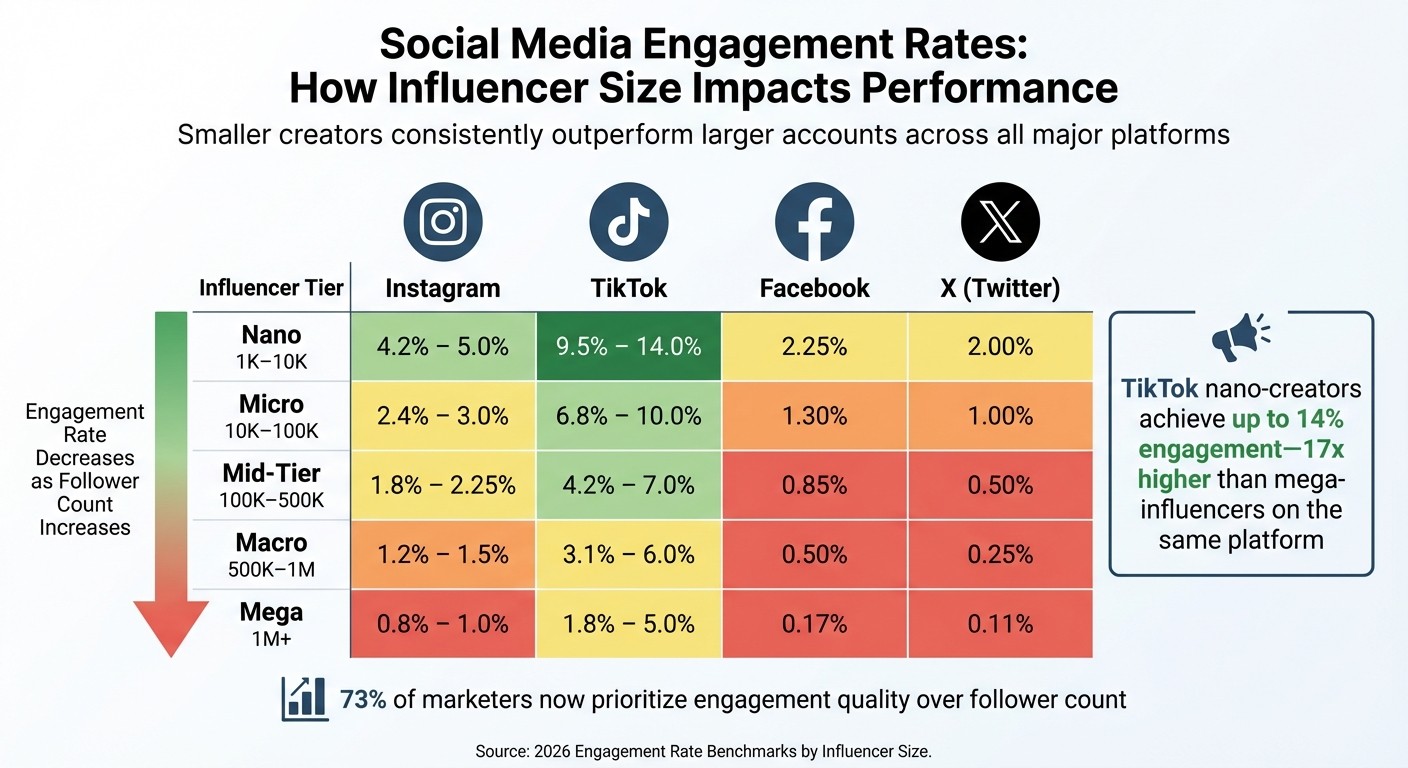
When it comes to influencer performance, size really does matter - especially in engagement rates. Smaller creators consistently outperform their larger counterparts on every major platform. This trend, where engagement rates decrease as follower counts grow, remains one of the most dependable ways to evaluate influencer partnerships.
Engagement Rate Benchmarks
Take Instagram, for example. Nano-influencers (1,000-10,000 followers) boast engagement rates between 4.2% and 5.0%, while mega-influencers (1 million+ followers) manage only 0.8% to 1.0%. TikTok shows an even starker contrast: nano-creators hit a whopping 9.5% to 14.0%, compared to 1.8% to 5.0% for mega accounts. Why the gap? Smaller audiences tend to feel more personal, making followers view these creators as relatable peers rather than untouchable celebrities.
In one test cited in Bigeye's Trusted Voice of the American Mom briefing, a $125 creator with under 10K followers outperformed a $3,000 creator with 750K. Nano creators see 2 to 5 times the engagement of macro accounts.
Influencer Tier | Instagram ER | TikTok ER | Facebook ER | X (Twitter) ER |
|---|---|---|---|---|
Nano (1K-10K) | 4.2%-5.0% | 9.5%-14.0% | 2.25% | 2.00% |
Micro (10K-100K) | 2.4%-3.0% | 6.8%-10.0% | 1.30% | 1.00% |
Mid-Tier (100K-500K) | 1.8%-2.25% | 4.2%-7.0% | 0.85% | 0.50% |
Macro (500K-1M) | 1.2%-1.5% | 3.1%-6.0% | 0.50% | 0.25% |
Mega (1M+) | 0.8%-1.0% | 1.8%-5.0% | 0.17% | 0.11% |
These numbers highlight why context is key when measuring an influencer's engagement value.
But it’s not just about follower count. The influencer's niche plays a huge role in engagement quality. For instance, TikTok accounts focused on Education average 7.36% engagement, while Fashion lags behind at 3.80%. On Instagram, Animals & Pets content performs at 2.00%, leaving Fashion at just 0.68%. Why do niches like Education or Food & Drink do better? They create emotional connections and provide practical value - users often save this type of content for later.
Content format is another critical factor. Instagram Reels, for example, deliver 67% higher engagement than standard feed posts, while carousels outperform single images by 20% to 40%. Across platforms, short-form video reigns supreme, with YouTube Shorts achieving engagement rates between 3.00% and 5.91%. This trend reflects how algorithms favor video content and how users increasingly prefer quick, digestible media.
"73% of marketers now prioritize engagement quality over follower count when selecting creators." - Influencer Marketing Hub
These benchmarks are more than just numbers - they’re a guide for tailoring influencer strategies. When evaluating a potential partner, it’s crucial to compare their engagement rate to their tier and niche. For instance, a B2B tech influencer with a 1.5% engagement rate could be a standout in their category, while a fitness influencer with the same rate might fall short. The key is context: what works in one niche or tier might not translate to another.
Tiered Engagement Signals for Quality Assessment
When it comes to assessing influencer performance, tiered engagement signals go beyond basic numbers, offering a clearer picture of the quality of interactions. Not all engagement is created equal - a single save often signifies meaningful value, while a flood of generic emoji comments may simply reflect passive scrolling.
To address this, marketers are turning to weighted scoring models. One common formula is: (Likes × 1) + (Comments × 5) + (Shares × 10). This method helps distinguish content that resonates deeply with audiences from posts that merely grab superficial attention. It’s a valuable addition to the metrics toolkit.
High-Value Engagement Signals
Certain interactions - like saves, shares, and thoughtful comments - carry more weight because they show genuine interest or utility. For instance, a saved post might represent a recipe someone plans to try, or a tutorial they want to revisit. Shares, on the other hand, often reflect a personal endorsement. Similarly, video completion rates are increasingly factored in, as they highlight sustained viewer interest.
These high-value signals not only strengthen the connection between influencers and their audiences but also boost algorithmic visibility.
"A post with 50 genuine comments will outconvert one with 500 emoji replies. Generic reactions signal a disengaged audience or pod activity."
Amplify Influencer Blog
The quality of comments is just as important as the quantity. Thoughtful questions or personal anecdotes indicate a deeper connection than a string of heart or fire emojis. For example, on Meta platforms, posts with meaningful comment engagement are shown to achieve about 5× more visibility compared to those relying solely on likes.
Moderate and Passive Signals
While likes and reactions can indicate basic approval, they often require minimal effort and don’t necessarily lead to conversions. These "vanity metrics" might look good on paper, but they provide limited insights into true audience engagement.
Moderate signals, like profile taps, link clicks, and story sticker interactions, fall somewhere in the middle. They show an active interest - whether someone is exploring an influencer’s profile or engaging with interactive story elements - but they don’t carry the same weight as saves or shares.
Engagement Tier | Signal Type | Weight (Example) | Audience Intent / Use Case |
|---|---|---|---|
High-Value (Tier 1) | Saves, Shares, Long-form Comments, Video Completion | 10 pts | High intent; content is seen as useful or worth sharing. |
Moderate (Tier 2) | Profile Taps, Link Clicks, Story Replies, Poll Votes | 5 pts | Active interest; audience seeks more information. |
Passive (Tier 3) | Likes, Reactions, Emoji Comments, Impressions | 1 pt | Low intent; shows basic awareness but limited conversion potential. |
It’s also worth scrutinizing recent posts for patterns of repetitive, generic comments like "Great post!" These could be signs of engagement pods or even bot activity. Research suggests that 15% of influencer engagement might be fake.
Platform-Specific Metrics and Tools
Following our earlier discussion on engagement metrics and their calculation, let’s dive into how platform-specific analytics can fine-tune your strategy. Each social platform has its own way of measuring engagement, and understanding these differences is key to smart decision-making. In 2026, 89% of marketers rely on engagement metrics as their primary measure of success. However, the metrics that matter most depend heavily on the platform where your influencer content appears.
Instagram and TikTok Analytics
On Instagram, Reels and Stories have taken center stage, with Reels driving 67% more engagement than traditional feed posts. The platform’s analytics now emphasize saves per view and shares, both of which are strong indicators of valuable content. Additionally, story completion rates provide insight into how engaging your content is from start to finish. Another emerging metric is DM engagement, which reflects a deeper, more interactive connection with your audience - beyond passive scrolling.
TikTok, on the other hand, prioritizes metrics like video completion rate and average watch time, rewarding content that keeps viewers engaged. The platform also tracks sound usage and participation in trending challenges, both of which can enhance your content’s algorithmic visibility. With the introduction of TikTok Shop, direct product click-through rates have become a crucial metric in 2026, allowing brands to measure not just engagement but also purchase intent.
These metrics highlight the unique ways video-driven platforms evaluate content success.
YouTube and Advanced Tools
On YouTube, key metrics include watch time and audience retention percentage, both of which gauge how well your video holds attention. Click-through rate (CTR) measures how effectively your thumbnail and title attract clicks, while "subscribers gained per video" reflects growth momentum. A warning sign to watch for is high CTR with low retention, as this often indicates a disconnect between the video’s promise and its actual content.
For marketers managing campaigns across multiple platforms, unified tracking tools are essential. Bigeye's EyeSight dashboard, for example, consolidates data from Meta, TikTok, YouTube, and more. A single view like this lets marketers compare influencer performance using standardized metrics while still accounting for each platform’s unique quirks.
In fact, 78% of marketers now use analytics dashboards to monitor campaign performance, a significant jump from 61% in 2023. This unified approach provides a competitive edge by offering a comprehensive view of cross-platform performance.
Modern tools also leverage AI to detect fraud, identifying bot accounts with 92% accuracy. This helps protect your investment by flagging suspicious activity, such as sudden spikes in engagement, audience location mismatches, or repetitive, generic comments that suggest fake interactions or engagement pods.
These platform-specific metrics and tools are the foundation for applying more advanced analytics techniques, which we’ll explore further in this guide.
Advanced Techniques for Analyzing Engagement Metrics
To truly understand influencer performance, you need to dive deeper than surface-level metrics. Advanced techniques can help you predict campaign success and pinpoint real impact. One such method, weighted engagement modeling, assigns varying importance to different types of interactions. This approach highlights which influencers create authentic, meaningful engagement rather than just attracting passive views or likes.
Another powerful tool is sentiment analysis, which becomes especially useful when engagement rates suddenly spike. A surge in activity might indicate positive brand enthusiasm - or it could signal controversy. AI-driven sentiment tools can help you distinguish between these scenarios, giving you a clearer picture of public perception. Additionally, anomaly detection flags unusual engagement patterns, like a tenfold increase in interactions. This allows you to act quickly - whether to amplify a viral moment or address a potential PR issue before it escalates. These techniques set the stage for even more refined insights through cohort analysis.
Cohort Analysis for Campaign Insights
Cohort analysis takes a more segmented approach by grouping influencers based on shared traits, such as audience demographics, how they were acquired, or their engagement history. This method helps you uncover deeper patterns. For example, you could compare influencers who successfully drove conversions in Q1 2026 with those who didn’t. By examining differences in audience age, location, or content style, you can pinpoint influencer profiles that consistently deliver strong results.
Techniques like incrementality testing and Influencer Lifetime Value (LTV) take this a step further. They measure the direct lift in engagement and forecast future earnings based on past performance, delivering up to 3.5x better ROI. These insights integrate seamlessly with advanced tools, as outlined below.
Bringing the Analysis Into One View

These techniques work best when the data lives in one place. A unified dashboard such as Bigeye's EyeSight consolidates performance data from Meta, TikTok, YouTube, and other platforms, so comparisons across channels use the same definitions instead of each platform's own math. When you need to understand why an audience responds the way it does, Bigeye's EyeQ returns consumer research results in about 72 hours.
With these tools, you can take a more targeted approach to analyzing engagement. For instance, focusing on the top 10% of your most engaged followers often reveals that they contribute as much as 50% of total campaign revenue. Another useful metric, "Likes Not From Followers", measures an influencer’s ability to break through platform algorithms and reach new audiences. By relying on data rather than guesswork, these insights turn influencer selection into a strategic, results-driven process.
Conclusion
Grasping influencer engagement metrics is a cornerstone for running impactful marketing campaigns in 2026. The focus has shifted from surface-level metrics like follower counts to more meaningful interactions such as saves, shares, and the sentiment behind comments. This change reflects how brands now gauge performance, with 89% of marketers prioritizing engagement metrics as their top indicator of success.
The trick lies in pinpointing the metrics that align with your goals. For a clearer view of content impact, calculate engagement rates using reach rather than follower counts, and assign more weight to interactions like shares, which often hold greater value than likes. Also, rely on platform-specific benchmarks instead of generic comparisons - engagement metrics differ across platforms and are better suited to measure the quality of interactions within each unique environment.
To go beyond basic numbers, advanced methods like sentiment analysis, anomaly detection, and cohort analysis can uncover deeper insights. These techniques help determine whether high engagement reflects genuine excitement or sparks controversy. They also identify influencers who consistently deliver strong returns on investment, enabling you to turn raw data into actionable strategies.
When it comes to engagement rates, micro-influencers often outshine their macro counterparts, an important factor to consider when allocating budgets and choosing partners. Pulling data from Meta, TikTok, and YouTube into one dashboard makes it much easier to compare creators on the same terms.
With the influencer marketing industry reaching about $24 billion in 2024, brands that excel at interpreting engagement metrics are poised to claim a larger share of future growth. Reassess your current methods, adopt the recommended calculations and benchmarks, and let data guide you in building campaigns that deliver results.
If you are still picking creators on follower counts, talk to Bigeye. Our social media team can help you score creators on the engagement that actually moves sales.
FAQs
Which engagement rate should I use - follower-based or reach-based?
When deciding between follower-based and reach-based engagement rates, it all comes down to your specific goals.
Reach-based engagement rates tend to offer a more precise way to assess content performance. Why? Because they calculate interactions based on the number of unique viewers, not just your follower count. This method paints a clearer picture of true audience engagement, especially since platform algorithms now focus more on content visibility than follower numbers.
For most situations, reach-based engagement rates will likely be the go-to choice in 2026.
What engagement actions matter most for sales (not just likes)?
Engagement actions that directly impact sales include click-throughs, shares, saves, and meaningful interactions with your audience that lead to conversions. These metrics are more than just surface-level indicators like likes or comments - they highlight intent and drive measurable outcomes.
How can I spot fake or low-quality engagement on influencer posts?
To spot fake or low-quality engagement, don't just focus on metrics like follower count. Instead, pay attention to signs like generic comments - things like "beautiful", "amazing", or just a string of emojis. Another red flag is a high number of likes paired with very few meaningful interactions.
Authentic engagement stands out with a variety of relevant comments that reflect real interest in the content. It's also helpful to track engagement patterns over time and compare them to industry benchmarks. This can make it easier to identify any unusual or suspicious activity.
Related from Bigeye
Case study: Buffbunny

CPG Marketing
Oct 4, 2026
A CPG marketing strategy for 2027 in eight steps, with Bigeye shopper research and current data on private label, retail media, creators and AI search.