/

Pet Industry

Pet Marketing Trends: What Pet Brands Need to Win Shelf and Loyalty

The U.S. pet market is on track for $165 billion in 2026, but more spend does not mean easier growth. Pet marketing trends now point to one problem: brands must win the first sale and the reorder while shoppers compare price, proof, and convenience across every channel. I’ll show what is shifting, what drives shelf pull and repeat purchase, and where brands should focus next.

TL;DR

  • Pet shoppers want proof, not broad claims. Ingredient details, sourcing, and outcome-led messaging now matter more than generic wellness language.

  • Shelf wins depend on channel fit. What works in mass retail will not always work in specialty, grocery, club, Amazon, or Chewy.

  • Repeat purchase is where growth compounds. Subscriptions, reorder timing, and pet-specific CRM drive more long-term revenue than one-time promo offers.

  • Friction kills sales fast. Price gaps, shipping fees, and out-of-stocks still push shoppers to switch brands.

  • Measurement must connect shelf and retention. Retail KPIs and loyalty KPIs need to be tracked together to show what is moving sales.
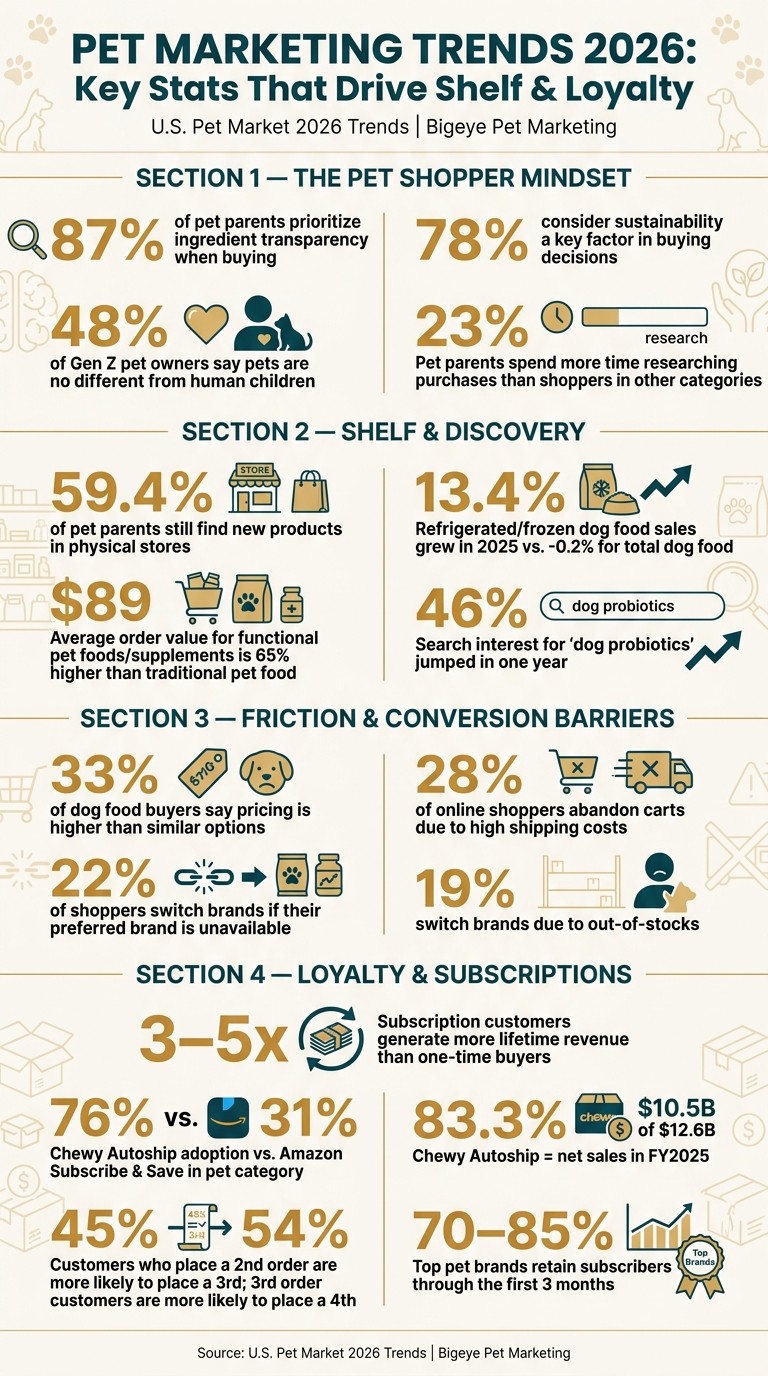
Pet Marketing Trends 2026: Key Stats on Shelf, Loyalty & Shopper Behavior

Pet Marketing Trends 2026: Key Stats on Shelf, Loyalty & Shopper Behavior

Why pet marketing trends are shifting

Pet care keeps getting more personal. That is changing how people shop.

When pets are treated more like family, shoppers expect more from every product. They want to know what is in it, what it does, and why it costs what it costs. That shift is plain in the data:

The main takeaway is simple: the middle is getting squeezed. Brands now tend to win on one of two sides:

  • a premium story tied to results

  • a clear value story tied to price and use

If a brand sits in between, it can get ignored.

What drives shelf wins in pet retail

Shelf still does a lot of work, even when discovery starts online. 59.4% of pet parents still find new pet products in physical stores. That means packaging and message order still shape the sale.

What matters most at shelf is speed. A shopper should be able to answer three questions almost at once:

  • What is this?

  • What is it for?

  • Why should I trust it?

A few shelf cues stand out:

  • outcome-led benefits like digestion, coat health, or joint support

  • proof markers like sourcing notes, certifications, or vet input

  • price framing like cost per day or cost per serving

  • pack design that fits the retail setting

That last point matters. Mass and club often reward price clarity and size value. Specialty tends to reward quality signals and proof. Grocery sits in the middle.

How pet shoppers move from discovery to purchase

Pet buyers do not follow one neat path. They move across social, search, retailer pages, reviews, and reorder tools before they buy.

A common path looks like this:

  1. See a product on TikTok or Instagram

  2. Search for reviews or ingredients

  3. Compare options on Amazon or Chewy

  4. Buy where price, shipping, and trust line up

  5. Reorder through autoship or direct CRM prompts

That behavior matters because each platform plays a different role.

  • Social starts interest, especially for younger shoppers

  • Search helps validate claims

  • Amazon helps compare price and reviews

  • Chewy supports trust, habit, and repeat order behavior

  • Retail stores help with trial and routine replenishment

Pet parents spend 23% more time researching purchases than shoppers in other categories. That means brand claims need to hold up under comparison.

What stops conversion and repeat purchase

Interest alone does not close the sale. Small points of friction still break conversion.

The biggest blockers in the piece are clear:

  • 33% of dog food buyers say a product is priced higher than similar options

  • 28% of online shoppers abandon carts because shipping costs are too high

  • 19% switch due to out-of-stocks

  • 22% say their preferred brand is not available where they shop

If the value story is weak, the total cost is high, or the item is hard to find, loyalty gets fragile fast.

That is why pet brands need to think past awareness. Good media can drive traffic, but it cannot fix:

  • poor shelf availability

  • weak product-page proof

  • confusing price comparison

  • bad reorder timing

Why subscriptions and CRM matter more than discounting

In pet care, habit is a major part of revenue.

A first order is good. A second order changes the economics. Subscription buyers bring in 3 to 5 times more lifetime revenue than one-time buyers, and Chewy’s autoship adoption shows how strong that model can be.

What works best is not just “offer subscribe and save.” It is making the next order feel easy.

That usually means:

  • default autoship or replenishment options at checkout

  • easy pause and skip controls

  • reminders based on supply timing

  • emails and texts that use pet data like name, breed, age, or life stage

The point is not more messages. It is better-timed messages.

A puppy nearing 12 months should not get the same flow as a senior dog with joint issues. That is where CRM starts to do more than remind. It starts to guide.

What pet brands should measure now

Shelf metrics show whether shoppers can find and choose the product.

Examples include:

  • out-of-stock rate

  • distribution breadth

  • shelf visibility

  • retail sell-through

  • top-of-mind share

Loyalty metrics show whether the first order turns into habit.

Examples include:

  • repeat purchase rate

  • second purchase rate

  • subscription retention

  • churn

  • LTV:CAC

  • MER

The key idea is that a good ROAS number can hide a weak business result. If a campaign drives first orders but reorder is low, the growth story falls apart.

What this means for pet brands in 2026

Pet brands that win now do three jobs well at once.

First, they make the product easy to trust.
Second, they make the first purchase easy to complete.
Third, they make the reorder easy to repeat.

That means the best next move is often not “make more ads.” It is to tighten the link between:

  • shopper research

  • packaging

  • retail placement

  • product-page proof

  • CRM timing

  • subscription setup

  • inventory health

When those pieces line up, shelf pull and loyalty start to support each other.

FAQ

Do pet owners spend more time researching before they buy?
Yes. The article says pet parents spend 23% more time researching purchases than shoppers in other categories. They compare reviews, ingredients, social proof, and product claims before they decide.

Why does autoship matter so much in pet care?
Because pet products are often part of a routine. Autoship reduces reorder friction and helps turn one purchase into repeat revenue. Subscription buyers also tend to produce much more lifetime revenue than one-time buyers.

What matters more now: premium or value?
Both can work. The pressure is on brands stuck in the middle. Premium products need a clear result and proof. Value products need a clear price story and easy comparison.

What are the biggest reasons pet shoppers switch brands?
The article points to three main issues: high price, shipping costs, and poor availability. Even interested shoppers will switch if the product feels too expensive or is out of stock.

TL;DR Summary

  • Proof now matters more than broad promises. Pet shoppers want to see what a product does, what is in it, and why it is worth the price.

  • Shelf performance depends on retail context. Brands need packaging, pricing cues, and claims that fit how shoppers buy in each channel.

  • Retention beats one-time conversion. Subscriptions, reorder prompts, and pet-based CRM help turn first orders into routine revenue.

  • Friction still costs sales. Shipping fees, stock gaps, and weak value framing can undo demand late in the buying path.

  • Measurement should cover the full path. Brands need retail and loyalty data in one view to see what is driving both trial and reorder.

Ready to improve shelf pull and repeat purchase?

If I were looking at this category with a growth goal, I’d start with a focused audit instead of more guesswork.

Bigeye’s pet brand growth audit looks at shopper behavior, packaging clarity, retail media openings, and retention flow gaps across Amazon, Chewy, DTC, and in-store channels. If you want to see where your brand is losing sales between first view and reorder, connect with Bigeye’s pet marketing team and request a pet shelf and loyalty audit.

Meta title: Pet Marketing Trends 2026: Win Shelf and Loyalty

Meta description: Pet marketing trends in 2026 show how brands can win shelf

Introduction

Pet buying in 2026 is shaped by a tough mix of care, caution, and higher standards. U.S. pet owners now expect wellness, transparency, convenience, and value from a single brand. 87% of pet parents prioritize ingredient transparency when making purchases, and 78% consider sustainability a key factor in their buying decisions. Those expectations don’t just affect trial. They shape reorders too.

Pet buying has turned more human-centered faster than many marketers saw coming. As Jorge Martínez, Global President, Pet Nutrition, ADM, put it:

"Today's pet parents are balancing quality and price. Their compassion for their pets has them seeking the highest-quality products, yet the unpredictable economic environment leaves them searching for the best value."

That tension sits at the center of today’s pet market. People want the best for their pets, but they’re still watching every dollar. If you want to understand what moves sales, purchase behavior is the place to start.

Positioning, packaging, retail execution, and retention all have to pull in the same direction. If one part slips, the whole system weakens. Brands win when shelf appeal turns into repeat purchase. The strategies below are built for the market pet brands face now.

Next: how pet owners shop and what drives the final decision.

TL;DR

The brands pulling ahead do three things well: they lead with transparency, win at shelf, and build systems that drive repeat purchase.

  • Wellness and transparency are now baseline expectations. A full 87% of pet parents look at ingredient transparency and sourcing when they decide what to buy. Broad claims like "natural" don't move the needle on their own. Shoppers want proof through sourcing details, third-party certifications, and clear outcome-based messaging.

  • Shelf performance depends on packaging clarity and channel fit. Context changes the sale. Price-focused marketplaces, community-led retailers, and value-focused mass retail each reward different creative choices. In pet care, trust built at first purchase has to carry into the reorder, and shelf cues only work when they line up with how people shop in that channel.

  • Loyalty is built through personalization and subscriptions, not discounts. Subscription customers bring in 3 to 5 times more lifetime revenue than one-time buyers. AI-driven emails that mention a pet's name and breed lift open rates by 22%. Chewy's Autoship adoption has reached 76%, which shows just how central subscription has become for retention.

  • Measurement has to cover both shelf and lifecycle. ROAS on its own gives an incomplete picture. The brands that move fastest watch retail KPIs such as out-of-stock rates and distribution breadth, while also tracking loyalty signals like Customer Lifetime Value (LTV) and 90-day retention rates.

Next, the article breaks down how pet owners shop and what drives the final decision.

Why U.S. Pet Marketing Trends Are Changing How Brands Win Shelf and Loyalty

U.S. pet marketing is shifting fast, and three forces are driving it: humanization, premiumization, and value pressure. Brands that line up with all three are the ones winning shelf space and repeat purchase.

The Rise of the Humanized Pet Consumer

A big mindset shift is changing how people shop. 48% of Gen Z pet owners say they see no difference between their pets and human children. That changes what shoppers expect at shelf. The bar is higher now. They want proof, plain language, and trust signals they can spot right away.

Broad pet-marketing claims don’t carry the same weight they used to. Shoppers want something more concrete. Search interest for "dog probiotics" jumped 46% in one year, and 53% of dog owners now give their pets vitamins or supplements. Functional diets with prebiotics and probiotics grew 18% in 2024. Put simply, claims tied to outcomes like joint mobility, coat health, or digestion do a better job of driving conversion than vague terms like "natural" or "premium."

Premiumization Meets Value-Seeking Behavior

The middle of the market is getting squeezed. Shoppers are moving in one of two directions: they’re either trading up to science-backed premium products or choosing high-quality private label options for more basic items. Private label pet care unit sales grew 3.5% from 2024 to 2025, while national brands fell 0.6%. That kind of split puts pressure on brands to pick a lane. A clear value story can work. A clear premium story can work. The fuzzy middle usually doesn’t.

What’s interesting is where shoppers are cutting back. Pet owners are trading down on commodity items, not on trust or on products that seem tied to results. In 2025, 22% of pet owners said they were cutting back on pet-related spending, up from 12% in 2024. Even so, demand has stayed steady for products linked to clear health outcomes. If a brand can’t explain why it costs more - or why it’s the smarter value play - it risks losing shoppers on both ends.

Freshpet gives a good read on this. The brand posted $297.6 million in net sales in Q1 2026, up from $263.2 million in Q1 2025. That’s a strong sign that premium products with direct health-related benefits can still perform well, even when shoppers feel cost pressure.

What Marketers Should Watch in 2026 and Beyond

Wellness claims backed by proof are now the baseline. They’re not the thing that sets a brand apart anymore. They’re the price of entry.

Another shift worth watching is the rise in cat ownership. Cats are now in 39% of U.S. households, which opens the door for more feline-specific premium products in a part of the market that still looks underbuilt. For marketers, that’s not just a product story. It’s a messaging story too. Cat owners want the same level of care, detail, and product logic that dog owners have been getting.

Omnichannel consistency matters more now as well. Shoppers bounce between digital and in-store touchpoints, and they expect the brand story to feel the same every time. If the message changes from one channel to the next, trust can slip at exactly the wrong moment. And when that happens, both conversion and reorder rates can take a hit.

Next: how these behaviors shape the shopper journey across retail and digital channels.

How Do Pet Owners Actually Shop and Decide What to Buy?

Pet owners rarely buy on impulse alone. The pet shopper journey moves across social feeds, search results, retailer sites, and repeat-order programs before a purchase happens. In a category tied to care and emotion, people dig deeper, compare more, and want proof before they spend.

  • Pet owners move from discovery to validation to purchase across multiple channels, not in one clean path.

  • Social media sparks demand for younger shoppers, while search and personal recommendations still matter for older groups.

  • Trust signals like reviews, UGC, ingredient transparency, and veterinarian input shape brand choice.

  • Price, shipping costs, and out-of-stocks often stop a sale even after strong shopper interest.

The Pet Shopper Journey Across Retail and Digital Channels

Shopping in pet care is messy in the most human way. A person might see a TikTok about joint chews, search Google that night, check Amazon reviews the next morning, and then reorder through Chewy a week later. That kind of channel-hopping is normal.

97% of Gen Z consumers use social media for shopping inspiration, and TikTok pet content generates 2.08 times higher engagement than general content on the platform. For younger pet owners, that makes social a major discovery engine. For older groups, the pattern shifts. Search engines and personal networks still carry more weight, especially when the purchase feels tied to health, diet, or long-term use.

Once shoppers move past discovery, their channel choice starts to show intent. Amazon tends to win on convenience and price comparison. Chewy leans into expertise and repeat purchase behavior. Mass retail plays a strong role in routine replenishment. Each stop in the journey serves a different job, and smart brands treat those touchpoints differently instead of using the same message everywhere.

Chewy’s Autoship model shows what happens when convenience meets habit. Chewy's Autoship program has a 76% customer adoption rate, compared to 31% for Amazon Subscribe & Save in the pet category. That gap matters because subscription buyers are worth far more over time. Subscription customers generate 3 to 5 times more lifetime revenue than one-time buyers. In plain terms, the first order matters, but the second order is where the business gets interesting.

Autoship also changes the role of the first sale. It’s not just a transaction. It’s the opening move in a retention cycle that can lock in routine buying behavior if the product and experience hold up.

What Drives Brand Choice at the Point of Decision

By the time a pet owner lands on a product page or stands in front of a shelf, the decision often feels half-made. The research happened earlier. Now they’re looking for confirmation.

Pet parents spend 23% more time researching purchases than consumers in other categories. That extra time goes into reading reviews, checking search results, scanning social content, and looking for signals that say, Yes, this is safe, this works, and this is worth the money. Pet care isn’t just another basket item. For many shoppers, it feels personal.

That’s why trust markers carry so much force. Veterinarian recommendations matter a lot in subcategories where people feel more risk, like prescription-adjacent supplements and premium food. In those areas, private-label brands rarely exceed 2% share. Shoppers want more than a low price. They want a reason to believe.

UGC helps close that gap. UGC earns 8.7 times more engagement than branded content, which makes it a strong signal when people are comparing options. A polished brand ad can introduce a product, but real customer photos, comments, and product experiences often help push the decision over the line. When someone sees a pet like theirs getting results, it lands differently.

Transparency also works as a filter at the point of decision. 87% of pet parents prioritize ingredient transparency when making a purchase decision. That stat says a lot. People don’t just want claims. They want labels, sourcing details, and clear proof of what they’re paying for.

At that stage, brands tend to win when they do two things well: show outcomes and explain value per serving. If the product costs more, shoppers want help seeing why.

Common Friction Points That Reduce Conversion and Repeat Purchase

Even after interest is there, plenty of sales still fall apart. Usually, the drop-off isn’t about awareness. It’s about friction.

Price is one of the biggest pain points. 33% of dog food buyers cite "priced higher than similar options" as a main conversion barrier. That doesn’t mean shoppers always choose the cheapest item. It means they need the price to make sense. If the value story is weak, they hesitate or switch.

Shipping costs create another hard stop. 28% of online shoppers abandon purchases because of high shipping costs. That number is a reminder that the cart experience matters just as much as the product page. A shopper may be sold on the item and still walk away when the final total jumps.

Availability problems can be just as damaging. 19% of shoppers cite out-of-stocks as a reason for switching brands, and 22% say their preferred brand isn't available where they shop. That kind of friction can break loyalty fast. If a shopper has already done the work to choose a product, they don’t want to start over because inventory failed them.

Format confusion adds its own layer of trouble. When shoppers can’t compare products easily, many fall back on price alone. That’s where clear per-serving pricing helps. It gives people a simpler way to judge value, especially in categories where bag size, dosage, or feeding instructions make apples-to-apples comparison harder than it should be.

FAQ

Do pet owners research more before buying?

Yes. Pet parents spend 23% more time researching purchases than consumers in other categories. They often review search results, customer feedback, and social proof before making a choice.

Which channels matter most in the pet shopper journey?

It depends on the shopper and the stage. Social media plays a major role in discovery for younger buyers, while search and personal networks still matter a lot for older groups. Amazon, Chewy, and mass retail each support different purchase goals.

Why does autoship matter so much in pet care?

Autoship helps turn one purchase into repeat revenue. Chewy's Autoship program has a 76% customer adoption rate, versus 31% for Amazon Subscribe & Save in the pet category, and subscription customers generate 3 to 5 times more lifetime revenue than one-time buyers.

What stops pet shoppers from converting?

The main blockers include price, shipping costs, and poor availability. 33% of dog food buyers cite "priced higher than similar options" as a barrier, 28% of online shoppers abandon purchases because of high shipping costs, and stock issues often lead shoppers to switch brands.

TL;DR Summary

  • Pet owners move from discovery to validation to purchase across multiple channels, not in one clean path. A brand may need to win on TikTok, search, retail, and reorder systems all at once.

  • Social media sparks demand for younger shoppers, while search and personal recommendations still matter for older groups. That split shapes where discovery starts and how trust gets built.

  • Trust signals like reviews, UGC, ingredient transparency, and veterinarian input shape brand choice. By the time shoppers are ready to buy, they want proof, not just promises.

  • Price, shipping costs, and out-of-stocks often stop a sale even after strong shopper interest. Small points of friction can undo a lot of strong marketing work.

CTA

If your pet brand is losing shoppers between discovery and reorder, Bigeye can help you spot where the funnel breaks. Schedule a free retail and eCommerce channel audit with Bigeye to see how your brand shows up across social, search, Amazon, Chewy, and in-store touchpoints - and where conversion leaks are costing you sales.

What Helps Pet Brands Win the Shelf in Mass, Specialty, Grocery, and Club Channels?

Shelf is the last test before purchase, and it still matters a lot. Even with more shoppers doing research online, 59.4% of pet parents still find new products in physical stores. That means shelf visibility can make or break a sale. And not every retail channel looks for the same thing. Mass and club shoppers want plain value. Specialty shoppers look for proof, quality, and premium signals. Grocery often sits somewhere in between.

Mass, specialty, grocery, and club reward different signals, so the same pack cannot do the same job everywhere.

Product Trends That Strengthen Shelf Appeal

Functional wellness products with Lion's Mane, Turkey Tail mushrooms, adaptogens, and probiotics are gaining momentum on shelf. At the same time, the newer wave of humanized pet marketing is shifting toward aging support, with more attention on geriatric conditions such as arthritis and diabetes.

Cold and fresh formats are moving fast. Refrigerated and frozen dog food sales grew by 13.4% in 2025, while the total dog food category slipped by 0.2%. That shift tracks with fast growth in fresh, dehydrated, air-dried, and enhanced kibble diets. In plain terms, shoppers are showing they will pay more for formats that feel closer to modern human food habits.

On-pack messaging needs discipline. Lead with one outcome claim and one proof point. That's extra important in trust-led segments like supplements, fresh and freeze-dried food, and condition-specific formulas. Too many claims can muddy the message. One clear promise, backed by one clear reason to believe it, tends to do a better job in a crowded aisle.

The money side matters too. The average order value for functional pet foods and supplements is $89, which is 65% higher than traditional pet food. That tells you these products are not just shelf fillers. They can drive a richer basket when the value story is easy to grasp.

Packaging and Messaging That Improve In-Store Conversion

Packaging now has to do its job fast. If shoppers can tell what the product is for and why it matters in a split second, the pack has a better shot at conversion. Clean design and direct claims matter in a category where 87% of pet parents care about ingredient transparency at the point of purchase.

This is one of those moments where less can do more. A cluttered front panel asks the shopper to work. A tighter front panel helps them move.

Color also does quiet but heavy lifting. Cool tones like teal and mint signal wellness, while neutral palettes with gold accents support premium positioning. Those cues may seem subtle, but on shelf, subtle is often enough. People don't read every package like a contract. They scan, compare, and decide.

Price framing plays a role as well. Brands should use cost per day messaging to help justify premium price points and make them easier to compare with standard formats . A higher sticker price can feel like a wall. Breaking it down into a daily spend can lower that friction and make the trade-off feel more reasonable.

Retail Media and Shopper Marketing That Extend Visibility Beyond the Shelf

Retail media pushes the shelf story farther than the aisle. Endcaps, retail placements, and in-aisle displays help keep the brand in view right when shoppers are making the call.

Endcaps can work especially well in grocery, where shoppers are often moving fast and making substitutions on the fly. They are useful for interrupting impulse switching, especially because 22% of shoppers will switch brands if their preferred option is not available at their main store. That's a hard truth for pet brands: if you're not visible, you're easier to replace.

In-aisle displays should repeat the same benefit claim used in digital ads. Repetition helps. If a shopper saw a promise online, then sees the same promise in store, the product feels more familiar and easier to trust.

Retailer fit matters here too. Match the creative to the retailer: lifestyle proof for Chewy, ingredient-led utility for Amazon.

The same proof points that help a product win on shelf should also show up in reorder messaging. Keep the product promise consistent across follow-up email, SMS, and reorder flows. If the shelf says one thing and the post-purchase message says another, the brand starts to feel scattered.

What Builds Repeat Purchase and Long-Term Loyalty in Pet Marketing?

Winning the first order is only half the battle. In pet marketing, loyalty starts when that first purchase turns into a routine. Pet consumables already post 35% to 45% repeat purchase over 12 months, which beats the 25% to 30% e-commerce baseline. That built-in edge matters, but it does not run by itself.

Personalization and Subscriptions as Retention Drivers

Chewy shows what habit-driven retention looks like at scale. Its Autoship program accounts for 83.3% of net sales - $10.5 billion of $12.6 billion in FY2025 - and 90% of revenue comes from existing customers. That kind of loyalty is built on routine, not constant price cuts.

A simple move can help: offer replenishment enrollment by default at checkout, then make pause and skip options easy to find. That one change can cut subscription churn by 20% to 30% because customers do not have to cancel just because they are overstocked.

Once convenience helps secure the second order, personalized CRM keeps things moving. Using a pet's name or breed in messaging can lift opens and clicks, and pet-specific SMS and email can top 90% open rates. The message lands harder when it feels tied to their dog or cat, not some faceless list segment.

Life-stage shifts are one of the most missed cross-sell moments in the category. If CRM data shows a puppy getting close to 12 months, that is the right time to suggest a move to adult food. If a dog's profile points to senior age, joint supplements become a sensible add-on. Brands that grow adoption across categories can push annual value into the $800 to $2,000 range. Timing is the whole game here. A prompt tied to actual behavior works far better than a generic calendar nudge.

Trust Signals That Keep Pet Parents Coming Back

A smooth first experience helps, but it does not lock in the second purchase. Pet parents need proof that the brand is worthy of trust. That bar is high because the product touches health, comfort, and daily care.

87% of pet parents prioritize ingredient transparency when they shop. Loose claims like "natural" are not enough anymore. What works now is detail: named suppliers, clear sourcing notes, manufacturing visibility, and third-party certifications. People want to know what is in the bag, where it came from, and why it is there.

Veterinary backing is one of the strongest trust signals a brand can earn. Pet owners are 7x more likely to act on a product recommendation from a veterinarian than on other forms of product guidance. That gives brands a clear path. Educational content, co-branded vet materials, and clinical proof can do far more for retention than another coupon ever will.

Post-purchase messaging should also point to outcomes the customer can notice. If you tell someone their dog's coat may look shinier within 30 days, you give them a simple result to watch for. When they see that change, the brand earns credit. That is often the moment a happy buyer starts to become a repeat buyer.

CRM, Email, and SMS Strategies That Support Loyalty

Timing matters more than volume. Replenishment reminders should hit around day 25 on a 30-day supply so customers do not run out or drift away. Those signals should feed straight into retention flows, not sit in a dashboard where no action happens.

Fresh Patch is a good example of what coordinated timing can do. The dog potty brand connected Meta and Google ads with Klaviyo replenishment flows and saw a 1,057.2% return on ad spend (ROAS) along with a 52% drop in customer acquisition cost. The lift did not come from one channel doing magic on its own. It came from paid media and CRM working in sync.

Lifecycle CRM should tie together replenishment windows, life-stage signals, and post-purchase trust messaging inside one setup. The first 30 days are especially important. Brands that use that window to set delivery expectations, share feeding guidance, and mention the pet by name can lower post-purchase stress and make the next order feel easy.

Second purchase rate is one of the clearest loyalty KPIs to watch. Customers who place a second order are 45% more likely to place a third, and customers who place a third are 54% more likely to place a fourth. That makes second purchase rate more than a nice metric. It belongs right next to retention and LTV in the next measurement pass.

How Do You Measure Whether Your Pet Brand's Shelf Strategy and Loyalty Programs Are Actually Working?

Once shelf and retention tactics are live, the next step is simple: measure what holds up in the market. Keep shelf KPIs and loyalty KPIs separate. Shelf metrics show whether shoppers can find your product and pick it. Loyalty metrics show whether that first order turns into a second one.

Retail KPIs That Show Whether Shelf Strategy Is Working

Availability is the clearest shelf signal. If a product is missing from the shelf, the sale is gone. No packaging, claim, or message can fix that in the moment. That’s why out-of-stock rates and distribution breadth are the clearest signs of whether your shelf strategy is holding.

Top-of-mind share (MMS) - how often shoppers think of your brand first in a purchase moment - is another useful signal. It works well as a leading indicator of shelf conversion, especially when you’re moving into new retail channels.

Shelf metrics tell you if the product gets chosen; loyalty metrics tell you if it gets reordered.

Loyalty KPIs That Reveal Repeat Purchase Strength

Pet care is a recurring category, so repeat purchase matters more than a one-time conversion spike. Repeat purchase rate (RPR) - customers with 2+ purchases divided by total customers - is the most direct read on loyalty momentum. For pet consumables, the benchmark sits at 35% to 45% over 12 months, well above the general e-commerce average of 25% to 30%.

The metrics that guide action are repeat purchase rate, subscription retention, monthly churn, and LTV:CAC. Top-performing pet brands retain 70% to 85% of subscribers through the first three months. Monthly churn for pet subscriptions runs about 3.4%. For acquisition efficiency, a 3:1 LTV:CAC ratio is the steady baseline. Many pet brands push for 4:1 or higher because subscription models tend to hold customers longer.

Why Integrated Research and Analytics Improve Iteration

Most pet brands don’t have a data shortage. They have a visibility problem. The issue is that retail media, e-commerce, email, and CRM data often sit in separate dashboards, which makes pattern-spotting harder than it should be. Bigeye's proprietary analytics platform EyeSight consolidates data from retail media networks, e-commerce, email, and CRM into a single source of truth. That gives brands one place to connect shelf performance, subscription behavior, and repeat purchase results in the same feedback loop.

Marketing Efficiency Ratio (MER) - total revenue divided by total ad spend - often gives a better read on overall efficiency than channel-level ROAS. Why? Because channel wins can look good on paper while the business picture says something else. Pair MER with blended CAC and contribution margin, and you get a measurement stack tied to actual business performance, not just nice-looking dashboard numbers.

Use this scorecard to shape the 90-day test plan next.

What's the Practical Playbook for Pet Brands That Want to Win Shelf and Loyalty?

Pet brands don’t lose because the product is bad. They lose because they guess. More than 60% of new pet products fail within their first year due to weak demand validation and poor channel fit. That’s why a practical playbook starts with one rule: research before creative. If a brand jumps straight into packaging, paid media, or content without clear consumer insight, it’s rolling the dice.

Start With Consumer Insight Before Creative Execution

One of the biggest mistakes pet brands make is treating “dog owner” as a usable segment. It’s not. That label is too broad to guide packaging, messaging, or media. A first-time puppy owner shopping at Target is not the same as a high-income raw-feeding subscriber who buys from Chewy every month.

Start with consumer research before production. That step matters even more now because creative quality drives 60%–70% of performance variation on social platforms. In plain terms, the ad itself often matters more than the targeting trick behind it.

Before anything moves, the insight phase should answer three basic questions:

  • Who is the exact pet-parent segment?

  • What emotional need does the product meet beyond the functional claim?

  • What does value mean to that segment right now?

Those answers should shape packaging, claims, and media before launch. If the insight is weak, the execution will wobble. If the insight is sharp, the rest of the work gets a lot easier.

Align Brand Promise With Commerce Execution

Once positioning is set, every shopper touchpoint needs to say the same thing. Not in the same exact words, but with the same clear promise.

On shelf, that often means clean, wellness-led packaging, ingredient transparency, and a message order that leads with a specific benefit instead of a soft, vague claim . Shoppers make snap calls. If the pack buries the point, the product gets skipped.

Channel context matters too. Someone scrolling Instagram is in a different mindset than someone standing in a pet aisle or comparing subscriptions online. The brand promise should stay steady, but the way it shows up should match the channel.

That’s where many brands miss the mark. They build one decent message, then paste it everywhere. A better move is to keep the promise fixed while changing the execution to fit how people shop on each platform.

When paid media and lifecycle flows work together, acquisition costs drop and ROAS goes up. That connection matters. An ad may win the first order, but email, SMS, and post-purchase flows help turn that order into habit.

Build a Test-and-Learn Roadmap for 90 Days

The next 90 days should be used to test, learn, and scale what converts. Think of it less like a big launch and more like a disciplined sprint with clear checkpoints.

Days 1–30 are about building the base. Audit platform performance, put server-side tracking in place, and launch early creative tests using three angles: rational, emotional, and social proof . Rational creative focuses on ingredients and certifications. Emotional creative leans into the pet-parent bond. Social-proof creative uses testimonials and vet endorsements. The point is not to guess which one will work. The point is to let the data decide.

Days 31–60 are for tuning what’s already in motion. Scale the creative angle that wins, tighten audience targeting, and expand into added platforms only if the numbers support it. This is the stage where discipline pays off. More spend does not fix weak messaging.

Days 61–90 move into acceleration. Launch coordinated cross-platform campaigns, then add partner and content tests. If the first two phases were about finding traction, this phase is about building momentum without losing focus. Introduce auto-ship after the second purchase. That timing matters because it meets the shopper after some trust has already been built.

TL;DR Summary

In 2026, pet brands win when shelf execution, proof, and retention tell the same value story. Pet owners don’t shop in a straight line anymore. They compare products, check claims, read reviews, and reorder across stores, marketplaces, and direct channels.

The category is splitting between premium and value, and the middle is getting squeezed. For many brands, that means one thing: you need a clear job to do in the market. Either give shoppers a strong reason to pay more, or make the value case plain and easy to see.

Outcome-led wellness helps support premium pricing. 87% of pet parents prioritize ingredient transparency, so sourcing, certifications, and proof matter at the shelf more than ever. When brands make those signals easy to spot, they earn trust at the point of choice. That trust can carry into repeat purchase, too. Subscription customers produce 3 to 5 times more lifetime revenue than one-time buyers, and personalized CRM flows that mention a pet’s name and breed can turn early interest into a routine purchase pattern.

Brands win when they meet pet owners with proof, convenience, and consistency across channels. The next move is simple: turn those signals into a shelf and retention audit.

Ready to grow your pet brand's shelf performance and loyalty?

If you want better shelf performance and more repeat purchase, start with a focused growth audit.

Bigeye helps pet brands connect shopper insight, creative, and pet-category media buying so teams can see what’s helping sales and what’s getting in the way. The goal is simple: move more shoppers from first glance to first purchase, then from first purchase to reorder.

Bigeye’s pet brand growth audit looks at shopper behavior, packaging and messaging clarity, retail media openings, and subscription and retention strategy. It uses the EyeQ platform to test messaging with real pet parents, with insights delivered in as little as 72 hours. It also uses the EyeSight analytics platform to pull paid media, email, retail media, and e-commerce data into one view of ROAS, CAC, and LTV.

That matters because research-first planning cuts wasted spend and shortens the path to repeat purchase.

Use the audit to spot where shoppers drop off between first purchase and reorder. If your brand is ready to improve shelf performance and repeat purchase, connect with Bigeye's pet marketing team to start your growth audit.

Related Posts

Related Posts

Related Posts

Pet Industry

Jun 12, 2026

Google Ads tactics for pet brands: creative frameworks, audience segmentation, and budget rules to grow spend while protecting ROAS.

Pet Industry

Jun 10, 2026

Pet marketing that leads with emotion outperforms product-first ads — boost CTR, conversions, and brand affinity with creative frameworks.

Pet Industry

May 27, 2026

Explore the 2026 pet marketing trends shaping growth, from premium wellness and value shoppers to retail media, TikTok, AI, and sustainability.

Pet Industry

Jun 12, 2026

Google Ads tactics for pet brands: creative frameworks, audience segmentation, and budget rules to grow spend while protecting ROAS.

Pet Industry

Jun 10, 2026

Pet marketing that leads with emotion outperforms product-first ads — boost CTR, conversions, and brand affinity with creative frameworks.

Perspective from a team that builds consumer brands for a living. Explore our thinking on creative strategy, media, consumer research, and the larger trends that matter to marketing leaders.

info@bigeyeagency.com

Optics Newsletter

Join 89,000 subscribers!

By signing up, you agree to our Privacy Policy

© 2026 BigEye

Perspective from a team that builds consumer brands for a living. Explore our thinking on creative strategy, media, consumer research, and the larger trends that matter to marketing leaders.

info@bigeyeagency.com

Optics Newsletter

Join 89,000 subscribers!

By signing up, you agree to our Privacy Policy

© 2026 BigEye

Perspective from a team that builds consumer brands for a living. Explore our thinking on creative strategy, media, consumer research, and the larger trends that matter to marketing leaders.

info@bigeyeagency.com

Optics Newsletter

Join 89,000 subscribers!

By signing up, you agree to our Privacy Policy

© 2026 BigEye