Challenger brand strategy is not about staying small. It is about growing share when the market leader can outspend everyone else. That is the core problem many consumer brands face: paid media costs climb, ads wear out, and growth slows. This guide shows how challenger brands can find weak points in the category, build brand memory, split budget with more discipline, and track growth beyond ROAS and CPA.
TL;DR
Challenger brand strategy works when a brand finds a weak point in the category and builds memory around it.
A category vulnerability audit helps show where the market leader’s promise does not match the buyer experience.
Brand assets matter because repeated cues help buyers spot and remember the brand with less media waste.
Brand building should come before performance media in sequence, because memory makes paid media work better.
Growth should be tracked with both brand signals and performance metrics, including share of search, CAC, and CLV.
How Do You Run a Category Vulnerability Audit to Find Where the Market Leader Is Weak?
A category vulnerability audit shows where the market leader is weak enough for a challenger to win. The point is not to list weak spots on paper. The point is to find a position a challenger can actually claim and defend.
Map the Leader's Perceived Strengths Against Consumer Friction
Category leaders often carry weak spots that look like strengths at first glance. Scale can add complexity. Legacy trust can drift into complacency. Broad distribution can lead to sameness. The audit starts by mapping the leader's stated strengths against the friction those strengths create in the buying process.
One clear signal is the promise-to-delivery gap - the distance between what a brand promises in its advertising and what buyers get in practice. When a leader says "simple" but the purchase process feels complicated, or says "trusted" but customer service moves slowly, that gap becomes an opening a challenger can use.
Leader's Claimed Strength | Friction It Creates for Buyers |
|---|---|
Scale | Generic shelf presence, no clear identity |
Legacy trust | Perceived as outdated or out of step |
Too many options | Confusing choices, decision fatigue |
Repeated messaging | Over time, repetitive messaging stops getting noticed. |
Find the Gap the Challenger Can Own
Once those friction points are visible, the next move is to identify which gap the challenger brand can credibly own. The strongest positions are specific. That might mean ingredient transparency where the leader is vague, speed where the leader is slow, community where the leader feels corporate, or clarity where the leader overwhelms buyers.
A clear position has to stick in memory, not just sound smart in a brainstorm. When a challenger earns attention through a meaningfully different position, it can build share of voice without category-level media spend.
Once the gap is clear, validate it with consumer input before building campaign work around it.
Use Consumer Research to Confirm the Opportunity
Assumptions about where the leader is weak are not enough. Consumer research confirms which gaps matter to buyers and which position is most likely to win attention and preference. It helps sort passing annoyances from purchase-level friction and shows which challenger position is most likely to land fast.
The next step is to test whether the brand's assets can make that position stick.
What Brand Assets Make Challenger Marketing Work?
A weak spot in the market means little if buyers can't link that opening to the right brand fast. Challenger marketing works when a brand becomes easy to spot, easy to remember, and easy to pick in a crowded field. Many challengers do not fail because they chose the wrong market gap. They lose because they did not put enough weight behind the brand assets that make that position stick.
What Counts as a Brand Asset?
Strong brand assets help a challenger get recognized and chosen with less friction. A brand asset is a repeatable cue that buyers connect to a brand even when the brand name is missing. That can include visual signals like a signature color, logo mark, or packaging shape. It also includes verbal signals like a tagline, naming pattern, or a clear tone of voice.
The key point is simple: an asset is a repeatable cue, not a one-off campaign style. As Faris Yakob, author of Paid Attention, puts it:
"Everything a company does is branding. Branding is the behavior of the company in totality: its product, its services, how it pays its staff, what people say about it in the press, and its advertising."
That idea matters for challengers because every touchpoint either strengthens the asset system or chips away at it. Customer service emails matter. Founder social posts matter. Packaging matters. A brand cannot say one thing in paid media, look like something else on shelf, and sound different again in email. That kind of mismatch muddies memory.
Fame and Uniqueness Both Matter
An asset needs two things at once: recognition and distinctiveness. A cue that many people know but that looks like the whole category will not do much work. A cue that feels one of a kind but that no one knows yet also falls short. The strongest assets do both jobs. They stand apart, and they become familiar through repetition.
The best cues are the ones that help a challenger own the weakness found in its audit. They should be specific enough to feel unmistakable and steady enough to build recall over time.
Asset | High Fame | High Uniqueness | Risk |
|---|---|---|---|
Signature color | ✓ | ✗ | Shared with the category |
Founder spokesperson | ✗ | ✓ | Not yet known widely enough |
Packaging shape | ✓ | ✓ | Strong - protect and repeat |
Tagline | ✗ | ✗ | Rebuild or retire |
This is where brand building turns from style into market impact. Binet and Field's work on excess share of voice (ESOV) gives a useful rule of thumb: roughly 0.5 points of market share growth per year for every 10 points of ESOV. That matters for challengers with leaner budgets. If brand assets earn attention on their own - through content people share, packaging people photograph, or campaigns people talk about - the brand can build ESOV without matching the leader dollar for dollar in media spend.
In plain terms, a cue that travels does more than decorate the brand. It helps the brand stretch each ad dollar.
Build a Consistent Asset System Across Paid, Organic, and Retail
One of the most common mistakes is treating paid, organic, and retail like separate worlds. The result is broken memory. Ads look one way, social sounds another way, and the retail experience feels like a third brand altogether.
The fix is not complex. Choose two or three core cues that anchor the brand - maybe a color, a shape, and a voice - then use them across every surface. Keep those same cues in ads, content, packaging, ecommerce pages, retail displays, and lifecycle messages.
Consistency speeds recognition. Buyers often are not studying a brand with full attention. They are scrolling, scanning shelves, or skimming inboxes. Repeated cues help the brain make the link faster. That is why asset consistency comes before budget decisions. More spend cannot clean up a scattered brand system.
A challenger does not need a huge set of assets. In many cases, a small set used with discipline beats a larger set used loosely. Think of it like road signs: if the signs keep changing shape and color, drivers miss the turn. Brands work much the same way.
How Should Challenger Brands Split Budget Between Brand Building and Performance Media?
Budget mix can make or break challenger growth. In challenger marketing, brand building and performance media are not rivals. They do different jobs at different points in the funnel. Brand work builds memory and mental availability. Performance media turns that stored demand into action. When those jobs get blurred, customer acquisition cost climbs, paid media tires out, and teams end up chasing short-term numbers without fixing the root problem.
Where Performance Media Helps and Where It Breaks Down
Performance media includes paid search, paid social, retail media, and display. It works best when people already know, or at least half-recognize, the brand. In that setting, performance channels can convert interest with more force because the audience is not meeting the brand cold.
The trouble starts when performance media is asked to carry the whole load. Transaction-focused ads can drive clicks for a while, but people get numb to them fast. Creative fatigue sets in. Auction pressure grows. Costs inch up. Conversion rates soften. A brand can keep spending more and still feel like it is running on a treadmill.
That is why performance media often looks sharp in the short run and weak over time when there is no brand support beneath it. Without memory in the market, paid media has to reintroduce the brand again and again. That makes each sale cost more than it should.
Brand builds memory; performance converts it.
For challenger brands, that line matters because budget is usually tight. There is not much room for waste, and there is even less room for a channel plan that depends on brute force.
How to Allocate Budget Without Category-Level Spend
A challenger does not need category-level spend to build a strong allocation model. It needs discipline. The goal is not to be everywhere. The goal is to make one market opening stick in the buyer's mind and then use performance media to harvest the demand that follows.
Brand spend should protect the part of the position that matters most: the single weakness in the category that the challenger plans to own. If the brand stands for too many things at once, the budget gets thin and the message gets muddy. If it stands for one sharp idea, the same dollars can go farther.
A simple allocation model usually works better than an overbuilt one. In practice, that means:
Keep brand investment steady enough to make the positioning memorable.
Put performance spend behind a small set of core growth levers instead of scattering dollars across too many channels.
Match media choices to the message so the budget supports one clear idea rather than a pile of disconnected tests.
A focused challenger will often outperform a scattered one, even with the same spend. That is because concentration creates repetition, and repetition is what helps a brand stick.
Brand-building work should anchor the plan. That includes the kind of messaging and media exposure that grows memory and mental availability over time. Performance media should sit on top of that base. Its job is to capture demand, not invent it from scratch every week.
The better question, then, is not whether brand and performance should compete for budget. The better question is how brand spend can make performance media work harder.
Why Connected Research, Creative, and Media Beat Siloed Execution
A lot of challenger waste does not come from overspending. It comes from misalignment.
Research sits with one team. Creative happens somewhere else. Media buying moves on a separate track. The result is easy to spot. The campaign may look polished, but it misses the buyer tension that would make the message land. Or the media plan may hit the right audience with the wrong message. Either way, spend leaks.
Connected planning fixes that problem. When research shapes the brief, and the brief shapes the media plan, each part of the system starts pulling in the same direction. The message is built around a real consumer tension. The channel mix is chosen to deliver that message where it has the best shot of landing. That is where efficiency starts to improve.
This kind of alignment also leads to cleaner measurement. Teams can look beyond surface metrics like clicks, impressions, or last-click return and ask a harder but more useful question: Is brand strength improving at the same time performance metrics improve?
When research, creative, and media are linked, that answer becomes easier to track. A brand can measure whether salience signals are moving along with conversion metrics and then shift budget based on what is changing buyer behavior, not just what is easiest to count in a dashboard.
That matters for challenger brands because they cannot afford false positives. A short spike in performance numbers may hide a weak brand base. Connected execution helps expose that gap before it turns into a CAC problem.
Why Brand Building Should Come First in Sequence
The right split is not just about percentages. It is about sequence.
Brand work comes first because it lays down memory. It gives people a reason to notice, remember, and later choose the brand. Performance media comes next because it captures the demand that memory helps create. Reverse that order, and the brand ends up paying more to push colder audiences through conversion paths that were never warmed up in the first place.
That is the core budgeting logic for challengers. Brand creates the conditions for performance to do its job. Performance then turns those conditions into measurable action. When both functions stay connected, budget compounds instead of leaking.
How Should Challenger Brands Measure Growth Beyond ROAS and CPA?
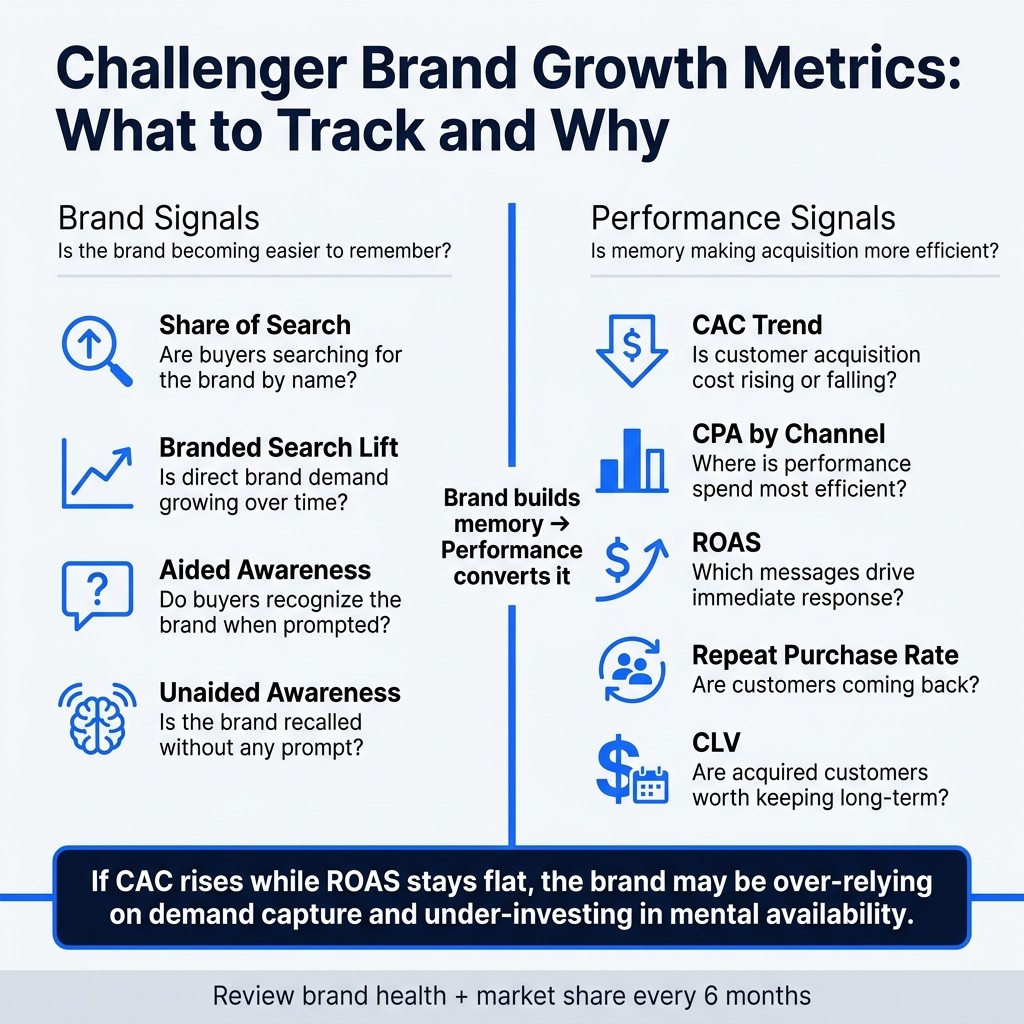
Challenger brand growth can't be judged by ROAS and CPA alone. Once brand and performance start working together, the next step is to see whether the brand is creating demand before anyone judges efficiency. ROAS and CPA still matter, but they show only one slice of the picture. A challenger brand can hit near-term performance goals and still lose ground over time if customer acquisition cost keeps rising. In many cases, higher CAC points to weaker brand memory and lower mental availability. The point of this measurement layer is to show whether distinctive assets and brand memory are helping bring CAC down, not just to give a surface-level read on brand health.
Track Share of Search, Awareness, and Brand Equity Signals
The strongest leading indicators are the ones that show whether the brand is becoming easier to remember and easier to choose. Share of search, branded search lift, aided awareness, and unaided awareness all help answer that question. When branded search goes up, it often means people are searching for the brand by name rather than responding only to paid prompts.
Fame matters here. It helps challenger brands get found, discussed, and searched. When those signals start moving, the next question becomes simple: are they also making customer acquisition more efficient?
Pair Brand Metrics With CAC, CPA, ROAS, and CLV
Brand metrics and performance metrics need to be read side by side. That is how marketers can tell whether awareness gains are helping lower acquisition costs.
Metric | Primary Job | What It Reveals |
|---|---|---|
Branded search / share of search | Brand demand | Whether the brand is gaining mental availability |
Aided awareness | Brand building | Whether more people recognize the brand when prompted |
Unaided awareness | Brand building | Whether the brand is recalled without a prompt |
CAC trend | Demand capture | Whether acquisition is getting more expensive |
CPA by channel | Demand capture | Where performance spend is efficient |
ROAS | Demand capture | Which messages drive immediate response |
Repeat purchase rate | Loyalty | Whether customers come back |
CLV | Profitability | Whether acquired customers are worth keeping |
If CAC rises while ROAS stays flat, that is a sign worth digging into. The brand may be leaning too hard on immediate-response demand capture and not putting enough weight behind mental availability. CLV, paired with repeat purchase rate, helps show whether the business is building a customer base that returns instead of churning after the first order.
This measurement model should be grounded in consumer research so it reflects how people buy in the category, not just what happens to be easy to pull from a dashboard.
Keep, Cut, or Scale
Keep creative systems that build recognition over time, even when single-ad results look average on the surface. Consistent brand assets tend to make low-attention media work harder over time.
Scale only when a piece of creative supports the position identified in the category vulnerability audit and improves both recall and response. If it drives clicks and lifts branded search in the following weeks, that is a strong signal to put more budget behind it. Cut tactics that no longer win attention, and scale the work that improves both brand memory and conversion response.
Brand health and market share should be reviewed together every six months, not just through weekly efficiency checks. That shift turns the audit into a growth tool instead of a simple diagnosis.
How Do Challenger Brands Put a Category Vulnerability Audit Into Practice?
Once the gap is mapped, the next move is simple: turn it into a working session. The point is not to collect notes or stack up opinions. The point is to make decisions. A Category Vulnerability Audit should turn strategy into action across four areas: the wedge, the assets, the tests, and the channel rules.
When Should a Challenger Brand Run a Category Vulnerability Audit?
A challenger brand should run the audit when the warning signs are hard to ignore. Creative starts to feel stale. Attention levels flatten. The brand promise no longer lines up with what buyers get in the market. Those moments matter because timing shapes the value of the session. If the team waits too long, drift sets in. If the team acts at the right time, the session can end with clear calls instead of vague takeaways.
What Should a Category Vulnerability Audit Working Session Produce?
The working session should produce four outputs: a clear wedge, the assets needed to own it, testable message ideas, and channel rules that show when performance media is helping and when it starts to overreach.
The wedge is the heart of the work. It is a sharp statement of where the category leader looks strong in perception but falls short in delivery. Put plainly, it identifies the space between what the leader promises and what buyers get. That gap is where a challenger brand can move.
From there, the team can build the right assets around that opening, shape message tests that can be checked in-market, and set channel rules so spend supports the brand instead of stretching the message past what it can carry. Rapid consumer research should be used to check the wedge and the messaging before production begins.
What Are the Next Steps for Consumer Brands Ready to Compete?
Once the wedge is set and the message tests are lined up, the focus shifts to execution. This works best for brand and marketing leaders who already sense the problem: weak differentiation, stale creative, or a system that is not building recognition. What they need is a clear way to confirm the issue and act on it.
For deeper context on the positioning logic behind this approach, the brand positioning guide lays out the full framework.
If you can see the gap but your current playbook is losing lift, talk to Bigeye. Our brand strategy team can help you pressure-test the wedge with real buyers and build the assets and media plan around it. You can also see how we've done it for other brands in our project work.
FAQs
What is challenger brand strategy?
Challenger brand strategy is a growth approach for brands that need to win market share without leader-level spend. The goal is to build memory, attention, and demand around a clear market opening.
What is a category vulnerability audit?
It is a structured look at where the category leader's promise stops matching what buyers actually get. You map the leader's claimed strengths against the friction they create, check which gaps buyers care about through consumer research, and pick one wedge a challenger can claim and defend.

Branding & Creative
Sep 24, 2026
Brand architecture guide comparing masterbrand, endorsed, and house of brands to cut wasted spend and sharpen buyer choice.