Pet Influencer Marketing: What Works and What Wastes Money
Pet influencer marketing often fails after follower counts get too big. In many pet categories, ROI slips past 100,000 followers, while smaller creators in the 5,000 to 50,000 range often post 5% to 10% engagement instead of the 1% to 3% common on large accounts. The problem is simple: brands buy reach when they should buy buyer intent. This guide breaks down where spend gets wasted, which pet creator niches tend to sell, and how brands can track results and find the right partner before putting more money into the channel.
TL;DR
Pet influencer marketing works best when the audience already cares about the product problem being solved.
Small and mid-size pet creators often beat big accounts because engagement and purchase intent tend to be stronger.
Veterinary, training, and breed-specific creators tend to fit pet product sales better than broad pet entertainment pages.
Tracking, usage rights, and paid reuse matter as much as the first post because content value should last past launch.
Small pet retailers should start with a low-cost pilot and judge success by local sell-through, not likes.
Pet Influencer Marketing Fails When Reach Replaces Buyer Intent
A pet post can get views, comments, and shares, then still move almost no product.
That gap usually starts with the wrong creator pick. Large pet accounts often pull in people who want cute or funny content, not shoppers ready to buy treats, supplements, grooming tools, or training gear. Once a creator grows past about 100,000 followers, the audience mix often shifts away from purchase-led behavior.
That is why influencer marketing for your pet products tends to work better with tighter audiences. A smaller creator with 8,000 or 20,000 followers can produce more sales than a big pet page if the followers already care about a clear issue like anxiety, dental care, leash pulling, or breed-fit products.
The key screen is not “How many followers does this creator have?”
It is “Does this audience act like buyers in this category?”
Alt text: pet product marketing with wellness-focused pet creator content
Small Pet Creators Often Outperform Macro Accounts
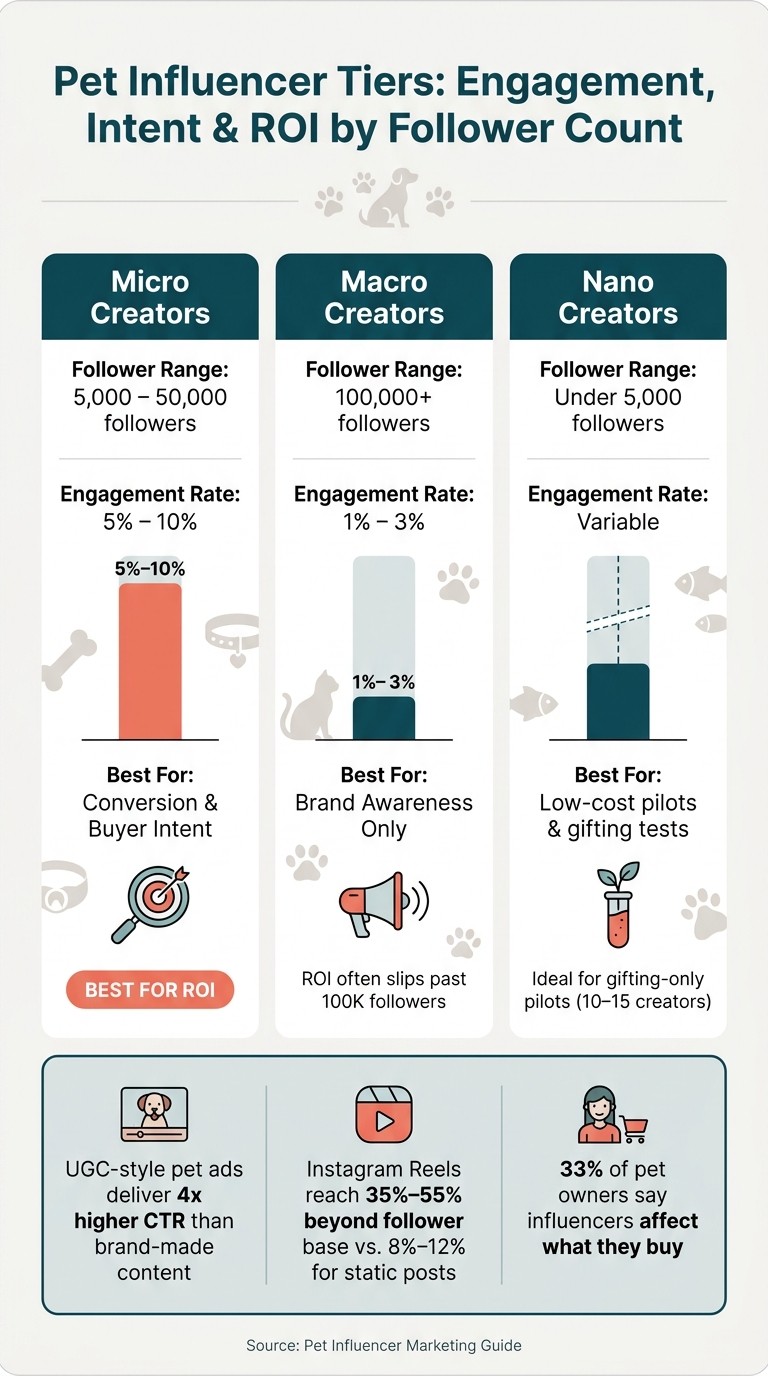
Pet Influencer Tiers: Engagement, Intent & ROI by Follower Count
Follower count looks neat in a report. It is a weak buying signal.
Micro and lower mid-tier creators often do better because their communities tend to be tighter, more topic-led, and more likely to ask product questions. In pet categories, those signals matter because many items are tied to a narrow use case. A calming chew is not bought for fun. A joint supplement is not an impulse buy in the same way a funny pet video is a quick like. This is why brands must focus on compelling pet product videos that drive action rather than just entertainment.
Common performance pattern:
5,000 to 50,000 followers: often the best balance of intent and engagement
100,000+ followers: often stronger for awareness than conversion
Under 5,000 followers: often useful for low-cost pilots or gifting tests
This does not mean every small creator will sell. It means the odds are often better when the audience is still close to the category.
A pet brand paying $2,500 for broad reach may get less back than a test with five niche creators at lower cost. For many teams, that is the first place budget starts leaking.
Veterinary, Training, and Breed-Specific Creators Usually Fit Best
Some pet niches line up with buying decisions better than others.
Veterinary and health-led accounts work well for products where trust and care matter. Training creators are often a strong fit for products with a visible job to do. Breed-specific creators help when buyers want to see how a product fits dogs or cats that look like their own pets.
Here is the simple breakdown:
Veterinary/health creators: good for supplements, dental care, special diets, and wellness items
Training creators: good for harnesses, treats, calming aids, toys, and behavior tools
Breed-specific creators: good for size-fit gear, breed formulas, and use cases tied to a pet’s build or habits
A broad pet meme page may get attention. A training account can show why a no-pull harness helps. A veterinary creator can add weight to a dental routine. A breed page can help a buyer picture fit and use.
That is why about 33% of pet owners say pet influencers affect what they buy. Relevance beats raw scale.
Alt text: pet product video marketing with dog trainer harness demo
Pet Product Video Marketing Should Be Built for Reuse
A one-time post has a short shelf life. A usable asset can keep working.
That is the shift many brands miss. They pay for a creator mention but do not secure the rights, raw files, or ad permissions needed to run the content later. That turns a strong post into a dead end.
UGC-style pet ads have posted 4x higher click-through rates and 50% lower cost-per-click than brand-made content in many tests. Instagram Reels with real pets can also reach 35% to 55% beyond the follower base, while static posts often stay around 8% to 12%.
That makes video format a budget issue, not just a content issue.
Pet brands should ask for:
raw reaction clips
voiceover versions
problem-solution edits
short paid-social cuts
files cleared for email and product page use
Without usage rights and whitelisting, good content often stops at organic reach. With those terms in place, the brand can turn one creator shoot into paid social, PDP video, retail media, and email support.
A pet creator post should be treated like an asset, not just a placement.
Creator Screening Should Start Before Outreach
A weak creator list cannot be fixed by sending more emails.
The first check is category supply. If a pet subcategory does not have enough intent-led creators, the plan may not support scale. That problem shows up a lot in narrow pet segments where there are many entertainment pages but very few educators, trainers, product reviewers, or health-led voices.
After that, each creator should be screened for signs of buyer intent.
The best checks include:
Comment quality: Are people asking about feeding, grooming, behavior, or product use?
Topic focus: Do at least 80% of recent posts stay close to the same category problem?
Sponsored-post share: Is the feed overloaded with paid posts?
Audience geography: Does the audience match the U.S. market where the brand sells?
Platform fit: Is the creator strong on TikTok, Instagram, or YouTube for the right job?
Emoji-heavy comments and generic praise often mean low buying intent. Specific product questions often mean the audience is closer to a sale.
If the creator pool is thin, a smaller ambassador group may work better than trying to force scale. In some cases, a UGC-first setup is the better spend.
Small Pet Retailers Should Test Local Sell-Through First
For a local or regional pet retailer, online engagement can mislead.
A creator may post strong numbers and still send almost no buyers into the store or local delivery zone. That is why small shops should not start with paid creator fees at scale.
A better first move is a gifting-only pilot with 10 to 15 creators under 5,000 followers. This keeps cost low while giving the retailer a batch of content and early signals on what works.
Retail-ready tracking can stay simple:
creator discount codes
UTM links
post-purchase surveys
QR codes
point-of-sale lift checks on featured SKUs
Those methods answer the main question: Did sales move in the target area?
If not, more likes will not fix the issue.
A strong pilot can also leave the store with a batch of reusable content. In many cases, about 40% of submitted creator content can be reused on the retailer’s own social channels.
Alt text: pet retail attribution dashboard for local creator code sales
Partnership Ads Often Stretch Winning Pet Content Further
When one creator post works, the next move is not always more creators.
Often, the better move is paid support behind the post that already showed promise. Partnership ads served from the creator’s handle can post lower CPMs than ads from the brand’s page because they look more native in-feed.
That matters for small pet brands and retailers with tight budgets. Instead of rebuilding a campaign from scratch, they can put paid dollars behind the content that already has signs of traction.
This is where rights planning matters again. If the deal did not include ad permissions, the brand may not be able to scale the winning post.
The Metrics That Matter Go Beyond Likes
Likes are light signals. They do not tell a brand if the program should scale.
The better metric groups are:
Sales signals: affiliate sales, code use, attributed revenue, add-to-cart rate
Content signals: watch time, completion rate, saves, shares
Reuse value: whether the content can work in paid social, email, and product pages
Buyer quality: repeat purchase rate and LTV from creator-led buyers
Add-to-cart rate matters in pet because shoppers often take time
Why Do So Many Pet Influencer Campaigns Burn Through Budget Without Moving Product?
Pet influencer marketing wastes budget when brands pay for reach instead of buying intent, tracking, and usable content. A campaign can rack up likes, comments, and views, then still do almost nothing for sales. The gap usually comes from poor setup, not from the channel itself. When a brand picks creators based on audience size alone, skips clean tracking, or forgets usage rights, it loses the link between spend and return. That is why creator fit matters more than creator size.
Why Large Pet Accounts Waste Spend
Once pet accounts move past 100,000 followers, they often lean more toward entertainment than shopping intent. That shift changes how people respond. The audience may enjoy the post, but enjoyment does not always lead to a click, add-to-cart, or purchase. As a result, conversion efficiency tends to drop as account size climbs.
That is why pricey macro-influencer posts often fail to beat smaller, tightly focused creators. A niche account with fewer followers can drive more sales if its audience already cares about the product category and trusts the creator's point of view.
How Creator-Category Mismatch Hurts Conversion
General pet accounts are built to hold attention. Veterinary, training, and breed-specific creators are built to deliver relevance. That difference shapes performance.
A broad pet page may put a product in front of many people, but a category-aligned creator puts it in front of people who are more likely to act. A dog training account can make a behavior aid feel useful. A veterinary creator can add trust to a wellness product. A breed-specific account can make a niche item feel made for that audience. In most cases, that kind of fit matters more than raw follower count.
How Weak Campaign Setup Makes Results Hard to Prove
Without UTMs, unique promo codes, and usage rights, a brand cannot tie campaign activity to sales or reuse the content in paid media. That creates two problems at once. First, the campaign becomes hard to measure. Second, any post that performs well may still have a short shelf life if the brand does not have permission to run it elsewhere.
One-off posts with no usage agreement and no tracking do not just underperform. They block learning. If a team cannot see which creator, message, or asset drove action, it cannot improve the next round with any confidence. The fix starts with a strict creator-fit screen, then extends to tracking and rights before the campaign goes live.
What Creator Tiers and Content Formats Actually Deliver Results for Pet Brands?
Pet creator marketing works best when brands plan for reuse, not just reach. After creator fit, the next question is simple: can that content keep working after the first post goes live? The pet brands that see repeat wins treat creator content like a media asset from day one, not a one-and-done placement. That shift matters because paid social, retail media, and organic distribution all reward content that feels native, useful, and easy to repurpose.
Why 5K to 50K Pet Content Creators Often Beat Bigger Accounts
Smaller pet creators often convert more cleanly than larger accounts. Their audiences tend to be tighter, more focused, and more likely to act on product recommendations. For pet brands, that usually means better efficiency instead of paying a premium for broad reach that looks good on paper but stalls at the point of sale.
That said, size alone should never drive the pick. The creator-fit screen should confirm that the category has enough intent-driven creators before budget gets committed. In some pet subcategories, that supply just is not there. A brand may want dozens of niche partners, but if the space lacks creators with the right audience behavior, the plan can fall apart fast.
The Best Creator Niches: Veterinary, Training, and Breed-Specific Accounts
The right niche depends on the product problem being solved, not just the type of pet on screen. A calming chew, for example, needs a different voice than a breed-sized harness or a dental product. When the creator’s lane matches the use case, the content feels more believable and performs better.
Creator Niche | Best Product Fit | Why It Works |
|---|---|---|
Veterinary/Health | Supplements, specialized food, dental care | High credibility and trust for wellness and medical claims |
Training/Behavior | Harnesses, treats, interactive toys, calming aids | Demonstrates functional utility and problem-solving in real-time |
Breed-Specific | Breed-specific formulas, size-appropriate gear | High relatability; owners follow pets that look like their own |
Veterinary and health-focused creators help when a brand needs trust around wellness claims. Training accounts are strong when the product has a visible job to do, like reducing pulling, rewarding behavior, or easing stress. Breed-specific creators can be a strong fit when owners want to see a product used by dogs or cats that look and live like their own pets.
How Pet Product Video Marketing Turns Creator Posts Into Media Assets
Once the creator matches the category, the brief should focus on assets that can run well beyond the creator’s feed. A post burns out fast. A reusable video asset can keep driving clicks, conversions, and learnings across channels.
That matters because performance gaps are wide. UGC-style pet ads deliver 4x higher click-through rates and 50% lower cost-per-click than brand-produced content. Instagram Reels featuring real pets also reach 35% to 55% beyond the follower base through organic distribution, while static posts reach only 8% to 12%.
To get that kind of mileage, pet product video marketing has to start with the right ask. Brands should brief for raw reaction clips, voiceover versions, and problem-solution edits that can be reused across paid social and retail media. Those formats give media teams more options to test hooks, pacing, offers, and placements without starting from scratch each time.
Just as important, usage rights and whitelisting permissions need to be locked in before launch. That is what makes amplification possible at scale. Without those terms in place, even strong creator content can end up stuck as a single organic post instead of turning into a repeat-use media asset.
How Should Pet Brands Screen Creators Before Spending Any Budget?
Pet brands waste budget when they chase reach before checking creator supply. The first job is simple: confirm that the subcategory has enough intent-led creator supply to support a program that can run more than once. If that supply is thin, outreach will not fix the problem.
Pet brands should confirm subcategory creator supply before any outreach starts.
Creator fit should be screened for buyer intent, not polished content.
Comment quality, category focus, sponsored-post share, audience geography, and platform fit all help flag better creator matches.
If creator supply is too thin, a small ambassador group or UGC-first plan usually works better than forcing scale.
What to Review in a Creator Fit Screen
Once supply is confirmed, the next step is to screen each creator for intent rather than polish. A polished feed may look good on a media plan, but that alone does not mean the audience is ready to buy. The better signal is whether followers already care about the problem the product solves.
The clearest sign is comment quality. Look for comments that ask specific questions about products, nutrition, grooming, training, or health routines. That kind of back-and-forth shows an audience that is thinking about action, not just passing time. By contrast, emoji-only replies and vague praise often point to an audience that is amused but not engaged at a purchase level. That gap matters, especially in pet care, where many products solve a narrow need and depend on trust.
Micro creators often perform well here. Their audiences are smaller, but they are often tighter and more intent-led. That can translate into more clicks and more purchases because the conversation feels closer to a recommendation than a broadcast.
A second check is the creator's recent posting history. Review the last 20 posts and look for topic concentration. At least 80% of the content should stay close to the category or problem the product addresses. In pet, that may mean senior dog care, raw feeding, joint health, anxiety support, or grooming rather than broad, catch-all pet content. If a creator talks about everything, the audience may not connect that account with any one buying need.
Also review the share of sponsored posts. A feed packed with paid partnerships and very little organic pet content is a warning sign. Audiences tend to tune out fast when every other post is an ad, and that hurts response even when the creator's numbers look good on paper. A stronger fit usually shows a mix: organic pet content that built trust first, then paid work that still feels tied to that account's normal focus.
Two more checks should happen before outreach: audience geography and platform fit. Viral pet content can pull followers from all over the map, which looks nice in screenshots but may not convert inside a set retail market. For brands selling through a U.S. retailer, a heavily global audience can turn high views into low sales.
Platform context matters too. Each channel does a different job. TikTok tends to drive discovery and trial. Instagram supports visual polish and tighter brand control. YouTube can keep showing up in search over time, which makes it useful for higher-consideration pet products such as supplements. A creator may be strong on one platform and weak on another, so fit should be judged in context rather than by follower count alone.
When a Pet Category Does Not Have Enough Creator Supply
Sometimes the screen shows a harder truth: the category simply does not have enough qualified creators. In that case, the issue is market depth, not outreach effort. More emails, more DMs, or looser screening will not change that.
The clearest sign is a creator pool filled with entertainment-first pet accounts and too few veterinarians, trainers, category educators, or product-led reviewers. That mix can produce views, but it may not support repeatable performance for products that need trust, explanation, or buyer education.
When a subcategory lacks enough intent-led creators, the best move is usually not to force a broad roster. A smaller ambassador core of five to ten high-quality creators is often the smarter path. That gives the brand a tight group with better alignment, steadier content quality, and more room to learn what actually moves buyers.
If even that level of supply is not there, budget should shift. In many cases, UGC-only assets or paid amplification of existing content make more sense than trying to scale creator partnerships that do not fit the market. That approach keeps the spend tied to usable content and distribution instead of forcing a roster that was never built to convert.
How Can Small Pet Retail Stores Avoid the Most Common Influencer Marketing Problems?
Small pet retail stores lose money when they spend on influencer marketing before they know whether creators can move product in a local market. The smarter path is simple: check whether the pet subcategory has enough intent-led creator supply, run a small pilot, track sales with plain retail methods, and build briefs that give the store content it can reuse. For smaller shops, the main test is not likes or comments. It is whether a creator can drive in-store purchases or local e-commerce orders.
TL;DR
Small pet retailers should start with a pilot before paying flat creator fees, because early testing shows whether local demand is there.
A gifting-only test with 10 to 15 creators under 5,000 followers can build a usable content library without heavy spend.
Retail-friendly tracking should focus on discount codes, UTM links, surveys, QR codes, and point-of-sale lift checks.
Clear creator briefs matter because pet stores need safe claims, proper FTC disclosures, and usage rights locked in before posting.
Partnership ads from a creator’s handle can cut CPMs versus ads from the store page because the format feels more organic.
Start with a Pilot, Not a Full Creator Roster
A full creator roster sounds like momentum. For a small pet store, it often means waste.
The better move is to begin with a gifting-only pilot using 10 to 15 creators with fewer than 5,000 followers before any flat-fee deal is signed. That keeps costs in check while giving the store a clean test. The goal at this stage is not broad reach. The goal is to see what kind of content comes back, how well it fits the store’s audience, and whether any early sales signals show up.
A pilot also gives the store a working content library. About 40% of submissions can usually be reused across the store’s own social channels. That matters. A small retailer may get more mileage from reposting strong creator content than from chasing big vanity metrics.
If the pilot shows weak signals, that is still a win. It tells the store not to pour more money into a channel that has not proved local sell-through.
Use Simple Attribution That Works in Retail
Once the pilot starts to show promise, measurement has to stay grounded in how retail works.
Small pet stores do not need a fancy attribution stack to know if creator activity is helping. They need a few plain signals that line up with how shoppers buy. A unique discount code for each creator is a good place to start. UTM-tagged links placed in bio sections or Stories help track traffic. A post-purchase survey can catch buyers who saw creator content but bought later. QR codes inside creator content can push direct action. A point-of-sale lift check can compare featured SKU sales during the campaign window against the prior period.
That mix gives a store a practical view of performance. It also helps answer the only question that counts: did sales move?
Alt text: pet retail attribution dashboard tracking creator discount codes and point-of-sale lift
Engagement data can still be useful, but it should not be the lead signal. A post that gets attention and does nothing at checkout is not doing the job.
Set Clear Briefs, Rights, and Deliverables
Good influencer work can go sideways when the brief is vague. In pet retail, that risk gets worse when creators talk loosely about product results.
Before launch, the store should lock the brief, rights, and deliverables. Creators should never make health claims. Copy should stick to what can be seen or described through direct use, such as pet interest, feeding behavior, play, or ease of handling. That keeps content safer and easier to approve.
Disclosure rules also need to be plain. Every caption must include #ad or #sponsored in the first three lines, and TikTok videos must include a verbal disclosure within the first 10 seconds under current FTC rules.
Usage rights need the same level of attention. Raw file access and repurposing terms should be settled before any content goes live. That is not a small detail. Reusing creator video in ads, email, and product pages often matters more than the original social post itself.
For a small store, this is where a lot of the return can show up. One solid creator video can work across paid social, email flows, and product detail pages long after the first post fades.
Partnership Ads Can Stretch Winning Content Further
When a creator post performs well, the next step is not always finding more creators. Sometimes the smarter move is to put paid support behind the content that already works.
For small pet retailers, running partnership ads from the creator’s handle instead of the store’s page often leads to lower CPMs because the format reads more like organic content. That can help a local store get more out of a post without rebuilding the whole campaign.
This matters because many small retail teams do not have room for trial and error at scale. If one creator’s content is pulling clicks, saves, or sales signals, extending that post through partnership ads can be a cleaner move than launching another round of untested collaborations.
Alt text: partnership ads for pet retail using creator handle to lower CPM
Why local sell-through matters more than engagement
Local sell-through is the filter that keeps influencer marketing tied to the shelf, the cart, and the register.
A small pet retailer serves a limited trade area. That means broad online attention can look good while doing very little for store traffic or nearby delivery orders. A creator campaign should be judged by whether it can shift featured SKU sales in the target area, not by whether it racks up social proof.
That is why the sequence matters so much. First, check whether the category has enough intent-led creator supply. Then test with a pilot. Then track with retail-ready methods. Then tighten the brief and rights. Only after those steps should spend start to climb.
Skipping ahead is where budgets get burned.
FAQ
How many creators should a small pet store test first?
A small pet store should usually begin with 10 to 15 creators under 5,000 followers in a gifting-only pilot. That keeps spend light while giving the store enough content and data to spot patterns.
What is the best way to track influencer sales for a pet retailer?
The best setup is usually a mix of unique discount codes, UTM-tagged links, post-purchase surveys, QR codes, and a point-of-sale lift check on featured SKUs. That method lines up with how shoppers move between content and purchase.
Should pet creators make product health claims?
No. Creators should avoid health claims and stick to direct, observable behavior. That lowers compliance risk and makes approval simpler.
When should a small retailer pay flat fees to creators?
A small retailer should wait until a pilot shows clear signs that creators can drive in-store or local e-commerce sales. Paying fees before that point can turn a test into an avoidable cost.
Are partnership ads better than posting only on the store page?
They often are when a creator post already performs well. Running partnership ads from the creator’s handle can lead to lower CPMs because the ad feels more like native social content.
TL;DR Summary
Small pet retailers should test before scaling creator spend. That helps confirm whether local demand and creator fit are strong enough to support a bigger program.
A gifting-only pilot with 10 to 15 small creators can produce content without heavy risk. It also helps the store judge reuse value, with about 40% of submissions often fit for owned social channels.
Retail-friendly attribution should stay simple and tied to sales. Discount codes, UTM links, surveys, QR codes, and POS lift checks give a clearer read than engagement alone.
Clear briefs and rights protect the store and make content more useful. Safe claims, FTC disclosures, raw file access, and usage rights should all be settled before publishing.
Partnership ads can help strong creator posts go farther. Using the creator’s handle instead of the store page can cut CPMs and extend the life of winning content.
CTA Block
Need help turning pet creator content into store traffic and local e-commerce sales? Bigeye can help build a retail-ready influencer and paid social plan with pilot design, creator briefing, tracking setup, and partnership ads built for sell-through. Contact Bigeye for a paid social and creator content audit tailored to pet retail growth.
How Do You Make Pet Adventure Videos More Engaging and More Profitable?
Pet adventure videos win or lose in the first three seconds. When the right creator is already in place, the next factor is structure: the hook must stop the scroll, the scenario must feel familiar, and the product moment must fit the story. That mix drives watch time, clicks, saves, and assisted conversions. In pet content, attention usually drops when the opening feels staged. It holds when the pet's behavior feels natural and the product shows up at the exact moment it makes sense.
TL;DR
Pet adventure videos tend to hold attention better when they open with a raw pet reaction instead of a scripted intro.
A problem-solution edit often works best because it sets up a clear need before the product appears.
Product placement performs better when it shows up in buying moments like travel prep, feeding, training, grooming, or recovery.
UGC-style pet ads tied to those moments have delivered 4x higher click-through rates and 50% lower cost-per-click than standard brand content.
Hook rate, hold rate, saves, and assisted conversions should guide what gets scaled across TikTok, Instagram, and YouTube.
What Hooks, Scenarios, and Product Moments Actually Keep Attention?
The first three seconds matter most. In practice, raw reaction clips do more work than polished openings. A dog's first sniff of a new treat, a pet's reaction to fresh gear, or a visible moment of curiosity gives viewers a reason to keep watching. These openings feel immediate. They do not ask for patience.
Scripted intros often drag because they explain before they show. Pet audiences usually respond better when the animal leads the scene. That means natural pet behavior should carry the opening, not a staged setup or brand-heavy line.
After the hook, a problem-solution edit is often the strongest format. The setup should show a pain point the audience can spot at a glance. A senior dog struggling with stairs. A pet showing travel anxiety before a car ride. A messy post-hike cleanup. Then the product enters as the answer. That sequence matters because the product should finish the story, not cut into it.
Product moments work best when they line up with purchase-relevant behavior. Good examples include:
travel prep
trail hikes
post-exercise recovery
feeding routines
training sessions
grooming
These are the points where viewers can picture using the item in their own lives. That is a big deal because interest rises when the use case is clear. UGC-style pet ads built around these moments have delivered 4x higher click-through rates and 50% lower cost-per-click than standard brand content.
Which Formats Work Best for Pet Content Creators on TikTok, Instagram, and YouTube?
Platform choice should match two things: how much thought the product needs before purchase and which metric matters most at that stage of the funnel. Once the hook and scenario are set, the format should fit the platform instead of forcing the same edit everywhere.
Platform | Best Format | Primary Metric |
|---|---|---|
TikTok | Short-form clips, Spark Ads | Hook rate, shares |
15–30-second Reels, Carousels | Saves, click-through rate | |
YouTube | Long-form trials, vlogs, reviews | Watch time, search traffic |
TikTok works best for short clips that get to the reaction or tension point fast. Instagram often performs well with short Reels and Carousels that make the use case easy to save and revisit. YouTube fits products that need more proof, more time in use, or a deeper review format.
Creative decisions should not be based on views alone. The metrics that matter here are hook rate, hold rate, saves, and assisted conversions tracked through UTM links and unique discount codes. These signals show whether the content is only being watched or whether it is also moving people toward purchase.
When those numbers are strong, the next move is amplification through partnership ads from the creator's handle. That step can extend reach without losing the social proof built into the original post. In plain terms, the early signals decide whether a creator concept is worth scaling.
What Should You Measure Before You Scale Pet Influencer Marketing?
Measurement decides whether pet influencer marketing earns more budget or burns through it. Once creator fit is in place, the next question is simple: should the program scale, get fixed, or stop? That question only matters after creator supply and category fit are proven. Scaling without a framework is how budgets disappear, especially after confirming the creator sits in the 5K to 50K range and the audience still shows category intent. At that stage, only a few metrics matter: the ones that show whether the program should scale, improve, or stop.
Sales signals show whether a creator drives buyer action, not just attention.
Content signals show whether people stay engaged long enough to care, compare, and shop.
Reuse value shows whether creator assets can keep working across paid social, email, and product pages.
Long-term buyer value matters more than a one-time spike in trial purchases.
Which Metrics Matter More Than Likes in Pet Influencer Campaigns?
Likes and follower counts are weak signals when the goal is scaling. They may look good in a dashboard, but they do not say much about buyer intent. Three groups of metrics matter more: content signals, sales signals, and reuse value.
Sales signals carry the most weight. That includes affiliate sales, unique code redemptions, attributed revenue, and add-to-cart rates. Add-to-cart rate is especially useful because it shows purchase intent even when checkout happens later. In pet categories, that lag is common. Shoppers may compare ingredients, check feeding guidance, or get input from another person in the household before buying.
Content signals answer a different question: did the post hold attention and push people closer to a buying decision? Watch time, completion rates, saves, and shares help answer that. Saves often point to consideration. Shares can mean something even more practical in pet buying, since many purchase choices involve more than one person. A pet owner may send a product post to a partner, roommate, or family member before placing an order.
Reuse value adds another layer. Creator content should not live and die in one organic post. If the asset can be reused in paid social, email, or product pages, that can justify spend even when direct organic conversion is only modest. A strong pet video with clear proof, visible pet enjoyment, and a clean product demo can keep pulling its weight long after the first post goes live.
For scaling over time, repeat purchase rate and LTV from creator-acquired buyers matter more than one-off trial sales. A creator who brings in buyers that stick is worth far more than one who creates a short burst of low-quality orders. Once sales data, content quality, and reuse value are viewed together, the next move becomes much easier to call.
How Do You Decide Whether to Scale, Improve, or Stop a Pet Creator Program?
The same creator-fit screen used at the start should also guide the next budget decision. The goal is to separate real buyer intent from vanity metrics. Three tests matter most:
Is the creator driving qualified buyers?
Is the content strong enough to reuse?
Does the category have enough creator supply to keep the program going?
Scale when a creator drives repeatable conversions and the content is good enough to reuse in paid media. That combination changes the economics of the program. The brand is no longer paying only for a post; it is also getting media-ready assets and proof of demand. At that point, paid amplification through the creator's handle is the next step.
Improve when engagement looks healthy, but conversions trail behind. A 4% to 7% engagement range is common for micro-influencer accounts. If engagement lands there and sales still lag, the problem is often not audience interest. More often, the issue sits in the hook, the proof, or the offer. In pet categories, that can mean the content lacks safety signals or does not show visible pet enjoyment clearly enough to build buyer trust. In that case, the program should not be scrapped too early. The stronger move is to adjust the message and reuse the current assets in paid social.
Stop when CAC stays above benchmark, geography drifts away from the brand's distribution footprint, or engagement no longer lines up with audience size. Strong-looking content is not enough if the buyers are too costly or in the wrong markets. For example, subscription pet food CAC above $45 or accessories under $50 with CAC above $25 are high-CAC warning signs. Those numbers do not leave much room for healthy unit economics, especially if repeat purchase behavior is weak.
FAQ
What is the best metric for scaling pet influencer marketing?
Sales signals matter most, especially attributed revenue, affiliate sales, code redemptions, and add-to-cart rate. Those metrics show whether creator content moves people toward purchase.
Why are likes less useful than saves or shares?
Likes are easy and low-commitment. Saves often show product consideration, while shares can show active product discussion, which is common in pet purchase decisions.
When should a pet brand reuse creator content in paid media?
Reuse makes sense when the content shows clear product proof, holds attention, and supports conversion. If the asset works in paid social, email, or product pages, it can justify spend beyond organic results.
How can a brand tell if a creator program should stop?
The clearest signs are high CAC, weak fit with the brand's distribution footprint, and engagement that does not match audience size. Benchmarks such as subscription pet food CAC above $45 or accessories under $50 above $25 are warning signs.
TL;DR Summary
Sales signals should lead the decision. Affiliate sales, code redemptions, attributed revenue, and add-to-cart rate show whether attention is turning into buyer action.
Content signals help explain performance. Watch time, completion rate, saves, and shares show whether the post holds interest and supports product research.
Reuse value can change the math. When creator assets can run in paid social, email, and product pages, the spend may still pay off even with modest direct organic conversion.
Long-term buyer value matters more than trial volume. Repeat purchase rate and LTV from creator-acquired buyers are stronger indicators for future budget decisions.
Need a clearer way to judge pet influencer marketing before scaling spend? Bigeye can help brands build a measurement plan that ties creator content to CAC, repeat purchase behavior, and paid media reuse. Schedule a pet influencer performance audit with Bigeye to find out which creators deserve more budget, which assets should move into paid social, and where the program should stop wasting spend.
What Is the Clearest Takeaway From Pet Influencer Marketing That Actually Works?
Pet influencer marketing works when brands buy relevance, not reach. That is why the creator-fit screen comes first.
The numbers follow that pattern. Niche creators tend to convert at a higher rate because their audiences already care about the problem a brand is trying to solve. Veterinary, training, and breed-specific creators bring built-in trust that entertainment-first content usually cannot match.
Once the creator fit is right, the content should keep working after the first post goes live. Strong creator content can be reused across paid social, email, and product pages. That reuse value helps determine whether a pet category has enough intent-driven creator supply to justify spend in the first place.

Branding & Creative
Sep 24, 2026
Brand architecture guide comparing masterbrand, endorsed, and house of brands to cut wasted spend and sharpen buyer choice.