Scent branding can shape recall faster than many visual cues because smell links closely with memory and emotion. The problem for brand teams is simple: many brands use fragrance as decor, not as a brand asset. That leads to mixed signals, weak recall, and poor rollout choices. This guide breaks down how scent branding fits brand identity, where it should show up, how to measure it, and what to check before launch.
TL;DR
Scent branding works best when a brand uses one owned fragrance across repeat touchpoints, not as a one-time room scent.
A brand scent should come from brand position and consumer research, then move into fragrance design and pilot testing.
The best starting points are places the brand controls, such as stores, spas, hotels, events, packaging, and unboxing.
ROI should be tracked through recall, dwell time, conversion rate, purchase intent, and repeat exposure across the customer journey.
A sensory brand audit helps brand teams find gaps between scent, sound, packaging, texture, and the rest of brand identity.
What Is Scent Branding, and How Is It Different From Ambient Scenting a Space?
Scent branding is not just about making a space smell nice. It is the planned use of a brand-owned fragrance to build recognition and emotional memory over time. Once scent becomes part of brand identity, the goal shifts. The aim is no longer a pleasant atmosphere alone. The aim is brand recall.
Scent Branding vs. Scent Marketing
Scent marketing usually means ambient fragrancing used to shape the in-store experience or affect near-term behavior. A retailer, hotel, or event venue may use a pleasant scent to make the space feel more inviting or calm.
Scent branding is different. It is a repeatable, brand-owned system linked to brand strategy. The fragrance is proprietary, intentional, and used with consistency across physical touchpoints. That could include a store, product packaging, treatment rooms, or live events. A generic ambient scent sets a mood. A signature scent builds recognition. That difference matters because a scent can only become a lasting brand cue when the brand owns it and uses it again and again.
Why Scent Belongs in Sensory Brand Identity
Smell has a clear place in a sensory brand system because it works with sound, texture, and packaging to shape how a brand is felt. When those cues line up, the experience feels planned instead of random.
A fragrance architecture should match visual and tactile cues so the brand experience feels aligned from one touchpoint to the next. That kind of fit is the goal of a sensory brand identity system. Scent is one part of that system, but it can play a strong role when the brand wants people to remember not just what they saw, but what the whole experience felt like.
Which Brand Categories Fit Scent Branding Best
The strongest fit tends to be in beauty, skincare, hospitality, wellness, and live events, categories where the brand has direct control over the physical experience.
More specifically, scent branding works best when a brand controls at least one of three things:
The space
The packaging
Repeated in-person contact
That is why it often makes sense for brands with stores, spas, hotels, treatment spaces, sample kits, or event booths. For brands in beauty and skincare, the key question is not whether scent can be used. The key question is whether the scent is brand-owned.
Why Scent Creates Stronger Brand Memory
Scent creates stronger brand memory because smell reaches emotion and memory with unusual speed. It can lock in brand associations before a customer pauses to analyze what they are seeing or hearing.
How Scent Shapes Memory and Emotional Recall
Scent leaves a mark because it is stored alongside feeling, not just simple recognition. When customers come across a brand’s signature fragrance later, the earlier moment often returns first as a feeling and only then as a clear thought. That sequence makes the brand easier to remember and much harder to shake.
What Scent Can Influence Across the Customer Journey
Fragranced spaces can help move people from simple awareness to deeper engagement with the brand. That effect does not stop at the store, hotel, showroom, or event. In product and packaging settings, a steady fragrance cue can follow the brand into the customer’s home and daily routine, stretching one purchase into a longer sensory link.
Because smell links so directly to emotion and memory, it gives brands a real opening for connection.
With repetition, a scent stops feeling like background atmosphere and starts working like a brand signal customers know on contact.
Why Consistency Matters More Than Intensity
Consistency drives recognition. Intensity does not. A light fragrance that appears again and again across touchpoints will build stronger memory links than a heavy scent used only once. That repeat exposure is what turns fragrance into part of the brand system instead of a one-off sensory moment.
That is why the next move is not picking a fragrance that smells good in isolation. The real task is turning the brand into a scent system that can be repeated with control.
How Do You Build a Signature Scent That Actually Fits Your Brand?
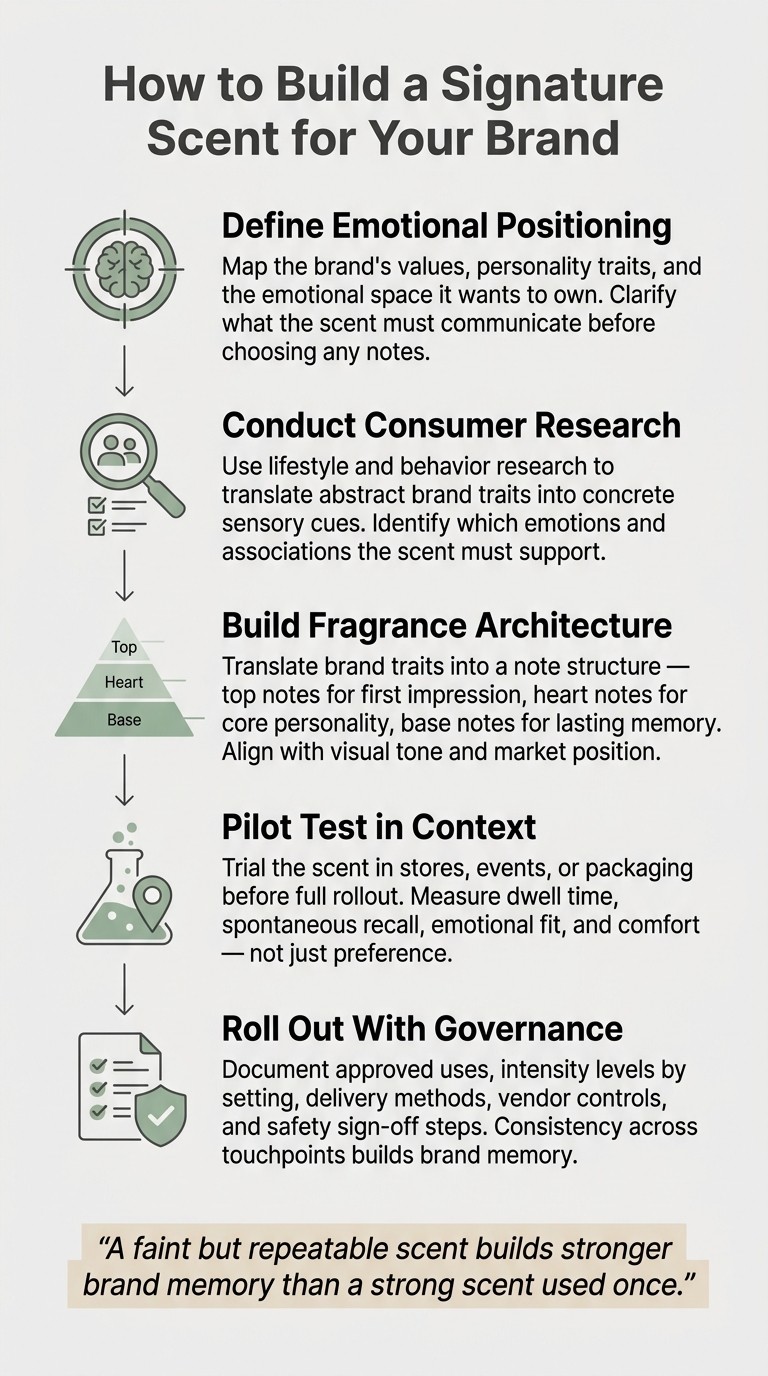
A signature scent should come from brand strategy, consumer insight, and testing, not from personal fragrance taste alone. The next step is turning that strategy into a scent brief with clear note directions.
Start With Brand Strategy and Consumer Research
The first move is defining emotional positioning, not picking fragrance notes. That means mapping the values, personality traits, and emotional space the brand already owns, or wants to own, and then asking what a scent must say to support those links. A signature scent should strengthen those associations, not pull against them.
Consumer research should show which emotions and associations the scent needs to support. Lifestyle and behavior questions can help turn abstract brand traits into sensory cues. In plain terms, if a brand wants to feel calm, polished, and modern, the scent direction should reflect that same mood instead of sending people somewhere else.
Translate Brand Traits Into Fragrance Architecture
Once the emotional positioning is set, the next step is turning brand traits into a note structure: the mix of top, heart, and base notes that gives a scent its character over time. Top notes shape the first impression. Heart notes carry the main personality. Base notes decide what stays with people and what the brand leaves behind.
A brand built around clean, modern minimalism may lean toward lighter, cleaner notes. A premium, indulgent position may call for richer, warmer notes. The note profile should line up with the brand’s visual tone and market position. If the store design, packaging, and voice feel crisp and pared back, but the scent feels heavy and ornate, that disconnect will show up fast.
Test Scent Concepts Before Rollout
Test scent concepts in live settings and judge them by emotional fit, comfort, and spontaneous recall. Pilots in stores, pop-ups, or events give teams a clearer read on how a scent performs in context. Paper concepts can look good in a brief. The real test is what happens when people walk into the space and react without prompting.
Comfort and spontaneous reactions can show whether the scent is landing the way the brand intended. If shoppers linger, describe the space in the right emotional terms, or remember the experience later, the scent is doing its job. That kind of in-market proof is what helps a scent system hold up after launch.
Once the scent direction is approved, map it to the touchpoints where customers will encounter it.
Where Should a Signature Scent Appear Across the Customer Journey?
A signature scent only works as a brand cue when people meet it in the right places, again and again. The goal is simple: place scent where a brand can control the experience and where customers spend enough time to notice it. From there, scent can move into more touchpoints without turning patchy or confusing. The strongest rollout starts with the moments a brand owns from start to finish, then expands into packaging, unboxing, and selected campaign uses as consistency holds.
A signature scent should begin in touchpoints with high brand control and steady customer exposure.
Physical spaces like stores, hotels, spas, showrooms, and events often make the best starting point.
Packaging and unboxing should mirror the in-space scent so the brand feels the same from shelf to home.
Campaign extensions work best after the main scent experience is already in place and stable.
In-Store, Hospitality, and Physical Environments
The best place to start is usually the most controlled setting. That means stores, hotels, spas, showrooms, and event spaces where the brand manages the air, the pace, and the full customer experience. These environments give scent a fair shot at doing its job. People return, stay longer, and connect the smell with the place itself.
That matters because scent is not like a logo on a sign or a color on a package. It needs time and repetition. In a retail or hospitality setting, customers are more likely to have both. A hotel lobby, for example, can turn a scent into a memory marker. A showroom can make the space feel tied together. A spa can make the fragrance part of the service itself, not just background detail.
These spaces also reduce the risk of mismatch. If a brand controls ventilation, staffing, timing, and product placement, it can keep the scent steady. That steady use is what turns a pleasant smell into a repeatable brand cue.
Packaging, Unboxing, and Product Experience
Once the scent is locked in within physical space, packaging and unboxing are the next logical move. This is where the brand travels home with the customer. If the package smells like the store, showroom, or hotel, the experience feels connected rather than random.
That link is a big deal. Someone opens a box days after a purchase and gets the same sensory cue they noticed earlier. That can strengthen recall in a quiet, almost automatic way. It also gives the brand a thread that runs from first encounter to post-purchase use.
Packaging should not introduce a different fragrance direction unless the brand is ready to split the sensory system on purpose. In most cases, the better move is alignment. The unboxing experience should echo the core scent, not compete with it. Once that match is working, the scent can move into select product touchpoints that make sense for the category and the audience.
Campaign Extensions and Digital-Adjacent Applications
After the core experience is in place, scent can branch into campaign moments with a lighter touch. Live events are a strong fit because they create focused, memorable exposure. A pop-up, launch event, or branded installation can use scent to tie the moment back to the main brand environment.
Selective product collaborations can work in the same way. The key word is selective. If scent shows up everywhere without control, it stops feeling like a signal and starts feeling messy. Campaign use should support recognition, not blur it.
This is also where digital-adjacent thinking comes in. Digital channels cannot carry scent directly, but they can point people toward places where scent is part of the experience. An email promoting an in-store event, a social campaign tied to a product drop, or a mailer that leads into a retail visit can all help bridge the gap. Used this way, scent supports recall over time rather than acting as a one-off stunt.
How Do You Measure the ROI of Scent Branding?
Once a scent program is live, the ROI of scent branding should be measured like any other brand investment. The same business signals still matter: foot traffic, dwell time, conversion rate, purchase intent, and brand recall. Scent is not some vague add-on. It is a testable brand variable that can be tracked against the outcomes marketers already use to judge performance.
Metrics That Matter
Dwell time is often the first metric to watch, especially when a signature scent is part of an immersive scent setting at an event or brand activation. If people stay longer, that is an early sign the physical experience is working. Conversion rate is another direct signal when scent is tied to an in-person touchpoint. Over a longer window, brands should also track preference, Net Promoter Score, and purchase intent.
Short-Term Tests vs. Long-Term Brand Equity
Not every scent effect appears on the same schedule. Short-term testing works best in controlled settings where the scent is the main new variable. Live events, pop-ups, and brand activations create a clear testing window for measuring engagement and conversion. After that, brands can track recall and preference over the next 6 to 12 months.
Long-term brand equity moves more slowly. At that stage, the question changes from "Did people respond?" to "Do they remember the brand in a different way?" That means measuring the memory links behind preference and loyalty, not just looking for a one-quarter sales bump.
The Role of a Sensory Brand Audit
A sensory brand audit measures scent alongside sound, texture, and packaging feel against category norms and customer expectations. Most brands have only reviewed their visual identity, which leaves a major gap in the brand experience. A scorecard like this gives teams a clearer base for rollout decisions and helps show where scent fits within the full customer journey.
Those findings also show where scent needs guardrails before rollout expands.
What Are the Biggest Risks of Scent Branding, and How Do You Avoid Them?
Scent branding can do real damage when it’s handled poorly. A sensory brand audit helps spot misalignment, uneven delivery, and compliance gaps before launch. In most cases, the biggest problems fall into three buckets: strategic mismatch, inconsistent execution, and skipped safety or legal checks.
Common Mistakes Brands Make With Scent
The biggest mistake is using scent with no clear brand role. A fragrance should not be added just because it seems memorable or trendy. It needs a job to do inside the brand system.
Another common problem is over-scenting. When a fragrance is too strong for the space, it stops feeling welcoming and starts feeling intrusive. That shift happens fast. What was meant to create comfort can end up causing irritation or pushing people away.
Scent also needs to align with the rest of the brand experience. If the fragrance clashes with the brand’s color palette, distinctive brand assets like sound and visuals, materials, or in-store mood, the result feels off. Customers may not always explain that disconnect out loud, but they still notice it.
Once the scent fits the brand, the next challenge is much less glamorous and much more practical: keeping it safe, steady, and repeatable from one setting to the next.
Operational and Compliance Considerations
Before rollout expands, brands need to check formulation safety, diffusion consistency, and legal approval. Those steps are not optional. They protect both the customer experience and the brand itself.
Diffusion becomes harder to manage as a system grows across locations, formats, or square footage. A scent that feels balanced in one store can feel faint in another and overpowering in a third. That’s why written sensory guidelines matter. They set clear rules for where scent appears, how it is delivered, and what level is acceptable in each setting.
Those rules should be in place before expansion begins. Without them, teams often improvise, and improvisation is where drift starts.
How to Keep a Scent System Scalable
Scalability starts with documentation. Written sensory guidelines help keep the program on track as more teams, vendors, and locations get involved. Without that structure, even a strong scent concept can slowly lose its shape.
Brands also need to prioritize touchpoints. A focused rollout makes it easier to test performance, adjust diffusion, and learn what works before expanding into more spaces or formats. That approach gives the brand more control and cuts down on preventable mistakes early on.
Those standards matter because scent works best when it supports a broader sensory system. On its own, fragrance can feel disconnected. As part of a full brand experience, it becomes much more consistent and much easier to manage.
How Does a Signature Scent Fit Into a Full Sensory Brand System?
Once the scent direction is set, the next step is making sure it works with the rest of the brand system.
A signature scent works best when it supports the full brand experience: sound, texture, packaging, and visuals. Those signals come together to form a single brand impression. When they match, the experience feels clear and unified. When they pull in different directions, the scent can feel out of place.
That fit starts by translating the brand’s visual and emotional language into fragrance choices. Fragrance architecture should reflect the brand’s color palette and emotional tone so the scentscape stays aligned across touchpoints. The same principle applies to audio branding, packaging materials, and in-store texture.
Scent is one of the strongest inputs into how people remember a brand, but it works only when it lines up with everything else the brand is saying. Consumer brands can also stretch that system into candles or perfumes that live beyond the core experience.
Build Sensory Guidelines That Teams Can Actually Use
Alignment does not last without clear use across teams and locations. Governance keeps the system steady across retail, packaging, and events. Approved uses and decision rules should live in one sensory guideline.
That guideline should connect scent standards to the rest of the brand system. It should reference the visual palette, audio identity, and material standards in the same document so teams can understand how each sensory asset connects to the others and make sound decisions in day-to-day work. That is how scent moves from a one-off tactic to a managed brand asset.
What This Means for Brand Leaders
For brand leaders, the value of a sensory system is stronger and harder-to-copy brand equity. Scent reaches memory before conscious evaluation. But that effect builds over time only when the scent stays consistent, is governed well, and is tied to the full brand experience.
Brands that treat scent as a standalone tactic may get a short burst of novelty. Brands that build it into a full sensory system, coordinated with audio branding, aligned with packaging cues, and grounded in brand strategy, build something much harder for competitors to copy.
If you want scent to do more than make a room smell nice, talk to Bigeye. Our brand strategy team can look at how scent, sound, packaging, and texture line up for your brand today and show you where the gaps are.
Related from Bigeye
Case study: Virtue Labs
Paid Media & Performance
Oct 7, 2026
A retail media strategy for 2027 in eight steps, with Bigeye shopper research and current data on Amazon, Walmart, Instacart and measurement.