Chewy Product Page Optimization for Pet Brands
Chewy product page optimization can swing repeat revenue far more than most pet brands expect. Chewy has more than 20 million active customers, and Autoship drives most of the platform’s sales, which means weak listing setup can hurt both conversion and reorders. This guide cuts through the clutter. It shows what matters on Chewy, where brands lose rank and sales, and how to fix titles, attributes, images, and catalog flow without treating Chewy like Amazon.
TL;DR
Chewy product page optimization should be built for Autoship, not just first-order conversion.
Pet product listings on Chewy need clean attributes, claim support, and pet-specific compliance data to stay live and searchable.
Chewy SEO depends on sales speed, review depth, in-stock rate, and page quality working together.
A SKU-level audit across Chewy, Amazon, and Petco helps pet brands spot the fixes most tied to revenue.
Why does Chewy product page optimization need its own playbook?
Chewy is not just another marketplace. Its pages are built around repeat buying behavior, and that shifts how brands should write, structure, and manage listings. Many brands work with a pet marketing agency to navigate these platform-specific nuances.
Amazon pages often lean on dense keyword copy. Chewy pages work better when they answer three shopper questions fast:
Is this right for my pet?
How long will it last?
Can I trust this enough to put it on Autoship?
That matters because Chewy’s model leans hard on recurring orders. According to company and industry estimates cited across pet product marketing reporting, a Chewy subscriber may be worth 5x to 8x more than a one-time buyer. That changes the job of the page. The listing is not just there to win a click. It needs to support habit and reordering.
For brands building a broader CPG marketing strategy, that means Chewy should not get recycled Amazon copy with a few edits.
What should a retail-ready Chewy listing include?
A retail-ready page starts with the basics done right. On Chewy, that means the title, bullets, attribute fields, and image stack all need to work together.
Titles should be direct and easy to scan. A common format is:
Brand + Product Line + Key Attribute + Format + Pack Size
That structure helps with search clarity and shopper understanding. A pet parent should know what the item is before opening the page.
Bullets should stay short and focused. Each bullet should answer one buying question, such as:
ingredients
feeding use
breed or life-stage fit
shelf life
texture or format
Long blocks of text can slow the shopper down. Shorter lines are easier to scan on mobile, where many Chewy purchases start.
The product detail fields may matter even more than the bullets. For pet food and supplement SKUs, pages often need data such as:
AAFCO nutritional adequacy statements
full ingredient lists
feeding directions
life stage
breed size
flavor
diet type
If those fields are wrong or missing, the SKU can miss filter placements for terms like puppy, grain-free, or small breed. That is a visibility problem and a sales problem.
How do images help Chewy conversion and Autoship sign-up?
On Chewy, images often do the last bit of selling work. Many shoppers skim fast, especially on phones, so the image set needs to answer questions in order.
A strong image flow usually looks like this:
Hero image on a pure white background
Lifestyle image showing the product in use
Ingredient or nutrition panel
Size or usage image showing what arrives
Pack-size reference
Video or motion asset if available
Brands can advertise like Chewy by following guidance that points them toward 1,500 x 1,500 px hero images with a white RGB background. That format helps with zoom and page clarity.
The image sequence should do more than look polished. It should answer:
what the product is
who it fits
how much comes in the order
how the item looks or works in real use
That matters for Autoship. A shopper is less likely to subscribe if pack size, feeding amount, or product texture is not clear.
Alt text: chewy product page image stack for pet ecommerce SEO
How should Chewy pages support Autoship conversion?
Chewy product page optimization should make replenishment feel simple. If the page does not explain timing and fit, Autoship can feel like a risk instead of a convenience.
The strongest pages make product usage easy to estimate. For example, they show how long a bag or case may last based on pet size, life stage, or daily serving amount.
That can be handled with:
a usage chart in images
bullet copy around feeding amounts
size guidance tied to pet weight
pack options built around 30-, 45-, or 60-day cycles
Price matters, but it is not enough on its own. Autoship messaging should also stress routine, ease, and fewer missed refills.
A shopper comparing two similar pet food SKUs may not choose only on discount. If one page makes reorder timing clear and the other does not, the clearer page has the better shot at repeat purchase.
What affects Chewy SEO and sales rank most?
Once a page is live and complete, rank tends to follow performance signals. On Chewy, search placement is closely tied to sales speed and page trust signals.
The big ones are:
conversion rate
review count
star rating
Q&A activity
in-stock rate
Autoship uptake
According to industry reporting cited in pet retail coverage, Chewy vendors are often expected to keep at least a 98% in-stock rate. Falling below that can hurt placement even if the page copy is strong.
Reviews matter too. A listing with more review depth and higher ratings tends to send a stronger proof signal to both shoppers and the platform. The Q&A section can also help because it adds useful shopper language around fit, usage, and common concerns.
Paid support can help at launch or during peak demand. Some retail media reporting shows that about 1 in 3 ad clicks on Chewy can turn into a purchase, and around 45% of ad-attributed orders may become Autoship orders. Those numbers show why promotions should support hero SKUs, not be spread too thin across the whole catalog.
For brands looking at rank drops or low conversion, a retail media audit and shelf review often finds the root issue faster than more ad spend alone.
Why do catalog issues break Chewy performance?
A page can look fine on the front end and still fail because the back-end catalog is messy. On Chewy, bad catalog data can block publication, hurt indexing, or push a SKU into the wrong filters.
The weak points are often simple:
mismatched UPCs
bad dimensions
wrong flavor or breed tags
unsupported claims
stale inventory data
title drift across systems
New item setup often starts in the Chewy Vendor Portal through a Product Addition Form. Missing fields or formatting mistakes can leave items unpublished for days or weeks.
For brands with large assortments, one master record should hold the core facts:
claims
ingredients
pack details
attributes
taxonomy fields
That same source should feed retailer-specific versions of the listing. The facts stay fixed. The wrapper can change by channel.
Inventory sync also matters. For many vendors and sellers, daily sync through API or EDI tools such as Rithum is the baseline. If Chewy sees one stock number and the internal system shows another, the damage can show up as oversells, suppressed pages, or lost rank.
Alt text: Chewy Vendor Portal catalog workflow for pet brands
How does a digital shelf audit find the best fixes?
A SKU-level digital shelf audit compares the same product across Chewy, Amazon, and Petco to find where the page is weak and where money is being left on the table.
The goal is not to create one “master” page and paste it everywhere. Each retailer has its own page logic, shopper behavior, and compliance pressure.
A strong audit checks:
title quality
bullet structure
image count and order
attribute accuracy
compliance support
review gaps
search rank by core terms
in-stock risk
pack-size setup for repeat purchase
Here is where the contrast often shows up:
Retailer | Page style | Main pressure point |
|---|---|---|
Chewy | Emotion-led, reorder-focused | Fit, trust, Autoship |
Amazon | Search-led, conversion-heavy | Keyword density, reviews |
Petco | Education-led | Health and product support |
That side-by-side view helps brands sort fixes by likely revenue impact. The best first move is often to start with the top 10 margin-driving SKUs, then repair missing fields, weak images, and poor taxonomy before spending more on ads.
Teams that also use commerce consulting services can connect the audit to channel planning, paid media, and catalog cleanup instead of treating the listing as a stand-alone task.
What should pet brands track after the first
How to Build a Retail-Ready Chewy Listing
Titles, fields, and images do the heavy lifting on a Chewy product page. Titles help shoppers find the SKU. Fields affect approval and search placement. Images answer the last buying questions and push the click toward purchase. The best workflow is simple: start with titles, lock down the required fields, then use images to clear up any doubt.
Write Titles and Bullets for Search Clarity and Pet-Parent Decisions
A strong Chewy title usually follows one clean pattern: Brand + Product Line + Key Attribute + Format + Pack Size. A clear example is Blue Buffalo Wilderness High Protein Grain-Free Dry Dog Food, 24-lb bag. It works because it puts top search terms near the front, shows diet and life-stage fit, and tells the shopper what the item is before the page even opens.
Bullets need the same kind of discipline. Each bullet should stay short, cover one point, and skip gimmicky formatting. Think of them as quick answers to the questions pet parents ask right before they buy. One bullet can address ingredients. Another can cover compatibility, shelf life, or feeding guidelines. When each line handles one concern, the page feels easier to scan and easier to trust.
Fill In the Product Detail Fields That Affect Indexing and Compliance
Once the title is set, the product detail fields need close attention. These fields affect both indexing and approval, so missing data can cause problems fast. For pet food SKUs, Chewy needs AAFCO nutritional adequacy statements, full ingredient disclosures, feeding instructions, and product attributes such as breed size, life stage, diet, and flavor.
These details do more than complete the page. They help Chewy sort the SKU into the right filters and search results. If a shopper narrows a search by puppy, grain-free, or small breed, those fields help the product show up where it should. That means cleaner discovery and fewer mismatches between the product and the buyer.
Use Images and Creative to Answer Buying Questions Fast
Images often do the final selling work, especially on mobile, where shoppers skim fast and decide even faster. Chewy shoppers lean heavily on product images, so a six-image setup gives the page enough room to answer key questions without making the shopper dig.
The image stack should follow a clear order:
Start with a hero image on a pure white background at 1,500 × 1,500 pixels with RGB 255/255/255.
Follow with lifestyle shots, an ingredient or nutrition infographic, a usage or size-reference image that shows pack size and what arrives in the box, and a last slot for video.
That sequence works because it mirrors the buyer's thought process. First: What is it? Then: Is it right for my pet? Then: What exactly will show up at my door? Video can help answer the last layer of doubt by showing texture, kibble size, or how the product is used.
Mobile presentation matters just as much as the image order. Bold text callouts and tight crops around the packaging make the product easier to read on a phone screen. If the shopper has to pinch and zoom to understand the bag, the page is already losing ground. Once the listing feels clear, complete, and easy to scan, the next move is to build the replenishment story.
How to Build an Autoship Strategy Into Your Chewy Product Pages
Once a Chewy product page covers fit and the core product details, the next step is simple: make replenishment easy to see and easy to choose. Chewy Autoship is the main conversion path, so each part of the page should support repeat purchase rather than treat it like an afterthought.
Make Replenishment Timing Clear on the Page
Autoship shoppers want one thing answered fast: How long will this last? If that answer is fuzzy, the recurring order option feels like a guess.
A usage chart or supporting image can spell out how long each pack size lasts based on pet size or life stage. Short, direct bullet points can back that up with answer-first copy on feeding guidelines, compatibility, and shelf life. That kind of clarity matters because pack-size choice shapes whether Autoship feels like a natural fit or a pushy ask.
Communicate Value Beyond Price
Autoship discounts help, but price by itself is a weak reason to stay enrolled. A better approach is to use benefit-led copy that speaks to routine, convenience, and trust.
Language near the price and header should lead with ease and dependability. When the product is framed around a steady routine and a good daily fit - not only cost savings - shoppers have a stronger reason to commit to recurring delivery.
Match Pack Sizes and Hero SKUs to Recurring Purchase Patterns
Once timing is clear, the SKU setup should match the way people actually buy again. Start with hero SKUs, then shape the page around pack options that fit common 30-, 45-, or 60-day cycles.
Chewy’s size-selection layout already helps shoppers connect volume to need. Brands that line up pack structure with real consumption patterns give pet parents a clearer path to repeat purchase through Autoship.
What Drives Sales Velocity and Ranking on Chewy?
Once a product page covers fit and replenishment, Chewy ranking shifts to sales velocity. Listings tend to move up when they convert well, collect reviews, stay in stock, and push Autoship adoption. During a digital shelf audit, each SKU should be scored against those signals.
Build Review Volume, Quality, and Visibility
Product copy and visuals should do two jobs at once: win the click and help close the sale. On Chewy, strong review volume and high ratings can lift search placement because the platform rewards products with a proven record of conversion.
The Q&A section is often overlooked, and that’s a miss. Active answers help keep shoppers on the page longer, while those responses add keyword-rich user-generated content that can help with search indexing for long-tail queries. A review base does not need to be massive to matter. Even a steady stream of reviews can build trust and support conversion.
Use Promotions, Coupons, and Merchandising Tools With a Plan
Ads and coupons work best when they support hero SKUs during launch periods or seasonal demand spikes. On Chewy, 1 in 3 ad clicks leads to a purchase, and about 45% of ad-attributed purchases turn into recurring Autoship orders. That’s a strong case for using paid merchandising with intent instead of treating it like a blanket tactic.
Coupons and introductory Autoship discounts, often around 5%, tend to perform best when the page message frames recurring orders as a convenience play, not only a price cut. Pet owners are not just looking to save a few dollars. They also want one less thing to remember.
Keep Availability, Pricing, and Catalog Data Clean
Inventory health is a direct ranking signal. Chewy requires vendors to keep at least a 98% in-stock rate. Falling below that line can suppress listings and hurt category standing, even when content and reviews look strong. For 3P sellers, real-time or daily inventory syncing through EDI or API connections is a must.
Pricing accuracy matters just as much. Clear display of list price, sale price, and Autoship price helps shoppers compare options fast and supports conversion. Standardized titles, accurate taxonomy, and clean catalog data also make pages easier for both shoppers and Chewy to interpret. Ranking gains from better content or stronger promotions rarely stick if catalog operations are messy.
The next step is to standardize the catalog workflow that keeps these signals in place.
How to Sell on Chewy With Better Catalog Operations
A Chewy page can look polished and still fail if the catalog behind it is messy. Chewy catalog operations drive whether a listing goes live, stays approved, and shows up in the right search results. Clean content, backed-up claims, and synced product data are what keep the page working day after day.
Clean product data helps Chewy listings get published without long delays.
Daily inventory sync keeps stock levels aligned between Chewy and internal systems.
One master source for claims, ingredients, and attributes cuts approval friction across channels.
Consistent naming and taxonomy help Autoship-ready SKUs stay easy to find.
Set Up a Clean Content Workflow for Chewy Vendor Portal and Vendor Tools
New item setup starts with the Product Addition Form (PAF) in the Chewy Vendor Portal. Product names, UPCs, descriptions, dimensions, and pricing should be complete before submission, since formatting mistakes can leave a listing unpublished for weeks.
For order and inventory flow, EDI or API integration through Rithum, formerly DSCO, can automate purchase orders, tracking, and invoicing. Daily inventory sync matters here. If Chewy sees one stock number and the internal system shows another, the listing can run into avoidable issues fast. The goal is simple: Chewy should see the same availability the brand sees internally.
The Chewy Vendor Portal inbox also needs close attention. Category managers may flag compliance questions or product-level errors there, and those messages often affect whether listings stay active and approved.
Once stock and order flow are steady, the next step is to tighten the rules around naming and claims. That is where many catalog teams either gain speed or get stuck.
Standardize Claims, Naming, and Taxonomy Across Channels
Every product claim should have substantiation files attached. That gives legal and content teams a clear path to review and approve updates without digging through email threads or scattered folders.
A single master record should hold claims, ingredients, and product attributes. That verified source keeps the core data stable, while the outer wrapper can shift by retailer. In practice, that means the facts stay fixed, but the channel-specific tone and format can be stored in the content master so each retailer gets the right version.
Naming standards also need to stay aligned across channels. Chewy titles should match the master catalog, not drift from it over time. Wrong size, flavor, or breed attributes can push a SKU out of relevant search results even when the base copy is accurate. That is a small data problem with a big sales cost.
Pack, flavor, breed, and life-stage fields should also line up with recurring purchase behavior. When those fields are set correctly, Autoship-ready SKUs are much easier to find and much easier for shoppers to reorder.
A SKU with the wrong breed or life-stage tag is a bit like shelving dog food in the cat aisle. The product still exists, but the right buyer may never see it.
Brands with large assortments often need periodic reconciliation between the Chewy Vendor Portal and the internal ERP or catalog system. That check helps catch drift before it spreads across channels. It also creates the master data baseline needed for an Amazon, Chewy, and Petco audit. When those controls are in place, the SKU audit moves faster and the results are far more dependable.
FAQ
How often should Chewy inventory data be synced?
Inventory data should be synced daily so Chewy reflects the same stock availability shown in the internal system.
What causes Chewy listings to stay unpublished?
Missing or badly formatted fields in the Product Addition Form, such as UPCs, dimensions, pricing, or descriptions, can delay publication for weeks.
Why do product attributes matter so much on Chewy?
Attributes like size, flavor, breed, pack, and life stage affect how SKUs appear in search. If those fields are wrong, the product may not show up for the right shopper.
What system should act as the source of truth for Chewy catalog content?
One verified master record for claims, ingredients, and product attributes should serve as the source of truth, with retailer-specific formatting handled around that core data.
TL;DR Summary
Clean product data helps Chewy listings get published without long delays. Even minor formatting errors in the PAF can hold a page back far longer than most teams expect.
Daily inventory sync keeps stock levels aligned between Chewy and internal systems. That cuts order flow issues and helps avoid mismatched availability across platforms.
One master source for claims, ingredients, and attributes cuts approval friction across channels. Legal, content, and commerce teams can move faster when everyone works from the same verified record.
Consistent naming and taxonomy help Autoship-ready SKUs stay easy to find. Search visibility depends on the accuracy of fields like breed, flavor, pack, and life stage.
Need help fixing Chewy catalog issues before they hurt sales? Bigeye can run a retail catalog audit across Chewy, Amazon, and Petco to spot broken attributes, weak taxonomy, claim-risk gaps, and sync problems. Schedule a Chewy catalog audit to clean up SKU data and tighten retail performance.
How Do You Run a Digital Shelf Audit Across Chewy, Amazon, and Petco?
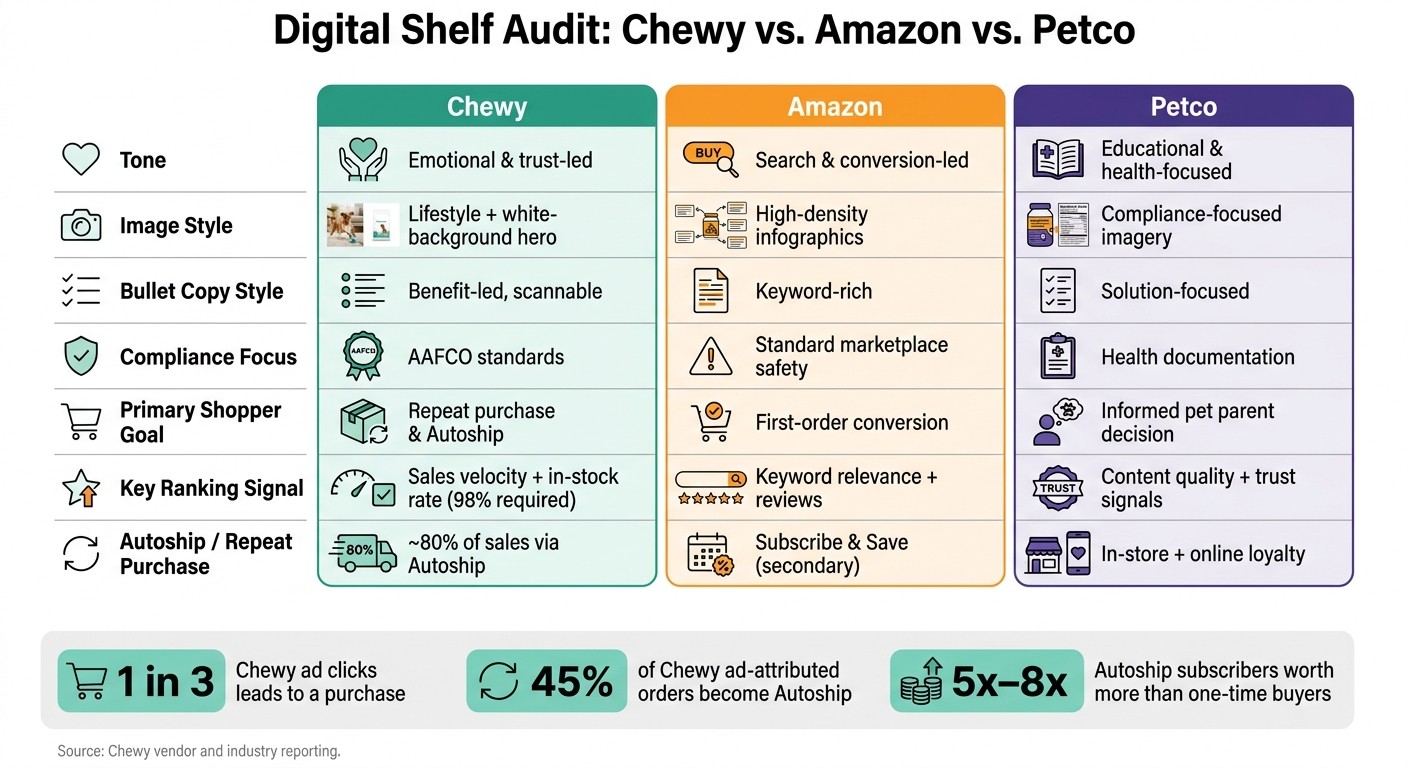
Chewy vs. Amazon vs. Petco: Digital Shelf Audit Comparison for Pet Brands
A SKU-level digital shelf audit shows where a product page wins, where it falls short, and where margin is being left behind. The process compares content, search visibility, review volume, and placement across Chewy, Amazon, and Petco, then pushes the highest-margin fixes to the front of the line. Each retailer plays by its own rules, so copy, imagery, and compliance proof should be tuned for each one. The audit should rank fixes by margin first, then by visibility gap.
Score Each SKU for Content Completeness and Purchase Readiness
Start with the same SKU across all three retailers. From there, compare what each page lacks and what each one does well. Review title quality, bullet structure, image compliance, attribute accuracy, and rank and index position against close competitors.
Missing attribute data should be flagged right away. The same goes for missing compliance proof, especially when a product makes claims such as grain-free or vet-approved. Those gaps can hurt trust and can also limit placement.
The table below shows what this audit often surfaces across retailers:
Audit Element | Chewy | Petco | Amazon |
|---|---|---|---|
Tone | Emotional | Educational | SEO-led |
Images | Lifestyle + hero | Compliance-focused | High-density infographics |
Bullets | Benefit-led | Solution-focused | Keyword-rich |
Compliance | AAFCO standards | Health documentation | Standard marketplace safety |
That retailer-by-retailer view matters. A page that looks fine on Amazon can still underperform on Chewy if the messaging feels too search-heavy and not trust-led. In the same way, a Petco listing may need stronger documentation and cleaner health-language support to match shopper expectations.
Compare Review Position and Search Visibility by Retailer
Once content has been scored, the next step is performance. Review volume, star rating, and Q&A activity should be compared across Chewy, Amazon, and Petco for the same SKU.
A SKU with deep review volume on one retailer and weak review depth on another often points to a trust gap. That gap can drag down conversion and search placement. On Chewy, that matters even more because shoppers tend to be highly loyal and lean hard on peer reviews before they buy.
Search visibility should also be tested platform by platform. Check whether each SKU ranks in the top 10 for its main category terms on each retailer, rather than assuming performance carries over from one marketplace to another. If a SKU ranks on Amazon but misses Chewy’s top 10 for core terms, that’s a clear signal that the Chewy page needs work.
Turn Audit Findings Into a 30-Day Optimization Plan
The audit should end with a fix list, not a document that sits untouched. Start with the top 10 SKUs by margin. That keeps the first round of work tied to revenue, not just page quality.
After that, confirm Autoship eligibility. About 80% of Chewy sales come through Autoship, so any eligible SKU that is not enrolled is giving up repeat revenue. That is not a small miss; it affects both short-term sales and repeat purchase flow.
Inventory health also needs to stay on the critical path. Chewy requires vendors to hold at least a 98% in-stock rate. Drop below that mark, and search ranking suppression can follow. Weekly tracking should cover conversion, add-to-cart rate, and returns so weak spots show up early instead of after sales soften.
Chewy Listing Optimization Is a Recurring Commerce Discipline, Not a One-Time Fix
Chewy product page optimization does not end at launch. It turns into steady upkeep tied to search visibility, review momentum, and in-stock performance. The pet brands that stay visible do not treat listing work like a one-and-done task. They treat it like routine commerce maintenance. Once a page goes live, the priority shifts from building the listing to watching it, fixing weak spots, and keeping it current.
What High-Performing Pet Brands Do After the First Optimization Pass
After the first content build, the work moves into monitoring and iteration. High-performing pet brands check conversion rates, add-to-cart rates, and search impressions every week so small issues do not snowball. They also refresh creative as pets move from puppy or kitten stages into adult and senior life stages.
The image carousel needs regular attention too. Brands keep it current with mobile-ready hero images, lifestyle video, and updated compliance graphics. On Chewy, a subscriber can be worth 5 to 8 times more than a one-time buyer. That makes even a small trust gap expensive over time. If a shopper lands on stale imagery, missing proof points, or outdated life-stage messaging, the hit is not just one lost order. It can mean lost repeat revenue.
Inventory discipline has to run alongside content work. Keeping availability at or above 98% is critical, because stockouts can suppress listings and hurt search placement. That problem can linger longer than many brands expect. Teams using EDI or DSCO integration to sync inventory daily or near real time are in a better spot to avoid those dips and protect ranking.
When both content and stock stay steady, the next step becomes clearer: compare performance across retailers and find what still lags.
Where a Cross-Channel Audit Creates the Fastest Gains
The fastest wins often show up when Chewy is compared against Amazon and Petco at the SKU level. That side-by-side review exposes content gaps, missing compliance proof, and visibility differences from one retailer to the next.
A Chewy-standard content rebuild often pays off beyond Chewy itself. Tighter copy, editorial photography, and claims substantiation can improve performance on Amazon too. In plain terms, Chewy sets a high bar. If a catalog is built to meet that bar, those same assets often travel well across the rest of the retail mix.
A SKU-level audit should focus on three things first:
content gaps
review gaps
in-stock risk
That order matters. Fix the page first, then address proof and momentum, then close any supply issues that could drag the listing back down. It is a simple sequence, but it keeps teams from patching symptoms while the core page still needs work.

Pet Industry
Sep 13, 2026
Amazon PPC for pet brands: separate intent, set bids by margin & reorder value, and stop wasted spend with a 90‑day audit.