Pet Brand Subscription Retention: The Month Three Problem
Pet brand subscription retention often fails at month three, not month one. That gap costs pet ecommerce brands margin, slows CAC payback, and cuts LTV before the subscription model has time to work. This guide breaks down why pet subscription churn spikes after the second order, what churn cohort analysis should flag, and which fixes - like cadence changes, pause options, and dose education - can keep more subscribers active.
TL;DR
Month-three pet subscription churn usually means shipment timing does not match product use.
Pet subscription retention improves when brands fix cadence before offering discounts.
Churn cohort analysis helps teams find whether the leak comes from product buildup, failed payments, or weak education.
Pause, skip, and delay options often save more subscribers than cancel-page discounts.
Dose education and depletion-based lifecycle marketing help reduce extra inventory and early exits.
Why does pet subscription churn spike at month three?
The first order runs on novelty. The second can still ride that momentum. By the third shipment, the customer knows whether the autoship schedule fits daily life.
That is why month-three churn matters so much for pet brands.
If food bags, treats, litter, or supplements are showing up before the last shipment is used, customers often cancel. In many pet households, the issue is not dislike. It is simple oversupply.
That timing also hits the business side hard. For many subscription brands, customer acquisition and shipping costs are not fully paid back until the second or third repeat order. If the customer leaves before then, revenue came in, but margin did not have time to catch up.
Pet products often come with a lower CAC than other categories, but that does not remove the risk. A pet brand can spend about $23 to get a customer, yet still lose on the account if month-three retention breaks. On the other side, subscription buyers can produce far more value than one-time shoppers. Some premium pet food programs can reach $400 to $900 in 12-month customer value, while many one-time buyers sit much lower.
So the main question is not whether the first box converted. It is whether the third box still makes sense.
What causes pet subscription churn after the second order?
The most common cause is simple: too much product at home.
A default 30-day shipment cycle often misses actual pet usage. Dogs eat different amounts based on weight, age, breed, and activity. Cats can be even harder to predict. Supplements add another layer because owners may skip doses or use less than directed.
By the third order, that mismatch becomes hard to ignore.
Common month-three churn drivers include:
Too much inventory on hand
Shipment frequency set too fast
Pack sizes that do not fit the household
Weak dose or feeding guidance
Slow product results, especially for supplements
Failed payments or service issues misread as customer choice
Doggy Do Good gave a strong example in 2024. The brand found that product buildup was the top churn driver. After adding pause and frequency-change options, reported monthly churn fell from 10% to 1% within one quarter.
That result points to a simple rule: when customers have too much product, a lower price does not fix the problem.
Discount-led retention can also train bad behavior. If the cancel page always offers a deal, shoppers learn to threaten cancellation to get a lower price. That may save a few accounts short term, but it does not fix the shipment mismatch that caused the problem.
How does churn cohort analysis show where retention breaks?
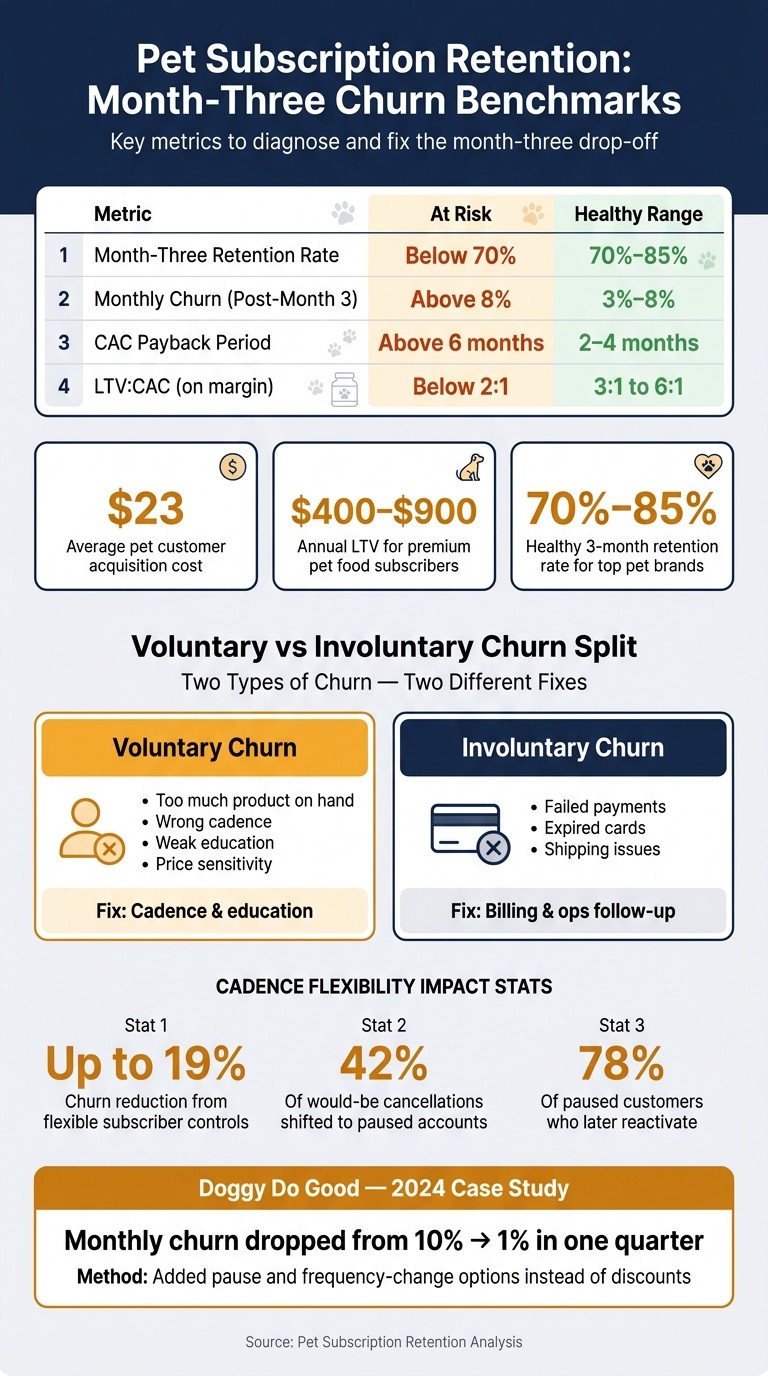
Pet Subscription Retention: Month-Three Churn Metrics & Benchmarks
Churn cohort analysis groups subscribers by signup month or billing cycle so the drop-off point becomes plain. Instead of looking at one blended churn rate, teams can see exactly when and where the subscription model starts leaking.
That matters because topline churn hides too much.
A pet brand should break cohorts down by:
Signup month
Product category
Pet type
Acquisition channel
First-order offer
Billing cycle
Cancel reason
Those cuts often show that not all subscribers behave the same way. Search traffic may hold better than paid social. One supplement SKU may hold better than another. A discount-heavy first order may bring in buyers who never make it past the third charge.
Top pet brands often keep 70% to 85% of subscribers through the first three months. If retention sits below that range, month-three churn deserves a close look.
It also helps to split churn into two groups:
Voluntary churn: the customer chooses to cancel
Involuntary churn: payment failure, expired card, shipping issue, or service problem
That split matters because each one needs a different fix. Voluntary churn often points to cadence, value, or education. Involuntary churn points to billing and service follow-up.
Key metrics to watch
A short scorecard can keep teams focused on the numbers that matter most:
Metric | Risk signal | Healthier range |
|---|---|---|
Month-three retention | Below 70% | 70%–85% |
Monthly churn after month 3 | Above 8% | 3%–8% |
Over 6 months | 2–4 months | |
LTV:CAC on margin | Below 2:1 | 3:1 to 6:1 |
Pause rate and skip rate should sit next to these numbers. Those are not side metrics. They often show whether customers need relief or want to leave for good.
Why does cadence flexibility beat discounts?
When month-three churn comes from oversupply, the fix is timing.
That is why cadence flexibility usually beats a discount.
If the brand can estimate use from weight, breed, age, activity level, bag size, and pet count, shipments can land closer to runout. Even a small shift can change how the customer feels about autoship.
A reminder based on expected depletion tends to work much better than a generic 30-day prompt. Data cited in the market shows personalized reorder reminders can convert at 41%, while generic calendar reminders may convert around 15%.
The practical fixes are plain:
Let customers skip one order
Let customers pause for one to three months
Let customers push the next ship date back
Let customers change frequency without talking to support
These options matter because many customers do not want to cancel forever. They want breathing room.
Reported results in the market support that idea:
Flexible controls can cut churn by up to 19%
A pause option can move 42% of would-be cancellations into paused accounts
About 78% of paused customers later reactivate
That is a better path than forcing an all-or-nothing choice.
Seasonality matters too. Some pet products do not move at the same speed all year. Anxiety products may pick up later in the year. Cooling products may move more in summer. If autoship stays rigid while demand changes, cancellations become more likely.
How does dose education reduce pet subscription churn?
For pet supplements and some food programs, month-three churn is often an education problem.
Customers may not know:
How much to give each day
How long one jar or bag should last
When they should expect results
That confusion creates two problems at once. First, the pet may not get the product as intended. Second, the customer ends up with extra product at home and starts to doubt the subscription.
This is common with joint, coat, skin, and digestive supplements. Visible results may take 30 to 60 days of steady use. If that timeline is not explained, the customer may decide the product is not working before it had enough time.
A better lifecycle flow can fix that.
The first two weeks should explain:
Daily dose in plain language
How long the package should last
What results may show up first
When results may take longer
Simple wording helps. A line like “one scoop per 10 lbs” is easier to follow than a dense instruction block.
Pet-specific guidance helps too. When the message reflects the pet’s weight, breed, age, or activity level, it feels more useful and tends to reduce guesswork.
The larger point is this: product pileup is often the symptom, not the root cause. If cadence is close but inventory still builds, poor usage guidance may be the issue.
What should lifecycle marketing do before month three?
Lifecycle marketing should step in before cancellation intent becomes final.
That means building flows around the risk window, often at:
Day 30
Day 60
Day 85
The goal is not to send more messages. The goal is to send the right message at the point when doubt starts to build.
That usually includes:
Onboarding emails with feeding or dosing help
Check-ins before the third shipment
Refill reminders based on depletion timing
Support for skipped shipments or pause requests
Product transition messages tied to pet age or life stage
Personalization can also help engagement. Market data shows emails using a pet’s name in the subject line can lift opens by 68% and clicks by 42% compared with generic subject lines.
Still, clicks are not the main score.
The better lifecycle metrics are:
Reactivation rate
Extra months retained after save action
Month-three retention lift by cohort
Saved accounts that renew again
Those are the numbers that connect retention work to LTV and payback.
What should pet brands fix first?
The order
What Are the Real Causes of Pet Subscription Churn at Month Three?
Month-three pet subscription churn usually has a simple cause: the box arrives before the pet finishes the last one. A churn cohort read makes that pattern hard to miss. Month-three cancellations tend to bunch up when shipping cadence and actual consumption drift apart. Brands that label this as a price problem and answer with discounts often push the issue deeper instead of fixing it.
Too Much Product Is the Most Common Cancellation Trigger
A 30-day cycle can move faster than a pet’s actual usage. Pet weight, activity level, bag size, and the number of pets in the home can all throw off the plan before the third shipment arrives.
Exit surveys often show that too much product on hand is the top reason subscribers cancel pet plans. Doggy Do Good confirmed the same pattern in 2024: product buildup was its main churn driver. After the brand added pause and frequency-change options, monthly churn fell from 10% to 1% in a single quarter.
Discount-Led Retention Programs Train Subscribers to Cancel
When the cancel page offers a discount, it can teach subscribers the wrong lesson. Instead of treating cancellation as a warning sign, the brand turns it into a negotiation tool. Subscribers learn that clicking "cancel" may unlock a better deal.
The sharper fix is to correct cadence first. Discounting can cover up the mismatch, but it does not solve it. A pet food brand with annual revenue between $5 million and $7 million added lifecycle-based subscription check-in flows during the second and third billing cycles rather than leaning on save offers. Within 10 weeks, monthly churn dropped from 7.8% to 5.8%, and average subscriber LTV grew from $285 to $348.
Weak Dose and Usage Education Speeds Up Cancellations
Supplements run into a different version of the same problem when customers do not know what timeline to expect. If dosing feels unclear, or if the product takes longer to show results than the buyer assumed, customers may decide it is not working before it has had a fair shot.
Mammaly tackled that issue with targeted cancellation flows that offered product swaps instead of a straight exit, recovering 3% of subscription revenue in the process. The bigger lesson is plain: when a subscriber is close to leaving, the first question is why. It is not how big a discount should appear on the screen. Skip requests and support tickets often flag risk before a cancellation shows up in the cohort data.
How Do You Use Churn Cohort Analysis to Find Where Pet Subscription Retention Breaks Down?
Churn cohort analysis shows exactly where pet subscription retention starts to fail. When subscribers are grouped by signup month and billing cycle, the month-three churn cliff usually comes into focus fast. That view helps teams figure out whether the problem sits in shipping cadence, customer education, or day-to-day operations.
Map Cancellation Timing by Cohort, Channel, and Product Type
Cohort cuts surface patterns that topline churn rates tend to hide. Grouping subscribers by signup month, acquisition channel, first-order offer, pet type, or product category makes it easier to spot whether one campaign or one SKU is driving a spike in cancellations during month three.
Channel-level cuts often tell the clearest story. Subscribers acquired through high-intent Google search often behave differently from those coming in through Meta’s emotion-led storytelling. Offer-level cohort splits can confirm which acquisition paths start leaking by the third month. Top pet brands keep 70% to 85% of subscribers through the first three months.
Split Voluntary Churn From Payment and Service Failures
Not every cancellation points to the same problem. Treating all churn as one number usually leads to the wrong fix.
Voluntary churn happens when a subscriber chooses to cancel because they have too much product, the timing feels off, or the price no longer works. That usually calls for a cadence or education fix.
Involuntary churn comes from failed payments, expired cards, or shipping issues. That points to an operations problem.
Cancellation-reason tags from exit surveys are a practical way to separate those two groups. Once that split is clear, teams can assign the right response: retention tactics for voluntary churn, and operational fixes for failed payments or service misses.
Metrics That Matter for Pet Brand LTV
Once churn is mapped and sorted, the scorecard needs to focus on what drives profit. For many pet brands, customer acquisition costs are not recovered until the second or third order. Pet acquisition runs about $23 per customer, which makes month-three retention one of the main numbers to watch.
Track these metrics:
Metric | At Risk | Healthy |
|---|---|---|
Month-Three Retention Rate | Below 70% | 70–85% |
Monthly Churn (Post-Month 3) | Above 8% | 3–8% (Best: 3–4%) |
CAC Payback Period | Above 6 months | 2–4 months |
LTV:CAC (on margin) | Below 2:1 | 3:1 minimum; 4–6:1 healthy |
Skip and pause rates should sit in the same dashboard too. Why? Because subscription mix shapes pet P&L far more than gross margin alone.
Even a modest lift can change the math. Improving repeat purchase rates by 10 percentage points can increase average customer lifetime value by 25% to 40%. Cohort analysis makes the month-three leak plain to see. Once that leak is visible, cadence flexibility becomes the next lever to test.
How Does Cadence Flexibility Reduce Pet Subscription Churn Better Than Discounts?
Month-three pet subscription churn usually points to a timing problem, not a price problem. When a cohort view shows a leak in the third month, cadence flexibility should be the first lever to test. Discounts may buy a little time, but they rarely fix the root issue. Matching delivery timing to actual product use does.
Match Shipping Frequency to Real Consumption
Use signup inputs like weight, breed, age, and activity level to estimate how fast a pet will go through the product. Then set delivery to land a few days before the expected run-out date. That small shift can change the whole experience. Instead of getting a box too early or too late, the customer gets it when it makes sense.
That matters because reminder timing drives action. Personalized reorder reminders based on depletion logic convert at 41%, while generic 30-day reminders convert at only 15%.
One direct-to-consumer pet food brand with annual revenue between $5 million and $7 million applied this idea through “Subscription Check-in” flows in the second and third billing cycles. The result was sharp and fast: monthly churn fell from 7.8% to 5.8%, and average subscriber LTV grew from $285 to $348 in just 10 weeks.
When the first schedule guess still misses the mark, the next move should not be an immediate coupon. It should be a simple way for the customer to push the next order back.
Make Skip, Pause, and Delay Options Easy to Find and Use
Skip, pause, and delay controls should be easy to spot and easy to use. If those options are buried, customers often head straight to cancellation. If they are visible, many customers choose a lighter adjustment instead.
Flexible subscriber controls can cut total churn by up to 19%. A pause option of one to three months can shift 42% of would-be cancellations into paused accounts, and 78% of those customers later come back. That’s the big point: a pause is not lost revenue forever. In many cases, it is a bridge.
Doggy Do Good showed how strong that effect can be. In 2024, the brand found that product buildup was its top reason for cancellation. After adding pause and frequency-change options instead of leaning on discounts, quarterly churn dropped from 10% to 1% in a single quarter.
For many pet brands, that result makes perfect sense. A household with too much product does not need a lower price. It needs breathing room.
Adjust Autoship for Seasonal Demand
Cadence should also shift with the calendar. Some pet products follow a clear seasonal rhythm, and a rigid autoship plan can ignore that reality. Cooling mats tend to move in summer, while anxiety aids often see more demand in fall and winter.
When brands pause shipments or stretch delivery intervals for products tied to weather, travel, or activity changes, billing stays closer to actual use. Then, when that demand returns, the subscription can restart on time. This approach helps prevent avoidable cancellations during slow seasonal periods.
In plain terms, the goal is simple: send product when it will be used, not just when the billing system says it is time. Discounts can lower the price of a bad experience. Cadence flexibility helps fix the experience itself.
How Does Dose Education Improve Pet Food and Supplement Subscription Retention?
Pet food and supplement subscription retention often breaks down by month three for one simple reason: the customer still doesn’t know if the product is working, how much to use, or how long one shipment should last. When cohort data shows month-three churn, shipping cadence may not be the main issue. In many cases, the bigger gap is education. If cadence is already close to the pet’s actual use rate, weak dose guidance can lead to product buildup, missed use, and canceled subscriptions.
TL;DR
Customers often cancel by the third order when they have not been told how long results usually take.
Clear dose instructions in plain language cut down on under-use, over-use, and extra product at home.
Pet-specific dosing guidance based on signup data makes the product feel more relevant to the customer’s pet.
Replenishment messages work better when they follow expected depletion timing instead of fixed calendar dates.
Set Clear Expectations Before the Third Order Arrives
Many pet supplement and food subscribers cancel before they have seen enough product benefit to stay enrolled. That issue shows up often with joint support, coat health, and digestive supplements, where visible results may take 30 to 60 days of steady use. If that timing is never explained, the customer can hit month three with no clear reason to continue.
The fix starts early. A five-email onboarding series across the first 14 days should explain product use, expected milestones, and the likely timeline for results. That message matters most before the third shipment lands. If the customer knows what to expect and when to expect it, repeat use becomes far more likely.
This is where many brands stumble. They talk about ingredients, not usage. They talk about benefits, not timing. For a pet owner, that leaves a simple question hanging in the air: Is this working, or is this just piling up in the pantry?
Teach Dosing in Plain Language
Dose guidance should feel easy at a glance. Plain-language instructions remove the friction that causes under-dosing, over-dosing, and product accumulation. A line like “one scoop per 10 lbs” is easier to follow than a technical instruction with too many qualifiers.
That simplicity matters because most cancellations do not come from active dislike. They come from confusion, inconsistency, or the feeling that the product lasts much longer than expected. If a customer guesses at the right amount, the brand loses control of the usage pattern. That can distort reorder timing and make a healthy cadence look wrong.
Pet-specific dosing guidance makes the message stronger. When recommendations use signup data the customer already shared - such as weight, breed, age, and activity level - the direction feels more relevant and easier to trust. The win is not just the reminder. The win is the specificity. It signals that the brand understands the pet, not just the order.
Example: A senior Labrador with joint issues and a young indoor cat with digestive support needs should not receive the same style of usage guidance, even if both are subscription buyers.
Support Usage With Lifecycle Content Tied to Depletion Timing
Once the customer understands how to use the product, the next step is support tied to expected depletion. Replenishment guidance should follow when the product is likely to run out, not a generic calendar schedule.
That timing matters because calendar-based reminders can land at the wrong moment. Too early, and they annoy the customer who still has a half-full bag or jar. Too late, and usage may pause. Depletion-based lifecycle content keeps the brand aligned with actual household use.
This kind of messaging also reinforces education without sounding repetitive. A reminder tied to expected runout can restate the same dose logic, confirm the product timeline, and help the customer stay consistent. That consistency is often what keeps churn from rising after the second shipment.
A simple flow can do a lot of work here:
Remind the customer when the product should be nearing depletion based on dose and pack size.
Restate the daily amount in plain language.
Reinforce the expected timeline for visible results.
Prompt the next order before a gap in use begins.
Why month-three churn often points to an education gap
Month-three churn is a useful signal because it often appears after the customer has had enough time to form an opinion, but not enough guidance to judge the outcome well. If shipment timing is already close, churn at this point usually points to a usage problem rather than a logistics problem.
For pet supplements in particular, the customer may expect fast change. But joint comfort, coat condition, and digestive response can take weeks of steady use. Without clear direction, the customer may use too little, skip days, or assume the product is not doing much. Then the next shipment arrives while old product remains on hand. That’s when cancellation risk climbs.
Education closes that gap by answering three practical questions:
How much should the pet get?
How long should one shipment last?
When should the owner expect to notice results?
When those answers show up early and often, the subscription feels easier to keep.
Dose education improves retention by reducing product pileup
Product pileup is often a symptom, not the core issue. If cadence is close but the customer still has too much product left, the brand should look at dose clarity first. Many households do not need a lower shipment frequency. They need better guidance on how to use what they already receive.
That is why onboarding, plain-language dose instructions, and depletion-timed lifecycle content work together. Each one handles a different part of the retention problem:
Retention issue | Likely cause | Education fix |
|---|---|---|
Canceling before third order | No clear benefit timeline | Explain 30- to 60-day result windows early |
Extra product at home | Under-dosing or skipped use | Use simple dose instructions |
Weak trust in guidance | Generic messaging | Personalize by pet data |
Poor reorder timing | Calendar-based reminders | Trigger messages by expected depletion |
A customer who understands the dose is more likely to use the product as intended. A customer who knows when results may show is more likely to stay patient. A customer who gets reminders based on expected depletion is less likely to feel oversupplied. Put together, that is how dose education improves retention in pet food and supplement subscriptions.
How Does Lifecycle Marketing Reduce Churn in Pet Ecommerce?
Month-three churn is where many pet ecommerce brands either steady the relationship or lose it. Once cohort analysis shows a drop in retention around that point, lifecycle marketing helps stop the leak before it turns into a cancellation. It works best as the next move after the problem is clear, not as the first guess.
Design Flows Around the Month Three Risk Window
After the leak is clear, build flows around the risk window. The goal is simple: reach subscribers before they decide to cancel. That usually means onboarding emails, check-ins, and depletion-based nudges timed to moments when risk starts to climb.
Map automated win-back sends to days 30, 60, and 85, since churn risk is often highest during that stretch. Use email for education, and use SMS when the message needs more urgency, such as a depletion reminder. A skipped order or a support ticket can signal cancellation intent before it shows up in cohort data. When automation responds to those signals right away, it can stop a temporary wobble from turning into a permanent exit.
Personalize Retention by Pet Profile and Customer Tenure
Once timing is in place, the message itself has to fit the customer. Pet profile data and customer tenure help shape offers, reminders, and formula transition messaging so each send feels more relevant.
Emails that include a pet's name in the subject line see 68% higher open rates and 42% higher click rates than generic subject lines. That lift matters because better engagement gives retention campaigns a better shot at changing behavior. Life-stage shifts matter too. Sending a puppy-to-adult formula transition guide 10 days before a pet's first birthday keeps the brand tied to a changing need. Instead of repeating basic product education, each message should answer the next question a subscriber is likely to have once that risk window opens.
Measure Which Messages Actually Lift Retention
Measurement should stay tied to retention impact, not surface-level engagement. The numbers that matter are the ones linked to cohort gains and pet brand LTV growth.
Track reactivation rate, or the share of paused or saved subscribers who renew, along with extra months retained after a retention intervention. Those two metrics show whether a flow changed the outcome in a way that matters. Testing should stay disciplined. Change one variable at a time, and run each experiment for at least four to eight weeks - two billing cycles - so renewal and churn behavior have time to show up clearly. The point is not only to see whether a subscriber stayed, but to learn what pushed them toward leaving in the first place.
Those signals should feed the retention framework that follows. Winning flows belong back in cohort reporting and the broader retention plan.
A Retention Framework for Pet Brand LTV Growth
The fastest path to pet brand LTV growth often starts with churn analysis, not a bigger discount. The clearest signal usually shows up around month three, when early subscribers decide whether the product fits their pet, budget, and routine. That’s why discounts should come last. The churn cohort read shows where cancellations stack up, why they happen, and which lever deserves attention next.
Start by Auditing the Month Three Leak
The first step is a cohort review by channel, pet type, and billing cycle. That cut helps show where cancellations bunch up after the second and third orders. In many pet subscription programs, that window is where the weak spot becomes plain. A customer may love the first shipment, tolerate the second, and cancel by the third because the cadence, pack size, or shipping economics no longer fit daily life.
Exit survey data adds the missing context. It helps separate overstock complaints from price sensitivity and service failures. Those are not the same problem, and they should not get the same fix. If a customer is sitting on too much product, a discount won’t solve the root issue. If the service experience is poor, a lower price may just keep an unhappy customer around for one more cycle.
Margin tracking matters here too. Gross margin, fulfillment margin, and post-acquisition margin should sit next to churn data, not in a separate dashboard. If fulfillment costs cut margin by more than 15 points, heavy SKUs are likely the leak. That points to an operating problem as much as a retention problem. Bulky food bags, litter, or multi-pack shipments can eat into profit fast, even when repeat rates look decent at a glance.
A clean audit answers a basic question: is month-three churn driven by value, inventory, or service? Once that answer is clear, the next move gets much easier.
Fix Cadence and Education Before Adjusting Price
When overstock is driving cancellations, the better move is to change the subscription schedule before changing the offer. That sounds simple, but many brands skip straight to discounting and end up treating the symptom instead of the cause.
Pause, skip, and delay options can cut churn by up to 19%. That’s a meaningful shift, especially for brands trying to protect both margin and customer goodwill. A one-to-three-month pause turns 42% of would-be cancellations into paused accounts, and 78% of those accounts reactivate. Those numbers make the case pretty clearly: many subscribers do not want to quit forever. They just need breathing room.
That changes how retention should work. Instead of forcing an all-or-nothing choice at the cancel page, brands can offer a softer path:
Pause the next order
Skip one shipment
Delay the next charge date
Adjust frequency based on actual usage
This is where education matters as much as settings. Replenishment reminders tied to actual weight and pack size help customers order at the pace their household can use. A 7-pound dog and a 70-pound dog should not move through the same bag on the same schedule. The same goes for wet food, treats, supplements, and litter. If the timing feels off, customers assume the subscription is wrong for them, when the issue may just be a poor default cadence.
In practice, cadence fixes often do two jobs at once. They reduce churn, and they make the product feel smarter and easier to live with. That’s a better outcome than cutting price and hoping the problem fades.
Connect Retention Work to Analytics and Growth Planning
Once the retention fix is live, the next job is measurement. A retention change is only useful if it shifts the unit economics in a clear way. That means watching whether the save tactic changes payback and LTV, not just whether it lowers near-term cancellation volume.
Reactivation rate is one of the key numbers to track. It shows the share of saved subscribers who come back and renew after a pause or delay. Another useful measure is extra months retained after a retention intervention. That number gets closer to the real business effect. Saving an account for one extra shipment is helpful. Saving it for three or four more billing cycles is a different level of impact.
Those reads should feed straight into forecasting. If month-three churn drops, media planning should reflect that. CAC targets can stretch when subscriber life gets longer. Subscription design can change too, especially if certain billing cycles or pack formats hold customers better than others. Retention is not just a lifecycle metric sitting off to the side. It shapes acquisition math, inventory planning, and channel budgets.
The strongest teams tie retention gains back to the numbers leadership already watches closely:
LTV:CAC
Payback period
Repeat-order velocity
That link matters because it turns retention from a support function into a growth lever. A cleaner month-three experience can improve forecast quality, protect margin, and make paid media more efficient at the same time. For pet brands, that’s often where the next stretch of LTV growth begins.
Conclusion: Month Three Is the Real Test of Pet Subscription Retention
Month three is the point where pet subscription retention often cracks. The early buzz wears off, buying habits level out, and extra inventory can push customers to cancel instead of reorder.
Start with diagnosis, not price cuts. Run a churn cohort read first, then adjust cadence, education, and lifecycle timing. That sequence matters. A discount can mask the problem for a moment, but it rarely fixes why subscribers leave. Once the pattern is clear, the leak can be mapped by cohort, channel, and product type.
Doggy Do Good cut churn from 10% to 1% in one quarter by adding pause and frequency-change options instead of discounts.
Audit Your Month Three Churn With Bigeye
Bigeye's cohort read pinpoints where month-three churn builds so brands can fix the leak at the source by cohort, channel, and product type. That ties retention work directly to email lifecycle marketing, marketing analytics and performance intelligence, and pet subscription strategy.
If subscribers are leaving after the second or third order, start with a cohort read.
FAQs
How do I know if month-three churn is a cadence problem?
Map cancellation timing by cohort to find where churn starts to bunch up. When cancellations spike around month three, that often points to product buildup. In plain terms, the subscriber may still have more product than their pet can finish before the next shipment arrives.
Back that up with exit surveys and a purchase gap analysis. If customers say they canceled because they had too much product, or they stop reordering within 1.5 times their usual purchase cycle, the default delivery cadence likely does not match how fast the product is being used.
What should I fix first to reduce pet autoship churn?
Start with the subscription cliff that hits between months two and four. During that stretch, product often starts piling up, and customers cancel not because they dislike the brand, but because they simply have too much on hand.
Adding flexible subscription management can cut that drop-off. Let customers pause, skip, or swap products instead of forcing an all-or-nothing choice. That small shift gives people room to stay in the program without feeling locked in.
Exit surveys should do the next job: show exactly why subscribers leave. If a customer says delivery timing is off, quantity is too high, or product is building up, that feedback can trigger a personalized follow-up for at-risk subscribers. The message should center on cadence flexibility and product education rather than discounts. In many cases, customers do not need a lower price. They need a plan that fits how fast they actually use the product.
Which metrics matter most for pet subscription retention?
Focus on retention health with metrics that go past top-line revenue: subscriber churn rate, net revenue retention, and CLTV.
Those numbers show whether a subscription business is keeping customers, keeping value, and stretching customer lifetime in a way that supports growth. ARPU, reactivation rate, LTV extension, Revenue Per Exposure, and cohort performance also matter, especially during the second and third billing cycles, where churn often piles up.
Cohort analysis is especially useful here. It shows when customers drop off, not just how many do. In many subscription models, the second and third billing cycles are the pressure points. That’s where early buyer regret, weak onboarding, pricing friction, or low product usage tend to surface. If a brand only watches revenue, those warning signs can slip by until the damage is already done.

Pet Industry
Sep 14, 2026
Optimize Chewy product pages for Autoship, clean attributes, and image-led trust to boost conversions and repeat revenue.