Lifecycle segmentation tailors email content to where a customer is in their journey with your brand. This strategy improves engagement and drives results. For example, segmented campaigns can deliver 320% more revenue, 14% higher open rates, and double the click-through rates compared to generic emails.
Here’s how it works:
Stages of the Customer Lifecycle: From Awareness to Advocacy, each stage reflects different customer needs and behaviors. Emails should align with these stages to stay relevant.
Key Data Types for Segmentation: Use behavioral, transactional, demographic, and engagement data to group subscribers effectively.
Dynamic Segmentation: Automate updates to customer segments based on actions like purchases or inactivity.
Personalized Campaigns: Tailor emails for specific lifecycle stages, such as welcome series for new leads or win-back offers for lapsed customers.
Proven Results: Brands like ThirdLove have seen a 25% revenue boost per recipient using predictive segmentation.
Lifecycle segmentation isn’t just about better emails; it’s about connecting with customers in a way that feels timely and personal, driving both short-term conversions and long-term loyalty.
Customer Lifecycle Stages Explained
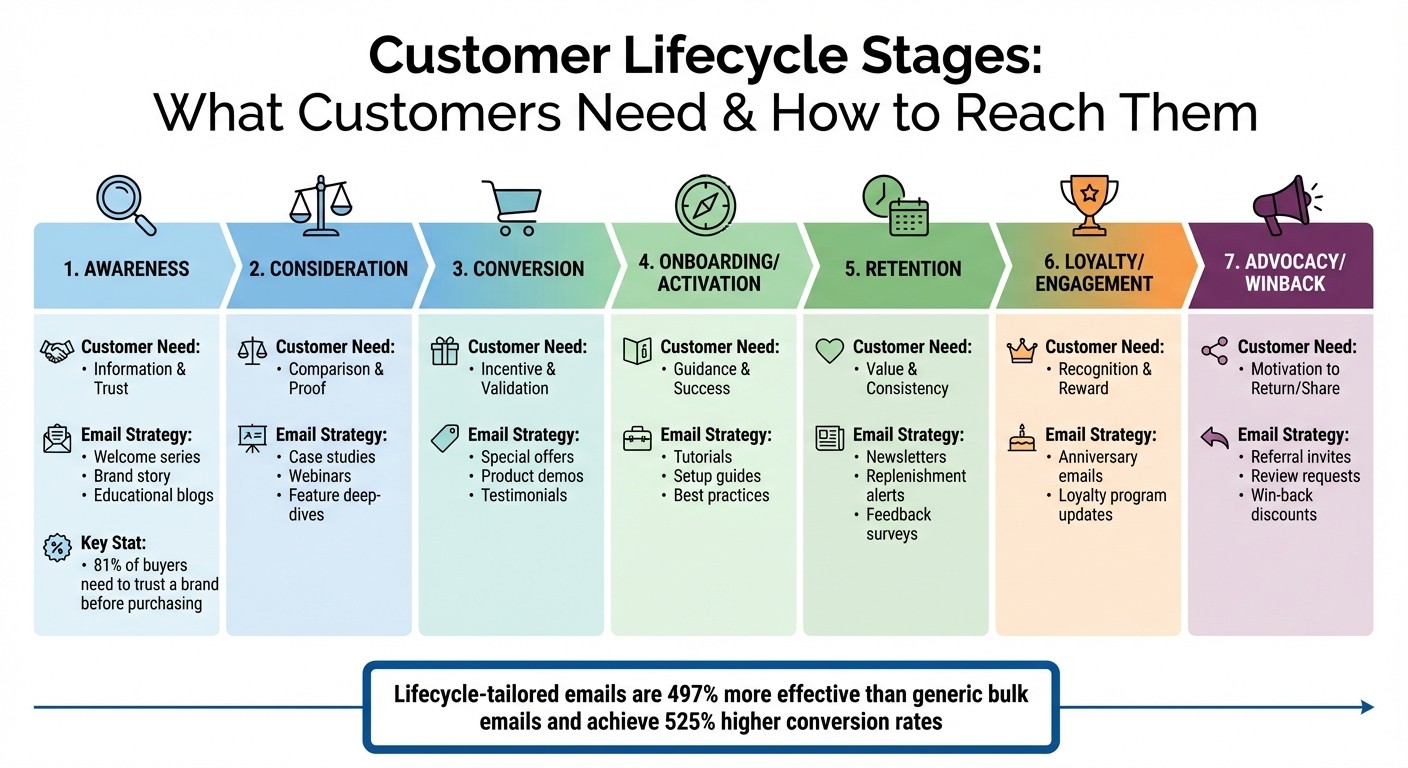
Understanding where a customer stands in their journey with your brand is key to creating personalized and effective email campaigns. When you tailor your messages to match each stage of the customer lifecycle, you move beyond generic communication and deliver something that resonates. Each stage reflects a unique mindset, specific needs, and a varying level of familiarity with your product or service. By aligning your email strategy with these stages, you can address what truly matters to your audience at the right time.
The 7 Core Lifecycle Stages
Awareness: At this stage, potential customers are discovering your brand for the first time. They’re focused on finding solutions to a problem. This is your chance to build trust through a welcome series and educational content. Avoid pushing for a sale - focus on being helpful and informative.
Consideration: Here, subscribers are weighing their options, trying to decide if your product or service fits their needs. Use content like case studies, webinars, and in-depth feature breakdowns to highlight your value and stand out from competitors.
Conversion: Customers in this stage are ready to make a purchase but might need a little encouragement. Send targeted emails with personalized offers, first-time buyer discounts, or product demos to ease any hesitation and close the deal.
Onboarding/Activation: Once someone becomes a customer, your priority is to help them see the value of their purchase quickly. Emails with tutorials, setup guides, or thank-you notes can make them feel supported and confident in their decision.
Retention: Keeping customers engaged and encouraging repeat purchases is crucial. Share newsletters, product updates, replenishment reminders, and feedback surveys. Since retaining a customer is far more cost-effective than acquiring a new one, investing in retention strategies can significantly impact your revenue [6].
Loyalty/Engagement: This stage is about deepening the relationship. Recognize and reward loyal customers through milestone celebrations, updates on loyalty programs, and exclusive content. These efforts can increase their lifetime value and keep them coming back.
Advocacy/Winback: Satisfied customers can become your brand advocates. Encourage them to share their experiences through referral programs and reviews. For inactive customers, win-back campaigns with compelling offers can rekindle their interest before they’re lost for good.
What Customers Want at Each Stage
Customer expectations shift as they move through these stages. During Awareness, for instance, 81% of buyers need to trust a brand before they’ll make a purchase [5]. This means your focus should be on credibility, offering valuable and non-promotional content.
In the Consideration phase, customers want comparisons and evidence of your product’s value. Real-life examples, detailed explanations, and social proof can make a big difference here.
When it comes to Conversion, customers look for reassurance. Incentives like discounts or testimonials can validate their decision.
For Onboarding, the goal is to make the customer’s experience seamless and successful. In Retention, the emphasis is on consistently providing value that keeps them engaged.
Loyalty is all about acknowledgment. Customers want to feel appreciated for their continued support, whether through rewards or recognition. And during Advocacy/Winback, happy customers want easy ways to share their experiences, while lapsed customers need a strong reason to return.
Lifecycle Stage | Customer Need | Email Strategy/Type |
|---|---|---|
Awareness | Information & Trust | Welcome series, Brand story, Educational blogs |
Consideration | Comparison & Proof | Case studies, Webinars, Feature deep-dives |
Conversion | Incentive & Validation | Special offers, Product demos, Testimonials |
Onboarding | Guidance & Success | Tutorials, Setup guides, Best practices |
Retention | Value & Consistency | Newsletters, Replenishment alerts, Feedback surveys |
Loyalty | Recognition & Reward | Anniversary emails, Loyalty program updates |
Advocacy/Winback | Motivation to Return/Share | Referral invites, Review requests, Win-back discounts |
It’s worth noting that emails tailored to a customer’s lifecycle stage are 497% more effective than generic bulk emails and can lead to a 525% higher conversion rate [4]. The key isn’t just clever subject lines or eye-catching designs - it’s understanding what your customer needs at that moment and delivering it. When your emails align with their journey, the results speak for themselves.
Data Collection and Segmentation Methods
Creating effective lifecycle segmentation starts with gathering the right data and organizing it in a way that’s actionable. Without understanding a customer’s actions - what they’ve done, purchased, or how they’ve interacted with your brand - it’s impossible to personalize emails to match their journey. Aligning your segmentation strategy with audience behavior is key to building email campaigns that resonate. The good news? Most of the data you need is already within reach.
4 Types of Data You Need
Behavioral data tracks what customers actually do. This includes activities like feature adoption, usage frequency, hitting product milestones (like experiencing an "aha moment"), login habits, session duration, and website behavior, such as viewing pricing pages.
Transactional data focuses on purchase-related insights. It covers metrics like purchase history, spending trends, and RFM analysis - Recency (how recently a customer made a purchase), Frequency (how often they buy), and Monetary value (how much they spend). Metrics like average order value (AOV), sensitivity to discounts, and purchased product categories also fall under this category. Marketers using RFM analysis have seen email revenue increase by 760% by targeting the right audiences with relevant offers [7].
Demographic and firmographic data include details like age, gender, income, location, job title, company size, and industry. These help tailor messaging to specific groups, making communication feel more relevant.
Engagement metrics track how subscribers interact with your emails. This includes open rates, click rates, and periods of inactivity. Monitoring these metrics not only improves email timing but also protects deliverability. Segmented campaigns, for instance, achieve 14.31% higher open rates and 101% higher click-through rates compared to non-segmented ones [7].
Building Dynamic Segments
Static segments often fail to keep up with evolving customer behavior. That’s why dynamic segments are essential - they update automatically as actions and behaviors change. For example, when a customer makes their first purchase, they should move seamlessly from a "Consideration" segment to "Onboarding." Similarly, a loyal customer showing signs of disengagement might shift into a re-engagement flow.
Progressive profiling helps collect data gradually, avoiding the need for long and overwhelming signup forms. Tools like quizzes, preference centers, and polls are great for gathering zero-party data - information customers willingly share about their preferences. A great example: In January 2025, Andie Swim used a fit-finder quiz to create preference-based segments, generating over $70,000 in additional revenue within eight months [7].
Automated triggers are the backbone of dynamic segmentation. These workflows respond to customer actions (or inactions) to move them through different lifecycle stages. For instance, after completing onboarding, a subscriber might shift to a retention segment. If they haven’t logged in for 14 days, they could trigger a re-engagement flow. Automated triggers have been shown to generate 332% more clicks and 2,361% more conversions than standard scheduled emails [7].
Data Type | Tracked Metrics | Segmentation Impact |
|---|---|---|
Behavioral | Feature adoption, login frequency, page views | Real-time intent and product-led growth triggers |
Transactional | RFM scores, lifetime value, purchase history | Value-based targeting and upsell opportunities |
Demographic | Role, industry, location, age | Content relevance and persona alignment |
Engagement | Open/click history, inactivity duration | Deliverability protection and re-engagement flows |
Multi-dimensional layering takes segmentation a step further by combining several criteria. Instead of broadly targeting "customers who purchased in the last 30 days", you could refine it to include those who also clicked the last three emails and hold a managerial role. This level of precision transforms generic campaigns into highly targeted ones with better results. However, it’s important to avoid over-segmentation. Aim for 6-8 core segments that each represent at least 5% of your customer base to keep campaigns practical and impactful [9].
Email Campaigns for Each Lifecycle Stage
Crafting email campaigns that align with each stage of the customer lifecycle is key to keeping your messaging relevant and impactful. By leveraging the dynamic segments you’ve already created, you can tailor your content to meet the specific needs and behaviors of your audience at every point in their journey. A one-size-fits-all approach won’t cut it - what grabs the attention of a new subscriber won’t resonate with a loyal customer who’s already made multiple purchases. The goal is to deliver emails that feel personal and timely, ensuring they match where the customer is in their relationship with your brand.
Campaign Types by Stage
Awareness stage emails are all about building trust and setting the tone. When someone signs up for your newsletter or downloads a lead magnet, send a welcome series that introduces your brand. Focus on educating them about the problem your product solves without diving straight into a sales pitch.
Knowledge and interest stage emails work to position your brand as an authority while keeping you top-of-mind. If a subscriber engages with your blog posts or downloads resources, follow up with educational content like in-depth guides or whitepapers that add value.
Consideration stage campaigns help potential customers weigh their options. For instance, if someone repeatedly visits your product or pricing pages, send them content like case studies, product comparisons, or invitations to webinars. A great example: SolitaireBrain saw a 30% boost in engagement for their "game of the day" by implementing an onboarding email series for new users in 2021 [3].
Selection stage emails aim to eliminate any last-minute doubts. If a customer requests a demo or signs up for a webinar, send follow-ups like product demos, testimonials, or white papers to provide social proof and address lingering concerns.
Purchase stage campaigns confirm transactions and reassure customers about their decision. Emails like order confirmations and "Thank You" notes sent immediately after checkout have high open rates and reinforce a sense of confidence in their purchase.
Satisfaction stage emails are designed to help customers get the most out of their purchase. Within the first week or two, send onboarding tutorials or best practice guides to help them experience their first "aha moment" - that moment when they realize the value of your product. Follow up with feedback requests to gather insights for refining future campaigns.
Retention and loyalty stage emails focus on keeping customers engaged over time. Use triggers like time-based replenishment reminders (perfect for consumables) or upsell and cross-sell offers. Celebrate milestones, like "30 days active", to build a deeper connection. For disengaged customers - those who haven’t logged in for over two weeks - send re-engagement campaigns with special offers. For example, Paw.com achieved a 145x monthly ROI by segmenting emails based on pet-specific data like breed and size, with email contributing to 30% of their annual growth [10].
Advocacy stage campaigns tap into the enthusiasm of your most satisfied customers. When someone makes their third or fourth purchase or shows high engagement, send referral program invites, incentivized review requests, or VIP early access to products to encourage word-of-mouth marketing.
Lifecycle Stage Campaign Mapping
Here’s a quick look at how each stage aligns with customer behavior, triggers, and the most effective campaign types:
Lifecycle Stage | Customer Behavior | Email Trigger | Recommended Campaign Type |
|---|---|---|---|
Awareness | Searching for solutions | Newsletter sign-up / Lead magnet | Welcome series, brand introduction |
Knowledge & Interest | Engaging with content | Blog views / Resource downloads | Educational content, detailed guides |
Consideration | Evaluating specific features | Pricing or product page visits | Case studies, product comparisons, webinars |
Selection | Comparing options | Demo request / Webinar registration | Product demos, testimonials, white papers |
Purchase | Completing a transaction | Order confirmation | Thank You emails, shipping confirmation |
Satisfaction | Using the product | Post-purchase (0-7 days) | Onboarding tutorials, best practice guides |
Retention & Loyalty | Repeat usage or inactivity | Replenishment triggers / Inactivity | Upsell/cross-sell, win-back campaigns |
Advocacy | High engagement/satisfaction | 3rd or 4th purchase / High NPS | Referral programs, incentivized reviews |
This table summarizes how to connect customer behaviors and triggers with the right campaigns. Keep in mind, not every email should be judged by revenue alone. Use metrics like open rates for awareness emails, click-through rates for consideration-stage campaigns, and conversion rates for purchase-stage emails. Research shows that relevant, data-driven emails are 497% more effective than generic bulk sends, and personalized campaigns see a 468% higher click rate and a 525% higher conversion rate compared to non-segmented emails [4].
Automation and Implementation
Automating workflows turns lifecycle segmentation into a hands-off, scalable system that works behind the scenes. These workflows trigger emails based on specific customer actions - like signing up, visiting a page, or completing a purchase - ensuring your campaigns are timely and relevant. This approach connects data collection to actionable campaigns, allowing for targeted communication at the right moment.
Creating Automated Workflows
The first step is defining the triggers that activate a workflow. These triggers generally fall into three categories:
Behavioral triggers: Actions like signing up for a newsletter or downloading a resource.
CRM-based triggers: Changes in lead status or milestones in a deal.
Event-based triggers: Activities like registering for a webinar or abandoning a shopping cart.
Dynamic segments that align with lifecycle stages can update automatically as customer data changes. For example, if someone downloads a lead magnet, they might enter an "Awareness" workflow. If they visit your pricing page three times, they shift to a "Consideration" sequence featuring case studies or product comparisons.
To keep emails relevant, set clear exit conditions. For instance, a customer who completes a purchase should exit the "Abandoned Cart" workflow and move into a "Purchase Confirmation" sequence. Frequency caps - such as limiting emails to 3-4 per week - help avoid overwhelming subscribers. Suppression lists can exclude customers who have already converted or opted out of specific campaigns. These tactics pay off: behavioral triggers generate 332% more clicks and 2,361% higher conversions compared to standard scheduled emails [7].
A real-world example comes from ThirdLove, which teamed up with Backstroke in January 2026 to test predictive clustering on 1.6 million subscribers. They grouped their audience into four clusters based on purchase behavior and demographics, then tailored email templates for each group. The results? A 25% increase in revenue per recipient, a 16% rise in order rates, and a 23% boost in click rates [2]. Leanne Chan, Sr. Director of Retention and Performance Marketing at ThirdLove, summed it up:
"Backstroke took (using subscriber data) a step further by helping us understand not just who to talk to, but how" [2].
Combining Segments for Better Targeting
Blending lifecycle data with RFM analysis (Recency, Frequency, Monetary value) fine-tunes your targeting. This approach helps identify high-value "Champions" versus "At-Risk" customers within the same lifecycle stage. For instance, a "Retention" stage customer who spends a lot but hasn’t opened an email in 30 days might get a VIP win-back campaign. Meanwhile, a lower-value customer in the same stage might receive a standard re-engagement offer.
Using AND logic narrows segments for precision, while OR logic expands reach when a segment gets too small. For example, a segment like "New Customer" AND "Clicked Last 3 Emails" AND "Located in Urban Area" targets engaged city dwellers who recently made their first purchase - ideal for promoting a local event or exclusive offer. Incorporating zero-party data from quizzes or preference centers ensures privacy while keeping messages relevant. Intermix demonstrated the power of this approach by using RFM segmentation to achieve a 10x boost in conversion rates (reaching 8%) and a 15% increase in annual revenue [7].
Integrating tools like Amplitude or Mixpanel with your email platform enables lifecycle emails triggered by specific user actions or "aha moments." For example, Mugafi cut the time to their "Aha" moment by 50% using hyper-personalized onboarding emails [7]. HP saw similar success, combining factors like job function, purchase history, and content interests to achieve response rates 300-1,000% higher and raise registration conversions from 2% to 31% [7].
Performance Tracking with Analytics Tools
Once your workflows are running, tracking their performance becomes vital. A unified dashboard such as Bigeye's EyeSight puts email performance next to channels like Meta, Google, Amazon, and TikTok. That lets you go beyond basic metrics like opens and clicks to understand how emails contribute to revenue and customer lifetime value.
Key metrics to monitor include Revenue per Email (RPE), Lead-to-Opportunity Improvement, and Feature Adoption Rate per Segment. To gauge the impact of automation, use holdout groups - small control segments that don’t receive automated workflows - to measure the revenue lift directly attributable to your efforts. For example, BustedTees saw an 8% lift in email revenue overnight by implementing AI-driven personalized send-time optimization [7]. Similarly, Huda Beauty doubled year-over-year revenue by focusing 70% of campaigns on highly engaged profiles, improving both deliverability and results [7].
A Smart CRM, such as HubSpot, monday CRM, or SAP Engagement Cloud, keeps customer profiles unified and ensures data flows seamlessly between systems. This real-time sync prevents data silos and errors, creating a reliable "single source of truth." Ellie Quacquarelli, Strategic Consultant at SAP Engagement Cloud, explains:
"Automation is no longer about ticking the box on a welcome series... it's about building a framework that proves impact on revenue [and] scales across lifecycle stages" [11].
Measuring and Improving Results
When it comes to driving growth, tracking the right metrics can make all the difference. Segment-level analysis is key because aggregate data often hides variations in performance across different lifecycle stages. By diving deeper into each segment, you can pinpoint where engagement surges or drops off.
Metrics That Matter
To measure success effectively, focus on four key categories of metrics. Each provides a unique perspective on your campaign's performance:
Engagement metrics: Open rates and click-through rates (CTR) reveal how well your content grabs attention. For instance, segmented campaigns often outperform generic ones, boasting 14% higher open rates and double the CTR [12][2].
Conversion metrics: Metrics like placed order rates and cart recovery strategies show how well your emails drive action, directly tying your efforts to tangible outcomes.
Revenue metrics: Revenue per email (RPE) and average order value (AOV) highlight the financial impact of your emails on different segments.
Retention metrics: Indicators such as churn rate, repeat purchase rate, and customer lifetime value (CLV) help measure ongoing loyalty and the overall health of your brand.
Metric Category | Key Indicators | What It Measures |
|---|---|---|
Engagement | Open Rate, CTR, Scroll Depth | Immediate interest and content relevance |
Conversion | Placed Order Rate, Cart Recovery Rate | Effectiveness of your call-to-action |
Revenue | Revenue per Email (RPE), AOV | Direct financial impact by segment |
Retention | Churn Rate, Repeat Purchase Rate, CLV | Long-term loyalty and brand health |
Once you’ve identified these metrics, keep a close eye on them. For example, if your active subscribers fall below 20% of your total list, it might signal issues with your segmentation or the frequency of your emails [12].
Testing and Iteration
To keep improving, regular testing is a must. A/B testing is a powerful way to refine your strategy by using real data to challenge assumptions. Start by testing one variable at a time - like the subject line, offer, or send time - on a randomized sample of at least 10,000 subscribers over 48-72 hours. This approach helps isolate what’s truly driving results [13].
Advanced techniques, such as predictive clustering and customized templates, can also lead to better outcomes, including higher revenue per recipient, order rates, and click rates. Keep a detailed log of every test to create a playbook you can replicate for different segments. If a test result surprises you, consider running it again. Longer experiments tend to produce more stable and reliable insights over time [13].
Don’t forget to schedule quarterly reviews to reassess your segmentation. This is the time to adjust inclusion criteria, phase out underperforming micro-segments, and ensure you’re not over-segmenting. Managing more than 15-20 overlapping segments can dilute your audience too much, making it harder to draw actionable insights [12].
Conclusion
Lifecycle segmentation takes email marketing from guesswork to a precise, data-driven strategy. By tailoring messages to specific lifecycle stages - from first-time visitors to loyal customers - you can see measurable results. In fact, segmented campaigns drive 320% more revenue compared to generic email blasts[1]. They also deliver 14% higher open rates and double the click-through rates[2].
But don’t think of segmentation as a one-and-done task. Customer behavior evolves constantly, which means your segments should, too. Updating segments in real time and regularly testing your strategies ensures your emails stay relevant and aligned with subscriber intent.
Industry leaders have already shown how effective this approach can be. By leveraging behavioral, demographic, and transactional data, you can create detailed subscriber profiles. Then, map specific campaigns to each lifecycle stage - like a welcome series for new subscribers, abandoned cart reminders to drive conversions, or loyalty rewards to encourage retention. Automating these transitions ensures smooth movement between segments as subscribers engage with your brand.
A single dashboard that consolidates your data makes it easier to track performance across segments, spot trends, and adjust campaigns quickly. By monitoring metrics like engagement, conversions, revenue, and retention, you can refine your strategy and maximize ROI.
The takeaway? The most successful brands are sending smarter, more targeted emails. With 90% of marketers confirming that data-driven segmentation boosts both engagement and conversions[8], the only question left is: how soon will you start implementing lifecycle segmentation?
If your lifecycle emails still go out to one big list, talk to Bigeye. Our lifecycle team can map your segments to real customer stages and build the flows around them.
FAQs
How do I know a subscriber’s lifecycle stage?
Understanding where a subscriber is in their lifecycle involves looking closely at their actions, engagement levels, and interactions. Things like purchase history, browsing patterns, and how often they engage with emails are all telling signs. By diving deeper with tools like behavioral data analysis or predictive modeling, you can pinpoint their exact stage - whether they’re in awareness, consideration, or loyalty. This helps you craft campaigns that feel personal and hit at just the right moment in their journey.
What data do I need to build dynamic segments?
To craft effective and dynamic segments for your email campaigns, focus on collecting data that highlights your subscribers' actions, preferences, and where they are in their customer journey. The most useful data includes behavioral patterns like purchase history, browsing activity, and engagement rates, alongside demographic details such as age and location. Incorporating zero-party data (information customers willingly share) and first-party data (gathered from direct interactions) allows you to create tailored, adaptable segments that can significantly improve engagement and drive conversions.
How can I measure ROI from lifecycle emails?
Measuring the return on investment (ROI) from lifecycle emails means keeping an eye on the metrics that directly reflect your campaign's success. Prioritize tracking conversion rates, revenue generated, and recipient engagement levels. These indicators give you a clear picture of how well your segmented emails are performing. While specific strategies may vary, these general practices provide a strong foundation for evaluating the effectiveness of your lifecycle email campaigns.

Branding & Creative
Sep 24, 2026
Brand architecture guide comparing masterbrand, endorsed, and house of brands to cut wasted spend and sharpen buyer choice.