
In 2026, consumer brands face a fragmented digital landscape where shoppers jump between platforms before making purchases. To thrive, brands must adopt a full-funnel marketing strategy - a unified approach that engages customers at every stage, from awareness to retention. This guide explores how to:
Build awareness through short-form videos, creator partnerships, and platforms like TikTok and YouTube.
Nurture prospects with retargeting, email workflows, and educational content in the middle funnel.
Drive conversions using Dynamic Product Ads, search campaigns, and optimized product pages.
Measure success with unified KPIs like Marketing Efficiency Ratio (MER), incrementality testing, and Marketing Mix Modeling (MMM).
Key takeaways:
Integrated strategies usually return more than siloed efforts.
Retention is cheaper and more impactful than acquisition, with repeat purchases boosting revenue by 20-40%.
Combining DTC data with retail media unlocks smarter targeting and better results.
Let’s dive into the tactics that make full-funnel marketing work in 2026.
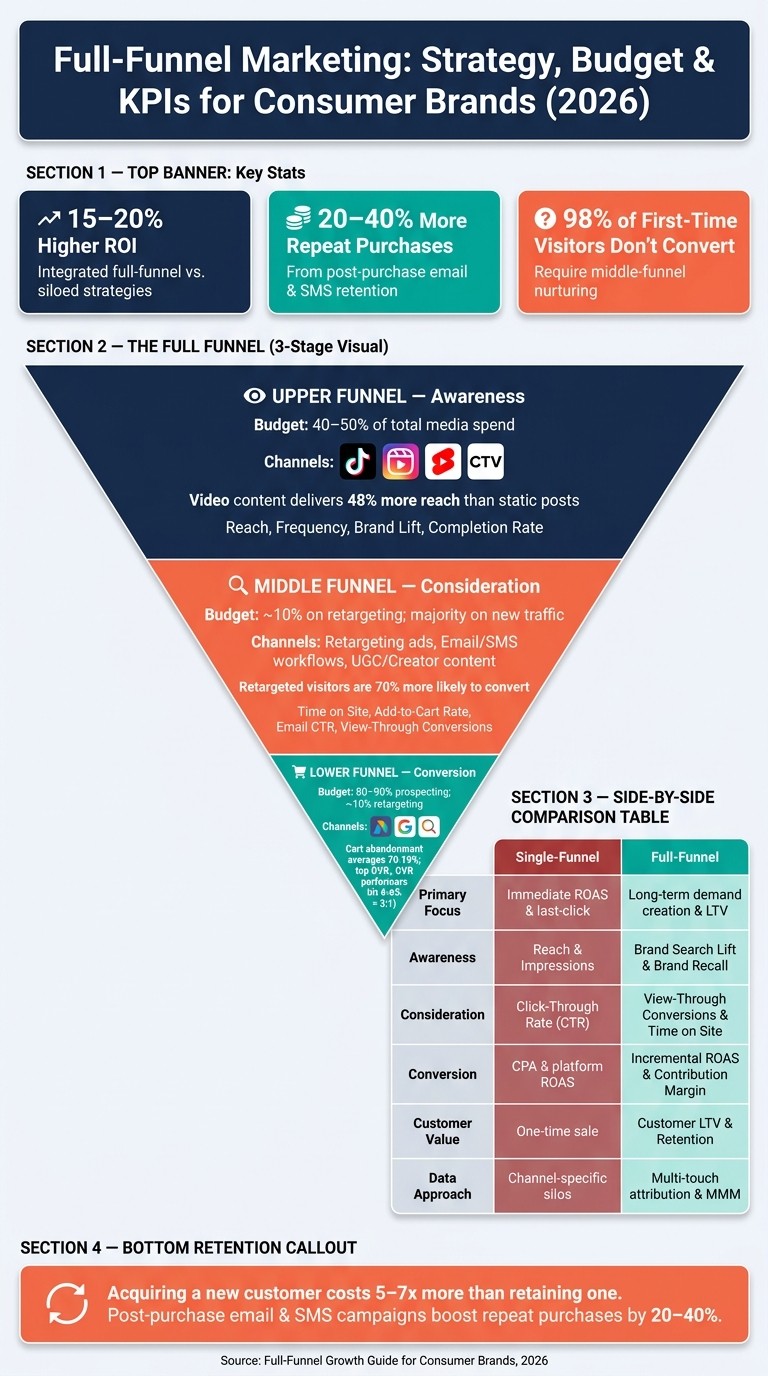
Upper Funnel: Building Awareness and Brand Recognition
The upper funnel is where your brand story begins. Before making a purchase, people need to know your brand exists - and remember it. To achieve this, consistent and engaging content across key channels is absolutely essential.
Content Marketing and Social Media for Awareness
The best awareness content doesn’t feel like an ad. It feels like an invitation to participate. Brands that succeed here focus on "discovery content" - educational and story-driven material that helps people explore a topic or trend before they’re even thinking about buying a product.
Platforms like Instagram, TikTok, and YouTube dominate this stage, but the format of your content is just as important as where you post it. Short-form video - think TikTok clips, Instagram Reels, and YouTube Shorts - is the powerhouse of upper-funnel reach. Why? Because it feels natural in the feed, not overly polished like a TV ad. On average, video content delivers 48% more reach than static posts. High-performing brands in 2026 are creating 25-40 new ad concepts every month to keep their content fresh.
To craft effective awareness videos, use this framework:
Grab attention with a hook in the first 0-3 seconds.
Show your brand or logo between 3-10 seconds.
Deliver your key message from 10-20 seconds.
End with a CTA that sticks.
This approach works for everything from 30-second YouTube ads to quick Instagram Reels. At this stage, emotional storytelling outshines product details - save those specs for later in the funnel.
Once you’ve built organic awareness, amplify it through paid media and creator partnerships.
Paid Media and Creator Partnerships
Organic content lays the groundwork; paid media accelerates it. The most effective paid strategies for top-of-funnel awareness in 2026 combine video ads, influencer collaborations, and Connected TV (CTV). CTV is especially powerful, offering TV-like attention with the precision of digital targeting.
Here’s how to make the most of each platform:
Meta (Facebook/Instagram): Use the "Reach" objective with a frequency cap of 2-4 exposures per week. Broad audience targeting helps you maximize reach without exhausting your audience.
YouTube: Bumper ads (6 seconds) are cost-effective for scaling, while TrueView ads (15-30 seconds) drive stronger recall.
CTV: Non-skippable 30-second ads deliver high attention, with 85% of CTV video viewed with sound on. This makes distinctive brand assets like sonic logos a key advantage.
Creator partnerships add authenticity that traditional ads can’t replicate. When a trusted creator integrates your brand into their content, it resonates more than a typical banner ad. Just make sure their audience aligns with your target market - relevance matters more than follower count. When one team plans creators, paid social, YouTube, CTV and retail media together, brands can achieve the cross-channel reach needed to make a lasting impression.
Key Metrics for Awareness Campaigns
To measure the success of your awareness efforts, focus on metrics that show impact, not just activity. The basics include:
Reach: How many unique users saw your brand.
Frequency: How often they saw it.
A common rule of thumb is that it takes 3-7 exposures for a brand to stick in someone’s memory.
In 2026, attention metrics have become essential. These include:
Dwell time: How long someone engages with your content.
Completion rate: Whether they watch your video to the end.
Audio-on rate: Whether they’re actively listening.
For larger campaigns, Brand Lift studies are the gold standard for measuring awareness impact. Keep in mind the platform minimums: $10,000+ on Google/YouTube, ~$30,000+ on Meta, and $50,000+ on TikTok. Always plan for measurement before launching your campaign.
Metric | KPI | Insight |
|---|---|---|
Reach & Frequency | Reach %, Effective Reach, Frequency | Audience scale and exposure depth |
Attention | Dwell time, Completion rate, Audio-on rate | How meaningfully the brand was noticed |
Brand Lift | Ad Recall, Awareness, Favorability | Psychological impact on the consumer |
Social Awareness | Share of Voice, Mentions, Follower Growth | Brand presence relative to the category |
A common recommendation for 2026 is to allocate 40-50% of your total media spend to top-of-funnel awareness. It’s a big investment, but without it, your performance campaigns will struggle to find a receptive audience.
Middle Funnel: Driving Consideration and Engagement
After building awareness in the upper funnel, the middle funnel steps in to turn curiosity into intent. This is where casual interest starts to deepen - but it’s also where many brands lose traction. Here’s a striking fact: only 2% of website visitors convert on their first visit. That leaves a whopping 98% who need nurturing before they’re ready to take action.
Retargeting and Educational Content
A solid middle-funnel strategy leans heavily on sequential retargeting. This approach tailors messages based on how long a potential customer has been engaged. For example:
Days 1-3: Reinforce brand awareness.
Days 4-7: Highlight product benefits.
Days 8-14: Introduce social proof, like testimonials.
Day 15 onward: Present specific offers.
This gradual approach mirrors how most people make buying decisions, moving step-by-step from awareness to action.
Pair retargeting with email and SMS workflows to create deeper connections. For instance, if someone buys a 30-day supply of a product, send a replenishment reminder around days 22-25. Waiting until day 31 risks losing their attention. Also, segment your audience by behavior. Someone who browses multiple pages deserves a more tailored message than someone who quickly bounces off the site.
For retargeting ads to remain effective, keep the frequency between 5-7 exposures per week and refresh creative content every 2-4 weeks. This keeps your messaging relevant and avoids ad fatigue. Done right, retargeted visitors are 70% more likely to convert than those who don’t see retargeting ads.
To make these efforts even stronger, incorporate creator-led content that addresses objections and builds trust.
Combining Creator Content with Paid Ads
Middle-funnel messaging shifts from simply grabbing attention to tackling objections and building confidence. This is where user-generated content (UGC) and creator-led videos shine. These formats provide relatable, authentic insights that help buyers feel more secure in their decisions.
Tailor your creative content based on intent:
Product viewers (within a 14-day window): Educational UGC works well here, such as "how it works" videos, sizing guides, or ingredient breakdowns.
Social engagers (over a 30-day window): These individuals, who haven’t yet visited your site, respond better to discovery ads with strong hooks that connect their social interaction to your product.
Manual retargeting campaigns are especially effective because they allow for thoughtful sequencing of content. However, retargeting should only take up about 10% of your total ad budget. Platforms like Meta often over-report retargeting conversions, with the true incremental lift typically being around 20-40%. The majority of your budget should still focus on bringing new traffic into the funnel, with retargeting acting as a trust-building layer.
Key Engagement Metrics to Track
Success in the middle funnel isn’t about immediate sales. Instead, it’s about tracking growing intent - the signs that prospects are moving closer to making a purchase. Here are some key metrics to watch:
Metric Category | Primary KPIs | What It Tells You |
|---|---|---|
Engagement | Time on site, pages per session, interaction rate | How deeply visitors are exploring your brand |
Intent | Add to carts, return visit frequency, view-through conversions | How close they are to making a purchase |
Nurturing | Email/SMS open rates, click-through rates, subscriber growth | How effective your direct communication is |
Efficiency | Cost per lead (CPL), retargeting click-through rate | Whether your spending is attracting quality prospects |
One metric to pay special attention to in 2026 is view-through conversions (VTC). Platforms like TikTok and YouTube often see users watch a video without clicking immediately, only to convert later. Tracking VTC provides a clearer picture of how video content influences purchasing decisions.
Lower Funnel: Converting Customers and Driving Sales
After building interest in the middle funnel, the next step is turning that interest into actual sales. This stage focuses on breaking down the final barriers to purchase, directly impacting revenue as part of a comprehensive funnel strategy.
Performance Tactics for Conversion
Dynamic Product Ads (DPAs) play a key role in lower-funnel campaigns. These ads target high-intent users - like those who abandoned their carts or viewed specific product pages - by showing them the exact items they considered. This keeps your brand fresh in their minds when they’re most likely to make a purchase. Pairing DPAs with search campaigns that focus on purchase-ready keywords and protecting branded terms helps capture traffic that’s already leaning toward conversion.
Platforms like Google Shopping, Amazon Sponsored Products, and retail media networks place your products right in front of shoppers at critical decision points. If you’re running campaigns across multiple Google properties (Search, Shopping, YouTube, and Display), Google’s Performance Max (PMax) uses AI to allocate budgets efficiently across these channels, often achieving over 20% more incremental conversions. Before investing in these ads, ensure your product pages are optimized with high-quality visuals, detailed descriptions, and verified reviews. Driving traffic to poorly designed pages is a quick way to waste ad spend.
To ease purchase hesitation, use strategies like free shipping, money-back guarantees, and alerts for low stock. For retargeting, keep spending to about 10% of your total ad budget, with the majority (80-90%) focused on prospecting.
Once conversion strategies are in place, the next step is refining attribution to understand what’s working across channels.
Cross-Channel Attribution and Optimization
A balanced attribution system is crucial for making informed decisions. Use a three-part approach: tactical attribution for daily adjustments, incrementality tests to measure true impact, and marketing mix modeling (MMM) for long-term planning. For example, platform-reported ROAS, Meta's included, often runs higher than true incremental return, so relying solely on platform-reported data can be misleading. Running holdout tests - pausing ads for 10-20% of your audience - helps calculate incremental ROAS and measure actual sales lift. A case in point: Hanes discovered that customers exposed to both display and search ads were twice as likely to convert, leading to $7.75 million in attributed sales.
For a clearer day-to-day performance metric, consider the Marketing Efficiency Ratio (MER), which divides total revenue by total marketing spend. Unlike platform-reported ROAS, MER avoids biases from attribution windows, offering a more accurate snapshot of overall performance. When scaling campaigns, avoid increasing budgets by more than 20% within 24 hours - larger jumps can disrupt the algorithm’s learning phase, potentially harming performance for 3-7 days.
These strategies are tied directly to key metrics that guide ongoing optimization efforts.
Key Conversion Metrics
At this stage, focusing on the right metrics is critical. Here are the key performance indicators to track:
KPI | What It Measures | Why It Matters |
|---|---|---|
Conversion Rate (CVR) | Percentage of visitors who make a purchase | Average ranges from 1.5-2.5%; top performers hit 4-6% |
Customer Acquisition Cost (CAC) | Total spend divided by new customers gained | Rising CAC (up 60% since 2020) highlights the need for efficiency |
Return on Ad Spend (ROAS) | Revenue generated per $1 spent | Use blended ROAS to avoid double-counting from platforms |
Marketing Efficiency Ratio (MER) | Total revenue divided by total marketing spend | Offers a big-picture view of overall performance |
Contribution Margin | Revenue minus costs like COGS, shipping, and marketing | Ensures profitability isn’t masked by high ROAS on low-margin products |
LTV:CAC Ratio | Lifetime value compared to acquisition cost | A healthy ratio is at least 3:1 |
Another key metric to watch is the cart abandonment rate, with an average of 70.19% of online carts left behind. By analyzing checkout completion rates alongside abandonment data, you can identify friction points. Simplifying the checkout process, offering guest checkout, and reducing form fields are quick fixes to recover lost sales.
For brands with both direct-to-consumer (DTC) and retail channels, connecting digital ad data to offline sales through retail media networks is vital. Many digital campaigns influence in-store purchases, even if it’s not immediately obvious. Integrating these data sources helps create a more complete picture for smarter budget decisions.
Measuring and Optimizing Full-Funnel Performance
Once your lower-funnel strategies are in place, the real challenge begins: creating a seamless connection across every stage of the funnel. Without a unified view, you risk running disconnected campaigns rather than a cohesive strategy.
Unified KPIs and Cross-Funnel Tracking
A common issue with measurement is that each channel operates in isolation. Search focuses on clicks, social highlights reach, and email tracks opens - but these metrics rarely show how top-of-funnel awareness drives bottom-of-funnel sales.
To solve this, a layered measurement framework is key. Tools like Brand Lift studies can measure awareness, View-Through Conversions (VTC) assess mid-funnel impact (especially on platforms like TikTok and YouTube, where users may engage passively), and incrementality testing or Marketing Mix Modeling (MMM) validate bottom-funnel results. Together, these tools create a complete view of performance across all funnel stages.
Bigeye’s proprietary platforms, EyeQ and EyeSight, are designed for this kind of cross-funnel visibility. EyeQ provides consumer insights to shape campaigns from the start, while EyeSight tracks performance across channels, showing how upper-funnel exposure influences lower-funnel results. This unified perspective lays the groundwork for smarter optimizations through media mix analysis.
With these unified metrics in place, MMM offers actionable insights to refine and improve campaign performance.
Media Mix Modeling and Campaign Adjustments
For brands generating $10M or more in annual revenue, MMM is a reliable way to identify which channels genuinely drive growth versus those that simply boost platform-reported metrics. Unlike last-click attribution, MMM accounts for factors like seasonality, competition, and cross-channel effects. Geo-holdout tests complement this approach: by pausing marketing in specific regions for 8-12 weeks, you can compare sales in those areas to control markets. This method reveals the incremental lift of your campaigns beyond what platforms claim. Incorporating such tests into your strategy allows for smarter budget adjustments, especially during high-spend periods like Q4.
To stay on track, report weekly on tactics, monthly on revenue, and quarterly for strategic budget decisions.
Single-Funnel vs. Full-Funnel KPIs: A Side-by-Side Comparison
Understanding the shift in measurement priorities is essential for aligning strategies with long-term growth goals. The table below highlights the differences between a siloed, single-funnel approach and a connected, full-funnel strategy:
Metric Category | Focus | Full-Funnel Approach |
|---|---|---|
Primary Focus | Immediate ROAS and last-click conversion | Long-term demand creation and LTV |
Awareness | Reach and Impressions | Brand Search Lift and Brand Recall |
Consideration | Click-Through Rate (CTR) | View-Through Conversions (VTC) and Time on Site |
Conversion | CPA and platform-reported ROAS | Incremental ROAS and Contribution Margin |
Customer Value | One-time sale | Customer Lifetime Value (LTV) and Retention |
Data | Channel-specific silos | Multi-touch attribution and MMM |
This comparison underscores that sustainable growth depends on integrating brand-building efforts with conversion-focused tactics.
The real difference comes down to decision-making. A single-funnel approach optimizes individual channels, often leading to reduced awareness spending when direct ROAS declines. In contrast, a full-funnel approach acknowledges that a small lift in conversion rate can outweigh a larger increase in traffic. Investing in the upper funnel is what enables efficiency in the lower funnel.
Full-Funnel Strategies for CPG and DTC Brands
Crafting a full-funnel strategy varies depending on whether you're selling through retailers, directly to consumers, or a mix of both. What works for one category, like functional supplements, might fall flat for another, such as pet food. The way you merge your DTC data with retail media plays a crucial role in boosting your funnel's overall performance.
Funnel Tactics by CPG Category
Every category has unique needs at each stage of the funnel. For instance, beauty and personal care brands lean heavily on social proof, using reviews and before-and-after visuals to build trust. Pet product brands, on the other hand, thrive on user-generated content and endorsements from veterinarians. Meanwhile, food and beverage brands often rely on recipe ideas and lifestyle imagery on platforms like Instagram, Pinterest, and TikTok to capture attention in the upper funnel.
Wellness and functional food brands face a different challenge: educating consumers before they’re ready to make a purchase. Middle-funnel assets like ingredient breakdowns, comparison content, and "how it works" videos are essential. A great example of this approach is HerWellness by Metagenics. In 2025, they used sequenced creative across Meta, TikTok, and CTV to guide users from awareness to purchase. The results? Over 10,000 new customers and a 30% boost in ROAS. Once you've nailed your category-specific tactics, use your DTC data to refine retail media targeting.
Connecting DTC and Retail Media
The real magic happens when DTC and retail media work together. These aren’t competing strategies - they complement each other. Your DTC channels generate invaluable first-party data, like purchase history, email sign-ups, and SMS opt-ins, which retailers typically don’t share. Use platforms like Meta and TikTok to drive DTC sales, then leverage that data for precise targeting on retail media networks like Amazon Sponsored Products and Walmart Connect.
For brands with physical retail distribution, packaging can play a pivotal role. QR codes, for example, can guide in-store shoppers to your digital ecosystem - whether that's a loyalty program, recipe hub, or email sign-up series.
If your budget is tight, prioritize Amazon Sponsored Products first, then expand to another retail media network tied to your highest-performing retail account. Before increasing ad spend, ensure your listings are optimized. High-quality images, A+ content, and a solid review profile can push Amazon conversion rates from a weak 5-8% to a much stronger 15-25%. One of the biggest - and costliest - mistakes CPG brands make is increasing ad spend without addressing listing quality first.
Starting with Consumer Research
Launching a full-funnel campaign without understanding your audience is like throwing darts blindfolded. Consumer research can uncover the questions your middle-funnel content needs to answer, the channels your audience prefers, and the messaging that resonates at each stage. Retail media networks provide valuable first-party data, such as demographics and co-purchase trends, which can sharpen your social media creative and email segmentation. On DTC sites, quizzes and guided selling tools collect zero-party data, offering direct insights into customer preferences.
At Bigeye, consumer research is the starting point for every campaign. Its proprietary platform, EyeQ, returns consumer results in about 72 hours, helping CPG and DTC brands gain a deep understanding of their audience before making major media or creative investments. This research-first approach separates brands that build effective, lasting funnels from those that waste resources optimizing the wrong metrics. Armed with these insights, brands can make precise adjustments at every stage of the funnel.
Conclusion: Key Takeaways for Full-Funnel Growth
In 2026, achieving success in marketing isn’t about having the largest budget - it’s about creating a seamless strategy that connects every stage of the funnel, from that initial impression to building loyal, repeat customers.
Here’s the bottom line: Combining brand-building efforts with conversion-focused tactics usually outperforms a conversion-only plan. Why? Because a connected funnel creates a snowball effect. Every dollar spent on building awareness amplifies its value as it flows through consideration, conversion, and retention. On the flip side, when these stages operate separately, that multiplying effect vanishes.
This compounding success hinges on smart data strategies. With third-party cookies becoming a thing of the past, first-party data - like email lists, purchase histories, and on-site behavior - has become your most dependable tool for targeting. By pairing this data with incrementality testing, you can ensure your marketing dollars drive new demand instead of merely capturing existing demand.
When every stage of the funnel works together, the impact of every marketing dollar grows exponentially. While acquisition and conversion are essential, retention is the real powerhouse for growth. Remember, acquiring a new customer can cost 5-7x more than retaining one. Plus, well-designed post-purchase email and SMS campaigns can increase repeat purchases by 20-40%. A disjointed funnel, however, forces you to overspend on acquisition, ultimately limiting long-term growth potential.
If your awareness spend and your conversion spend are being judged by two different scorecards, talk to Bigeye. Our paid media team can map your funnel end to end and show you where the handoffs are leaking.
FAQs
How do I split my budget across awareness, retargeting, and conversion?
Allocating your budget effectively across the marketing funnel is crucial. A typical approach divides resources as follows: 20% for awareness (TOFU), 20% for consideration (MOFU), and 60% for conversion (BOFU). However, for eCommerce businesses, many suggest dedicating 80-90% to prospecting and testing (TOFU/MOFU) while reserving only 10% for retargeting (BOFU). These percentages aren’t set in stone - adjust your allocation based on factors like audience size, campaign performance, and where your business stands in its growth journey to fine-tune your strategy.
How can I prove upper-funnel ads actually drive sales?
To demonstrate that upper-funnel ads contribute to sales, it's important to go beyond just impressions and click-through rates. Focus on metrics such as incremental sales, future purchase intent, and brand familiarity - these are indicators that often lead to conversions down the line. Additionally, using full-funnel attribution models can help tie upper-funnel efforts directly to revenue, providing clear proof of their role in driving sales.
What’s the simplest full-funnel KPI set to track weekly?
To effectively measure success throughout the customer journey, a straightforward set of KPIs can be used to cover each stage of the funnel. Focus on:
Awareness: Metrics like website traffic help gauge how well you're reaching potential customers.
Engagement: Click-through rates show how effectively your content or campaigns are capturing interest.
Conversion: Sales numbers provide insight into how many prospects are turning into paying customers.
Retention: Repeat customer rates highlight how well you're keeping customers coming back.
These KPIs offer a practical way to track performance and make timely adjustments, ensuring you stay on top of your goals week by week.

Branding & Creative
Sep 24, 2026
Brand architecture guide comparing masterbrand, endorsed, and house of brands to cut wasted spend and sharpen buyer choice.