Klaviyo flows are automated email, SMS, or push notification sequences triggered by customer actions or inactivity. For direct-to-consumer (DTC) brands, these flows are essential tools for building customer relationships and driving revenue. Optimized flows can contribute 30%-50% of total email revenue, making them a must-have for any DTC strategy. Key flows include:
Welcome Series: Introduce new subscribers and convert them into customers.
Abandoned Cart/Checkout: Recover lost sales by targeting users who didn’t complete a purchase.
Post-Purchase: Build loyalty and encourage repeat purchases.
Win-Back: Re-engage inactive customers to maintain list health.
VIP and Referral: Reward top customers and drive advocacy.
Flows align with the customer lifecycle, from acquisition to re-engagement, and can be personalized using lifecycle segmentation, dynamic content, and predictive analytics. To maximize results, focus on clear goals, measurable KPIs (like Revenue per Recipient), and regular testing. A well-maintained Klaviyo flow strategy is key to automated, scalable growth for DTC brands.
Building a Flow Strategy Around the DTC Customer Journey
Mapping the Customer Journey
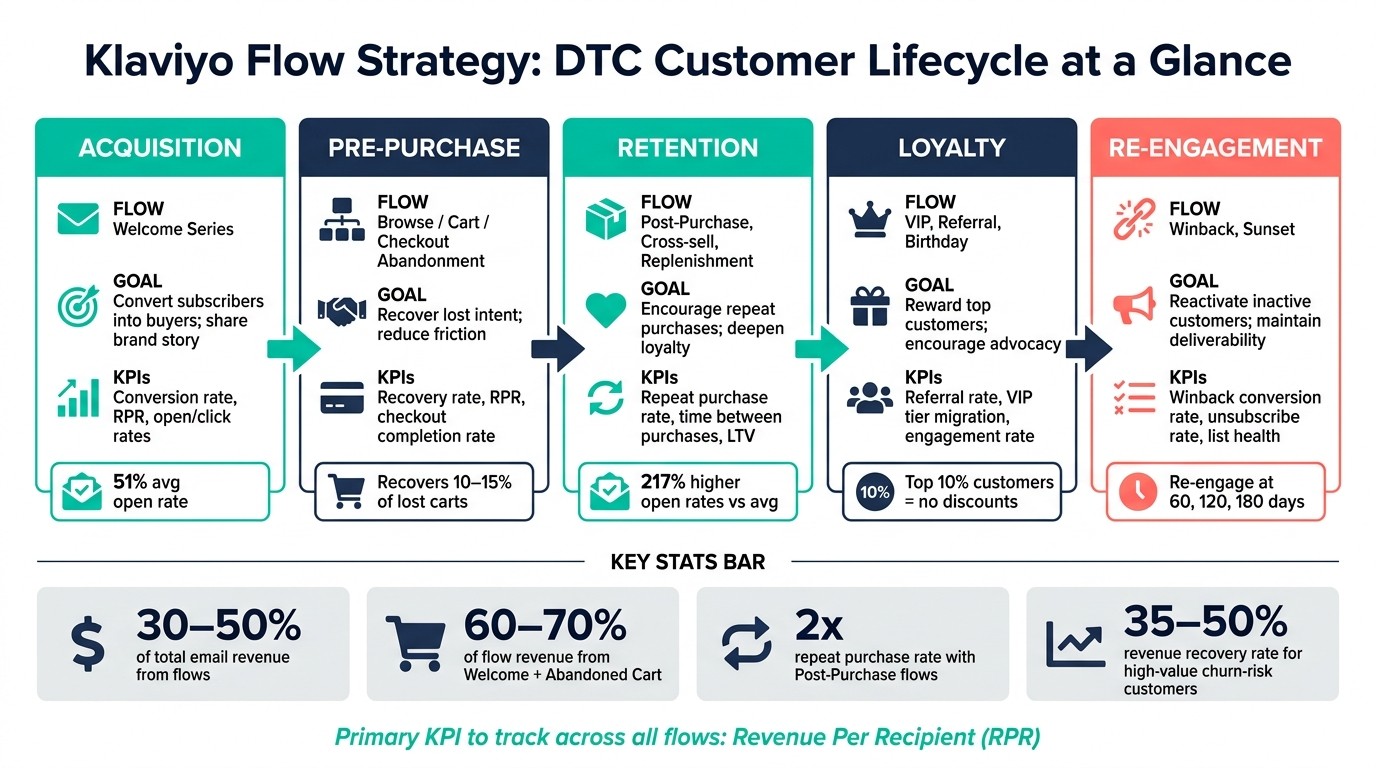
Before launching any flow, it’s crucial to understand where your customer is in their journey. A helpful way to approach this is by breaking the journey into five lifecycle stages: Acquisition, Pre-Purchase, Retention, Loyalty, and Re-engagement. Each stage comes with its own emotional context, meaning your flows need to address specific customer needs.
Behavioral signals play a key role in effective mapping. For instance, a customer who keeps revisiting a product page has a different intent than someone who just made a purchase. Your flows should respond to these behaviors, rather than relying solely on time-based triggers.
Consider the nuances of your vertical:
Apparel shoppers often focus on identity and seasonality.
Supplement buyers need reminders to build consistent habits.
Beauty customers look for education and rituals.
Home goods buyers are motivated by aspirations and expanding categories.
Once you’ve segmented the customer journey, align each stage with clear goals and performance metrics.
Setting Goals and KPIs for Each Flow
Every flow should have a defined purpose and measurable outcomes. The table below outlines how each lifecycle stage connects to its primary flows, goals, and key performance indicators (KPIs):
Lifecycle Stage | Primary Flow(s) | Key Goals | Primary KPIs |
|---|---|---|---|
Acquisition | Welcome Series | Convert subscribers into buyers; share your brand story | Conversion rate, Revenue per Recipient (RPR), open/click rates |
Pre-Purchase | Browse/Cart/Checkout Abandonment | Recover lost intent; reduce friction | Recovery rate, RPR, checkout completion rate |
Retention | Post-Purchase, Cross-sell, Replenishment | Encourage repeat purchases; deepen loyalty | Repeat purchase rate, time between purchases, LTV |
Loyalty | VIP, Referral, Birthday | Reward top customers; encourage advocacy | Referral rate, VIP tier migration, engagement rate |
Re-engagement | Winback, Sunset | Reactivate inactive customers; maintain deliverability | Winback conversion rate, unsubscribe rate, list health |
Among these metrics, Revenue per Recipient (RPR) stands out. While open rates can show initial interest, RPR provides a clearer picture of what’s driving results. Priya Shah, Senior Operator at GrowwithBA, emphasizes:
"Revenue-tied metrics - contribution margin by cohort, payback period trends, conversion rate at each funnel step - drive the allocation decisions that actually move the P&L."
Which Flows to Build First
With your lifecycle stages and KPIs in place, focus on the flows that deliver immediate revenue while laying the groundwork for long-term engagement. Start with the most impactful flows before layering in more specialized ones.
The Welcome Series and Abandoned Cart/Checkout flows are essential, as they can account for 60%-70% of total flow revenue:
The Welcome Series is a prime opportunity, with 30%-50% of first purchases happening during this period.
Abandoned Cart flows recover 10%-15% of lost carts, making them one of the most effective tools for direct revenue recovery.
Once these foundational flows are running, shift your attention to Post-Purchase and Browse Abandonment flows. These focus on retention and keeping customers engaged over the long term. Brands that implement strong Post-Purchase flows often double their repeat purchase rates compared to those that don’t.
"The brands making real money from email? They have 10+ [flows]." - BS&Co
Core Klaviyo Flows Every DTC Brand Should Set Up
Once you've mapped out your customer journey and identified your KPIs, these key email flows can help drive revenue and keep your audience engaged.
Welcome Series Flow
The welcome series is one of the most effective email flows. On average, it boasts a 51% open rate, with top performers achieving a 15% click rate and nearly 10% of recipients placing orders - bringing in about $2.35 per recipient.
This flow kicks off when someone joins a specific list, often through a pop-up signup form. To keep your targeting sharp, use a dedicated list for pop-ups rather than a general newsletter list, which might include existing customers who don’t need introductory offers.
The first email should go out immediately after signup. Disable Smart Sending to ensure delivery, even if the recipient recently received other emails. A five-email sequence spread over seven days is ideal for capitalizing on the initial engagement window:
Timing | Content Focus | |
|---|---|---|
Email 1 | Immediate | Welcome offer and shipping/return policies |
Email 2 | Day 1-2 | Brand story or invitation to follow on social media |
Email 3 | Day 3-4 | Showcase best-sellers and customer reviews |
Email 4 | Day 5-6 | Personal message from the founder or how-to content |
Email 5 | Day 7 | Final offer reminder with a sense of urgency |
"A single welcome email with a discount code is a massive missed opportunity. You have a window of 5-7 days where open rates are at their peak." - BS&Co Editorial
Use "AND" logic in your flow filters to exclude existing customers and set it up so subscribers exit the flow as soon as they make a purchase. This keeps your list clean and ensures recipients only get relevant messages.
Abandoned Cart and Checkout Flows
Abandoned Cart and Abandoned Checkout flows target two slightly different behaviors. The Abandoned Cart flow goes after users who added items to their cart but didn’t proceed, while the Abandoned Checkout flow focuses on those who began entering details but didn’t complete the purchase - indicating higher intent. Running both flows together can recover far more revenue than using just one.
Abandoned Cart Flow: 2-3 emails
Abandoned Checkout Flow: 3-4 emails
Send the first email within 1-4 hours of abandonment to stay top of mind. Avoid offering discounts in the first email; instead, focus on addressing potential obstacles - like explaining your return policy, highlighting free shipping thresholds, or providing customer support details. Save any incentives for the final email.
Dynamic product blocks are key here. They showcase the exact items left behind, complete with images, titles, quantities, and prices. For added precision, use conditional splits to adjust messaging based on cart value or customer type. For instance, a returning customer with a $150 cart might receive a different email than a first-time visitor with a $30 cart.
"Including personalized product recommendations in an abandoned cart email can turn heads and drive much higher click rates as shoppers investigate new finds that align with what they've already shown an interest in." - Sharon Goldstein, former CEO, LimeSpot
Post-Purchase and Order Follow-Up Flows
Once you've re-engaged customers through welcome and abandoned cart flows, the post-purchase flow helps build a deeper relationship.
Post-purchase emails deliver exceptional results - 217% higher open rates, over 500% higher click rates, and 90% more revenue per recipient compared to average campaigns. Separate transactional emails (like order confirmations and shipping updates) from marketing emails (such as cross-sells or review requests). This ensures transactional emails reach all customers immediately, regardless of their marketing preferences.
Here’s how to structure your post-purchase flow:
Day 0: Send a thank-you message.
Day 2: Provide onboarding or instructional content.
Days 7-14: Request a review (timed to ensure delivery has occurred).
After Review Sequence: Introduce cross-sells and replenishment reminders based on the product's typical usage cycle.
For first-time buyers, consider adding extra reassurance and brand context through conditional splits. Meanwhile, direct repeat customers to loyalty perks or VIP programs to encourage long-term retention and increase lifetime value.
Personalization and Segmentation in Klaviyo Flows
Using Segments to Refine Flow Logic
Segmentation is what turns generic emails into sequences that truly resonate. In Klaviyo, you can fine-tune who receives your messages using three key tools: triggers (what initiates the flow), filters (who gets excluded at the flow level), and conditional splits (how the flow branches based on user behavior or attributes).
Conditional splits are particularly effective. They allow you to create "Yes/No" paths depending on factors like purchase history, engagement patterns, profile details (e.g., location or VIP status), or even actions like clicking specific links. For instance, in a post-purchase flow, first-time buyers can be routed into a path that focuses on introducing them to your brand and building trust, while repeat buyers might get loyalty rewards or cross-sell offers. When setting exclusion filters, avoid "OR" conditions; instead, use "AND" to ensure customers who haven't placed an order or started checkout are excluded, preventing overlaps between flows.
This level of segmentation lays the foundation for using dynamic content to make flows even more tailored.
Adding Dynamic Content and Product Recommendations
Selecting the right product block can make or break your email's effectiveness. Dynamic table blocks are ideal for events involving multiple items - like a Started Checkout or Placed Order event - because they automatically adjust to display each product in the cart or order. On the other hand, static table blocks are better suited for single-product events, such as Viewed Product in a browse abandonment flow.
Including personalized product images in browse abandonment emails can increase click-through rates by 2-3x compared to generic content. Additionally, category-based recommendations and personalized images are proven to drive higher engagement.
Another powerful tool is zero-party data - information customers willingly share through quizzes or sign-up forms. For example, if someone mentions they have sensitive skin or follow a plant-based diet during signup, you can use that data to tailor the products featured in their flows.
"If you already know your subscribers' preferences from your data touchpoints, there's no reason not to activate them consistently across campaigns and flows." - Anna Sophie Fokdal Christensen, Head of Email and Retention, FABO
Dynamic content is just the beginning; predictive analytics can take personalization to the next level.
Using Predictive Analytics in Flows
Klaviyo's machine learning models provide four key insights for active customers: predicted next-order date, predicted Customer Lifetime Value (CLTV), churn risk score, and inferred demographic data. These insights can help you anticipate customer behavior and take action before it's too late.
For example, focus on high-value customers at risk of churning - those in the top 20% of predicted CLTV with a churn risk above 50%. Targeted recovery flows for this group can achieve a 35-50% revenue recovery rate. Similarly, use the predicted next-order date to trigger replenishment emails with curated recommendations 2-3 days before the expected purchase, potentially accelerating the next order by 15-20%.
For your top 10% of customers by predicted CLTV, steer clear of discounts. Instead, offer perks like early access, exclusive content, or personalized support to strengthen the relationship without eroding margins.
"The prediction should drive segment routing, not individual sentence-level personalization. That feels creepy." - Manish Chandwani, Founder & CEO, GrowwithBA
Keep in mind that to unlock predictive analytics in Klaviyo, your store must have at least 180 days of order history and a minimum of 500 customers who have made a purchase.
How to Optimize Klaviyo Flows for Better ROI
Fine-tuning your Klaviyo flows is the last step in turning customer interactions into revenue for your DTC brand.
Measuring Flow Performance
Once your flows are live, it’s time to evaluate their performance. Head to Klaviyo's Analytics > Custom Reports to track up to 10 conversion metrics - such as Placed Order and Placed Order Rate - alongside engagement and deliverability stats. You can organize these results by "Flow", "Flow Message", or "Flow Message (including variations)" to identify which email in your sequence might be underperforming.
Focus on Revenue Per Recipient (RPR) as your primary metric. A drop in RPR often signals one of three issues: ineffective messaging, targeting the wrong audience, or low-quality profiles entering your flow. Klaviyo also offers peer benchmarks based on revenue tiers, letting you compare your open, click, and conversion rates to similar brands. High-intent flows like Welcome Series, Abandoned Cart, and Post-Purchase typically achieve open rates of around 40%. If your rates are significantly lower, it’s worth investigating.
However, be cautious of inflated open rates caused by Apple Mail Privacy Protection (MPP), which auto-loads tracking pixels. Use Klaviyo's MPP property filter in custom reports to separate genuine opens from machine-triggered ones, ensuring your data remains reliable.
Once you’ve established clear metrics, it’s time to improve performance through testing.
Testing and Improving Flows Over Time
When testing, focus on one variable at a time. For instance, avoid changing the subject line, delay timing, and offer all at once - it makes it impossible to pinpoint what actually worked. A good starting point is a 50/50 split test to compare different time delays between emails. For example, test whether a 1-day delay versus a 3-day delay for the second email in a welcome series drives better results. Since MPP may skew open rates, use click rate as your primary metric for content tests. Klaviyo can even automate test conclusions once statistical significance is reached, or you can set a fixed end date.
To keep your flows fresh and relevant, schedule reviews and updates 2-3 times per year. If a flow hasn’t been updated in over a year, it’s likely underperforming due to outdated creative or shifts in subscriber behavior.
Testing is crucial, but maintaining strong deliverability ensures your emails actually reach the inbox.
Protecting Deliverability and List Health
Sending too many emails with low engagement can hurt your sender reputation, even if it boosts short-term revenue. Klaviyo’s Smart Sending feature helps by capping the number of emails a subscriber receives within a set timeframe, across both flows and campaigns. During your audits, double-check these settings to avoid over-emailing.
For subscribers who stop engaging, a sunset flow is a smart way to clean up your list. Build it around a win-back sequence - try re-engaging them at 60, 120, and 180 days of inactivity. If there’s no response, automatically remove them from your list. This keeps your subscriber base lean and protects your domain authority. Segment your audience by engagement level: send frequent emails to active subscribers and reduce frequency for those who haven’t interacted in over 180 days. Brands that treat list maintenance as an ongoing process - not just a one-time fix - are better positioned to maintain strong inbox placement rates, ensuring their flows deliver maximum value.
Conclusion: Next Steps for Your Klaviyo Flow Strategy
The key to driving 30-50% of DTC email revenue lies in consistent refinement, not a flawless setup from day one. Fixing broken or outdated flows alone can increase revenue by 15% - even before introducing new ones.
Start by auditing your current flows. Review your trigger logic, identify flows that haven't been updated in over a year, and prioritize optimizations based on intent. For example, focus on checkout abandonment first, then tackle cart and browse abandonment. This groundwork paves the way for more targeted improvements. Once your core flows are optimized, consider expanding to additional sequences like win-back campaigns, replenishment reminders, and browse abandonment flows. These steps can help shift your email revenue from average to top-tier performance.
"If your flows are weak, no amount of campaign sending will compensate." - Jake Ballard, Creator of The DTC Stack
Personalization and segmentation should be central to every update. Treat optimization as an ongoing process, not a one-time task. Regular A/B testing of timing and subject lines, along with tracking Revenue Per Recipient as your key metric, will guide your strategy. As Jake Ballard aptly says: "The AI generated version 1. You and the data generate version 2."
By auditing your flows, refining critical touchpoints, and testing consistently, you can make smarter, data-driven decisions that maximize both engagement and revenue.
If your flows haven't been touched since the day they went live, talk to Bigeye. We've spent 20+ years helping consumer brands grow and have driven $200M+ in revenue for clients. Our email and lifecycle team can audit your Klaviyo flows and show you where revenue is slipping.
FAQs
How many flows should I launch first?
To lay a solid foundation with Klaviyo, start by implementing 3-4 key email flows that deliver the most impact. Prioritize flows such as:
Welcome Series: Make a great first impression and introduce your brand to new subscribers.
Abandoned Cart: Recover lost sales by reminding shoppers of the items they left behind.
Browse Abandonment: Engage visitors who viewed products but didn’t add them to their cart.
Post-Purchase Emails: Strengthen customer relationships with order updates, tips, or cross-sell opportunities.
These flows alone can drive 30-45% of your email revenue. Once your brand gains traction, consider adding flows like win-back campaigns to re-engage lapsed customers or product review requests to gather valuable feedback. This step-by-step strategy allows your email marketing to grow alongside your business, ensuring long-term success.
What’s the difference between cart and checkout abandonment?
Cart abandonment happens when a shopper adds items to their cart but leaves without starting the checkout process. On the other hand, checkout abandonment refers to customers who begin filling out checkout details - like billing or shipping information - but stop before completing their purchase. Klaviyo flows are designed to tackle these scenarios differently. Cart flows target customers who haven't started the checkout process, while checkout flows aim to re-engage those who began but didn’t finish. This tailored approach helps recover potential sales effectively.
What should I test first to lift RPR fast?
If you want to see a quick boost in your Revenue Per Recipient (RPR), start with your abandoned cart flow. This strategy targets customers who have already shown interest in purchasing, making it one of the most effective ways to recover lost sales.
To maximize its impact, focus on personalized messaging - tailor emails to reflect the items left in the cart or include the recipient’s name. Sweeten the deal by offering incentives like discounts or free shipping to nudge them toward completing their purchase.
Experiment with key elements such as subject lines, timing of the emails, and the types of offers you include. Small tweaks in these areas can significantly improve conversion rates and deliver results fast.

Branding & Creative
Sep 24, 2026
Brand architecture guide comparing masterbrand, endorsed, and house of brands to cut wasted spend and sharpen buyer choice.