
Moms in the U.S. control 85% of household purchases, driving $2.4 trillion in spending annually. However, only 8% trust traditional paid ads, making it essential for brands to focus on trust, relevance, and personalized strategies. Moms interact with a variety of platforms daily, from Facebook and TikTok to YouTube and Amazon, and rely heavily on peer recommendations and relatable content.
Here’s how to effectively reach moms:
Social Media Ads (Facebook & Instagram): Leverage community-driven content and visuals. Millennial moms are highly active, with 84% on Facebook and 93% on Instagram weekly.
TikTok Creator Content: Partner with relatable parenting creators. 64% of users buy products after seeing creator-led content.
YouTube Video Ads: Focus on engaging the first 5 seconds. Connected TV (CTV) ads now account for 45% of YouTube watch time.
SMS Campaigns: With a 98% open rate, SMS offers direct, timely engagement. Use segmented, concise messages for better results.
Email Segmentation: Tailor campaigns by life stage or behavior to boost relevance and conversions.
Retail Media Ads: Target moms actively shopping on platforms like Amazon or Walmart using precise data.
Search Ads: Reach moms during high-intent searches. Emphasize time-saving benefits and trust signals.
Influencer Partnerships: Collaborate with parenting influencers for relatable, trusted recommendations.
Connected TV Ads: Use streaming platforms like Hulu or Roku for targeted, high-completion-rate ads.
Story-Driven Content: Focus on real-life challenges and solutions to build an emotional connection.
The key is to meet moms where they are, with messaging that reflects their busy, multi-faceted lives. Focus on trust, relatability, and solving real problems to drive engagement and loyalty.
1. Social Ads on Meta (Facebook & Instagram)
To align with a consumer-focused growth strategy, targeted social ads on Meta's platforms - Facebook and Instagram - are a must. These platforms are especially effective for reaching moms. For instance, 84% of Millennial moms are active on Facebook compared to 73% of the general population, and 92% of them share family milestones. On Instagram, 93% of Millennial moms use the platform weekly, with 68% logging in daily. These stats highlight the importance of tailoring strategies to each platform's unique characteristics for better engagement.
Why Facebook and Instagram Excel
Each platform has its strengths, and understanding them is key to success. Facebook thrives on community-focused content, making it perfect for parenting groups, local events, and shared recommendations. On the other hand, Instagram is all about visuals, so it’s ideal for showcasing family activities, wellness products, or creative ideas. Both platforms also offer advanced audience segmentation, letting you target by life stage (like expecting parents or parents of teens), location, and interests such as family health or education.
The Secret to Effective Ads: Authenticity
Authenticity is the cornerstone of successful campaigns. Ads that feel overly polished or too salesy tend to get skipped. Messaging that reflects the day-to-day life of a parent, messy, busy and real, gets watched.
This approach works. Campbell's ran an Instagram campaign aimed at Millennial moms using video ads, recipe hacks, and user-generated content under the hashtag #RealRealLife. The result? A 35% higher engagement rate compared to standard benchmarks. Marci Raible, Director of IGS Marketing Services and Global Media at Campbell's, emphasized the impact:
"Millennial moms are more connected now than ever... By highlighting real life moments moms can relate to, we were able to connect with them in a new and authentic way which helps drive brand relevancy."
Practical Tips for Better Engagement
When crafting ads, avoid aggressive tactics. Instead of pushing "Buy Now", opt for softer calls-to-action like "Learn More" or "Explore." This low-pressure approach resonates more with busy moms who appreciate helpful and relatable messaging. Pair these softer CTAs with lookalike audiences to efficiently reach similar moms and amplify your campaign’s reach.
2. TikTok Creator Content
TikTok has become a go-to platform for discovery among moms. As of early 2026, family-related content views on TikTok shot up by 156% year-over-year. Moms aren’t just scrolling - they’re searching. They’re using TikTok as a search engine to find product reviews, parenting tips, and "how-to" guides before they even think about opening a browser. The #MomTok community alone boasts over 3.6 million posts, making it one of the most vibrant parenting spaces online. This discovery-driven environment helps brands build trust through authentic recommendations.
The platform’s trust factor sets it apart. 78% of parents trust recommendations from parenting creators more than traditional ads. Even more impressively, 64% of TikTok users have purchased a product after watching creator-led content. This isn’t a coincidence - it’s the result of creators coming across as genuine and relatable, rather than as polished brand representatives.
To make the most of TikTok, let creators speak in their own voice. TikTok For Business emphasizes this point:
"When content is delivered in a creator's own natural voice, it can drive a stronger engagement rate, since being real is crucial on TikTok."
Scripts that feel forced lead to content that’s easy to ignore. Instead, share your key messages and allow creators to incorporate them in a way that feels natural. The results speak for themselves: creator-led ads see a 70% higher click-through rate and 159% more engagement compared to non-creator ads. A great example? In early 2025, Felix Pago collaborated with TikTok’s Creator Marketplace to produce over 35 creator-led ads. The campaign delivered a 38% jump in conversions and a 26% boost in click-through rates compared to their standard content.
When it comes to influencers, smaller can sometimes mean better. Parenting-focused micro-influencers with 10,000-50,000 followers often achieve engagement rates of 6-10%, far outpacing the 2-4% rates seen with macro-influencers. With this in mind, many brands choose to partner with 20-30 micro-influencers instead of relying on a single big-name creator. To find these creators, explore the TikTok Creator Marketplace (part of TikTok One) or search hashtags like #momtok, #momhacks, and #toddlerlife. Once you’ve identified top-performing creators, consider transitioning them from product-gifting arrangements to long-term ambassadorships. Consistent collaborations build familiarity - and familiarity drives repeat purchases.
3. YouTube Video Ads
YouTube has become a go-to platform for moms to research, learn, and make decisions. In fact, YouTube video ads deliver 2.3x higher brand recall than standard display ads.
A major trend shaping viewing habits is the rise of Connected TV (CTV). Over 45% of total YouTube watch time in the U.S. now happens on CTV, with these ads achieving a 95%+ completion rate compared to just 30-40% on mobile. This means a significant portion of your audience is watching YouTube on their living room TVs rather than their phones.
Why the First 5 Seconds Matter
The first five seconds of your ad are critical. Ads that establish a brand presence before the skip button appears experience 40% higher view-through rates. To make the most of this window, start with a relatable hook - perhaps a real parenting moment or a common challenge - and seamlessly introduce your brand. As Digital Applied explains:
"Ads that establish brand presence before the skip button appears see 40% higher view-through rates than ads that bury branding at the end."
This strategy not only improves ad performance but also sets the stage for impactful collaborations with creators on YouTube.
The Power of Creator Partnerships
YouTube creators are highly trusted by their audiences. Compared to other social platforms, users are 98% more likely to trust creator recommendations on YouTube. Additionally, 78% of YouTube viewers say creators help them make quicker decisions about whether to buy a product. A great example of this is Uber’s May 2025 campaign with the Pantons Squad. By using vlog-style Shorts and in-stream ads to promote its Teen Accounts feature, Uber saw a 24% increase in awareness, a 110% lift in "uber teens" searches, and a 6% lift in conversions.
Advanced Targeting Options
YouTube offers targeting tools that go far beyond basic demographics. With Custom Intent audiences, you can reach moms based on their recent Google searches. For instance, someone searching for "best non-toxic strollers" is much more likely to engage with your ad than someone targeted solely by age or gender. Combine this with In-Market segments and parental status filters to ensure your budget is spent wisely.
And don’t forget about YouTube Shorts. With 70 billion+ daily views globally in 2025, Shorts are a fast-growing platform for Gen Z and Millennial moms who favor quick, vertical videos over longer formats. This makes it an essential space for engaging with your audience.
4. SMS Campaigns
SMS campaigns provide a direct and immediate way to connect with busy moms, offering a level of urgency and visibility that other channels like email or social media often can’t match. With a 98% open rate and an average response time of just 90 seconds, text messaging cuts through the noise effectively. For moms - many of whom feel perpetually rushed (with 40% of working mothers reporting they "always feel rushed") - this immediacy is a game-changer. A quick, well-timed text can deliver results where an unopened email cannot.
Timing is everything. Sending messages between 10 AM and 2 PM local time aligns with a period when moms are more likely to engage. To make the most of this window, lead with value - grab attention in the first 20 characters. Simplify the path to conversion by including direct links to products, auto-applied discounts, and one-tap actions. The less friction, the better the results.
Audience segmentation is another key to success. Break your audience into groups such as:
Gift givers: Highlight shipping deadlines and curated gift guides.
Self-gifters: Use messages like "You deserve this" to appeal to personal shoppers.
VIP loyalists: Offer early access and exclusive deals to your most loyal customers.
This approach is especially effective during high-pressure shopping periods like Mother's Day, when nearly 40% of purchases are made last-minute. Messages with urgency, such as "6 hours left" or "Only 47 items in stock", perform better than vague phrases like "limited time".
One standout example of SMS success comes from Oz Hair and Beauty, an Australian beauty retailer. During Black Friday 2024, they ran a segmented SMS campaign using Sinch Engage’s Shopify integration. The results? A 12% click-through rate, a 15% response rate, and an impressive 38x ROI. This underscores how even a brief, personalized text can deliver exceptional outcomes.
To boost retention, consider sending a follow-up text 30 days after purchase. Include tracking details, a prompt for reviews, and suggestions for complementary products. Increasing customer retention by just 5% can boost profits by anywhere from 25% to 95%. This type of follow-up fits seamlessly into a broader strategy focused on long-term customer engagement.
Bigeye’s expertise in integrating email and SMS marketing through platforms like Klaviyo makes it easier to build automated, effective post-purchase sequences that keep your customers coming back.
5. Email Segmentation
Email segmentation takes the precision of targeted campaigns in social, video, and SMS and applies it to one of the most cost-effective channels for reaching moms. Considering moms control 85% of household income and wield over $2.1 trillion in buying power annually, generic messaging just doesn’t cut it.
The secret to success lies in personalized segmentation. Instead of focusing on the mom's age, segment emails by the child’s age or life stage. This approach ensures communications resonate with specific groups - think first-time moms, toddler moms, empty nesters, or single moms. For instance, 45% of single mothers plan to treat themselves to a Mother’s Day gift. A tailored email flow for this self-gifting group will perform far better than a generic “gifts for mom” campaign.
Behavioral data is another game-changer. By analyzing browsing habits, reducing abandoned shopping carts, purchase history, and email engagement, you can craft messages that align with what moms are ready to buy. For example, send discount codes to high-value cart abandoners while using simpler reminders for lower-value ones to recover sales without sacrificing profit margins.
Real-world examples show how this approach works. Andie Swim’s fit-finder quiz generated $70,000 in additional revenue in just eight months, while Huda Beauty doubled its year-over-year revenue attributed to Klaviyo by refining its email list. These results prove that tailored email strategies can deliver measurable gains in the mom market.
Additionally, offering a preference center allows moms to opt out of sensitive campaigns. This not only protects your email list’s health but also builds trust. For example, segmented Mother’s Day campaigns using this feature have achieved open rates of 55.4% and click-through rates of 3.7%.
Bigeye specializes in creating precise, automated email and SMS segmentation strategies through Klaviyo, helping consumer brands achieve measurable results.
Next, we’ll dive into retail media ads to explore even more ways to refine audience targeting.
6. Retail Media Ads
Retail media ads are designed to connect with moms at the exact moment they're ready to buy. Unlike ads that disrupt a social media scroll or a YouTube video, these appear when moms are actively shopping for items like diapers, snacks, or even a thoughtful Mother's Day gift. Platforms such as Amazon, Walmart, and Target use their own first-party shopper data - like purchase history, loyalty information, and browsing habits - to serve ads that feel timely and relevant.
This approach works. Retail Media Networks (RMNs) outperform standard digital ads by 1.8x and are nearly three times more effective at driving purchase intent. With global retail media ad spending projected to hit $179.5 billion by 2025, brands aiming to connect with moms can no longer overlook this channel.
To make the most of retail media, brands can utilize three main strategies:
On-site ads: These include sponsored product listings on platforms like Amazon or Walmart, targeting moms already searching in your category.
Off-site ads: Retailer data is used to reach the same shoppers on social media or other online platforms.
In-store digital displays: These connect with moms during those critical last moments before they add an item to their cart.
Seasonal campaigns, such as those for Mother's Day, require careful timing. With 56% of shoppers planning their purchases at least two weeks ahead, launching campaigns 4-6 weeks before the event is key. A great example comes from Nathan James, a furniture brand that leveraged retail media data to create Facebook lookalike audiences. This strategy led to a 176% boost in conversion rates, over $100,000 in additional revenue, and a 52% drop in customer acquisition costs.
Each Retail Media Network has its own strengths and budget requirements, making it essential to choose the right one for your goals:
Retail Media Network | Best For | Starting Budget |
|---|---|---|
Amazon Ads | High-intent search and scale | ~$3,000+/month |
Omnichannel reach (online + 4,600+ U.S. stores) | ~$4,500+/month | |
Beauty, family, and lifestyle-focused categories | ~$10,000+/month | |
Grocery and household essentials | ~$300-$1,000/day |
Bigeye specializes in crafting retail media strategies that tie ad spending directly to measurable sales outcomes.
7. Search Ads
Search ads connect with moms at the exact moment they’re actively seeking solutions - whether it’s finding non-toxic sunscreen or the perfect Mother’s Day gift. These searches show clear intent, not just casual browsing, making the search bar a direct and effective path to drive purchases.
The way you craft your ad copy plays a big role. Four in ten working mothers report they "always feel rushed", so ads that emphasize time-saving or stress-reducing benefits often perform better than generic messages. Additionally, phrases like "certified organic", "non-toxic", or "safety-tested" help establish trust right away, which is essential for moms looking for safe and reliable options.
Ad extensions can further boost performance. Tools like Location Extensions help moms quickly locate the nearest store, while Review Extensions add credibility through third-party endorsements. Image Extensions make your ad visually stand out at the top of the results page. For brands with physical stores, Local Inventory Ads showing real-time product availability can be the final push to turn a search into an in-store purchase that same day.
Timing your search ads around key seasons is crucial. For example, searches for Mother’s Day-related terms begin to climb about five weeks before the holiday, with a noticeable spike in the final week. In 2020, searches for "flower arrangements" surged by 57% year-over-year during Mother’s Day, while restaurant-related searches rose 46% YoY in 2021 during the same period. Waiting until the last minute to launch your campaign could mean missing out on a significant portion of potential customers.
Combining search ads with other advertising channels can amplify results. Microsoft Advertising highlights this synergy:
"People exposed to ads in both search and native environments are more likely to visit websites and convert."
In fact, users who see both search and native ads convert at a rate 6.9 times higher than those who only see search ads. A great example of this is Santa Barbara Chocolate, which used a mix of search and native ads to target gift-seekers. Over the course of a year, they achieved a 476% increase in conversion rates and saw 315% revenue growth.
This combination of search and native ads paves the way for even deeper connections through partnerships with mom influencers. Up next, discover how collaborating with these influencers can enhance trust and engagement with your brand.
8. Creator Partnerships with Mom Influencers
After search ads, partnering with mom influencers is a powerful way to build trust with your audience. These influencers are seen as relatable and trustworthy by their followers. In fact, 64% of parents have purchased a product based on a recommendation from a trusted influencer. This trust stems from their ability to share authentic, unfiltered glimpses into family life.
To make the most of these partnerships, identify influencers whose niche aligns with your brand. For example, a "Crunchy Mom" might resonate with non-toxic or eco-friendly brands, while a "Working Mom" could be ideal for productivity tools or services. Focus on authentic interactions, like meaningful comments or questions, rather than simply chasing follower counts.
For smaller brands, working with nano-influencers (1,000-10,000 followers) can be an affordable and effective strategy. Barter deals often work well - offering high-value products (like a stroller or seasonal wardrobe) in exchange for genuine content. If you're considering paid partnerships, here's a snapshot of typical costs in the U.S. for 2026:
Creator Tier | Instagram Reel | TikTok Video | YouTube (Dedicated) |
|---|---|---|---|
Nano (1K-10K) | $75-$350 | $50-$300 | $200-$750 |
Micro (10K-50K) | $350-$1,200 | $300-$1,000 | $750-$3,000 |
Mid-Tier (50K-200K) | $1,200-$5,000 | $1,000-$4,000 | $3,000-$10,000 |
Macro (200K+) | $5,000-$15,000+ | $4,000-$12,000+ | $10,000-$30,000+ |
One key mistake to avoid is giving influencers rigid, word-for-word scripts. As Influencity explains:
"If you hand a parenting creator a rigid, word-for-word script, the content will flop."
Instead, provide influencers with a clear product story and let them incorporate it naturally into their content. Pampers showcased this approach in their "Behind Every Baby" campaign in late 2025. By allowing both macro- and micro-influencers to create unpolished, real-life content - complete with messy rooms and tired parents - they saw 22% higher engagement than paid ads, a 34% boost in positive brand sentiment, and an Earned Media Value of $5.2M. Similarly, Fisher-Price leveraged micro-influencers for unscripted product demos, achieving a 3.8x ROI compared to paid ads and engagement rates between 7-10%.
While one-off posts can generate buzz, the real magic happens with long-term partnerships. When creators share their parenting journeys - from pregnancy to toddlerhood and beyond - brands that stay engaged during these milestones build deeper loyalty and recall. These enduring relationships foster trust and amplify the impact of your advertising across all channels.
9. Connected TV (CTV) Ads
Traditional TV is no longer the go-to for moms. Streaming platforms now dominate their screen time, and Connected TV (CTV) advertising offers brands a level of precision that traditional broadcast just can't match. Here's a standout stat: 88% of U.S. households own at least one CTV device, and CTV ads often hit completion rates above 95%.
What makes CTV so effective? The targeting capabilities are next-level. Instead of relying on broad time slots, brands can target specific household profiles. For example, you could reach moms of toddlers in select ZIP codes who recently searched for organic baby food. Platforms like Amazon Prime Video, Roku, and the Disney+/Hulu ecosystem (with Hulu merging into Disney+ by 2026) offer powerful tools for this. Roku, for instance, has partnered with Kroger to connect streaming ad impressions directly to in-store grocery purchases - something traditional TV could never do. This kind of granular targeting opens the door to creative campaigns that resonate with modern moms.
Shoppable CTV formats are another game-changer. These ads use interactive QR codes to seamlessly shift viewers from their TV screens to their mobile devices. Engagement rates for these formats have doubled year-over-year through 2025, and interactive CTV ads are shown to boost unaided recall by 36% and brand affinity by 33%. To maximize reach, consider pairing a QR code with a dual call-to-action: display your URL on-screen while stating it aloud. This approach ensures you're connecting with viewers in any setting, whether they're actively watching or just listening.
When it comes to creative content, authenticity is non-negotiable. Moms are tired of seeing idealized portrayals of motherhood. In fact, 60% of women feel advertisers often depict them in stereotypical caregiver roles. To break through, your ads need to reflect the humor, chaos, and multitasking that define real-life motherhood. Showcase your product as a solution to everyday challenges, not as a prop in an unrealistic scene. As Jeannine Shao Collins, president of SeeHer, puts it:
"Every mother has their own unique story, and it's crucial that advertising and media recognize that there is not one story to tell, but many. We all want to be seen."
Even with smaller budgets, CTV can deliver strong results. Platforms like Paramount Ads Manager start at just $7 CPM, while The Trade Desk ranges from $15-$40 CPM. Seasonal moments like Mother's Day, which has seen spending top $33 billion annually for three years straight, are particularly effective times to invest. However, brands that maintain consistent CTV campaigns through Q1 and Q2 have seen a 61% drop in average Cost per Acquisition compared to those that focus only on holiday periods. The key takeaway? A genuine portrayal of motherhood paired with smart targeting can make all the difference in your CTV strategy.
10. Story-Driven Brand Creative
Numbers might explain what moms buy, but stories uncover why they buy. While targeted advertising gets your message in front of moms, storytelling creates a real connection. Here's the challenge: over half of moms feel misrepresented in ads, and only 8% trust traditional advertising. That’s a massive trust gap - and where storytelling can step in to make a difference.
It’s time to stop selling perfection and start showing reality. Just like influencer partnerships build trust, authentic storytelling resonates with moms by reflecting their everyday struggles. Consider this: 52% of moms wrestle with meal planning and time management daily, while 69% find home organization overwhelming. Ads that acknowledge these challenges and offer genuine solutions hit home far more than glossy, idealized imagery.
Moms value honesty over unattainable ideals.
To create impactful narratives, focus on solutions first. Instead of showcasing product features upfront, center your story on a specific pain point - like the chaos of getting dinner on the table at 5 p.m. or the mental overload of back-to-school prep. Then, demonstrate how your product seamlessly fits into that moment. By weaving storytelling with data-driven targeting, brands can connect with moms in ways that foster both immediate engagement and lasting loyalty. After all, moms are often the decision-makers for their households. As Maria Bailey, CEO of BSM Media, puts it:
"Moms don't want to be marketed to. They want to be reassured."
Incorporating diverse narratives further strengthens this connection. When you combine authentic storytelling with user-generated content and real customer stories, you shift from brand-driven messaging to peer-led validation. This is critical, given that 76% of moms depend on recommendations from friends and family when making purchases. This creative approach not only drives sales but also builds long-term loyalty, ensuring moms keep coming back. Story-driven campaigns tie seamlessly into a multi-channel strategy, making your message feel personal and meaningful.
Channel Comparison Table
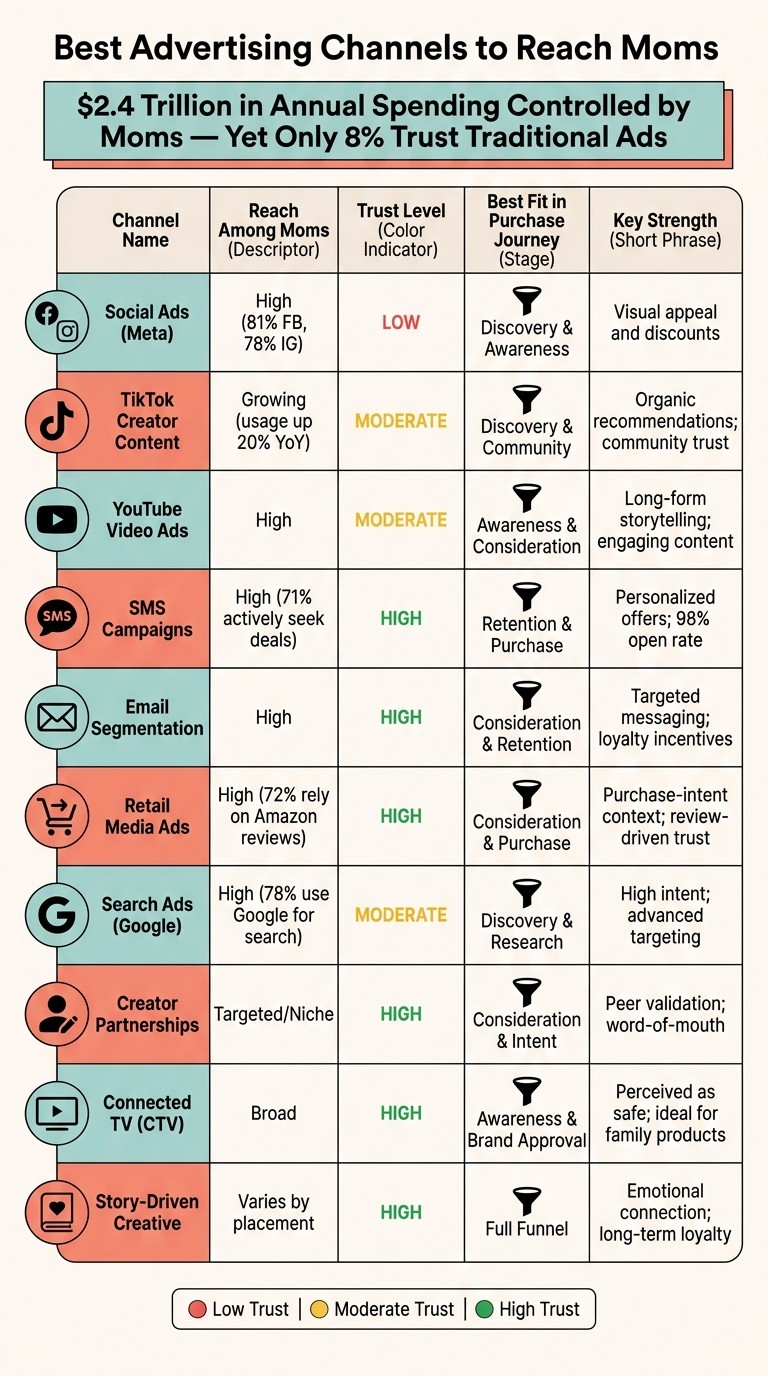
Channels differ greatly in how they resonate with various audiences. For example, a Gen X mom researching dishwashers on Google will likely respond differently than a Millennial mom discovering snack ideas on TikTok. Aligning the right channel with your goals and audience is key to ensuring every marketing dollar works effectively. The table below provides a breakdown of the strengths and roles of different channels, helping you craft strategies that connect with diverse mom demographics.
Channel | Reach Among Moms | Trust Level | Best Fit in Purchase Journey | Key Strength |
|---|---|---|---|---|
Social Ads (Meta) | High - 81% on Facebook, 78% on Instagram | Low - only 8% trust paid ads | Discovery & Awareness | Visual appeal and focus on discounts |
TikTok Creator Content | Growing - usage up 20% year-over-year | Moderate - peer-led feel | Discovery & Community | Organic recommendations; community trust |
YouTube Video Ads | High | Moderate - investing heavily in safety | Awareness & Consideration | Long-form storytelling; engaging content |
SMS Campaigns | High - 71% of moms actively seek deals | High - personalized and direct | Retention & Purchase | Personalized offers; high open rates |
Email Segmentation | High | High - opt-in audience | Consideration & Retention | Targeted messaging; loyalty incentives |
Retail Media Ads | High - 72% rely on Amazon reviews | High - 62% trust online reviews | Consideration & Purchase | Purchase-intent context; review-driven trust |
Search Ads (Google/AEO) | High - 78% of moms use Google for product search | Moderate | Discovery & Research | High intent; advanced targeting |
Creator Partnerships | Targeted/Niche | High - when relatable | Consideration & Intent | Peer validation; word-of-mouth effect |
Broad | High - legacy trust | Awareness & Brand Approval | Perceived as safe; ideal for family products | |
Story-Driven Creative | Varies by placement | High - when authentic | Full Funnel | Emotional connection; builds long-term loyalty |
This table highlights how trust and effectiveness vary across platforms. For instance, although Meta's social ads have wide reach, they require compelling creative to counteract low trust. On the other hand, SMS and email campaigns shine during the conversion phase, leveraging personalization and deal-focused messaging to drive action.
Conclusion
Moms hold incredible influence over the market, controlling 85% of household purchasing power and driving $2.4 trillion in spending. Yet, despite their economic impact, traditional paid ads fail to earn their trust. Success in this space isn’t about sheer reach - it’s about being present with the right message, in the right place, at the right time.
It’s clear there’s no one-size-fits-all approach. A Gen X mom researching appliances on Google has vastly different needs from a Millennial mom scrolling Instagram during her lunch break or a Gen Z mom catching up on TikTok after bedtime. The most effective strategies acknowledge these differences and meet moms where they already are.
Timing is just as critical as choosing the right platform. Moms often research and buy in the spare minutes between everything else. If your ad leads to a slow-loading website or a complicated checkout process, that sale is likely lost. Smooth, frictionless experiences are non-negotiable.
Emotional connection sets forgettable campaigns apart from those that create loyalty. Moms don’t want to be patronized or stereotyped - they want to feel seen and understood. Brands that approach them with sincerity, address real challenges, and reflect the complexity of their lives are the ones that earn trust and repeat business.
To truly connect with moms, your strategy needs to balance precision with genuine understanding.
If you sell to moms and aren't sure which of these channels deserves the next dollar, talk to Bigeye. Our paid media team can map your mix to how your customers actually shop and show you where the budget is working.
FAQs
What are the best ways to advertise to moms?
Understanding how to effectively advertise to moms means tapping into their buying behaviors and connecting through channels they trust. Moms tend to prioritize peer recommendations, reviews, and stories from real-life experiences rather than traditional advertising. To reach them, focus on genuine content such as testimonials that feel relatable and honest.
Campaigns that highlight convenience, address everyday challenges, and align with their fast-paced routines are especially effective. Additionally, seasonal moments like Mother’s Day offer a chance to craft personalized, heartfelt messages that celebrate family and values close to their hearts.
Which channels do moms trust the most?
Moms gravitate toward platforms that provide personalized, relevant, and relatable content that fits seamlessly into their demanding routines. Digital spaces like social media, podcasts, and in-app ads have proven to be highly effective, with TikTok emerging as a growing favorite among this audience.
They also appreciate channels that deliver deals, rewards, and loyalty programs, as saving money is often a top priority. Beyond that, moms dedicate considerable time to online audio platforms and mobile games, making these excellent opportunities for meaningful engagement.
How do I tailor messaging by a mom’s life stage?
To craft messages that resonate with moms, consider where they are in their journey. Early motherhood often revolves around convenience, safety, and family bonding. For moms with older children, their focus may shift to areas like education, extracurricular activities, or health. By understanding their changing challenges and priorities, you can create messages that connect with their needs and reinforce their role as the central decision-makers in the household.
What makes TikTok creator ads work with moms?
Moms are increasingly turning to TikTok, and creator ads are striking a chord with this audience. These ads work because they focus on engaging content that feels genuine and relatable. By reflecting the different stages of motherhood, they create a deeper connection, making the ads not only engaging but also relevant to moms' everyday lives.
How do I pick the right mom influencers?
To find the right mom influencers for your brand, pay close attention to their audience, their genuine connection with followers, and how their content fits with your brand’s objectives. Choose influencers who actively engage their audience, share relatable content, and cover topics that matter to your target demographic. By taking the time to understand their style and audience, you can ensure they’ll resonate with moms and effectively represent your brand.
How much should I budget for influencer content?
When it comes to budgeting for influencer content, there’s no one-size-fits-all answer. The cost depends on several factors, including the influencer's audience size, engagement rates, and the specific niche they operate in. To make the most of your investment, evaluate these aspects carefully and align your budget with the objectives of your campaign. A customized approach can help you achieve the best possible results.
What should my YouTube ad do in the first 5 seconds?
To make your YouTube ad stand out, it’s crucial to grab attention within the first 5 seconds. Speak directly to busy moms by addressing a problem or need they care about. Highlight a solution or value right away - this is key for connecting with moms who are often juggling multiple tasks and have limited time to spare.
When is the best time to send SMS to moms?
The ideal time to send SMS messages to moms is during moments when they’re more likely to check their phones and respond - typically mid-morning or early evening. These windows often coincide with short breaks in their busy routines. That said, the perfect timing may differ based on each mom’s unique schedule.
How do retail media ads reach moms while they shop?
Retail media ads connect with moms by focusing on their shopping behaviors and how they consume media online. Moms often spend time on platforms like online audio, mobile games, and social media, making these spaces ideal for delivering ads tailored to their preferences. With the growing popularity of platforms like TikTok, brands have an opportunity to engage moms while they scroll, listen, or interact with content, ensuring the ads align with their interests and daily routines.
How do I measure ROI across these channels?
To gauge ROI when targeting moms through advertising, focus on tracking essential KPIs such as conversion rates, sales, engagement, and customer acquisition across each platform. Leverage tools like unique links, promo codes, or pixel tracking to directly tie results to individual campaigns. Regular analysis of this data helps pinpoint which channels yield the best results, allowing you to reallocate your budget toward the most effective strategies.

Branding & Creative
Sep 24, 2026
Brand architecture guide comparing masterbrand, endorsed, and house of brands to cut wasted spend and sharpen buyer choice.