Marketing to Expecting Parents and New Families
Marketing to expecting parents and new families is a timing problem before it is a reach problem. The CDC recorded 3,622,673 U.S. births in 2024, and many households make brand choices during pregnancy that shape repeat buying for years. The challenge is simple: most brands show the wrong message at the wrong stage. This guide explains how to segment parent audiences using lifecycle segmentation, match channels to intent, build trust with clear proof, and measure which parent cohorts turn into long-term revenue.
TL;DR
Brands get better results when they segment expecting parents by due date, baby age, and buying stage instead of using one broad parent audience.
Parent marketing works best when messaging leads with safety, fit, materials, and ease of use in plain language.
Search, registry, retail media, social, email, and SMS each play a different role across the parent journey.
Repeat purchase rate, LTV, second-order timing, and stage retention matter more than top-of-funnel clicks alone.
Parent data should be used for timing and routing, with clear consent and careful handling.
Why is this audience worth so much attention?
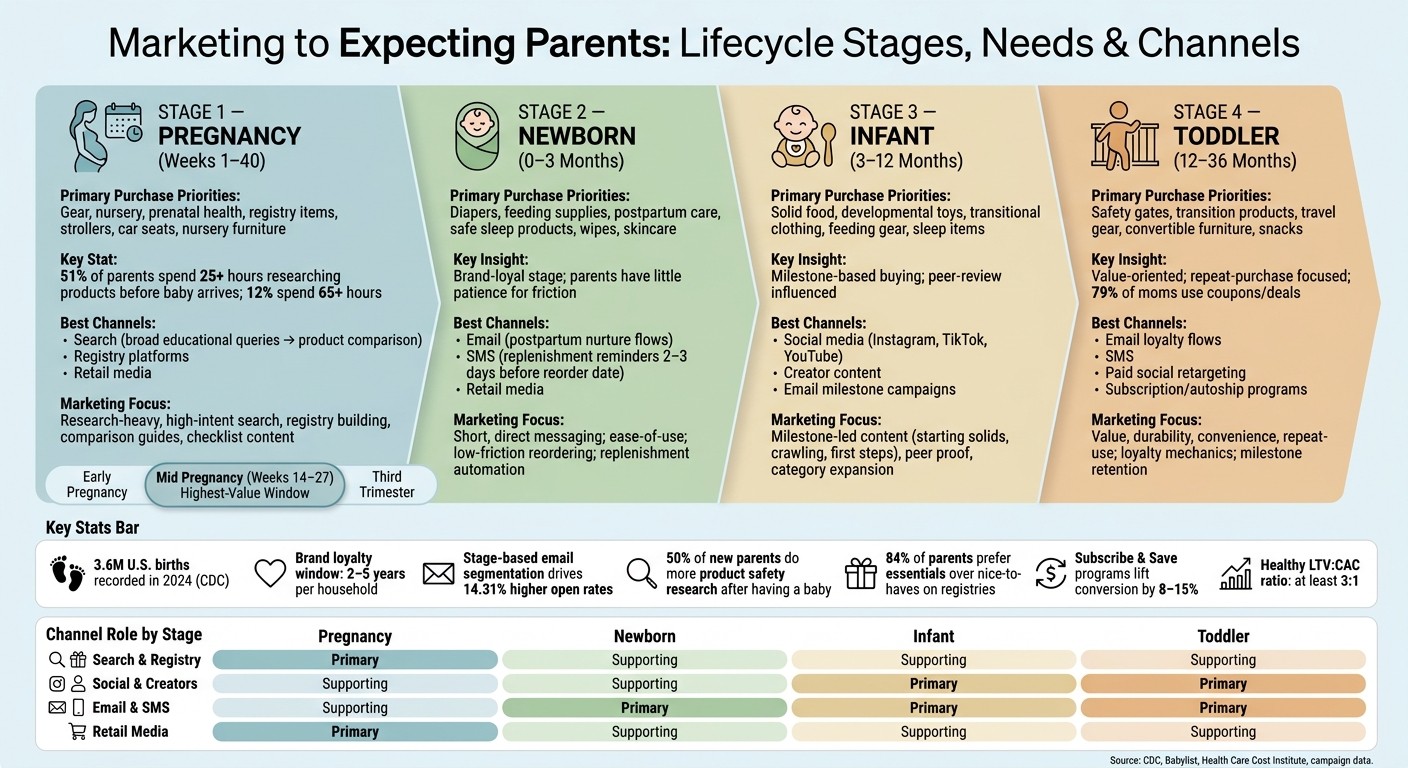
Parent Lifecycle Marketing: Stages, Needs & Channels at a Glance
Expecting parents compress years of shopping decisions into a short window. During pregnancy, many households move from low awareness to heavy research, registry building, and first purchases in a matter of weeks. After birth, that purchase cycle often turns into repeat orders for diapers, wipes, feeding supplies, skincare, sleep items, and child gear.
That makes this audience different from many other retail groups. The first order is not the full story. A brand that wins early may keep that household for 2 to 5 years or more.
Several forces drive that value:
High repeat demand for daily-use products
Heavy product research before first purchase
More than one buyer in the household, including co-parents and gift buyers
Stage-based needs that change from trimester to toddlerhood
Babylist found that 51% of parents spend at least 25 hours researching products before a baby arrives, and 12% spend 65 hours or more. That means parents are not waiting for clever ads. They are looking for answers.
Lifecycle segmentation beats broad parent targeting
Generic baby-brand messaging tends to miss the moment. Parent needs change too fast for one campaign stream to do the job well. A household in the second trimester is still comparing strollers and registry items. A household with a 6-week-old baby may only care about feeding, sleep, recovery, and reordering daily-use items.
The strongest starting point is lifecycle segmentation built around signals a brand can actually use:
Due date
Birth date
Registry creation date
Baby age
First-time vs. returning parent
Past purchases
Category browsing behavior
A simple lifecycle model often includes five groups:
Early pregnancy
Mid-to-late pregnancy
Newborn
Infant
Toddler
This works because each stage brings a different set of questions, products, and urgency levels.
During pregnancy, brands should focus on education, comparison, registry planning, and high-consideration gear. During the newborn stage, parents want short, direct help and low-friction reordering. During infancy, milestones like starting solids or sleep changes open the door to new categories. During the toddler stage, value, durability, and repeat-use convenience matter more.
According to campaign data cited in the source set, stage-based segmentation can drive 14.31% higher email open rates than broad baby campaigns. The lift comes from relevance, not volume.
What messages move parents from doubt to purchase?
Parent-focused messaging works when it removes doubt fast. In this category, broad claims rarely do enough work. Parents want to know what a product is made from, which age range it fits, how to clean it, and whether it meets safety rules.
The strongest parent marketing usually follows three rules.
Lead with proof, not puff
Plain details beat vague comfort language. Instead of saying a product is “safe” or “gentle,” product pages and ads should show facts such as:
BPA-free silicone
Fits babies 6–12 months
Machine washable
Meets ASTM standards
Third-party tested
That type of copy lowers friction because it answers the next question before the parent has to dig for it.
Match the message to the stage
The right message changes as family needs change.
In the second trimester, comparison guides and registry checklists fit the moment.
In the third trimester, reassurance and preparation work better.
In the first weeks after birth, ease of use and daily utility matter most.
In later months, milestone-led content such as starting solids or travel with baby becomes more relevant.
Parents shopping late at night on a phone do not want long setup. They want quick proof and short paths to action.
Build trust through consistency
The same proof points should appear across paid search, retail listings, creator content, landing pages, product pages, packaging, email, and SMS. If the ad highlights one claim and the product page hides it, confidence drops.
Useful trust markers include:
Verified parent reviews
Pediatrician or doula input
Certification details
Materials info
Care instructions
QR codes linking to test documents or how-to videos
Which channels work best across the parent journey?
The best channel mix depends on stage and intent. This is not a case where one channel wins everywhere. Each part of the journey has a different job to do.
Search, registry, and retail media drive high-intent discovery
Early in pregnancy, parents often search broad questions such as newborn checklists or registry ideas. Later, those searches turn into direct comparisons like the best infant car seat or best diaper bag for hospital and travel.
That shift matters because search intent gets much stronger as the due date gets closer.
Registry platforms matter for the same reason. They are planning hubs where expecting parents gather product options, compare features, and shape future purchases. Many registry users begin in the second trimester and keep updating lists into the third. That gives brands a long window to influence what gets added.
Registry and retail media performance often comes down to basics:
Product title clarity
Review quality
Image quality
Stock status
Price point
Safety details near the top
Parents often create one main registry and then copy items across retailers to get easier returns and completion discounts, often in the 10% to 15% range. That behavior makes registry placement more than a branding play. It is part of the buying path.
Social and creators help parents compare and feel more sure
Social platforms matter because parents use them for both information and reassurance. Data in the source set shows that among U.S. parents:
88% use YouTube
79% use Facebook
47% use Instagram
Among pregnant users, platform use is also high, with strong activity on Instagram, Facebook, and TikTok.
Each platform tends to serve a different role:
Instagram and TikTok support product discovery and short reviews
Facebook groups support peer advice
Pinterest supports planning and list building
YouTube supports demos and longer walkthroughs
Creator partnerships can work well here, but only when the content stays tied to the same proof points used elsewhere. A stroller demo in a hallway or a diaper bag packed for a hospital trip can answer questions that static product shots cannot. But the content still needs clear disclosure and a path to measurement through tracked links or promo codes.
Email and SMS keep timing aligned after opt-in
Once a parent shares a due date or birth date, email and SMS become strong lifecycle tools. Their value comes from timing. Instead of sending the same campaign to every parent, brands can route each subscriber into a stage-based flow.
Examples include:
Pregnancy welcome series by trimester
Registry build reminders
Third-trimester prep emails
Postpartum setup and recovery messages
Replenishment reminders for diapers, wipes, or skincare
Milestone campaigns tied to baby age
For short reminders, SMS often works well. A restock alert or reorder message sent 2–3 days before the likely reorder date can prevent the moment when a parent runs out.
Consent rules matter here. Parent audiences expect clear opt-in language, easy opt-out steps, and respectful timing.
Lifecycle campaigns should follow dates, not guesswork
The strongest parent lifecycle programs are built around due dates, birth dates, and baby age. Those signals let brands send messages when the need is present instead of pushing products too early or too late.
A simple flow might look like this:
During pregnancy
First trimester: light education, reassurance, early registry prompts
Second trimester: registry checklists, nursery planning, product comparison
Third trimester: hospital bag lists, feeding prep, postpartum bundles, registry completion reminders
After birth
Days 1–7: welcome home, setup help, recovery basics, newborn care
Days 7–14: product guidance and early review requests
Weeks 2–8: replenishment reminders, feeding support, sleep items, daily-use refills
Through infancy and toddlerhood
First bath
Better sleep routines
Starting solids
Crawling
First steps
Travel needs
Transition products
A milestone model often works well because parents do not buy in abstract category buckets. They buy
TL;DR
Marketing to expecting parents and new families in 2026 works best when brands show up at the right moment with the right message - then stay useful as the family grows.
What Works | Why It Matters |
|---|---|
Segment by lifecycle stage | Needs change fast from pregnancy through infancy and beyond |
Lead with empathy and safety | 50% of new parents do more product safety research after having a baby |
Use the right channel for each stage | Search and registry activity capture intent; social and creator content build trust |
Measure cohort performance | Repeat purchase rate and LTV matter more than click-through rate alone |
Build for retention | Brand decisions made during pregnancy often shape loyalty for 2 to 5 years or more |
The sections that follow lay out a practical framework for brands that want to reach, convert, and retain this audience across each stage of the parent journey.
Why Are Expecting Parents and New Families Such a High-Value Audience for Brands?
Expecting parents and new families drive fast-moving demand, heavy research, and long buying cycles that can lock in brand preference for years. Needs change quickly, product stakes feel high, and households often stick with what works. For brands, that makes timing everything. The message, channel, and offer need to match the family’s exact stage.
Expecting parents and new families are a high-value audience because their needs shift fast and trigger repeated purchases across many product categories.
Pregnancy is a key research window, especially in the second trimester, when parents begin active evaluation of gear, registry items, and nursery products.
After birth, buying decisions become more urgent and more practical, with safety, ease, and price shaping choice.
The primary parent is not the only buyer, since co-parents, grandparents, friends, and other relatives often shape research, gifting, and final purchase.
Expecting parents and new families are high-value because needs change fast, research is intense, and early brand choices often repeat for years. For marketers, the key is matching message, channel, and offer to the stage a family is in.
That steady flow of new households creates recurring demand for diapers, feeding, safety, and postpartum essentials.
The parent lifecycle from pregnancy to toddlerhood
Needs shift by stage. During pregnancy, parents focus on high-consideration gear such as strollers, car seats, nursery furniture, and registry items. The second trimester, weeks 14–27, is the highest-value window because parents often move beyond early uncertainty and begin active product research. That early period matters because many choices made during pregnancy can shape repurchase behavior long after birth.
Once the baby arrives, the newborn stage (0–3 months) tightens the decision set fast. Sleep-deprived parents lean toward immediate essentials like feeding supplies, diapers, safe sleep products, and postpartum recovery items. They also have little patience for friction from brands that are already meeting the need. The infant stage (3–12 months) expands spending into solid food, developmental toys, and transitional gear. Then the toddler stage (12–36 months) shifts attention toward safety products, developmental items, and convertible furniture, with price and repeat-use convenience becoming top concerns. Those shifts create clear openings for sharper targeting by milestone, behavior, and household role.
Lifecycle Stage | Primary Purchase Priorities | Marketing Implication |
|---|---|---|
Pregnancy | Gear, nursery, prenatal health | Research-heavy, high-intent search |
Newborn (0–3 mo) | Diapers, feeding, postpartum care | Brand-loyal, little patience for friction |
Infant (3–12 mo) | Solid food, developmental toys, clothing | Milestone-based, peer-review influenced |
Toddler (12–36 mo) | Safety gates, transition products, travel gear | Value-oriented, repeat-purchase focused |
What drives purchase decisions in this category
Safety, health, and cost sit at the center of purchase behavior in this market. After becoming parents, 50% of new parents report doing more research about product safety, 45% become more budget- and time-sensitive, and 41% do more shopping online. That is not a small adjustment. It signals a broad shift in how households weigh product claims, compare options, and decide where to buy.
Convenience and reassurance matter too. According to Babylist, 51% of parents spend at least 25 hours researching products before a baby arrives, and 12% spend 65 hours or more. That amount of effort says a lot. Brands do not win by interrupting these shoppers. They win by helping them. Clear product claims, plain comparisons, and useful answers to common questions tend to matter more than flashy messaging.
Money pressure also plays a central role. A Health Care Cost Institute analysis found average total spending for pregnancy, delivery, and postpartum care reached $24,336, while 40.2% of U.S. births in 2024 were covered by Medicaid as the primary payer. In a market like that, price clarity and affordability are not nice extras. They are basic expectations.
Who else influences the purchase beyond the primary parent
The primary caregiver is rarely the only person making the call. Co-parents are taking a more active role in research, especially for products like car seats, monitors, and strollers. Yet 52% of millennial parents say current advertising still leans too heavily toward mothers, even though 83% believe it should speak to both parents equally. That gap matters. Brands that treat the household like a one-parent decision system miss part of the market.
Grandparents and extended family also carry weight. Babylist found that 83% of parents rely on informal caregiver support from extended family, and grandparents account for the most baby spending among relatives. Registry behavior expands that influence even more. About 57% of new and expecting parents create a registry, and grandparents, friends, and coworkers often buy from it. That changes the targeting picture. It affects segmentation, registry-focused offers, gift messaging, and the type of creative that works across a full household, not just with one parent.
These stage and household differences explain why segmentation by life stage, intent, and decision-maker matters next.
How Should Brands Segment Expecting Parents and New Families for Better Campaign Results?
Stage-based parent segmentation beats generic baby-brand messaging. Once a brand maps the parent journey, the next step is to turn that map into targetable segments based on life stage, household role, and behavior. Generic messaging tends to lag because it misses context. By contrast, lifecycle segmentation tied to pregnancy week, newborn stage, and toddler phase drives 14.31% higher email open rates than broad baby-brand campaigns.
Segment by life stage and milestone signals
The strongest place to start is with observable milestones. Due date, birth date, registry creation, and baby age are some of the most useful signals available to U.S. brands. When a brand captures due date during opt-in - through a sign-up form, calculator, or registry flow - it can trigger stage-based messaging automatically.
Five base segments create a solid operating model: early pregnancy, mid-to-late pregnancy, newborn, infant, and toddler. That structure sounds simple, but it changes campaign performance because it lines up outreach with what parents are dealing with at that moment. A parent who just built a registry is still comparing options and reading reviews. A parent with a nearly finished registry and an approaching due date is much closer to purchase. Same broad category, very different buying window.
One baby brand used due-date tracking and weekly stage-specific newsletters to grow email’s share to 36% of total revenue. That kind of lift tends to happen when timing matches need instead of forcing every family into the same campaign stream.
Layer in demographic and psychographic profiles
Life stage shows when to reach parents. Demographic and psychographic signals help shape how to talk to them.
First-time parents often spend more time researching and comparing products because nearly every purchase feels new. Experienced parents tend to move faster, stick with brands they already trust, and skip starter items they no longer need. That split should affect both message angle and offer design. A first-time parent may respond to education, checklists, and reassurance. A returning parent may respond better to convenience, refill prompts, and product upgrades.
Generational patterns add another layer. Millennial parents, born roughly 1981–1996, often respond well to detailed comparison content, expert proof, and longer email sequences. Gen Z parents, born roughly 1997–2007, tend to favor short-form video, peer proof, and clear brand positions around sustainability and inclusivity. When brands capture parent generation at opt-in and connect it to acquisition channel, they can match content style to actual decision habits rather than guesswork.
Price sensitivity also matters. Most brands do not need to ask directly about household income. They can infer price posture from product choices, response to promotions, and ZIP-code-level demographic data. Premium segments often react to quality cues and early access. Value-focused segments tend to react to bundles, savings language, and direct price comparisons. That difference can change subject lines, product mix, and even landing-page layout.
Use behavioral data to prioritize high-LTV cohorts
After life stage and parent profile are in place, behavior should help rank value. High-LTV cohorts usually share a few patterns: they opt in early, stay engaged, buy across more than one category, and join replenishment programs for items like diapers and wipes. Their value builds over time because each purchase can lead to the next stage - newborn care, feeding, sleep, mobility, toddler essentials, and beyond.
Brands can score LTV tiers using signals such as recency, frequency, monetary value, category breadth, and content engagement. This gives teams a working model for who deserves more attention and what kind of campaign each group should receive.
High-LTV cohorts should get treatment that reflects their future worth, such as:
Early access to product launches
Personalized bundle suggestions
Retention campaigns tied to child development stage
Mid-LTV groups can be nudged with cross-category recommendations based on the patterns of higher-value parents. If high-value families often move from feeding products into sleep support, for example, that path can shape nurture flows for the next tier. Still, scorecards alone are not enough. Segment logic should be checked against consumer research so targeting stays tied to real parent needs, not internal guesses.
The end goal is simple: send the right message when the parent is ready to hear it, in a format that fits how that household makes decisions. That is where better campaign results usually begin.
What Messaging Works Best for Expecting Parents and New Families?
Parent-focused messaging works when it cuts through doubt fast. For expecting parents and new families, the first job is simple: spell out safety, fit, and material details right away. Once that context is in place, the copy needs to answer the next question before the parent has to go looking for it.
Lead with Empathy, Clarity, and Reassurance
The tone that lands best with this audience is direct, calm, and non-judgmental. Generic wording rarely helps. Specific language does. Phrases like "BPA-free silicone", "fits babies 6–12 months", and "machine washable" work because they answer the exact questions parents already have in mind.
A simple filter helps: the 3 a.m. test. If a tired parent cannot grasp the message at a glance, it needs to be trimmed or rewritten.
The message should also speak to both parents, not only mothers. That small shift broadens relevance and reflects how many households shop and decide together.
These proof cues need to stay the same across every channel. A parent who sees one claim in search, another in social, and a third on the product page is more likely to pause than proceed.
Match Product Benefits to Stage-Specific Needs
Copy performs better when it lines up with where the family is in the journey. During pregnancy, comparison-led language helps parents sort options and weigh tradeoffs. In the third trimester, reassurance-led copy tends to matter more. After birth, ease-of-use language becomes the priority.
That shift makes sense. New parents are often short on sleep and short on patience, so broad brand promises carry less weight than practical details. The strongest copy focuses on how the product works day to day: how to clean it, how simple it is to use, and whether it meets safety standards.
In other words, the message should meet the moment. A parent shopping before delivery may want help choosing. A parent shopping after birth often wants friction removed.
Build Trust with Proof Elements
Products tend to convert better once they have enough reviews to feel tested in everyday life, and specific reviews do more than vague praise. A line like "easy to clean" or "fits in a diaper bag" does more work than a generic five-star comment because it answers a real buying question. The same goes for comments such as "worked for travel", which help parents picture actual use.
Trust signals should be easy to find, especially on mobile product pages. That includes third-party certifications, expert backing from pediatricians or doulas, and verified parent reviews. Safety claims, fit guidance, material details, and cleaning instructions should appear above the fold rather than being buried in tabs.
Packaging can help here too. QR codes can send shoppers straight to safety documents, certificates, and how-to videos. That kind of access cuts friction and gives parents a fast path to the details they care about most.
Credible proof helps lower hesitation on a first purchase and also supports repeat buying later. Consistency is a big part of that. When the same proof points appear in search, social, email, product pages, and packaging, the message feels clearer and easier to trust.
Use the same proof points across ads, landing pages, email, and packaging.
Which Channels Reach Expecting Parents at the Right Moment?
The best channels for reaching expecting parents depend less on reach and more on timing. Search, registry, and retail media tend to win during active discovery. Social platforms and creator content help during comparison and reassurance. Email and SMS keep brand messages tied to the family’s stage after opt-in. Once a household’s stage is known, channel planning becomes a timing choice rather than a simple media mix decision.
Search, Registry, and Retail Media for High-Intent Discovery
Expecting parents usually begin with broad educational searches early in pregnancy. Common queries include terms like “what do I need for a newborn” and “first trimester checklist.” Later, in the second and third trimesters, that behavior shifts toward direct product comparison. Searches become more specific, such as “best infant car seat 2026” or “best diaper bag for hospital and travel.”
That shift matters. At the comparison stage, brands that show up with clear safety details, certifications, and parent reviews have a measurable edge. Parents are no longer browsing in a casual way. They are trying to narrow choices, reduce risk, and feel confident before buying.
Registry platforms play a similar role. They act as high-intent planning hubs where parents organize needs over time. Many start a registry in the second trimester and keep updating it through the third, which gives brands a long discovery window. Parents often create one main registry and then copy it across major retailers to get convenience, easier returns, and completion discounts, often 10% to 15% off remaining items.
That behavior turns registry ecosystems into more than a checklist. They become a decision space where product titles, images, reviews, and ratings shape what gets added and what gets skipped. Brands that fine-tune those details are in a better spot to earn registry adds. Retail media placements on major retailer sites add another layer by reaching parents while they browse a category, build a registry, or sit near checkout.
When parents move from product comparison to emotional reassurance, the center of gravity often shifts to social platforms.
Social Media and Creator Content for Community and Consideration
Social media stays present throughout pregnancy and early parenthood because it serves more than one need at once. It informs, reassures, and connects. Among U.S. parents, 88% use YouTube, 79% use Facebook, and 47% use Instagram, and more than half engage daily. Among pregnant individuals, Instagram use reaches about 74% to 84%, Facebook about 69% to 74%, and TikTok 55.5%. About 85% of pregnant women use digital media to seek information, while about 67% use it for social support.
Each platform tends to serve a different job:
Instagram and TikTok help with inspiration, reviews, and product discovery.
Facebook groups support peer advice and lived experience.
Pinterest supports planning and list-making.
YouTube supports tutorials, demos, and deeper product education.
Creator partnerships extend brand reach inside those spaces with a voice that feels closer to peer advice than standard brand messaging. That matters in this category. Expecting parents often want proof, but they also want to see how a product fits into everyday life.
Formats that tend to perform well include registry walkthroughs, honest multi-product comparison series, and day-in-the-life content with a newborn where products appear in context rather than in a polished studio setup. That context does a lot of work. A stroller shown in a hallway, a diaper bag packed for the hospital, or a bassinet used during a real nighttime routine can answer doubts that a product page cannot.
Still, the strongest creator content does not drift away from core proof points. It works best when it repeats the same signals parents already saw in ads and product pages, including certifications, safety claims, and fit details. That consistency helps move a parent from “this looks good” to “this feels like the right pick.”
Clear disclosure also matters. Labels such as #ad or sponsored by are key for trust and FTC compliance. On the measurement side, UTM links and unique promo codes help separate surface-level attention from sales impact. Views alone do not show which creators, messages, or product stories led to conversion.
Once a parent opts in, direct messaging channels take on a bigger role.
Email and SMS for Lifecycle Nurturing
After opt-in, email and SMS become the most dependable channels for staying relevant over time. These channels work because they can be tied to stage, timing, and recent behavior instead of broad audience assumptions.
A strong lifecycle program usually starts with a triggered welcome flow based on the parent’s self-identified stage or a captured due date. From there, messages can stay aligned with changing needs by using custom properties such as due date, birth date, past purchases, and browse history.
That structure helps brands avoid a common mistake: sending the same message to every parent. A family preparing for a baby shower does not need the same outreach as a household dealing with feeding issues at six weeks postpartum. Timing changes the message, the offer, and even the channel.
SMS is especially useful for short, time-sensitive communication. It tends to work well for back-in-stock alerts, shipping updates, and quick reminders linked to the baby’s current age or stage. A brief text about a restocked bottle set or an upcoming shipment lands differently when it arrives at the exact moment a parent needs it.
Compliance cannot be treated as an afterthought. U.S. SMS programs must meet privacy and TCPA consent rules, including clear opt-in language, easy opt-out paths, and send times that respect the recipient’s local time zone. In a category built on trust, sloppy consent practices can damage brand perception fast.
The channel mix works best when each touchpoint has a clear job. Search and retail help parents find options. Social and creators help them compare and feel more sure. Email and SMS keep the relationship useful as needs change from trimester to trimester, and then from newborn stage into daily family life.
How to Build Lifecycle Campaigns from Pregnancy Through Early Parenthood
Lifecycle campaigns for expecting parents and new families perform better when they follow timing, not guesswork. Due dates, birth dates, and baby age give brands a clear way to send messages that match what a family needs right now. That matters because stage-based lifecycle segmentation yields 14.31% higher email open rates than generic baby product campaigns.
Due dates should drive pregnancy email flows because they let brands time each message to a family's actual stage.
Postpartum campaigns work best when they shift from planning content to short, useful support.
Baby birth dates make milestone retention programs more accurate and more relevant.
Replenishment reminders sent 2–3 days before the expected reorder date can help prevent stock-out moments for parents.
Once a family's stage is known, that insight should turn into timed lifecycle flows. Campaigns for expecting parents and new families work best when they are anchored to due dates, birth dates, and baby age rather than broad demographic assumptions. That is where lifecycle data turns into automated action.
Trimester-Based and Due-Date Marketing Sequences
The due date is the core trigger. One field can power trimester-based flows, countdown sequences, and postpartum transitions through automated lifecycle flows. Brands should build date-triggered automation that works backward from the due date and routes parents into separate journeys for each trimester.
First-trimester content should stay light and reassuring. Educational emails about what to expect, what is normal, and how to start thinking about a registry tend to beat hard product pushes. At this stage, many parents are still adjusting. A message that reduces stress lands better than one that asks for a fast purchase.
Second-trimester campaigns should move into planning mode. Nursery planning, category education, registry checklists, and product comparison guides fit the moment well. Parents are usually farther along in decision-making, so this is the point where structured help matters. Instead of pushing a full catalog, brands should guide one decision at a time.
Third-trimester messaging should become more action-focused. Hospital bag checklists, feeding essentials, postpartum recovery bundles, and registry completion reminders all fit naturally here. Each email should focus on one job, such as "Build your registry," "compare infant car seats," or "shop recovery essentials." That single-task approach keeps the flow easier to act on.
When the baby arrives, the flow should switch from planning to support.
Postpartum and Newborn Nurture Campaigns
Once the baby is born, campaigns should move at once into postpartum and newborn support. The tone shift matters just as much as the content shift. Parents in early postpartum are often exhausted and overloaded with information, so short, empathetic emails that solve one clear problem usually perform best.
A practical postpartum flow can start with a welcome home message. That email should cover recovery basics, newborn care essentials, and a simple offer such as a postpartum care bundle or a newborn starter kit. The point is not to flood the inbox. It is to help a tired parent take the next small step.
Day 2 can introduce setup and how-to guidance. Useful examples include how to use the bottle warmer, how to set up the bassinet, and what to expect in the first week of diapering. These messages work because they answer the exact question many parents have in the moment: What does this thing do, and how do they use it today?
Review requests fit naturally at days 7–14, when product use is fresh and feedback is more relevant. That timing also gives the household a little breathing room before asking for a response.
For consumable categories like diapers, wipes, and skincare, replenishment reminders triggered 2–3 days before the expected reorder date help brands stay ahead of the moment parents run out. That is a small timing change, but it can make a big difference. Nobody wants to remember wipes only after the last pack is open.
After the first weeks, the job changes again. Recovery and setup matter less, and age-based retention triggers start to do more of the work.
Milestone-Based Retention Programs
After the newborn stage, the strongest retention lever is often a milestone calendar built from the baby's birth date. Developmental transitions such as first bath, better sleep routines, starting solids around 6 months, crawling, and first steps each create a natural opening to introduce a related product category with useful context.
A first-bath email that explains product safety and what to expect during the routine earns more trust than one that opens with a discount. The same rule applies later. A starting-solids campaign should introduce feeding tools, storage solutions, and cleaning essentials alongside plain guidance that helps the parent handle the shift.
This works because the message meets the moment. Parents do not just buy products in early parenthood. They solve stage-based problems. When a campaign aligns with that problem, the offer feels timely instead of forced.
A common structure for milestone transitions is three touches over 14 days: a day-1 notification tied to the age window, a day-5 educational email, and a day-12 reminder with a relevant offer or loyalty reward. That cadence keeps the brand present without crowding a household that is already getting a high volume of messages. It also creates a clean bridge into the next repeat-purchase stage as the child grows.
How Should Brands Position Products for Expecting Parents and New Families?
Stage-specific positioning works better than broad category labels because it lines up with how expecting parents and new families actually shop. They are not browsing in vague buckets. They are trying to solve the next problem fast. Once timing is clear, packaging and offers need to remove friction and help them choose with less effort.
Create Offers That Reduce Decision Fatigue
Parents move faster when product lines are arranged around the next decision instead of the full catalog. The goal is simple: make the path easier. Products should be grouped into milestone-based paths such as Registry, Newborn Essentials, Feeding Transitions, Travel with Baby, and Toddler to cut decision fatigue.
Bundles and starter kits help for the same reason. A curated newborn starter kit lowers the friction of picking products one by one. That matters when shoppers are tired, busy, or buying under a deadline. For consumables like diapers, wipes, and formula, Subscribe & Save programs can lift conversion by 8% to 15% while also reducing the mental load of remembering to reorder. Age range, primary benefit, and safety details should stay above the fold so the shopper does not have to hunt for basic answers.
Use Registry-Friendly and Gift-Oriented Packaging
Baby registries create a high-intent discovery moment. Gift buyers, including co-parents, grandparents, and friends, often shop under time pressure. Packaging has to perform well in that setting.
Front-panel hierarchy matters. At a glance, packaging should communicate three things: the product name, the age range, and the primary benefit. That front panel does the heavy lifting. Technical details, certifications, and care instructions still matter, but they belong on an insert or a secondary panel so they do not crowd the main message.
After clarity, the next hurdle is perceived worth.
Communicate Value Without Sounding Transactional
79% of moms actively incorporate sales, coupons, and deals into their purchase process, but value is not the same as discounting. Price matters, sure, but families also want a clear reason to trust the buy. The strongest positioning leads with plain-language specifics, grow-with-child longevity, and proof-backed safety.
That means claims should sound direct, not vague. It is the difference between saying a product is “good for growing families” and showing how it fits the next stage, lasts through repeat use, or meets safety needs in terms a tired shopper can scan in seconds. The promise has to feel worth the price without sounding like a hard sell. And that promise still needs clear claims and careful data use, which the next section covers.
How Should Brands Handle Trust, Safety, and Ethics When Marketing to Parents?
Trust is often the deciding factor in marketing to parents. Once the offer makes sense, parents look for proof. Safety details, material facts, age fit, and cleaning guidance often move a purchase faster than polished brand language alone.
Parents respond best when brands lead with facts such as safety, materials, age range, and care details.
Fear-based and guilt-driven creative can lift clicks in the short run, but it can damage loyalty over time.
Specific product claims and easy-to-find compliance details help parents make fast decisions with less doubt.
Parent and child data should support useful lifecycle messaging, not ad tactics that feel invasive.
Avoid Fear-Based or Guilt-Driven Creative
Using anxiety as a conversion tool is tempting in this market. A headline that hints a parent is failing - or suggests a product is the only barrier between a child and danger - may earn a short-term click. The cost shows up later in weaker loyalty, lower trust, and more resistance to future messaging.
That tradeoff matters because this audience tends to remember how a brand made them feel. Parents are not just buying a product. They are judging whether a company sounds honest, steady, and respectful.
There is also a clear signal around representation. 83% of millennial parents believe parenting advertising should appeal to both mothers and fathers equally, and 52% feel current ads are still skewed toward mothers.
That gap should not be ignored. Father-inclusive creative works better when it treats co-parents as active decision-makers, not side characters. That can shape everything from casting and copy to audience targeting and landing page imagery.
Be Precise with Safety and Product Claims
Loose language creates risk in this category. Words like “safe” or “gentle” may sound reassuring, but without proof they often do the opposite. They can leave a parent wondering, safe how, exactly?
Specific wording gives people something they can act on. Instead of broad claims, brands should use direct, checkable language such as “BPA-free silicone.” That kind of detail helps a tired parent scanning a product page make a fast call.
Compliance details also need to be easy to find. CPC, COA, ASTM, and other third-party certifications should appear clearly on the product page and on packaging. One smart move is to place QR codes on packaging that link straight to compliance documents and third-party test results.
A simple internal filter can help teams catch weak pages before they go live: the “3 AM Test.” Review every product page and every ad with a tired-parent mindset. If safety details are not visible above the fold on mobile, they will likely be missed entirely.
Example: A stroller accessory page that lists “tested materials,” but hides the actual certification details in a footer link, creates friction. A page that shows materials, age fit, care instructions, and testing proof near the top removes guesswork.
Trust also depends on what happens after the click, especially when data enters the picture.
Respect Privacy When Using Parent and Child Data
Due dates, birth dates, and health-related behavior data are among the most sensitive signals a brand can hold. That kind of data should be used with restraint.
A better approach is to use due dates and behavior for lifecycle routing, not sentence-level personalization. In plain terms, that means using the data to place parents into the right stage-based flow, not to write ad copy that feels overly close or unsettling. Stage-specific emails, milestone-triggered offers, and postpartum check-ins can feel useful. Aggressive retargeting can feel like surveillance.
Brands should also put expiration rules in place. Automatic suppression for inactive subscribers after 180 days helps keep lists clean and sends a clear message: parent data is not being stored forever without a reason. That approach can support stronger opt-in quality, better conversion, and healthier retention.
Trust Standards Should Shape Retention and Measurement
Trust is not only a messaging issue. It also affects how brands measure retention and manage lifecycle programs.
If a brand claims to put parents first, that standard should show up in campaign setup, segmentation rules, and reporting. Teams should watch for signs that messaging is crossing the line from helpful to intrusive. Higher unsubscribe rates, lower open rates after milestone campaigns, and weak repeat purchase patterns can all point to trust friction.
The same goes for product pages and creative testing. A campaign may drive efficient acquisition, but if the message leans on guilt or thin safety claims, the lift may not last. For parent audiences, the strongest retention engine is usually clarity plus respect.
FAQ Section
Q: What builds trust fastest when marketing to parents?
Clear facts usually do the job fastest. Safety details, material specs, age fit, certifications, and cleaning instructions help parents decide without digging.
Q: Should brands use fear in parenting ads if it boosts clicks?
Short-term click gains can come at the cost of long-term loyalty. Messaging that makes parents feel judged or pressured often weakens brand trust over time.
Q: How specific should safety claims be on a product page?
Very specific. Replace broad words like “safe” or “gentle” with direct details such as material type, testing status, age guidance, and third-party documentation.
Q: What is the 3 AM Test for parent marketing?
It is a simple review standard. Teams check whether a tired parent on mobile can see the key safety and product details right away.
Q: How should brands use due dates or child-related data?
That data should guide lifecycle timing and audience segments. It should not fuel copy or ad behavior that feels too personal or invasive.
TL;DR Summary
Parents respond best when brands lead with facts such as safety, materials, age range, and care details.
Clear product information reduces doubt and helps busy parents make fast decisions.Fear-based and guilt-driven creative can lift clicks in the short run, but it can damage loyalty over time.
Respectful messaging builds a stronger relationship with parents who are likely to buy more than once.Specific product claims and easy-to-find compliance details help parents make fast decisions with less doubt.
Terms like “BPA-free silicone,” plus visible CPC, COA, ASTM, and QR-linked test documents, give parents proof instead of vague promises.Parent and child data should support useful lifecycle messaging, not ad tactics that feel invasive.
Stage-based emails and milestone flows can help, while over-targeted retargeting can quickly weaken trust.
CTA Block
Brands that market to parents need more than polished copy. They need clear trust signals, compliant messaging, and lifecycle systems that respect sensitive data. Schedule a free Bigeye audience trust and conversion audit to review product pages, parent-focused creative, and retention flows for trust gaps that may be slowing sales.
How Should Brands Measure Marketing Performance Across Expecting Parent and New Family Cohorts?
Parent cohort measurement works best when it tracks behavior after the first order, not just the first conversion. For expecting parent and new family audiences, the clearest picture comes from measuring cohorts by life stage, channel, and repeat value. That means using the same due-date, birth-date, and purchase cohorts already built into lifecycle automation, then watching how each group performs over time. The core metrics are CAC, LTV, repeat purchase rate, bundle attach rate, registry conversion, and stage retention.
Brands should measure due-date, birth-date, and purchase cohorts the same way they run lifecycle automation.
Stage retention is one of the strongest signals of long-term parent value, especially across child-age transitions.
Channel and lifecycle stage should be tracked together at 30, 90, 180, and 365 days to show which cohorts keep buying.
Testing should go past discounts and timing to compare message framing, proof points, and milestone-based send cadence.
The KPIs That Matter Most for This Audience
For baby and parenting brands, stage retention is one of the strongest predictors of long-term value. It shows the share of parents who stay active as their child moves from one age band to the next. Healthy benchmarks sit around 40% to 50%. Below 30% points to weak transition flows, while above 60% is rare and strong.
Second-purchase timing matters just as much. The target window is 30 to 45 days. Once that gap stretches past 60 days, post-purchase engagement usually needs work. In plain terms, if a parent buys once and then disappears for two months or more, the brand may be losing momentum right when habit should start to form.
Bundle attach rate adds another useful read. It measures the share of orders that include a curated multi-product set. That number helps answer a simple question: is the brand making shopping easier, or forcing tired parents to build a solution from scratch? For this audience, decision fatigue is real. A weak attach rate can point to unclear product grouping, weak merchandising, or offers that do not line up with actual parenting needs.
Registry performance needs a more granular view. It should not be judged as a single number. Instead, track:
Registry impressions
Adds
Shares
Gift fulfillment
Post-registry self-purchase
A high add rate with low fulfillment often points to pricing, stock issues, or weak product positioning, not an awareness gap. That distinction matters. If plenty of parents add items but few gifts convert, more top-of-funnel spend will not fix the problem.
Use Cohort Analysis by Channel and Lifecycle Stage
Once lifecycle flows are live, cohort analysis should be split by both acquisition source and life stage. Each parent should be tagged at acquisition with channel, campaign, and stage. From there, behavior should be tracked at 30, 90, 180, and 365 days.
That structure helps brands compare how registry, search, social, email, and SMS cohorts perform over time. These groups rarely behave the same way. A registry-acquired shopper may arrive with high intent but only convert around milestone buying moments. A paid social shopper may convert fast but fade after the first order. Email and SMS cohorts may look cheaper at first glance, yet their repeat value can vary a lot depending on timing and message fit.
The goal is to compare LTV, retention, and attach rate by source so budget decisions come from actual downstream value, not surface-level conversion rates. Brands should also use contribution margin by cohort, payback period, and step-by-step conversion to decide where spend belongs.
A healthy LTV:CAC ratio is at least 3:1. Below 2:1 is risky. That line matters because parent audiences can be expensive to acquire, especially in crowded categories. If a brand is winning the first order but not building repeat value, the math starts to break fast.
Example: a search cohort with a higher CAC may still beat a cheaper social cohort if it holds better stage retention, stronger bundle attach, and a shorter payback window.
Improve Results Through Testing and Consumer Insight
Testing for parent audiences works best when it goes past offer structure. Price tests and discount tests still matter, but they do not tell the full story. The stronger learnings usually come from message framing.
Comparing angles such as empathetic reassurance, expert-backed guidance, and convenience framing shows which emotional register builds trust and drives repeat purchase, not just first conversion. Parents in early life stages are often balancing urgency, doubt, and overload all at once. So the message that wins the click is not always the one that keeps the customer.
Proof-point testing also plays a major role. Safety certifications, peer reviews, and clinical results can shift conversion rate while also cutting returns by setting expectations more clearly upfront. That is especially useful in baby and parenting categories, where risk perception often shapes purchase behavior as much as price does.
Send cadence needs testing too. Milestone-timed emails tied to real parenting moments tend to beat generic drip sequences, but the right frequency changes by life stage. A parent in the final trimester does not behave like a parent managing feeding, sleep, or toddler transition. Because of that, performance should be judged with revenue per recipient, not open rate. Opens can look good while sales stay flat. Revenue tells the cleaner story.
Cohort Patterns Should Guide Spend and Automation
The point of this measurement model is not just reporting. It is budget control and lifecycle tuning. When brands know which parent cohorts hold value across time, they can shift spend toward channels and stages that keep paying back.
That means using cohort patterns to decide where the growth framework should place media dollars, which transition flows need work, and where automation should become more stage-specific. If second-purchase timing slips, the post-purchase journey may need stronger education or better replenishment timing. If stage retention drops at a child-age transition, the issue may be product fit or weak message continuity. If registry adds are high but fulfillment is soft, pricing or stock may be blocking conversion.
For expecting parent and new family cohorts, the cleanest measurement system is the one that ties acquisition source, lifecycle stage, and repeat behavior into a single view. That is how brands move from one-order wins to lasting customer value.
What a Practical Parent-Focused Growth Strategy Looks Like
A parent-focused growth strategy works best when every team runs on the same timing signals. In this model, parent insight does not sit in a slide deck. It moves through one working system: research shapes messaging, creative reflects each stage of the journey, media meets parents when intent is highest, and CRM keeps each touchpoint in sync.
Align Research, Creative, Media, and CRM Around the Parent Journey
The starting point is a shared parent journey map built into day-to-day work. That map should use the same lifecycle triggers already set earlier: due date, registry creation, birth date, and baby age. When those signals guide every team, the brand stops acting like a set of separate functions and starts showing up like one steady presence.
Research teams should define stage-based questions, then turn those findings into playbooks that creative and media teams can use in every brief. That matters because parent needs change fast. A family preparing for delivery does not need the same message as a household trying to keep up with diapers, wipes, and formula six months later.
Creative teams can then build modular message libraries around those stages. For example:
Reassurance-led copy fits third-trimester birth prep.
Supportive framing fits the first six weeks postpartum.
Convenience-led messaging fits the 6–18 month replenishment phase.
Media teams should assign each channel a clear role by stage. Search may do the heavy lifting when parents are comparing strollers, monitors, or feeding gear. Paid social may help build recall earlier in the process. Retail media and registry placements can intercept intent when families are actively building shopping lists. CRM should run on the same logic, using triggered flows tied to due dates, registry creation dates, first purchase dates, and subscription starts.
That consistency is the point. A parent who clicks a paid search ad during late pregnancy should not receive a generic post-purchase email that ignores the child’s age or the family’s next likely need. The journey should feel connected, not stitched together.
Quarterly reviews help keep the system sharp. Teams should look at social feedback, survey findings, and performance data together, then adjust spend, message framing, and channel mix by stage. When one phase starts underperforming, the fix is often not more volume. It is better timing, sharper relevance, or a clearer offer.
With that journey map in place, budget should follow purchase intent.
Focus Budget on the Moments With the Highest Purchase Intent
Not every stage deserves the same level of spend. Budget should move toward the moments when parents are researching hard, comparing options, and still deciding what to buy. In most cases, that means the second trimester deserves more attention.
That window matters because research activity climbs while many big-ticket choices are still open. Parents may know they need a crib, car seat, stroller, feeding setup, and postpartum care items, but they have not locked in every brand yet. That creates room for paid search, shopping placements, registry media, and high-intent retail placements to do real work.
Registry building and late-pregnancy birth prep also support heavier spending in search and sponsored registry placements. At that point, parents are not browsing casually. They are curating future purchases, comparing product details, and deciding what belongs on the list.
Spend should match the stage rather than follow a flat calendar. That means:
Postpartum care bundles and newborn starter kits should be triggered by due date or birth confirmation.
Retention channels and loyalty mechanics should take over during the 0–18 month replenishment phase for diapers, formula, and wipes, where cumulative LTV is highest.
This shift sounds simple, but many brands still spread budget too evenly. That approach wastes money on low-intent moments and underfunds the periods when parents are most ready to act. A better plan puts dollars where the decision window is open.
After acquisition, the same lifecycle logic should drive repeat purchase and loyalty.
Build for Retention, Not Just Acquisition
A parent-focused growth strategy should not stop at the first order. The same lifecycle logic used to win a customer should carry through post-purchase flows, replenishment prompts, and loyalty design.
Subscription and autoship models fit recurring essentials well, especially in categories like diapers, wipes, and formula. But the offer has to match family life as it changes. Easy pause options matter. Size-change options matter. Timing tied to child age matters. Without that flexibility, a helpful service can start to feel like a hassle.
Milestone-based engagement is another strong move. Campaigns tied to developmental moments give brands a way to connect content and offers without leaning only on discounts. A family with a four-month-old may respond to feeding guidance and product suggestions very differently than a family dealing with toddler sleep or on-the-go snacks. The offer should make sense because the moment makes sense.
Loyalty health also needs close attention. If reward redemption falls below 10%, the program likely has a design problem, not a promotion problem. In that case, the answer is to rebuild the program rather than push it harder.
That shift often means moving away from transaction-led points systems and toward relationship-led models. Expert access, safety guidance, and parent community features can make the program more useful in day-to-day life. For parent audiences, utility often beats gimmicks. If the brand can reduce friction, answer questions, or help families feel more prepared, repeat purchase becomes easier to earn.
Done well, this keeps the strategy connected from first click through repeat order. Every part of the system reflects the same parent journey, the same timing cues, and the same effort to meet needs at the right moment.
What Are the Most Important Takeaways for Marketing to Expecting Parents and New Families?
The core point is straightforward: life stage matters more than demographics. Brands should segment by due date, birth date, registry creation, and child age so messaging stays relevant across pregnancy, newborn care, infancy, and toddlerhood. Those same milestone signals should guide targeting, ad creative, and CRM flows.
Three pillars shape the approach:
Stage-based segmentation and automation: Set clear lifecycle groups - pregnancy, newborn (0–3 months), infant (4–12 months), and toddler (13–36 months) - then trigger email and SMS journeys from due date or birth date automatically.
Trust-building messaging: Lead with empathy, safety, and proof. Parents tend to research heavily before buying: 50% say parenthood made them do more research about product safety, and 40% say they research products online before purchase.
Cohort-based measurement: Track LTV, repeat purchase rate, and CAC by stage and channel so budget shifts toward the audiences that drive the most long-term value.
When registry and early-life offers are on the table, essentials beat nice-to-haves. In registry research, 84% of parents said they prefer essentials over nice-to-haves. That makes the path pretty clear: put essentials first in registry bundles and early-life promotions. Those priorities are what turn parent data into repeatable growth.
How Can Brands Turn Parent Audience Insights Into Scalable Growth?
Parent audience insights only drive growth when they turn into a system that runs across the full customer journey. In family-focused categories, timing often matters more than spend because choices made during pregnancy can repeat for 2 to 5 years or longer.
That changes how execution should work. Research should come first. Then creative, media, and CRM should follow from the same parent signals, not from separate teams working in silos. The first move is fast consumer research that pressure-tests creative, positioning, and category assumptions before paid media expands.
From there, brands need to connect segmentation, creative, media, and CRM into one operating model. Due date and birth date triggers, stage-by-stage cohort tracking, and milestone-based CRM help tie paid media, email, and SMS to the same parent journey. That way, each channel works from the same audience signal instead of reacting on its own.
The path is straightforward. Pregnancy research feeds newborn urgency. Newborn urgency carries into infant-stage demand. That demand can then extend into toddler retention. When each stage links to the next, parent insight stops being a one-off readout and starts working like a repeatable growth engine.
At every stage, the main goal stays the same: fast, specific insight that guides decisions across the full journey. That kind of alignment is what turns a high-intent parent audience into repeat growth.

Pet Industry
Sep 16, 2026
Month three is the real test for pet subscription retention: early shipments cause churn - fix cadence and dose education, not discounts.