Emerging Trends in YouTube Ads for 2026
YouTube advertising trends now shape core media plans, not test budgets. With YouTube ad revenue at $36.1 billion in 2024, TV-screen spend climbing, and Shorts pulling about 200 billion daily views, many U.S. brands face a simple problem: old YouTube planning no longer fits how people watch and shop. This guide breaks down what changed, where spend is moving, and how CMOs can link Shorts, creator-led ads, AI buying, and shoppable CTV to business results.
TL;DR
YouTube Shorts now works as a main discovery and acquisition surface, not just an awareness add-on.
Creator-led ads have moved into paid media plans, giving brands a direct way to scale social proof through YouTube campaigns.
AI-powered buying now shifts budget across Shorts, in-stream, Search, and CTV based on conversion value and ROAS goals.
Shoppable CTV ads are shortening the path from TV viewing to mobile purchase with QR codes and product feeds.
Brand safety, verification, and incrementality now shape YouTube planning before launch, not after.
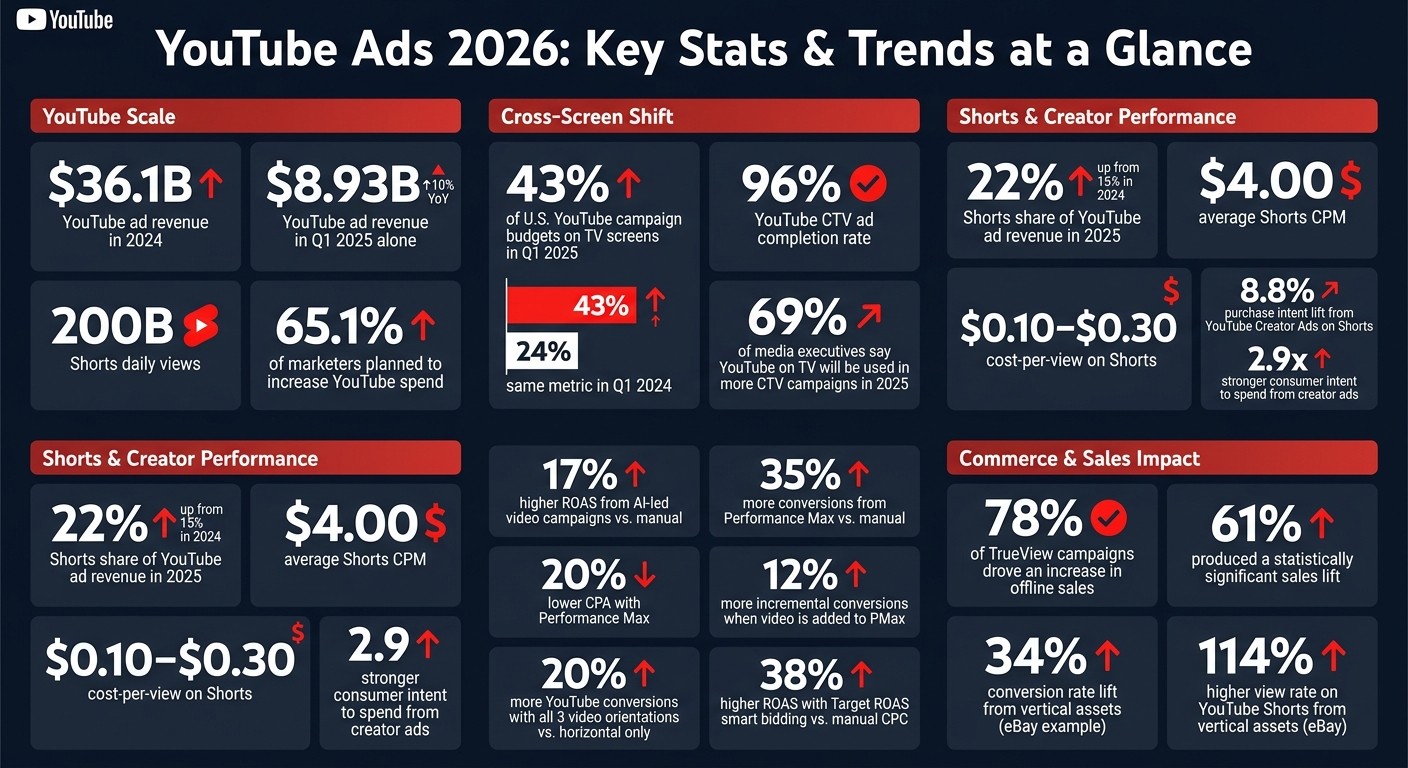
YouTube Ads 2026: Key Stats & Trends at a Glance
YouTube ads now run as a cross-screen system
YouTube no longer works like a single placement buy. Mobile, desktop, and connected TV each play a different role, and budget now follows that split.
Tinuiti found that U.S. brands put 43% of YouTube campaign budgets on TV screens in Q1 2025, up from 24% in Q1 2024. That shift shows why media teams can no longer stretch one video across every surface and hope for the same outcome.
The media buying strategies and planning models are changing in three clear ways:
Shorts drives fast reach and top-of-funnel traffic
CTV handles larger-screen reach and longer storytelling
Creator content adds trust signals inside paid media
Shoppable units connect attention to product action
That also means measurement has to change. A completed view on TV and a swipe-stop on Shorts do not mean the same thing. Teams now need format-level goals tied to one revenue view.
Alt text: YouTube cross-screen planning with Shorts, creator ads, and connected TV placements
Why are YouTube Shorts and creator ads driving more performance?
Shorts is no longer just a low-cost reach tool. It now sits inside Demand Gen, App, and Performance Max systems, which gives brands a direct route from short-form exposure to conversion-focused campaigns.
Short-form video’s share of YouTube ad revenue moved from about 15% in 2024 to roughly 22% in 2025, while Shorts daily views climbed far past early 2024 levels. For marketers, that means vertical video now has to sit near the center of YouTube planning.
The ad format rules are clear:
Hook viewers in the first 1–2 seconds
Use 9:16 framing
Keep prospecting ads under 30 seconds
Build for mobile behavior, not TV cutdowns
Shorts CPMs near $4.00 and cost-per-view between $0.10 and $0.30 also help make the case for scale.
Creator-led ads are moving the same way. YouTube’s BrandConnect tools and partnership ad setup now let brands turn creator videos into paid media assets. That closes the gap between influencer work and media buying.
Instead of running creator work in a separate lane, teams now fold it into:
audience planning
rights management
paid amplification
conversion reporting
That change matters because creator content often feels more native to the feed and can improve watch time and click rate compared with polished brand spots alone.
AI buying is changing budget control and video testing
AI now sits in the middle of YouTube campaign delivery. In Google systems like Performance Max, Demand Gen, and AI Max, marketers set business goals and guardrails while the platform routes spend where returns look strongest.
That changes the main planning question.
It is no longer just, “How much goes to Shorts versus CTV?”
It is now, “What signal should the system optimize toward?”
Google data shows:
AI-led video campaigns delivered 17% higher ROAS than manual setups
Performance Max drove 35% more conversions at a 20% lower CPA
Adding video to Performance Max lifted incremental conversions by about 12%
AI also affects how teams build video. Instead of producing a few finished ads, many brands now build modular asset libraries with:
hooks
product shots
offers
voiceovers
CTAs
vertical, square, and horizontal versions
That setup gives the system more combinations to test across YouTube placements. Google reported that campaigns with all three video orientations drove 20% more conversions on YouTube than campaigns using only horizontal video.
Alt text: AI-powered YouTube ad buying across Performance Max, Demand Gen, Shorts, and CTV
Shoppable CTV is bringing commerce to the living room
Shoppable YouTube ads are cutting steps between product interest and purchase. On mobile, that can mean product stickers, shopping buttons, and shelves tied to Google Merchant Center. On TV, it now includes product feeds and QR codes that move the viewer to a phone.
That handoff matters because CTV is growing fast, and YouTube completion rates on connected TV have reached as high as 96%.
For brands, the model is simple:
Use CTV for reach and product story
Add shoppable overlays or QR codes
Move viewers to mobile product pages
Retarget with Shorts or in-stream ads
This is changing campaign structure. TV is no longer just for awareness while mobile handles conversion. The two now work together inside one shopping path.
To run these ads well, brands need:
a clean Merchant Center feed
current prices and stock status
a tight SKU set
mobile landing pages that load fast after the QR scan
Visual categories like beauty, apparel, and home goods tend to fit this format well because the product can sell itself fast on screen.
Measurement and brand safety now shape YouTube strategy earlier
As automation grows, control matters more. Teams cannot wait until after launch to check placements, traffic quality, and lift.
Brand safety now needs to cover:
in-stream inventory
Shorts feeds
CTV placements
creator-linked media
Third-party verification from firms like DoubleVerify and IAS helps check viewability, invalid traffic, and suitability. On top of that, brands need incrementality testing to show whether YouTube changed outcomes that would not have happened on their own.
A simple measurement stack looks like this:
Brand Lift for awareness and recall
Search Lift for demand signals
Conversion Lift for lower-funnel action
MMM for channel contribution over time
Retail and CPG brands are also using shopper data from partners like Kroger Precision Marketing, Instacart, and Albertsons to connect YouTube exposure to purchase behavior. That changes targeting from broad demo guesses to buyer-based audience groups like heavy buyers, lapsed buyers, and switchers.
The result is clear: YouTube is being judged less by views alone and more by sales effect, margin impact, and cross-channel contribution.
What should CMOs do with these YouTube advertising trends?
CMOs should treat YouTube as a planning system made up of separate surfaces with separate jobs.
That means:
building format-specific roles into the media plan
aligning video assets to those roles from day one
using AI systems with clear value-based goals
tying YouTube reporting to incrementality and revenue
putting safety and verification checks in place before launch
The brands getting more from YouTube are not using one hero spot everywhere. They are pairing the right message, length, and screen with the right buying goal.
For 2026, the core shift is simple: YouTube works best when Shorts, creator ads, AI buying, and CTV commerce run together instead of in isolation.
FAQ
What are the biggest YouTube advertising trends in 2026?
The main trends are Shorts as a performance surface, creator-led paid ads, AI-based budget allocation, shoppable CTV, and tighter measurement tied to lift and sales.
Are YouTube Shorts ads good for conversions?
Yes. Shorts now supports performance-focused campaign types, and low CPMs plus large daily view volume make it useful for discovery and customer acquisition.
How is AI changing YouTube ad buying?
AI now shifts spend across YouTube and other Google surfaces based on signals like conversion value, CPA, and ROAS. It also tests multiple video versions across placements.
What makes shoppable YouTube CTV ads different?
They add product feeds, QR codes, and send-to-phone actions to TV ads, which helps viewers move from the living room screen to a mobile purchase path.
How should brands measure YouTube performance in 2026?
Brands should look beyond views and track lift, incrementality, conversion value, retail sales effect, and cross-channel contribution.
TL;DR Summary
**YouTube Shorts is now
Why YouTube Ads in 2026 Look Different Than They Did in 2024
YouTube is no longer a single-screen video buy. By 2026, YouTube spans mobile, desktop, and CTV, so media plans now treat it as a cross-screen channel, not a single-screen buy. That change matters more than any one format update. It explains why Shorts, creator-led ads, and shoppable placements now shape media planning.
From Experimental Formats to Core Media Strategy
The clearest signal is where budgets are moving. According to Tinuiti, U.S. brands spent 43% of their YouTube campaign budgets on TV screens in Q1 2025, up from 24% in Q1 2024, which made CTV the largest YouTube surface by spend for many advertisers. Shorts now drives more than 50 billion global daily views and sits inside Video Reach and Demand Gen campaigns, with Google AI helping choose the best mix of placements across in-stream, in-feed, and Shorts inventory. Creator-led media now sits inside paid plans, not outside them. Shoppable CTV has also moved into mainstream media plans across Performance Max, Demand Gen, and DV360.
CTV, Shorts, creator partnerships, and shoppable units now each carry their own budgets, performance goals, and creative rules. That changes the shape of the media plan. Instead of one video asset stretched across every placement, marketers now build around format-specific roles.
What Senior Marketers Are Evaluating Now
A survey of 171 U.S. media executives found that 69% said YouTube on TV will be used in more CTV campaigns than ever before in 2025, and agencies reported a 51% increase in YouTube ad investment in 2025 versus 2024. As spend spreads across more surfaces, attribution and creative efficiency matter more.
Senior marketers now look closely at incrementality, cross-screen attribution, and creative fatigue. Unskippable 30-second ads on CTV, multiple short-form ads in the Shorts feed, and shoppable overlays all compete for attention. Brands that use the same creative across every surface are seeing returns fade faster. The teams getting better results are building modular creative systems instead - different hooks, lengths, and treatments made for each surface from the start, rather than reworking one hero asset later.
Those planning shifts lead straight into the next change: how Shorts and creator-led ads now drive performance.
How Have YouTube Shorts and Creator-Led Ads Become Core Performance Formats in 2026?
YouTube Shorts and creator-led ads now do far more than generate reach. They drive measurable performance at massive scale. Daily Shorts views have reached about 200 billion per day, up from roughly 70 billion in early 2024, and Shorts’ share of total YouTube ad revenue grew from about 15% in 2024 to more than 20% by 2025–2026. For U.S. consumer brands, that level of usage makes vertical, mobile-first placements a core part of both reach and customer acquisition. It also changes how teams build creative, set budgets, and buy media.
YouTube Shorts Is Now a Primary Discovery and Performance Surface
Short-form video on YouTube has moved well beyond awareness. Shorts now supports full-funnel media across Demand Gen, App, and Performance Max campaign goals. That shift matters because brands no longer need to treat short-form video as a side test. It now sits inside the same performance system as other paid channels.
Google Creative Works reviewed 2,000 global ads that ran on Shorts and found three patterns among top performers: vertical alignment, speed, and emotional appeal. In plain terms, the ad has to feel built for the format. Winning Shorts ads usually:
Start with a clear hook in the first 1–2 seconds
Use 9:16 vertical framing
Stay under 30 seconds for prospecting
Feel native to mobile viewing instead of cut down from long-form video
That last point matters more than many brands expect. A repurposed TV spot or landscape video often looks out of place in the Shorts feed. By contrast, voiceovers, text overlays, and trending audio help the ad match the pace and feel of organic creator content.
For broad U.S. campaigns, the economics also work. Shorts CPMs sit near $4.00, with cost-per-view often landing between $0.10 and $0.30. That gives brands a low-cost way to drive top-of-funnel exposure at large scale while still feeding performance campaigns with new traffic and new audiences.
The result is simple: Shorts is no longer just a reach tool. It is now a core discovery and acquisition surface.
Creator Partnerships Are Moving Into Paid Media
The same shift is happening with creator content. Creator-led assets are now built into paid YouTube plans, not handled only as separate influencer buys. That changes the role of creators from awareness partners to direct media assets.
YouTube’s creator-initiated video linking feature gives brands a more formal way to do this. Brands can link sponsored creator videos, review organic performance data, and turn those videos into paid ads aimed at viewers who already engaged with the creator’s content. That creates a cleaner path from creator post to paid amplification.
Open Call pushes the model further. Advertisers publish a brief, eligible YouTube creators submit content, and the brand can boost the strongest assets as partnership ads at scale. It is a practical setup for brands that want variety in creative without building every ad in-house.
In working media plans, teams now identify creators who match the target audience, secure usage rights and whitelisting permissions, and place creator-made assets directly into paid YouTube campaigns. That includes Shorts inventory as well as connected TV placements. Instead of treating creator work as a separate stream, brands now fold it into the same planning, trafficking, and reporting systems used for paid media.
That operating change is important because creator-led ads often bring built-in trust and social proof. Those signals can improve watch time, click-through rate, and conversion rate compared with brand-only spots. People tend to respond when the ad feels like it comes from someone they already know, not from a polished brand script dropped into their feed.
So the media job is no longer just buying impressions. It now includes creator selection, briefing, rights management, and performance analysis inside one paid media workflow.
Short-Form Drives Discovery While Long-Form Supports Depth
Short-form and long-form now play different jobs inside the same YouTube plan. Shorts handles fast discovery, broad reach, and immediate response. Long-form video does the heavier lifting once a prospect wants more detail.
For more complex purchase decisions, longer YouTube videos - usually 8 to 20 minutes - help build trust through product demos, customer stories, and category education. That is where a brand can answer objections, show proof, and explain why its offer stands apart.
A common path looks like this: a viewer discovers the brand through a Short, shows intent by watching or clicking, and then enters a retargeting path built around in-stream ads and deeper video content. Many teams prioritize retargeting for viewers who watched at least 50% to 75% of a Short, since that level of engagement signals stronger interest.
The measurement framework should match each format’s role. Shorts is usually judged on reach, view-through rate, and click-through rate. Long-form video is better judged on brand lift, conversion rate, and revenue per view. Mixing those goals can muddy the read on performance. A Short does not need to do the same job as a 12-minute product demo, and a long-form asset should not be graded like a swipe-fast mobile ad.
The bigger point is that YouTube is now working more like a full video funnel. Short-form gets attention. Long-form builds confidence. Paid retargeting connects the two.
How Is AI Changing YouTube Ad Buying, Creative Testing, and Measurement in 2026?
YouTube ad buying in 2026 is no longer driven by manual media splits alone. With Shorts, creator content, and CTV now central to media plans, AI is deciding how budget moves across Google’s campaign systems and which outcomes matter most. Across Performance Max, Demand Gen, and AI Max, marketers now set goals and limits while machine-led systems shift spend between surfaces based on expected return. That change has pushed brands to rethink not just buying, but also how they test video assets and measure YouTube’s effect on revenue.
YouTube Is Now Part of AI-Powered Omnichannel Buying
Performance Max and Demand Gen now place YouTube inside a shared budget framework, which means marketers are no longer carving up spend by hand across Shorts, creator placements, and CTV inventory. Instead, teams define objectives, feed in audience and asset signals, and let AI route dollars where performance is strongest.
For many brands, the setup now follows a three-part model. Performance Max is used to capture high-intent demand. Demand Gen is used to build demand with YouTube-led creative. AI Max then supports Search by helping align intent signals with budget allocation across Google properties.
That structure changes the role of the media team. The work is less about surface-level budget splitting and more about setting the right inputs, guardrails, and success metrics. In plain terms, the question is no longer, “How much should go to Shorts versus CTV?” It is, “What business goal should the system optimize toward, and what signals will help it do that well?”
The performance lift is hard to ignore. AI-powered video campaigns on YouTube deliver 17% higher ROAS than manual setups, while Performance Max campaigns produce 35% more conversions at a 20% lower CPA than manual campaigns. Those numbers help explain why AI-led buying has moved from test budget territory to the center of channel planning.
Image alt text: AI-powered YouTube ad buying across Performance Max, Demand Gen, Shorts, creators, and CTV
As buying gets more automated, the pressure shifts downstream. If budget allocation becomes easier, then the next fight is over creative speed and measurement accuracy.
Creative Optimization Is Getting Faster and More Automated
AI is shrinking the creative testing cycle by turning one asset library into many video combinations across horizontal, vertical, and square formats. Instead of building each version from scratch, teams can supply modular assets and let the system mix, match, and test them across placements.
That matters because YouTube no longer behaves like a single-screen video platform. A viewer may see a brand in Shorts on a phone, long-form content on desktop, and CTV in the living room. Creative has to fit each environment, and AI makes that scaling process less manual.
Google’s own campaign data points to the payoff. Advertisers that uploaded at least one video to Performance Max saw an average 12% increase in total incremental conversions. Campaigns that included video in all three orientations delivered 20% more conversions on YouTube than campaigns using horizontal video alone.
The shift is even clearer in brand-level results. AI now generates and tests modular video variants across formats, and eBay’s vertical assets lifted conversion rates by 34%, lowered CPMs by 11%, and drove a 114% higher view rate on YouTube Shorts. For U.S. consumer brands, that is a strong signal: polished hero spots still have a place, but they are no longer enough on their own. What wins now is a library of parts that AI can recombine at scale.
This changes how creative teams work. Instead of betting on a small set of finished ads, they build systems: product shots, hooks, offers, voiceovers, CTAs, aspect ratios, and creator-style edits that can be swapped in and out. It is a little like moving from one fixed meal to a full kitchen pantry. The pantry gives the machine more ways to assemble something that fits the moment.
Image alt text: YouTube creative testing with vertical video, modular assets, and Shorts ad formats
Once testing speeds up, a tougher issue comes into view. If AI can produce many versions and serve them across many placements, what exactly should it optimize for?
Optimization Is Shifting From Views to Business Value
The center of measurement is moving away from views and toward business outcomes like conversion value, ROAS, and lifetime value. That shift lines up with the way AI-led campaign systems work. They need stronger signals than simple attention metrics if they are going to allocate spend well.
Enhanced Conversions improves purchase matching, while smart bidding steers campaigns toward higher-intent outcomes. That gives YouTube a stronger role in revenue analysis, not just awareness reporting. Brands are placing more weight on whether YouTube drives measurable incremental revenue rather than just adding impressions or view counts.
Target ROAS bidding is one of the clearest examples. Advertisers using Target ROAS smart bidding reported a 38% higher return on ad spend compared with manual CPC bidding. That kind of gap changes how marketers define success. A campaign with strong view volume but weak downstream value becomes much harder to defend when AI systems can optimize toward purchase quality instead.
This also affects reporting language inside organizations. Teams that once talked mostly about completed views or cost per view now need to tie YouTube to margin, repeat purchase potential, and blended channel return. The metric stack is getting closer to finance, not just media.
Image alt text: YouTube measurement using conversion value, Target ROAS, and smart bidding signals
Measurement Now Depends on Unified Cross-Channel Visibility
As YouTube becomes part of a shared AI-led buying system, channel-level reporting alone starts to fall short. A conversion may be shaped by Search, YouTube, Meta, Amazon, and retail media in sequence, not in isolation. That makes unified measurement more important than ever.
Bigeye’s EyeSight platform brings YouTube, Google, Meta, Amazon, and retail signals into one view, giving consumer brands a way to compare YouTube’s role against other channels and shift spend based on observed performance. That matters because YouTube’s value often shows up in combination with other touchpoints. Without a single performance view, teams risk over-crediting last-click channels and under-counting upper- and mid-funnel video influence.
In practice, this means YouTube measurement in 2026 is less about asking whether the platform “worked” on its own and more about asking how much incremental revenue it helped create inside the full media mix. That is a tougher standard, but it is also a smarter one.
How Are Shoppable and Connected TV YouTube Ads Expanding Commerce Reach in 2026?
Shoppable YouTube ads are cutting out steps between discovery and purchase on both mobile and TV. Instead of asking viewers to remember a product and look it up later, brands can now move people from interest to action inside the ad experience itself. That shift changes how YouTube campaigns should be built in 2026. Format choice now matters just as much as targeting, because the way products appear on screen can shape whether a viewer watches, scans, taps, or buys.
Shoppable Ad Formats Are Shortening the Path to Purchase
Shoppable ads turn YouTube attention into measurable commerce. In long-form videos and Shorts, brands can add in-video product tagging that triggers a Shopping button overlay or product sticker. Viewers can open a product panel without leaving the viewing experience, which trims friction at the exact moment interest is highest.
A second buying prompt can appear below the video through a product shelf tied to the brand's Google Merchant Center feed. That gives the same impression more than one path to action, which matters when buyers want to compare items, check price, or move straight to a product page.
To run these formats, brands need a connected Merchant Center feed with current pricing, in-stock status, and product images. In practice, most brands should keep the lineup tight and lead with a small group of top-selling SKUs. That approach keeps the ad focused and avoids turning the product panel into a cluttered storefront. These formats tend to work best for visual categories like beauty, apparel, and home goods, where the product can sell itself fast on screen.
The same shopping logic now reaches beyond the phone and into the living room.
Connected TV Is Changing How Brands Use YouTube for Storytelling
On Connected TV, the path to purchase becomes part of a larger brand moment. YouTube CTV gives brands living-room-scale reach, which makes it a strong fit for product education, recall, and slower storytelling that has room to breathe.
Google has expanded non-skippable in-stream options for CTV, including 30-second units available globally and spots of up to 60 seconds on YouTube TV in the U.S.. Those longer ad lengths give brands more time to show how a product works, where it fits in daily life, and why it matters. That extra space is useful on TV, where viewers are often leaning back, listening closely, and not in a rush to tap through.
Shoppable CTV formats add another layer. Brands can now place an interactive product feed on the right side of the TV screen. Viewers can scan a QR code or send the offer to their phone, then keep shopping on a second screen. It is a simple handoff: the TV builds interest, and the phone closes the gap to purchase.
Cross-Screen Behavior Is Reshaping Campaign Architecture
The strongest YouTube commerce plans now connect TV reach with mobile action. A common setup starts with CTV non-skippable and shoppable formats to drive household reach and early intent. From there, brands can retarget or reinforce the message with skippable in-stream ads on mobile, using shopping buttons or product stickers. Shorts placements can extend the same effort with the same Merchant Center feed, which keeps product data aligned across screens.
QR codes and send-to-phone actions sit at the center of that flow. They help move viewers from the TV screen to a mobile product page with very little effort. That matters because cross-screen commerce usually fails when the handoff feels like work. If the viewer has to search, type, or remember too much, the moment is gone.
This shift also changes how campaigns should be measured. Brands can use incrementality testing to tie second-screen actions back to specific CTV creatives and estimate each channel's contribution to shoppable performance. That makes YouTube less of a split between "brand" and "performance" and more of a connected system where each screen plays a different role.
How Are Brand Safety, Measurement, and Accountability Shaping YouTube Ad Strategy in 2026?
YouTube ad strategy in 2026 lives or dies on control. As buying gets more automated and more shoppable, brand safety, verification, and retail-linked measurement now act as the guardrails, supported by the right marketing tools. Brands that leave those areas for later put both media spend and brand trust on the line. Governance is no longer a cleanup job after launch. It now belongs in planning from the start.
Brand Safety and Suitability Standards Are Expanding Across Formats
YouTube governance now reaches across in-stream, Shorts, and CTV. Each format brings a different risk profile, so one blanket rule set no longer works.
In-stream placements still depend on familiar controls such as category exclusions, keyword blocklists, and channel-level settings to avoid sensitive placements. Shorts are harder to manage. The feed moves fast, contextual cues can change in seconds, and user-generated content can vary from one swipe to the next. That makes suitability checks more demanding than they were in static or slower video environments. YouTube's MRC brand-safety accreditation now includes Shorts, and third-party partners support video-level verification across formats.
CTV calls for a tighter hand. Larger-screen viewing can carry more brand impact, so weak placement controls can cost more than a wasted impression. Stricter inventory filters make sense here, while Expanded inventory fits broad-reach campaigns only when layered exclusions are in place.
A sound 2026 governance workflow includes pre-flight suitability checks, in-flight placement quality monitoring, and post-flight audits that flag low-quality channels for future exclusions. That process turns governance into a repeatable system rather than a one-off reaction.
Measurement Is Moving Toward Verification and Incrementality
Once buying is automated, measurement has to prove value, not just delivery. Impressions and views still matter, but they only set the floor. The harder question is whether YouTube changed outcomes that would not have happened otherwise.
That answer depends on two linked methods. First, third-party verification confirms that ads reached real people in suitable environments. Independent partners such as DoubleVerify and IAS track viewability, invalid traffic, and brand safety compliance across campaigns. Without that outside check, delivery data can look clean while quality issues sit underneath.
Second, incrementality testing isolates YouTube's actual effect by comparing exposed and control groups. Google's Conversion Lift measures incremental conversions directly. Brand Lift and Search Lift show movement in ad recall, awareness, consideration, and organic search behavior.
A simple way to frame the measurement stack:
Use Brand Lift and Search Lift when the goal is awareness and demand creation.
Use Conversion Lift when the goal is purchases or other lower-funnel actions.
Use MMM for budget planning across channels and for a longer-term read on marginal ROI.
For brands running omnichannel programs, marketing mix modeling adds the broader business view. It helps show how YouTube interacts with search, retail media, and other channels over time, instead of treating each one like an island.
Retail and CPG Signals Are Shaping YouTube Audience Strategy
For CPG marketers, accountability now leans heavily on retailer-linked audience data. In categories like food and beverage, pet, beauty, and wellness, stronger YouTube targeting in 2026 comes from commerce and retailer signals, not loose demographic guesses.
Kroger Precision Marketing's partnership with YouTube lets brands connect ad exposure to both in-store and online purchase behavior, linking video impressions to SKU-level sales. Instacart and Albertsons first-party data can also be activated on YouTube to build commerce audiences and shoppable campaigns with sales-linked reporting.
That link matters because it changes audience strategy from broad targeting to shopper-based targeting. Instead of leaning on generic in-market segments, brands can build around heavy buyers, lapsed buyers, and switchers. Those audience definitions reflect actual shopping behavior. They also shape which SKUs get featured, which message leads, and where each placement fits in the media plan.
Google found that 78% of TrueView campaigns studied drove an increase in offline sales, and 61% produced a statistically significant sales lift for the advertised brand. For CPG teams, that creates a clear baseline for incrementality expectations. It also strengthens the case for building YouTube audiences with retailer data tied to purchase behavior, not just age, gender, or broad category interest.
Governance Is Now a Planning Function, Not a Post-Buy Fix
The thread running through all of this is simple: safety, verification, and sales accountability now shape YouTube strategy before a campaign goes live.
A campaign can hit delivery goals and still underperform if placements are weak, traffic quality is poor, or audience logic rests on old assumptions. That is why governance now sits closer to audience design, inventory choices, and test planning. Pre-flight checks reduce risk up front. In-flight monitoring catches quality problems while budget is still moving. Post-flight audits make the next campaign sharper by turning weak placements into future exclusions.
For advertisers working across Shorts, in-stream, and CTV, that discipline is not extra process for its own sake. It is the control layer that keeps automation pointed in the right direction.
What Do the 2026 YouTube Ad Trends Mean for CMOs and Growth Leaders?
YouTube in 2026 is no longer just a media line item. It is a planning system. YouTube ad revenue hit about $8.93 billion in Q1 2025, up roughly 10% year over year, and 65.1% of marketers planned to increase YouTube spend over the next 12 months. For CMOs and growth leaders, that kind of spend changes the job. Instinct is not enough. Planning now has to connect governance, measurement, commerce, device use, and format roles into one clear system.
Research-Led Planning Is Becoming a Competitive Advantage
The first job is to understand how people split attention across devices and formats. Strong planning starts with device, intent, and role. Mobile drives discovery. CTV delivers reach. Creators build trust. Long-form video supports consideration.
That split matters more than broad demographic guesses. Audience behavior is moving fast, and media plans need to move with it. TV screen ad spend on YouTube rose from 26% to 39% of total campaign spend between Q4 2023 and Q4 2024, while mobile share dropped from 53% to 44%. That shift points to a plain truth: each format needs a defined job based on audience data, not habit.
Integrated Creative and Media Strategy Is Now Required
Once those audience roles are clear, creative and media can no longer sit in separate lanes. They need to be built at the same time. A single modular asset system should flex across Shorts, creator ads, in-stream, and CTV, with each version tied to a media goal from day one.
That approach is showing up in results. Performance Max campaigns with video generate 12% more conversions. The lesson is simple. Better output tends to follow when media planning and asset design happen together instead of being passed from one team to another at the last minute.
Measurement also has to keep pace with that shift. Views alone do not explain whether YouTube built demand or just caught demand that already existed. Senior leaders need a tighter set of questions: Is the campaign driving incremental lift? Is branded search moving? Is retail sales impact showing up? Is cross-screen reach improving? Those are the numbers that tie exposure to business results.
Where Bigeye Fits for Consumer Brands Navigating YouTube in 2026

Bigeye works with consumer brands that need YouTube planning tied to growth, not guesswork. The agency brings together consumer research, creative strategy, performance media, and analytics in one team. That makes it easier for brands to turn audience insight into format choices, test creative across placements, and measure performance across Shorts, creator partnerships, shoppable ads, and CTV.
Bigeye’s EyeQ and EyeSight support that work by connecting audience insight, creative planning, and performance tracking across YouTube and the rest of the media mix.
Conclusion: YouTube Ads in 2026 Point to a More Integrated Future
YouTube advertising in 2026 demands one connected plan, not a patchwork of separate tactics. Shorts, creator ads, shoppable units, CTV, and AI-driven buying now work best as one system. Brands that still treat each format as its own lane risk losing growth. The shift is clear: YouTube is no longer just a group of ad placements. It is one linked system built to move people from discovery to purchase.
YouTube’s growth in 2025 backs that up. Shorts, creator ads, shoppable units, and CTV are now pulling double duty by driving both scale and sales. YouTube Creator Ads on Shorts increase purchase intent by 8.8% and drive 2.9x stronger consumer intent to spend.
For consumer brands, the message is straightforward. Each format now plays a separate role in the funnel. Short-form video drives discovery. Creator content builds trust. CTV pushes reach into the living room. Shoppable formats help shrink the distance between interest and purchase.
AI now sits at the center of bidding, audience targeting, budget allocation, and creative testing across YouTube formats.
For brands ready to move, the next step is unified planning and measurement. Bigeye helps consumer brands connect research, creative, media, and analytics into one YouTube growth system.

Pet Industry
Sep 16, 2026
Month three is the real test for pet subscription retention: early shipments cause churn - fix cadence and dose education, not discounts.