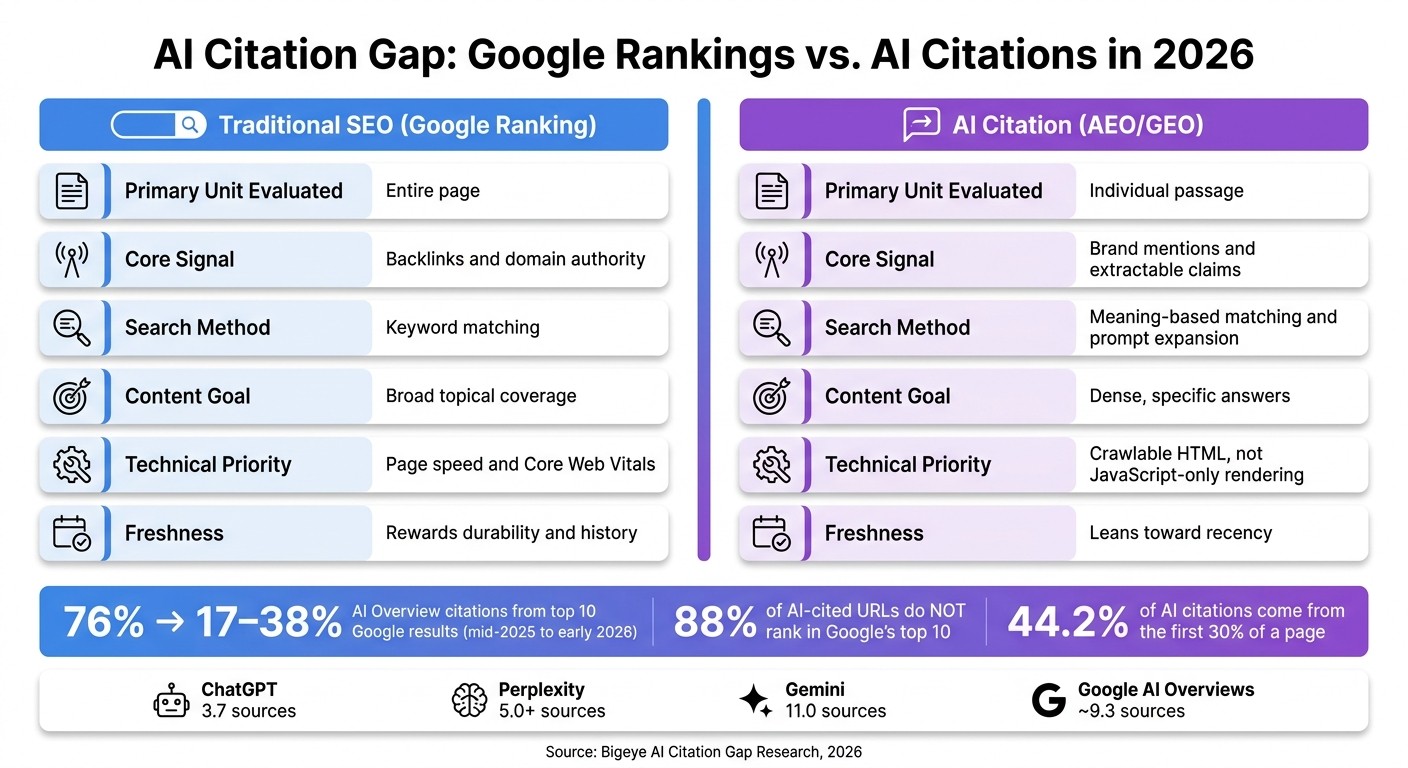
The AI citation gap is now a direct visibility problem. Some industry analyses put the share of Google AI Overview citations drawn from Google’s top 10 organic results at roughly 17% to 38% in early 2026, down from about 76% in mid-2025. Whatever the exact figure, the direction is clear: a page can rank well and still get skipped inside AI answers. This guide explains why that happens, how AI search visibility is judged at the passage level, and what marketing teams should track if they want brand mentions inside ChatGPT, Perplexity, Gemini, and AI Overviews.
TL;DR
A high Google ranking no longer means a brand will appear in AI-generated answers.
The AI citation gap happens because answer engines select short passages, not full pages.
Standard SEO reporting often misses answer-layer visibility because it tracks rankings, clicks, and traffic more than AI citations.
Brands need to measure AI answer mentions, cited URLs, and passage performance across each engine.
Pages that rank but do not get cited often have fixable issues tied to structure, entity clarity, or bot access.
What Is the AI Citation Gap, and Why Does It Matter for Your Brand?
A top-three Google ranking no longer means a brand will show up in ChatGPT, Perplexity, or Google AI Overviews. A page can rank near the top and still get zero citations. That gap matters because users may form opinions, compare options, and move closer to a decision before they ever click through to a site.
Why High Organic Rankings No Longer Guarantee Visibility
Fewer AI Overview citations now come from Google’s top 10 organic results than a year ago. In plain terms, AI systems are not just rewarding the page with the best overall rank. They break a prompt into smaller questions, scan for the clearest answer to each one, and cite the source that is easiest to extract and trust.
That shifts the game. Rank still matters, but it is no longer the whole story. The page also needs language that AI can lift cleanly, along with precise entity signals that make the source easy to identify. Without those traits, even strong pages can get skipped.
That helps explain why many pages in Google’s top three positions still get skipped: they lack the structural traits AI citation depends on, such as extractable claims and entity specificity. Ranking signals and citation signals overlap, but they do not lead to the same result. One helps a page appear in search. The other helps a passage get selected inside an AI answer.
What This Costs CMOs and Marketing Directors
The damage often shows up in places many dashboards miss. An analysis of 28 days of Search Console data found that 531 queries ranking in the top 10 drove 28,847 impressions but only 161 clicks, for a 0.56% click-through rate, because AI summaries answered the user’s question before any link got attention.
For CMOs and marketing directors, this is an awareness problem wearing the clothes of a traffic problem. If AI answers the question and leaves out the brand, the user still gets what they came for, but the brand loses the chance to be seen, remembered, or weighed against other options.
That missing mention can chip away at brand recognition long before a session shows up in analytics. Standard traffic reports may show flat or falling clicks, but they do not fully show the lost exposure inside AI-generated answers. The next section looks at the signals that shape whether a page gets cited at all.
How ChatGPT and Perplexity Decide Which Sources to Cite
A page can clear discovery, retrieval, and answer-building, then still miss the final citation list. That last cut is where many brands lose visibility. ChatGPT and Perplexity move through four stages: access, retrieval, synthesis, and citation selection. Because of that process, a strong Google ranking does not guarantee brand attribution inside AI answers. Research tracking 548,534 retrieved pages found that only 15% made it into a final AI answer. The gap comes down to the signals these engines use when they choose which pages survive the filter.
The Signals That Drive Citation Selection
When a user enters a prompt, the engine often splits it into several sub-questions. That behavior appears in 89.6% of AI searches. Each sub-question looks for the clearest, most self-contained answer for that one part of the prompt. That changes the game. A page can rank well for a broad topic and still lose citations to a narrower page that answers one sub-question more directly.
Pages that cover related questions are 161% more likely to be cited than pages that match only the main keyword. In plain terms, AI systems are not just looking for topical overlap. They are looking for passages that solve the exact slice of the prompt in front of them.
Recency also matters. Cited pages are, on average, 25.7% fresher than standard organic results, and pages updated within the past 3 months receive an average of 6 citations versus 3.6 for older content. That is a sharp difference. It suggests these engines give extra weight to pages that show current information, especially when the topic shifts fast.
Brand visibility across the web matters more than many SEO teams expect. Brand web mentions correlate with AI citations at 0.664, which is about three times stronger than the correlation for backlinks at 0.218. That points to a simple idea: answer engines look for signs that a brand or claim is echoed across multiple places online, not just linked.
Passage structure is the last hurdle. AI engines evaluate content at the passage level, not only at the page level. A passage that starts with a direct answer and includes a verifiable claim has a much better chance of being pulled into the final response. If the answer is buried halfway down the page, it is easier for the engine to skip it and quote a competitor instead.
Why Ranking Factors and Citation Factors Are Not the Same
Classic SEO and AI citation work overlap in a few places. Domain authority still matters. Crawlability still matters. But the two systems judge success in different ways, and that difference explains why high-ranking pages often fail citation tests.
Factor | Traditional SEO (Google Ranking) | AI Citation (AEO/GEO) |
|---|---|---|
Primary unit evaluated | Entire page | Individual passage |
Core signal | Backlinks and domain authority | Brand mentions and extractable claims |
Search method | Keyword matching | Meaning-based matching and prompt expansion |
Content goal | Broad topical coverage | Dense, specific answers |
Technical priority | Page speed and Core Web Vitals | Crawlable HTML, not JavaScript-only rendering |
Freshness | Rewards durability and history | Leans toward recency |
The split is easy to miss. Google can reward the strongest page on a topic overall. An AI answer engine may ignore that same page if another source offers a cleaner, tighter passage for a single sub-question. One system ranks pages. The other lifts snippets.
That is why citation work needs its own lens. Brands that want visibility in ChatGPT and Perplexity need pages built for extraction: direct answers near the top, support for related questions, recent updates, and claims that can be checked against other mentions on the web.
Why Do High-Ranking Pages Still Fail AI Citation Tests?
Ranking near the top no longer guarantees visibility in AI-generated answers. A page can perform well in standard search and still get passed over by AI systems when it is hard to extract, hard to map to a clear entity, or hard to crawl.
Pages That Bury Answers or Lack Extractable Passages
The first problem is structure. The answer may be on the page, but not in a format a model can pull cleanly. When the main point is buried under setup, background, or long-winded copy, AI systems often move on.
Industry studies suggest a large share of AI citations come from the top portion of a page, and the passages cited most often run between 40 and 80 words. That range is short enough to quote cleanly and specific enough to stand on its own. In plain terms, pages need extractable passages, not just long-form depth.
That changes how strong pages should be written. Instead of making readers or crawlers dig for the answer, the page should state the core point early, then add context after it.
Weak Entity Signals, Schema, and Off-Site Trust
The second problem is identity. AI systems do not just need topic relevance. They also need a clear signal that ties the page to a specific brand, product, or knowledge graph entity.
When a page leans on vague wording, generic category terms, or inconsistent naming, entity mapping gets weaker. That makes citation less likely because the system has less confidence about who the page represents, not just what it discusses.
Schema can help organize information, but it does not solve the problem on its own. Clean HTML, direct brand references, and third-party mentions across the web carry more weight than markup by itself. Independent mentions matter more than on-page schema alone.
Crawlability and AI Bot Access Issues
The third problem is access. If crawlers cannot read the page, they cannot cite it. That sounds obvious, but it still trips up many high-ranking pages.
The most common issues include blocked bots, JavaScript-heavy pages that fail to render for crawlers, and CDN or firewall settings that shut AI bots out before they even see the content. In a July 2026 study covering more than 10,000 domains, GPTBot fetched pages successfully only 54.2% of the time, compared with 83.8% for a standard browser.
Snippet controls can also get in the way. The nosnippet tag and max-snippet:0 directive may rule a page out of generative AI features. That is why a raw HTML review matters. Search Console can show indexation signals, but it does not always show what an AI crawler can actually access and parse. For brands focused on AI search visibility, bot access audits should come first.
These problems often appear together in the same audit, which is why citation loss rarely comes from a single weak spot.
Citation Blocker | Why It Matters | Typical Fix |
|---|---|---|
Buried answers | The answer is missed in the first 30% of content | Lead with the conclusion, then add context |
JavaScript rendering | Crawlers may see no content on JS-only pages | Use server-side rendering for main body copy |
Vague entity language | Generic wording makes entity mapping harder | Use specific, consistent brand and product names |
CDN rules | CDNs may block AI crawlers by default | Explicitly allow relevant bots in firewall settings |
Snippet directives |
| Audit and remove old snippet restrictions |
If even one of these blockers is in place, citation odds can drop fast. The upside is that each one can be checked, tested, and fixed.
How Do You Measure Your Citation Gap Across AI Engines?
The citation gap only matters when it can be measured. Search rank alone does not show whether a brand is visible inside AI-generated answers. A page can rank on Google and still get ignored by ChatGPT, Perplexity, Gemini, or Google AI Overviews.
The Metrics That Matter
The first test is simple: does the brand appear in the AI answer at all? After that, citation rate tracks the share of target prompts where a brand is cited over time. Share of cited response goes one step further. It measures how much of the answer is tied to a given source, not just whether that source shows up at the bottom as a footnote.
Two more metrics help sort signal from noise. Linked vs. plain-text mention shows the difference between a clickable citation and a brand name dropped into the response with no link or clear source. Then there is the Search Console click pattern, which often acts like an early alarm. If impressions go up while clicks stay flat or fall, an AI summary may be answering the query without sending traffic to the site. A click-through rate under 1% on queries that used to land in the 2% to 8% range for positions 4 through 10 should be flagged.
A Cross-Engine Audit Framework
Start with 10 to 20 buyer questions pulled from real sales calls, search queries, site search logs, or support tickets. Run those same prompts across ChatGPT, Perplexity, Google AI Overviews, and Gemini, then record every cited URL by engine. After that, compare the cited pages with current Google rankings to spot every page that is ranked but not cited.
That comparison is where the gap becomes useful. It shows which pages already have search visibility but fail to make it into AI answers. In plain terms, those pages are on the field but not touching the ball.
The engine-by-engine differences are sharp. Only 2.7% of cited domains appear across all five major AI engines, while 69.6% of sources are cited by exactly one engine. ChatGPT averages 3.7 sources per answer and often leans on Wikipedia and Reddit. Gemini averages 11.0 sources and pulls more often from multimedia content and the Google ecosystem.
Engine | Avg. Sources per Answer | Citation Tendency |
|---|---|---|
ChatGPT | 3.7 | Wikipedia and Reddit |
Perplexity | 5.0+ | Live retrieval and numbered citations |
Gemini | 11.0 | Multimedia and the Google ecosystem |
Google AI Overviews | ~9.3 | YouTube and high-authority domains |
Why engine-by-engine tracking matters
An audit that blends all AI platforms into one score can hide what is going wrong. ChatGPT, Perplexity, Gemini, and Google AI Overviews do not cite the web the same way. One engine may reward crisp, quote-ready text. Another may pull from video, forum threads, or pages tied closely to a known entity.
That means a page can perform well in one engine and disappear in another. A brand might show up often in Perplexity because of direct citations, yet remain absent from Gemini because the page lacks entity signals or media support. Without engine-level logging, those differences stay hidden.
Ranked but not cited usually points to fixable issues
When a page ranks but does not earn citations, the issue is usually not ranking alone. In many cases, the page is hard for AI systems to parse, hard to attribute, or hard to access.
For pages missing from AI responses, use a five-part eligibility check across crawlability, extractability, specificity, entity clarity, and freshness. If the page already ranks but still does not get cited, the breakdown usually sits in extractability, entity clarity, or access.
Think of it this way: ranking gets a page onto the shortlist, but citation depends on whether the engine can lift a clear answer from the page and tie it to a known source. If that handoff fails, the page stays invisible inside the response.
Those gaps point straight to the content and technical fixes that come next.
Content and Technical Fixes That Turn Rankings Into Citations
Three weak spots usually explain the gap between ranking and citation: extraction, entity clarity, and crawler access. A page may be crawlable and still miss citation opportunities if the answer is hard to extract. It may also look clean and well organized yet still fail if robots.txt, CDN settings, or firewall rules block the bots that matter.
Rewrite Pages for Direct Answers and Passage-Level Clarity
Use 40- to 80-word answer blocks that can stand on their own. If the main point hides behind a long intro, the extraction window often closes before the answer shows up.
Lead with the bottom line first. The first one or two sentences under each heading should give the direct answer. After that, the page can add nuance, limits, and proof. Long warm-ups hurt citation odds, so the answer needs to appear right away.
Question-led headings help as well. An H2 like "How does [Product] reduce customer churn?" gives AI retrieval systems a cleaner signal than a label like "Our Benefits." The heading lines up with the subquestion the engine is trying to answer, and pages that address those nearby questions are more likely to be cited than pages aimed only at the broad head term.
A simple test works well here: highlight the first 60 words under any H2. If those words do not work as a direct, stand-alone answer, rewrite them before doing anything else. The goal is extractability, not just completeness.
Once the answer is easy to pull, the source also needs to be easy to identify.
Strengthen Entity Signals and Schema Markup
Use the full brand and product name in the lead sentence of each section. When copy leans on pronouns like "we", "it", or "our tool" instead of the actual brand or product name, engines have a harder time linking the claim to a known entity.
Schema markup supports that entity signal at the machine level. Add FAQ, Organization, Article, and sameAs schema where they fit. Keep schema and visible copy identical for prices, ratings, specs, and FAQs. If a value appears only in hidden markup, many AI engines will not surface it during live retrieval. sameAs links in Organization schema also help connect the brand to trusted third-party profiles.
Even strong copy and clean entity signals will fall flat if crawlers cannot reach the content.
Fix Technical Access and Earn Third-Party Mentions
If the main content loads through JavaScript, move it into server-rendered HTML or prerender it. Client-side content is often invisible to AI crawlers.
Bot permissions are a separate problem. Blocking GPTBot in robots.txt stops OpenAI from using a page for model training, but that does not block OAI-SearchBot, which handles live ChatGPT Search citations. Pages should allow OAI-SearchBot and PerplexityBot while restricting training bots if the goal is to keep citation access open.
Third-party mentions matter too. Independent brand mentions across relevant outside sources support citation authority more than links alone. That outside confirmation tells engines the brand exists beyond its own site and is worth referencing.
Fix | Before | After |
|---|---|---|
Answer placement | Main point buried mid-page | Direct answer in the first two sentences |
Headings | Vague nouns ("Our Process") | Question-led ("How does [Product] reduce churn?") |
Entity language | Pronouns ("we", "it") | Full brand and product name in each section |
Schema | Basic markup only | FAQ, Article, Organization, |
Rendering | Client-side JavaScript | Server-rendered or prerendered HTML |
Bot access |
|
|
What Does the AI Citation Gap Actually Mean for Consumer Brand Growth?
The AI citation gap is a growth problem in plain sight. When a consumer brand ranks well in search but gets left out of AI-generated answers, it misses the exact moment buyers start building a shortlist. If an AI engine skips a brand, that brand may never even make it into consideration. In that sense, AI citation is not just a search detail. It is a direct signal of market visibility and demand capture.
AI Citation as a Visibility KPI
Citation rate and share of answer now belong on the growth dashboard. Search ranking still matters, but ranking alone no longer decides who shows up in the answer layer.
For consumer brands, awareness and demand capture now depend in part on how often a brand is cited in AI answers, not just where it ranks on a results page. A brand that appears again and again in AI responses about its category builds recognition during the consideration phase. A brand that ranks well but never gets cited is much less likely to land on a buyer’s shortlist.
Citations also need to be tracked by engine. Strong visibility in one AI platform does not automatically transfer to another. That is why citation data cannot sit inside a single-platform report.
Why Integrated Measurement Matters
For leadership teams, the practical move is simple: treat citation data like any other revenue signal. Citation rate, share of answer, and independent mentions should sit next to clicks, conversions, and other core growth numbers.
The gap becomes clear in query data. When impressions climb while clicks stay flat, AI summaries are often intercepting demand.
Off-site presence matters here more than many teams expect. As noted above, brand presence across outside sources affects whether AI systems view a brand as cite-worthy. This is not a vanity measure. It shapes citation eligibility.
Summary
AI citation gap matters now. A page can rank well on Google and still get ignored by AI engines because answer systems pull specific passages, not entire pages. That split is no longer small.
That gap can be measured across engines, prompts, and pages by comparing organic rankings with AI citations for target queries. Once that view is in place, weak spots start to stand out.
The fixes are simple and direct. Start each section with a clear answer. Keep entity language consistent across the page. Make sure content is served in crawlable HTML. Build outside brand mentions on relevant sources.
Find Out Where Your Brand Is Losing Ground to AI Engines
If your pages rank but AI answers keep naming someone else, talk to Bigeye. Our AI SEO and GEO team can compare your rankings against citations in ChatGPT, Perplexity, Gemini, and AI Overviews and show you which pages and passages are getting skipped.
FAQs
Why does a page rank on Google but not show in AI Overviews?
Because Google ranking and AI citation use different selection logic. A page may rank well overall but still lack a short, direct passage that an answer engine wants to quote.
Does ranking in Google’s top 10 still help with AI citations?
Yes, but it is no longer a safe predictor. A growing share of AI Overview citations now come from pages outside Google’s top 10.
What do AI engines look for when choosing a citation?
They often look for a clear passage that answers the prompt directly, uses specific language, and is easy to attribute to a known source.
How can a team measure AI search visibility?
A team can compare search rankings with AI mentions, cited URLs, and answer frequency across ChatGPT, Perplexity, Gemini, and Google AI Overviews.
Related from Bigeye
Case study: Florida Crystals

Paid Media & Performance
Oct 7, 2026
A retail media strategy for 2027 in eight steps, with Bigeye shopper research and current data on Amazon, Walmart, Instacart and measurement.