Answer Engine Optimization: How Consumer Brands Get Mentioned by AI
Answer Engine Optimization is now a visibility issue, not just a search issue. With Google AI Overviews appearing on about 30% of U.S. queries and standard result clicks dropping when AI summaries show, brands need to earn mentions inside AI answers before a shopper ever visits a site. In this piece, I break down what matters most, what to measure, and how I would turn AEO into a repeatable growth channel for a consumer brand.
TL;DR
Answer Engine Optimization shifts the fight from page rank to AI citation, which can shape buyer choice before a click happens.
I would start with prompt clusters, because AI users ask longer, more specific buying questions than search users do.
I would format pages around short answer blocks, clear questions, and schema so AI systems can pull clean passages.
I would build brand signals beyond the site, since AI tools cite third-party sources far more often than brand-owned pages.
I would track Answer Share, citation quality, and AI-led conversions instead of looking at search rank alone.
Why Answer Engine Optimization matters now
The article’s core point is simple: if AI does the first round of product research for shoppers, the cited brand gets the first shot at demand.
That changes how I think about search. A ranked page still matters, but it is no longer the only thing that gets seen. If an AI answer names three brands and mine is missing, I can lose the buyer before the visit starts.
Two numbers stand out:
Google AI Overviews show on about 30% of U.S. searches
Click-through on standard results can drop to 8% when an AI summary appears
That means AEO is tied to both visibility and revenue.
Prompt mapping comes before content
One of the best parts of the article is the focus on buyer questions first.
I would not begin with a page outline. I would begin with the actual prompts buyers use in ChatGPT, Perplexity, Gemini, and Google AI Overviews. Those prompts are often longer and more specific than search terms, which makes intent easier to read.
The article points to prompt sources that make sense:
Sales calls
Support transcripts
Site search
Retailer Q&A
Reddit
Quora
YouTube comments and transcripts
Search Console question queries
That approach helps me find where AI research is already happening and where my brand may be mentioned but not cited.
That gap matters. If a brand gets mentions without citations, AI may know the brand name but not trust the brand’s content enough to quote it.
Structure decides whether AI can use your content
The article makes a strong case that AI systems do not read pages the way people do. They often pull small passages, not full articles.
So if I want citation, I would focus on generative engine optimization to build pages around extraction:
Question-based H2s and H3s
A direct answer in the first sentence
Short blocks of about 40–60 words
Lists when order matters
Sections that still make sense when read alone
Clean HTML and JSON-LD schema
Server-rendered or static pages when possible
I also like the point about anchor IDs. That small step can help AI tools point to the exact answer block instead of the full page.
In plain terms: if the answer is buried, it is harder to cite.
Brand authority does not live only on your site
A key takeaway from the article is that most AI citations come from outside brand-owned sites.
That means I would treat AEO as more than a content task. It also touches PR, reviews, retailer pages, Wikipedia where fit, expert bylines, and third-party coverage.
A few points carry weight:
Brand-owned sites account for only 5% to 10% of AI citations
Earned media makes up about 84% of citations across major platforms
Third-party sources are cited far more often than company sites
So if brand facts differ across profiles, press mentions, product listings, and social accounts, that can weaken citation odds.
I would focus on:
Consistent brand naming
sameAslinks in schemaAuthor pages with credentials
Original data with source details
Updated timestamps
AI crawler access checks
The article also calls out llms.txt. That is worth testing, though I would treat it as one signal, not the whole plan.
The right KPI is Answer Share
The strongest measurement idea in the article is Answer Share: the share of buyer-relevant AI answers that cite the brand.
I like this because rank alone cannot explain AI visibility.
If I were setting up reporting, I would track three layers:
Visibility: citation rate, share of voice, citation accuracy
Conversion: AI referral traffic, assisted conversions, lead or sales rate
Business impact: revenue, branded search lift, paid click lift
The article notes that AI-referred traffic can convert much better than standard organic traffic, with examples such as 15.9% for ChatGPT referrals versus 1.76% for standard Google organic traffic.
Even if those numbers vary by brand, the message is clear: AI traffic can be small in volume but high in intent.
Testing has to be routine
Another point I agree with: AEO should run on a schedule, not as a one-time publish cycle.
I would keep a prompt set of 20 to 50 buyer questions and test them across platforms each month to improve AI search visibility. Since AI answers can change run to run, I would repeat each prompt 3 to 5 times before drawing a conclusion.
I would also review:
Server logs for AI crawler activity each week
Citation checks each month
AI referral and conversion data each quarter
Prompt list updates each quarter
That process helps separate random answer shifts from actual movement.
Where the article is strongest
I think the article is at its best when it turns AEO into a working model instead of a buzzword.
It does three things well:
It reframes the problem from rankings to citations
It gives a workflow from prompts to page structure to measurement
It ties AI visibility to business outcomes such as conversion and branded search lift
That makes it useful for consumer brands that need a plan, not just a trend recap.
What I would add in practice
If I were applying this playbook, I would add a few working rules:
Start with one product line, not the whole catalog
Build pages for high-margin prompt clusters first
Compare AI citations against top category rivals every month
Watch for wrong or outdated AI answers about your brand
Pair AEO work with PR and retailer content updates
That keeps the work tied to dollars, not just mentions.
FAQ
What is Answer Engine Optimization in simple terms?
It is the work of formatting content so AI tools can find, trust, and cite your brand in generated answers.
How is AEO different from SEO?
SEO helps pages rank in search results, but AI search is shifting the focus toward conversational answers. AEO helps answer blocks and brand facts get pulled into AI summaries and chat responses.
Why do consumer brands need AEO now?
Because AI answers can shape brand choice before a user clicks a result, and fewer clicks may go to standard listings when AI summaries appear.
What should I measure first for AEO?
I would start with citation rate, competitor share of voice, citation accuracy, and AI-led conversion data.
TL;DR Summary
Answer Engine Optimization is now a front-end visibility channel. If AI answers appear before clicks, cited brands get seen first.
Prompt research should lead the work. The best pages answer the exact questions buyers already ask AI tools.
Page structure affects citation odds. Short answer blocks, question-led headings, and schema make content easier to pull.
Off-site signals matter a lot. AI systems often lean on publishers, forums, and review sources more than brand sites.
Measurement should focus on Answer Share and business impact. Citation gains matter most when they lead to search lift, traffic, and sales.
Ready to see how your brand shows up in AI answers?
If I were starting this work, I would begin with a baseline. A citation audit can show where your brand appears, where rivals win, and which prompt clusters matter most.
Request an AEO audit from Bigeye to review your current AI visibility and find the next pages, signals, and prompt groups to fix first.
What's the Difference Between AEO and Traditional SEO for Consumer Brands?
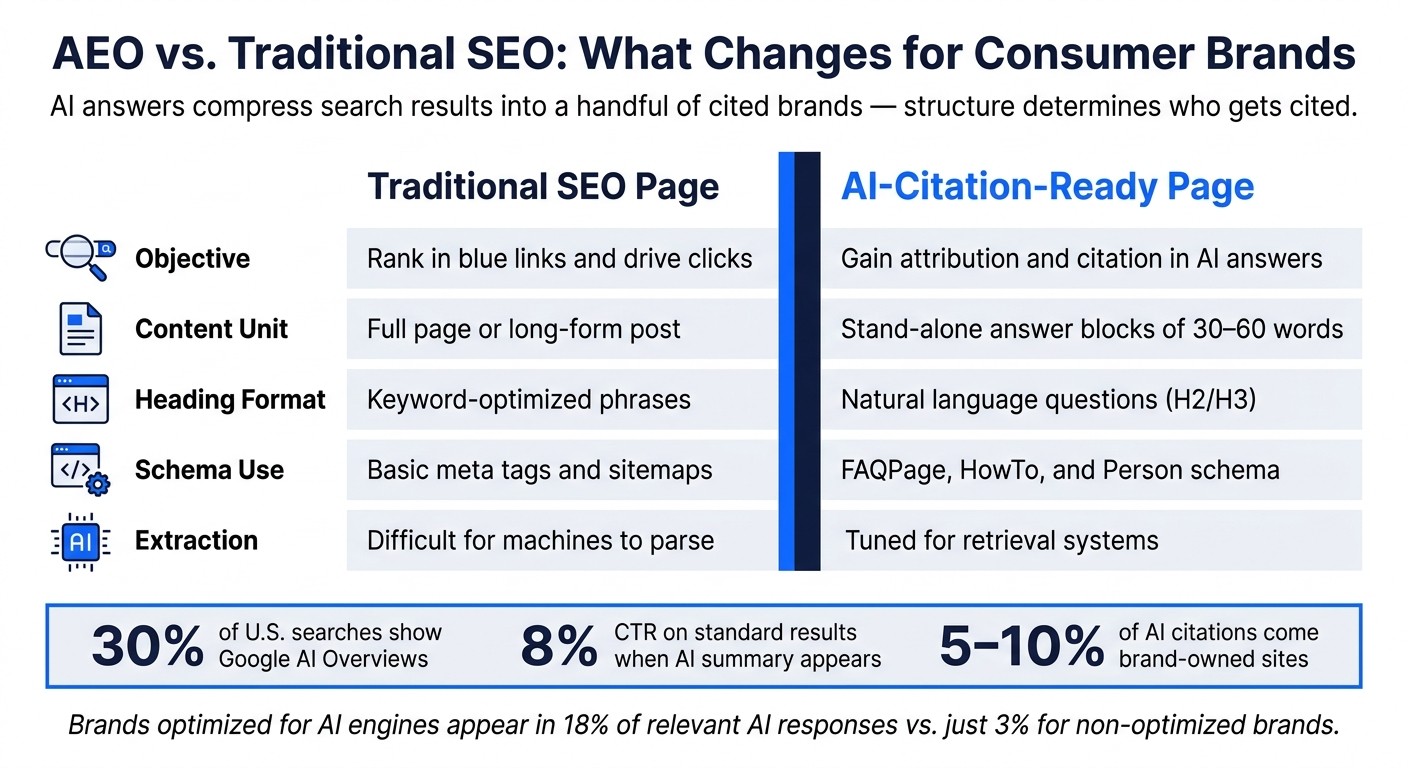
AEO vs. SEO: How AI Citation Changes Brand Visibility
AEO gets your brand cited inside AI answers. SEO helps your pages rank in search. Consumer brands now need both, but the order of visibility has shifted. In many cases, a citation inside an AI response gets seen before a search result gets clicked. SEO still helps pages earn position. AEO helps answer blocks, summaries, and product facts get pulled into AI-generated responses. That change affects how consumer brands plan content, track performance, and structure pages so AI systems can extract the right information.
Why AI citation is the new visibility battle
When AI answers show up, citation matters more than ranking by itself. AI answer engines often compress a full page of search results into one short narrative and mention only a handful of brands. If your brand isn’t in that cited group, you can disappear from view even if you rank well in search. For consumer brands, the shift is clear: the game is moving from keyword ranking to question-level relevance. The citation set is small, and the brands that make it into that set are far more likely to win high-intent traffic right when a buying decision starts to take shape.
How AEO and GEO work together
AEO focuses on on-page answer blocks. GEO builds authority across outside sources. Once that difference clicks, the next step is prompt research and content design - mapping the questions consumers are already asking, then shaping content so those answers are easy to find, trust, and cite.
How Do You Map the Questions Consumers Actually Ask AI Before They Buy?
Map buyer prompts before you write a single page. The job here is simple: find the exact questions people ask ChatGPT, Perplexity, and Google AI Overviews at each step of the buying path, then group those prompts by intent and sort them by business value. Use U.S. phrasing and U.S. units, because that’s how American buyers ask AI. Brands that skip this step often end up tuning pages for questions no one asks.
Identify high-intent consumer use cases
Start with stages, not broad topics. A useful prompt set usually moves from discovery, like "What is answer engine optimization?", to comparison, like "AEO vs. SEO difference", then into use, like "How to implement an AEO strategy", and finally objection handling, like "Is [product] worth the investment?" The stage changes, but the intent stays steady. That’s what AI systems are trying to sort out.
Research prompt patterns across channels
Your best source of buyer language is usually your own data, not a keyword tool. Pull phrasing from sales calls, support transcripts, site search, and retailer Q&A. Those are often the same words people carry straight into AI tools.
Then add outside language from Reddit, Quora, YouTube transcripts, and niche forums. In Search Console, filter for question words such as who, what, where, when, why, and how to spot prompts that are already showing up in AI answers. When you combine internal data with community language, you get a prompt inventory built on actual demand instead of guesswork.
One signal matters a lot here: high mentions with low citations. That usually means AI knows the brand name but doesn’t trust the brand’s content enough to quote it. When you track which prompt types lead to citations and which only lead to mentions, the next move becomes much clearer.
Prioritize prompt clusters by business value
Not every question deserves an answer page. Once you have a prompt inventory of 30 to 200 queries, rank clusters using four factors:
Revenue potential for the product category
Margin profile
How crowded the AI citation space is for that cluster
How often buyers use AI to research that kind of question
Go after clusters with the best citation upside, not just the most search volume. A high-margin, lower-competition category with fast-growing AI research behavior is often a much better bet than a commodity query where editorial sites already dominate.
The gap can be stark. Brands tuned for AI engines show up in 18% of relevant AI responses, while non-optimized brands appear in just 3%. That spread is biggest in the clusters many brands skip during this step.
Use those top-value clusters to shape the answer-first page structure in the next section. Then turn them into pages AI can parse, quote, and trust.
How Should You Structure Content So AI Systems Can Extract and Cite It?
AI systems cite content they can grab fast. If you already know the prompt cluster, the next move is simple: shape the page so the answer is easy to pull without cleanup. That means question-led headings, short answer blocks, and markup that tells retrieval systems what they’re looking at.
Lead with direct answers and scannable sections
Write H2 and H3 headings as plain-language questions, then answer that question in the first sentence. It sounds almost too simple, but that first line does a lot of work. It gives the system a clean snippet to pull, and it gives the reader the answer right away.
Keep each section deep enough to show you know the topic, but don’t bury the main point under extra setup. If sequence matters, use bullets or step-by-step lists. They’re easier for AI systems to parse, and they help people skim too.
Each answer block should also stand on its own. If a passage only makes sense because of the paragraph above it, it’s harder to extract cleanly. Cut references that depend on surrounding text and make the section readable in isolation.
Use semantic HTML and structured data
A clean H1-to-H3 hierarchy helps retrieval systems spot page structure and key entities fast. Structured data adds another layer of clarity. For consumer brands, the most useful schema types often include FAQPage, HowTo, Product, Article, and Person for bylined authors. Use JSON-LD so the markup is easy for AI systems to parse.
There’s also a technical catch many teams miss: some AI crawlers don’t handle JavaScript well. That’s why server-side rendering or static generation is often the safer choice. If the content isn’t there when the crawler arrives, it may as well not exist.
Add unique anchor IDs to FAQ items and answer blocks too. That gives AI systems a way to cite the exact passage instead of pointing only to the page as a whole.
Traditional SEO pages vs. AI-citation-ready pages
Use this table as the editorial standard for every AEO page.
Dimension | Traditional SEO Page | AI-Citation-Ready Page |
|---|---|---|
Objective | Rank in blue links and drive clicks | Gain attribution and citation in AI answers |
Content unit | Full page or long-form post | Stand-alone answer blocks of 30–60 words |
Heading format | Keyword-optimized phrases | Natural language questions (H2/H3) |
Schema use | Basic meta tags and sitemaps | Schema such as |
Extraction | Difficult for machines to parse | Tuned for retrieval systems |
Once the page is easy to extract, the next job is making the brand credible enough to cite.
How Can Consumer Brands Build the Authority Signals AI Systems Actually Cite?
Parsing your site is only step one. If AI systems don’t trust your brand, they won’t cite it. For consumer brands, that trust usually comes from two places working together: data only your company can publish and a steady brand presence everywhere your name appears online.
Publish original, U.S.-relevant data
Publish data that belongs to you and no one else. A survey, benchmark report, or consumer trend study gives publishers and AI systems something concrete to point to. Adding quantified statistics to content can improve AI citation rates by up to 41%, and proprietary research can lift AI visibility by up to 30%.
The key is to make each stat stand on its own. That means every number should include the audience, the behavior, the timeframe, and the source. If a reader or AI system lands on that one line out of context, it should still make sense.
Strengthen trust signals across owned and earned media
Fixing your own site matters, but it’s only half the job. Brands are 6.5 times more likely to be cited through third-party sources than through their own domains, and earned media makes up about 84% of all AI citations across major platforms. That tells you something simple: AI leans toward facts it sees repeated across multiple trusted sources.
When your brand name, offer, or company facts shift from one platform to another, trust drops. A mismatch on your site, social profiles, review pages, or press mentions can hurt your odds of being cited.
Named authors matter more than many brands think. Adding a verified expert quote with credentials can boost content trust signals in AI systems by 41%. Author pages with bios, credentials, and links to social profiles help AI evaluate a Person entity alongside the content.
Authority signals you can control
The table below shows the gap between signals that weaken citation potential and signals that help build it.
Signal Type | Weak AI Citation Signal | Strong AI Citation Signal |
|---|---|---|
Brand Identity | Inconsistent naming across social and web | Canonical name and facts with |
Data and Claims | Generic statements ("industry-leading") | Proprietary stats with population and timeframe |
Technical Access | Blocking AI crawlers in |
|
Authority | Anonymous or uncredited blog posts | Named experts with |
Freshness | Static pages with no update dates | Monthly refreshes with visible "Last Updated" timestamps |
Validation | Claims made only on the brand's own site | Consistent descriptions across third-party media and reviews |
You can act on many of these signals right away. Publish an llms.txt file. Allow AI crawlers in robots.txt. Fill out Organization and Person schema, with close attention to sameAs links pointing to official profiles.
Then watch what happens. Track which signals line up with more citations, and put more effort behind the ones that increase share. The next step is testing which changes actually improve citation share.
How Do Consumer Brands Measure AI Citation Performance and Improve Over Time?
Publishing answer-ready content is only half the job. If you want AEO to pay off, you need to prove your pages are earning AI citations and turning that visibility into demand. That means tracking citation frequency, share of voice, and the business activity those mentions create, not just rankings. Brands that treat AEO like a one-and-done content task miss the snowball effect that comes from steady testing, reporting, and refinement.
Define the right AEO KPIs
Start with three tiers of metrics.
Visibility metrics come first: citation rate, AI share of voice against competitors, and citation accuracy. That last one matters more than many teams think. A study of eight AI search engines found they answered more than 60% of source queries incorrectly, which makes citation accuracy a KPI you can't skip.
Next are conversion metrics. AI-referred visitors can convert at rates 4.4x to 23x higher than standard organic traffic, and ChatGPT referral traffic has been shown to convert at 15.9% compared to 1.76% for standard Google organic search. That's a huge gap. It's also a good reason to build a custom GA4 channel group for AI referral sources.
Last, track business outcome metrics such as revenue, pipeline, and branded search lift. If your dashboard stops at citations and never ties them to revenue, you're not seeing the whole picture.
Once those metrics are in place, put them on a fixed testing schedule.
Set a recurring testing and reporting cadence
Build a prompt library with 20 to 50 natural-language prompts. Cover category questions, brand queries, and problem-based searches. Then run those prompts each month across ChatGPT, Perplexity, Gemini, and Google AI Overviews.
One thing to watch: AI answers can shift from one run to the next. Because of that, run each prompt 3 to 5 times per session. That helps filter noise and makes trend lines easier to trust.
Here’s a simple cadence that works in practice:
Frequency | Action | Signal |
|---|---|---|
Weekly | Check server logs for | Crawler access verification |
Monthly | Full citation probe run (20–50 prompts) | Citation rate per platform |
Monthly | Direct visibility testing (5–10 key queries) | Tone and accuracy check |
Quarterly | GA4 AI referral traffic review | Traffic and conversion validation |
Quarterly | Prompt set refresh | Alignment with shifting buyer behavior |
This kind of rhythm keeps your team from guessing. It also helps you spot movement early, before a win fades or a problem spreads.
Connect AI visibility to business outcomes
Citations matter when they lead to demand. That's the part many dashboards miss.
When AI answers don't send a click, branded search lift in Google Search Console is often the cleanest proxy for impact. Samsung attributed a 28% increase in direct brand searches to more zero-click exposure inside AI engine responses. A good rule of thumb is to look for branded query lifts 7 to 14 days after citation gains.
There's more. Brands cited in AI Overviews also see 35% more organic clicks and 91% more paid clicks than competitors that aren't cited. So if you're only tracking visibility, you're leaving out the downstream effect that hits both SEO and paid media.
Put those signals in one reporting view. Citation rate, branded search growth, assisted conversions, and paid click lift tell a much clearer story together than they do on their own.
Fill the attribution gaps AI traffic leaves behind
AI discovery often breaks neat attribution models. A buyer may see your brand in an AI answer, skip the link, and search for you later by name. In analytics, that can look like direct or branded search traffic instead of AI influence.
A simple fix helps: add a "How did you hear about us?" field and include "AI assistant" as one of the choices. That gives you a way to catch discovery that never shows up as a referral source.
It's not perfect, but it closes part of the gap. And in a channel where many sessions leave no clean trail, even a small bit of declared-source data can help you make better calls.
How Do You Turn Answer Engine Optimization Into a Repeatable Growth Capability?
Once the KPIs are in place, the next move is turning Answer Engine Optimization into a steady growth engine. AEO starts to pay off when you treat it like an operating model, not a one-time content push.
AEO works best when research, content, authority, and measurement run in one loop.
It also needs one clear owner with cross-functional authority across content, PR, SEO, and revenue ops.
Track Share of Model: the share of buyer questions that matter to your business where AI tools cite or recommend your brand.
The goal is not more content. The goal is a system that keeps earning citations.
TL;DR Summary
Taken together, these moves close the gap between buyer demand and AI citations.
Ready to See Where Your Brand Stands in AI Search?
If you need a baseline, start by auditing your current AI citations.
Request an AEO audit to see where your brand appears in AI answers.

Pet Industry
Sep 16, 2026
Month three is the real test for pet subscription retention: early shipments cause churn - fix cadence and dose education, not discounts.