Baby Boomer targeting still drives sales in 2026, but age alone is a weak way to plan media, messaging, or offers. Pew Research Center estimates there were 67 million Baby Boomers in the U.S. as of July 1, 2024, or about 20% of the population. The problem is simple: too many brands treat Boomers as one group. This guide shows how to segment by life stage, buying behavior, and channel use so teams can build campaigns that fit how this audience shops and decides.
TL;DR
Baby Boomer targeting works best when marketers segment by life stage, not just age.
Search, email, Facebook, and YouTube are core channels, while mail and TV still help in high-trust categories.
Boomers respond to clear pricing, proof, support access, and low-friction offers more than hype.
Testing should happen before budget growth, with results tracked by segment, not broad age bands.
CRM, landing pages, and offline response tracking matter as much as paid media for this audience.
Why Baby Boomer targeting still matters
Baby Boomers were born from 1946 to 1964, which puts them at about 62 to 80 years old in 2026. That span covers people still working full time, people easing into retirement, and people dealing with health or caregiving needs. Treating all of them the same leads to weak message-market fit.
The case for this audience is still strong. Bank of America Institute has reported that spending growth per household has been stronger among Boomers and older groups than among younger groups since mid-2022.
The upside is often highest in sectors where trust, service, and ease of purchase shape the sale:
Healthcare
Financial services
Travel
Home improvement
Senior living
Premium consumer goods
The main point: the value is not in the age label. It is in finding the right sub-group and matching the offer to real needs.
How Do Baby Boomers Actually Make Purchase Decisions?
Baby Boomers make purchase decisions based on trust, product quality, and plain value, not hype or celebrity tie-ins. In consumer surveys, Boomers consistently rank product and service quality, features and performance, and price among their top buying factors. That points to a clear pattern: segment, offer, and channel choices need to match a buyer who wants proof, not polish.
What Baby Boomers Value When They Shop
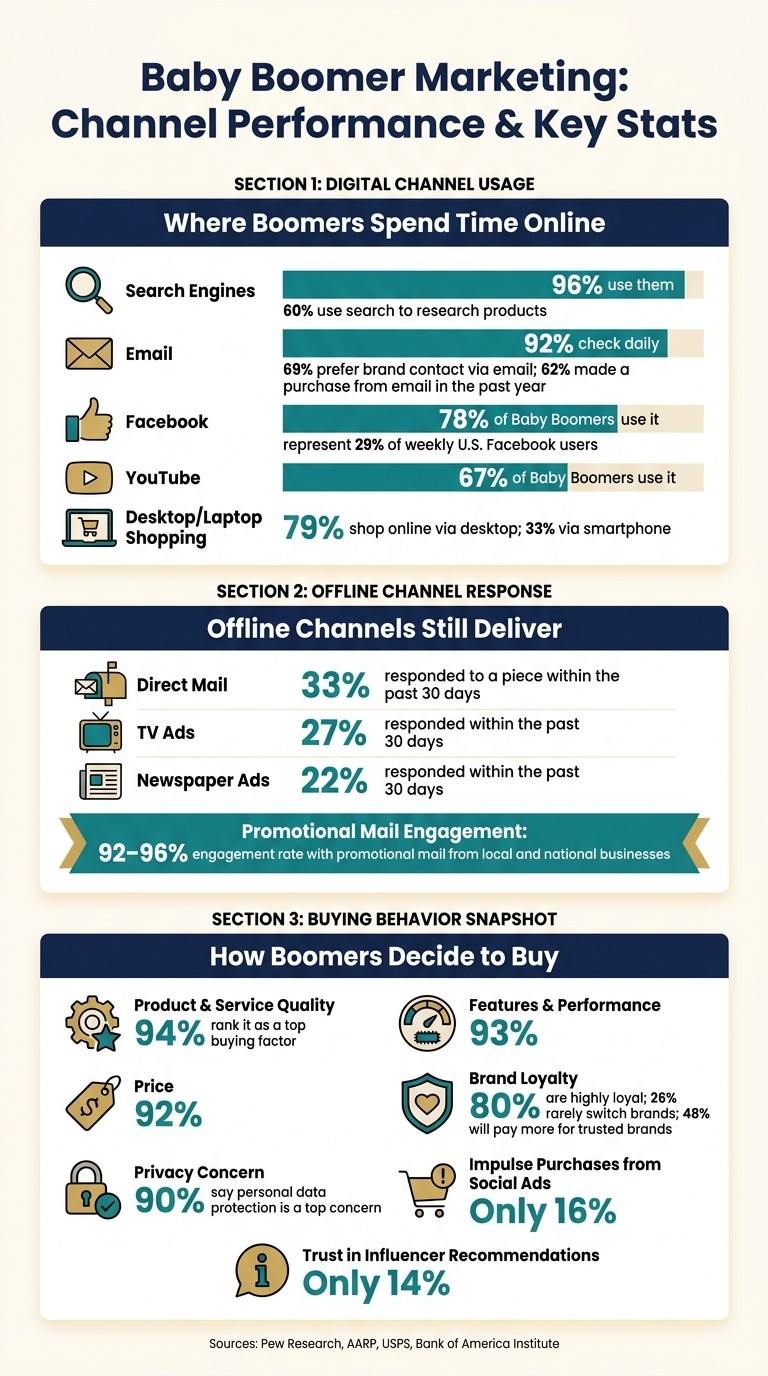
Brand loyalty runs deep with this group. About 80% are highly loyal, 26% rarely switch, and 48% will pay more for brands they trust. That loyalty does not come from flashy messaging. It comes from consistency, dependability, and products that do what they promise.
Boomers also lean toward practical benefits over image. Comfort and utility often drive purchases across home, DIY, grocery, health, and travel. In plain terms, they want things that make life easier, work well, and feel worth the money.
Privacy also shapes conversion. About 90% say personal data protection is their top concern, and 1 in 10 avoids online shopping because of data-sharing worries. That means privacy messaging is not a side note. It can affect whether a shopper clicks, signs up, or leaves.
How Digital and Traditional Media Work Together for Boomers
Boomers are not offline shoppers clinging to old habits. Roughly six in ten are digital buyers, and 36% made more than half of their purchases online in the past year. At the same time, their digital habits look different from those of younger groups.
Desktop and laptop still lead. Among Boomers who shop online, 79% do so on a desktop or laptop, while 33% use a smartphone. That one detail can shape everything from landing page design to email layout.
Email stands out as the top contact channel, with 69% saying they want brands to reach them that way. Search engines also rank among their main online activities, along with email use and product research. The pattern is pretty clear: they often hear about a brand through one channel, then verify it through another.
TV, print, radio, and direct mail help build awareness. Search and email tend to do the heavier lifting during research and conversion. Boomers are more likely than younger generations to find brands through newspapers and company emails or letters, then check those claims on a website or through a search engine before buying.
Direct mail still matters here. Many Boomers say they pay more attention to promotional pieces that arrive by post than to those sent by email. That does not mean mail replaces digital. It means both work better together, especially when the message stays consistent.
Why Younger and Older Boomers Respond Differently
The split between younger and older Boomers is shaped more by life stage than by comfort with tech. That distinction matters because a 60-year-old still working full time often shops with a very different mindset than a retired 75-year-old.
Younger Boomers are often still employed, managing household budgets, and planning for retirement. They tend to respond to messaging built around efficiency, convenience, and financial planning. Offers that save time, reduce friction, or help them stay organized can land well.
Older Boomers are more likely to be retired, dealing with health needs, or balancing caregiving duties. Their buying choices tend to reflect those realities. Ease of use, trust, health-related benefits, and support often carry more weight than speed or novelty.
Media habits shift with those needs. Older Boomers spend more time with YouTube content tied to health, home, and lifestyle topics. Younger Boomers often research online before heading into a store to buy. Same generation, different daily context.
Sub-Group | Life Stage | Key Motivators | Channel Emphasis |
|---|---|---|---|
Younger Boomers | Working / pre-retirement | Efficiency, financial planning, convenience | Search, email, Facebook, in-store |
Older Boomers | Retired / health-focused | Ease of use, trust, health benefits, support | YouTube, direct mail, TV, email |
These differences should guide segmentation. Life stage, channel preference, and purchase intent give marketers a much better frame than age alone. The pattern is simple: purchase behavior becomes useful when it is turned into segments built around what people need, where they pay attention, and how close they are to buying.
How to Build a Baby Boomer Segmentation Framework That Actually Drives Campaign Results
Knowing how Baby Boomers differ is only the first step. The next step is turning those differences into segments that can be targeted, tested, and measured. A strong Baby Boomer segmentation framework should use life stage, household context, income, caregiving, health mindset, and buying behavior, not age alone. Two 67-year-olds may need completely different campaigns: one may be retired, while the other is still working.
Start With Research, Not Assumptions
The clearest audience view comes from using several research inputs instead of leaning on just one. Quantitative surveys show scale and help identify attitudes, preferred channels, and purchase barriers. Qualitative interviews and focus groups explain why those patterns show up. CRM data and purchase history show actual buying behavior, including repeat rates, offer response, churn signals, and category involvement. Behavioral analytics, such as site visits, email engagement, reducing abandoned shopping carts, and content downloads, show what moves people to act.
Put together, these inputs create audience hypotheses that can be tested in media and CRM. One Boomer subgroup may convert after reading educational content, while another may respond more to reviews, proof points, and time-limited offers. That difference can shift the entire creative approach and channel mix. Segment definitions should come from those findings, not from surface-level audience descriptions.
Replace Age Buckets With Life-Stage Segments
Once the research base is in place, define four to six core segments based on life stage rather than birth year. Useful segments for the Boomer audience include Still Working 60s, Newly Retired, Aging in Place 70s-80s, Caregiver-Influenced Households, and High-Value Loyalists.
These segments do more work than a broad label like "55+" because they connect directly to different needs, urgency levels, and buying barriers. A caregiver segment may need convenience-led messaging backed by strong proof of reliability. A newly retired segment may respond better to messaging around flexibility, simplicity, and long-term value. The right segments are the ones that predict clear differences in conversion, engagement, customer value, or channel preference.
Turn Segment Definitions Into Audience Plans
Each segment should connect to a clear audience plan before media buying starts or CRM workflows are built. At a minimum, every segment should map to four parts: who they are, what they need, where to reach them, and the desired action.
Here is what that looks like in practice:
Segment | Primary Need | Priority Channels | Offer Strategy |
|---|---|---|---|
Still Working 60s | Efficiency, financial planning | Search, email, Facebook | Time-saving offers, planning tools |
Newly Retired | Simplicity, reassurance | Email, Facebook, YouTube | Educational content, trial offers |
Caregiver-Influenced Households | Convenience, reliability | Direct mail, email, search | Proof-heavy creative, easy reorder |
High-Value Loyalists | Quality, recognition | Email CRM, Facebook | Loyalty rewards, exclusive access |
Each segment brief should also include exclusion rules. For example, a brand may want to suppress unlikely buyers from high-cost media placements or separate current customers from acquisition audiences. That keeps spend tight and helps avoid a common problem: the same person getting mixed messages across channels.
Segmentation that lives only in a slide deck will not improve results. The point is to tie audience insight directly to media buying, creative briefs, and CRM flows so every channel team is working from the same foundation.
How Should You Research and Test Baby Boomer Campaigns Before Scaling Spend?
Baby Boomer campaigns should be tested before budget expansion, not after. Boomers tend to be careful buyers, and the numbers make that plain: only 16% report impulse purchases from social ads, and only 14% trust influencer recommendations. That caution changes the playbook. Pre-launch testing is not a nice extra. It is the filter that shows which messages land, which offers build trust, and which channels move people to act. After segments are set by life stage and behavior, testing shows what each group will respond to in practice.
How Do Qualitative and Quantitative Research Work Together for Baby Boomer Audiences?
Qualitative and quantitative research do different jobs, and both matter. The first finds the why and the language behind it. The second checks whether those patterns hold across a larger U.S. Baby Boomer audience.
Start with in-depth interviews inside the top Boomer segments. Those conversations help surface how people talk about trust, value, hesitation, and risk in their own words. That language matters. A marketer may say “convenience,” while a Boomer may say “simple and easy to deal with.” That gap can shape headline performance, offer framing, and even CTA wording.
Small focus groups add another layer. They help reveal peer language, shared concerns, and the kinds of trust signals that feel believable instead of polished or sales-heavy. In categories where confidence matters, group discussion can show what people repeat, question, or dismiss.
Usability sessions should also be part of early testing. They often show friction that standard campaign metrics miss, especially for older audiences. Common trouble spots include:
Navigation that feels cluttered or hard to follow
Font sizes that strain readability
Low contrast that makes pages harder to scan
Jargon-heavy copy that slows understanding
Once the main themes are clear, surveys can validate them with a representative U.S. Boomer sample. That step separates broad patterns from niche opinions. A common model uses a handful of small focus groups, followed by around 1,000 telephone or online interviews to validate findings at scale. That approach is useful because it starts with human detail, then checks the signal across a much larger pool.
Surveys can verify channel preference, trust signals, and purchase drivers. They can also show whether one segment leans toward email while another responds more to search, Facebook, YouTube, or direct mail. That kind of confirmation helps shape media mix before spend starts climbing.
What Messaging Tests Should Run Before a Baby Boomer Campaign Goes Live?
Once research identifies the core message themes, the next move is structured A/B testing. The goal is simple: find out which version gets action, not just attention.
Four message variables should be tested before launch: value proposition, headline and tone, offer structure, and proof points.
For value proposition testing, compare different benefit angles against each other on landing pages or inside email sequences. Reliability, ease of use, and financial prudence are strong starting angles for many Baby Boomer segments. Traffic should be randomized, and performance should be measured with click-through rate, bounce rate, and conversion rate. If one angle gets clicks but fails to convert, that gap matters.
Headline and tone tests should compare direct, functional copy with more energetic options. For this audience, plain language often beats hype, but that should be proven rather than assumed. Review not only click-through rate, but also time on page and scroll depth. A headline can pull traffic in and still lose the reader halfway down the page.
Offer testing should focus on structure, not just discount size. In many cases, risk-reducing offers outperform aggressive price cuts. That can mean trial periods, clearer guarantees, lower-friction commitments, or other offer types that reduce buyer hesitation. Still, category matters, so each offer should be tested in context.
Proof point testing is where trust often gets won or lost. Rotate peer testimonials, third-party certifications, and longevity claims to see which credibility cue drives the strongest response from each segment. One group may respond to customer stories. Another may react more to years in business or outside validation. There is no shortcut here; the right answer comes from the test.
The same message should also be tested across the channels Boomers use, including email, landing pages, direct mail, and print where those channels are active. A proof point that works in email may need a different setup in direct mail. The message can stay the same, but the format often needs adjustment.
Clean Test Design Matters More Than Volume Alone
A messy test can waste money fast. Clean test cells and clear success metrics make results usable.
Email subject line testing should begin with three to five variations. Those options should be scored for readability and length, and then the top two should be tested on a subset of the list before a full send. That process helps narrow the field before larger exposure.
For direct mail, sample size matters. A minimum of 5,000 to 10,000 pieces per test cell is recommended to reach roughly 95% confidence. Smaller cells may produce noise that looks like a signal.
Results should not be judged on response rate alone. Conversion rate matters. Cost per sale matters. Customer lifetime value matters too. A test winner that brings in low-value customers can look good at first glance and still underperform over time.
Incremental change is also important. If too many variables move at once, it becomes hard to tell what caused the lift or drop. Keeping changes controlled gives the team a cleaner read and helps preserve message consistency for the audience.
Which Channels Should Be Tested for Baby Boomer Campaigns?
Baby Boomer channel testing should follow actual usage, not habit or trend chasing. The usual starting set includes email, search, Facebook, YouTube, and direct mail where it fits the segment.
Email remains a strong option for many Boomer groups, especially when the message is plain, useful, and easy to scan. Search can work well when intent is high and the copy answers a practical need. Facebook still matters for many older consumers, especially for reach and repeated message exposure. YouTube can help when demonstration, trust, or explanation plays a big role in the sale. Direct mail can still perform when the offer is clear and the audience is a good fit.
The key is not to treat every channel the same. The winning claim, proof point, or offer from testing should guide channel-specific creative. A testimonial that works well in direct mail may need to be shortened for paid social. A reliability-focused message that performs in search may need more visual support on YouTube.
When the message stays clear and the adjustments stay small, the audience sees consistency instead of a patchwork of unrelated ads.
How Do Platforms Like EyeQ and EyeSight Speed Up Baby Boomer Insight and Tracking?
Speed matters once research starts producing answers. When segment insight, testing, and performance tracking sit in one workflow, teams can move from learning to launch with less drag.
Bigeye's EyeQ can turn research findings into segment hypotheses quickly. That makes it easier to move from raw input to practical audience direction. Bigeye's EyeSight can bring search, social, email, video, direct mail, and CRM data into one dashboard. With those signals in one place, teams can compare performance across channels without jumping from tool to tool.
That setup helps connect the dots between audience research and campaign action. It also gives teams a clearer way to brief channel-specific messaging and creative based on what the data is already showing.
What Messaging and Creative Strategy Actually Works for Baby Boomer Campaigns?
Effective Baby Boomer messaging depends on clarity, proof, and respect. After audience segment research is in place, creative needs to turn those findings into messages people can understand at a glance and test across channels. This group responds to facts, plain pricing, and direct calls to action. Those rules should shape every landing page, ad, and email.
How Should Marketers Write Clear, Benefit-Led Messaging for Baby Boomers?
Start with the main benefit, not a clever teaser. A line such as "Cut your monthly prescription costs by up to 30%" gives readers a concrete reason to keep going. Then explain how the offer works, what it costs, and what kind of support is included. Pricing should appear in plain U.S. dollar amounts, with fees shown up front.
Dollar amounts often land better than percentages. "Save $120 per year" is easier to picture than "Save 20%." It gives the reader a number they can weigh against a monthly bill, a budget, or a fixed income. That makes the offer feel more grounded.
Proof matters more than polish. Testimonials, expert endorsements, and hard numbers can lower hesitation and help people move forward. Signals like "Over 250,000 customers nationwide" or "4.7/5 average rating" give the message weight. That proof should sit close to a direct CTA such as "Get the guide", "Compare plans," or "Call for a quote." The same plainspoken approach should carry into the page layout, typography, and site navigation.
Why Does Avoiding Ageist Language Matter for Baby Boomer Creative?
Ageist copy can break trust before a prospect even reads the offer. Phrases like "simple enough for seniors" or "before it's too late" sound dismissive. They suggest weakness, decline, or fear, and that can make a brand seem out of touch.
AARP research found that 67% of adults 50-plus wish ads showed more realistic images of people their age. That points to a clear gap between how many brands present this audience and how this audience sees itself.
Better language respects experience and autonomy. Terms like "experienced homeowners", "seasoned investors," and "stay in control of your finances" speak to real life without leaning on decline-based framing. Copy should deal with real concerns such as health, financial planning, and mobility, but it should do so without implying helplessness. Many Baby Boomers are still working, traveling, using digital tools every day, and making major purchase choices. Messaging should reflect that fact.
Which Visual and Layout Choices Improve Usability and Conversion for Boomer Audiences?
Reading speed can slow with age, so readability has a direct effect on performance. At least 12-point default body copy, strong contrast, generous white space, and a clear visual hierarchy help reduce mental strain and keep users moving through the page.
Buttons should be large enough to spot and tap without effort, and each one should use a clear action label. Navigation should use text labels rather than icon-only menus. Auto-play animation, flashing motion, and too many pop-ups compete for attention and often get in the way. When a page feels crowded, even a good offer can lose momentum.
Visuals matter too. Show active, tech-comfortable adults in realistic settings. Skip the old clichés. The goal is simple: help people see themselves in the message without making age the punchline.
Creative Element | What Works | What Doesn't |
|---|---|---|
Tone | Direct, respectful, benefit-led | Patronizing or hype-heavy |
Copy | Short sentences, concrete outcomes, transparent pricing | Jargon, vague claims, hidden fees |
Imagery | Active, realistic, age-diverse people | Frail stereotypes |
Layout | Large type, high contrast, clear buttons | Cluttered layouts, tiny text, unclear CTAs |
Proof | Testimonials, ratings, guarantees | Empty or exaggerated claims |
Once the creative is clear and easy to use, the next step is matching that message to the channels Baby Boomers use most.
What Is the Best Channel Mix for Reaching Baby Boomers in the U.S.?
The best channel mix for reaching Baby Boomers in the U.S. starts with search, email, Facebook, and YouTube. Those four channels match the way Boomers research, compare, and buy. Traditional media still plays a strong support role when trust, local presence, or broad reach matters. In practice, younger Boomers usually respond better to a more digital-heavy plan, while older Boomers often need more offline support. The right mix should also shift based on buying stage, not just age.
Why Should Brands Prioritize Search, Email, Facebook, and YouTube?
These four channels line up closely with how Baby Boomers move through a purchase decision.
Search often comes first. 96% of Boomers use search engines, and about 60% actively use search to research new products and services. Google is the most-used phone app for 76% of Boomers. That makes paid search and strong SEO central for reaching this audience when intent is already there. When a Boomer wants to compare providers, check pricing, or find answers, search is often the first stop.
Email drives action. 69% of Baby Boomers prefer brands to contact them via email, and 62% have made a purchase directly from an email in the past year. With 92% checking email daily, email reaches Boomers in a habit-based, task-focused setting. Welcome series, quote reminders, reorder prompts, and service follow-ups can all perform well because they meet people where they already pay attention.
Facebook and YouTube help during consideration. Boomers make up 29% of weekly Facebook users in the U.S., and 78% of Baby Boomers use Facebook. 67% of Boomers use YouTube, often for tutorials, product research, and practical how-to content. These platforms work well for educational content, explainers, testimonials, and retargeting. They help move people from early awareness to active evaluation without asking them to change their normal media habits.
When Do Direct Mail, TV, Radio, and Print Still Deliver Results?
Offline channels still matter, especially in high-trust categories. They work best as support for digital channels, not as a separate system competing against them.
TV, radio, print, and direct mail can be effective in high-trust categories such as healthcare, financial services, insurance, and home improvement. In those categories, the main barrier is often trust rather than awareness alone. Local radio and local print can also help build credibility for healthcare providers, local banks and credit unions, home services brands, and community-based retail.
Direct mail can be a strong response tool when the fit is right. Surveys have often found Boomers more likely to respond to a direct mail piece than to a TV or newspaper ad. That does not mean direct mail works the same way in every case. Results vary by product type, offer, and audience segment, so testing matters. When it performs well, direct mail is often strongest when paired with branded search and follow-up email. A postcard may spark interest, but search and email usually help close the loop.
How Should Channel Mix Change Based on Segment and Buying Stage?
Age segment changes the mix, but it should not be the only factor.
Younger Boomers, often in their late 50s to mid-60s, tend to be more active online and more at ease with ecommerce, video, and social platforms. For that group, a digital-forward mix usually makes sense. Search, email, Facebook, and YouTube can carry a larger share of spend and attention.
Older Boomers, often in their late 60s and 70s, tend to lean more on TV, radio, print, and direct mail for daily information and brand discovery. That does not mean they are offline. Many still use search, email, and Facebook often. It means offline channels may need a stronger role at the top of the funnel or in trust-building moments.
Buying stage matters just as much as life stage. A person may discover a brand through direct mail, research it on Google, watch a YouTube explainer, and then convert through email or by phone. That path is common, and it shows why channel planning should follow the customer journey rather than a single-platform mindset.
Buying Stage | Primary Channels | Supporting Channels |
|---|---|---|
Awareness | TV, direct mail, print | Facebook, YouTube |
Research | Google Search, YouTube | Facebook, email |
Evaluation | Email, branded search | Website, YouTube explainers |
Decision | Email, phone | Remarketing (search, Facebook) |
Retention | Email, direct mail | Facebook, loyalty programs |
This table makes the role of each channel easier to see. Traditional media can create trust and initial awareness. Search helps people verify what they have seen. Email supports evaluation and conversion. Facebook and YouTube keep the brand visible during the middle of the funnel.
What does the best practical mix look like?
For many brands, the smartest approach is simple: use traditional media to open the door, then let search and email do the heavy lifting. Facebook and YouTube sit in the middle, helping with recall, education, and retargeting.
A healthcare provider, for example, may use local TV or direct mail to build trust in a market, then rely on search ads, local SEO, and email reminders to turn interest into booked appointments. A financial services brand may use print or radio for credibility, then use branded search, educational video, and nurture emails to move prospects toward a decision.
The key point is not to treat digital and offline as separate lanes. They work best together. Once the channel mix is set, email and CRM do much of the work of moving a buyer from first interest to repeat purchase.
Email Flows and CRM Programs That Convert Baby Boomers
Email and CRM programs turn audience segments into repeatable customer journeys. For Baby Boomers, that only works when messages are clear, useful, and steady. The inbox is not the place for clutter, vague offers, or too many sends. Each email needs a plain purpose and a simple next step.
How Should Brands Build Welcome and Education Flows for Baby Boomers?
Welcome flows work best when they are short, steady, and useful right away. A 3- to 5-email series sent over 10 to 14 days gives enough room to explain the brand without wearing out the subscriber. Every message should do one job well: confirm the signup, explain the product, answer common questions, or show proof that other customers trust the brand. Baby Boomers are more likely to tune out when email volume feels excessive, so each send needs a clear reason to exist.
A practical setup starts with an immediate welcome email. That message should confirm who the brand is, what the subscriber signed up for, what future emails will include, and how to reach support. The second email should explain the product or service in plain language. A short checklist or video walkthrough works well here because it cuts friction. The third email should focus on FAQs, especially the topics Baby Boomers tend to check before buying: safety, refunds, privacy, and support access. A fourth email can then use testimonials and trust markers, such as certifications, awards, or customer stories from people in the same life stage, to reduce doubt before any sales push appears.
Education should not stop after onboarding. Monthly or bi-weekly emails with practical tips, how-to guidance, or loyalty program updates help keep the relationship active without crowding the inbox. Each email should stay focused on one topic and one CTA. That simple structure makes the message easier to scan and easier to act on.
How Should Retention, Loyalty, and Win-Back Campaigns Be Segmented for Boomers?
Retention campaigns perform better when they reflect actual customer behavior instead of treating all Baby Boomers as one block. Lifecycle stage should shape the timing, message goal, and CTA. A new buyer does not need the same message as a loyal repeat customer, and a lapsed customer needs a very different tone from both.
Loyalty emails should favor plain value over game-like systems. A direct summary of how much a subscriber has saved and what they can redeem tends to work better than abstract tier models because it ties the reward to practical benefit and fairness. That kind of message answers the silent question many customers ask: What do I get, and is it worth it? Brands should also give subscribers a clear way to set email frequency, since Baby Boomers show a stronger preference than younger groups for controlling how often a brand reaches out.
Win-back campaigns need more caution. Baby Boomers tend to be more alert to security risks and less open to unfamiliar senders, so re-engagement emails should lead with clear brand identity. That means a recognizable From name, a visible physical address, a plain unsubscribe link, and a direct reminder of the past relationship. A 3- to 4-email sequence over 30 to 45 days is usually enough. If there is no response, the brand should stop. Pushing past silence often hurts trust more than it helps response.
What Email Design Choices Improve Readability and Response for Baby Boomers?
Even a well-planned flow can fall flat if the email is hard to read. Design is where many programs quietly lose Baby Boomer engagement, and the fixes are not complicated.
Body text should be at least 14 to 16 px, with larger headings and enough line spacing to keep the page from feeling cramped. Color contrast should meet WCAG 2.1 AA standards, using dark text on a light background and a minimum contrast ratio of 4.5:1 for normal text. Single-column layouts also help by cutting visual clutter, and they tend to work better on mobile devices, where 68% of older adults check email through apps each week.
Paragraphs should stay short, ideally under 75 words, with clear subheadings that make scanning easier. CTA buttons should be large enough for touchscreen use and should use plain, action-based labels. “View rewards” or “See how it works” is much easier to process than a vague prompt. Every email should also include a visible phone number or support link. For many Baby Boomers, the option to reach a real person matters before any click happens.
Lifecycle stage should guide timing, purpose, and CTA.
A lifecycle-based email plan keeps CRM programs focused and easier to manage. It also helps brands match the message to the customer’s current need instead of guessing.
Lifecycle Stage | Customer Behavior | Recommended Email Approach |
|---|---|---|
Welcome | New subscriber or first purchase | 3-5 email series: confirmation, education, FAQ, social proof |
Education | Early product use | How-to tips, video links, printable guides |
Retention | Repeat buyer | Replenishment triggers, loyalty updates, practical offers |
Loyalty | High-frequency buyer | Savings summaries, early access, value statements |
Win-Back | Lapsed customer | Reassurance, simple offer, preference reset |
This structure keeps the program grounded in actual behavior. It also makes the customer experience feel more orderly, which matters with a group that tends to respond well to clarity, predictability, and visible support.
How Should Baby Boomer Websites and Landing Pages Be Designed After the Click?
After search, email, social, or direct mail earns the click, the page has to confirm the promise fast. A targeting plan only works when the post-click experience lines up with the message that brought the visitor there. Landing pages should handle objections early and clearly, using proof points such as reviews, guarantees, return policies, shipping timelines, and secure payment signals that show how the offer works. The same life-stage segments used in audience planning should shape the hero message, proof points, and CTA. Younger Boomers tend to look for speed and comparison, while older Boomers tend to look for reassurance and support.
How Should Website Navigation Be Structured to Help Baby Boomers Move Through a Site?
Clean, predictable navigation is the base of a Baby Boomer-friendly website. Menus should stick to a small set of top-level items with plain, familiar labels like "Shop", "Support," and "Contact" instead of internal category names or clever wording that makes people stop and decode the menu. Accessible UX guidance recommends keeping key tasks completable in three steps or fewer, so the path from landing page to action should feel short and obvious.
Breadcrumbs, sticky headers, and a visible search bar help users get back on track if they lose their place. Many older users would rather search than dig through a deep menu, so a forgiving site search can do more work than a layered navigation tree. Contact details - a phone number, support link, or live chat option - should stay visible in the header or footer on every page. For many Baby Boomers, the simple fact that real help is easy to find plays a big part in whether a site feels trustworthy.
Plain language matters here. So do short paragraphs, large type, strong contrast, and generous whitespace. If people can find what they need without strain, the next question is simple: can they finish the form without getting stuck?
What Checkout and Form Design Choices Reduce Friction for Baby Boomer Shoppers?
Once visitors can move through the site with ease, checkout should remove friction instead of adding it. Use static labels rather than floating placeholders, and give formatting examples for inputs such as dates and phone numbers. Validation should happen in real time, with plain-language error messages that point to the exact field and explain how to fix it. No one wants to play guess-and-check with a checkout form.
Guest checkout should be available. The full order total - including taxes and shipping - should appear before the final submission step. If a purchase includes a subscription or recurring billing, those terms need to appear in plain language right next to the call to action, not hidden in fine print.
The landing page’s visual and verbal promise should also match the ad. If the ad says simple setup, the page should show simple setup. If the email offers free shipping, that message should appear right away. That kind of continuity lowers doubt and helps Baby Boomer shoppers move ahead with more confidence.
How Should Baby Boomer Marketing Performance Be Measured Across Media and CRM?
Baby Boomer marketing performance should be measured by life-stage segment, not by age band alone. Broad age reporting blurs what drives revenue, repeat purchase, and long-term customer value. The right readout tracks business results by segment across media, site activity, email, and offline response. For Baby Boomers, the core KPIs are conversion rate, average order value (AOV), repeat purchase rate, customer lifetime value (CLV), and engagement signals such as email open rate, click-through rate, and time on site. Once trust is in place, CLV and repeat purchase rate often matter more than a single-click conversion rate.
Measure KPIs by Life-Stage Segment
Tracking KPIs by life-stage segment shows gaps that age-only reporting hides. A 60-year-old still working full time and a 60-year-old who just retired may sit in the same age bucket, yet they can behave very differently. That difference shows up fast in AOV, purchase rhythm, and channel response.
Working Boomers often drive higher AOV. Recent retirees may show stronger engagement, but with smaller basket sizes, which means CLV can matter more than AOV. One campaign may turn a profit for one Boomer segment and only break even for another. That is why segment-level reporting matters for budget decisions.
In practice, brands should define three to five life-stage segments, such as Working Boomer Professionals, New Retirees, Health-Focused Retirees, and Caregiver Boomers. Those segments should be stored as fields or tags inside the CRM and customer data platform (CDP). Once that structure is in place, segment IDs can sync into ad platforms through customer lists or API connections. Reports can then show conversion rate, AOV, and CLV by segment instead of by raw age range.
Unify Media, Creative, and CRM Reporting
Once life-stage segments are tagged in the CRM, the next step is to connect those segments to paid media, site data, and offline sales in one view. A unified dashboard for Baby Boomer targeting should show segment-level performance across paid channels such as Meta, Google, and YouTube, along with owned channels like email and the website, plus offline sales activity.
A practical dashboard setup includes top-level metrics by Boomer segment: spend, revenue, ROAS, and CLV. It should also show performance by ad concept, email subject line, and landing page variant, with segment-specific conversion and engagement rates attached to each one. That setup answers a simple but tough question: which message works for which life stage?
Search, email, and offline response should each have separate rows so every touchpoint is measured on its own. Many Boomers still respond through phone calls, in-store visits, and direct mail. USPS research has found high engagement with promotional mail among this group. If those actions stay outside the reporting flow, the picture stays incomplete.
Assigning unique promo codes or phone numbers to each campaign helps tie offline actions back to the right source. Importing those offline transactions into the CRM with clear source and segment tags gives teams a truer conversion rate across the full journey, not just the digital portion.
Use a unified dashboard to tie segment-level spend, revenue, ROAS, and CLV to creative and CRM performance.
Use Testing to Optimize Channel Mix
Once reporting is unified, testing should guide scale decisions. Lift tests and cohort analysis help show which channels drive long-term value instead of only short-term conversions. That matters with Baby Boomer audiences because a channel that looks costly at first glance may still bring in stronger repeat purchase behavior over time.
A controlled lift test can isolate the effect of one channel. For example, one Boomer segment may receive direct mail while a matched control group does not. The difference in revenue between the two groups shows whether direct mail added sales beyond what email or search would have delivered on their own. That kind of test cuts through guesswork.
Cohort analysis adds another layer. It follows customers acquired from a given campaign and tracks repeat purchases, cross-sell behavior, and CLV over a 6- to 12-month window. This shows which acquisition channels bring in the best long-term customer relationships, not simply the lowest short-term CPA.
Monthly or quarterly reviews give teams enough time to spot patterns without waiting too long to act. Budgets, offers, and creative can then shift based on cohort CLV, not just surface-level conversion data.
How Do You Turn Baby Boomer Research Into a Marketing Plan That Actually Works?
Once segments, channels, and creative are set, the job shifts from planning to rollout. The goal is simple: connect research, audience groups, messaging, media, and measurement in one clear sequence so the campaign can move without guesswork.
What Does a Step-by-Step Baby Boomer Campaign Rollout Look Like?
Start with research. Then define 4-6 life-stage segments, test 2-3 message angles in 1-2 channels, and roll out the best-performing mix across the full media plan. Use lift and minimum-conversion thresholds to decide what earns more budget.
As tests run, results should be read through the same segment tags used during planning. That matters. A campaign aimed at Baby Boomers often works better when performance is tracked by life-stage segment, not by a broad age band. A unified dashboard that links paid media and CRM data makes that possible. From there, quarterly reviews can guide updates through a steady test-and-learn cycle, with changes to messaging, creative, and channel mix based on each segment. Usability findings should also feed into the process to cut friction in forms, landing pages, and checkout.
Phase | Timeframe | Output |
|---|---|---|
Research | Weeks 1-4 | Validated segment findings, media habit data |
Segment | Weeks 3-6 | 4-6 life-stage profiles with channel maps |
Test | Weeks 5-10 | Winning message angles and creative formats |
Launch | Weeks 8-14 | Full channel mix, segment-based audience sets |
Measure | Weeks 8+ | Unified dashboard, segment-level KPIs |
Refine | Quarterly | Updated briefs, channel reallocation |
Scale | Months 4-12 | Expanded creative, deeper CRM programs |
Where Does an Integrated Marketing Partner Fit Into This Process?
When internal teams need faster execution, an integrated partner can keep research, creative, media, CRM, and analytics lined up from day one.
Bigeye’s EyeQ platform returns consumer results in about 72 hours, and EyeSight brings paid media, email, and CRM data into one dashboard so teams can track segment-level results and adjust plans fast. For consumer brands trying to move from broad Baby Boomer audience data to a working campaign plan, that research-led model helps turn insight into a rollout that can be repeated and improved over time.
If your brand sells to Boomers and your plan still runs on one "55+" bucket, talk to Bigeye. Our consumer research team can help you split the audience by life stage and test what each group actually responds to.

Paid Media & Performance
Oct 7, 2026
A retail media strategy for 2027 in eight steps, with Bigeye shopper research and current data on Amazon, Walmart, Instacart and measurement.