BeReal advertising is still small, yet it can shape how Gen Z sees a CPG brand. BeReal reports about 5 million U.S. users, and one 2026 study found that 81% of active users are Gen Z. The problem for CPG teams is simple: BeReal does not work like Instagram, TikTok, or retail media. This guide breaks down where BeReal fits, what to test first, how to judge results, and when a pilot deserves more budget.
TL;DR
BeReal advertising fits CPG teams best when the goal is trust, daily-use proof, and shopper interest rather than mass reach.
The platform works best for snacks, beverages, beauty, household, and pet brands that can show products in normal day-to-day settings.
Native BeReal metrics are only early signals, so teams should check search lift, offer use, and store sales before making budget calls.
A BeReal pilot should stay small, test one content angle and one offer angle at a time, and scale only after clear lift appears.
What Is BeReal and How Does It Work for Brands?
BeReal gives brands almost no room to hide behind polish. The app runs on one daily prompt that asks people to post what they’re doing right then, and that single rule shapes everything: timing, content, approvals, and what good performance even looks like. For CPG teams, BeReal is not just another social channel. The format itself is the hard limit.
BeReal Format and User Experience Basics
When BeReal sends its daily Time to BeReal push alert, users usually get two minutes to take and post a photo. The app turns on both the front and rear cameras at the same time, so each post shows a main image of the setting plus a small selfie inset in the corner. There are no filters and no editing tools. If someone posts after the timer ends, BeReal marks the post as late and shows how late it was. That small detail helps keep the app tied to real time.
There’s another mechanic that matters just as much: users can’t view friends’ BeReals until they share their own. That creates a short burst of attention right after the notification goes out. Reactions come through RealMojis - selfie-based reactions that stand in for emojis - and comments are the main other way people respond. Both features favor posts that feel immediate and human, not posts that look built in a studio.
For consumer brands, the takeaway is simple. Creative has to be made for real moments, not slotted into a neat posting calendar. The fixed rule is hard to ignore: brand content must be ready to capture, not tied to a preplanned media window.
The Anti-Polish Culture Brands Must Respect
BeReal was built as a pushback against polished social behavior. Its random timing, tight posting window, and dual-camera setup all add friction on purpose. That friction makes staged sets, perfect lighting, and heavy post-production feel wrong for the platform. Users expect everyday settings - dorm rooms, office desks, grocery aisles, couches - not a cleaned-up ad world.
Scarcity and lived-in context beat polished creative on BeReal.
That shift matters for CPG marketers. Product proof lands better than brand shine. Teams that perform well on BeReal usually show products in places that feel used and real: a half-open bag of snacks on a messy desk, a coffee creamer on an office kitchen counter, or a product sitting inside a working team space. The rough edges are not a flaw. They are the point.
The Current State of BeReal Advertising
BeReal started as a no-ad, friend-first platform, and that origin still shapes how people react to brand activity. Its ad system is still early, with limited access and basic reporting. Formats, access, and reporting can still change by market.
For CPG leaders, the plain reading is this: BeReal’s ad rules are still shifting as the company tries to balance revenue pressure with the anti-polish expectations that drew users in the first place. That makes BeReal better suited to early testing than to mature media buying strategies.
Participation Mode | What It Looks Like | Current Read |
|---|---|---|
Organic brand account | Daily or near-daily BeReals from real people using the product | Practical today |
Employee/ambassador posting | Personal accounts posting from real-life contexts with clear guardrails | Practical today |
Early paid placements | Limited, evolving sponsored activity or brand tools | Emerging |
Creator partnerships | Creator-led posts that feel like a real-life moment, not a polished ad | Format-dependent |
Next, the focus shifts to audience fit: who uses BeReal, and what each CPG category can learn from that behavior.
Which Audience Signals Matter Most for CPG Teams on BeReal?
BeReal’s daily prompt model changes the core question for CPG teams: does the audience actually show up in the app during real-life moments, and does that behavior match the brand’s use case? The platform leans heavily Gen Z, with most users between ages 18 and 24. For CPG teams, age matters, but behavior matters more. The key signal is not just who uses BeReal. It is how they use it.
BeReal Demographics and Usage Patterns
BeReal skews young and female. In the U.S., about 58% of users are female, and 75% are 18-34. That puts the platform in front of college students, early-career workers, and young adults building new household routines.
What sets BeReal apart is its daily-prompt pattern. The app’s notification creates a short burst of attention instead of an all-day scroll loop. For CPG teams, that has a clear effect: content is more likely to land inside a tight, predictable window rather than drift through the feed across many hours.
That timing changes execution. Offers, post timing, and calls to action need to fit a brief attention spike. A brand that treats BeReal like Instagram may miss the point. The better read comes from watching when users open the app and how they react once they are there.
What Consumer Brands Can Learn From BeReal Engagement
These patterns only matter if they turn into action. For most consumer brands, the strongest signals show up in comments, reactions, and redemption behavior.
Comment tone can reveal positioning fit faster than many in-app metrics. If users keep using words like real life, relatable, and references to daily routines such as meals, commutes, late-night snacks, or cleaning, those responses can point to message areas worth testing before paid support enters the mix.
Reaction patterns matter too. Posts built around imperfect daily moments often give the clearest signal. A messy desk snack, a 6 a.m. coffee, or a fast skincare routine in a bathroom can draw steady reactions because the scene feels normal, not staged. If those moments keep landing, they can help validate ideas like pantry tours or Sunday reset content before a larger campaign rolls out.
On the numbers side, promotion response rates give a more direct view of whether BeReal can move people to act. A post tied to a clear offer, such as a promo code, a “first 500 sign-ups” sample prompt, or a landing page pushed through another channel, can give a rough conversion read. Teams should also watch branded search and direct traffic in the hours after a post.
How Audience Expectations Differ by CPG Category
What feels real on BeReal changes by category because daily routines are different.
For food and beverage, users expect actual consumption moments. That means fridge snapshots, rushed weeknight dinners, late-night snacks, and desk lunches. Styled product shots usually feel out of place.
For beauty and personal care, users respond better to bare-skin routines and imperfect application moments than polished glam content. A skincare creator applying serum after a workout, with sweat still visible and a cluttered bathroom counter in the frame, fits the platform far better than a studio close-up.
Wellness content tends to land when it admits that habits are messy. Missed workouts, supplements between Zoom calls, or a late-night snack replacing a planned meal can feel more in step with the platform than polished “perfect routine” content.
Pet brands often do better with unfiltered chaos. Chewed packaging, fur on furniture, and late-night walks match how people actually live with pets. Household and cleaning brands work best when the mess is plainly visible. A Sunday reset with laundry piles and a fast cleaning fix reads as believable. A spotless kitchen with one product placed just right usually does not.
A simple working map can help teams plan content around these routine-based cues:
CPG category | Moments that fit BeReal | Moments that tend to miss |
|---|---|---|
Food and beverage | Desk lunches, fridge checks, late-night snacks, rushed dinners | Styled hero shots, polished table setups |
Beauty and personal care | Post-workout skincare, bare-skin routines, cluttered counters | Studio beauty shots, heavy glam reveals |
Wellness | Missed routines, quick supplements, busy-day tradeoffs | Perfect habit content, rigid self-care scenes |
Pet | Messy homes, chewed items, walk-time chaos | Over-produced pet portraits |
Household and cleaning | Real mess, laundry piles, quick resets | Spotless rooms with staged placement |
For each category, CPG teams should map 5-10 recurring moments from U.S. daily life and build BeReal content around them. Small apartments, roommates, commuting, kids, and other everyday pressures give brands a much better base than polished concepting.
Where Does BeReal Fit in a CPG Campaign Plan?
BeReal fits best in a CPG campaign plan when the goal is trust, not reach. It can support timed offers and short bursts of attention, but it should not sit at the center of a conversion plan. For most CPG brands, that means using BeReal as a credibility play rather than a core sales channel. It helps brand-building more than direct response, and it tends to fall short when teams expect it to work like a main performance media buy.
Brand Trust and Transparency Use Cases
BeReal rewards brands that show actual work in actual settings. For CPG teams, that might mean quick dual-camera posts from the factory floor, R&D labs, QA checks, team meetings, product development sessions, or day-to-day operations. About 80% of BeReal users say they feel safest on the platform.
That matters for CPG because trust often starts behind the scenes. A snack brand can show batch consistency checks. A personal care brand can show safety testing. A beverage team can share a retail visit from the field. None of that looks polished, and that is the point. The format works when the moment feels lived-in rather than staged.
Product Launches, Sampling, and Real-Time Promotions
For launches and sampling, BeReal’s daily alert creates a narrow but clear action window. Chipotle used BeReal to share a coupon code to 2,000 friends, giving the first 100 people a free entrée. The codes disappeared within 30 minutes, and in later activations, within the first minute. e.l.f. Cosmetics gave the first 150 followers a code for a free travel kit while posting team photos and product sneak peeks. Glow Recipe uses BeReal to share humorous snaps, exclusive checkout codes for free samples, and BeReal-style UGC that can later appear in email campaigns.
CPG teams can use the same playbook in a way that fits the category:
Surprise sampling drops tied to a single moment
Launch-day sneak peeks from production lines or store shelves
Event coverage paired with limited-time offers
The key is simple: the promotion should feel tied to a real moment, not built to look like one.
How BeReal Supports Cross-Channel Media Planning
BeReal works best when its raw social proof feeds other channels. A Hootsuite study of 670 integrated campaigns from September 2025 through March 2026 found that pairing BeReal with Instagram Stories produced 39% higher click-through rates than Instagram Stories alone and 52% higher than BeReal by itself, with the best results in apparel, cosmetics, and DTC food.
That makes BeReal useful as a source of raw creative for TikTok, Reels, retail media, and marketplace assets. The platform helps a brand show what is happening in the moment. Other channels do the heavier lifting on traffic, conversion, and sales velocity.
Channel | Primary role in CPG campaign | Content style |
|---|---|---|
BeReal | Trust-building and timed sampling | Raw, spontaneous, dual-camera |
Retail media | Lower-funnel conversion and velocity | Product-focused, search-driven |
Use BeReal for trust and timed sampling. Use conversion channels to close the sale. That split should shape the asset plan and the approval workflow in the next section.
How Should CPG Teams Plan BeReal Content Assets to Stay Authentic and Move Fast?
CPG teams need a BeReal content system that moves fast without looking staged. That’s the whole game. BeReal’s random daily alert and tight posting window make polished campaign planning a bad fit. Teams can’t wait around for a perfect setup. They need a simple system, clear roles, and ready-to-use content patterns so they can post when an actual moment happens.
What Organic Content Themes Work Best for BeReal Brand Presence?
The strongest BeReal content usually comes from repeatable daily moments, not one-off campaign ideas. For CPG brands, that means building around a few steady operating buckets instead of chasing novelty every day.
Useful themes include:
Behind-the-scenes operations: manufacturing lines, packaging checks, quality control, sustainability practices, loading docks, and inventory realities.
Store checks and retail realities: shelf resets, out-of-stock moments, in-aisle merchandising, and conversations with store managers.
Customer care moments: support teams answering questions or resolving common issues.
Everyday product usage: unpolished moments of staff and customers using products at home, in offices, gyms, or stores.
The pattern is simple: show work as it happens. A packaging line mid-shift, a merchandiser fixing a shelf, or a support rep handling a common question all feel more natural than a polished brand tableau. That matters on a platform built around immediacy.
Visual style should stay plain and grounded. Natural light works best. Editing should be light. Framing should feel unforced. A slightly messy break room, a crowded stock area, or an imperfect kitchen counter can help prove the moment is real rather than assembled for the camera. Teams can keep this organized by tying posts to three or four brand pillars, such as Craft, People, Principles, and Market Reality.
What Are the Visual and Copy Requirements for Emerging BeReal Ad Formats?
BeReal ad units need to look and feel close to regular posts. If the content looks like a banner ad dropped into a social feed, it will likely miss the mark.
The dual-camera format gives CPG teams a useful structure. The back camera can show context, like a production line, a store shelf, or a kitchen counter. The front camera can show the human side: a reaction, a quick explanation, or a face tied to the moment. That split does a lot of work. It grounds the post in a real setting while giving viewers someone to connect with.
A few execution rules help:
Keep the main subject large enough to read at a glance.
Avoid clutter when possible so the viewer knows where to look.
Use high-contrast text overlays and keep them inside mobile-safe margins.
Write short captions, around 15 to 25 words, that explain what’s happening, why it matters, and what’s difficult about it.
Copy should sound plainspoken. This is not the place for polished sales language. “Running a quality check before tomorrow’s shipment” fits the platform better than a slogan-heavy product push. A line like that tells the viewer what is happening and why it matters, without trying too hard.
It also helps to pre-build a small bank of BeReal-ready templates. That doesn’t mean scripting the post word for word. It means giving teams fast starting points. For example, a brand might prep formats like “QA check plus team selfie” or “retail display plus merchandiser reaction.” When the posting window opens, the team can act fast instead of staring at a blank screen.
How Can CPG Teams Build Approval Workflows That Are Fast Enough for BeReal?
Fast posting only works when approval rights are settled ahead of time.
A standard social approval chain is usually too slow for BeReal. By the time a post clears a long review process, the moment is gone. A more workable setup is to name one to three trained employees as designated posters. That group might include a social lead, brand manager, or community manager. The key point is that they are clearly allowed to post inside pre-set guardrails without prior approval.
Those guardrails should be short and direct. A one-page content code is usually enough. It should cover visual standards, tone, product or claim limits, and any clear do-not-post scenarios. That gives teams room to move while lowering risk.
For edge cases, speed still matters. A direct Slack or Microsoft Teams line to brand or legal can help answer a question in minutes instead of turning one post into a long email chain. That kind of setup keeps the system moving without removing oversight.
Post-publication review is a better fit than pre-approval for most routine BeReal activity. Teams can review posts daily or weekly, catch issues, and tighten the rules as patterns emerge. Brands can roll all of this into a single one-page BeReal content code and share it with every approved contributor.
Next, the key question is whether this asset system is doing more than helping teams post on time - whether it is producing lift that matters.
How Do CPG Teams Measure BeReal Advertising Performance Without Reliable Native Data?
BeReal advertising performance can look better inside the platform than it does in the market. For CPG teams, that creates a plain problem: native metrics can hint at momentum, but they rarely prove sales impact on their own. BeReal advertising measurement works best when teams pair platform data with outside proof. Start with native signals to see whether the ad got attention. Then check search lift, promo response, sales trends, and retail data to find out whether that attention turned into shopper action.
What Native BeReal Metrics Should CPG Teams Track First?
The first pass should focus on quality of attention, not just surface activity. For BeReal, the most useful native signals are dwell time, completion rates, reactions, and comments. Those metrics show whether the content held attention long enough to matter and whether people responded in a way that suggests interest rather than passive scrolling.
Dwell time matters because it shows whether users stayed with the ad instead of skipping past it. Completion rate adds another layer. If people are staying through the full unit, that usually points to stronger message delivery. Reactions and comments help fill in the human side of performance. They show whether the ad sparked a response, not just an impression.
That said, platform reporting has limits, especially for CPG brands, where the sale often happens later, in another channel, or in a physical store. Last-click attribution also misses delayed conversions, which is a big issue for products with longer purchase cycles or repeat-store behavior.
A better read comes from treating native metrics as directional. If completion rates are climbing and comments show interest, the ad is probably doing something right. But those signals should open the door to deeper validation, not end the measurement process.
BeReal Needs Outside Validation to Show Sales Impact
Once native engagement looks solid, the next step is to see whether people did anything after exposure. This is where BeReal measurement moves from signal to proof.
One of the clearest outside indicators is branded search. If a campaign runs and search demand for the brand rises during or just after the flight, that can point to new shopper intent. Google Trends and Google Search Console are useful here because they show whether platform activity drove people to look up the brand by name.
Coupon or promo redemption is another strong checkpoint. For CPG teams, this can act like a bridge between digital exposure and shopper behavior. If users saw a BeReal ad and then redeemed a code, clipped an offer, or used a campaign-linked discount, the path becomes easier to track. It is not perfect attribution, but it is much closer to action than likes or comments alone.
For brands selling through retail, in-store measurement matters even more. Digital platform numbers can only go so far if the actual sale happens at Walmart, Target, Kroger, or another retail partner. Matching BeReal spend windows with store-level sales trends gives teams a more grounded view of impact.
Retail Analytics Partners Help Connect BeReal to Store Sales
Retail data partners can help close the gap between ad exposure and sell-through. Brands with retail distribution can connect digital spend with analytics from Walmart Luminate, Circana, or Nielsen to see whether BeReal activity lines up with in-store sales lift.
This matters because CPG marketing often works through a chain reaction. A shopper sees a BeReal ad, remembers the brand later, searches it, notices it on shelf, and buys it days after the impression. Native dashboards rarely capture that full path. Retail analytics can.
A clean way to use this data is to compare campaign periods with matched control periods or holdout groups. If stores or regions exposed to BeReal activity show better sell-through than those without exposure, the signal gets much stronger. That approach also helps reduce the risk of giving BeReal credit for demand that would have happened anyway.
For teams working across retailers, the goal is not perfect one-to-one attribution. The goal is a sound read on whether the channel helped move product. In CPG, that is often the difference between a test that looks flashy and a test that earns more budget.
Incrementality Tests and MMM Give a Better Read Than Last-Click
When native reporting is thin or inflated, CPG teams need measurement methods that look at contribution instead of claiming a direct conversion path. Two of the best tools here are incrementality testing and Marketing Mix Modeling.
Incrementality tests show whether BeReal changed outcomes that would not have happened on their own. A common setup is to pause ads for 10% to 20% of an audience and compare sales results between exposed and unexposed groups. That creates a cleaner picture of actual lift.
Marketing Mix Modeling, or MMM, works at a broader level. It absorbs BeReal spend alongside TV, paid social, retail media, search, and other channels. That helps teams avoid over-crediting or under-crediting BeReal when results are spread across the full media plan.
Think of it this way: last-click attribution often behaves like giving the final relay runner full credit for winning the race. MMM and incrementality are closer to watching the whole handoff. For CPG brands, that broader view is often the only way to judge a channel fairly.
MER Keeps BeReal Measurement Grounded
Marketing Efficiency Ratio, or MER, is one of the cleanest checks for channel performance. It is calculated as total revenue divided by total marketing spend. Instead of asking whether BeReal got the last click, MER asks a simpler question: did total marketing efficiency improve, hold steady, or slip while the campaign was live?
That makes MER useful when platform attribution gets noisy. If a BeReal test runs and direct attribution looks light, but total revenue stays strong relative to total spend, the channel may still be pulling its weight. On the other hand, if engagement looks high and MER gets worse, that is a warning sign.
For best use, teams should compare MER before and during the test window. If the ratio improves or at least holds while other indicators like branded search and completion rate also move up, the case for keeping the channel grows stronger.
A Measurement Table CPG Leaders Can Use
Use the table below to match each goal to the right KPI and data source.
Objective Type | Primary KPI | Data Source | Success Threshold |
|---|---|---|---|
Brand Awareness | Completion rate and dwell time | BeReal native analytics | Improves vs. baseline |
Brand Search Lift | Branded Search Volume | Google Search Console / Trends | Measurable uptick during campaign windows |
Conversion Intent | View-through conversions | Site or conversion analytics | Above control period |
Promo Response | Coupon / promo redemption rate | Coupon / promo data | Improves vs. baseline |
Retail Impact | In-Store Sales Lift | Walmart Luminate / Circana / Nielsen | Positive lift vs. holdout |
Portfolio Efficiency | Marketing Efficiency Ratio (MER) | Unified marketing dashboard | Total revenue ÷ total spend improves or holds |
CPG teams running a BeReal pilot should review these signals together, not one by one in isolation. A channel with stronger completion rates, a lift in branded search, and stable MER may deserve more testing even if direct platform attribution looks thin. That kind of read is far more useful than taking native dashboard numbers at face value.
How Should CPG Teams Budget for a BeReal Advertising Pilot?
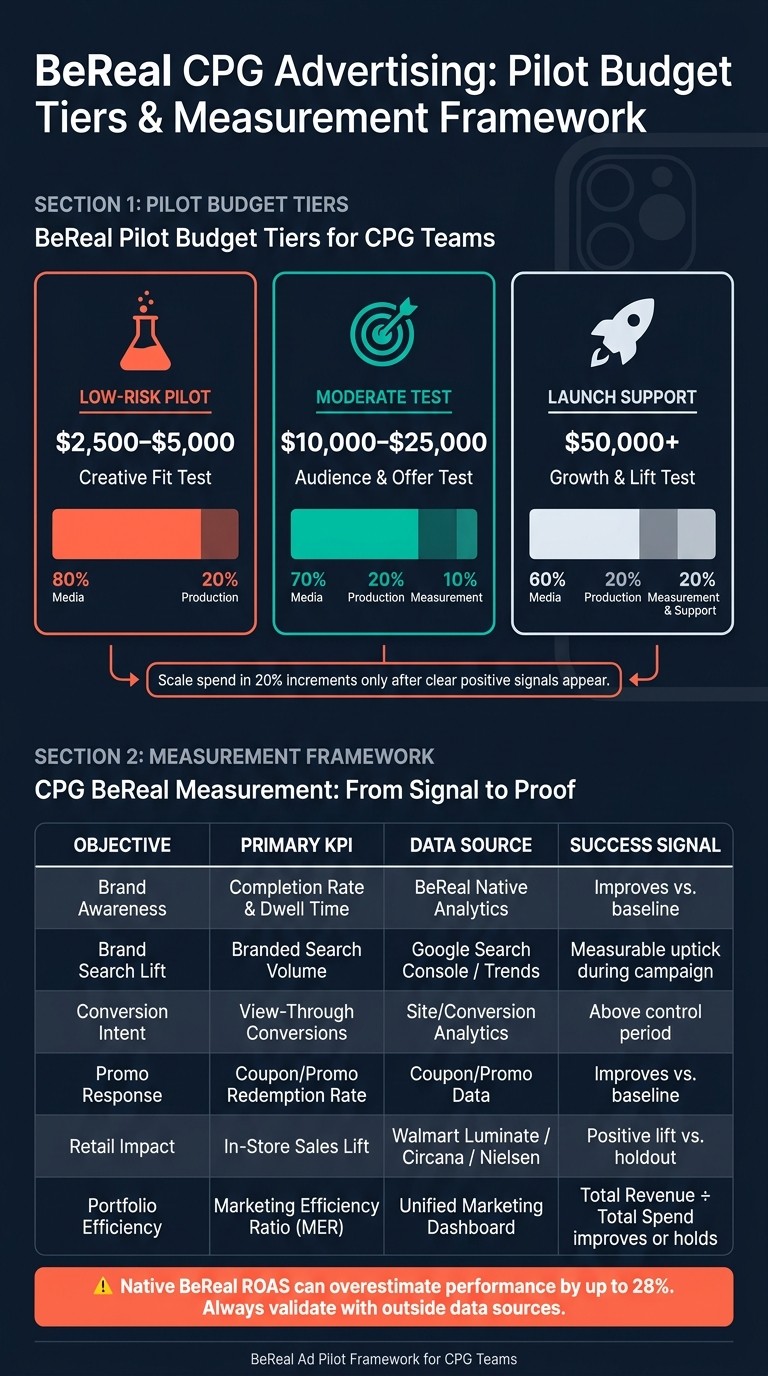
BeReal advertising works best when the first budget is built to answer one clear question. For CPG teams, that question is usually about creative fit, offer response, or sales lift. The first spend should act as a test bed, not a big bet. The aim is to gather usable signals on audience attention, content resonance, and channel fit before moving more dollars into the platform.
Starter Budget Ranges and Pilot Structure
A clean pilot budget keeps the team focused. It also makes readouts easier. If too many moving parts get packed into the first run, it becomes hard to tell what actually drove the result.
Budget Tier | Range (USD) | Primary Objective | Recommended Split |
|---|---|---|---|
Low-Risk Pilot | $2,500-$5,000 | Creative fit test | 80% Media / 20% Production |
Moderate Test | $10,000-$25,000 | Audience and offer test | 70% Media / 20% Production / 10% Measurement |
Launch Support | $50,000+ | Growth and lift test | 60% Media / 20% Production / 20% Measurement & Support |
Once the budget is set, the next move is simple: test one creative variable and one offer variable at a time. That kind of discipline matters. Without it, results can look noisy and hard to act on.
Content and Offer Variables to Test First
The smartest starting point is narrow. Test creative style first, then test offer type.
On the creative side, one of the most useful early comparisons is behind-the-scenes content versus promotion-led content. A behind-the-scenes clip that shows how a product is made, packed, or prepared for launch can fit BeReal's more casual posting style. It feels less polished and more in-the-moment, which can help the content blend into the platform instead of sticking out like a standard ad.
Promotion-led content tests something else. A post tied to a limited-time coupon code or sampling offer can show whether the audience responds to direct incentives. That matters for CPG teams trying to gauge not just attention, but action.
For brands with retail distribution, a BeReal post paired with a retailer offer adds another layer of tracking. That setup can help connect platform activity to store impact.
When to Scale, Pause, or Reframe the Channel
Scale only after the pilot shows clear engagement and business signals worth acting on.
That does not always mean direct conversion has to look strong right away. If dwell time and completion rates are strong, but direct-response metrics like CPA and ROAS are weak, BeReal may still be doing its job. In that case, the channel should be treated as upper-funnel rather than shut off too soon. High engagement with low conversion often means the platform is helping build awareness and familiarity, even if it is not closing the sale on its own.
If engagement remains weak, the answer is not to spend more and hope. Pause the test and fix the creative, the offer, or both.
When a pilot does earn more budget, increase spend in measured steps. A 20% lift in spend is the safer move, not a sudden jump that changes too many conditions at once.
The point of the pilot is to decide whether BeReal has earned a bigger place in the media mix.
How Does BeReal Fit Into a Long-Term CPG Brand Growth Strategy?
BeReal can matter for CPG brand growth, but only in a narrow lane. It works when teams need low-fi creative that feels credible with younger shoppers and when the goal is to test which messages feel real enough to drive a response. On BeReal, polish carries less weight than believability. That changes both the creative approach and the way success should be judged.
Audit BeReal's Role in Your Social Mix
Start by defining what the pilot needs to prove: trust lift, content fit, or shopper response. That step sounds simple, but it decides almost everything that follows. If the team cannot name a clear test objective before spend goes live, the channel is not ready for a fair read.
For CPG brands targeting younger audiences, BeReal makes the most sense when the creative team can stick to low-fi production and the measurement plan goes past surface metrics. Native engagement can help show whether the content landed. Incrementality can help show whether it changed behavior. Reported ROAS alone is too thin for a channel like this.
BeReal earns a place in the mix only if it proves something other channels cannot show as clearly. That may be trust, launch lift, or a sharper read on which messages feel believable in market. If the platform fits the brand's growth plan, the next move is a small pilot with tight creative rules and a measurement setup built to look past platform numbers.
If you want to run a BeReal pilot that can actually be read, talk to Bigeye. Our CPG marketing team can help you set the test question, the creative rules and the measurement before a dollar goes live.
FAQs
How should CPG teams measure BeReal if native attribution is weak?
CPG teams should start with BeReal native signals such as dwell time, completion rate, reactions, and comments, then validate impact through outside sources like branded search, coupon redemption, retail sales data, incrementality tests, and MMM.
Can BeReal ads drive in-store sales for CPG brands?
Yes, but proving that link usually requires retail analytics tools rather than platform reporting alone. Walmart Luminate, Circana, and Nielsen can help connect campaign timing and spend to in-store sell-through.
What is the best KPI for a BeReal pilot campaign?
There is no single KPI that works on its own. The strongest read comes from combining native engagement metrics with search lift, promo response, retail sales lift, and MER.
Why is last-click attribution a poor fit for BeReal advertising?
Last-click attribution misses delayed conversions and offline purchases, both of which are common in CPG. That can make BeReal look weaker than it is, or in some cases allow platform reporting to overstate direct impact.
Related from Bigeye
Case study: Florida Crystals
Podcast: In Clear Focus, the Bigeye podcast

Paid Media & Performance
Oct 7, 2026
A retail media strategy for 2027 in eight steps, with Bigeye shopper research and current data on Amazon, Walmart, Instacart and measurement.