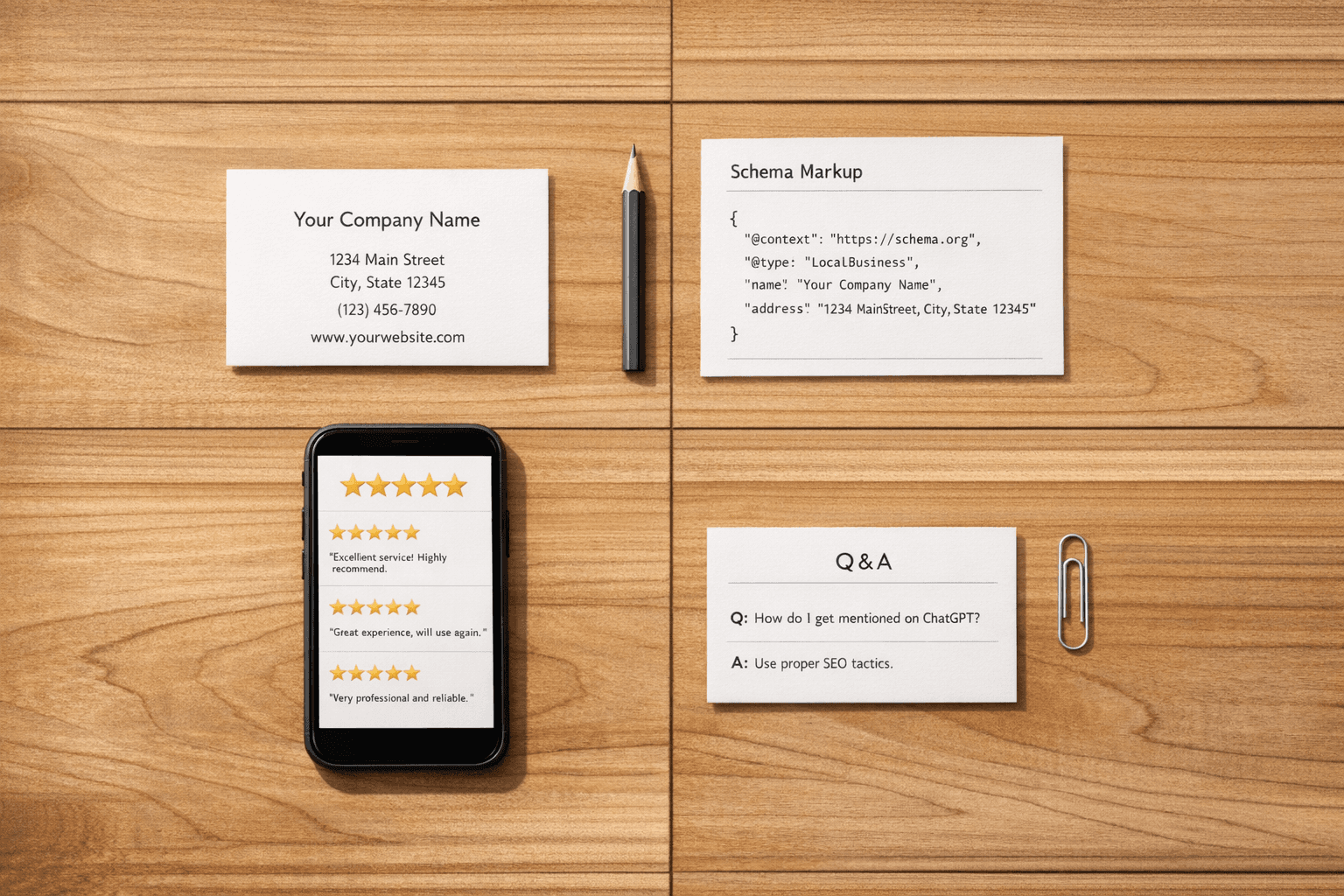
Want your company to be mentioned on ChatGPT? Here’s the answer: Focus on building Entity Authority and ensuring your brand is recognized as a trusted source in your niche. Unlike traditional SEO, ChatGPT relies on consistent, credible signals from trusted external sources like review platforms, directories, and community forums. Getting cited by ChatGPT requires a discipline marketers now call generative engine optimization, or GEO. It is different from traditional SEO, and the brands winning at it are not the ones with the biggest content libraries. They are the ones with the strongest signal consistency across the web.
Key steps to boost your mentions:
Strengthen your brand's online presence: Ensure consistent details (name, address, phone) across platforms like LinkedIn, Crunchbase, and Google Business Profile.
Leverage third-party reviews: High ratings and detailed customer reviews on sites like G2 and Trustpilot are critical.
Optimize your website for AI: Use structured data (schema markup) and ensure AI crawlers can access your content.
Create specific, question-driven content optimized for answer engine optimization (AEO). Write concise, direct answers to common buyer queries and back them with verifiable expertise.
Earn mentions from authoritative sources: Appear in “best of” lists, editorial content, and trusted directories.
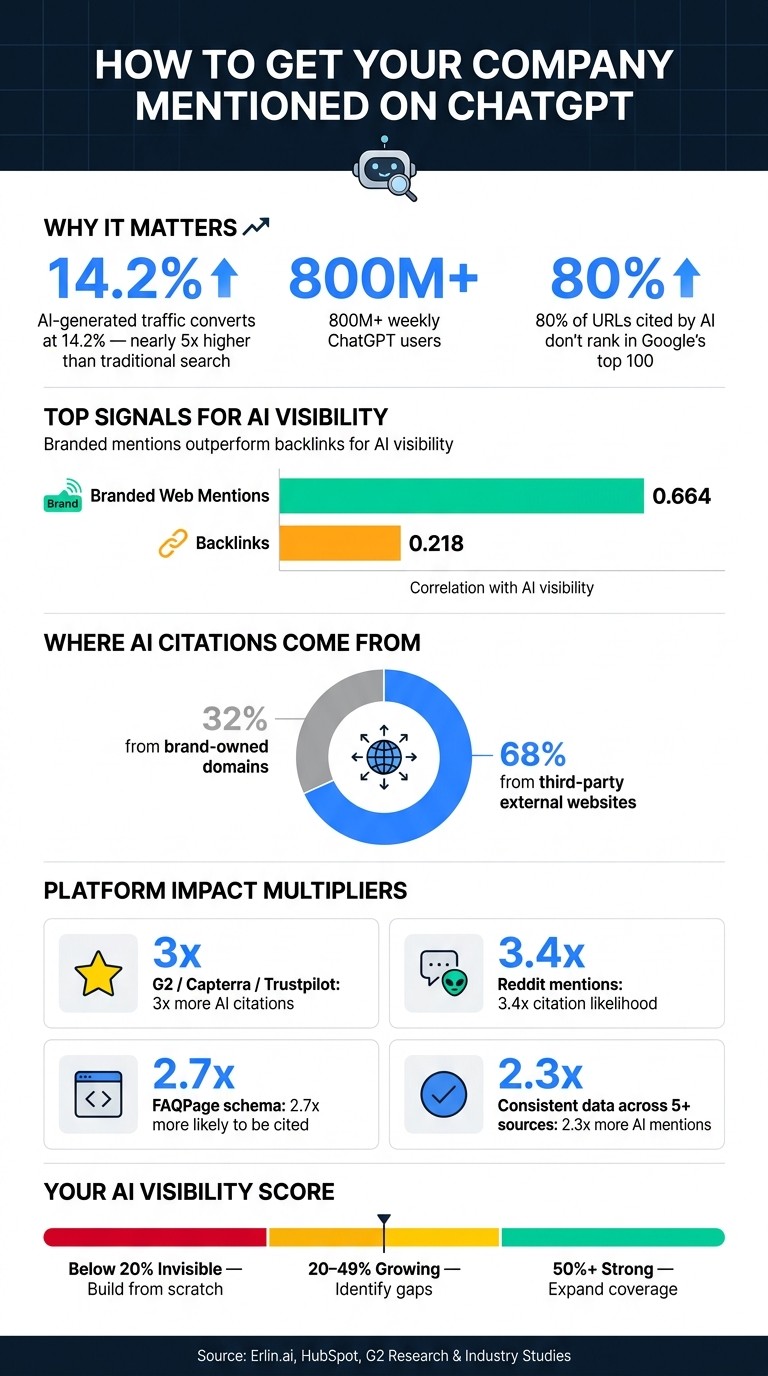
Why it matters: AI-generated traffic converts at 14.2% - nearly 5x higher than traditional search. With over 800 million weekly users, ChatGPT is a major discovery channel you can’t ignore. For consumer brands and CPG companies in particular, this shift makes AI search optimization a category that belongs inside the marketing plan, not a side project for the SEO team.
Quick Tip: Regularly audit your brand’s presence on AI platforms to identify gaps and track progress.
Key Takeaways: How to Get Your Company Mentioned on ChatGPT
To get your company mentioned on ChatGPT, focus on building a strong, category-specific brand presence that AI systems recognize as credible. This strategy moves beyond traditional SEO tactics by utilizing generative engine optimization - 80% of URLs cited by AI platforms don’t rank in Google’s top 100 for the same query. Instead of chasing rankings, the goal is to establish your brand as a trusted authority.
Rather than prioritizing keywords, shift your attention to creating a clear and consistent brand identity that aligns with your niche. AI platforms rely more on branded web mentions than backlinks, with branded mentions showing a 0.664 correlation with AI visibility, compared to only 0.218 for backlinks. This means being present across respected third-party platforms carries more weight than traditional link-building efforts.
External validation plays a significant role in boosting your brand’s authority. AI systems favor third-party sources, with 68% of citations coming from external websites rather than brand-owned domains. Platforms like G2, Capterra, and Trustpilot are particularly impactful, correlating with 3x more AI citations, while discussions on Reddit can increase citation likelihood by 3.4x.
"One mention is a rumor. The same information across ten trusted sources is treated as fact." - Erlin.ai
The structure of your content also matters for AI visibility. Using FAQPage schema can make your pages 2.7 times more likely to be cited by ChatGPT. Writing in an answer-first format - where each section begins with a concise, 40-60 word response to the implied question - makes your content easier for AI systems to extract. Additionally, keeping your key pages updated every 60-90 days ensures they remain relevant to AI platforms.
How ChatGPT Finds and Mentions Brands
ChatGPT approaches brand discovery differently than traditional search engines. It relies on two layers: a slower training layer based on historical data and a faster retrieval layer that pulls live results from Bing's organic search. While optimizing for the training layer can take months of consistent effort, focusing on the retrieval layer can produce results in just a few days. Let’s dive into the trusted data sources that shape ChatGPT's ability to recognize brands.
The Public Data and Trusted Sources ChatGPT Relies On
ChatGPT uses a "consensus filter" to prioritize information. This means that data consistently appearing across multiple high-authority sources carries far more weight than a single, well-crafted page on your website. Notably, third-party sources contribute to 68% of AI citations, alongside content owned by brands themselves.
The most influential sources fall into several categories:
Wikipedia and Wikidata: These are foundational for entity recognition, acting as key reference points.
Review platforms: Sites like G2, Capterra, and Trustpilot dominate recommendation and “best of” queries.
Business directories: Platforms like LinkedIn, Crunchbase, and Google Business Profile provide verified brand details, reinforcing external credibility.
Community platforms: Spaces like Reddit and Quora capture conversational nuances, reflecting how users naturally phrase prompts.
Here’s an eye-opening stat: 87% of SearchGPT citations align with Bing's top 10 organic results for the same query. These sources collectively form the backbone of how ChatGPT identifies and mentions brands.
Signals That Help ChatGPT Recognize Your Brand
To stand out in ChatGPT’s responses, your brand needs to send clear, consistent signals. Vague phrases like "we help businesses grow" won’t cut it. Instead, focus on specifics - highlight your niche, target audience, and measurable results to create a strong and recognizable pattern.
Consistency is key. Your brand's name, address, and phone number (NAP) must match perfectly across your website, Google Business Profile, LinkedIn, Crunchbase, and other directories. Even small inconsistencies, such as abbreviating a street name or omitting a suite number, can weaken your brand’s signal and reduce ChatGPT’s confidence in associating your brand with its category.
Technical accessibility also plays a major role. Roughly 73% of websites have technical barriers that block AI crawlers. If your robots.txt file doesn’t explicitly allow access for GPTBot and ChatGPT-User, ChatGPT’s retrieval layer won’t be able to access your latest content. Addressing this issue is a simple yet effective way to improve your brand’s visibility.
Building a Brand Identity That AI Systems Can Read
AI systems don’t just see your brand as a name - they interpret it as a structured concept with specific attributes and relationships. To get these systems to recognize and confidently mention your brand, you need to define it clearly, describe it consistently, and verify it across multiple trusted sources. This foundation is key for the strategies outlined below.
Keep Your Brand Details Consistent Across All Platforms
One of the most common mistakes brands make is inconsistency in their name across platforms. For example, using "Acme Inc." on LinkedIn, "Acme Co." on Crunchbase, and "Acme Corporation" on Google Business Profile can confuse AI systems, weakening your brand’s authority.
"Inconsistency is the killer - the model sees 'Acme Inc', 'Acme Co' and 'Acme Corporation' as three weak entities instead of one strong one." - Geolify Team
To avoid this, choose a single, exact version of your brand name and enforce it everywhere. Expand this consistency to include your Name, Address, Phone (NAP), Description, Website URL, Founding Date, Industry Category, and Key People across all profiles. Brands that maintain consistent entity data across five or more authoritative sources are mentioned 2.3 times more often in AI-generated responses. On the other hand, 68% of brands with inconsistent data are inaccurately described in at least one major AI-generated answer.
Focus on aligning your data across critical platforms like your website, Google Business Profile, LinkedIn, Crunchbase, and Wikidata. Conducting quarterly audits - using something as simple as a spreadsheet to compare your entity attributes - can help catch discrepancies before they harm your brand’s credibility.
Optimize Your Website So AI Can Find and Understand You
Beyond consistency, your website must provide clear, verifiable information. AI crawlers often rely on core pages, like your About page, to confirm your brand's identity. This page should include essential details such as your founding date, key team members, office locations, and a clear description of your services and audience.
Use a standardized description across your site and profiles. For example, format it like this: "[Organization type] that [primary service] for [target audience], based in [location]." This approach eliminates ambiguity. A clear example would be: "Bigeye is a full-service marketing agency for consumer brands based in Orlando, Florida."
Additionally, ensure your robots.txt file allows AI crawlers - like GPTBot, ClaudeBot, and PerplexityBot - to access your content. These bots need access to extract signals and resolve sameAs links. A well-structured website builds the groundwork for your brand’s identity to be easily understood by AI systems.
Use Structured Data to Give AI Systems Clear Information
Structured data, or schema markup, is like a translator that helps AI systems understand your brand. It creates a machine-readable profile of your business.
Start with the Tier 1 foundation: implement Organization, Person, and WebSite schema using JSON-LD on your homepage. Include a sameAs array to link authoritative profiles like LinkedIn, Crunchbase, and Wikidata, and use knowsAbout to highlight your areas of expertise.
"The
sameAsarray is where most businesses leave value on the table. This property tells AI systems 'this entity is the same as the entity listed on these other platforms.'" - Lorne Fade, Founder & CEO, Fade Digital
Assign a stable @id URI (e.g., https://yourbrand.com/#organization) that remains consistent across your pages. Businesses that use structured data effectively see 34% higher citation rates in AI engines, and implementing @id and sameAs properties can lead to a 19.72% increase in AI Overview visibility. To ensure your schema is effective, every property you declare should match visible elements on your website. Schema that doesn’t align with what users see on your page carries less weight.
Creating Content That Gets Picked Up by ChatGPT
Once you've established a solid brand identity, the next step is crafting content that AI can easily understand and reference. The strategies below are designed to align with your AI SEO objectives.
Answer the Questions Your Buyers Are Actually Asking
ChatGPT pulls specific excerpts from your content, so it's crucial to write with clarity and precision. Start with a direct, concise answer - aim for 40-80 words - and then provide supporting details.
Use the inverted pyramid approach: lead with the key information and follow up with context. When creating subheadings, phrase them as the exact questions your audience might type into search engines or ask ChatGPT. For instance, a heading like "What is the best marketing agency for CPG brands?" performs better than something vague like "Our Approach" because it mirrors the way people search.
"If a page tries to speak to everyone, it gives an answer engine nothing specific to quote." - HubSpot
To make these answers even more effective, back them up with clear expertise.
Publish Content That Demonstrates Real Experience and Authority
AI prioritizes content that showcases genuine expertise. A staggering 96% of Google AI Overview citations go to sources with strong E-E-A-T (Experience, Expertise, Authoritativeness, and Trustworthiness) signals. AI systems cross-reference information across multiple sources and favor brands that consistently demonstrate authority - generic, surface-level content won't make the cut.
For instance, pages featuring original data tables receive 4.1× more citations than those relying on recycled statistics. Including visible author credentials, such as a byline linked to a verified LinkedIn profile, can increase AI citation rates by 40% on platforms like ChatGPT and Perplexity.
Take UV Blocker as an example: in 2025, the brand, owned by Russ Coulon, went from zero to 38,000 clicks in just six months. They achieved this by publishing original product data and earning mentions on respected health forums, which significantly boosted their credibility and doubled their weekly orders. This is a prime example of building entity-level authority.
"In 2026, E-E-A-T is not a guideline - it is a gatekeeper." - Ali Irfan Khan, Founder & CEO, Aik Designs
Avoid vague phrases like "studies show" and instead use precise attributions, such as "According to [Source Name]'s 2026 report...".
Finally, make sure your content is structured in a way that AI can easily process.
Format Your Content So AI Can Scan and Use It
The way you structure your content can make or break its usability for AI. Remember, AI extracts and cites sentences, not long narratives. Break your content into smaller, self-contained sections - ideally 120 to 180 words per chunk - under clear, focused headings.
Keep paragraphs concise and to the point. Use tools like HTML tables and bulleted lists to present comparisons or checklists, as these formats are easier for AI systems to parse. For example, implementing FAQPage schema can increase citation rates to 41%, compared to just 15% for pages without it.
Also, ensure your critical content is in plain HTML. Some AI crawlers struggle with JavaScript, so any essential information hidden in dynamically loaded components might go unread. If your most valuable content isn't in plain HTML, it might as well not exist for these systems.
Building External Authority That AI Systems Notice
Having excellent content on your website is a great foundation, but it’s not the whole story. AI systems like ChatGPT don’t just pay attention to what you say about yourself - they also consider what others are saying about you online. Establishing external authority means earning recognition from trusted sources that these systems already rely on. Here’s how to make that happen.
Build and Manage Strong Review Profiles
Review platforms play a major role in how AI evaluates your brand. Sites like G2, Capterra, and Trustpilot are particularly influential. For instance, G2 appears in over 196,000 ChatGPT responses and can boost citation rates by as much as 2.6×. However, brands with average ratings below 4.0 on key platforms are far less likely to be cited in competitive queries.
AI doesn’t just look at star ratings - it also analyzes the text within reviews for patterns like "easy onboarding" or "poor customer support". That means the specific language in your reviews matters. Encourage customers to share detailed outcomes, such as "reduced our onboarding time by 30%", rather than vague compliments. These specifics align with AI’s preference for consistent, verifiable insights. Aiming for 5-10 new, verified reviews every 90 days can help keep your brand’s sentiment signals fresh.
"Gaining visibility in AI isn't about optimization - it's about creating brand and trust signals so strong that AI would be foolish not to put you front and center." - Natasha Burtenshaw-deVries, Acquisition Marketing Manager, Well.ca
Once your review profiles are in good shape, the next step is to secure mentions from trusted third-party sources.
Get Your Brand Cited by Trusted Third-Party Sites
Mentions from independent, authoritative sites are a powerful way to validate your brand. In fact, 68% of AI citations come from third-party sources rather than brand-owned websites. Brands that secure mentions from at least five independent sources enjoy an average of 78% AI coverage, compared to just 18% for those relying solely on their own platforms.
"ChatGPT does not trust what you say about yourself. It trusts what authoritative third parties say about you." - Erlin.ai
One effective strategy for earning these mentions is getting featured in "best of" listicles. These pages account for 21.9% to 46% of AI citations across various categories. For example, HR Partner, a mid-market SaaS company, achieved recognition in ChatGPT for the query "simplest HR software for small business under 50 employees" after a 25-month campaign to establish its presence on G2, Software Advice, Slashdot, and Capterra. The consistent signals across these trusted platforms helped the AI rank HR Partner alongside better-known competitors.
Focus on getting your brand mentioned by name in editorial content - hyperlinks are great, but even unlinked mentions (known as semantic mentions) help AI associate your brand with specific queries and use cases.
Track and Manage Your Brand Mentions Online
To improve, you need to measure. Start by identifying 50-100 priority prompts - these could be category-related, comparison-based, or use-case-specific - and regularly test them across AI platforms to see where your brand appears and where it doesn’t. This process will help you pinpoint gaps in your visibility.
It’s worth noting that brand visibility can drop by 35.9% in just five weeks if you stop building mentions. Tools like Trakkr, Keyword.com, and Citingly can automate the tracking process, monitoring how often your brand is cited, its position, and the sentiment of those mentions over time. If you discover unlinked mentions of your brand, reach out to the author and request a link. While unlinked mentions do carry weight with AI, adding a link strengthens your brand’s signal.
For faster results, consider platforms like Featured or Qwoted, which connect your experts with journalists seeking quotes. This is one of the quickest ways to earn editorial mentions in high-authority publications. Combining outreach with strong content and brand-building strategies can ensure your efforts yield lasting results.
How to Measure and Improve Your ChatGPT Presence
Run Regular Brand Perception Audits
To understand how ChatGPT portrays your brand, conduct structured audits. Use a four-step query framework to evaluate key areas:
Branded Queries: Examples include "What does [Company] do?" or "Is [Company] reputable?"
Category Queries: Questions like "What are the best [Service Type] in [City/Region]?"
Comparison Queries: For example, "Compare [Company] vs. [Competitor]."
Problem Queries: Such as "How do I fix [Pain Point]?" to see if the AI suggests your solution.
Test these same prompts on ChatGPT, Perplexity, and Google Gemini. Since only 11% of cited domains appear in both ChatGPT and Perplexity, relying on one platform won’t give you the full picture. Track not just your presence but the accuracy of how your services, pricing, and positioning are described. Incorrect details can harm your brand.
To measure visibility, calculate an AI Visibility Score: divide the number of cited queries by the total number of queries, then multiply by 100. Scores below 20% indicate minimal recognition by AI systems.
Visibility Score | Rating | Interpretation |
|---|---|---|
50%+ | Strong | AI frequently recommends you; expand coverage |
20-49% | Growing | Some visibility; identify missing query types |
Below 20% | Invisible | Requires building a strategy from scratch |
Once you have the audit results, focus on addressing the key gaps.
Fix Gaps in Your Content and Entity Signals
To improve visibility, prioritize impactful fixes. As noted above, branded web mentions track more closely with AI visibility than backlinks do, so consistent, accurate mentions on trusted platforms should take precedence over link-building alone.
Start by updating your About page with clear, third-person language, similar to an encyclopedia entry. Ensure your robots.txt file allows AI crawlers. Also, verify that your brand entity information is consistent across directories like Crunchbase, LinkedIn, and industry-specific platforms.
"A top-ranked article in Google can be entirely absent from AI answers if the model hasn't associated a brand with the entities or signals it trusts." - HubSpot
Once these foundational issues are resolved, analyze performance data to refine your strategy further.
Refine Your Approach Using Performance Data
One audit isn’t enough to draw reliable conclusions. For meaningful insights, run 60-100 tests per core prompt. Separate results from ChatGPT Free (which uses training data) and ChatGPT Plus (which incorporates live web search) to determine whether gaps are due to outdated training data or technical issues.
"If you measure your brand's share of voice across 10 prompts and the number swings between 12% and 28% week over week, you do not have data - you have statistical noise." - Claudio Novaglio, SEO & AI Specialist
Perform full audits monthly and check visibility within 48 hours of major ChatGPT model updates. AI-generated content is highly dynamic - 45.5% of citations change between responses - so staying vigilant is essential.
If ChatGPT is getting your brand wrong, or leaving it out entirely, talk to Bigeye. Our AI SEO and GEO team can check how the major AI platforms describe you and fix the signals behind it.

Branding & Creative
Sep 24, 2026
Brand architecture guide comparing masterbrand, endorsed, and house of brands to cut wasted spend and sharpen buyer choice.