Amazon PPC for Pet Brands: Structure, Bids, and the Mistakes That Burn Budget
Amazon PPC for pet brands often wastes money before bids are even changed. The core issue is poor campaign setup in a category built on repeat orders, not one-time sales. This guide shows how to split traffic by intent, set bids by margin and reorder behavior, and use a 90-day waste audit to cut spend that does not lead to profit.
TL;DR
Amazon PPC for pet brands works best when branded, discovery, harvest, and conquest traffic sit in separate campaigns.
Auto campaigns should find terms, while exact-match campaigns should own proven winners.
Repeat-purchase SKUs can support a higher first-order ACoS when 90-day reorder data is strong.
Subscribe & Save products need their own campaign layer because their payback math is different.
A 90-day search term audit can turn wasted spend into a hard dollar figure and a clean negative list.
Why Amazon PPC for Pet Brands Breaks Down Fast
Pet is crowded. That means loose campaign structure gets expensive fast.
When branded traffic, generic traffic, and competitor traffic live in the same campaign, the account loses clean readouts. A blended ACoS may look fine, but the inputs behind it are mixed. That makes bid changes harder and budget control weaker.
The main fix is intent separation.
Each traffic type needs its own lane:
Branded defense
Non-brand harvest
Discovery
Competitor conquest
That split matters even more in pet because shopper intent is often tight. A search for cat calming chews, senior dog probiotics, or grain-free puppy food is not loose browsing. It is often a high-intent search. If those searches get mixed with broad discovery traffic, the account starts paying for bad overlap.
Negative keywords matter just as much as campaign naming. Without them, auto campaigns and exact-match campaigns can compete for the same search term. That can push up costs with no gain in sales.
Repeat Orders Change How Pet Brands Should Judge Ad Spend
A crate and a bag of dog food should not be judged the same way.
Durables often need to make sense on the first order. Consumables often do not. Food, treats, dental chews, litter, and supplements may bring in repeat orders for months. That changes how ad spend should be judged.
A first-order ACoS can look too high and still make sense if the buyer reorders.
That is why pet brands need to look at:
Break-even margin
90-day reorder behavior
TACoS
Subscribe & Save rate
In many pet accounts, the first sale works like a customer acquisition cost. If the SKU has strong reorder behavior, a higher first-order ACoS may still leave room for profit later.
That only works when the reorder pattern is proven in data.
If the SKU does not show repeat demand inside a 90-day window, then a high first-order ACoS is just margin loss.
The Campaign Structure That Gives Better Control
The cleanest setup is simple, but it has to stay strict.
Auto campaigns should be used for search term mining, not for long-term scale. They should run on low budgets and tighter bid controls. Their job is to find new converting queries and ASIN targets.
Once a term proves it can convert, it should move into an exact-match campaign.
After that move, the same term should be added as a negative exact in the auto campaign. That keeps discovery focused on net-new search terms instead of paying again for traffic the account already knows is good.
A useful budget split is:
60% to exact-match winners
30% to phrase match and competitor targeting
10% to broad discovery
This keeps most spend tied to proven traffic while still leaving room to test.
Brand traffic also needs its own campaign. A shopper searching for a brand name behaves differently from a shopper searching for a generic product need. The same is true for competitor conquest traffic, which tends to convert at a different rate and often needs lower bid ceilings.
Subscribe & Save SKUs Need Their Own Campaign Layer
This is one of the most common misses in Amazon PPC for dog food and pet supplement accounts.
Consumables should not be mixed with durables in the same campaign logic. Their economics are different, and their bid rules should be different too.
For high-repeat SKUs, campaigns should focus on terms tied to refill behavior, such as:
monthly supply
bulk refill
refill pack
These campaigns should be judged on more than first-order return. They should also look at:
TACoS
Subscribe & Save take rate
90-day customer value
That changes bidding.
A bed or crate often needs first-order profit. A supplement or dog food SKU may support a more aggressive acquisition cost if the customer is likely to reorder.
How Bids Should Be Set for Pet Consumables
Bids should start with contribution margin, not category averages.
That means working backward from:
Amazon fees
Fulfillment cost
Cost of goods
Contribution margin
Repeat-order value
From there, the account can set a break-even ACoS. That is the line where ad spend uses up contribution margin.
For repeat-purchase pet SKUs, TACoS is often a better account-level health metric than ACoS alone because it shows the link between ad spend and total revenue. In many pet accounts, a healthy TACoS falls around 10% to 14%, but that range should not be used as a fixed bid rule.
The better move is to model blended revenue across a 90-day cohort.
If reorder data is strong, higher bids can make sense on high-intent recurring-demand searches. If reorder data is weak, bids need to stay tighter.
Hope is not enough. The math has to hold.
Bid Rules and Placement Controls Matter
Not every campaign should use the same bid setting.
A common setup looks like this:
Auto and discovery campaigns: Dynamic Bids – Down Only
Stable exact-match campaigns: Dynamic Bids – Up and Down
High-intent branded terms: top-of-search multipliers
Competitor conquest: lower bid ceilings and portfolio caps
This works because each layer has a different job.
Discovery needs cost control while it learns. Exact-match winners can handle more flexibility once enough conversion data is in place. Branded terms often justify stronger placement because they sit close to conversion. Conquest traffic usually needs tighter limits because conversion rates and margin tend to swing more.
Portfolio budget caps also matter. Without them, one unstable conquest campaign can drain spend from the parts of the account that drive repeat sales.
The Structural Mistakes That Burn the Most Budget
Most waste in Sponsored Products pet campaigns comes from structure, not from small bid errors.
The biggest mistakes are easy to spot:
Mixing traffic types in the same campaign
When branded, discovery, and conquest traffic are lumped together, the account loses clean data. One strong segment can hide losses in another.
Moving winners to exact without adding negatives
This is one of the costliest errors.
A winning search term moves from auto to exact, but the term stays active in the source campaign. Now both campaigns can bid on the same query. That leads to overlap, weak control, and extra spend.
Cutting spend too early on repeat-purchase SKUs
Pet brands often judge acquisition campaigns too soon. If a supplement, food, or chew SKU brings in repeat orders, first-order ACoS alone can understate its value.
That can lead teams to cut the very campaigns that are bringing in future subscription revenue.
How a 90-Day Search Term Waste Audit Finds Hidden Leaks
A 90-day search term audit turns waste into dollar terms.
That longer view matters in pet because repeat orders can change the read on a keyword. Short windows often miss that.
The audit should pull, at minimum:
Spend
Clicks
Sales
Orders
ACoS
Campaign type
The report should be run at the ASIN or SKU level. Account-wide totals can hide weak traffic on one product behind stronger results on another.
Then the search terms should be sorted by intent:
Branded defense
Non-brand harvest
Discovery
Competitor conquest
Pet brands should also flag mismatch traffic, such as:
Puppy terms for senior dog products
Cat terms for dog SKUs
Durable-product queries in consumable campaigns
Product-form mismatches like soft chews vs. wet food
Those mismatches often look close on the surface but fail once shopper intent gets more specific.
The Negative Keyword Rules That Cut Waste
The audit needs simple rules.
A practical starting point is:
Mark any term with 15 clicks and 0 conversions as a negative.
Remove any non-brand term with less than 0.5% of revenue and no clear business value.
Check for search terms already proven in exact-match campaigns but still spending in auto or broad campaigns.
That last point matters a lot.
Self-competing traffic is one of the easiest ways to waste budget in pet PPC. If an auto campaign is still buying a query that already converts in exact match, the account is paying discovery-level costs for traffic that belongs in a controlled lane.
TL;DR
The five things this guide covers:
Pet is crowded, and generic setups hide the winners.
Auto finds search terms; exact harvests winners; negatives keep them separate.
Repeat-purchase SKUs can support a higher first-order ACoS because lifetime value matters.
Subscribe & Save SKUs need their own campaign layer because their economics differ.
A 90-day search term audit shows wasted spend in dollars and sharpens every bid decision.
The rest of this guide shows how to build that structure, set bids, and cut waste without starving repeat revenue.
Why Does Amazon PPC for Pet Brands Fall Apart Without a Clear Structure?
Amazon PPC for pet brands breaks fast when campaign structure ignores buyer intent, SKU margins, and repeat purchase patterns. Pet shoppers tend to search with tight product intent, not broad curiosity. When campaigns treat those searches the same way, spend leaks, search terms get mixed together, and clean readouts disappear. The result is simple: wasted clicks, weak control, and performance data that tells only half the story.
Pet Is Saturated, and Generic Campaign Setups Hide Performance
The bigger issue sits inside the account itself. When branded defense, generic discovery, and competitor conquest traffic all live in the same campaigns, bid decisions get muddy. A blended ACoS may look fine at a glance, but the numbers underneath can’t be trusted because different kinds of traffic are pulling in different directions.
The fix is intent separation. Campaigns should be split into clear tiers: branded defense, non-branded harvest, discovery, and competitor conquest. Negative keywords should work as the seams between those tiers so traffic does not spill from one bucket into another. Without those seams, auto campaigns can end up competing with exact match campaigns and paying twice for the same traffic.
Once intent is separated, the next step is deciding which campaign layers need their own bid logic. That’s where structure stops being a naming exercise and starts shaping profit.
Repeat Purchases Change How Pet Brands Should Measure Ad Efficiency
The issue gets sharper with consumables. Repeat-purchase SKUs can support a higher first-order ACoS than one-time-purchase products because the customer may buy again and again. In plain terms, the first sale may not tell the whole story. Brands that judge ad spend only on first-order ACoS, without a 12-month LTV model, often pull back too soon.
That gap matters most in pet categories where reorder behavior is common. Food, treats, supplements, and other refill-driven items should not be judged the same way as a one-time accessory. First-order efficiency and lifetime value are not the same number, and treating them as if they are leads to bad decisions.
Bigeye's Research-First View on Pet Brand Growth
That is why Bigeye starts with search intent, SKU economics, and repeat-purchase behavior before changing bids. Bid changes can’t fix a broken structure. A search-term waste audit comes first, because it shows where money is leaking, where campaigns overlap, and where the account needs a cleaner framework before any rebuild begins.
The Campaign Architecture That Works for Pet Product Amazon Ads
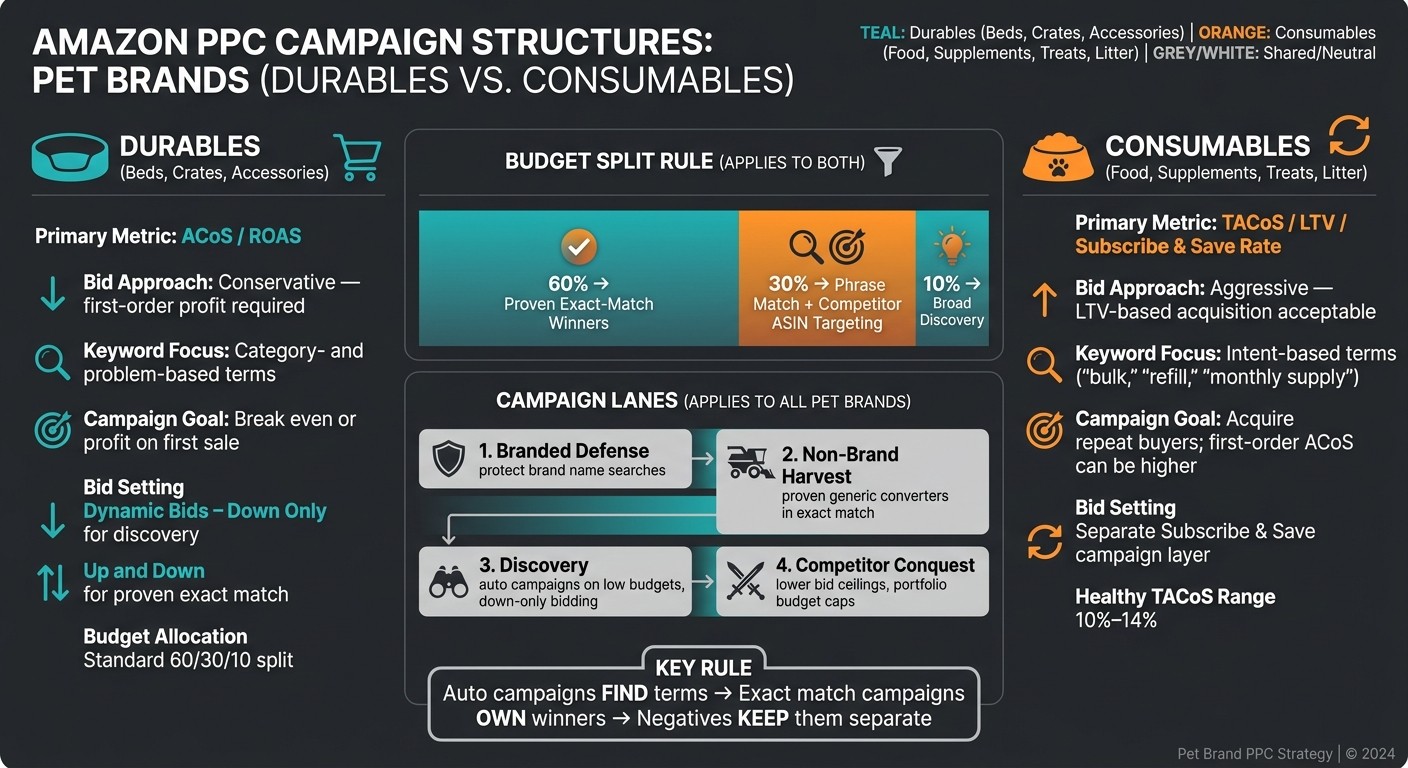
Amazon PPC Campaign Structure for Pet Brands: Durables vs. Consumables
Winning pet product Amazon ads depends on one thing many brands skip: clean campaign separation. Discovery, control, defense, and conquest should not sit in the same bucket. When they do, budgets blur, bids fight each other, and performance gets hard to read. The fix is simple in concept and strict in practice. Each campaign layer needs its own budget, bid cap, and negative list so every dollar has a clear job.
Auto Campaigns for Discovery and Search Term Mining
Auto campaigns should do one job only: find converting search queries and ASIN targets the brand has not uncovered yet. That sounds basic, but it matters. If auto campaigns are not kept separate, they keep spending on terms that should already live in a controlled campaign.
The clean setup is to run auto on low budgets with down-only bidding. That keeps the campaign focused on harvesting search term data instead of drifting into scale mode. In pet, that segmentation should go deeper than a generic product split. Auto campaigns should be grouped by SKU or product family, while pet intent stays separated by species, life stage, breed size, and dietary need.
Search term reports decide what moves next. When a query starts converting, it should graduate into a dedicated exact-match campaign. Once that move happens, the same term should be added as a negative exact in the source auto campaign so the account does not compete against itself.
That line between discovery and control is what stops discovery spend from cannibalizing high-intent traffic.
Exact, Brand Defense, and Competitor Conquest Campaigns for Control
When winning terms are found, they belong in exact-match campaigns with their own budgets and bid targets. This is the control layer. It gives the brand a cleaner read on spend, sales, and return by term instead of blending proven traffic with testing traffic.
A useful starting point is a 60/30/10 budget split:
60% goes to proven exact-match terms.
30% goes to phrase match and competitor ASIN targeting.
10% stays in broad discovery.
That mix keeps most spend pointed at what is already working while still leaving room to mine for new volume.
Brand defense should also run in its own campaign lane. Branded keywords should not compete with generic category terms for budget, especially in consumable pet categories where repeat orders can shape account economics over time. A shopper searching the brand by name is not the same as a shopper browsing for a generic need like grain-free dog food or cat calming chews.
Competitor conquest deserves its own controls too. Rival ASIN traffic behaves differently. Conversion rates shift. Margin shifts. Bid ceilings that make sense for branded searches often do not make sense for conquest traffic.
Keeping these lanes separate makes later bid changes far cleaner. Instead of looking at blended results and guessing, the brand can adjust each layer on its own terms.
A Separate Campaign Layer for Subscribe & Save and High-Repeat SKUs
For Amazon PPC for dog food, pet supplements, and other consumables, one extra layer is needed. These products should not be mixed into the same campaign structure as durables because the economics are different. A one-time purchase item and a repeat-purchase item do not deserve the same success metric.
Mixing consumables with durables hides what matters most: repeat revenue.
Consumable campaigns should focus on subscription-intent terms such as "monthly supply", "bulk refill," and "refill pack." Those campaigns should be measured against Subscribe & Save rate and lifetime value, not just first-order return. In leading pet accounts, subscription revenue often makes up well over 50% of total revenue.
The contrast is easier to see in a side-by-side view:
Campaign Layer | Primary Metric | Bid Approach | Keyword Focus |
|---|---|---|---|
Durables (beds, crates) | ACoS / ROAS | Conservative; first-order profit | Category- and problem-based |
Consumables (food, supplements) | TACoS / LTV / Subscribe & Save rate | Aggressive; LTV-based acquisition | Intent-based ("bulk", "refill", "monthly supply") |
This split changes how bids should work. A crate or bed often has to justify itself on the first order. Dog food or supplements may support a higher acquisition cost if the repeat rate is strong enough.
That is why a clean campaign architecture matters so much. Once each layer is separated, bidding can finally match break-even margin, repeat purchase behavior, and the role each product plays in total account growth.
How Should Pet Supplement Amazon Advertising Bids Be Set for Repeat-Purchase SKUs?
Pet supplement Amazon advertising bids should be set from contribution margin and repeat-purchase behavior, not from pet-category averages. In crowded consumables, the wrong bid can wipe out margin fast. The right one leaves room after Amazon fees, fulfillment costs, and cost of goods. For repeat-purchase SKUs, account economics depend on more than the first sale, so bid decisions need to protect lifetime value, not just first-order return. That is why a 90-day search term waste audit should happen before any bid reset.
Start With Break-Even ACOS, Then Model Blended Revenue
Break-even ACoS is the point where ad spend consumes contribution margin. That number sets the floor for rational bidding. Without it, bid changes turn into guesswork.
For repeat-purchase categories, TACoS is a better health metric because it shows the link between ad spend and total revenue, including organic sales and recurring subscription orders. In 2026, a healthy pet-category TACoS usually falls between 10% and 14%.
That range matters, but it should not drive bidding on its own. The better move is to model blended revenue across a 90-day cohort instead of judging performance on first-order revenue alone. A single order can look unprofitable at first glance, then make sense once reorder behavior shows up. Put simply, the first purchase is only part of the picture.
Waste still has to be stripped out first. If weak search terms stay in the mix, even a sound blended-revenue model will point to the wrong bid target.
Example: a supplement SKU may look weak on a first-order ACoS basis, but a 90-day cohort can show that repeat orders change the payback window in its favor.
When Higher First-Order ACoS Makes Sense for Amazon PPC Dog Food Campaigns
In high-frequency categories, a first-order loss can make sense when repeat data backs it up. If cohort behavior shows strong reorder rates inside 90 days, the first sale works more like an acquisition cost than a one-time profit event . Later Subscribe & Save deliveries do not carry that same acquisition cost.
That is why Amazon PPC dog food campaigns and supplement campaigns can support more aggressive bids on high-intent, recurring-demand terms. Terms tied to routine replenishment often deserve a different bid lens than one-off or low-intent searches.
There is a catch, and it is a big one: aggressive bidding only works when repeat behavior is proven with actual cohort data. Hope is not a bidding strategy. If reorder patterns are weak, a high first-order ACoS is just margin loss with extra steps.
A cleaner way to frame it is simple:
Higher first-order ACoS can be acceptable when 90-day reorder data is strong.
Subscribe & Save changes payback math because later deliveries do not repeat acquisition cost.
High-intent recurring-demand terms can carry stronger bids than low-intent or one-time purchase terms.
Cohort data has to confirm the pattern before spend scales .
Placement Multipliers, Bid Rules, and Volatility Control
After search terms are grouped by intent, bid controls should match that structure. Discovery and auto campaigns should use Dynamic Bids – Down Only. That setup helps control waste while the campaign is still learning. Once exact-match campaigns show stable conversion data, they can move to Dynamic Bids – Up and Down after about a 21-day learning period .
Top-of-search multipliers belong on branded defense and other high-intent subscription keywords . Those placements can be worth paying more for because they sit closest to conversion, especially for shoppers already showing repeat-demand signals.
Competitor conquest traffic and lower-margin terms need a tighter leash. Bids should stay tighter there, and portfolio caps should be in place so one volatile campaign does not drag down the rest of the account. Without those caps, spend can leak from profitable lanes into unstable ones before the account team catches it.
This is where bid mechanics start to look less like knob-turning and more like traffic control. Not every click deserves the same freedom.
Mixed Traffic Can Burn Budget Even When Bids Look Right
Even a well-set bid can waste budget when discovery, branded, and conquest traffic are mixed in the same structure. That is the next risk after basic bid setting. Mixed intent muddies performance signals, makes placement decisions less clean, and pushes spend toward search terms that do not deserve it.
Branded defense traffic behaves differently from discovery traffic. Conquest traffic behaves differently from both. When they are lumped together, one segment can mask the weakness of another. A campaign may look healthy on the surface while budget quietly leaks through poor-fit queries or lower-margin clicks.
That is why the 90-day search term waste audit comes first. It isolates waste before bid levels are reset, which gives every later decision a cleaner base. Without that step, the account may respond to noisy blended data and end up scaling the wrong search terms.
The main job of bid strategy in repeat-purchase pet categories is not just to win traffic. It is to buy the right traffic at a cost that leaves room for future profit.
What Structural Mistakes Burn the Most Budget in Sponsored Products Pet Category Campaigns?
Sponsored Products pet campaigns waste more budget through poor structure than through bad bids. In the pet category, spend often leaks when brands blend traffic types, ignore negative keywords, or judge Subscribe & Save SKUs by first-order ACoS alone. Once bids are in place, campaign structure shapes whether spend grows with control or bleeds out in ways that stay hidden until too much money is gone.
Mixing Discovery, Branded, and Conquest Traffic in the Same Campaigns
One of the fastest ways to lose budget is to combine unlike traffic inside one campaign. When branded defense, generic discovery, and competitor conquest traffic all sit together, the result is muddy data. Averages may look acceptable, but waste hides inside the blend. One traffic source can mask the weakness of another, and it becomes hard to see what is driving sales versus what is simply draining spend.
The fix is simple: separate these traffic types. Branded defense, generic discovery, and conquest should each run in their own campaign, with a separate budget and a separate ACoS target. That setup gives each traffic type room to perform on its own terms. It also makes budget control far easier, especially when conquest traffic turns volatile. Portfolio budget caps on conquest campaigns add one more layer of control, helping prevent that one campaign type from emptying the account before the problem becomes clear.
Moving Winners to Exact Match Without Adding Negatives
Pulling a strong search term from an auto campaign and moving it into an exact match campaign is the right play. The mistake happens when the process stops there. If that search term is not added as a negative in the source auto campaign, both campaigns can keep bidding on the same query.
That overlap creates a costly mess. The brand ends up paying for the same click twice, or at least forcing campaigns to compete against each other for traffic that has already been identified. Instead of using the auto campaign to find new search terms, the account starts wasting money on terms it already knows work.
The answer is the harvest-and-negate loop. Once a converting term moves to exact, it should be negated in the original auto campaign. That keeps discovery campaigns aimed at net-new query mining rather than cannibalizing proven traffic.
Cutting Spend Too Early Because ACoS Is Judged Too Narrowly
The most expensive structural error is often a timing problem. Brands cut acquisition spend before repeat orders have time to show up. When teams judge performance only on first-order ACoS, they can shut down campaigns that are doing exactly what they should do: bringing in buyers who reorder later.
That problem matters even more for pet supplement Amazon advertising and other high-frequency consumables. In those cases, the first order does not tell the whole story. A narrow ACoS snapshot can make a healthy acquisition campaign look weak, even when 90-day customer value tells a very different story.
A better read starts with 90-day cohort behavior and TACoS. Those two views help show whether ad spend is bringing in customers who come back and whether advertising supports total sales growth over time. Brands that skip this step often make the wrong cut. They pull budget from their best acquisition campaigns and push more spend into lower-value activity that looks cleaner only in the short term.
How Does a 90-Day Search Term Waste Audit Find Hidden Spend Leaks in Amazon PPC Pet Campaigns?
A 90-day search term waste audit shows where Amazon PPC pet campaigns still bleed money even after bids and campaign structure look fine. It turns waste into a hard dollar figure and a working negative keyword list. That longer window matters in pet, where repeat purchase value can make a term look weak on the first order even when it pays back later. It also brings out patterns that short reporting windows often miss, including irrelevant queries, self-competing traffic, and intent mismatches across the catalog.
TL;DR
A 90-day search term waste audit puts Amazon PPC waste into dollar terms and shows which queries should be blocked.
The audit works best when search term data is pulled at the ASIN or SKU level, so one strong product does not hide weak traffic on another.
Pet brands need to sort terms by intent and flag species or life-stage mismatches, such as puppy or cat terms triggering ads for senior dog products.
Search terms with 15 clicks and no conversions should be marked as negatives, and weak non-brand terms with little revenue impact and no business value should also be removed.
The cleaned list feeds the harvest-and-negate loop, improves bid control, and tightens campaign structure for the next round.
What to Pull From the Search Term Report
Start with six core columns: spend, clicks, sales, orders, ACoS, and campaign type. Those fields give a plain view of what each query costs and what it gives back.
Pull the report at the ASIN or SKU level. That step matters because aggregate account data can hide bad traffic. A strong seller can soak up weak query performance from a weaker product, which makes waste harder to see. In pet catalogs, that problem shows up all the time. One dog chew may convert well on broad traffic while another burns budget on loose-match queries that never had a shot.
Once the raw data is in place, sort search terms by intent:
Branded defense
Non-branded harvest
Discovery
Competitor conquest
That intent split makes decision-making much cleaner. A branded defense term may deserve more room because it protects share. A discovery term, on the other hand, should face stricter control until it proves itself.
Pet brands should also tag species and life-stage mismatches, especially in mixed catalogs. A senior dog supplement should not be paying for puppy or cat-related queries, even if those terms look close enough at first glance. The same goes for product-form mismatches. Soft chews, wet food, litter, and dental products often pull adjacent traffic that looks relevant in the abstract but fails when shopper intent gets more specific.
A senior dog supplement should not be paying for puppy or cat-related queries, even if those terms look broadly relevant at first glance.
How to Spot Waste and Turn It Into Negatives
The waste review needs clear rules. Without them, teams tend to debate every term and leave money on the table.
Mark any search term with 15 clicks and no conversions as negative. That threshold creates a simple line in the sand. It does not mean every blocked term was bad forever. It means the query has had enough chances and failed to show buying intent.
Remove any non-brand term that drives less than 0.5% of revenue and has no business value. Business value matters because some terms support category presence, new product learning, or shelf defense. If a term does none of that and still fails to pull revenue, it is a budget leak.
The audit should also look for self-competing traffic. This happens when auto campaigns spend on search queries that already exist as manual exact matches elsewhere in the account. In plain terms, the account is bidding against itself. That usually leads to messy budget allocation, weak signal quality, and less control over where top-performing search terms live.
In pet campaigns, self-competition often hides inside catalog overlap. Common examples include:
Durable-product terms entering consumable campaigns
Cross-species queries pulling spend in the wrong ad groups
Broad or auto campaigns continuing to fund terms already proven in exact-match campaigns
A dog supplement campaign, for example, should not keep paying discovery-level prices for a query that already converts in a manual exact setup. That proven term belongs in a controlled lane, with cleaner bidding and tighter negatives around it.
Pet products also need a close review for durable-product and cross-species terms showing up in consumable campaigns. A shopper looking for a refillable feeder, crate, or grooming tool is often on a very different path than a shopper looking for treats, probiotics, or food toppers. If those paths get mixed together, budget gets spread too thin.
How the Audit Sharpens the Next Round of Bids and Campaign Structure
The output from the audit should flow right into the harvest-and-negate loop. Proven terms move into controlled exact-match campaigns. Then those same terms get negated in the discovery campaigns where they first appeared. That prevents duplicate spending and gives the account a cleaner structure.
This is where the audit stops being a reporting task and starts acting like a control system.
Search terms with a strong conversion history should earn higher bids in controlled exact campaigns. Those are the terms with enough data to justify more aggressive placement. Discovery campaigns, by contrast, should shift to down-only bidding so the account can limit downside while gathering new search term data.
That split is especially useful in pet because product economics vary so much by subcategory. A first order on a supplement, food item, or dental chew may not tell the whole story if the buyer reorders later. The goal is not to choke off all upper-funnel traffic. The goal is to separate search terms that deserve room to scale from search terms that keep taking bites out of budget without giving anything back.
A cleaned search term list also helps reset bids by intent tier. Branded defense, non-branded harvest, discovery, and competitor conquest should not share the same bid logic. They play different roles, and the audit gives the account the evidence needed to treat them differently instead of lumping them into one model.
Use the cleaned search term list to reset bids by intent tier.
What Should Mid-Sized and Enterprise Pet Brands Do Next on Amazon PPC?
Mid-sized and enterprise pet brands that need to fix Amazon PPC without interrupting performance should clone the new structure, then move budget in stages over two to three weeks before shutting down old campaigns.
The 90-day search term audit should guide which terms move first. That keeps the shift grounded in actual demand instead of guesswork.
Priority 1: Rebuild Campaign Structure Around Intent and SKU Economics
Campaign structure should be rebuilt around four lanes: branded defense, non-brand harvest, discovery, and conquest. Consumables should sit apart from durables, since buying patterns, margin, and repeat behavior are not the same.
Amazon Portfolios can be used to set budget caps by intent tier, which helps stop conquest spend from eating into the harvest campaigns that drive growth.
Priority 2: Reset Bid Targets Around Repeat Purchase Behavior
Once the structure is split cleanly, bid targets should be reset around repeat-purchase value.
Bids should be based on break-even margin and 90-day cohort value, not just first-order ACoS. For a closer look at how subscription retention builds revenue over time, pet subscription retention strategies that boost LTV lays out the mechanics.
Get a Free Search Term Waste Audit From Bigeye
The audit turns the migration plan into a clear list of exact negatives and budget leaks.
Send 90 days of search term data to get a negative list and a dollar waste estimate. Bigeye is a pet marketing agency and ecommerce agency that starts every engagement with consumer research before rebuilding campaign structure around how pet shoppers actually buy.
FAQs
How should I split campaigns by intent?
Use one campaign, one intent, one job. Split the account into four intent-based portfolios: branded defense, non-branded harvest, discovery, and competitor conquest.
Inside each portfolio, organize campaigns around pet-category needs such as life stage, ingredient, or problem. That keeps targeting tight and makes budget decisions far easier.
Use automated discovery to surface new search terms. When a keyword starts to perform, move it into a manual exact-match campaign. Then add that same term as a negative in discovery, so the account doesn’t pay twice for the same traffic.
When is a higher first-order ACoS acceptable?
A higher first-order ACoS can make sense when a search term or campaign brings long-term value through repeat purchases and strong subscription attachment. In pet categories, repeat purchase rates tend to be high, so judging performance only on first-order ACoS can lead teams to cut budget too early.
Before accepting a first-order loss, confirm repeat behavior with accurate cohort data. If that proof is thin, use first-order economics as a guardrail and watch TACoS, not just ACoS.
What should a 90-day waste audit include?
A 90-day waste audit should review search-term reports across all campaign types to find and cut wasted spend.
It should include:
Measuring the true incremental contribution of branded defense campaigns.
Flagging long-tail keywords driving less than 0.5% of total revenue.
Checking auto campaigns for overlap with manual exact-match campaigns.
The goal is simple: remove obvious bloat and build a negative-keyword list.

Business Growth
Sep 10, 2026
Scent branding aligns a signature scent with brand identity to boost recall, dwell time, and conversions — start with a sensory audit.