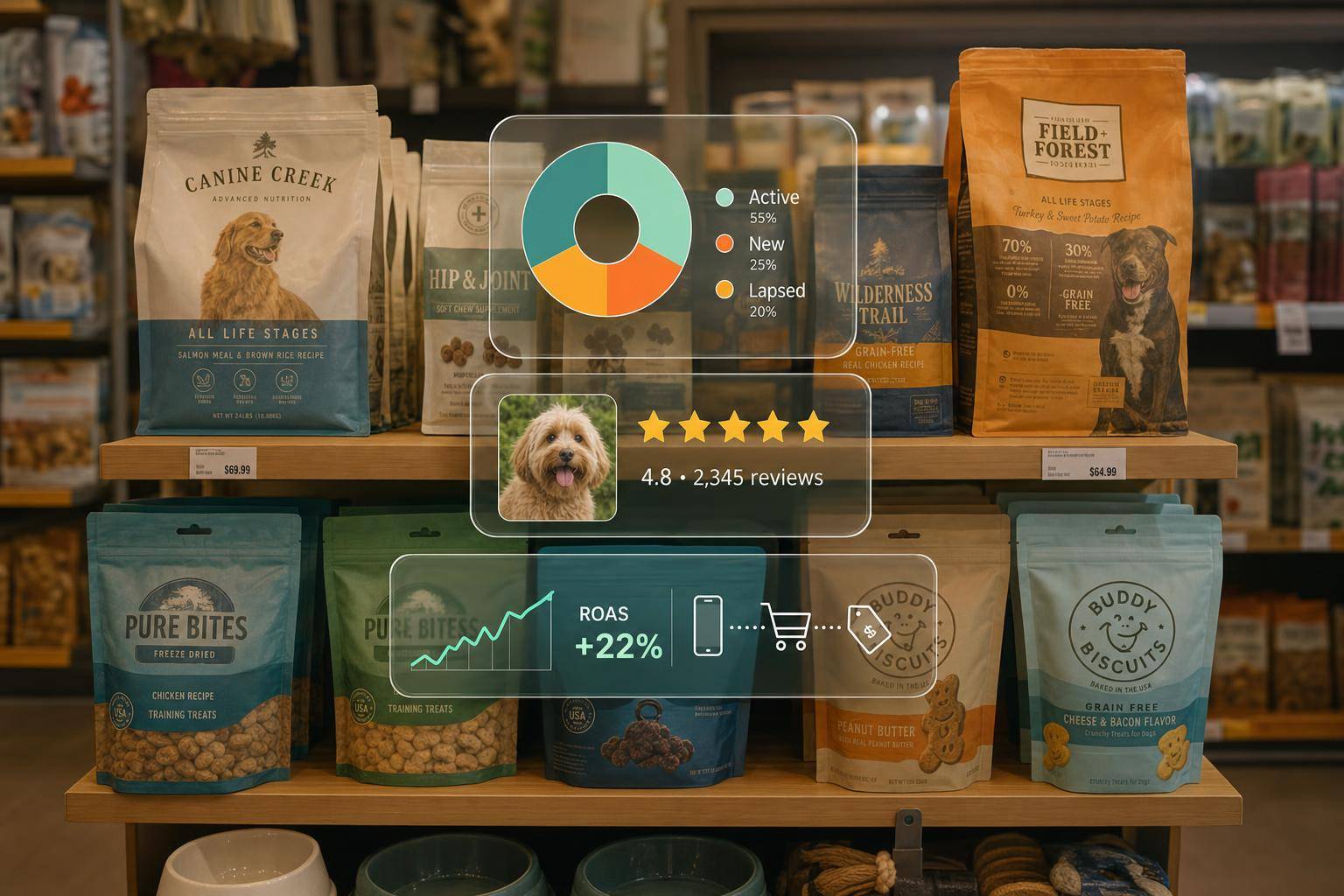
Pet marketing trends 2027 will favor brands that map buyer behavior before they map channels. APPA valued the U.S. pet industry at $158 billion in 2025, with estimates pointing to $165 billion in 2026. The problem is not demand. The problem is wasted spend from broad targeting, weak proof, and channel plans that do not match how pet parents shop. This guide breaks down what pet brands need to change in segmentation, retail media, wellness messaging, and retention so teams can plan with more control and less guesswork.
TL;DR
Pet marketing trends 2027 point to a buyer journey shaped by research, reviews, retail search, and short-form video before purchase.
Pet audience segmentation now works best when brands group buyers by need, repeat potential, and price tolerance instead of species alone.
Retail media for pet brands should be tied to shopper intent, with Amazon, Walmart, Target, Instacart, and Chewy each serving a different sales role.
Pet wellness marketing needs plain proof, named ingredients, and clear outcomes because broad claims no longer hold price power.
UGC, email, and SMS should work as one system that moves buyers from first order to repeat purchase and subscription.
What Are Pet Parents Actually Doing in 2027?
Pet parents no longer make most buying decisions at the shelf. In 2027, the path to purchase looks more like a short omnichannel research cycle: short-form video, search, retailer pages, reviews, and then an in-store check before purchase. Nearly four out of five shop both in-store and online. Pet parents pay more only when a product shows clear wellness benefits, transparent ingredients, and day-to-day convenience. The key question is no longer where they shop. It is what proof gets them to act.
Which Outdated Assumption Is Hurting Pet Brands Most?
The most damaging assumption in pet marketing is that the shelf is still where decisions happen. It is not. While 59.4% of pet parents discover new products in physical stores, the choice to buy - and the choice to trust - is often shaped before they arrive. By the time they reach the aisle, many have already watched creator content, checked retailer search results, and read reviews. In-store time serves as confirmation, not discovery.
Premium is a mindset, not an income bracket. It comes from pet-as-family behavior, wellness priorities, and emotional attachment - not household income alone.
The table below shows how old planning assumptions from 2018 to 2022 compare with current behavior:
Old Assumption (2018-2022) | 2027 Behavior Reality |
|---|---|
The shelf is where decisions happen. | Decisions are shaped before the shelf by social, reviews, and retail search; in-store confirms. |
Social is top-of-funnel only. | Social now starts and closes many journeys; discovery and direct commerce happen in-app. |
Premium is an income segment. | Premium is a mindset: pet-as-family, wellness-first, values-driven, even under cost pressure. |
How Do Pet Parents Research Before They Buy?
The research journey often starts with short-form video. TikTok, Instagram Reels, and YouTube Shorts put pet products in front of buyers through creator content that shows outcomes people can see: coat improvement, mobility support, or enrichment results. For younger owners in particular, proof from creators tends to drive more intent than polished brand ads.
After discovery, pet parents move to reviews and retailer pages. Acosta Group found that 52% of dog and cat owners mainly rely on online research to check ingredients, packaging, reviews, and prices before buying. When the product is food, supplements, or wellness-related, scrutiny gets even tighter. Buyers read ingredient lists, look at sourcing claims, and assess how clearly the product explains its function. Many also compare brand claims with third-party articles, vet blogs, and comparison guides. Veterinary-backed content can lift conversion rates by 25% to 35%, which is why vet endorsement is now a core content asset rather than a nice extra.
Creative must answer the buyer’s next question, not just win the click.
Those proof points also shape which brands can charge more.
What Makes Pet Parents Pay More in 2027?
Clear health outcomes drive willingness to pay more. Dog owners are more willing to spend on food labeled for specific health conditions such as joint support, digestive health, and weight management. Sales of functional food formats - including mixers, toppers, probiotic-enhanced options, and freeze-dried products - have grown more than 120% since 2018. The shift is plain: buyers care less about simply what is in the product and more about what the product does.
Bigeye has tracked pet insurance for years: 25% of owners had it in the 2019 US Pet Industry Study, 34% in the 2023 National Pet Owners Study, and 54% of Gen Z owners in that same 2023 study. Spend follows the "family member" mindset, not the pet's price tag.
Ingredient transparency is the second lever. 87% of pet parents prioritize transparency in ingredients when making purchases. Broad claims like “natural” or “wholesome” no longer do much heavy lifting, especially with Millennials and Gen Z owners who expect proof they can check. Brands that offer plain-language ingredient summaries, sourcing maps, and third-party testing disclosures make it easier for buyers to justify a higher price.
Convenience is the third lever. Busy pet parents will spend more for reliability. Auto-delivery, timed shipments, and bundled care plans reduce the mental load of pet care. When premium pricing is framed around time saved and routine reliability, the value case becomes much easier to defend.
Those value cues should shape segmentation and offer design next.
How Data-Led Segmentation Drives Pet Brand Growth
Pet brand growth in 2027 will come from sharper segmentation, not broader reach. Targeting “dog owners” or “cat owners” sounds simple, but it leaves margin sitting on the table. The brands pulling ahead are building audiences around need states, attitudes, and buying behavior. That shift changes everything: the proof point in the ad, the offer on the landing page, and the path to conversion. Segmentation turns a messy market into a cleaner growth system.
Broad pet-owner targeting leaves too much value on the table. “Dog owners” and “cat owners” are not buying for the same reasons, at the same moments, or with the same price tolerance. Some want proof of a health outcome. Others want ease, lower effort, or help solving a clear problem. When brands treat them as one audience, they flatten demand and weaken margin.
That is why consumer research needs to come first, before creative briefs and media spend. Pet-parent behavior shifts with life stage, budget pressure, and category trends. A segmentation model built once and left untouched can turn from useful to harmful in a short span. What worked last year may already be out of step with how households shop now.
Which Pet Parent Segments Will Drive Margin in 2027?
The highest-margin pet parent segments in 2027 are shaped by repeat potential and willingness to pay, not raw audience size. Four groups stand out.
In Bigeye's 2026 American Pet Owner report, Gen Z pet households grew 43.5%, and 70% of Gen Z owners have two or more pets. That's a multi-pet buyer, and it changes pack size, bundle and subscription math.
Premium wellness buyers spend more when the product promises a clear, verifiable health outcome. Functional dog foods tied to specific conditions already show real price gaps: allergy relief formulas average $3.89 per pound, weight management averages $3.52, and sensitive digestion averages $3.19. This group leans hard into ingredient transparency and third-party validation. For that reason, proof-led messaging tends to beat broad brand storytelling.
Subscription loyalists are the margin engine many brands still underplay. Subscription customers generate 3 to 5 times more lifetime revenue than one-time buyers. Top pet brands already post subscription attachment rates above 60%. This segment is less moved by a one-off discount than by convenience, auto-replenishment, and the freedom to change delivery timing.
First-time pet parents become high-value customers only if the brand turns onboarding into repeat purchase or subscription. This group spends more time researching, testing, and reading onboarding content. That creates an early opening to shape brand preference before routines set in. If a brand wins at this stage, the lift to lifetime value can be outsized because loyalty to a rival has not formed yet.
Problem-solution shoppers are often the fastest to convert because they are already beyond the awareness stage. A pet parent looking for anxiety relief, digestive support, or shedding help is not browsing for fun. They want proof of the outcome, clear usage guidance, and a low-risk trial offer. A brand-values message will not do the job here.
How Segmentation Should Shape Messaging and Offers
Segmentation has no business value unless it changes execution. It should change the creative angle, the price framing, the offer, and sometimes even the product bundle. The connection is practical, not theoretical.
Segmentation Approach | Focus Area | Messaging and Offer Strategy |
|---|---|---|
Demographic | Age, income, species, breed | Breed-specific nutrition; Gen Z and Millennial wellness positioning; value bundles for cost-conscious households |
Attitudinal | Values, emotional attachment, wellness orientation | Ingredient transparency for modern pet parents; safety and reassurance for anxious buyers; sustainability proof for values-first buyers |
Behavioral | Purchase frequency, subscription adoption, research depth, average order value | Auto-ship as default for high-frequency categories; multi-pet bundles for multi-pet households; urgency retargeting for cart abandoners |
Occasion-based | New adoption, life-stage transitions, seasonal needs, pet milestones | Starter kits for new adopters; senior supplement introductions; birthday and gotcha day bundles |
A demographic lens can still help, but it is rarely enough on its own. Breed, income, and age can point a team in the right direction, yet they do not explain why one household pays a premium while another waits for a bundle offer. That is where attitudinal and behavioral views start to matter more.
Attitudinal Segmentation Is a Missed Growth Lever for Many Pet Brands
Attitudinal segmentation is where many pet brands underinvest, even though it often explains margin better than species-based targeting. Mintel identifies at least five U.S. pet owner clusters, including Modern pet parents, Fur-baby parents, and Values-first pet owners, with different spending patterns and different proof needs. APPA outlines seven attitudinal segments, including Passionate Parents, Wellbeing Warriors, and Prudent Pragmatists.
These are not abstract audience labels. They are commercial segments with different buying logic. Wellbeing Warriors need clinical proof. Prudent Pragmatists need clear value and a low-risk way to try the product. One brief cannot sell both, and one landing page should not try.
That mismatch shows up in market performance all the time. A campaign can look polished, the media plan can be tight, and the product can be strong, yet results stall because the proof point is wrong for the buyer. It is a bit like handing every shopper the same store coupon and acting surprised when redemption stays flat. The message fits some people and misses the rest.
Behavioral and Occasion-Based Segments Turn Insight Into Revenue
Behavioral segmentation is often where pet brands can move from insight to action the fastest. Purchase frequency, subscription use, research depth, and average order value all point to different forms of demand. A high-frequency food buyer should not see the same offer as a low-frequency treat shopper. A multi-pet household likely needs a different pack size, bundle, or savings frame than a single-pet home.
This is where auto-ship defaults, flexible delivery timing, and retargeting logic matter. Subscription loyalists respond to less friction. Cart abandoners may need urgency or a lower-risk entry point. High-research shoppers may need more proof before they click. The segment should decide the path.
Occasion-based segmentation matters just as much. New adoption, life-stage change, seasonal concerns, and pet milestones create moments when purchase intent rises. A starter kit for new adopters meets a clear need. A senior supplement introduction fits a life-stage shift. Birthday and gotcha day bundles turn emotion into a timely offer. These are not random campaigns. They align message and timing.
Segmentation Works Best as a Living System
The strongest segmentation frameworks are not static slide decks. They are working tools tied to research, creative, media, and product choices. When buyer behavior shifts, the segments need to shift too. Economic pressure changes price sensitivity. Category trends change proof requirements. Life-stage movement changes purchase triggers.
Results back that up. One personalized segmentation rollout doubled its loyal base and increased repeat dog food purchases by 44%. That was not just a win for ad copy. It was a win for segmentation, with creative and execution following through.
A good framework should help answer a few plain questions. Which audiences deserve more budget? Which proof points belong in the ad? Which offers belong on the product page? Which KPIs matter by segment? If the model cannot guide those choices, it is not doing enough work.
How Omnichannel and Retail Media Shape Pet Commerce in 2027

Pet commerce in 2027 will be won by brands that treat channels like a coordinated system, not a pile of separate line items. NIQ's 2025 pet retail analysis found that 82% of pet spend comes from omni-shoppers, while online pet spending climbed 12% year over year. That changes the job of every channel. Once segments are set, the next call is simple: decide which channel should create demand, capture it, or keep the customer coming back. Channel roles should follow shopper intent, not retailer preference.
Where Should Pet Media Budgets Move in 2027?
Pet media budgets in 2027 should be built on three layers: demand creation, demand capture, and retention. Retail media sits at the center of demand capture because that is where many pet shoppers move from interest to purchase. MikMak data on pet-care purchase-intent clicks shows how concentrated that behavior is: Amazon at 42.6%, Walmart at 23.2%, and Target at 19.4%. Social platforms may spark discovery, but retail environments often close the sale.
Each network works best when it has one clear job.
Retail Media Network | Shopper Intent | Best Pet-Category Use Case |
|---|---|---|
Amazon | High, search-led | Product launches, branded search defense, replenishment |
Walmart Connect | Value and omnichannel | Everyday essentials, seasonal in-store tie-ins |
Target Roundel | Premium and lifestyle | Wellness-positioned products, cross-category household campaigns |
Instacart Ads | Replenishment-driven | Pet food and treats added to grocery missions |
Chewy Ads | Category-native, loyalty | Health and wellness, subscription upsell, vet-adjacent products |
For a mid-to-large U.S. pet brand, that mix may mean putting 30-40% of digital working media into retail media networks, 25-35% into demand creation across Meta, TikTok, and YouTube, and 20-30% into Google Search, Performance Max, and YouTube for high-intent capture. The split matters, but alignment matters more. One planning framework across Google, Meta, Amazon, TikTok, YouTube, and retail media networks keeps creative, targeting, and measurement pointed at the same business outcome.
How to Unify Commerce Measurement Across Channels
Channel mix only means something if every retailer and owned channel is measured against the same outcomes. Without that shared view, pet CMOs end up judging spend on platform ROAS alone. That is risky. Platform ROAS can make lift look bigger than it is, while cross-retailer cannibalization stays hidden in plain sight.
The market is already moving toward cross-channel measurement. Criteo found that combining onsite video with display and sponsored products drove a 5.6x lift in new-to-brand customers and a 460% lift in sales. Those gains only show up when formats are measured together instead of being treated as isolated placements.
Retailer-level testing tells the same story. In 2024, Mondelez used Walmart Connect's Search Incrementality feature to adjust ad frequency and rotate seasonal creative assets. That work led to a 53% year-over-year increase in conversions and a 29% boost in incremental ROI. For pet brands, the takeaway is not that Walmart fits every SKU. The point is sharper than that: incrementality testing at the retailer level shows which spend is driving new volume and which spend is only recapturing demand that would have happened anyway.
A working measurement framework ties together RMN data from Amazon, Walmart, Target, Kroger, Instacart, and Chewy with retailer sell-through data, DTC and marketplace store metrics, owned-channel signals from email and SMS, and upper-funnel reach data from Google, Meta, TikTok, and YouTube. The target is retailer-level scorecards that connect media inputs to gross sales lift, new household acquisition, repeat rates, and margin. Those are the growth outcomes segmentation is meant to defend.
How Wellness and Personalization Are Changing Pet Brand Positioning
By 2027, "natural" and "premium" won't set a pet brand apart. Specific proof will. Pet parents now judge wellness products much like they judge their own supplements and functional foods: they read ingredient panels, ask how the product works, and look for evidence that it does what it claims. An ADM global survey found that 85% of consumers agreed that proper nutrition and supplements are as important for their pets as they are for themselves. That shift changes brand positioning at its core, not just the look and feel of the package.
U.S. pet food spending hit $65.8 billion in 2024, with premium growth tied to pet humanization and functional nutrition. The average order value for functional pet foods and supplements is $89, or 65% higher than standard pet food. Pet parents will spend more, but only when the benefit feels specific, believable, and easy to verify.
Which Wellness Claims Will Matter Most in 2027?
Once proof becomes the standard, the next issue is clear: which benefits will drive demand? Joint and mobility, gut health, skin and coat, and calming are the four benefit territories set to drive the most volume and margin in pet wellness through 2027. Joint and mobility products now hold the top revenue share in supplements, pushed by aging pets and more active pet lifestyles.
Gut health is climbing fast. 60% of pet owners want digestive health benefits from pet food and treats, and 71% of U.S. pet owners have already bought biotics - prebiotics, probiotics, or postbiotics - for their pets at least once. Calming is not far behind. 33% of U.S. pet owners want calming or anxiety relief benefits built directly into pet food and treats.
Skin and coat completes the top four, with a dedicated U.S. supplement segment growing at an 8% CAGR through 2036. Weight management and life-stage support still matter, but they work best when they strengthen a core benefit rather than try to stand on their own.
Claims need to do two things at once: name the active ingredient and state the outcome. 57% of global pet owners say health claims matter when choosing pet food. The claims that move shoppers to buy tie a named ingredient to a plain-language result, such as "with glucosamine and chondroitin to support healthy joints" or "with prebiotics and probiotics to support gut microbiome balance." Structure/function wording like supports, helps maintain, and promotes keeps messaging persuasive without drifting into disease-treatment claims that create legal and trust problems.
How Pet Brands Should Balance Emotion With Functional Proof
The most effective pet wellness positioning in 2027 uses emotion as the entry point and functional proof as the reason to believe.
An emotional promise can pull attention, but it needs proof in the same moment. On pack, a brand might lead with a line like "For their happiest, bounciest years" and then support it with a subhead such as "with glucosamine and chondroitin to support healthy joints." In retail media and PDPs, the same pattern works well: start with the emotional payoff, then move straight into benefit callouts, ingredient visuals, and proof points.
The table below gives brand and creative teams a working map for six main wellness territories. It shows what pet parents want, what proof they look for, and where claims can slip into risky territory.
Benefit Territory | Core Consumer Need | Key Proof Points | Primary Messaging Risk |
|---|---|---|---|
Joint & Mobility | Keep aging or active pets comfortable and mobile longer | Named actives (glucosamine, chondroitin, MSM, hyaluronic acid), vet endorsements, mobility assessments | Cure claims; "pain-free" promises |
Gut & Digestive Health | Reduce stomach upsets, support immunity, manage sensitivities | Pre-, pro-, and postbiotics with strain-level detail; microbiome mechanism explained | Overstating microbiome science; cure claims for chronic GI disease |
Skin & Coat | Visible shine, reduced shedding, itch relief | Omega-3 levels, biotin, vitamin E; vet or groomer endorsements | Implying elimination of medical skin conditions |
Calming & Emotional | Reduce stress without sedation | Named ingredients (L-tryptophan, chamomile, magnesium) with plausible mechanisms | Cure claims for anxiety disorders; implying sedation |
Weight Management | Prevent obesity to extend healthy years | Calorie-controlled formulas, feeding guides, satiety-supporting fiber references | Rapid weight-loss promises without responsible feeding guidance |
Life-Stage Support | Age-specific nutrition | Age-specific nutrient levels, benefit overlays (e.g., senior mobility) | Over-generalizing age needs; implying guaranteed lifespan extension |
The same proof hierarchy should appear across packaging, PDPs, retail ads, and creator briefs. When the message changes from one touchpoint to the next, trust slips. When the proof stays clear and consistent, the brand position gets much harder to ignore.
How Creators, UGC, and Owned Channels Build Lasting Growth
Pet brands that win in 2027 will not rely on one-off influencer posts. They will run a content system that turns attention into sales and sales into repeat orders. In that system, creator-led discovery fills the top of the funnel, review-led proof supports conversion in the middle, and owned channels like email and SMS drive repeat purchase at the bottom. Each asset has a clear role, a clear placement, and a measurable result. Brands still working campaign by campaign are missing the compounding effect that comes from reuse, timing, and channel coordination.
Which Content Formats Will Influence Pet Purchases Most?
Short-form video on TikTok, Instagram Reels, and YouTube Shorts is a core discovery format for pet purchases in 2027. The top-performing content does not lead with polish. It leads with proof. The pattern is simple: show the result first, then show the product.
A 30- to 60-second video of a senior dog moving more freely after eight weeks on a joint supplement can beat a polished brand ad when it opens with the outcome, then walks through the routine, and finally shows the product itself. That structure works because it answers the buyer's main question right away: Does this help?
The performance gap is not small. UGC outperforms branded content in pet marketing with 8.7x higher engagement, 4x higher CTR, 50% lower CPC, and 74% higher product-page conversion. Those numbers have a direct effect on whether traffic turns into revenue.
TikTok pet content also outpaces general platform content, producing 2.08x higher engagement. At the creator level, micro-creators with 5,000 to 50,000 followers are posting engagement rates between 5% and 10%. Macro-influencers average 2.4%. That gap matters because pet purchases often depend on trust, relatability, and visible product use. A polished celebrity mention may get reach, but a smaller creator showing a feeding routine, a toy test, or before-and-after mobility can move buyers much closer to action.
Creator briefs should be built with reuse in mind from the start. One shoot should produce reusable vertical cuts, one direct testimonial, and one product-in-use shot. That single asset set can support paid social, PDP content, email, and SMS. Since creative drives much of the performance spread, each piece needs to earn its keep across the full funnel. Brands that treat creator content as a one-time post are wasting much of the return.
That reuse model also ties discovery to retention. The same clip that stops a user in-feed can show up later in an onboarding email, a retargeting message, or a replenishment reminder. Done well, creator content does not end when the post goes live. It keeps working deeper in the customer journey.
How Pet Brands Should Use Email and SMS After the First Purchase
Once the first order is placed, email and SMS take over the job of turning a buyer into a repeat customer. For pet brands, owned channels are where LTV grows. The fastest-moving brands are not sending one-size-fits-all blasts. They are building behavior-triggered flows based on species, life stage, and purchase pattern.
Personalization drives that system. Emails that include a pet's name and breed lift open rates by 22% and click-through rates by 14%. That makes sense. A message about a growing Labrador puppy should not sound like a message for an older indoor cat. Relevance is what keeps the brand from sounding like background noise.
Timing matters just as much. Personalized reorder reminders based on actual usage cycles convert at 41%, compared with 15% for generic reminders sent on a fixed 30-day schedule. A supplement, food topper, or litter product is not used at the same pace in every home. Brands that ignore that fact lose sales they should have kept.
Fresh Patch offers a strong example of what happens when owned channels and paid media work together. The brand connected Meta and Google ads with Klaviyo replenishment flows and produced a 1,057.2% ROAS while cutting customer acquisition cost by 52%. That result did not come from sending more messages. It came from sending the right message at the right point in the customer cycle.
Post-purchase flows should be mapped by species, life stage, and benefit. A solid sequence often includes:
Order confirmation and expectation setting
Pre-arrival education
A day 7 to 14 check-in
A review request timed to visible results, such as 30 to 45 days for food and supplements, and 10 to 14 days for treats or toys
This is where many brands slip. They ask for a review before the pet owner has seen a result, or they push a reorder before the first package is close to running out. That kind of mistiming weakens trust and cuts response.
Owned channels should also be used to reduce churn, not just promote the next order. Exit-survey data can surface the main reasons buyers leave, whether the issue is price, timing, product fit, or overstock. From there, pause options and frequency changes can keep customers in the system instead of losing them outright. Email and SMS are not just promo tools. They are the operating layer for a customer relationship that builds over time.
That only works when paid media, commerce, and CRM follow the same journey map. If acquisition promises one thing, the PDP says another, and post-purchase messages ignore what the buyer actually bought, the system breaks. When all three line up, creator content, UGC, and owned channels stop acting like separate tactics and start working like a growth engine.
What Pet CMOs Need to Change Before 2027
Pet CMOs who wait for a market-wide reset will be too late. The pet brands set to win in 2027 are making narrow but high-impact changes now in insight gathering, creative briefing, media allocation, and measurement. The shift is less about flashy moves and more about operating discipline. The gap is already growing between brands that act on a shared customer journey and brands that still let teams work apart.
How Teams Should Align Around the 2027 Pet Customer Journey
Pet brands need one shared journey map and one clear role for each function. Too many teams still run insight, creative, media, e-commerce, and CRM in separate lanes. That leads to a customer experience that feels uneven and a reporting setup that cannot explain why revenue changes.
The journey map should be simple: discover, compare, buy, repeat. That map has to reflect how pet parents shop now, not how teams wish they shopped. Nearly 80% shop both in-store and online. Any brand still planning one channel at a time is using the wrong map.
Once that shared journey is in place, each team needs a defined job.
Insight and analytics should run always-on listening and refresh segments every quarter. That includes tracking shifts such as cat-household growth and rising subscription use.
Strategy teams should turn those segments into message rules.
Creative teams should build modular assets once and then tailor them for TikTok, retailer PDPs, email, and SMS.
Media teams should build campaigns around journey stage - discover, compare, buy, repeat - instead of channel alone.
That structure matters because creative quality now drives 70% of performance variation, up from 40% in 2024. When insight, creative, and media stay siloed, that upside gets wasted. It becomes luck instead of process.
The operating rhythm matters just as much as the org chart. A quarterly journey review should bring research and analytics together to present updated segment data, behavior shifts, and category changes. Every function then adjusts from the same read on the market. A monthly creative and media lab should review results across retail media, social, search, and owned channels, then decide what to scale and what to test next.
These cannot be status meetings. They need to be decision meetings with one shared scorecard. Budget shifts should come out of those sessions based on what pet parents are doing across the full journey.
What a 2027-Ready Investment Mix Should Include
A 2027-ready investment mix for a U.S. pet brand does not look like the mix many teams run today. Budget should follow segment economics, channel behavior, and retention value.
Consumer research and insight should account for 5% to 10% of total marketing investment. That spend should move away from one-off studies and toward continuous tracking. More than 60% of new pet products fail in their first year because demand was not validated well enough. Continuous consumer research helps teams test segment assumptions and creative angles in days instead of weeks.
Retail media and commerce media should take 20% to 35% of the mix. Amazon captures 42.6% of purchase-intent clicks in pet care, with Walmart at 23.2% and Target at 19.4%. That is where high-intent demand shows up. Brands that treat Amazon Ads, Walmart Connect, and Chewy like simple ad vendors are giving up ground at the point of purchase.
Ongoing creative testing deserves its own budget line at 10% to 15%. This should sit apart from production. The point is to fund structured testing across social, video, and retail media, including wellness claims, offer framing, and format changes. Too many brands expect one campaign to do the heavy lifting for an entire year. That approach breaks down fast when audience behavior shifts.
Owned-channel retention and loyalty should make up 15% to 25% of spend. That includes email, SMS, loyalty programs, and subscription offers. In pet, subscription customers generate 3 to 5 times more lifetime revenue than one-time buyers. That kind of revenue profile changes how retention should be funded. It is not a support line item. It is a growth engine.
Unified data and reporting should receive 5% to 10% of budget. That covers identity resolution, data engineering, and analytics systems that connect retailer data, DTC, CRM, and paid media. Reporting has to link strategy and execution from the start, not get patched together later. Without that setup, leadership is making spending calls from channel-level dashboards that do not match how pet parents move from discovery to repeat purchase.
That is the operating model pet CMOs need before 2027: one journey, clear team roles, and an investment mix built around how people actually shop.
What Are the Key Takeaways From the 2027 Pet Marketing Playbook?
Pet marketing in 2027 will reward brands that guide buyers from first impression to repeat purchase. Pet parents often check several sources before buying, which means planning has to follow the full decision path, not a single channel. The playbook comes down to four moves: segment, place media, prove value, and measure across the full journey.
The biggest strategic error pet brands make heading into 2027 is assuming that product features or broad awareness campaigns are enough to close a sale. A brand can have real demand and still lose the transaction if its retail creative is weak, its wellness claims lack proof, or its post-purchase communication is generic. That puts retail creative at the first execution test.
Retail creative now decides conversion. With e-commerce accounting for more than $21 billion of a $54 billion market, brands that treat Amazon, Walmart, and Chewy as secondary channels lose the sale at the moment of intent. Retail creative needs concise benefits, clear differentiation, and thumbnail-scale imagery. The next constraint is trust: wellness claims must be specific enough to earn the premium.
Wellness claims must be proven, not asserted. 87% of pet parents prioritize ingredient transparency when making a purchase decision. Aspirational language alone will not hold price power. Once proof is clear, the remaining growth lever is coordinated measurement across channels.
Cross-channel measurement must tie every touchpoint to sales and repeat behavior by linking spend to purchase intent, repeat rate, subscription retention, and margin across retail media, paid social, creator content, email, and SMS.
Build a 2027 Pet Marketing Strategy Backed by Consumer Insight
Pet parents check several sources before buying, which puts real pressure on brands to update the consumer data behind every journey map. A 2027 pet marketing strategy cannot run on stale personas or broad segments that blur high-margin buyers with everyone else. Generic promotions often waste spend, flatten response rates, and miss the groups most likely to drive growth.
If your pet brand is still planning by channel instead of by buyer, talk to Bigeye. Our pet marketing team can use EyeQ to show you which segments are worth the spend, with consumer results back in about 72 hours.
FAQs
What is data-led segmentation for pet brands?
Data-led segmentation groups pet buyers by needs, attitudes, and behavior instead of only by species. That helps brands match messaging, offers, and conversion paths to how people actually shop.
Why isn’t targeting dog owners or cat owners enough?
Species-level targeting is too broad to explain willingness to pay, repeat purchase odds, or what kind of proof a buyer needs. Two dog owners can have very different reasons for buying the same product.
Which pet parent segments tend to be the most profitable?
Premium wellness buyers, subscription loyalists, first-time pet parents, and problem-solution shoppers stand out because they combine stronger repeat potential with clearer purchase intent.
How often should a pet brand update its segmentation model?
Brands should revisit segmentation whenever buyer behavior shifts in a clear way, especially during periods of price pressure, category change, or major life-stage movement. A stale model can hurt message fit and media efficiency.
Related from Bigeye
Case study: Moe's Healthy Pets

Paid Media & Performance
Oct 7, 2026
A retail media strategy for 2027 in eight steps, with Bigeye shopper research and current data on Amazon, Walmart, Instacart and measurement.