
Pet owners make decisions with their hearts, not just their wallets. With over 90 million U.S. households owning pets, marketing that prioritizes emotional connections over product features consistently drives stronger results. This article explores why emotion-first creative outperforms product-first ads in pet marketing and provides actionable frameworks like the PET Messaging Framework and Emotion Ladder to help you craft campaigns that resonate deeply with pet owners.
TL;DR: Key Takeaways
Emotion-first ads significantly outperform product-first approaches in pet marketing by tapping into pet owners' caregiving instincts.
Campaigns that lead with emotional storytelling can boost purchase intent by up to 51% and brand affinity by 40%.
Frameworks like the PET Messaging Framework (Pet-Emotion-Transformation) help structure campaigns for maximum emotional impact.
Emotional triggers like nurturance and trust drive higher engagement, with ads achieving up to 4x higher click-through rates.
Testing and optimizing emotional hooks is critical for achieving metrics like 3%+ CTR and 7%+ conversion rates.
By the end of this article, you'll know how to build emotion-driven campaigns that deliver measurable results for your pet product marketing strategy.
The Performance Gap Between Emotion and Features
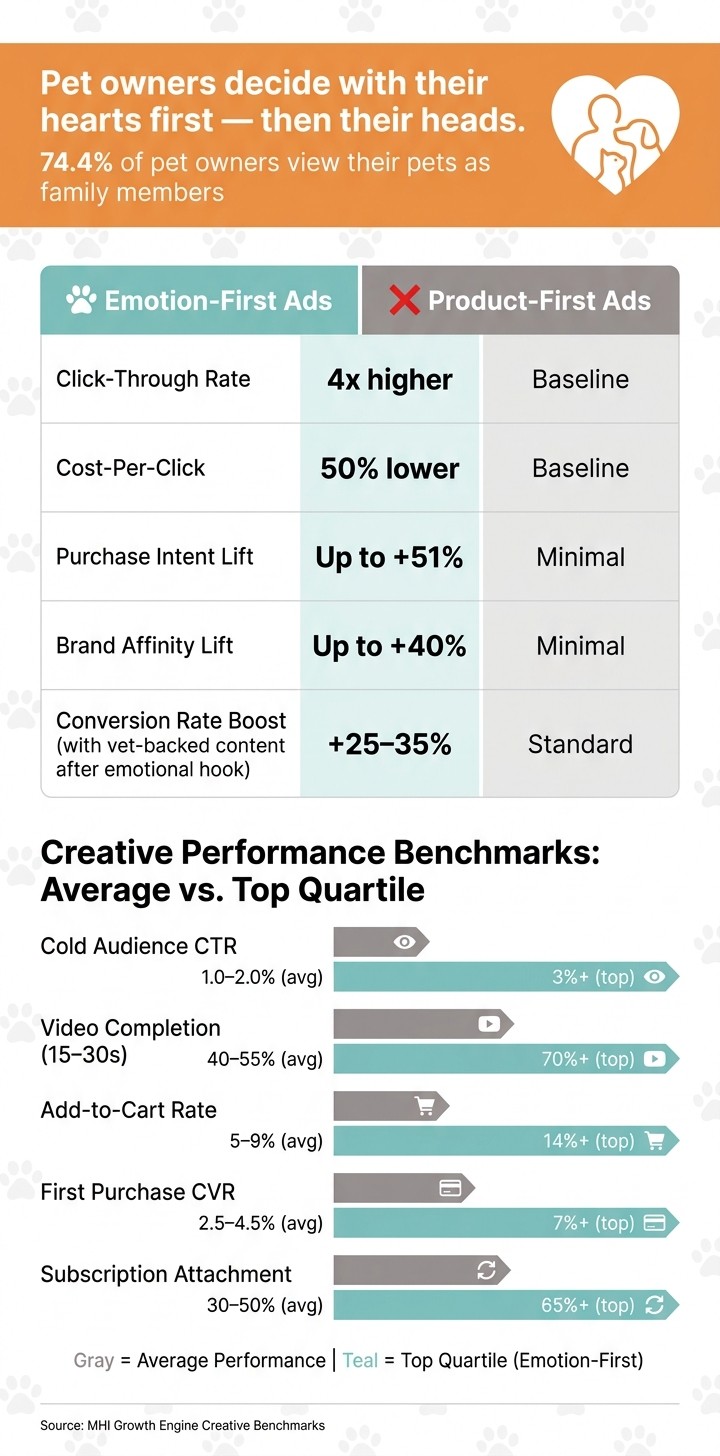
Emotion-first creative is a game-changer in pet marketing, delivering results that far outpace product-first approaches. Why? Because pet owners think like caregivers, not typical consumers. For them, product details - like ingredients, clinical proof, or price - serve as secondary reassurances after an emotional connection has been made. The emotional hook needs to come first.
The numbers support this. Take Hill's Pet Nutrition's campaign: emotional storytelling led to significant increases in purchase intent and brand loyalty. Similarly, UGC-style testimonial ads in the pet category outperform traditional branded content with 4x higher click-through rates and 50% lower cost-per-click - a clear testament to the power of emotional storytelling.
The most impactful pet campaigns share three key elements: they make the pet the visual centerpiece, appeal to the owner's identity as a caregiver, and follow emotion with logical proof instead of leading with it. For instance, introducing veterinary-backed content after an emotional narrative can boost conversion rates by 25-35%.
This article delves into the behavioral science behind these findings, offering actionable frameworks like the PET Messaging Framework (Pet-Emotion-Transformation) and the Emotion Ladder to help marketers consistently execute emotion-driven strategies. Whether you're crafting a cold-audience acquisition campaign or enhancing subscription retention, these principles apply across every stage of the marketing funnel.
Metric | Average Performance | Top Quartile Performance |
|---|---|---|
Cold Audience CTR | 1.0-2.0% | 3%+ |
Video Completion (15-30s) | 40-55% | 70%+ |
Add-to-Cart Rate | 5-9% | 14%+ |
First Purchase CVR | 2.5-4.5% | 7%+ |
Subscription Attachment | 30-50% | 65%+ |
Source: MHI Growth Engine Creative Benchmarks
These metrics highlight why prioritizing emotion-first creative is essential for pet marketing agencies. The difference between average and top-tier performance is substantial, and emotion-first strategies are the driving force behind that gap. This foundation sets the stage for exploring creative frameworks designed to deepen emotional engagement and drive results.
Why Emotion-First Creative Wins in Pet Marketing
Emotion-first creative consistently outshines product-first ads in pet marketing because pet owners often shop with their hearts rather than their heads. Much like parents, they make decisions driven by love, concern, and a deep desire to care for their non-verbal companions. This emotional connection forms the backbone of every successful pet marketing campaign.
How Pet Purchase Decisions Are Driven by Emotion
Pet owners make emotional decisions first, then seek logical reasons to back them up. With 74.4% of pet owners viewing their pets as family members, their mindset is more about caregiving than consumerism. This shift explains why leading with emotional storytelling is far more effective than focusing solely on product features.
Bigeye's 2023 National Pet Owners Study found 97% of owners see their pet as family, 57% say "like a child," and 79% say their pet gives them happiness or support.
Since pets can’t directly express satisfaction, pet owners rely on emotional signals like a shinier coat, increased energy, or a happy wagging tail. These visible improvements, often seen over weeks or months, provide reassurance that they’ve made the right choice. In essence, what’s being sold isn’t just the product - it’s the peace of mind that comes from knowing, "I’m doing the best for my pet."
A particularly strong emotional driver is pet parent guilt - the worry that they’re not doing enough for their furry family members. Hill’s Pet Nutrition tapped into this effectively with its "Pet Confessions" campaign in June 2026. The campaign featured creator-led videos where pets "wrote" heartfelt letters of unconditional love to their owners. According to a Nielsen study, this approach led to significant boosts in social views, awareness, brand connection, and purchase intent. This demonstrates the measurable impact of prioritizing emotion in marketing.
By contrast, ads that focus solely on product features often fail to connect with pet owners on this deeper level.
The Problems with Product-First Ads
Given how emotionally charged pet purchase decisions are, product-first ads often miss the mark. These ads typically lead with technical details - like protein content, ingredient sourcing, or certifications. While these facts may be relevant, they don’t tap into the emotional "why" that pet owners need to feel invested. For instance, starting an ad with "real salmon as the first ingredient" answers a question the viewer may not even be asking yet. Without an emotional hook, even the strongest product claims risk being ignored.
As MHI Growth Engine explains:
"The emotional close ('seeing him run around again at 10 years old makes everything worth it') is often what triggers the viewer's purchase decision, not the ingredient list."
Data backs this up. Ads that focus on the bond between humans and pets - like user-generated content (UGC) featuring real owners sharing their journeys - achieve 4x higher click-through rates and 50% lower cost-per-click compared to traditional product-focused ads. These results aren’t about flashy production or big budgets; they’re about emotional relevance. Overly polished, feature-heavy ads can feel insincere and even foster distrust.
A successful pet marketing strategy builds emotional trust first, then follows up with rational proof to convert interest into action. This is the approach Bigeye, a pet marketing agency informed by its National Pet Owners Study, consistently takes. By starting with consumer insights and leading with emotion, Bigeye helps pet brands craft campaigns that truly resonate.
What Are the Core Principles of Emotion-First Creative in Pet Marketing?
Emotion-first creative in pet marketing revolves around three main principles: focusing on the pet-parent relationship, using behavioral science to enhance emotional resonance, and ensuring that all creative elements - visuals, copy, and tone - work together to evoke a specific emotional response. These principles are designed to create campaigns that resonate deeply with pet owners. Let’s explore how each principle strengthens the connection between pets and their caregivers.
Lead with the Pet-Parent Bond
Successful pet marketing begins by emphasizing the deep connection between pets and their owners. In this narrative, the pet takes center stage, while the product is portrayed as a tool that helps the pet thrive. This approach signals to the audience that the campaign prioritizes their bond with their pet, rather than simply pushing a product.
Today’s pet owners, particularly Millennials and Gen Z, approach pet care with the same dedication and research they apply to their own well-being. They view themselves as caregivers, and marketing that highlights this role consistently outperforms messages focused solely on product features. A powerful way to reinforce this bond is by showcasing the owner’s emotional journey - from initial worry about their pet’s health to the joy of seeing them thrive. Bigeye, a pet marketing agency informed by its National Pet Owners Study, taps into this emotional arc to create authentic connections.
Apply Behavioral-Science Principles
Behavioral science offers three powerful tools for pet marketing: identity framing, loss aversion, and social proof. These strategies build trust and inspire action.
Identity framing appeals to the owner’s sense of self. Buying premium pet products signals that the owner is informed, caring, and selective. Phrases like "For dog owners who refuse to compromise" reinforce the aspirational identity of being a responsible pet parent.
Loss aversion is equally compelling. Messaging that addresses safety, transparency, and risk removal taps into the protective instincts of pet owners. Highlighting veterinary endorsements can also significantly boost trust. Studies show that veterinary-backed content can achieve 25-35% higher conversion rates compared to standard brand messaging.
Social proof reassures pet owners through testimonials, reviews, and endorsements, helping them feel confident in their choices.
Match Visuals, Copy, and Tone to the Emotion You Want to Trigger
To create a cohesive emotional experience, every element of an ad - visuals, headlines, body copy, and calls to action - should work together toward the same emotional goal. Visuals should focus on the pet, using close-ups to evoke empathy. The setting also plays a crucial role; familiar, domestic environments like sunny kitchens or cozy bedrooms outperform generic outdoor scenes because they reinforce the pet’s role as a cherished family member.
The copy should directly address the owner’s motivations, such as their sense of responsibility, pride, or relief. The tone should transition from empathetic to reassuring, offering solutions to their concerns. Specific claims, like measurable benefits, tend to outperform vague statements, often doubling click-through rates. As the CineRads team explains:
"The animal does not need to be on camera. The owner's emotional connection to their pet is the actual sales driver."
What Frameworks Can Marketers Use to Build Emotion-First Pet Campaigns?
A defined framework ensures pet marketing campaigns stay focused on emotional connections, rather than defaulting to product features. By emphasizing emotion-first principles, these frameworks provide actionable strategies for crafting campaigns that resonate deeply with pet owners.
The Emotion Ladder for Pet Buyers
The Emotion Ladder identifies and ranks the emotional states that most influence pet-related decisions. It helps creative teams prioritize messaging by starting with the emotion that holds the strongest sway over their audience and then working down the ladder.
An analysis of over 3,400 pet advertisements revealed that Nurturance - feelings of care, comfort, and warmth - is the most influential emotional driver, scoring 7.1 out of 10. Security (safety and trust) follows with a score of 5.2, while Esteem (self-worth and identity) ranks third at 4.3 for image-based ads. As MHI Growth Engine explains:
"The viewer's emotional response to the animal earns the attention that the product then has to justify."
In practice, this approach works by first capturing attention through Nurturance, such as a close-up of a dog's face or a tender moment between a pet and its owner. Next, Security builds trust through elements like veterinary endorsements or transparent ingredient lists. Finally, Esteem reinforces loyalty with messaging like "For owners who refuse to compromise." This sequence mirrors the way pet owners naturally think - emotions come first, followed by rational validation.
The PET Messaging Framework: Pet, Emotion, Transformation
The PET framework structures campaign messaging into three key elements. First, the Pet becomes the visual and narrative centerpiece, not the product. Close-ups of a pet's face create immediate emotional engagement. Second, the Emotion introduces a relatable truth about pet ownership, such as the joy of giving your pet the best or the anxiety of seeing them struggle. Finally, the Transformation highlights a clear, measurable result - like a senior dog climbing stairs again or a rescue cat enjoying its food for the first time.
What makes this framework effective is its sequence. It begins with an emotional connection, followed by rational proof like ingredient quality or veterinary endorsements. As MHI Media notes:
"The winning pattern: open with an emotional truth about pet ownership, transition to how your product enables that emotional outcome, then substantiate with product specifics."
As a pet marketing agency drawing on its National Pet Owners Study, Bigeye uses this approach to create campaigns that feel personal and relatable rather than overtly promotional.
The Feeling → Outcome → Action Ad Structure
This framework is highly adaptable, working seamlessly across platforms like Meta, YouTube, email, and retail media. The structure begins with The Feeling, a relatable scenario that resonates with pet owners' sense of responsibility. Examples include: "My 7-year-old lab started avoiding the stairs and I didn't know what to do" or "Every time I leave the house, Juni acts like it's the end of the world".
Next, The Outcome replaces vague claims with specific, time-bound results, such as "visible difference in morning stiffness by week 2" or "92% of dogs ate it on the first try". Ads featuring precise outcomes often double click-through rates compared to generic claims.
Finally, The Action provides an easy, low-pressure call-to-action. Instead of generic "Shop Now" buttons, options like "Try the 30-day starter pack" or "Build your pet's plan" reduce barriers and maintain the ad's emotional tone. This structure not only guides viewers smoothly through the ad but also allows for ongoing optimization to ensure emotional triggers remain effective.
How to Test and Optimize Emotion-First Creative
Testing emotion-first campaigns requires a more detailed approach than standard A/B testing. The focus is on the emotional entry point, not just the headline or image. A useful method involves creating a 27-variation system, testing three different Feelings (problem-led, failure-led, discovery-led), three Outcomes (ingredients, timelines, validation), and three Actions (urgency, value, risk reversal). This approach pinpoints which emotional triggers are driving performance, removing guesswork from optimization.
Key metrics to monitor include achieving a cold-audience click-through rate (CTR) above 3%, a video completion rate of over 70% for 15-30 second ads, and a first-purchase conversion rate of more than 7%. If an ad underperforms, the first element to review is the emotional hook. A weak Feeling at the start rarely recovers, even with a strong CTA at the end.
How Should You Structure Your Team and Agency to Run Emotion-First Pet Campaigns?
To successfully execute emotion-first pet campaigns, your internal team and pet marketing agency need more than just a shared brief - they need a shared way of thinking. Aligning both sides with the same emotional framework ensures campaigns maintain consistency across platforms and assets, preserving the emotional impact from concept to production. This approach builds on the emotion-first frameworks discussed earlier, fostering a unified creative vision.
Start with a shared framework. The HEART strategy - Health, Emotional Connection, Authentic Moments, Reassurance, Transformation - provides a consistent lens for evaluating creative work. When everyone, from copywriters to media buyers, references the same model, feedback becomes faster and more precise. This eliminates any confusion about whether an ad resonates emotionally.
Set clear messaging guardrails to ensure emotional consistency. From the start, establish a simple "Do and Don’t" list for emotional tone. For instance, use phrases like "family member" or "fur baby" to reflect how pet owners view their animals, but avoid using guilt-based tactics or exploiting grief. Research consistently demonstrates that genuine, heartfelt marketing resonates better than manipulative approaches. These guardrails protect your brand reputation while keeping creative efforts aligned with building trust over time.
Use a four-week creative calendar to keep everyone aligned. Start with a briefing in Week 1 to identify three emotional hook angles based on past performance. In Week 2, test variations with a modest budget to gather early data. By Week 3, analyze performance metrics like click-through rates (CTR) and cost-per-click (CPC) to identify the top-performing creative pieces. In Week 4, use the winning emotional strategies to refine your next iteration. This structured timeline ensures your team and agency work in sync while continuously improving results.
Leverage a hybrid production model to maximize strengths. Your internal team can provide authentic content, like product B-roll, real customer photos, and expert insights from veterinarians or founders. Meanwhile, your agency - especially one like Bigeye, equipped with insights from its National Pet Owners Study - can transform these raw materials into polished, high-impact narratives. This approach combines authenticity with professional storytelling, boosting conversion rates by using relatable and credible assets.
Define "emotional effectiveness" through shared metrics. Beyond standard CTR and conversion rates, track metrics like comment sentiment, share rates, and subscription attachment rates. Setting benchmarks - such as achieving a 3%+ CTR with cold audiences or a 65%+ subscription attachment rate - creates a common understanding between your team and agency. This shared framework not only streamlines communication but also amplifies the overall success of your campaigns.
What's the Bottom Line on Emotion-First Pet Marketing?
Here’s the takeaway: adopting an emotion-first approach is a game-changer for pet brands. With over 90 million U.S. households making pet-related purchases based on emotional connections - fueled by a sense of pet-parent responsibility - brands that focus solely on product details risk missing the mark entirely.
The frameworks outlined earlier, such as the Emotion Ladder, PET Messaging Framework, and the Feeling → Outcome → Action structure, provide a clear, repeatable process for using emotional triggers to drive conversions. These tools ensure your creative efforts are tied to measurable results rather than relying on generic sentimental appeals. By integrating these strategies, your pet marketing agency can align its creative work with emotion-first principles, setting the stage for stronger performance.
Data backs this up: leading direct-to-consumer (DTC) pet brands consistently outperform category averages with click-through rates exceeding 3%, first-purchase conversions surpassing 7%, and subscription attachment rates climbing above 65%. These results aren’t anomalies - they’re the outcome of a disciplined emotional strategy applied across creative, copy, and media.
If your pet ads are heavy on ingredients and light on the bond, talk to Bigeye. Our pet marketing team can test emotional angles with real pet parents through EyeQ, with results in about 72 hours, before you put media behind them.
Related from Bigeye
Service: Brand Strategy and Creative Design
Case study: Cat's Pride

Paid Media & Performance
Oct 7, 2026
A retail media strategy for 2027 in eight steps, with Bigeye shopper research and current data on Amazon, Walmart, Instacart and measurement.