
Google Ads for Pet Brands: Scale Spend Without Killing ROAS
Pet brands scaling Google Ads face a tough challenge: how to grow ad spend while protecting ROAS. With CPCs up over 20% since 2024, a poorly planned strategy can quickly lead to wasted budgets and lower profitability. This guide breaks down actionable methods for scaling Google Ads campaigns effectively, covering audience segmentation, ad creative, and budget strategies tailored to pet product marketing. By the end, you’ll know how to scale campaigns that drive results without eroding margins.
TL;DR:
Scaling Google Ads requires tying ROAS targets to LTV and contribution margin. Avoid focusing solely on first-purchase revenue.
Segment audiences by species, life stage, and health needs. Tailored targeting improves ad efficiency and results.
Use modular ad messaging with emotional hooks, rational proof, and trust signals. Align ads with user intent for better performance.
Increase budgets incrementally (15–20%) only after stable ROAS. Avoid disrupting algorithm learning by scaling too quickly.
Track KPIs like CAC, ROAS, and contribution margin by SKU. Monitor performance closely to identify and fix inefficiencies.
How Should Pet Brands Build Ad Creatives That Actually Convert on Google?
Creating ad creatives that resonate with pet owners while maintaining a strong return on ad spend (ROAS) is key for scaling campaigns effectively. Unlike social media, where content often sparks discovery, Google Ads thrive on addressing the specific intent of pet owners. Every ad must act as an immediate answer to a question the user is already asking. This intent-driven approach requires a tailored strategy that aligns the search query, ad copy, and landing page seamlessly.
Google Ads Creative vs. Social Media Creative
Social media platforms like Meta or TikTok rely on eye-catching, scroll-stopping content. For instance, a video of a golden retriever enjoying a meal might perform well on these platforms, drawing viewers in through emotional appeal. On Google, though, the same video would fall flat if it doesn’t directly address the user’s search intent. A pet owner searching for "grain-free puppy food for sensitive stomachs" expects a solution tailored to their query - not a generic or unrelated ad. This highlights the importance of aligning Google Ads with user intent, ensuring the ad copy and landing page provide an immediate and relevant answer.
Modular, Pet-Specific Ad Messaging
A smart way to scale Google Ads is by using modular messaging. This involves creating interchangeable components - such as species-specific headlines, targeted health benefits, and trust-building elements - that can be mixed and matched across campaigns. For example, a headline like "Joint Support for Senior Labs" will resonate far more with a Labrador owner than a vague "Premium Dog Food." This approach mirrors how pet owners think about their pets' unique needs.
The structure of these ads should include three key elements:
Emotional hooks that highlight the bond between pets and their owners.
Rational proof with measurable outcomes, such as "shinier coat in 3–4 weeks."
Trust signals like veterinary endorsements or positive customer reviews.
This modular strategy is especially helpful for subscription-based pet brands, where potential customers often hesitate due to concerns about long-term commitment. By addressing these pain points directly, advertisers can reduce barriers to conversion.
Ad Creative Best Practices by Google Surface
Different Google surfaces require tailored creative approaches to maximize performance:
Search Ads: Focus on concise, solution-oriented headlines that directly address user queries. For example, "Best Food for Dogs with Allergies" is far more effective than a brand-focused tagline.
Performance Max and YouTube: These formats benefit from storytelling and visual transformation. “Before and after” videos showcasing improvements in a pet’s coat or energy level tend to perform well. Custom video assets are crucial here, as auto-generated videos from static images often underperform.
Shopping Ads: Success depends on clean, high-quality product imagery and precise product titles. Given that over 60% of pet product searches happen on mobile devices, ensure images and text are optimized for smaller screens to capture mobile shoppers effectively.
Testing and Refining Ad Creative
Testing and refining your creatives is an ongoing process. A great example is ManyPets, a pet insurance brand that saw a 21% increase in sales, a 20% drop in CPA, and a 13% boost in overall ROAS by leveraging fully automated Performance Max campaigns. By uploading a wide range of creative assets - headlines, descriptions, and visuals - they gave Google’s machine learning tools the resources to optimize for conversions effectively.
As Hélène Vincent, Head of Performance Marketing at ManyPets, explained:
"The main appeal of opting for Performance Max campaigns was having access to an extensive ads inventory from a single automated campaign, all optimised to our conversion goals."
To maximize results:
Allow a 14-day window for machine learning to optimize new creative assets.
Review search term reports weekly to understand the exact language your audience uses.
Refresh creative assets at least every 30 days. Advertisers who do this see an average 17% boost in conversion value.
Keeping a detailed creative log can help track what works and what doesn’t, ensuring continuous improvement in campaign performance.
How Do You Build Audience Targeting for Pet Owners That Protects ROAS?
Targeting pet owners effectively involves understanding their decision-making signals and aligning your strategy with their emotional and practical purchase triggers. The key is to focus your budget on reaching those most likely to convert, rather than casting a wide net over general pet enthusiasts. As the Sona Editorial Team aptly states:
"Pet food advertising thrives on understanding intent signals. Identifying which visitors are actively researching premium kibble, specialty diets, or local delivery options allows brands to allocate budget to high-value audiences."
Conversion Tracking and Data Setup
A strong foundation in conversion tracking is essential for any audience strategy. Use Google Tag Manager to track all critical actions - such as calls, form submissions, purchases, and offline conversions. This setup ensures Google's AI can optimize campaigns based on meaningful business outcomes, not just superficial metrics like clicks.
For e-commerce pet brands, enhanced conversions and value-based bidding allow you to focus on higher-value transactions. Additionally, importing offline conversion data - like a customer who clicks an ad but completes the purchase over the phone - helps close attribution gaps, giving you a clearer picture of campaign performance.
First-Party and In-Platform Audience Segments
With tracking in place, create a structured audience strategy using three tiers: Affinity, In-Market, and Custom Intent.
Affinity segments (e.g., "Pet Lovers") are great for building upper-funnel awareness.
In-Market segments (e.g., "Dog Food & Supplies" or "Cat Food & Supplies") target users actively comparing and purchasing products.
Custom Intent audiences allow you to refine further by focusing on specific keywords or URLs, such as "grain-free senior dog food" or competitor product pages.
First-party data offers even greater potential. By syncing your CRM with Google's Customer Match, you can target high-value customers, exclude current subscribers from acquisition campaigns, and create lookalike audiences modeled on your best buyers. Using Customer Match with Performance Max campaigns has shown to drive noticeable improvements in sales and ROAS.
Layering and Sequencing Audiences
Audience segmentation becomes even more effective when paired with demographic and behavioral layering. For example, combine In-Market segments with filters like income level or life stage to zero in on premium pet owners. Retarget cart abandoners within 48 hours using urgency-driven messaging, and set a 7-day window for users who have viewed products but not purchased. Additionally, use past purchase data to trigger reminders for replenishment based on typical usage cycles.
Geographic and Contextual Bid Adjustments
Geography significantly influences pet owner behavior. Urban owners often prioritize space-saving products, portable gear, and on-demand services, while suburban and rural owners may focus on outdoor supplies, larger items, and preventive care. For local pet services, targeting within a 3–15 mile radius and pairing it with local intent signals can improve cost efficiency.
Seasonality also plays a major role in shaping demand. For instance, dog grooming searches spike by 40% ahead of major holidays like Thanksgiving and Christmas. Allocating 10–15% of your budget to test new approaches during seasonal surges - such as spring adoption periods or summer flea prevention - can keep your campaigns competitive. Start new audience segments in Observation mode to gather data before making bid adjustments. For consistently high-performing segments, consider increasing bids by 25% to maximize ROAS.
These strategies, when combined with thoughtful creative and budget planning, ensure that every piece of your Google Ads campaign works together to deliver measurable results.
How Should Pet Brands Structure Budgets to Scale Google Ads Without Losing ROAS?
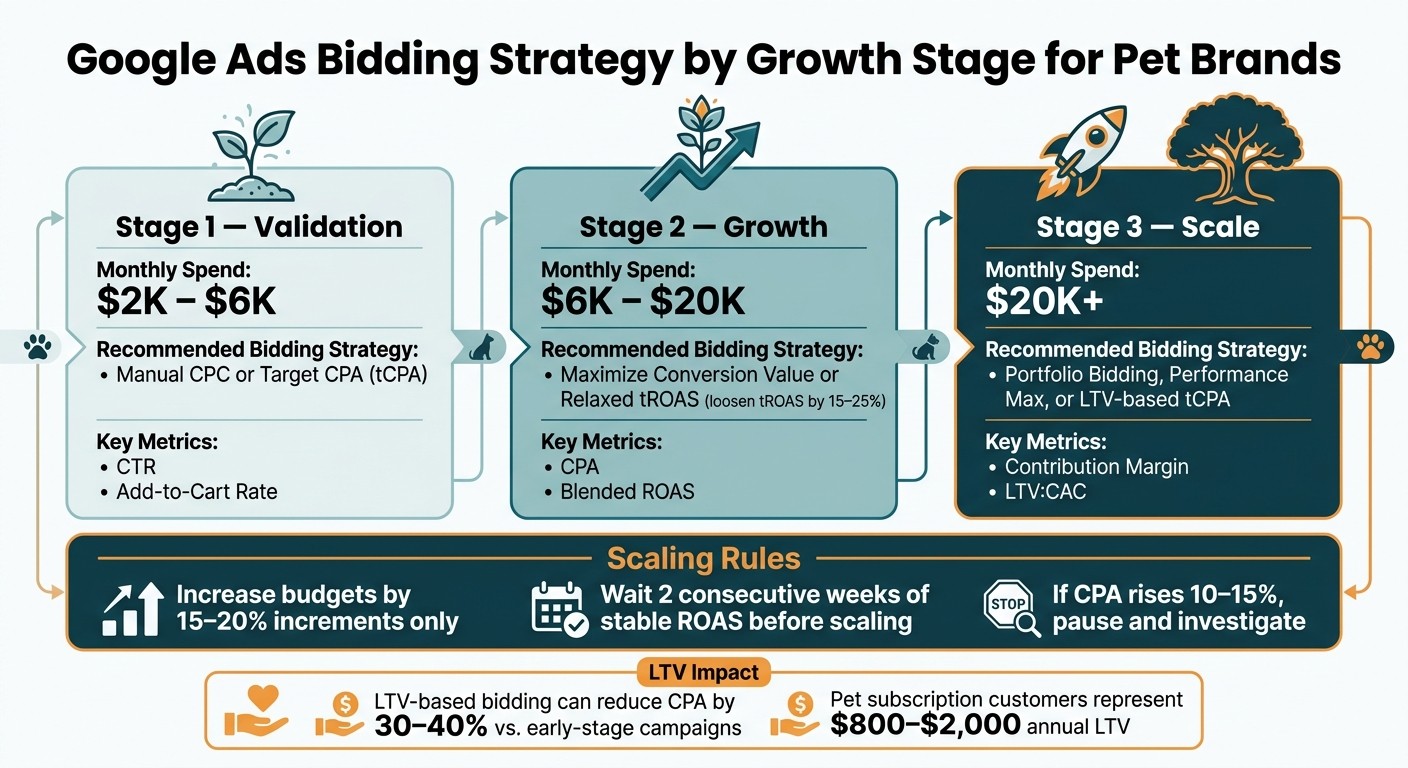
Google Ads Bidding Strategy by Growth Stage for Pet Brands
Scaling Google Ads effectively while maintaining a healthy ROAS demands a well-thought-out budget structure. It’s not just about spending more - it’s about spending smarter. Many pet brands fall into the trap of ramping up budgets on campaigns that aren’t optimized for growth. The key lies in organizing your account properly, selecting the right bidding strategies for your growth stage, and only increasing budgets when performance data supports it.
Baseline Campaign Structure
Before making any budget adjustments, ensure your campaigns are well-organized. Separate branded, category-specific, and competitor conquesting terms into distinct campaigns. This segmentation allows for better control over spending and clearer attribution of what’s driving conversions.
For Performance Max campaigns, avoid lumping everything into a single, broad asset group. A Shopify-based pet supplies brand demonstrated the power of restructuring by creating multiple asset groups tailored to product niches and animal types. They also optimized their product feed with attributes like breed and size. Over three months, a $15,100 spend yielded $208,000 in conversion value, achieving a 13.8x ROAS and a 40% year-over-year sales increase. This example shows how a focused structure can lead to outstanding results.
Once your campaign structure is optimized, the next step is aligning your bidding strategy with your brand’s growth stage.
Bidding Strategies by Growth Stage
Your growth stage should guide your bidding strategy. Here’s a framework to consider:
Growth Stage | Monthly Spend | Recommended Bidding Strategy | Key Metrics |
|---|---|---|---|
Validation | $2K – $6K | Manual CPC or Target CPA (tCPA) | CTR, Add-to-Cart Rate |
Growth | $6K – $20K | Maximize Conversion Value or a relaxed tROAS | CPA, Blended ROAS |
Scale | $20K+ | Portfolio Bidding, Performance Max, or LTV-based tCPA | Contribution Margin, LTV:CAC |
During the validation phase, manual bidding helps pinpoint the best-performing creative and audience combinations. As you move into the growth phase, relaxing your Target ROAS by 15–25% gives Google’s algorithm the flexibility to explore new opportunities and avoid hitting a ceiling. Alexander Perleman, Head of Product at groas, explains:
"A 700% tROAS tells Google to only bid on the cheapest, most obvious conversions. That works fine at low spend, but it creates a hard ceiling. Scaling requires accepting slightly lower marginal efficiency to unlock significantly higher total profit."
At the scaling stage, brands often shift to LTV-based bidding, which can reduce CPA by 30–40% compared to earlier campaigns.
Rules for Incremental Budget Increases
One of the most common mistakes when scaling is increasing budgets too quickly. Raising a campaign’s budget by more than 20% at once can disrupt Google’s learning algorithm, causing a performance dip that may last 2–3 weeks.
Instead, increase budgets incrementally - by 15–20% - only after achieving stable ROAS for at least two consecutive weeks. Allow 2–3 weeks for the system to adjust after each increase. If CPA rises by more than 10–15% during this period, pause further increases and investigate potential issues before proceeding. Once performance stabilizes, you can gradually tighten ROAS or CPA targets back toward your efficiency goals.
Structural Levers for Scaling
Account structure adjustments can also play a critical role in scaling while maintaining ROAS. For example:
Remarketing Lists for Search Ads (RLSA): Use RLSA to bid more aggressively on previous site visitors who search for category-specific terms.
Negative Keywords: Exclude low-intent terms like "free", "DIY", "cheap", and "jobs" to prevent budget waste.
Enhanced Shopping Feeds: If you’re running Shopping campaigns, enrich your Google Merchant Center feed with breed-specific and size-specific attributes to improve product relevance and boost conversion rates.
For subscription-based models, like auto-ship for pet food or supplements, the predictable revenue from recurring orders justifies more aggressive top-of-funnel bidding. Pet owners with recurring purchase habits can represent an annual LTV of $800–$2,000, providing a solid basis for investing more in acquiring these high-value customers.
How Do You Track and Fix Performance Problems When Scaling Pet Google Ads?
Scaling Google Ads for pet brands requires meticulous monitoring to ensure campaigns remain profitable as budgets grow. Small inefficiencies can quickly escalate, making it essential to focus on metrics like contribution margin, ROAS (Return on Ad Spend), and CAC (Customer Acquisition Cost). By tracking performance at the SKU level, brands can identify which campaigns are driving results and which are underperforming. This granular approach lays the groundwork for pinpointing key performance indicators (KPIs) that guide adjustments.
Which KPIs Should Pet Brands Monitor at the Campaign Level?
The most relevant KPIs depend on your business model. For direct-to-consumer pet food brands, prioritize metrics such as add-to-cart rate, purchase conversion rate, revenue per click, and ROAS. Subscription-based businesses, like auto-ship pet food or supplements, should also monitor subscription sign-up rates and customer lifetime value alongside traditional e-commerce metrics. Meanwhile, service-focused businesses - such as veterinary clinics, grooming salons, or pet training services - should emphasize cost per lead, phone call duration, and appointment booking rates over direct revenue.
It's crucial to reconcile data from Google Ads, GA4, and your CRM to ensure consistency. Misaligned metrics can lead to poor decisions, with discrepancies ranging from 7% to 23%. Always verify that your data aligns across platforms before making strategic changes.
How Do You Diagnose a ROAS Drop or Rising CPCs When Scaling?
A sudden drop in ROAS or rising CPCs (Cost Per Click) often signals issues like creative fatigue, overly broad targeting, or aggressive budget increases. Creative fatigue, for instance, can cause click-through rates to drop by 18% to 31% within 6–8 weeks of elevated spending, while CPCs can rise by 12% to 27%. To avoid these pitfalls, refrain from increasing budgets by more than 20% at a time - larger jumps can destabilize performance for 2–3 weeks as algorithms recalibrate.
Another common issue is branded term cannibalization, where branded keywords inflate ROAS figures while draining budget. To counteract this, add your brand name as a negative keyword in Performance Max campaigns.
How Should Pet Brands Structure Seasonal Tests and Audience Experiments?
Seasonal trends and audience experiments are valuable tools for fine-tuning campaigns. Pet brands can leverage seasonal demand patterns to maximize efficiency. For example, grooming services often peak from May to July and before the holidays, while boarding services see increased demand around Thanksgiving, Christmas, and spring break. Training services typically experience spikes from January to March and again in September. Adjusting budgets by 30–50% during these high-demand periods and scaling back in slower months can help align spending with customer intent.
When testing new creative or audience segments in Performance Max campaigns, allow a two-week learning period. ManyPets demonstrated the importance of this approach by optimizing their headlines, descriptions, and creative assets while incorporating first-party data through Customer Match. This strategy resulted in a 21% increase in sales and a 20% reduction in CPA (Cost Per Acquisition). Hélène Vincent, Head of Performance Marketing at ManyPets, highlighted the value of data and creative volume, stating:
"Machine learning works on volume. The more data, creative assets, and well-crafted messaging you can put in, the faster and potentially better the optimisation."
During active tests, review performance every three days. Keep an eye on negative keywords, conversion data, and bids to identify and address potential issues before they escalate. Regular adjustments ensure campaigns stay on track, even as market conditions shift.
FAQs
×
How do I set a ROAS target using LTV and contribution margin?
To determine a ROAS target using lifetime value (LTV) and contribution margin, start by calculating your contribution margin. This involves subtracting variable costs like cost of goods sold (COGS) and shipping from your revenue. Next, use LTV to project the total revenue a customer is expected to generate over their lifetime. Your break-even ROAS can be found using the formula: 1 ÷ contribution margin percentage. Aim for a ROAS target higher than this break-even point to ensure your Google Ads campaigns remain profitable and promote long-term growth.
×
What’s the best way to segment pet audiences by species and needs?
To segment pet audiences effectively, it's essential to move beyond broad categories like "dog" or "cat owners." Instead, dive into specific needs, behaviors, and life stages to create more tailored campaigns. Consider structuring your approach around:
Product preferences: For example, differentiate between buyers of dry food, wet food, or treats.
Life stages or health concerns: Target pet owners based on their pet’s age (puppy, adult, senior) or specific health needs like grain-free diets or joint care.
Purchase intent: Identify whether the audience is in the research phase, comparing options, or ready to make a purchase.
For even sharper targeting, combine demographic data with custom segments built from search behaviors, visited websites, or app usage patterns. This layered strategy helps ensure your message reaches the right audience at the right time.
×
How can I scale budgets without triggering a ROAS drop?
To grow budgets without compromising ROAS, concentrate on targeting high-intent audiences and making data-based adjustments. Focus on keywords that show strong potential for driving conversions, and use negative keywords to filter out irrelevant traffic that could drain your budget. Ensure you have reliable conversion tracking in place to pinpoint your best-performing campaigns, then scale those with care. Leverage first-party data to fine-tune audience segments - for instance, retargeting based on specific pet types - to ensure that increased spending reaches the most qualified and relevant prospects.
Pet brands scaling Google Ads face a tough challenge: how to grow ad spend while protecting ROAS. With CPCs up over 20% since 2024, a poorly planned strategy can quickly lead to wasted budgets and lower profitability. This guide breaks down actionable methods for scaling Google Ads campaigns effectively, covering audience segmentation, ad creative, and budget strategies tailored to pet product marketing. By the end, you’ll know how to scale campaigns that drive results without eroding margins.
TL;DR:
Scaling Google Ads requires tying ROAS targets to LTV and contribution margin. Avoid focusing solely on first-purchase revenue.
Segment audiences by species, life stage, and health needs. Tailored targeting improves ad efficiency and results.
Use modular ad messaging with emotional hooks, rational proof, and trust signals. Align ads with user intent for better performance.
Increase budgets incrementally (15–20%) only after stable ROAS. Avoid disrupting algorithm learning by scaling too quickly.
Track KPIs like CAC, ROAS, and contribution margin by SKU. Monitor performance closely to identify and fix inefficiencies.
How Should Pet Brands Build Ad Creatives That Actually Convert on Google?
Creating ad creatives that resonate with pet owners while maintaining a strong return on ad spend (ROAS) is key for scaling campaigns effectively. Unlike social media, where content often sparks discovery, Google Ads thrive on addressing the specific intent of pet owners. Every ad must act as an immediate answer to a question the user is already asking. This intent-driven approach requires a tailored strategy that aligns the search query, ad copy, and landing page seamlessly.
Google Ads Creative vs. Social Media Creative
Social media platforms like Meta or TikTok rely on eye-catching, scroll-stopping content. For instance, a video of a golden retriever enjoying a meal might perform well on these platforms, drawing viewers in through emotional appeal. On Google, though, the same video would fall flat if it doesn’t directly address the user’s search intent. A pet owner searching for "grain-free puppy food for sensitive stomachs" expects a solution tailored to their query - not a generic or unrelated ad. This highlights the importance of aligning Google Ads with user intent, ensuring the ad copy and landing page provide an immediate and relevant answer.
Modular, Pet-Specific Ad Messaging
A smart way to scale Google Ads is by using modular messaging. This involves creating interchangeable components - such as species-specific headlines, targeted health benefits, and trust-building elements - that can be mixed and matched across campaigns. For example, a headline like "Joint Support for Senior Labs" will resonate far more with a Labrador owner than a vague "Premium Dog Food." This approach mirrors how pet owners think about their pets' unique needs.
The structure of these ads should include three key elements:
Emotional hooks that highlight the bond between pets and their owners.
Rational proof with measurable outcomes, such as "shinier coat in 3–4 weeks."
Trust signals like veterinary endorsements or positive customer reviews.
This modular strategy is especially helpful for subscription-based pet brands, where potential customers often hesitate due to concerns about long-term commitment. By addressing these pain points directly, advertisers can reduce barriers to conversion.
Ad Creative Best Practices by Google Surface
Different Google surfaces require tailored creative approaches to maximize performance:
Search Ads: Focus on concise, solution-oriented headlines that directly address user queries. For example, "Best Food for Dogs with Allergies" is far more effective than a brand-focused tagline.
Performance Max and YouTube: These formats benefit from storytelling and visual transformation. “Before and after” videos showcasing improvements in a pet’s coat or energy level tend to perform well. Custom video assets are crucial here, as auto-generated videos from static images often underperform.
Shopping Ads: Success depends on clean, high-quality product imagery and precise product titles. Given that over 60% of pet product searches happen on mobile devices, ensure images and text are optimized for smaller screens to capture mobile shoppers effectively.
Testing and Refining Ad Creative
Testing and refining your creatives is an ongoing process. A great example is ManyPets, a pet insurance brand that saw a 21% increase in sales, a 20% drop in CPA, and a 13% boost in overall ROAS by leveraging fully automated Performance Max campaigns. By uploading a wide range of creative assets - headlines, descriptions, and visuals - they gave Google’s machine learning tools the resources to optimize for conversions effectively.
As Hélène Vincent, Head of Performance Marketing at ManyPets, explained:
"The main appeal of opting for Performance Max campaigns was having access to an extensive ads inventory from a single automated campaign, all optimised to our conversion goals."
To maximize results:
Allow a 14-day window for machine learning to optimize new creative assets.
Review search term reports weekly to understand the exact language your audience uses.
Refresh creative assets at least every 30 days. Advertisers who do this see an average 17% boost in conversion value.
Keeping a detailed creative log can help track what works and what doesn’t, ensuring continuous improvement in campaign performance.
How Do You Build Audience Targeting for Pet Owners That Protects ROAS?
Targeting pet owners effectively involves understanding their decision-making signals and aligning your strategy with their emotional and practical purchase triggers. The key is to focus your budget on reaching those most likely to convert, rather than casting a wide net over general pet enthusiasts. As the Sona Editorial Team aptly states:
"Pet food advertising thrives on understanding intent signals. Identifying which visitors are actively researching premium kibble, specialty diets, or local delivery options allows brands to allocate budget to high-value audiences."
Conversion Tracking and Data Setup
A strong foundation in conversion tracking is essential for any audience strategy. Use Google Tag Manager to track all critical actions - such as calls, form submissions, purchases, and offline conversions. This setup ensures Google's AI can optimize campaigns based on meaningful business outcomes, not just superficial metrics like clicks.
For e-commerce pet brands, enhanced conversions and value-based bidding allow you to focus on higher-value transactions. Additionally, importing offline conversion data - like a customer who clicks an ad but completes the purchase over the phone - helps close attribution gaps, giving you a clearer picture of campaign performance.
First-Party and In-Platform Audience Segments
With tracking in place, create a structured audience strategy using three tiers: Affinity, In-Market, and Custom Intent.
Affinity segments (e.g., "Pet Lovers") are great for building upper-funnel awareness.
In-Market segments (e.g., "Dog Food & Supplies" or "Cat Food & Supplies") target users actively comparing and purchasing products.
Custom Intent audiences allow you to refine further by focusing on specific keywords or URLs, such as "grain-free senior dog food" or competitor product pages.
First-party data offers even greater potential. By syncing your CRM with Google's Customer Match, you can target high-value customers, exclude current subscribers from acquisition campaigns, and create lookalike audiences modeled on your best buyers. Using Customer Match with Performance Max campaigns has shown to drive noticeable improvements in sales and ROAS.
Layering and Sequencing Audiences
Audience segmentation becomes even more effective when paired with demographic and behavioral layering. For example, combine In-Market segments with filters like income level or life stage to zero in on premium pet owners. Retarget cart abandoners within 48 hours using urgency-driven messaging, and set a 7-day window for users who have viewed products but not purchased. Additionally, use past purchase data to trigger reminders for replenishment based on typical usage cycles.
Geographic and Contextual Bid Adjustments
Geography significantly influences pet owner behavior. Urban owners often prioritize space-saving products, portable gear, and on-demand services, while suburban and rural owners may focus on outdoor supplies, larger items, and preventive care. For local pet services, targeting within a 3–15 mile radius and pairing it with local intent signals can improve cost efficiency.
Seasonality also plays a major role in shaping demand. For instance, dog grooming searches spike by 40% ahead of major holidays like Thanksgiving and Christmas. Allocating 10–15% of your budget to test new approaches during seasonal surges - such as spring adoption periods or summer flea prevention - can keep your campaigns competitive. Start new audience segments in Observation mode to gather data before making bid adjustments. For consistently high-performing segments, consider increasing bids by 25% to maximize ROAS.
These strategies, when combined with thoughtful creative and budget planning, ensure that every piece of your Google Ads campaign works together to deliver measurable results.
How Should Pet Brands Structure Budgets to Scale Google Ads Without Losing ROAS?

Google Ads Bidding Strategy by Growth Stage for Pet Brands
Scaling Google Ads effectively while maintaining a healthy ROAS demands a well-thought-out budget structure. It’s not just about spending more - it’s about spending smarter. Many pet brands fall into the trap of ramping up budgets on campaigns that aren’t optimized for growth. The key lies in organizing your account properly, selecting the right bidding strategies for your growth stage, and only increasing budgets when performance data supports it.
Baseline Campaign Structure
Before making any budget adjustments, ensure your campaigns are well-organized. Separate branded, category-specific, and competitor conquesting terms into distinct campaigns. This segmentation allows for better control over spending and clearer attribution of what’s driving conversions.
For Performance Max campaigns, avoid lumping everything into a single, broad asset group. A Shopify-based pet supplies brand demonstrated the power of restructuring by creating multiple asset groups tailored to product niches and animal types. They also optimized their product feed with attributes like breed and size. Over three months, a $15,100 spend yielded $208,000 in conversion value, achieving a 13.8x ROAS and a 40% year-over-year sales increase. This example shows how a focused structure can lead to outstanding results.
Once your campaign structure is optimized, the next step is aligning your bidding strategy with your brand’s growth stage.
Bidding Strategies by Growth Stage
Your growth stage should guide your bidding strategy. Here’s a framework to consider:
Growth Stage | Monthly Spend | Recommended Bidding Strategy | Key Metrics |
|---|---|---|---|
Validation | $2K – $6K | Manual CPC or Target CPA (tCPA) | CTR, Add-to-Cart Rate |
Growth | $6K – $20K | Maximize Conversion Value or a relaxed tROAS | CPA, Blended ROAS |
Scale | $20K+ | Portfolio Bidding, Performance Max, or LTV-based tCPA | Contribution Margin, LTV:CAC |
During the validation phase, manual bidding helps pinpoint the best-performing creative and audience combinations. As you move into the growth phase, relaxing your Target ROAS by 15–25% gives Google’s algorithm the flexibility to explore new opportunities and avoid hitting a ceiling. Alexander Perleman, Head of Product at groas, explains:
"A 700% tROAS tells Google to only bid on the cheapest, most obvious conversions. That works fine at low spend, but it creates a hard ceiling. Scaling requires accepting slightly lower marginal efficiency to unlock significantly higher total profit."
At the scaling stage, brands often shift to LTV-based bidding, which can reduce CPA by 30–40% compared to earlier campaigns.
Rules for Incremental Budget Increases
One of the most common mistakes when scaling is increasing budgets too quickly. Raising a campaign’s budget by more than 20% at once can disrupt Google’s learning algorithm, causing a performance dip that may last 2–3 weeks.
Instead, increase budgets incrementally - by 15–20% - only after achieving stable ROAS for at least two consecutive weeks. Allow 2–3 weeks for the system to adjust after each increase. If CPA rises by more than 10–15% during this period, pause further increases and investigate potential issues before proceeding. Once performance stabilizes, you can gradually tighten ROAS or CPA targets back toward your efficiency goals.
Structural Levers for Scaling
Account structure adjustments can also play a critical role in scaling while maintaining ROAS. For example:
Remarketing Lists for Search Ads (RLSA): Use RLSA to bid more aggressively on previous site visitors who search for category-specific terms.
Negative Keywords: Exclude low-intent terms like "free", "DIY", "cheap", and "jobs" to prevent budget waste.
Enhanced Shopping Feeds: If you’re running Shopping campaigns, enrich your Google Merchant Center feed with breed-specific and size-specific attributes to improve product relevance and boost conversion rates.
For subscription-based models, like auto-ship for pet food or supplements, the predictable revenue from recurring orders justifies more aggressive top-of-funnel bidding. Pet owners with recurring purchase habits can represent an annual LTV of $800–$2,000, providing a solid basis for investing more in acquiring these high-value customers.
How Do You Track and Fix Performance Problems When Scaling Pet Google Ads?
Scaling Google Ads for pet brands requires meticulous monitoring to ensure campaigns remain profitable as budgets grow. Small inefficiencies can quickly escalate, making it essential to focus on metrics like contribution margin, ROAS (Return on Ad Spend), and CAC (Customer Acquisition Cost). By tracking performance at the SKU level, brands can identify which campaigns are driving results and which are underperforming. This granular approach lays the groundwork for pinpointing key performance indicators (KPIs) that guide adjustments.
Which KPIs Should Pet Brands Monitor at the Campaign Level?
The most relevant KPIs depend on your business model. For direct-to-consumer pet food brands, prioritize metrics such as add-to-cart rate, purchase conversion rate, revenue per click, and ROAS. Subscription-based businesses, like auto-ship pet food or supplements, should also monitor subscription sign-up rates and customer lifetime value alongside traditional e-commerce metrics. Meanwhile, service-focused businesses - such as veterinary clinics, grooming salons, or pet training services - should emphasize cost per lead, phone call duration, and appointment booking rates over direct revenue.
It's crucial to reconcile data from Google Ads, GA4, and your CRM to ensure consistency. Misaligned metrics can lead to poor decisions, with discrepancies ranging from 7% to 23%. Always verify that your data aligns across platforms before making strategic changes.
How Do You Diagnose a ROAS Drop or Rising CPCs When Scaling?
A sudden drop in ROAS or rising CPCs (Cost Per Click) often signals issues like creative fatigue, overly broad targeting, or aggressive budget increases. Creative fatigue, for instance, can cause click-through rates to drop by 18% to 31% within 6–8 weeks of elevated spending, while CPCs can rise by 12% to 27%. To avoid these pitfalls, refrain from increasing budgets by more than 20% at a time - larger jumps can destabilize performance for 2–3 weeks as algorithms recalibrate.
Another common issue is branded term cannibalization, where branded keywords inflate ROAS figures while draining budget. To counteract this, add your brand name as a negative keyword in Performance Max campaigns.
How Should Pet Brands Structure Seasonal Tests and Audience Experiments?
Seasonal trends and audience experiments are valuable tools for fine-tuning campaigns. Pet brands can leverage seasonal demand patterns to maximize efficiency. For example, grooming services often peak from May to July and before the holidays, while boarding services see increased demand around Thanksgiving, Christmas, and spring break. Training services typically experience spikes from January to March and again in September. Adjusting budgets by 30–50% during these high-demand periods and scaling back in slower months can help align spending with customer intent.
When testing new creative or audience segments in Performance Max campaigns, allow a two-week learning period. ManyPets demonstrated the importance of this approach by optimizing their headlines, descriptions, and creative assets while incorporating first-party data through Customer Match. This strategy resulted in a 21% increase in sales and a 20% reduction in CPA (Cost Per Acquisition). Hélène Vincent, Head of Performance Marketing at ManyPets, highlighted the value of data and creative volume, stating:
"Machine learning works on volume. The more data, creative assets, and well-crafted messaging you can put in, the faster and potentially better the optimisation."
During active tests, review performance every three days. Keep an eye on negative keywords, conversion data, and bids to identify and address potential issues before they escalate. Regular adjustments ensure campaigns stay on track, even as market conditions shift.
FAQs
How do I set a ROAS target using LTV and contribution margin?
To determine a ROAS target using lifetime value (LTV) and contribution margin, start by calculating your contribution margin. This involves subtracting variable costs like cost of goods sold (COGS) and shipping from your revenue. Next, use LTV to project the total revenue a customer is expected to generate over their lifetime. Your break-even ROAS can be found using the formula: 1 ÷ contribution margin percentage. Aim for a ROAS target higher than this break-even point to ensure your Google Ads campaigns remain profitable and promote long-term growth.
What’s the best way to segment pet audiences by species and needs?
To segment pet audiences effectively, it's essential to move beyond broad categories like "dog" or "cat owners." Instead, dive into specific needs, behaviors, and life stages to create more tailored campaigns. Consider structuring your approach around:
Product preferences: For example, differentiate between buyers of dry food, wet food, or treats.
Life stages or health concerns: Target pet owners based on their pet’s age (puppy, adult, senior) or specific health needs like grain-free diets or joint care.
Purchase intent: Identify whether the audience is in the research phase, comparing options, or ready to make a purchase.
For even sharper targeting, combine demographic data with custom segments built from search behaviors, visited websites, or app usage patterns. This layered strategy helps ensure your message reaches the right audience at the right time.
How can I scale budgets without triggering a ROAS drop?
To grow budgets without compromising ROAS, concentrate on targeting high-intent audiences and making data-based adjustments. Focus on keywords that show strong potential for driving conversions, and use negative keywords to filter out irrelevant traffic that could drain your budget. Ensure you have reliable conversion tracking in place to pinpoint your best-performing campaigns, then scale those with care. Leverage first-party data to fine-tune audience segments - for instance, retargeting based on specific pet types - to ensure that increased spending reaches the most qualified and relevant prospects.