
Reducing your cost per acquisition (CPA) is more important than ever in 2026. Rising ad costs, longer sales cycles, and increased competition have made acquiring customers more expensive, with CPA rates increasing by 60% over the last five years. But you don’t need a bigger budget to fix this - you need smarter strategies.
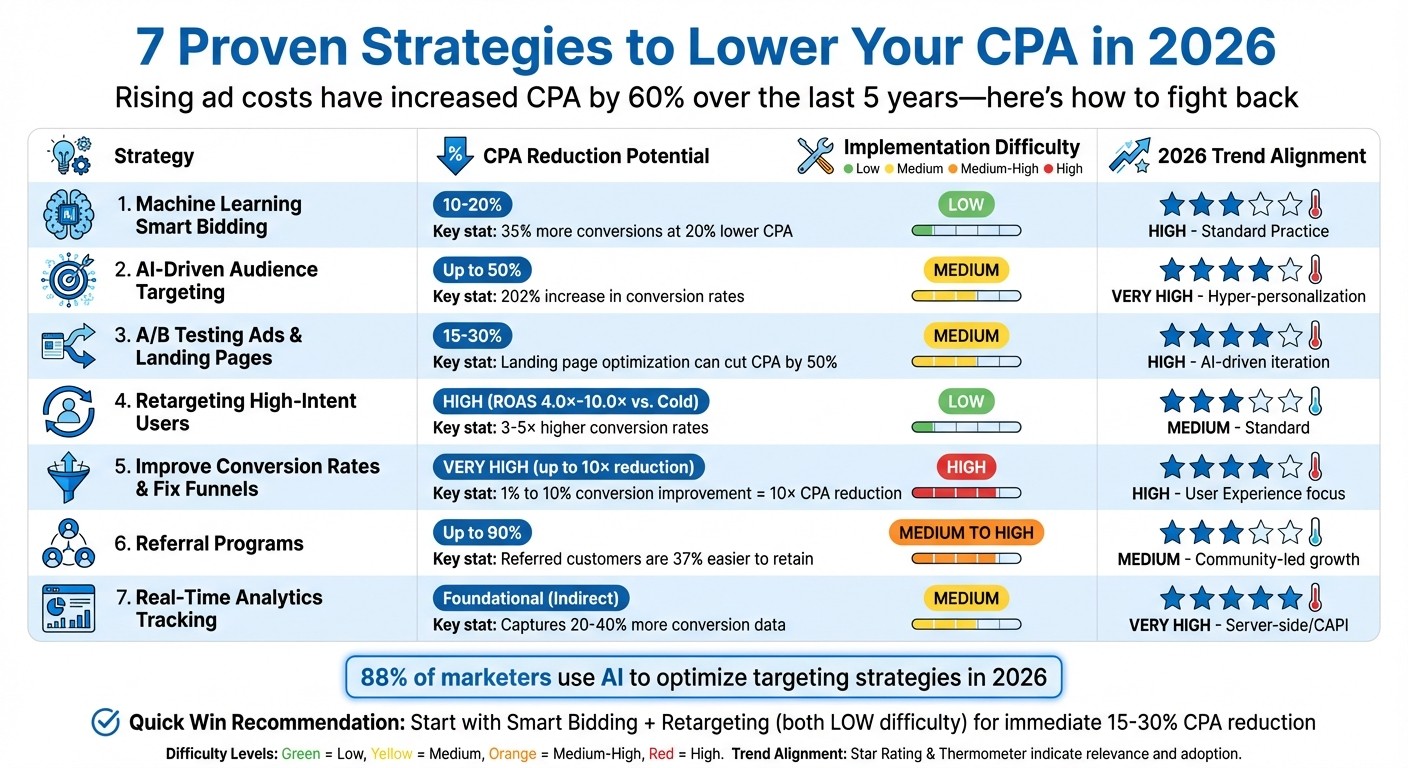
Here’s a quick look at 7 proven ways to lower CPA:
Smart Bidding with Machine Learning: Use AI to optimize ad spend and target high-intent users, cutting CPA by up to 20%.
AI-Driven Targeting: Leverage behavioral data for hyper-personalized campaigns, reducing CPA by as much as 50%.
A/B Testing: Test ad creatives and landing pages to find what converts best, lowering CPA by 15-30%.
Retargeting: Focus on high-intent users like cart abandoners, achieving 3-5x higher conversion rates.
Improve Conversion Rates: Fix funnel leaks and optimize landing pages, which can slash CPA by up to 10x.
Referral Programs: Turn customers into advocates, reducing acquisition costs by up to 90%.
Real-Time Analytics: Monitor performance instantly to adjust campaigns and avoid wasted spend.
Each of these methods aligns with the latest marketing trends, including AI-driven optimization, personalization, and privacy-focused tracking. By combining these tactics, businesses can maximize ROI while staying competitive in today’s expensive digital landscape.
1. Use Machine Learning for Smart Bidding
Machine learning has transformed bidding strategies by enabling real-time decisions for individual auctions. These algorithms calculate the best possible bid in milliseconds for each potential viewer of your ad. They process over 70 million contextual signals per auction, such as device type, location, time of day, search history, and user intent - something no human could ever manage manually. This level of precision not only helps stretch your budget but also increases the chances of converting leads.
How It Lowers CPA
Smart bidding optimizes spending by focusing on high-probability converters and avoiding low-intent users. It also adapts to market trends, seasonal shifts, and competitive changes automatically. For instance, advertisers using Target ROAS (tROAS) Smart Bidding in 2026 reported a 38% higher return on ad spend compared to manual CPC bidding. Performance Max (PMax) campaigns, which now account for over 80% of ad spend in median enterprise accounts, deliver 35% more conversions at a 20% lower CPA than comparable manual campaigns.
How to Get Started
To get started, set your Target CPA 10-20% above your 30-day average to give the algorithm enough flexibility to learn. Allow a 2-3 week learning period, during which the system should gather 30-50 conversions. During this phase, avoid making drastic changes to budgets or targets - keep adjustments under 20%.
For accounts with fewer conversions, consider using portfolio bid strategies to combine data from multiple campaigns. This helps the AI reach data thresholds faster. Providing strong audience signals, like Customer Match lists, can also speed up the learning process. Advertisers who do this see learning periods shorten by 25% and CPAs drop by 15% in the first 30 days. Following the 70/20/10 budget framework is another best practice: allocate 70% to PMax, 20% to branded search for control, and 10% to experimental campaigns.
Adapting to 2026 Trends
With the rise of AI-first platforms, Performance Max has become the go-to structure for most advertisers. Value-Based Bidding is now prioritizing lifetime customer value and advanced conversion metrics. New features even allow you to enforce brand-safe constraints on AI-generated ad copy. Additionally, cross-channel arbitrage automatically reallocates budgets across Search, Shopping, Display, and YouTube, ensuring you get the lowest-cost conversions in real time.
"Smart bidding will not just be a recommendation. It will be the only path back to sustainable performance." - Clicks Gorilla
Once your campaign stabilizes after the learning phase, gradually tighten CPA targets by 5-10% every 2-3 weeks to improve efficiency without disrupting performance.
2. Apply AI-Driven Audience Targeting and Personalization
By 2026, AI-driven audience targeting has moved well beyond basic demographic profiling like age and location. Instead, it dives into behavioral data - tracking the specific products users browse, the content they interact with, and their entire purchase history. This allows businesses to target consumers based on their actual intent and actions, not just generalized assumptions about their demographics. This behavior-based targeting is crucial for identifying high-intent prospects, which can significantly lower your cost per acquisition (CPA).
How It Reduces CPA
AI uses behavioral insights to predict how likely an individual is to convert. By analyzing real-time data - like device type, browsing patterns, time of day, and competitive factors - AI calculates conversion probabilities before placing bids. It also identifies lookalike audiences and tests thousands of micro-segments simultaneously, something manual processes simply can’t achieve efficiently. These AI-powered hyper-personalized campaigns can cut acquisition costs by up to 50% and increase conversion rates by as much as 202%. Additionally, AI minimizes wasted ad spend by spotting fraudulent clicks in real-time and reallocating budgets to genuine prospects.
Implementation with Current Tools
To make the most of AI-driven targeting, start by implementing server-side tracking (Conversions API) to capture 20-40% more conversion data. Once you’ve recorded 15-30 conversions per month, enable Target CPA bidding. A three-campaign framework works best:
Testing campaigns: Experiment with new creatives and audiences.
Scaling campaigns: Focus on proven performers.
Retargeting campaigns: Re-engage high-intent users.
When scaling a successful campaign, increase budgets gradually - by 20-30% every three days - to keep the algorithm’s learning phase intact. For creative testing, use multi-armed bandit algorithms to allocate 70-80% of impressions to the best-performing creatives within 24-48 hours. This proactive approach complements the real-time, data-driven marketing strategies that define 2026.
Fit with 2026 Digital Marketing Trends
Marketers in 2026 are less focused on managing the technical details of campaigns and more on driving creative strategy, as AI now handles much of the heavy lifting. In fact, 88% of marketers regularly use AI to optimize their targeting strategies. This shift toward hyper-personalization not only improves targeting precision but also supports a consumer-first marketing philosophy that drives long-term growth.
"AI that sees all your channels together makes better budget decisions than AI optimizing each platform in isolation. Unified data = unified strategy." - Improvado
For accounts with over 100 conversions, broad targeting with minimal manual restrictions often outperforms detailed audience setups. Why? Because AI uses creative signals to automatically identify potential customers, making the creative itself a key targeting tool.
Impact on ROI and Customer Retention
Teams leveraging AI for media buying report an average ROI increase of 20% while significantly reducing manual optimization efforts. AI’s multi-touch attribution assigns credit across the entire customer journey, ensuring budgets are allocated effectively and avoiding over-investment in any single touchpoint. Automated guardrails - like setting AI to pause campaigns if CPA exceeds targets by 20-50% - add another layer of budget protection. This approach not only boosts ROI but also strengthens customer retention by aligning marketing efforts with consumer behaviors and preferences.
3. Run A/B Tests on Ads and Landing Pages
Even with AI taking on much of the optimization process, A/B testing remains a cornerstone of effective digital marketing. Why? Because algorithms often miss the emotional and clarity-driven nuances that connect with people. Testing different versions of your ads and landing pages reveals what resonates most with your audience. The trick is to focus on one variable at a time - whether it’s a headline, call-to-action (CTA), or page design - so you can get clear, actionable insights. This process works hand-in-hand with AI, capturing the subtleties of human behavior.
How It Reduces CPA
Creative fatigue is one of the biggest culprits behind rising CPAs. Ads often lose their punch after just 4-7 days, which can drive costs up. To counter this, run high-volume tests with over 25 variations to keep your campaigns fresh and avoid performance drops. A great starting point? Test the first 1-3 seconds of video ads (the hook). This small tweak can boost click-through rates by 20-30%. Another effective tactic is to include pricing or service details directly in your ad copy. While this might reduce clicks, it filters out unqualified traffic, leading to higher conversion rates.
Optimizing your landing page is just as important. A well-designed page improves user experience and conversion rates, making every advertising dollar work harder. For instance, improving your landing page conversion rate can potentially cut your CPA in half. And don’t underestimate the impact of speed - every extra second your page takes to load can lower conversions by 7-10%. Matching the landing page headline with your ad’s promise and adding trust signals like testimonials can further enhance performance.
"Testing ads without fixing a broken page is pointless. Fix the front door before rearranging furniture." - Aditya Pandey, CausalFunnel
Implementation with Current Tools
Start with a disciplined approach: test one element at a time, such as your headline, CTA button, or layout, to ensure your results are statistically valid. Google Ads Experiments can help you split traffic evenly (50/50), so both versions compete under identical conditions. Wait until you’ve gathered 500-1,000 impressions and 48-72 hours of data before making decisions to avoid reacting to noise.
For creative testing, use a step-by-step approach. Begin with messaging, then tweak bidding strategies, and finally refine your landing page. Avoid changing everything at once. UGC-style AI video ads are another game-changer - they average 29% lower CPAs and achieve four times the click-through rates of traditional brand ads.
Strategy | Average CPA Reduction | Time to Impact |
|---|---|---|
Dynamic Creative Testing | 25-40% | 3-4 weeks |
UGC-style Creative | 20-35% | 1-2 weeks |
Hook Testing | 10-20% | 1-2 weeks |
Landing Page Optimization | Up to 50% | Immediate after launch |
Source: AdCreate Performance Marketing Data 2026 [9]
These strategies integrate seamlessly into your broader optimization efforts, improving results across various channels.
Fit with 2026 Digital Marketing Trends
As AI takes over tactical tasks like bidding and targeting, marketers are stepping into more creative, strategic roles. Predictive tools now allow brands to test creative concepts before launch, minimizing wasted spend on underperforming ideas. Platforms like Meta are also leaning toward broad targeting with tools like Advantage+, making your creative the primary driver of success. This shift underscores the importance of A/B testing.
Native content that blends seamlessly with platforms like TikTok and Instagram consistently outperforms traditional promotional ads by 2-5x. AI-powered talking avatars are also gaining traction, enabling brands to produce user-generated-style content at scale without the high costs ($100-$500 per video) or slow turnaround times (1-2 weeks) of human creators.
Impact on ROI and Customer Retention
A structured creative testing process can boost ROAS by 28% compared to random testing. The difference between top-performing and underperforming creatives can be dramatic - ROAS can vary by 5-8x, showing the value of systematic testing. Running five or more creative variants per ad set can also lower CPA by 20-30% compared to testing just one or two.
"The advertisers who win in 2026 are not the ones with the biggest budgets. They are the ones who test the most, learn the fastest, and scale their winners most effectively." - RedClaw Performance Team
For customer retention, A/B testing can refine retargeting strategies. For example, running a brand recall ad on day one followed by an incentive ad on day seven aligns messaging with the customer’s journey, improving conversions. Strict audience exclusions, like removing recent buyers from acquisition campaigns, prevent budget waste and maximize ROI.
4. Retarget High-Intent Users
Not all website visitors are equal. Someone who bounces off your homepage in seconds is far less valuable than someone who spends a few minutes exploring your pricing page. Retargeting focuses your ad spend on users who’ve already shown interest in your brand, helping you compete in less crowded ad auctions and pay lower costs per click compared to targeting cold traffic. By leveraging behavioral data, retargeting ensures smarter budget allocation.
How It Reduces CPA
Warm leads are far more likely to convert than cold traffic. While cold audiences typically convert at a rate of 1-2%, cart abandoners convert at 8-12%, and past customers can hit an impressive 15-25%. This difference can shrink your CPA from $50+ to the $15-25 range for high-intent segments. Plus, targeting these users means competing in less crowded auctions, saving money while improving results.
Here’s a key stat: only 2-4% of website visitors convert on their first visit, leaving a massive 96-98% of visitors as prime candidates for retargeting. The trick is to segment these visitors by intent level. For example, someone who viewed your pricing page might respond well to a direct offer or discount, while a blog reader may need more educational content first. This approach avoids wasting your budget on low-intent users and ensures your ad spend is focused on those closest to converting. And don’t forget to exclude recent purchasers - there’s no point advertising to someone who just bought from you.
Once you’ve identified these high-intent segments, advanced tools can help you reach them effectively.
Implementation with Current Tools
Start with Meta’s ecosystem, using the Meta Pixel and Conversions API (CAPI) to track and retarget users across Facebook, Instagram, Messenger, and the Audience Network. For Google, integrate GA4 for seamless remarketing across Display, YouTube, and Gmail. As privacy regulations evolve, first-party data becomes essential. Use tools like Google’s Customer Match or Meta’s Custom List Audiences to directly target known users, especially as third-party cookies phase out.
Create audience tiers based on behavior:
High-intent users (cart abandoners, pricing page viewers): Show them direct calls-to-action with urgency messaging within 3-7 days.
Medium-intent users (product or service viewers): Share case studies or social proof over 14-30 days.
General site visitors: Focus on brand awareness content over 30-180 days.
Campaigns using well-structured Custom Audiences have been shown to lower CPA by 47% compared to interest-based targeting.
To avoid ad fatigue, set frequency caps at 5-7 impressions per person over seven days. Update your CRM lists regularly - weekly for high-volume businesses - to ensure your targeting stays accurate. For e-commerce brands, dynamic product ads showcasing items users viewed can drive 150% more conversions.
Fit with 2026 Digital Marketing Trends
As privacy regulations tighten, retargeting strategies need to adapt. Server-side tracking with tools like Conversions API captures data that traditional pixels might miss, making it a critical piece of the puzzle. Engagement-based audiences - like users who watch 75-95% of your videos or interact with your social profiles - are also growing in importance since they don’t rely on browser tracking.
Sequential storytelling is another powerful tactic. By guiding users through a journey - from brand introduction to social proof and finally a specific offer - you can respect their decision-making process and avoid overwhelming them with aggressive ads. Meta Advantage+ campaigns, which automate retargeting, have been shown to reduce CPA by 15-20% compared to manual setups.
Impact on ROI and Customer Retention
Retargeting delivers measurable results. Conversion rates for retargeted users are 3-5x higher than for prospecting campaigns. In fact, retargeted users are 70% more likely to convert than cold traffic. The combination of lower CPCs and higher conversion rates means your customer acquisition costs drop significantly, while your return on ad spend gets a noticeable boost.
For retention, use exclusion lists to avoid wasting budget on recent purchasers. Instead, focus on retention campaigns that promote complementary products or loyalty programs. This ensures every dollar is spent on the right audience - whether it’s acquiring new customers or maximizing the value of existing ones.
"The lowest CPA isn't the goal. The lowest CPA that delivers customers who generate profit is the goal." - AdBid
5. Improve Conversion Rates and Fix Funnel Problems
After fine-tuning bidding and targeting strategies, the next step is to ensure your funnel is airtight. Driving more traffic won’t help if your funnel lets conversions slip through the cracks. Boosting conversion rates is one of the most impactful ways to lower CPA. Why? Because it makes every dollar count. Instead of spending more to drive traffic, you get more value from the visitors already landing on your site.
How It Reduces CPA
Higher conversion rates naturally reduce CPA without needing extra ad spend. Let’s break it down: if you increase a 2% conversion rate to 3%, you go from 200 to 300 customers. That’s a 33% drop in CPA - just by improving how your site converts traffic.
In 2026, clarity outshines persuasion. Visitors need to understand your offer and know how to act within three seconds of landing on your page. Simplify everything: remove navigation menus and unnecessary links, and give users a singular, obvious path to conversion. Speed is equally critical - every extra second of load time increases bounce rates by 7%. Use tools like PageSpeed to keep load times under three seconds.
This is where funnel audits come into play. Map out every step from ad click to purchase. Measure conversion rates at each stage and compare them to industry standards. For instance, the average cart abandonment rate is around 70%. That’s a huge opportunity to recover lost sales, especially at the bottom of the funnel. Focus on fixing these leaks to maximize ROI from visitors you’ve already paid to acquire.
Now, let’s talk about actionable steps to tighten your funnel.
Implementation with Current Tools
Start by diagnosing your funnel. Track conversion rates at every stage and pinpoint where drop-offs occur. For e-commerce, streamline checkout to just three steps and offer guest checkout options. For lead generation, only ask for the essentials in your forms.
Use cart recovery sequences to win back abandoned sales. Send automated emails or SMS reminders within an hour of cart abandonment. Sweeten the deal with a small incentive for high-value carts. For mid-funnel leads, create nurturing sequences that span 7-14 days. Address objections, provide social proof, and build trust during this period.
Optimize for mobile users - over 60% of traffic now comes from mobile devices. Compress images, reduce scripts, and design with mobile-first principles. Place trust signals like customer reviews, security badges, or money-back guarantees near your primary call-to-action to ease hesitation.
In paid campaigns, use negative keywords to filter out low-intent traffic. Exclude terms like “free,” “DIY,” or “jobs” to ensure your budget targets buyers who are ready to act. This reduces wasted clicks and improves overall efficiency.
Fit with 2026 Digital Marketing Trends
Funnel optimization is evolving alongside technology. AI-driven hyper-personalization is reshaping how businesses approach conversion. Tools now dynamically adjust landing pages, messaging, and CTAs based on real-time visitor behavior. For example, David.AI used dynamic landing pages tailored to visitors’ industries - healthcare visitors saw healthcare case studies, while real estate visitors saw real estate examples. This strategy cut bounce rates by 42% and boosted demo requests by 31%, driving down CPA through smarter conversions.
Interactive experiences are also gaining traction. UpperHand swapped its “Request a Demo” button for an ungated, interactive product tour in 2025. The result? A 127% increase in qualified leads and a 23% shorter sales cycle. These interactive demos engage users twice as much as traditional video walkthroughs, and the leads they generate close 20-25% faster.
Another trend is radical pricing transparency. Dynamic pricing calculators and clearly defined plan options help reduce decision fatigue. Visitors coming from AI-driven search tools like ChatGPT or Perplexity convert 23 times more often than traditional organic search visitors because they arrive ready to act. Optimize your content and pricing pages for these platforms to capture high-intent traffic.
Impact on ROI and Customer Retention
Improving conversion rates doesn’t just cut CPA - it strengthens your entire acquisition strategy. A healthy LTV:CAC ratio is 3:1 or better. Conversion optimization helps you achieve this by extracting more value from each visitor. For instance, if your site gets 10,000 monthly visits and has an average order value of $50, a 1% improvement in conversion rate adds $5,000 in monthly revenue.
On top of that, fixing funnel issues boosts customer retention. Focus on the “first 30-day onboarding experience” to increase retention rates. A smooth onboarding process spreads acquisition costs over a longer customer lifespan, making your economics more stable. Remove barriers between visitors and your product’s value - ungated demos, simplified forms, and seamless checkouts all contribute to a better first impression.
"The best funnel optimization in 2026 doesn't feel like optimization to the customer - it feels like a helpful, frictionless experience." - Distk Team
6. Create a Referral Program for Lower Acquisition Costs
Your current customers can be your most affordable way to gain new ones. Referral programs take advantage of word-of-mouth marketing - 88% of people trust recommendations from friends and family, making it more effective than traditional ads. While paid channels often have customer acquisition costs (CACs) between $21 and $377, referred customers can sometimes be brought in for as little as a $20 prepaid card. This strategy works hand-in-hand with other methods that combine paid and organic efforts to reduce CPA.
How It Reduces CPA
Referrals work because they rely on trust, which makes them highly efficient. These programs can double conversion rates, speed up purchases by 18%, and even increase spending by 25% compared to non-referred customers. In short, you get more value for every marketing dollar spent.
In 2026, forward-thinking brands are moving beyond simple "invite a friend" links. They're creating referral loops where customers are rewarded for keeping an active network of referrals. For businesses with fixed costs, like SaaS companies or gyms, adding a referred customer often costs next to nothing. Once overhead is covered, referral discounts don’t require additional cash, essentially trading small margins for high-quality, organic traffic.
Modern referral programs often use ongoing micro-incentives instead of one-time bonuses. For example, customers might get $1 off per month for every active referral. If a referred friend cancels, the referrer's bill increases, triggering loss aversion and motivating them to find a replacement. This creates a self-sustaining cycle where customers actively recruit others.
"When a customer knows they can get their entire membership for free just by maintaining a small group of referrals, they stop being a consumer and start being a recruiter." - Stormy AI Blog
Implementation with Current Tools
Focus on customers with high Net Promoter Scores (NPS) of 9 or 10 or those who have hit key milestones with your product. These individuals are most likely to share their positive experiences. Use double-sided incentives - rewards for both the referrer and the referred customer - to increase referral rates by up to 68%.
Platforms like RefRef.ai (a free self-hosted option) or Tremendous (offering over 2,000 incentive choices like gift cards) can automate reward distribution. By integrating these tools with your CRM and payment systems, you can streamline tracking, attribution, and payouts. One company, for instance, boosted referral revenue by 36% and saved over five hours of manual work each month through automation.
Consider creating a "Get it for Free" dashboard where customers can see their current discount and how many referrals they need to hit a $0 balance. Use deep-linking technology so new users can sign up quickly without entering a referral code manually. Pre-made sharing assets, like Canva templates for social media posts or pre-written email copy, can also make it easier for customers to share.
Timing matters, too. Ask for referrals right after a customer has an "aha!" moment with your product or after a positive support interaction. You can also use tiered rewards to keep momentum going, offering bonuses for the first five referrals, for example.
Fit with 2026 Digital Marketing Trends
Modern referral programs fit seamlessly into broader CPA reduction strategies. They align with 2026’s move toward AI-powered customer insights. AI can help identify "micro-influencers" within your customer base - engaged users with natural networks that match your target audience. These aren’t traditional influencers but loyal customers who can spark viral growth.
Embedding referral tools directly into your product’s interface is becoming a best practice. In-app referral dashboards, placed in navigation menus or account settings, can boost engagement by 30-50% by making the process easier.
Hybrid sharing tools are also gaining traction. Offer customers both digital deep-links for social sharing and physical "VIP Guest" cards for in-person referrals. This approach ensures customers can share recommendations in whatever way feels most natural to them.
Impact on ROI and Customer Retention
Referral programs don’t just help with acquiring customers - they also improve retention. Referred customers are 37% easier to retain and are 31-57% more likely to refer others compared to those acquired through traditional channels. This creates a ripple effect, where each new customer could bring in even more.
Take Byte, a direct-to-consumer orthodontics company. In just one year, they generated 10,000 referrals. With an average lifetime value of $2,500 per customer, this translated to $12.5 million in referral-driven revenue. Similarly, Casper’s referral program achieved returns seven times higher than their typical marketing investments by leveraging enthusiastic customer advocates.
For subscription-based businesses, referral programs can significantly improve profitability. A strong LTV:CAC ratio of 3:1 or better means you’re not only reducing acquisition costs but also increasing customer lifetime value. Referred customers tend to stick around longer and bring their friends along for the ride.
"The most motivated salesperson in the world is a customer whose 'free' service just started costing them money again." - Stormy AI Blog
7. Track Performance in Real-Time with EyeSight Analytics
Keeping track of performance in real-time has become a game-changer for managing CPA effectively. Real-time analytics ensure you’re not wasting budget by waiting on delayed reports. Instead, you get instant insights that allow you to tweak ad placement, targeting, and bidding strategies as market conditions shift. This quick response can make all the difference in cutting unnecessary spending.
How It Reduces CPA
When performance dips - like a sudden drop in click-through rates or underperforming ad sets - real-time tracking catches it immediately. This means you can swiftly redirect your budget to better-performing areas. It also helps combat ad fraud by identifying suspicious click patterns and device activity, ensuring your budget is spent on genuine prospects. Plus, integrating data from platforms like Google, Meta, and LinkedIn provides a clearer picture of cross-channel performance. For example, multi-touch attribution often shows that early awareness channels contribute to 20% to 40% of conversions.
Implementation with Current Tools
Start with server-side event tracking. By using domain verification, tag manager pixel installation, and Conversions API integration, you can capture key e-commerce events and more accurate conversion signals. This setup bypasses ad blockers and browser privacy restrictions, recovering 20% to 40% more conversion data. With third-party cookies on their way out, this approach ensures your Smart Bidding algorithms work with accurate, real-time data, reducing wasted spend caused by outdated or incomplete information.
Fit with 2026 Digital Marketing Trends
Real-time analytics fit seamlessly into the demands of 2026’s fast-paced digital marketing world. With AI handling much of the heavy lifting in bidding and targeting, marketers can focus on creative strategy. Modern tools even predict performance before campaigns launch, helping you avoid the costly “learning tax” from low-performing tests. And with mobile traffic now accounting for over 60%, tracking mobile performance in real-time is vital. A delay of even one second can reduce conversions by up to 10%.
Impact on ROI and Customer Retention
Real-time analytics don’t just lower CPA - they also improve the quality of customer acquisition. By pinpointing the channels and touchpoints that attract high-value customers, you can allocate your budget more effectively. Additionally, real-time landing page optimizations can increase conversions by up to 300%, driving better ROI and supporting long-term growth. It’s about smarter spending that leads to stronger, lasting customer relationships.
Strategy Comparison Table
Here’s a side-by-side breakdown of key strategies to help you decide which ones to prioritize:
Strategy | Estimated CPA Reduction | Implementation Difficulty | 2026 Trend Alignment |
|---|---|---|---|
Machine Learning Smart Bidding | 10-20% | Low | High (Standard Practice) |
AI Audience & Personalization | Up to 50% | Medium | Very High (Hyper-personalization) |
A/B Testing (Ads/Landing Pages) | 15-30% | Medium | High (AI-driven iteration) |
Retargeting High-Intent Users | High (ROAS 4.0×-10.0× vs. Cold) | Low | Medium (Standard) |
CRO & Funnel Fixes | Very High (up to 10× reduction) | High | High (User Experience focus) |
Referral Programs | Up to 90% | Medium to High | Medium (Community-led growth) |
Real-Time Tracking (EyeSight) | Foundational (Indirect) | Medium | Very High (Server-side/CAPI) |
Referral programs stand out as a game-changer, potentially reducing CPA by up to 90% when paired with well-designed incentives and tracking systems. AI-driven personalization also offers a massive edge, cutting acquisition costs by as much as 50%. Conversion rate optimization (CRO) takes things even further - improving a landing page’s conversion rate from 1% to 10% can slash CPA by up to 10×.
When it comes to ease of implementation, smart bidding and retargeting are straightforward options. Smart bidding typically delivers results with just 30 or more conversions per month, while retargeting often achieves ROAS between 4.0× and 10.0×. Meanwhile, real-time tracking ensures accurate optimization, making it a foundational tool for success.
The strategies most aligned with 2026 trends are AI-driven personalization and real-time tracking, reflecting a shift toward hyper-personalized experiences and server-side solutions.
"In this market, justifying your premium means proving performance at every touchpoint. The entire funnel matters - from the bottom to the top, each stage needs to pull its weight." - Justin Hayashi, CEO of New Engen
Conclusion
The advertising game in 2026 has shifted dramatically. Businesses can no longer rely on simply throwing more money at their ad campaigns. Success now depends on blending AI-powered precision, fine-tuned funnel optimization, and sustainable growth strategies that reduce reliance on costly paid channels.
The seven strategies discussed here provide a smarter way to allocate resources. For example, AI personalization and referral programs have shown the potential to slash customer acquisition costs (CPA) by up to 50% and 90%, respectively. But here’s the catch: none of these tactics will work without a solid foundation of accurate tracking.
"The goal is to shift from just buying customers to investing in them. You want to build a system where every marketing dollar is spent with precision." - Proom.ai
To ensure your efforts don’t go to waste, conduct monthly tracking audits. This helps you catch issues like broken pixels or outdated codes before they lead to data loss. Once your tracking is solid, tackle the biggest bottleneck in your funnel - whether it’s low landing page conversions or poor audience targeting. Fixing the major leaks first ensures you're not wasting resources on small tweaks while bigger problems drain your budget.
If your CPA keeps creeping up and you can't tell which lever to pull first, talk to Bigeye. Our paid media team can look at your bidding, audiences and funnel together, and EyeSight, our unified analytics dashboard, puts every channel's numbers in one place so you can see where the money is leaking.
FAQs
Which CPA lever should I fix first?
Start by focusing on improving your traffic quality. Refine your audience by targeting the right demographics and using negative targeting to filter out irrelevant clicks. This approach minimizes wasted ad spend and drives more meaningful conversions, ultimately reducing your cost per acquisition.
How many conversions are needed for Smart Bidding to work?
Smart Bidding performs most effectively when there’s enough data to work with. Ideally, aim for at least 30 conversions over a month or longer. For campaigns using Target ROAS, it’s better to have around 50 conversions to ensure the system can make precise predictions and adjustments. This level of data helps the algorithm fine-tune its performance.
What tracking setup do I need for 2026 privacy changes?
To prepare for the 2026 privacy changes, businesses need to shift their tracking strategies toward consent management and compliance with state privacy laws. Here's how:
Set up systems for opt-in/opt-out preferences, ensuring users have control over their data.
Use cookie banners and privacy preference centers to clearly communicate choices and gather consent.
Perform a thorough online tracker audit to identify and fix any issues that might conflict with the new regulations.
Additionally, adopt a privacy-by-design approach. This means weaving data protection into every layer of your operations, from APIs to analytics and even AI models, right from the start. This proactive mindset can help ensure compliance while respecting user privacy.

Branding & Creative
Sep 24, 2026
Brand architecture guide comparing masterbrand, endorsed, and house of brands to cut wasted spend and sharpen buyer choice.