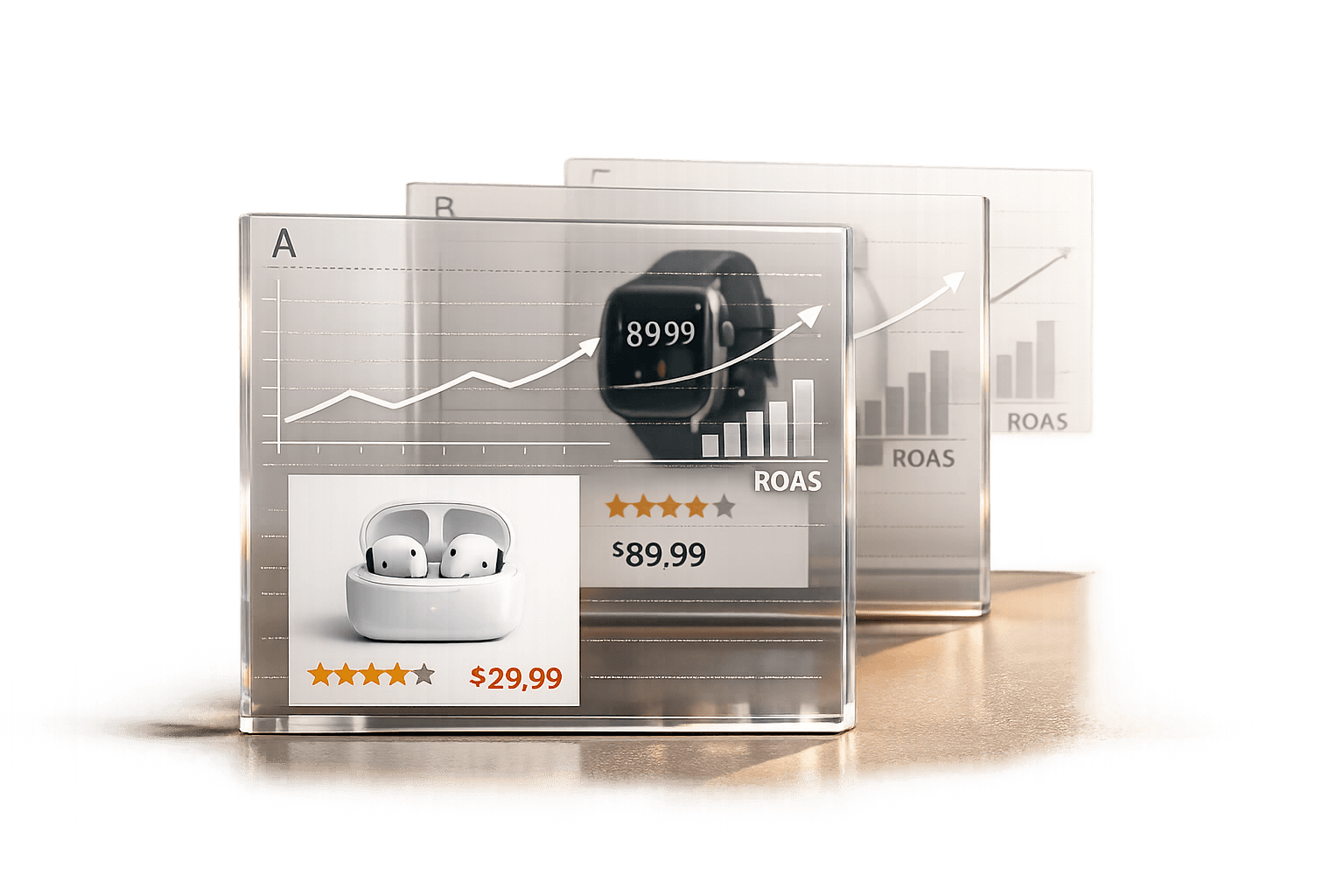
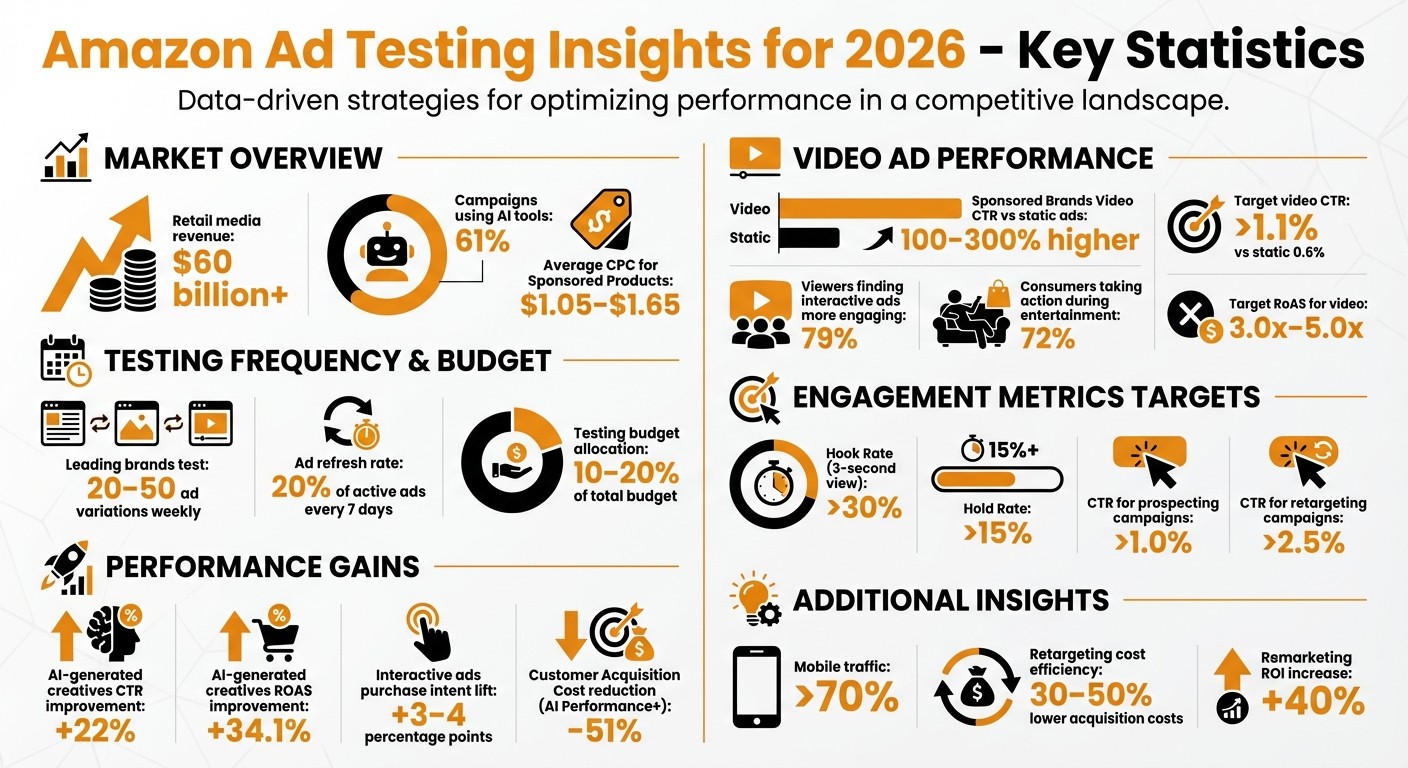
Amazon advertising in 2026 revolves around AI-driven creative testing and high-quality visuals to boost engagement, sales, and ROI. With retail media revenue surpassing $60 billion and 61% of campaigns using AI tools, the focus has shifted to creating and testing multiple ad variations weekly to combat rising costs and ad fatigue.
Key Takeaways
AI Tools: Automate creative production, cutting weeks of work into hours.
Ad Costs: Average CPC for Sponsored Products is now $1.05-$1.65.
Interactive Ads: Formats like Prime Video's "pause ads" increase purchase intent by 3-4%.
Testing Frequency: Leading brands test 20-50 ad variations weekly.
Performance Gains: AI-generated creatives deliver 22% higher CTR and 34.1% better ROAS.
Effective ad testing requires structured A/B testing, isolating variables, and leveraging metrics like CTR and ROAS. To stay competitive, brands must refresh at least 20% of active ads every 7 days and allocate 10-20% of their budget for testing. AI tools like Performance+ and Amazon Marketing Cloud streamline this process, helping brands optimize faster and smarter.
Key Trends in Amazon Ad Testing for 2026
Creative Quality Drives Performance
As Amazon's tools like Performance+ take over bidding and targeting, creative quality has become the cornerstone of ad success. Static images are quickly losing their edge, as AI-generated creatives are delivering a noticeable boost in engagement, including a 34.1% improvement in ROAS.
The change is striking. Leading brands are now testing 20-50 creative variations weekly and updating at least 20% of their active ads every 7 days to combat ad fatigue. With creative quality driving results, formats like interactive videos are proving even more effective at capturing consumer attention.
Interactive Video Ads Lead Engagement
Interactive video ads are reshaping how brands connect with shoppers. Unlike traditional video, these formats let users interact directly - checking prices, saving products, or even adding items to their cart without pausing their content. 79% of viewers find these ads more engaging than standard formats, and they deliver a 3-4 percentage point lift in purchase intent and brand perception.
Amazon features like "Shop the Show" on Prime Video and interactive pause ads are turning entertainment into seamless shopping experiences. For example, 72% of consumers now take actions like adding to cart while engaging with entertainment content. Lay's capitalized on this trend in early 2026, using Amazon DSP and Amazon Marketing Cloud to fine-tune their creatives in real-time. This approach led to a 133% higher purchase rate and 79% greater incremental reach as they pinpointed which visuals resonated most with their audience.
AI-Powered Optimization and Automation
AI is transforming ad production and deployment, going beyond basic automation to what experts call "creative agents." These systems can plan, script, and generate high-quality assets using simple natural language prompts. Currently, 61% of Amazon ad campaigns rely on AI-driven management tools. Brands adopting AI-powered Performance+ campaigns have seen a 51% reduction in Customer Acquisition Cost.
Clovia, for example, used Amazon Marketing Cloud to analyze their entire conversion path, achieving an 80% increase in New-to-Brand orders. AI also enhances contextual bidding by analyzing factors like device type, time of day, and browsing history to serve the most effective creative asset for each moment.
These trends highlight the importance of blending exceptional creatives with cutting-edge AI strategies to succeed in 2026's Amazon ad landscape.
Best Practices for Effective Ad Creative Testing
A/B Testing Frameworks for Amazon Ads
To maximize efficiency and minimize wasted resources, follow a three-phase cycle for ad testing. Start with Concept Validation, where you test broad hooks or angles to see what resonates most with your audience. Once you identify a winning concept, move to the refinement phase by isolating specific elements for improvement. Finally, scale up by dedicating 70-80% of your budget to proven winners while continuing to test fresh ideas on a smaller scale.
The secret to reliable results lies in variable isolation. Change only one major element at a time - like testing two different main images while keeping the titles identical. Making multiple changes at once leads to "Multivariate Chaos", making it impossible to pinpoint what caused any performance shifts. For Amazon ads, start by testing key elements in this order: Product Title and Main Image first, followed by Bullet Points and A+ Content.
Patience is key when determining winners. Gather enough data - at least 10,000 impressions, 100 clicks, or 30 conversions per variant - before making decisions. If you're using Amazon's "Manage Your Experiments" tool (available to Brand Registry members), wait for at least 90% confidence before declaring a winner. For example, in 2025, Onkata Hardware added just two words - "front door" - to a doorstop product title, resulting in an 8% increase in conversion rate.
Using Diagnostic Metrics for Creative Insights
Once you've established a structured testing process, diagnostic metrics can help you dig deeper into ad performance. Start with Click-Through Rate (CTR), which serves as an early indicator of ad appeal. Aim for a CTR above 1.0% for prospecting campaigns and above 2.5% for retargeting. Conversion Rate (CVR) and ROAS are lagging metrics that confirm whether your ads are driving real business outcomes.
If you notice high CTRs and low conversions, it could signal issues with your landing page, pricing, or offer. For video ads, track your Hook Rate (percentage of viewers who watch at least 3 seconds, targeting above 30%) and Hold Rate (percentage of viewers who stay until the core value proposition, targeting above 15%) to evaluate stopping power and content relevance. In one test, Jungle Scout found that plain text descriptions outperformed visually rich A+ Content for their Jungle Stix product, achieving a 77% confidence level. This result challenges the assumption that A+ Content always performs better.
"Every ad is a hypothesis. Testing is how you prove or disprove that hypothesis. The winner is the company that runs the most experiments and learns the fastest."
Keep a record of your hypotheses, results, and insights - like finding that "social proof outperforms benefit-focused copy for this audience." Over time, this process builds a knowledge base that helps you refine your strategies and improve consistently.
Continuous Testing for Long-Term Results
In 2026, the lifespan of a winning ad has shrunk significantly - from weeks to just a few days. Repeating the same creatives too often leads to audience fatigue, resulting in higher CPMs and lower CTRs. To stay ahead, high-growth brands now refresh at least 20% of their active ads every 7 days. Brands that test fewer than five new creatives per month often see a steady 15% increase in CPA.
Allocate 10-20% of your monthly ad budget specifically for testing new creative variations. This approach prevents waste on underperforming ads and helps identify winning ideas before scaling. For instance, Angry Orange saw a 26% boost in conversion rate and a 46% increase in sales volume within just 20 days after a creative refresh by Thrasio.
With Amazon's automated targeting handling most placement decisions, creative quality has become the biggest driver of success. The performance gap between top-tier and average creatives can be as much as 3-5x. The brands leading in 2026 aren't necessarily spending more - they're simply testing smarter. By following these practices, you can continuously refine your approach and stay competitive in an ever-changing ad landscape.
Top Ad Formats to Use in 2026
In 2026, tapping into cutting-edge ad formats while focusing on continuous creative testing can significantly improve campaign results.
Sponsored Brands Video and Sponsored Display
Sponsored Brands Video (SBV) has proven to deliver a 100-300% higher click-through rate (CTR) compared to static ads. These autoplaying, looping videos (lasting 6-45 seconds) appear across platforms like search results, Prime Video, and Twitch. Now, they're even interactive - allowing shoppers to add items to their cart using voice commands or a remote during pause ads. Since these videos autoplay silently, brands succeed by following the "Silent Salesman Rule", which involves using burn-in subtitles and bold text overlays that cover at least 20% of the screen to communicate key messages without sound.
For video campaigns, a healthy return on ad spend (RoAS) target ranges from 3.0x to 5.0x, with videos consistently achieving a CTR of over 1.1%, compared to static image ads' average of around 0.6%.
Sponsored Display, now integrated into Amazon DSP workflows, allows brands to target audiences based on lifestyle and habits rather than just recent searches. This format reaches shoppers both on and off Amazon, leveraging first-party purchase data to deliver ads across third-party websites and apps. Retargeting through Sponsored Display has proven cost-efficient, with acquisition costs that are 30-50% lower than prospecting campaigns. Remarketing campaigns have also shown impressive results, driving a 40% increase in ROI and a 45% rise in return visits this year. When paired with Streaming TV video ads, brands have seen a doubling of brand awareness and a 3.5x boost in brand favorability.
To get the most out of these formats, aim for videos that are 15-30 seconds long, emphasize product benefits within the first three seconds, use bold, high-contrast fonts, and refresh creative assets every 7-14 days. Additionally, allocate up to 40% of your budget for targeting complementary products.
A+ Content and Enhanced Product Pages
In 2026, A+ Content is no longer optional. With over 70% of traffic coming from mobile devices, it’s essential to use large, easy-to-read fonts, clean visuals, and benefit-driven copy to reduce decision-making friction for shoppers. Comparison charts are particularly effective for encouraging cross-selling and simplifying purchase decisions.
Optimizing landing pages can also make a big difference. Switching from a Brand Store to a specific product detail page has been shown to improve conversions by 20% to 40%. For Sponsored Brand ads, linking to relevant sub-pages - like directing traffic from a "Winter Jackets" ad to a dedicated "Winter Jackets" page - often outperforms sending shoppers to a generic homepage. Campaigns that feature logos adhering to creative guidelines achieve 20% higher engagement on desktop and 13% higher engagement on mobile. Sellers combining Sponsored Brands with Sponsored Products have also seen a 30% increase in category impression share.
Conclusion: Preparing for Amazon Ad Success in 2026
Amazon advertising is evolving, with AI-driven creative testing leading the charge. With average Sponsored Products CPCs now roughly $1.05 to $1.65, success in 2026 means working smarter, not harder. Brands thriving today are those that embrace rapid creative testing - producing 20 to 50 variations weekly - to counter ad fatigue. AI tools have drastically cut production times, shrinking what once took weeks down to just 2-4 hours.
AI-generated creatives are proving their worth, delivering a 22% higher CTR compared to static images. Meanwhile, brands leveraging AI-powered campaign management report an average 34.1% boost in ROAS.
While AI takes care of execution and optimization, human input remains vital for ensuring emotional resonance. This balance between automation and human creativity reflects earlier shifts in ad quality and engagement strategies, underscoring the importance of staying ahead through constant innovation.
Next Steps for Marketers
To get ahead, start by adopting the 3-Phase Testing Framework. First, focus on Concept Validation to test broad creative ideas. Next, move to Element Isolation, refining specific hooks and visuals. Finally, scale successful campaigns by allocating 70-80% of your budget to proven performers.
Keep an eye on diagnostic metrics: aim for a hook rate (3-second view rate) above 30% and a hold rate over 15% for video ads. Allow Amazon's AI algorithms a 7-14 day learning period before making manual adjustments. Use Amazon Marketing Cloud (AMC) to analyze the full conversion path and measure how upper-funnel efforts, like streaming TV ads, contribute to final sales.
The tools, data, and formats are already in place. The real question is: are you ready to deploy an AI-driven testing system that runs on autopilot?
If your Amazon creative is going stale faster than you can replace it, talk to Bigeye. Our retail media team can set up a testing cadence that keeps fresh winners in rotation without burning budget on guesswork.
FAQs
How do I structure Amazon ad tests so I’m only changing one variable?
To test just one variable in your Amazon ads, create two versions of your ad or listing that are exactly the same, except for the one element you want to test - like the headline, image, or call-to-action. This approach helps you pinpoint how that specific change affects performance, making it easier to draw clear conclusions.
How much budget should I set aside for creative testing in 2026?
In 2026, setting aside 10% to 20% of your paid social budget for creative testing is a smart move. This approach helps you collect enough data to make informed decisions while keeping the performance of your top-performing ad creatives steady.
Which metrics tell me if my ad creative is the problem or my listing is?
Metrics such as Hook Rate (above 30%) and Hold Rate (above 15%) are valuable for assessing how well your ad creative captures and retains attention. If you're analyzing your listing, pay close attention to performance indicators like conversion rate and click-through rate. These figures can pinpoint areas that might need improvement, helping you decide whether to tweak your ad creative, your listing, or both.
Related from Bigeye
Case study: Zesty Paws
CPG Marketing
Oct 4, 2026
A CPG marketing strategy for 2027 in eight steps, with Bigeye shopper research and current data on private label, retail media, creators and AI search.