/

Paid Media & Performance

Amazon Marketing for Baby Brands: What Actually Drives Sales

Amazon marketing for baby brands fails when traffic lands on a page that does not earn trust fast. With Amazon driving close to 50% of U.S. online baby-supplies sales, the issue is rarely visibility alone. It is conversion, stock, and repeat order setup. In this article, I’ll show what moves sales, what slows them down, and where I’d focus first if I wanted more orders without wasting ad spend.

TL;DR

  • I would optimize product listings before adding spend, because weak titles, images, bullets, and A+ Content waste paid traffic.

  • I would treat reviews, ratings, and Q&A as sales drivers, because baby shoppers want proof on safety, fit, and ease of use.

  • I would guard Buy Box share and inventory levels closely, because stockouts and seller issues can drag down rank and ad return.

  • I would use Amazon PPC, coupons, and Subscribe & Save only after the listing converts at a normal category rate.

  • I would build for repeat orders, especially in diapers, wipes, and skincare, because reorder behavior is what turns one sale into account growth.
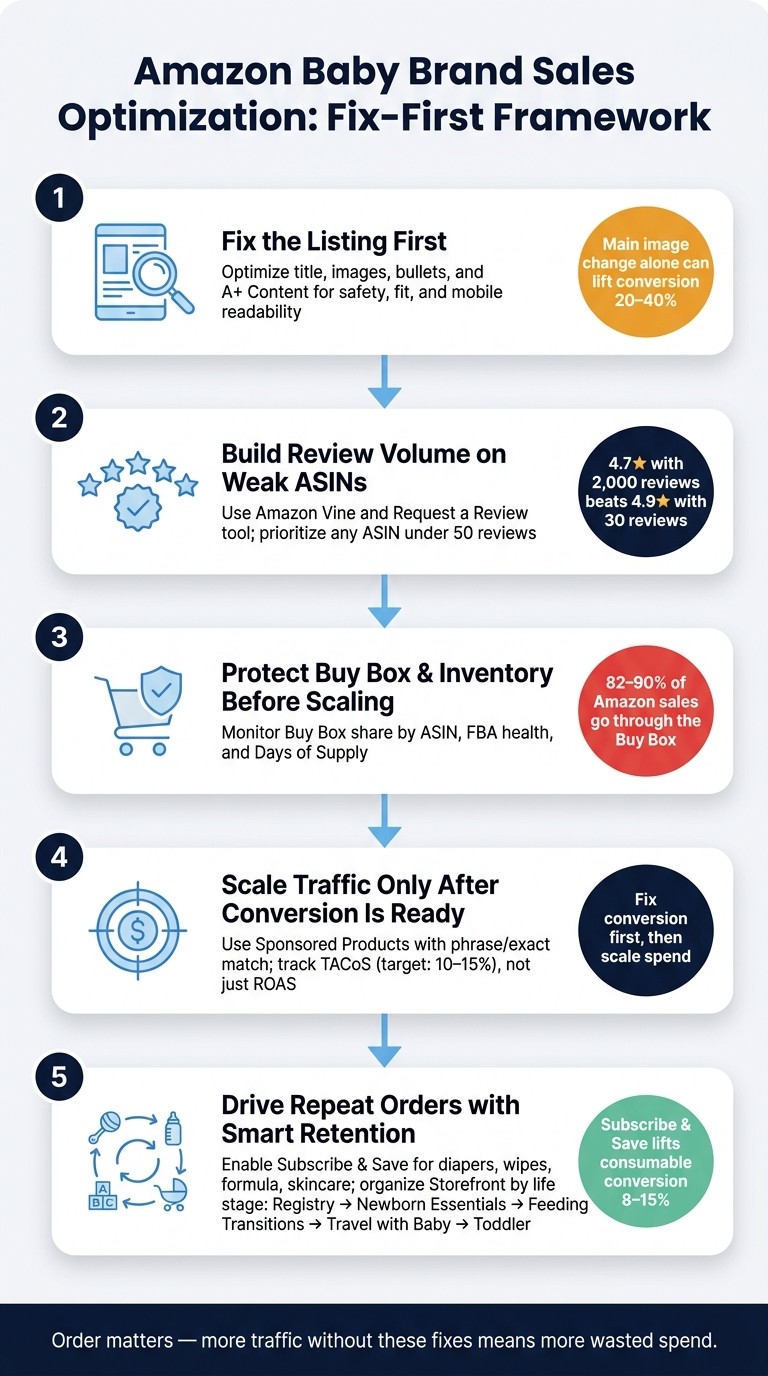
Amazon Baby Brand Sales Optimization: Fix-First Framework

Amazon Baby Brand Sales Optimization: Fix-First Framework

Why Amazon traffic does not always turn into baby product sales

Baby shoppers do not buy the same way as many other Amazon shoppers. They want answers fast, but they also want proof. If a listing is vague on materials, age range, safety, or setup, shoppers leave.

I see this happen in two common cases:

  • A parent wants to know if the item is safe and right for their child.

  • A gift buyer wants a simple yes: Is this a safe, trusted pick?

If the page does not answer both, clicks do not turn into orders.

The article makes one point very well: traffic that does not convert can hurt more than short-term sales. It can also weaken organic rank over time if impressions stay high and purchases stay low.

The product detail page is the first sales lever

I would not start with media. I would start with the page.

For baby brands, the product detail page has to do three jobs at once:

  • Show what the product is

  • Reduce buyer doubt

  • Prove safety and fit

That means the listing needs to be plain, direct, and mobile-friendly.

What I’d fix first

  • Title: Put the product type, main feature, material, size/count, and age range near the front.

  • Bullets: Lead with buyer concerns like safety, materials, and who the product is for.

  • Images: Show the product, size, use case, and trust markers right away.

  • A+ Content: Help the shopper choose the right variant and answer common objections.

One stat stands out: a main image change alone can move conversion by 20% to 40%. That tells me many baby listings lose sales before the shopper even starts reading.

If the shopper has to guess, the listing is doing too little.

Reviews and ratings do more than build comfort

For baby products, reviews are often the line between “maybe” and “buy now.”

The article points to a useful benchmark: products often stall until they have at least 50 reviews and a rating around 4.2 stars or higher. It also notes that a 4.7-star product with 2,000 reviews can beat a 4.9-star product with 30 reviews.

That makes sense. In this category, volume and recency matter because they show the item has been used by many families.

I would focus on:

  • Amazon Vine for new parent ASINs

  • Fast follow-up with Amazon’s review request tool

  • Q&A updates based on repeat complaints

  • Listing edits tied to low-star review patterns

A review program should not be treated as a side task. It shapes conversion, and conversion shapes rank.

Buy Box share and inventory control protect sales

A brand can have a strong page and still lose orders if stock runs out or another seller controls the Buy Box.

The article notes that 82% to 90% of Amazon sales run through the Buy Box. It also says listings with Buy Box control above 90% can see conversion rates 3x to 5x higher than listings with heavy seller competition.

That means ad spend can leak if the wrong seller owns the offer.

I would watch:

  • Buy Box share by ASIN

  • FBA health and delivery speed

  • Pricing issues that invite seller conflict

  • Days of Supply before any promo push

The stockout warning is just as important. Recovery may take 4 to 6 weeks even after stock returns. For a brand doing $500,000 per month, a two-week stockout could cost about $250,000 in direct missed sales, before counting rank loss.

That is why inventory planning and ad planning have to move together.

PPC, pricing, and promotions work only after conversion is in place

I agree with the article’s order of operations: fix conversion first, then scale traffic.

Once the listing converts and inventory is stable, I’d use these levers:

  • Sponsored Products first

  • Phrase and exact match for high-intent baby searches

  • Retargeting after core search campaigns are working

  • Coupons for trial on repeat-purchase products

  • Subscribe & Save for diapers, wipes, formula, and skincare

The article also makes a strong point on measurement: ROAS is not enough. I would also look at TACoS, SKU margin after Amazon fees, promo cost, and reorder behavior.

A campaign can look good in the ad dashboard and still lose money.

Long-term growth comes from repeat purchase, not one-time wins

The last part of the article is where many brands miss the bigger picture.

Amazon growth for baby brands does not come from one good campaign. It comes from building a path that matches how parents shop and then making reorders easy.

I like the article’s focus on life-stage shopping paths such as:

  • Registry

  • Newborn Essentials

  • Feeding Transitions

  • Travel with Baby

  • Toddler

That is a better fit than organizing only by product type. Parents often shop by problem or milestone, not by internal catalog structure.

For repeat-purchase categories, Subscribe & Save matters because it can improve both conversion and reorder rate. The article cites a lift of 8% to 15% for consumables. That can add up fast when a product has monthly or near-monthly reorder behavior.

What I’d do first if I ran a baby brand on Amazon

If I had to turn this article into a short action plan, mine would be:

  1. Audit the product detail page for image clarity, safety proof, bullets, and mobile readability.

  2. Fix review gaps on weak ASINs, especially any product under 50 reviews.

  3. Check Buy Box share and stock risk before pushing more traffic.

  4. Tighten PPC to high-intent terms and cut waste from broad traffic.

  5. Build Subscribe & Save and milestone-based Storefront paths for repeat purchase categories.

That order matters. More traffic without these fixes usually means more wasted spend.

FAQ

Why do baby brands get Amazon clicks but not sales?
Most often, the listing does not answer buyer concerns fast enough. Parents and gift buyers want proof on safety, fit, materials, and ease of use.

How many reviews does a baby product need on Amazon?
Many baby products struggle to convert until they have around 50 reviews and a solid star rating. Review count and recency often matter as much as score.

Does Subscribe & Save help baby brands grow on Amazon?
Yes, especially for consumables like diapers, wipes, formula, and skincare. It can improve first-order conversion and support repeat purchase.

Why do stockouts hurt Amazon baby brands so much?
A stockout does not just stop sales in the moment. It can also weaken organic rank, ad return, and Buy Box momentum for weeks after inventory comes back.

TL;DR Summary

  • I would fix the listing before increasing ad spend. Better images, bullets, titles, and A+ Content help traffic convert instead of bounce.

  • I would treat reviews as part of the sales engine. In baby categories, shoppers want proof from other buyers before they place an order.

  • I would protect stock and Buy Box control. Those two factors can shape conversion, rank, and media return more than many teams expect.

  • I would use PPC and promos with discipline. These tools work best when the page already converts and inventory can support the demand.

  • I would build for repeat orders. Subscribe & Save and milestone-based shopping paths help turn one sale into longer-term Amazon growth.

CTA

Want a sharper Amazon plan for your baby brand? Schedule a free Amazon marketplace audit with Bigeye. I’d use it to review your Storefront flow, listing conversion points, inventory risk, and repeat-order setup so you can see where sales are slipping - and what to fix first.

Meta title: Amazon Marketing for Baby Brands That Drives Sales
Meta description: Learn what drives Amazon marketing for baby brands, from conversion and reviews to stock control, PPC, and repeat purchase growth.
URL slug: amazon-marketing-baby-brands

TL;DR

Key takeaways:

  • Fix the product detail page first. Titles, images, bullets, and A+ Content need to answer a parent’s main objections fast.

  • Protect your reviews and ratings. Baby products often stall until they reach at least 50 reviews and a 4.2-star rating; a 4.7-star product with 2,000 reviews often beats a 4.9-star product with 30.

  • Keep the Buy Box and stay in stock. Stockouts can push rankings down for 2–3 weeks even after inventory returns.

  • Use PPC and promotions with care. Sponsored Products, coupon badges, and pricing moves can add growth, but only when the listing already converts well.

  • Use Subscribe & Save for consumables. For diapers, wipes, and baby skincare, it often lifts conversion by 8% to 15% and helps build the repeat-purchase engine that separates growing brands from stuck ones.

Why Do Baby Brands Get Amazon Traffic But Still Fail To Convert It Into Sales?

Baby brands often win the click and still lose the order. On Amazon, that usually happens because the listing does not answer the questions buyers care about most: safety, fit, materials, and ease of use. Parents move fast, but they do not buy on blind faith. Gift buyers do the same. If the page feels vague, both groups bounce. The issue is not traffic volume. It is weak conversion.

1. The Baby Category Plays by Different Conversion Rules

Baby listings have to do more work than many other Amazon pages. One product page may need to speak to parents, gift buyers, and registry shoppers at the same time. That is a tough balancing act. Roughly 40% of baby-related purchases come from gift buyers, and that group is more likely to search by brand reputation and ease of use than by technical specs.

That detail matters. A parent may want to know fabric type, age range, and wash method. A gift buyer may want one simple answer: Is this safe, trusted, and easy to choose? If the listing leans too hard in one direction, it misses the other buyer.

In early 2026, Amazon tightened listing standards for safety-sensitive subcategories such as pacifiers and children's pajamas after Consumer Reports findings of misleading safety claims. That changed the stakes. Safety certifications like CPC, ASTM, and JPMA are not just back-office documents anymore. They function as trust signals, and they need to be visible in images and A+ Content. Buyers should not have to hunt for them. Those signals need to show up right away on the product page.

2. Common Amazon Mistakes That Hurt Sales

A lot of baby brands spend money getting traffic, then quietly lose sales through weak listing basics. Wrong keywords can pull in shoppers who were never a fit. Thin product pages can create doubt even when the product itself is good. And once doubt shows up in the baby category, conversion drops fast.

Reviews are one of the clearest pressure points. Products with fewer than 50 reviews face a major conversion penalty because parents often see them as unproven. That reaction is easy to understand. When someone is shopping for a baby product, they are not just comparing price. They are asking, Can I trust this for a child?

There is also an Amazon ranking problem here. Amazon’s algorithm puts a lot of weight on conversion rate, so high impressions paired with low conversion can hurt organic ranking over time. In other words, traffic that fails to convert is not harmless. It can make the listing harder to grow.

Traffic that does not convert is not neutral - it can make the listing harder to grow.

That is where many brands get stuck. They think more clicks will solve the issue, when the page itself is the problem.

3. What To Fix First, Scale Next, and Stop Doing

The first move is simple: make the listing conversion-ready. That means better main-image legibility, visible compliance documentation, and clear safety callouts in the first two bullet points. If a shopper has to scroll, zoom, or guess, the page is already doing too little.

A smart order of operations looks like this:

  • Fix first: Build a listing that makes safety, use case, and trust easy to understand at a glance.

  • Scale next: Increase ad spend only after conversion reaches category-normal levels.

  • Stop doing: Using A+ Content for generic brand storytelling instead of answering objections, and treating impressions as proof that the listing is working.

This is the part many teams skip. They scale media before the page can carry the load. That is like pouring water into a bucket with a crack in the bottom. You may see motion, but you do not get the result you want.

That makes the product detail page the first fix. That is why the next section starts with the product detail page.

How Do You Fix an Amazon Baby Product Page That Doesn't Convert?

Your product detail page has to convert before ad spend can do its job. If the page is weak, more traffic just means more wasted clicks. That’s why the product detail page is the first thing to fix.

1. Write Titles, Bullets, Images, and A+ Content for Parents

For baby products, clear wins. Clever wording usually doesn’t. A simple title format works best: Brand + Product Type + Main Feature + Material + Size or Count + Age Range. For example: "Brand Name Baby Lotion - Fragrance-Free - 8 fl oz - Newborn to 12 Months."

Your bullets should follow a plain structure: Benefit → Feature → Proof. Put the age range, safety details, and materials near the front, because that’s what parents look for first.

Images do a lot of the heavy lifting too. A main image swap by itself can move conversion rates by 20% to 40%. That’s a huge swing from one change. Secondary images help calm doubt by showing size, materials, and setup in a way text can’t. The image sequence that tends to work best uses seven frames: hero shot on white, lifestyle image in use, feature callouts, size reference beside a familiar item, comparison chart, quality close-up, and trust markers like JPMA or GREENGUARD Gold certification. Every image should be built for mobile, because that’s where many shoppers will see it first.

Once the page handles the basic objections, reviews and ratings take over much of the trust job.

2. Reviews, Ratings, and Q&A Are Core Trust Signals

Reviews are not just “social proof.” For parents, they’re the layer of trust that helps turn caution into action. A 4.7-star product with 2,000 reviews will often beat a 4.9-star product with only 30 reviews. Products with fewer than 50 reviews usually take a real conversion hit because they feel untested. In plain terms, high review volume and recent feedback beat a tiny stack of perfect scores.

Review velocity matters just as much as total count. If you’re launching new ASINs, enroll them in Amazon Vine at $200 per parent ASIN as of mid-2026 and automate the "Request a Review" button for five to seven days after delivery to build volume fast.

Low-star reviews can help, too. They show you where shoppers get stuck. Use those reviews to spot repeat objections, answer those points in Q&A, and update the listing when the same complaint shows up again.

After you’ve built trust, A+ Content should help shoppers pick the right size or variant without leaving the page.

3. Use A+ Content To Reduce Hesitation and Guide Variant Choice

Basic A+ Content can increase sales by up to 8%, and well-done Premium A+ Content can push sales up by 20% or more. For baby brands, the comparison chart is often the best-performing A+ module. It helps shoppers sort out which option fits their needs without bouncing around your catalog.

Use that chart to point people to the right size or version: size 1 vs. size 2 diapers, newborn vs. infant feeding bottles, or 8 oz vs. 16 oz lotion. That small bit of guidance can keep a shopper on the page instead of sending them off to hunt for a better fit elsewhere.

Once the page converts, the next sales lever is Buy Box readiness and in-stock rate.

How Buy Box Loss and Stockouts Quietly Undermine Baby Brand Sales on Amazon

A baby brand can have a sharp listing, strong reviews, and solid ad spend - and still lose sales fast if the Buy Box slips away or inventory dries up. On Amazon, those two issues hit harder than many teams expect. Buy Box loss and stockouts don't just trim revenue. They weaken ad return, hurt ranking, and chip away at repeat demand. Parents expect fast shipping, steady availability, and trusted fulfillment. When any of that breaks, conversion often drops before the brand spots the root cause.

1. Buy Box Readiness Protects Every Other Marketing Investment

Between 82% and 90% of Amazon sales go through the Buy Box. That means if a competitor or unauthorized seller takes control of it, your listing may still get traffic while conversion drops hard. In many cases, the product page looks fine on the surface, but the sale goes elsewhere. Listings that hold the Buy Box more than 90% of the time see conversion rates 3–5x higher than listings that are contested.

This gets expensive fast once paid media enters the picture. If your ads send shoppers to a product detail page where an unauthorized seller owns the Buy Box, your budget can end up driving sales for someone else. That's not just frustrating - it turns media spend into leakage.

For baby brands, the risk is even sharper because trust matters so much. Gift buyers and registry shoppers often care most about Prime readiness and delivery dates. If the offer in the Buy Box doesn't show fast, dependable shipping, that shopper may bounce or pick another item without much thought.

A few basics do a lot of heavy lifting here. FBA helps strengthen Buy Box readiness, and seller health metrics matter more than some brands think. Keep Order Defect Rate below 0.5%, and watch Late Shipment Rate and Pre-fulfillment Cancel Rate closely. Those numbers affect whether Amazon sees your offer as dependable.

Channel control matters too. Amazon Transparency can help block unauthorized or counterfeit sellers from hijacking your Buy Box. On top of that, active MAP enforcement is a must. Unauthorized sellers who undercut your price are one of the main reasons baby brands lose the Buy Box in the first place. If pricing slips and enforcement is weak, the damage tends to spread: lost control of the offer, lower conversion, weaker ad return, and more pressure on margin.

2. Inventory Planning Must Match Promotions and Demand Spikes

A stockout may look like a short pause in sales, but the hangover lasts much longer. Recovery often takes 4–6 weeks after restocking to win back organic ranking and Buy Box momentum. That's the part many teams underestimate. The units come back in, but the listing doesn't snap right back to where it was.

The revenue hit can be brutal. For a brand doing $500,000 per month, a two-week stockout can cost $250,000 in direct lost sales, not counting the drag on Buy Box share, organic placement, and ad efficiency. In other words, the loss doesn't stop when the shelf is empty.

Advertising can make this worse. When PPC ramps up before a big retail event and inventory plans stay flat, stock can disappear weeks earlier than expected. That's why ad intensity should track closely with Days of Supply (DoS), not just sales goals.

  • At 60+ days of supply, scale.

  • At 30–60 days, optimize.

  • Below 30 days, cut bids on high-volume terms.

  • Below 15–21 days, pause nonessential campaigns and defend branded terms only.

That kind of pacing helps keep demand from outrunning supply. It's not flashy, but it saves a lot of pain.

For baby basics like diapers, wipes, formula, and skincare, Subscribe & Save adds another layer. Repeat orders make demand easier to forecast, which sounds great - until inventory gets tight. Then that same demand becomes a problem. If DoS drops below 45 days, protect current subscribers first by reserving inventory for scheduled deliveries. Brands may also want to lower the Subscribe & Save discount from 10% to 5% to slow new enrollment until stock levels recover. That move can help reduce pressure without cutting off loyal buyers who already count on regular shipments.

Peak periods need even more discipline. Before Prime Day and during Q4 holiday demand, hero SKUs should usually carry 60–90 days of FBA stock, especially for any ASIN that drives more than 15% of total revenue. If inbound shipments are delayed and inventory starts to thin out, a measured 3–5% price increase can slow sales velocity enough to avoid a full stockout while also protecting margin on the units left.

Once availability is under control, pricing and promo strategy can start driving incremental growth instead of patching avoidable gaps.

How Should Baby Brands Use Amazon PPC, Pricing, and Promotions To Drive Real Sales Growth?

Once a baby brand has a page that converts and inventory that can hold up, Amazon PPC, pricing, and promotions become the next big growth levers. At that point, the job shifts from fixing the shelf to capturing demand and driving repeat purchase.

1. Start With Sponsored Products, Then Add Additional Ad Formats

Sponsored Products should sit at the center of a baby brand’s Amazon ad plan. When parents search for terms like “newborn diapers,” “anti-colic bottles,” or “eczema lotion for babies,” they’re usually close to buying. That’s why phrase and exact match should come first, mainly for safety-, certification-, function-, and stage-based searches. In baby PPC, broad match can eat budget fast on searches that seem related at first glance but don’t convert well.

A simple rollout works best:

  • Run auto campaigns for the first 30 days.

  • Move winning search terms into exact match in days 31–60.

  • Add Sponsored Brands and retargeting in days 61–90.

  • Refresh negative keyword lists every week using search-term reports across the full period.

Sponsored Display retargeting is often one of the lowest-cost ways to bring back shoppers who viewed a product detail page and left without buying.

Once Sponsored Products are driving efficient sales, add more ad formats to extend reach while keeping traffic closely tied to shopper intent.

2. Pricing, Coupons, and Subscribe & Save Can Lift Trial and Repeat Purchase

In the baby category, discounting should be deliberate, not automatic. Coupons and first-order offers tend to work best as trial drivers for high-repeat items like diapers, wipes, formula, and skincare. In those cases, lifetime value can offset the early margin hit.

Subscribe & Save is the main retention tool for consumable baby products. It gives brands a way to avoid paying high acquisition costs on every reorder. As Mike Begg, Founder of AMZ Commerce Advisers, puts it:

"If you have a consumable product and your Subscribe and Save enrollment rate is below 12%, that is a conversion problem worth fixing before you spend another dollar on new-customer acquisition."

The split between gear and consumables matters a lot. A stroller or baby monitor usually has to pay off fast because there’s no repeat order cycle to make up for a high acquisition cost. Consumables work differently. A brand can often afford to spend more on the first sale because repeat orders can pay that back over time.

Once trial and repeat purchase start moving in the right direction, the next step is to check whether that lift is helping total profit, not just revenue.

3. Measure Contribution Margin, Not Just ROAS

ROAS tells you how much revenue ads produce, but it does not tell you how much money you keep. TACoS is a better metric for scaling because it tracks ad spend against total revenue, not just ad-driven sales. For a scaling brand, a healthy TACoS usually falls between 10% and 15%. Mature accounts should target under 10%.

That matters because the goal isn’t just cleaner ad efficiency. The goal is total account growth, with organic sales doing more of the work over time.

You also need to review PPC at the SKU level after Amazon fees, FBA costs, and promotions. That’s the only way to see what’s actually profitable and what just looks good in the ad dashboard.

How Can Baby Brands Build Long-Term Growth on Amazon Beyond the First Sale?

Long-term growth on Amazon doesn’t come from getting one order. It comes from turning stressed, distracted parent shoppers into repeat buyers. Once that first sale is working, the next move is simple: build an Amazon experience that matches how parents shop, not how brands sort products internally.

  • Baby brands grow faster when Amazon content lines up with parent shopping stages instead of product categories.

  • Storefront pages built around milestones can lift basket size and cut drop-offs by making shopping easier.

  • Testing with Amazon data helps brands fix the right problem, whether that’s clicks, conversion, or both.

  • Repeat purchase growth comes from a clear path, strong conversion, stable inventory, and replenishment tools like Subscribe & Save.

1. Organize Content Around Parent Journeys and Life Stages

Most baby brand Storefronts are set up by product type: “Bottles,” “Lotions,” “Diapers.” That may make sense inside the business, but it often misses how parents shop in the moment.

Parents usually shop by need, stage, and urgency. They’re thinking about registry must-haves, what a newborn needs this week, how to handle feeding changes, or what to pack for travel. When Storefront navigation and A+ Content match those moments - Registry, Newborn Essentials, Feeding Transitions, Travel with Baby, Toddler - the path feels faster and easier for distracted parents.

That shift can also change what ends up in the cart. A shopper who lands on a “Newborn Essentials” page is already in the mindset to buy wipes, diaper rash cream, and skincare together. That can mean more units per order and fewer exits. A separate gifting path in Storefront navigation can also help pull in registry and gift-buyer traffic directly.

Once the path fits the shopper, the next step is to see which changes move sales.

2. Test and Refine Based on Real Shopper Behavior

After organizing the shopping path, use data to see what’s working. Amazon’s Manage Your Experiments tool lets brand-registered sellers A/B test main images, titles, and A+ Content with live traffic. That matters because it shifts decisions away from internal opinion and toward shopper response.

Search Query Performance (SQP) helps pinpoint where things break down. If click share is low, the issue is often the main image or price. If purchase share is low, the issue usually sits deeper in the listing or content experience. Those are not the same problem, and treating them like they are can burn both time and ad spend.

A simple example: if shoppers see the product but don’t click, rewriting A+ modules won’t fix much. On the other hand, if clicks are fine but purchases lag, the brand likely needs better detail page content, stronger trust signals, or a clearer product story.

PPC can get the product in front of shoppers, but it doesn’t do the full job on its own.

3. Conclusion: What Actually Drives Sales for Baby Brands on Amazon

PPC creates visibility, but conversion and outside demand signals help determine whether rankings stay in place. The brands that keep growing tend to focus on the basics first: fix conversion, protect inventory, and scale only the tactics that improve margin and repeat purchase.

Content built around parent life stages, Subscribe & Save for replenishable products, and structured testing can create a compounding growth loop. In that loop, organic rank gets better, acquisition costs come down, and repeat purchase rates move toward the 15–30% range that scaled baby brands tend to reach.

Better fit for the shopper. Fewer exits. More repeat orders. That is what actually drives sales for baby brands on Amazon.

FAQ Section

How should baby brands organize an Amazon Storefront?
Baby brands should organize Storefront content around parent needs and life stages, not just product categories. Pages like Registry, Newborn Essentials, and Travel with Baby are often easier for shoppers to use.

What does Search Query Performance show on Amazon?
SQP shows where shoppers fall off in the buying path. Low click share often points to image or price issues, while low purchase share usually points to content or conversion issues.

Why does A/B testing matter for Amazon baby brands?
A/B testing helps brands see what shoppers respond to in live traffic. Tools like Manage Your Experiments can test titles, images, and A+ Content so updates are based on data.

What helps increase repeat purchases for baby products on Amazon?
Repeat purchases tend to grow when brands pair strong conversion with replenishment tools like Subscribe & Save, steady inventory, and content that fits parent shopping behavior.

TL;DR Summary

  • Baby brands grow faster when Amazon content matches parent shopping stages instead of internal product groupings. That makes the experience easier to follow when shoppers are tired, rushed, or buying for a specific milestone.

  • Milestone-based Storefront pages can increase basket size and lower exits. A parent shopping “Newborn Essentials” is more likely to add related items in one order.

  • Amazon testing tools help brands fix the right issue. Click problems and conversion problems need different solutions, and SQP helps show which is which.

  • Repeat purchase growth comes from a system, not one tactic. Strong conversion, stable inventory, Subscribe & Save, and ongoing testing work together to support long-term Amazon growth for baby brands.

Want a clearer Amazon growth plan for your baby brand? Schedule a free Amazon marketplace audit with Bigeye. We’ll review your Storefront structure, content flow, conversion points, and repeat-purchase setup to find where sales are leaking - and where your next gains can come from.

Popular Posts

Popular Posts

Branding & Creative

Jun 17, 2026

2027 design trends: warmer palettes, tactile packaging, and modular brand systems that boost shelf standout and ecommerce conversion.

Related Posts

Related Posts

Related Posts

Paid Media & Performance

Jun 15, 2026

Walmart Sponsored Brands Ads: optimize retail-ready SKUs, tight keywords, and lifestyle creative to boost CTR and new-to-brand sales.

Paid Media & Performance

Jun 3, 2026

Practical guide to geographic targeting in Meta Ads: choose radius, ZIP, DMA, and exclusion tactics; set market-tier budgets; combine location with audience filters; localize creative; test new markets; and measure city- and ZIP-level ROAS.

Paid Media & Performance

May 21, 2026

Use Broad, Phrase and Exact match with Smart Bidding, negatives, and audience signals to optimize Google Ads in 2026.

Paid Media & Performance

Jun 15, 2026

Walmart Sponsored Brands Ads: optimize retail-ready SKUs, tight keywords, and lifestyle creative to boost CTR and new-to-brand sales.

Paid Media & Performance

Jun 3, 2026

Practical guide to geographic targeting in Meta Ads: choose radius, ZIP, DMA, and exclusion tactics; set market-tier budgets; combine location with audience filters; localize creative; test new markets; and measure city- and ZIP-level ROAS.

Perspective from a team that builds consumer brands for a living. Explore our thinking on creative strategy, media, consumer research, and the larger trends that matter to marketing leaders.

info@bigeyeagency.com

Optics Newsletter

Join 89,000 subscribers!

By signing up, you agree to our Privacy Policy

© 2026 BigEye

Perspective from a team that builds consumer brands for a living. Explore our thinking on creative strategy, media, consumer research, and the larger trends that matter to marketing leaders.

info@bigeyeagency.com

Optics Newsletter

Join 89,000 subscribers!

By signing up, you agree to our Privacy Policy

© 2026 BigEye

Perspective from a team that builds consumer brands for a living. Explore our thinking on creative strategy, media, consumer research, and the larger trends that matter to marketing leaders.

info@bigeyeagency.com

Optics Newsletter

Join 89,000 subscribers!

By signing up, you agree to our Privacy Policy

© 2026 BigEye