Best Practices for Walmart Sponsored Brands Ads
Walmart Sponsored Brands ads can sit above search results, and in FY25, 46% of orders from this format came from new-to-brand shoppers. That puts pressure on brands to get setup, targeting, and spend right from day one. In this recap, I break down what matters most so I can help you see where these ads fit, what to fix first, and how to improve performance without wasting budget.
TL;DR
I would launch Walmart Sponsored Brands only with retail-ready SKUs that are in stock, reviewed, and built to convert.
I would keep campaigns tight by search intent, product line, and keyword match type control.
I would use short headlines, clear brand assets, and lifestyle images that match the shopper’s search.
I would review search terms, bids, and budget pacing each week instead of making daily changes.
I would judge Sponsored Brands as part of a full Walmart media mix, not as a standalone ad unit.
Why Walmart Sponsored Brands Ads matter
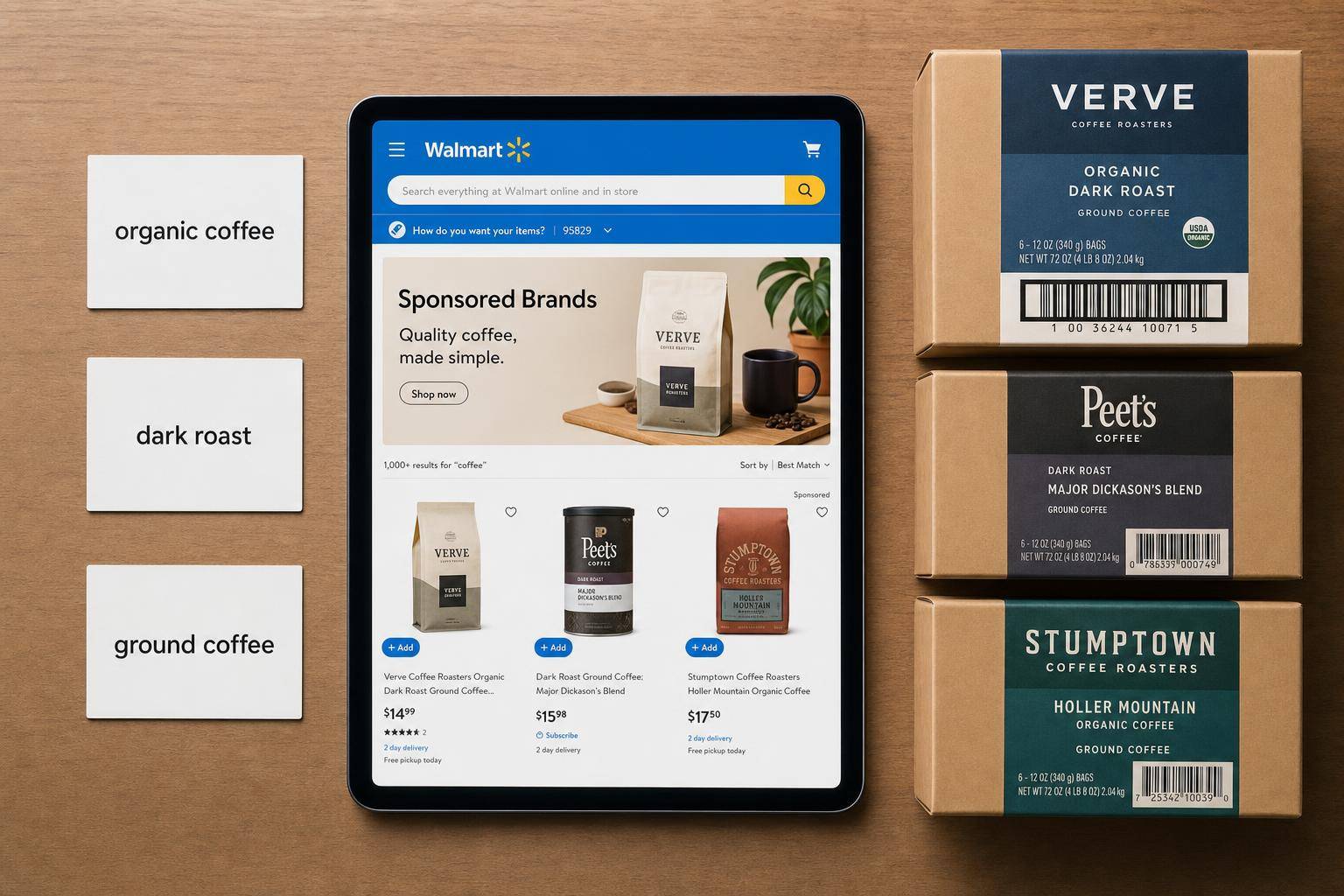
I see Sponsored Brands as a top-of-search format built for visibility, branded search protection, and new customer growth.
The article makes one point clear: placement matters. These ads can appear above organic results and Sponsored Products, which gives brands an early chance to win the click. That matters even more on Walmart, where shoppers often search with short, direct queries and make fast decisions.
I also think the article is right to frame these ads as more than a traffic tool. They can help support both online sales and store demand because Walmart has 4,600+ stores and 150 million weekly shoppers.
What I would fix before launch
Before I spent a dollar, I would check product readiness.
The article’s main message is simple: ads do not fix weak product pages. If the item is out of stock, missing reviews, priced poorly, or has weak content, traffic will cost money without doing much else.
The clearest launch checks are:
Item Content Score of at least 70
At least 3 reviews
At least a 3.5-star rating
Published, in-stock products with the Buy Box
At least 3 SKUs in the ad group
That last point matters because Walmart may limit delivery if too few items stay in stock. If the ad falls to one live SKU, desktop delivery can stop.
My takeaway: retail readiness comes before bid changes, keyword work, or image testing.
How I would structure Walmart Sponsored Brands campaigns
I would not lump everything into one campaign.
The article does a good job showing that structure shapes performance more than small bid edits. Since Sponsored Brands have manual targeting only, one ad group per campaign, and one asset set per campaign, clean structure matters from the start.
I would split campaigns by:
Branded search terms
Category terms
Competitor terms
Product line
Use case
Price tier
That makes reporting easier to read and budget easier to control. If branded traffic and broad category traffic live in the same campaign, it gets much harder to know what is driving sales and what is draining spend.
I also agree with the article’s timing advice. Since review can take 24 to 48 hours, I would build campaigns ahead of promotions instead of waiting until the last minute.
What keyword and bidding rules I would follow
The strongest part of the article is its focus on tight keyword control.
I would start with Exact match for brand terms and proven search terms from Sponsored Products. Then I would add Phrase match for high-intent category searches. I would use Broad match mostly for query mining, not as the center of the account.
The article also warns against splitting the same keyword set across separate campaigns by match type. I agree with that. It can drive overlap and wasted spend.
A few rules stand out:
Move converting search terms from auto Sponsored Products into manual Sponsored Brands
Add promoted winners back as negative exact in the source campaign
Cut search terms that spend $3.00+ with no orders
Watch the 200-keyword cap per ad group
For bids, I like the article’s reminder that Walmart uses a second-price auction. Your bid is the ceiling, not always the final CPC.
The formula shared is useful:
Max CPC = Conversion Rate × Average Order Value × Target ACOS
That gives me a simple way to sanity-check bids before I chase top placement.
The article also gives a few benchmark ranges:
4% to 8% conversion rate
15% to 30% ACOS
3x to 5x ROAS
Average CPC often lands between $0.35 and $1.20
I would treat those as starting points, not fixed rules.
Which ad elements deserve the most attention
The article makes a strong case that small ad choices can shift click-through rate in a big way.
I agree. Sponsored Brands give brands more control over presentation than Sponsored Products do, so asset quality matters more.
The core points I would keep are:
Use a PNG logo
Keep the headline to 45 characters or fewer
Use a lifestyle image that shows the product in use
Keep the product set tied to one clear shopper need
The most striking stat in the article is the 2025 Walmart test showing lifestyle recipe imagery lifted:
CTR by 176%
Conversion rate by 49%
ROAS by 150%
That tells me the image is not filler. It can change performance in a major way when it matches shopper intent.
I also like the advice to test one variable at a time and wait for at least 1,000 impressions before judging a result. If I change the headline, SKU mix, and image all at once, I lose the ability to tell what worked.
How I would handle optimization each week
I would not optimize this format every day.
The article repeats one point that I think many teams ignore: Walmart reporting can lag by about 48 hours. If I react too fast, I may be editing against incomplete data.
The weekly workflow in the article is solid:
Review search term reports
Add negatives to cut waste
Move winners into tighter manual control
Adjust bids only after enough click data comes in
Fix budget caps on campaigns that run out too early
Check listing quality if traffic clicks but does not convert
The article gives a few action thresholds that help:
Cut bids on terms with 30+ clicks if ACOS is more than 20% above target
Increase bids by 10% when ACOS is below target and more volume is available
Review listings when a product gets 50+ clicks and CVR is under 3%
That framework is useful because it separates keyword problems from product page problems. Low CTR usually points to the ad or targeting. Low CVR usually points to the listing, reviews, price, or stock.
How Sponsored Brands fit into a Walmart media plan
I would not judge Sponsored Brands on ROAS alone.
The article is strongest when it treats this format as a top-of-search driver that works with Sponsored Products and Display. That view makes sense because Sponsored Brands can help introduce the brand, while other formats close the sale.
Two stats support that point:
46% of Sponsored Brands orders came from new-to-brand shoppers in FY25
Sponsored Products conversion rates improved by 30% when they ran alongside Sponsored Brands
The article also notes that adding Onsite Display can lead to a 3x higher likelihood of conversion and 40% more spend per customer.
That is why I would watch both ROAS and TACoS. ROAS shows ad efficiency. TACoS shows how ad spend tracks against total sales. If TACoS drops while total sales grow, that can point to paid search helping organic performance too.
FAQ
Are Walmart Sponsored Brands good for new customer growth?
Yes. The article notes that 46% of FY25 orders from this format came from new-to-brand shoppers, which makes it useful for customer acquisition.
How many products should I include in a Sponsored Brands campaign?
I would use at least 3 SKUs. That helps the ad keep serving if one item goes out of stock.
Should I optimize Walmart Sponsored Brands every day?
No. The article recommends weekly reviews because reporting can lag by about 48 hours.
What does low CTR usually mean?
Low CTR often points to weak headlines, poor image choices, weak brand presentation, or keyword mismatch.
What should I check if conversion rate is low?
I would check the product page first: content, reviews, price, and inventory status.
TL;DR Summary
I would start with retail-ready products because traffic will not fix weak listings. In-stock items, solid reviews, and strong content give the ad a fair shot to convert.
I would keep campaign structure simple and focused. Clear separation by search intent and product group makes reporting and budget control much easier.
I would lean on Exact and proven search terms before going broad. That helps reduce waste and gives me tighter control over spend.
I would treat images, headlines, and SKU mix as performance levers. The article’s data shows that the right lifestyle image can shift CTR
What Are Walmart Sponsored Brands Ads and How Do They Work?
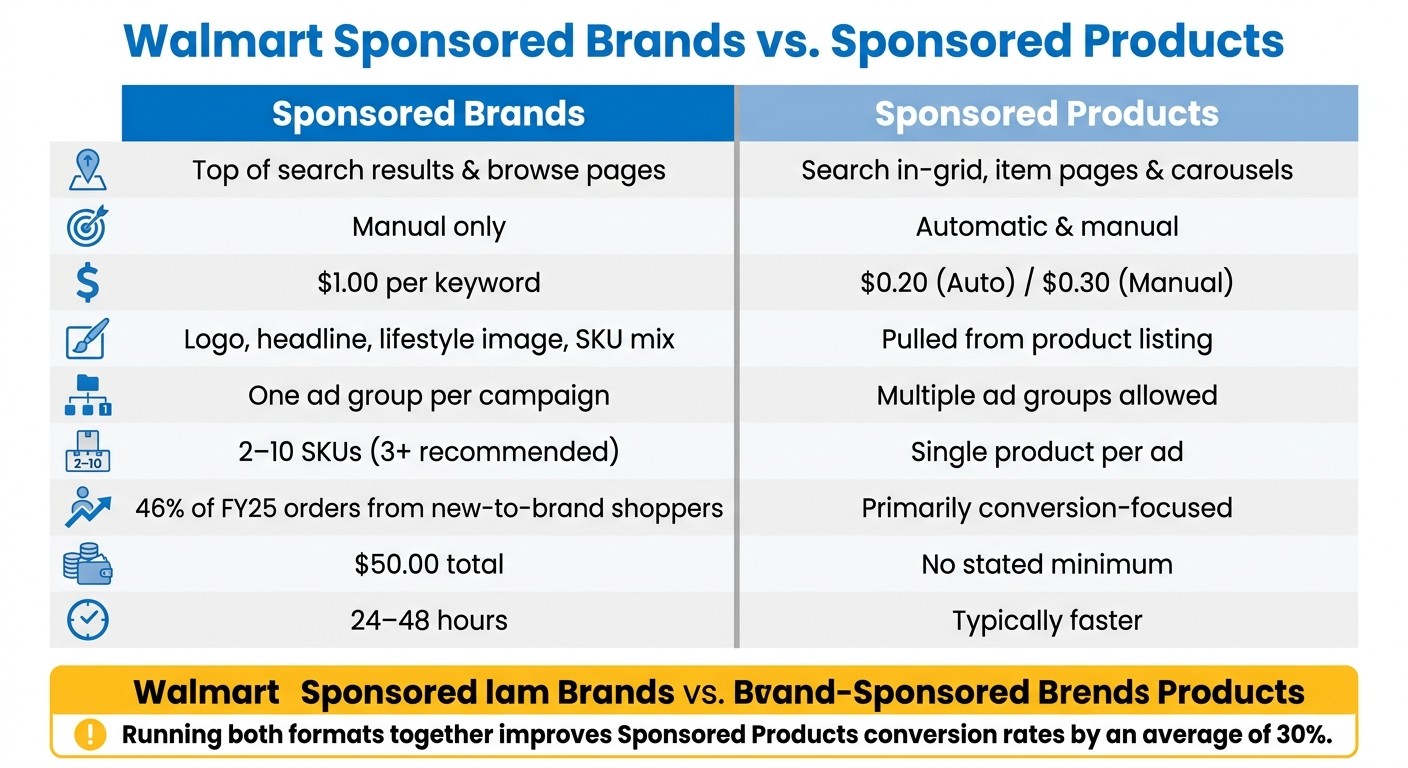
Walmart Sponsored Brands vs Sponsored Products: Key Differences
Walmart Sponsored Brands put your brand front and center at the top of search results. These banner-style PPC ads show a brand logo, headline, and selected products across desktop, mobile web, and the Walmart app on search results and browse pages.
You get direct control over the ad setup. That includes a PNG logo, a custom headline with up to 45 characters, and an optional lifestyle image. Each campaign can include up to 10 SKUs, and Walmart shows the four most relevant products at a time. When a shopper clicks a featured product, they land on that product detail page. When they click the logo or headline, they go to a Brand Shop, Brand Shelf, or a search or browse page.
That’s the big difference from Sponsored Products. Sponsored Products pull much of the ad look from an item listing. Sponsored Brands let you shape how the brand shows up. If you’re testing headlines, images, or product mixes, that extra control matters.
Eligibility, Brand Registration, and Account Requirements
To run Sponsored Brands, you need an active Walmart Marketplace seller or supplier account with Walmart Connect access, verified Brand Portal registration, and a trademark registered with the U.S. Patent and Trademark Office (USPTO). Authorized brand representatives can apply, but Brand Portal verification is still required.
Once you have access, performance comes down to how you set up the campaign and which products you choose.
Campaign Components and Current Format Limitations
Sponsored Brands come with a few fixed rules that shape setup and testing:
Minimum total budget: $50.00
Minimum keyword bid: $1.00
Ad groups and creative sets: one each per campaign, so testing different headlines or images means building separate campaigns
SKU range: 2 to 10 products, with at least 3 suggested so the ad can still serve if one item goes out of stock
Targeting: manual only
Review window: New campaigns and creative assets usually take 24 to 48 hours to review before launch
Those limits affect how many tests you can run at one time. Put simply, your testing pace is tied to campaign structure from the start.
Feature | Sponsored Brands | Sponsored Products |
|---|---|---|
Placement | Top of search results and browse pages | Search in-grid, item pages, and carousels |
Targeting | Manual only | Automatic and manual |
Minimum Bid | $1.00 | $0.20 (Auto) / $0.30 (Manual) |
How to Structure Walmart Sponsored Brands Campaigns for Performance
Once the format limits are clear, campaign structure becomes the biggest lever for efficiency. In Walmart Sponsored Brands, setup choices shape how well you match shopper intent and how much spend slips away. Product mix matters. Intent grouping matters. Launch timing matters. In many cases, those decisions have more impact than small bid tweaks.
Choose Retail-Ready, Well-Stocked Products
The products you feature have a direct effect on whether the campaign can keep serving. Walmart only shows ads for items that are published, in stock, and holding the Buy Box. There’s also a practical catch: if your campaign falls to one in-stock item, the ad stops serving on desktop and appears only on mobile.
A simple rule helps here. Include at least three SKUs and keep at least two of them in stock. When possible, feature your highest-rated or best-selling items. That setup gives the ad unit more staying power and lowers the odds of losing visibility when one product sells out.
Just as important, keep the product set focused. Use those placements to support one campaign theme rather than stuffing in unrelated items. If a shopper sees a clear connection between the products, the ad makes more sense, and the traffic is easier to judge later.
Segment Campaigns by Intent, Category, or Product Line
Split defensive, offensive, and discovery campaigns so bids and budgets stay tied to a single type of intent. Defensive campaigns go after your own brand keywords. Offensive campaigns target category and competitor terms. Discovery campaigns help you gather search term data from broader queries.
That separation sounds basic, but it keeps decision-making cleaner. A branded searcher behaves differently from someone comparing category options, and both behave differently from a shopper using a broad, early-stage query. If all of that sits in one campaign, performance data gets muddy fast.
Inside each campaign, group products around one clear theme, such as:
a product line
a price tier
a use case
Campaigns built around one category or one story are easier to tune over time. On the flip side, mixing unrelated categories makes search term data harder to use and limits your ability to refine performance as results come in.
Plan Launch Timing Around Approval Windows and Ramp-Up
Every new Sponsored Brands campaign goes through moderation before it can go live. New items, keywords, and brand profiles may also stay pending until review is done. If you’re launching near a major promo window, give yourself enough lead time to deal with edits or resubmission.
That matters more than many teams expect. A campaign that looks ready in the platform may still be stuck in review while traffic spikes elsewhere. Submitting early gives you room to fix problems without missing the moment.
Once the campaign is live, resist the urge to make big bid swings right away. Keep budgets steady during the first few weeks. Walmart Connect reporting lags by 48 hours, so daily changes can lead you to react to data that is still incomplete. A steadier ramp makes it easier to spot which keywords, products, and bid levels are pulling their weight.
What Keyword and Bidding Strategies Work Best for Walmart Sponsored Brands?
Keyword choice and bid control make or break Walmart Sponsored Brands. Even a clean campaign setup can leak money fast if you chase too many terms or bid without a clear target. Since Sponsored Brands ad groups cap out at 200 bid-on keywords, you can't afford a bloated list. The goal is simple: put budget behind terms that show buying intent, cut overlap, and use search term data to keep tightening performance.
Build a Focused Keyword List Around Branded and High-Intent Terms
Start with Exact match on branded terms. That helps protect top-of-search banner placement and keeps high-intent traffic with your brand instead of handing it to a competitor.
Next, layer in Exact match for terms that already converted well in your Sponsored Products campaigns. That move is common sense. If shoppers have already used a query to buy, you're not guessing anymore. You're backing a signal that has already done its job.
Use Phrase match for category searches like "protein powder for women" or "stainless steel water bottle". These terms help you show up when shoppers search by product type, not just by brand.
Save Broad match for discovery and search query mining. Broad can still help, but it works best when you treat it like a testing ground, not the center of the account.
One thing many advertisers get wrong: splitting Exact, Phrase, and Broad into separate campaigns for the same keyword set. On Walmart, that can create self-competition and burn budget with little upside. It's smarter to keep match types in one campaign and let performance data show which terms deserve more spend.
Walmart searches also tend to be short and direct. That matters. Long, bloated keyword lists often look good in a spreadsheet but don't line up with how people actually shop on the platform. A tighter list usually wins.
Use Search Term Harvesting to Improve Efficiency Over Time
Your best keyword source is your own search term data. Not a third-party tool. Not a brainstorm doc. Your actual shopper queries.
A solid way to build that data set is to run automatic Sponsored Products campaigns for three to four weeks, then review the Search Term Reports. Look for terms with at least two orders and ACOS at or below your target, then move those into manual Sponsored Brands campaigns.
Once a term moves up to manual, add it back to the original auto campaign as a negative exact keyword. That blocks overlap on the same query and keeps the campaigns from stepping on each other.
You should also cut waste fast. If a term spends $3 or more and drives no orders, negate it as exact match. That kind of weekly cleanup can trim wasted spend over time without making the account harder to manage.
This process is less about volume and more about discipline:
Promote terms that earn their spot with orders and target-level ACOS.
Block overlap once a winning term moves into manual control.
Prune spenders that don't convert before they eat more budget.
Once the keyword set is in place, search term data becomes your filter. It shows you what to push, what to pause, and what to block.
Set Bids and Budgets Based on Competition, Conversion Rate, and ROAS
Walmart Sponsored Brands run on a second-price auction, which means the winner pays $0.01 above the next-highest bid. That's useful because your bid is a ceiling, not always the amount you pay.
A practical starting point for bid setting is:
Max CPC = Conversion Rate × Average Order Value × Target ACOS
That formula gives you a rough ceiling based on what your economics can support. If your conversion rate or average order value is weak, a high bid won't fix the problem. It'll just make losses arrive faster.
Sponsored Brands also come with a higher bid floor. Minimum keyword bids start at $1.00, compared with $0.30 for Sponsored Products. Even so, average CPCs across categories usually land between $0.35 and $1.20, so you need to watch category pressure and placement demand rather than assume every click will cost the floor price or more.
For performance guardrails, track these benchmarks:
4% to 8% conversion rate
15% to 30% ACOS
3x to 5x ROAS
These numbers won't fit every brand or category, but they give you a useful starting range when you need to judge whether a campaign is healthy or just busy.
After bids are set, budgets decide whether good campaigns can keep running long enough to matter. Brands balancing awareness with performance should put 10% to 20% of total Walmart Connect spend into Sponsored Brands, while performance-led brands can often work well at around 15%.
If a campaign burns through its daily budget early, fix the budget first before pushing bids higher. Otherwise, it's like flooring the gas pedal in a car with an almost empty tank. You may win more auctions, but you won't stay in them for long.
What Creative Choices Actually Drive Click-Through Rate on Walmart Sponsored Brands?
On Walmart Sponsored Brands, small creative choices can have an outsized effect on click-through rate. After you lock in keywords and bids, the next lever is the ad itself: the logo, headline, product lineup, and optional lifestyle image. You don’t get much room to work with, which is exactly why each piece has to pull its weight. When those parts line up, the ad stands out faster and makes sense faster. That’s what gets the click.
Clear branding helps shoppers recognize the ad at a glance and cuts down on confusion.
Short headlines tend to work better when they match what the shopper already wants.
SKU grouping changes the story your ad tells, so the product mix needs to support the same intent as the headline.
Lifestyle imagery can move CTR in a big way when it shows the product in use.
Follow Walmart Asset Specs and Keep Branding Clear
Start with the basics. Use a PNG logo under 200 KB at 300 × 180 px, and keep the brand name under 35 characters with matching spelling and casing. That sounds simple, but it matters. If the logo file is off, the name is inconsistent, or the branding feels messy, the ad becomes harder to process in a split second.
For the optional lifestyle image, use a 16:9 format at a minimum of 1,200 × 675 px, up to 1 MB, in JPG or PNG, without added text, logos, or pricing. That image slot can do a lot of work because it helps shoppers picture the item in context instead of seeing a plain brand mark.
Lifestyle imagery is one of the stronger CTR levers here because it shows the product in use. That’s not just theory. In a 2025 Walmart test, lifestyle recipe imagery lifted CTR 176%, conversion rate 49%, and ROAS 150% versus logo-only ads.
That kind of lift makes the point pretty plainly: if the image helps shoppers “get it” faster, performance can jump.
Write Short Headlines That Match Shopper Intent
After asset specs, the next job is message clarity. Walmart limits headlines to 45 characters, including spaces. That leaves no room for filler. A vague brand slogan may sound nice in a boardroom, but it usually won’t help much in search.
Lead with a benefit or purchase intent instead. The headline should reflect the same language shoppers are already using when they search. If someone is looking for a quick dinner fix, a broad brand line won’t land as well as a line tied to that need. Same story with value, convenience, pack size, or product type.
The key is alignment. Your headline, keyword targeting, and product assortment should all point to the same shopper need. If those pieces drift apart, the ad feels disjointed. If they line up, the ad reads like a direct answer to the search.
Test SKU Mixes and Ad Angles in a Controlled Way
The product lineup matters just as much as the copy. Sponsored Brands ads require at least 2 and up to 10 items per ad group, with four SKUs typically displaying together in search results. Include at least 3 items so the ad can keep serving on desktop if one product goes out of stock; if only 1 item remains in stock, the ad serves on mobile only.
That inventory detail has a direct media impact. A thin SKU mix can quietly limit delivery, even if the ad itself looks fine.
Grouping also shapes the message. The products should reinforce the same shopper intent as the headline, not compete with it. Common setups include Shop the Look for complementary items, Good, Better, Best for price tiers, and New Arrivals for recent launches. Each one tells a different story. A complementary bundle says, “here’s the full solution.” A tiered lineup says, “pick the option that fits your budget.” A launch set says, “see what’s new.”
Pick the grouping that fits the campaign goal, then test with discipline. Change one variable at a time and wait for at least 1,000 impressions before judging the result. If you swap the headline, image, and SKU mix all at once, you won’t know what moved the number. Clean tests beat guesswork every time.
How to Optimize and Measure Walmart Sponsored Brands at Scale
Walmart Sponsored Brands can look shaky day to day, but that’s often just reporting noise. The smarter move is a weekly review cycle, not constant tinkering. With Walmart’s 48-hour reporting lag, daily edits can push teams into bad calls based on half-formed data.
TL;DR
Weekly optimization works better than daily changes because Walmart reporting lags by about 48 hours.
CTR, CVR, CPC, attributed sales, and impression share are the core metrics for judging Walmart Sponsored Brands performance.
Low CTR often points to weak ad creative or poor keyword fit, while low CVR usually signals a product page or inventory issue.
Scaling should follow stable ROAS, more conversions, and rising impression share over several weeks, with tighter budget control around exact-match winners.
Track the Metrics That Guide Decisions
At scale, optimization gets easier when the team focuses on a short list of metrics that actually change decisions. For Walmart Sponsored Brands, that list is CTR, CVR, CPC, attributed sales, and impression share.
CTR tells you whether shoppers are responding to the ad itself. If it’s low, the issue is often the headline, image, brand presentation, or keyword alignment. In plain English: people saw the ad and didn’t find it worth the click.
CVR tells a different story. If shoppers click but don’t buy, the ad may not be the main problem. More often, the friction sits on the product page. Check content quality, review count, price position, and stock status before touching bids. That step matters because bid changes won’t fix a weak listing.
CPC helps you judge how hard you’re pushing in a given category. In competitive categories, $1.50–$2.50 CPC is common. That range doesn’t mean the spend is bad on its own. It means the brand has to judge cost against conversion and sales output, not react to price in isolation.
Attributed sales matter because Walmart Connect uses closed-loop attribution across online and in-store sales. That gives advertisers a clearer read on what the ads are doing beyond the digital shelf alone. Impression share rounds out the picture by showing how much of the available demand the campaign is winning.
If CVR is weak, check the product page and inventory before changing bids.
Metric | Target | What It Signals |
|---|---|---|
CTR | 4%–8% | Creative and keyword alignment |
CVR | 4%–8% | Listing quality and shopper intent |
CPC (Competitive) | $1.50–$2.50 | Bidding efficiency vs. category demand |
Ad spend as a share of revenue | 8%–15% | Typical for growth-stage brands |
Build a Weekly Optimization Workflow
A weekly review is where setup turns into repeatable action. It’s the operating rhythm for spotting what’s working, trimming wasted spend, and catching listing problems before they drag down the account.
Three actions should anchor that workflow:
Review search terms and add negatives or promote winners. Flag terms that are spending without converting and negate them. If a term has enough converting orders, move it into manual exact match.
Adjust bids on terms with enough click data. For keywords with 30 or more clicks, cut bids if ACOS is running more than 20% above target. Increase bids by 10% when ACOS is below target and there’s room to win more volume.
Fix budget pacing and product page and placement review on underperformers. If a strong campaign is hitting its daily cap too early, increase budget. If a product has 50 or more clicks and CVR under 3%, the listing needs work more than the bid does.
This matters because not every weak result calls for the same fix. A search term problem needs a keyword move. A budget cap needs more spend. A listing problem needs merch, pricing, reviews, or inventory work. Treating all three the same is where a lot of wasted spend creeps in.
There’s also a timing rule that saves a lot of second-guessing: don’t change the same keyword twice inside 48 hours, and wait at least 72 hours before judging the result of an edit. That pause gives the data time to settle. Without it, teams end up chasing blips.
Scale Winning Campaigns With Tighter Controls
Once a campaign shows stable ROAS, rising conversion volume, and growing impression share for several weeks, it’s time to move more budget behind the winners. That doesn’t mean opening the floodgates. It means scaling with tighter control.
The usual pattern is simple. Push most budget into Manual Exact, keep Manual Phrase running for expansion, and leave Manual Broad active for discovery. Exact match gives the cleanest read on what is already working. Phrase helps uncover close variants. Broad keeps the account from going stale.
That structure also supports one of the bigger payoffs in Walmart media: strong exact-match performance can help organic rank. Paid and organic don’t sit in separate boxes. When the right terms keep converting, the effect can stack over time.
To judge whether scaling is doing its job, track TACoS alongside ROAS. ROAS shows ad efficiency. TACoS shows the share of total sales tied to ad spend. If TACoS is dropping while total sales keep growing, that’s a good sign the ads are helping organic rank and not just buying revenue at full price.
Impression share adds another checkpoint. If exact-match terms sit below 20%–30%, bids may not be high enough to win the visibility Walmart needs to reward with more sales velocity. In other words, the campaign may be efficient on paper but still underpowered in the auction.
FAQ
What metrics should I watch for Walmart Sponsored Brands each week?
The main metrics are CTR, CVR, CPC, attributed sales, and impression share. Together, they show ad appeal, listing health, cost pressure, sales impact, and how much demand the campaign is winning.
Should I optimize Walmart Sponsored Brands every day?
No. Weekly optimization is the better fit because Walmart reporting has a 48-hour lag. Daily changes can lead to snap decisions based on incomplete data.
What does low CTR usually mean in Walmart Sponsored Brands?
Low CTR often points to weak creative or poor keyword alignment. The ad may not match shopper intent, or it may not stand out enough to earn clicks.
What should I do if CVR is low?
Start with the product page and inventory. Check content quality, review count, and stock status before changing bids. If shoppers click but don’t buy, the problem is often after the click.
TL;DR Summary
Weekly optimization beats daily edits because Walmart’s 48-hour reporting lag can make short-term swings look more meaningful than they are.
CTR, CVR, CPC, attributed sales, and impression share give the clearest view of ad response, listing quality, and auction strength.
Low CTR often means the ad or keyword targeting needs work, while low CVR usually points to listing friction, weak reviews, pricing issues, or inventory trouble.
Scale comes after several weeks of stable ROAS, more conversions, and stronger impression share, with more budget shifted into exact-match terms and TACoS tracked beside ROAS.
CTA Block
Want a cleaner way to scale Walmart Sponsored Brands without guessing from noisy data? Book a Walmart media performance audit with Bigeye. We’ll review your campaign structure, search term flow, bid logic, budget pacing, and product-page friction so you can put more spend behind the terms that are set up to drive sales.
How Walmart Sponsored Brands Fit Into a Broader Retail Media Plan
Walmart Sponsored Brands work best as a top-of-search demand driver, not a solo play. They show up at the top of search results, where they can build awareness and shape shopper interest before Sponsored Products do the heavier lifting on conversion. That role changes how brands should think about budget, success metrics, and campaign goals.
Align Campaign Strategy With Brand, Research, and Analytics
If you're judging Sponsored Brands on ROAS alone, you're missing the bigger picture. The clearest signal is often new-to-brand customer acquisition. In FY25, 46% of Sponsored Brands orders came from shoppers who had not bought from that brand on Walmart in the previous 12 months. For a consumer brand trying to grow, that number says a lot.
This is where a full-funnel view matters. When Sponsored Brands run alongside Sponsored Products, conversion rates on Sponsored Products improve by an average of 30%. Add Onsite Display, and brands see a 3x higher likelihood of conversion and 40% more spend per customer. Those gains don't happen in a vacuum. They stack up when media, messaging, and measurement work together.
That means teams need to stay aligned on a few core points:
Messaging should match what shoppers see across ad formats.
Product priorities should reflect both sales goals and brand goals.
Measurement should look at ROAS and TACoS together to spot incrementality.
A disconnected setup can make good campaigns look weaker than they are. A coordinated one gives you a much clearer read on whether Sponsored Brands are helping bring in new buyers and lift total account performance.
When to Bring In a Retail Media Partner
There comes a point when an in-house team is juggling too much at once. As accounts grow, campaign management gets messier, creative needs pile up, and measurement turns into its own job. That's usually when outside help starts to make sense.
Bring in a retail media partner when scale, creative volume, or reporting needs outgrow your team's bandwidth. A good example comes from a 2025 Freshpet Sponsored Brands custom image test. In that test, lifestyle imagery paired with category-level keyword targeting improved CPC efficiency by 25% and lifted new-to-brand sales by 30% versus earlier logo-only campaigns.
That's the kind of lift that can come from tighter coordination between media strategy, ad creative, and performance analysis. Bigeye helps consumer brands connect Walmart media, creative, and analytics into one retail growth plan: https://www.bigeyeagency.com.
What Are the Most Important Walmart Sponsored Brands Best Practices to Follow?
The playbook is pretty simple: start with retail-ready products, keep targeting tight, use clear creative, and optimize every week.
Here’s the short version that matters most.
Launch only retail-ready, in-stock SKUs, with at least three items per ad group.
Once your product set is in place, the next lever is targeting. Use Exact for branded and proven terms, Phrase for controlled expansion, and Broad for discovery. Review search terms weekly and move winners into tighter control.
Use clear branding, short headlines, and lifestyle imagery; the image format usually outperforms logo-only ads.
After targeting and creative are in place, stick to a weekly optimization cycle. Optimize weekly, not daily, because Walmart reporting lags about 48 hours.
CTA: Audit Your Walmart Sponsored Brands Strategy
Audit your Walmart Sponsored Brands setup with Bigeye.

Pet Industry
Sep 13, 2026
Amazon PPC for pet brands: separate intent, set bids by margin & reorder value, and stop wasted spend with a 90‑day audit.