A content marketing agency is no longer optional for many consumer brands. When ad fatigue can hit in days and paid social often needs 25 to 40+ live assets at once, most in-house teams simply can’t keep up. In this piece, I break down what this shift means, how brands should plan content across channels, and what a better production system looks like in 2026.
TL;DR
Brands now need a steady flow of channel-specific assets because each platform, placement, and funnel stage asks for different formats and messages.
More output is tied to better paid media results, with brands testing 15+ variants per month often seeing 23% higher ROAS than brands testing fewer than five.
A content marketing agency helps turn one idea into many platform-ready versions without putting all the strain on the internal team.
The best systems link research, production, media, and reporting so each round of output improves the next one.
Brand control matters more as output grows, so approval rules and pre-approved templates should be set before volume scales.
Why Do Brands Need More Content Than Ever Before?
Brands need more content because modern marketing runs on volume, speed, and fit. Every platform, every ad slot, and every funnel stage calls for its own version of the message. And those versions can’t sit unchanged for months. They need to be refreshed before people tune them out and performance starts to slip.
The Multi-Platform Content Landscape Is Changing Brand Production Needs
Meta makes this shift plain: creative volume is now a weekly production problem, not a quarterly planning exercise. Brands need channel-native content across paid social, organic social, video, retail media, email, search, and web. In other words, teams need to build for the placement from the start, not treat it like a last-minute resize.
Video adds even more pressure. It delivers an average of 48% more reach than static posts. Short-form video helps people discover a brand. Educational content helps move them through consideration. Dynamic product ads help drive conversion. Each channel, and each format inside it, creates its own production demand.
Ad Fatigue Forces Brands to Treat Content Refreshes as a Performance Requirement
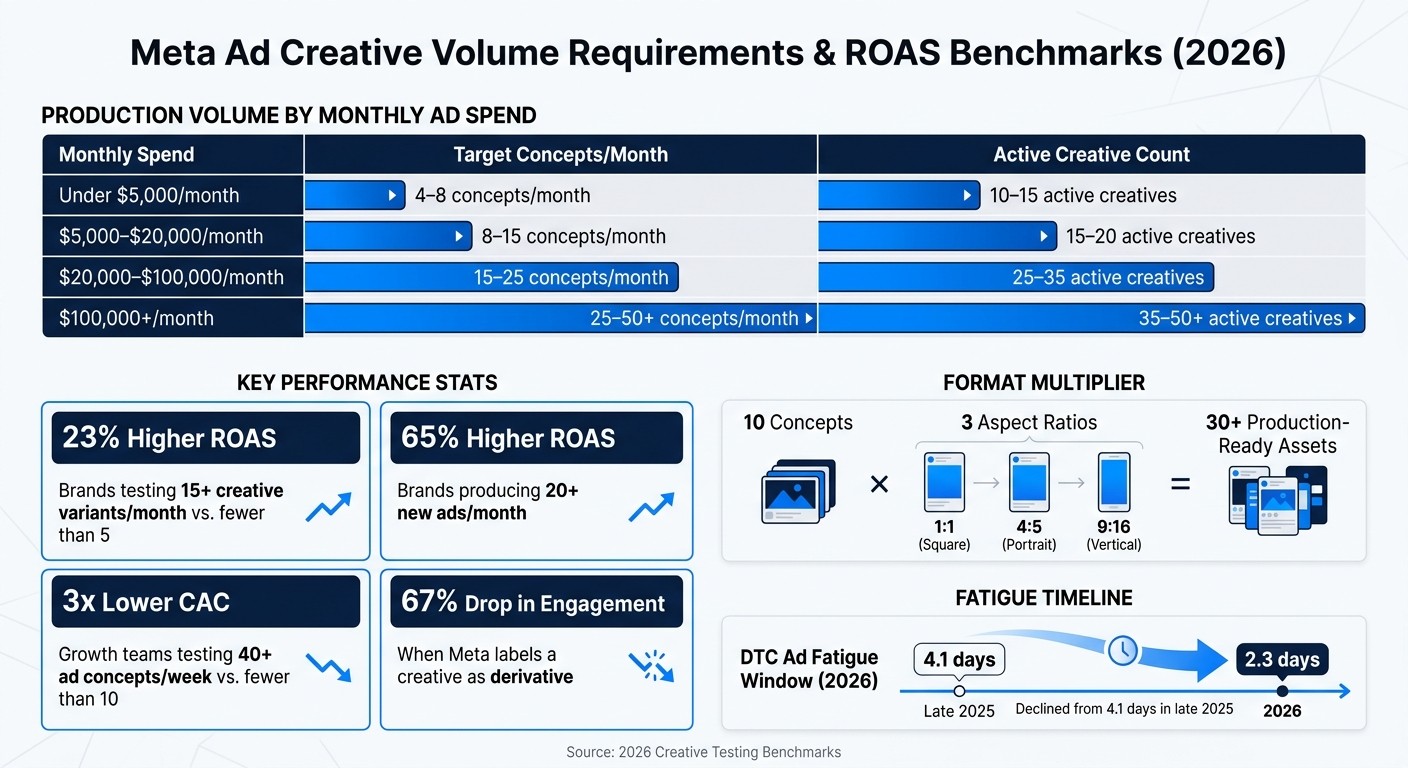
Ad fatigue isn’t a vague brand problem anymore. It shows up fast, and it hits paid performance hard. For DTC brands, creative fatigue can now set in within days, and when Meta’s system reads a creative as a near-duplicate of what’s already running, delivery and engagement drop off quickly.
That changes the math. If a brand scales ad spend without scaling creative volume, it speeds up fatigue on assets already in market. More spend against the same small batch of ads usually means wear-out comes sooner, not later.
The brands getting ahead of this are producing 25 to 40 new ad concepts each month. There’s a clear payoff: brands testing 15 or more creative variants per month see a 23% higher ROAS than brands testing fewer than five. That’s why many teams turn to a content marketing agency. They need a partner that can keep fresh variants moving every week instead of scrambling after performance dips.
Where a Content Marketing Agency Fits Into This Production Reality
Inside many brands, marketing leaders set the direction and make approvals. The content marketing agency handles the production load. That setup gives teams more scale, tighter control, and a bigger flow of variants without turning every internal review into a bottleneck.
The agency’s job is to turn platform guidance into output at scale. That usually means research, production, versioning, and performance feedback working together instead of sitting in separate silos. Done well, it helps a brand keep pace with what each channel needs while staying on-message.
That kind of volume only works when creative is planned by channel, format, and refresh cadence. The next step is to map those assets by platform, funnel stage, and refresh cadence.
How Should Brands Map Content Across Every Platform, Media Type, and Environment?
Mapping content means deciding the right format, output, and refresh pace for each channel before production begins. Put simply, every asset should be matched to the channel, the audience, and the funnel stage from the start. A content marketing agency usually builds that map upfront so teams are not guessing later. The issue is not whether brands need more content. It is how to assign each asset to the right format and the right cadence.
Meta now expects a steady flow of new creatives each week. That pressure turns into a channel-by-channel production map. Each platform needs its own output target, format specs, and refresh trigger. From there, the work becomes clear: match each master concept to the formats each channel can actually use.
Match Content Formats to Channel Requirements
Start with one master concept, then shape it for each platform. A single video idea can turn into 8-12 variants across platform-specific formats. That is where component-based templates earn their keep. They help teams scale output, keep the brand steady, and make high-volume production possible.
A structured hook-angle matrix can produce 144 messages from a small set of inputs. That gives teams a repeatable system for building volume without starting from zero every time. For a content marketing agency, this is a standard way to multiply output across platforms without letting the work drift.
Retail media and in-store placements need a different approach. These placements usually call for fewer assets, but each one needs a more polished finish and a monthly or seasonal refresh cycle.
Plan by Funnel Stage, Not Just by Channel
Content planning works better when each channel has a defined job in the funnel. TikTok and Meta often handle awareness and discovery. LinkedIn and Reddit can support consideration. Google Search and Amazon Ads tend to drive conversion.
The same channel can also do different jobs at different moments. Awareness creative, consideration creative, and conversion creative should not sound the same. Each one needs its own message, proof, and pace.
Retention creative deserves its own brief as well. Post-purchase messaging needs different proof points, offers, and timing than acquisition assets. If brands skip that distinction, they end up talking to existing customers like first-time prospects, and that usually falls flat.
A Comparison Table: Volume, KPIs, and Refresh Cadence by Channel
These ranges reflect 2026 creative testing benchmarks and refresh guidance.
Channel / Format | Refresh Cadence | Production Cadence / Volume | Primary KPIs |
|---|---|---|---|
Meta | Every 5-8 days | 10+ fresh creatives per active campaign | CAC, frequency, ROAS |
TikTok / UGC | Every 7-10 days | 3+ hook variations per concept | Thumbstop rate, hook rate |
Static Ads | Every 14+ days | 5-8 variations per concept | CTR, CPA |
Retail Media / In-Store | Monthly or seasonal | Fewer, higher-finish assets; monthly or seasonal refreshes | Conversion rate, brand consistency |
Once the map is set, production can move into repeatable creative systems.
What Does Meta's Push for More Ad Variations Actually Mean for Production Volume?
Meta's push for more ad variations isn't a nice-to-have anymore. With Meta's 2026 Andromeda system filtering ads before ranking, weak creative can get screened out before it even has a shot at delivery. For a content marketing agency, that changes the job from building isolated campaigns to running an always-on production engine. For consumer brands, creative volume is now a weekly operating demand, not a once-in-a-while lift.
Why Meta Pushes for More Ad Variations
The reason is pretty simple: Andromeda reads creative content directly, which means the ad itself now plays a central role in performance. If Meta wants to match the right message to the right person, it needs a deep bench of assets to choose from.
That also means small edits won't carry the load. Meta groups near-identical ads together when they look too similar, so brands need actual signal diversity, not just a new background color or a swapped headline. On top of that, ad fatigue shows up faster now. What used to feel like a campaign task has turned into a recurring production rhythm.
Turning Platform Guidance Into Weekly and Monthly Production Targets
The practical takeaway is more output. For teams spending more than $5,000 per month on Meta, that often works out to 5 to 15 new creatives per week. Advantage+ campaigns work best with at least 20 diversified ads and can support up to 150 creative combinations.
Monthly spend sets the floor. The table below turns budget into production targets.
Monthly Spend | Target Concepts per Month | Active Creative Count |
|---|---|---|
Under $5,000 | 4-8 concepts | 10-15 active creatives |
$5,000-$20,000 | 8-15 concepts | 15-20 active creatives |
$20,000-$100,000 | 15-25 concepts | 25-35 active creatives |
$100,000+ | 25-50+ concepts | 35-50+ active creatives |
There’s another multiplier hiding in plain sight: format. For each concept, brands should produce three aspect ratios - 1:1 for Feed, 4:5 for Instagram Feed, and 9:16 for Reels and Stories - to expand placement coverage. So if a team builds 10 concepts, that quickly turns into 30 assets before copy variants even enter the picture.
Once those output goals are set, the real question becomes operational: how do you keep that pace without the whole process turning into chaos?
How a Content Marketing Agency Manages Meta-Level Output
A content marketing agency handles that level of volume with systems, not brute force. One of the clearest examples is a hook-angle matrix. A single strategy session can turn into 144 distinct messages by mixing six hooks, six angles, and four proof elements. That's enough testing material to cover three to four months, which gives teams room to move without reinventing the wheel every week.
Templates do the heavy lifting too. When headers, body copy, and CTAs can be swapped inside approved layouts, one template can produce 20 to 50 variants. That kind of modular setup can cut production time by 60% to 70%. Without that time savings, weekly creative drops sound good on paper and fall apart in practice.
Approvals need structure as well. A tiered review process keeps work moving: standard variants go to a team lead, new messaging angles move to a brand director, and net-new concepts go through full stakeholder review. It's a simple way to keep output moving while still protecting brand standards.
That level of production only holds up when creative is modular, templated, and built to be reused.
How Do You Build a Scalable Content Engine Instead of Running One-Off Campaigns?
A scalable content engine beats the old campaign-by-campaign model because it turns one strong idea into a steady flow of on-brand assets across channels. Once channel needs and refresh cadence are clear, the next move is simple: build a system that can keep up. That matters even more now because Meta rewards weekly creative refreshes, not the occasional campaign reset.
Start With Messaging Pillars and Modular Content
Begin with a tight set of messaging pillars. Think core brand truths, audience pain points, product benefits, and emotional hooks. That gives the team a clear base to work from. Instead of facing a blank page every time, each new asset becomes a version of something that already has direction.
From there, a content marketing agency can build modular parts that mix and match: headlines, body copy, CTAs, visual backgrounds, and proof elements. One approved concept can then spin into 20 to 50 variants by swapping those parts inside a locked template. That’s the real shift. You stop building one campaign at a time and start running an engine.
Build Templates, Versioning Rules, and Asset Libraries
Templates keep brand execution tight at scale. When fonts, colors, logo placement, and tone of voice are baked into the template, standard variations can move through a lighter approval path. That saves time without letting the work drift off-brand.
It also helps to set clear versioning rules. Which parts can a team swap freely? Which parts need review? When that’s defined up front, production gets smoother. Pair that with a clean asset library, and teams can pull approved visuals, copy blocks, and proof points whenever they need them instead of hunting through old files and Slack threads.
The payoff is hard to ignore:
Template systems can cut manual design time by about 70%.
AI-assisted copywriting can reduce writing time by around 60%.
Those time savings make weekly creative output far more realistic at the volume Meta and other platforms now expect.
With the system in place, the next issue isn’t production. It’s judgment. Which ideas are worth multiplying?
Use Consumer Research to Decide What Gets Scaled
A content marketing agency shouldn’t scale ideas just because it can. Volume works only when the team is multiplying concepts that have a real shot at winning. More output won’t fix a weak message. It just spreads it faster.
That’s where research earns its keep. Bigeye's EyeQ platform delivers audience insight in 72 hours, giving creative teams a clear read on which messaging pillars, emotional angles, and product claims connect before a single asset goes into production. In plain English, it helps keep the agency from pouring time and budget into the wrong idea.
Once a concept clears a set performance threshold, it earns the right to scale across formats, placements, and spend levels. That research-to-scale handoff is what turns a content engine into a compounding asset instead of another one-off campaign.
What Does a Content Marketing Agency Actually Do to Support High-Volume Production?
High-volume content breaks down fast when research, production, media, and reporting all live in different places. Once the content engine is in place, a content marketing agency keeps it running by turning research into briefs, briefs into variants, and variants into live tests. A content marketing agency handles research, production, media, and measurement inside one workflow so brands can keep up with platform demand. Bigeye uses this model to support ongoing consumer brand content.
How Do Integrated Teams Connect Research, Content, Media, and Analytics Under One Workflow?
When research, creative, and media buying sit in separate silos, the feedback loop falls apart. A content marketing agency keeps those teams connected, so performance data from live campaigns shapes the next brief instead of sitting in a monthly report.
That shared workflow turns consumer insight into test-ready creative briefs and structured test plans. Weekly refresh pressure on Meta-style platforms leaves little room for guesswork. In that setup, the agency’s output can’t be based on what looks best in a deck. It has to be based on what performs in market. Bigeye’s EyeQ platform supports that process by delivering actionable consumer insights in 72 hours, which helps teams check messaging before assets move into production.
The day-to-day payoff is simple: the learning loop gets shorter. Each new batch of content is built from live performance data, not assumptions.
How Does a Content Marketing Agency Improve Approval Speed, Governance, and Brand Consistency?
High-volume production can create governance problems fast when brand standards are loose. If a brand is shipping 40 or more creative variants a month across Meta, TikTok, YouTube, and retail media, drift starts to creep in.
A content marketing agency helps control that pressure with templates and tiered review paths. That gives teams a way to scale output without losing grip on brand standards. It also cuts down on approval slowdowns, which matter a lot when content has to move from brief to launch on a tight schedule.
In plain terms, the goal is not just to make more assets. It’s to make more assets without turning every review cycle into a bottleneck.
Why Is Bigeye Built for Ongoing Consumer Brand Content Rather Than One-Off Projects?
Sustained content production takes more than occasional campaign support. Bigeye supports ongoing consumer brand content with consumer insight, creative production, and performance media in one workflow, so the team shaping the content stays closely tied to the team measuring results.
That matters because steady production only works when performance data feeds the next round of creative. If those teams drift apart, the system slows down and the content starts running on instinct instead of proof.
Bigeye is set up for that continuous loop. The point isn’t a one-time launch and a nice recap deck a few weeks later. The point is to keep the engine moving, learn from live results, and use those lessons in the next wave of content.
How Should Brands Measure Multi-Platform Content Performance Across Every Channel?
Multi-platform content performance is not just a media question. It’s a creative question too. Brands that only watch CPM, reach, and frequency can see delivery, but they can’t see why one asset pulls ahead while another stalls. Measuring multi-platform content performance means tracking two layers at once: platform metrics and content-level signals. Platform metrics such as CPM, reach, and frequency show how media is delivered. Content-level signals such as thumb-stop rate, hold rate, and CTR decay show whether the asset itself is doing its job. For a content marketing agency, measurement determines what gets scaled next. That’s why content marketing agency teams need a closed-loop measurement system, not just a recap deck.
Which Platform Metrics and Content-Level Signals Actually Matter?
Creative drives campaign results, so asset-level signals should come first, not media-only numbers.
On Meta, a healthy hook rate for DTC brands in 2026 usually lands between 25% and 30%. If thumb-stop rate drops below 25%, the issue is almost always in the first 1.5 seconds of the content, not the offer or the audience. That’s a big deal. It means a weak opening can sink performance before the rest of the message even has a chance to work.
High-performing content on Meta also tends to follow a 10-day decay curve, with a 30% to 50% CTR drop by days 8-10. In plain terms, even strong assets wear out. If a team waits too long to refresh, performance slips while spend keeps moving.
Standardize event definitions in one dashboard so every channel reports the same way. Without that, one team may define a “view” one way, another team may log engagement another way, and the result is messy reporting that slows decisions. A content marketing agency needs one shared scorecard so the team can compare content fairly across channels.
How Should Performance Data Flow Back Into the Next Production Cycle?
Performance data should move straight into production on a fixed weekly rhythm. A simple cadence works well: review live performance Monday, choose refreshes Tuesday, produce Wednesday, approve Thursday, and launch Friday.
This kind of rhythm keeps teams from getting stuck in analysis mode. It also cuts the lag between “we found a winner” and “the next version is live.” When brands map winning patterns straight back to the brief that produced them, they stop guessing. They start building from proof.
That feedback loop is how a content marketing agency keeps high-volume production tied to live results. It’s not enough to say a video worked. The team needs to know what part worked. Was it the hook? The framing? The offer? The CTA? Those answers belong in the next brief.
A Test-and-Learn Table for Faster Creative Decisions
Use these thresholds to decide what to scale, refresh, or stop.
Content Test Type | Success Metric | Typical Test Window | Scale-or-Stop Rule |
|---|---|---|---|
Hook Test | Thumb-stop Rate / Hook Rate | 48-72 hours | Scale if >30%; stop if <20% |
Format Test | Hold Rate / VCR | 7 days | Scale if Hold Rate >25% |
Offer/CTA Test | CTR / CVR | 7-10 days | Scale if CTR is above baseline by 30%; stop if CTR is below baseline by 30% |
Fatigue Check | Frequency / CTR Decay | Ongoing | Refresh if frequency exceeds 2.5 and CTR declines |
This table gives teams a simple way to move from opinion to action. If a hook clears 30%, it has room to scale. If it falls under 20%, don’t babysit it. Kill it and move on. The same logic applies to format, offer, and fatigue checks. Good measurement should speed up choices, not drag them out.
Each creative variant should get at least 1,000 to 2,000 impressions before a scale-or-stop call is made. That helps teams avoid calls based on statistical noise.
Once you know what wins, the next job is protecting speed with brand safety and governance.
How Do You Protect Brand Safety and Compliance When Content Volume Scales Fast?
Brand safety and compliance risk climbs fast when output jumps. If a brand goes from publishing 5 ads a week to 50 or more, one non-compliant template can spark dozens of violations in a single wave. That’s the central issue for any content marketing agency handling high-volume work across Meta, retail media, CTV, email, and social. More assets mean more chances for errors, so guardrails need to be in place before production ramps up.
How Do You Protect Brand Voice Across Every Touchpoint at High Volume?
Once performance is measured, governance decides what can scale safely. At high volume, small slips in voice, visuals, and claims don’t stay small for long. They spread across placements fast. Even worse, one bad template can repeat that slip across dozens of versions before anyone spots it.
The answer is to build brand rules straight into the production workflow. A central brand governance library should hold approved photography, color palettes, logo rules, fonts, and tone-of-voice guidance. That library becomes a hard constraint during generation, not a loose reference document sitting in a folder.
That matters for more than brand consistency. Creative quality drives more than 70% of campaign performance variance across Meta ad placements. So when brand identity starts to drift, it’s not just a design issue. It hits performance too. When the governance library is locked in, teams can scale output without watching the brand splinter across channels.
What Review Processes Do Regulated Brands Need for Content Compliance?
As content volume grows, compliance exposure grows with it. For regulated brands in food, beauty, wellness, finance, and healthcare, every performance or efficacy claim should go through legal review. That step can’t be treated as optional when the stakes include policy violations, takedowns, or legal risk.
A better setup starts before production. Build a pre-approved claim library with legal and marketing aligned on approved headline phrases, product descriptors, and required disclaimers. Then the production engine pulls from that approved language instead of making claims from scratch. This cuts out asset-by-asset legal review without cutting legal out of the process. It shifts compliance upstream, where it costs less and moves faster.
Watermarked proofs add one more checkpoint. Internal teams can review marked versions before anything gets exported or uploaded into platform managers. That lowers the odds of unapproved content going live by mistake.
How Does a Content Marketing Agency Balance Approval Speed With Compliance Control?
The smart way to set review depth is by risk level, not just by volume. Not every asset needs the same level of scrutiny. A net-new campaign concept should not move through the same lane as a routine size or format variation.
A three-tier approval model helps sort that out:
Review Tier | Content Type | Approver | Target SLA |
|---|---|---|---|
Tier 1 | Net-new concepts, brand campaigns | Executive / Legal | 48 hours |
Tier 2 | New messaging angles, performance ads | Brand Director | 24 hours |
Tier 3 | Standard brand-compliant variants | Team Lead | 4 hours |
This model can cut average approval time by 60% to 70% for most assets. The slower path is saved for work that is actually new, risky, or regulated. Everything else moves through a shorter lane.
That’s the point of governance at scale. It’s not about piling on more reviewers or building a bloated sign-off chain. It’s about setting up a system where most content is approved by design, and human judgment is saved for the calls that need it.
What Are the Most Important Takeaways CMOs Should Act On Right Now?
The big issue for 2026 isn't a shortage of ideas. It's a content operations gap. A lot of brands are still treating Meta, retail media, email, and social like a string of one-off campaigns. That model is too slow now. The teams pulling ahead are running a repeatable production engine, not reinventing the wheel every time. For CMOs, that gap points to four priorities that need action now.
Key Takeaways
Volume is now a performance input, not a production afterthought. Platforms reward brands that keep a steady stream of fresh, varied creative in market, and manual one-off production can't keep up with that pace.
Modular content systems make scale possible without linear cost growth. When content works like a kit of interchangeable parts, teams can move faster instead of rebuilding assets from scratch.
Governance and speed work together when review rules match asset risk. Brand safety doesn't mean slowing every asset down; it means setting the right guardrails before production begins.
Measurement should feed the next brief, not just report the last one. When performance signals flow back into production, the content program gets better over time instead of just generating reports.
Those four levers are the fastest path to more output without losing control.
How Can Bigeye Help?
Bigeye brings consumer intelligence, creative strategy, and performance media together in one place. Our EyeQ platform returns consumer results in about 72 hours, so messaging gets checked before production starts, and the same team reads the results and feeds them into the next brief.
If your team can’t keep up with the pace the platforms now expect, talk to Bigeye. Our content team can look at how you produce, approve, and measure creative today and show you where the system is breaking down.
Related from Bigeye
Case study: Coursera
Podcast: Creative Production for Marketers with Jillian Gibbs

Paid Media & Performance
Oct 23, 2026
How CPG brands should use Walmart Connect in 2027: budget, access, item pages, Sponsored Search, store ads, offsite media and measurement.