
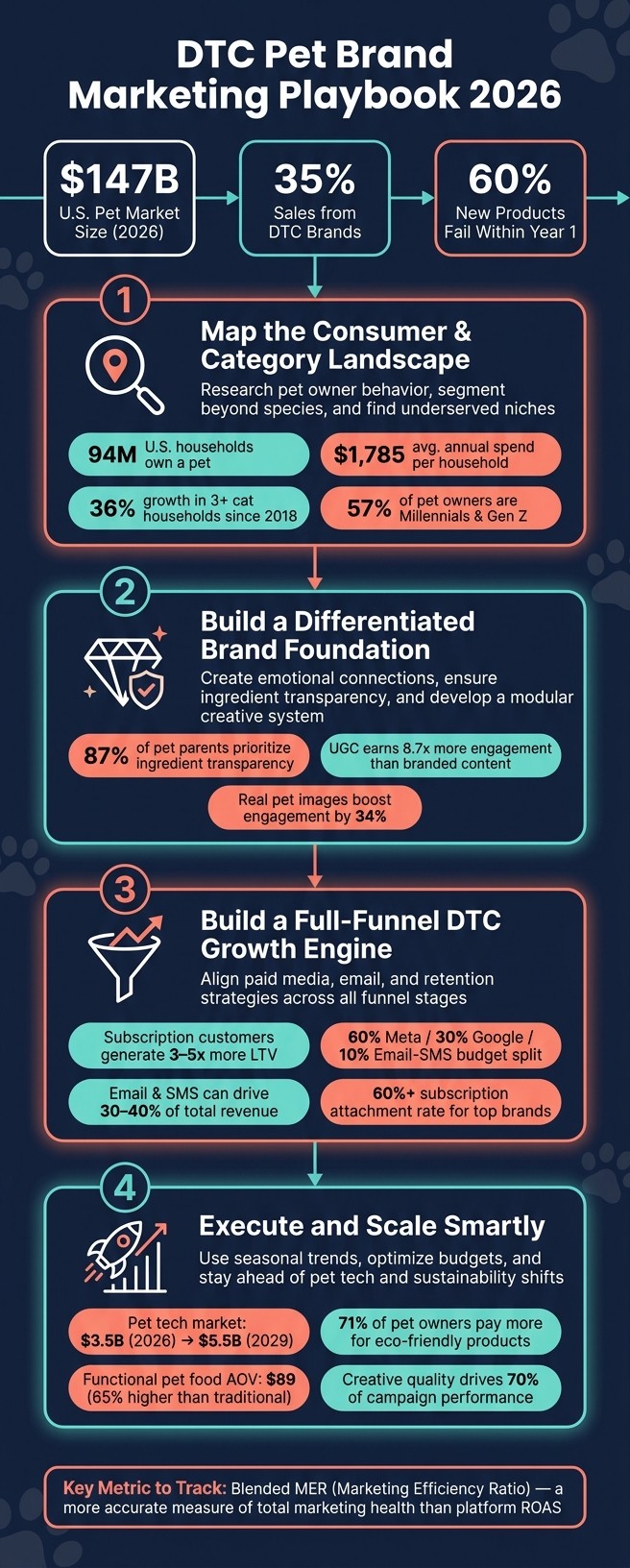
In 2026, the U.S. pet market hit $147 billion, with 35% of sales driven by direct-to-consumer (DTC) brands. But with 60% of new products failing within a year, success demands a clear plan. This guide outlines four essential steps for DTC pet brands:
Understand Your Market: Research pet owners' behavior, segment audiences beyond "dog" or "cat", and identify gaps like multi-cat households or premium health products.
Build a Strong Brand: Focus on emotional connections, transparency, and a polished identity that resonates with pet parents.
Develop a Marketing Funnel: Align paid ads, email, and retention strategies to maximize lifetime value, especially through subscriptions.
Scale Smartly: Use seasonal trends, optimize budgets, and stay ahead of shifts like AI-driven search and eco-conscious buying.
Pet parents are spending more time researching and expect proof of value. By prioritizing data-driven decisions and focusing on loyalty, your brand can thrive in this competitive space.
Introduction: Why DTC Pet Brands Need a Marketing Playbook for 2026
The U.S. pet industry is an ever-evolving space, constantly adapting to new trends and consumer demands. For brands in the direct-to-consumer (DTC) sector, thriving in 2026 will require more than just good products - it’ll take a well-crafted, market-specific playbook. To get there, we need to first understand the current market landscape, its challenges, and the opportunities waiting to be seized.
The U.S. Pet Market Today
With 94 million U.S. households owning a pet, this market is massive, and it influences every decision a DTC brand makes. On average, pet owners now spend $1,785 annually per household, with a growing preference for premium products. In fact, 42% of dog and cat owners are opting for premium pet food, reflecting how deeply the idea of "pet humanization" has become ingrained in everyday life.
Bigeye's 2026 American Pet Owner report puts the market at 94 million households and $158 billion in 2025 spending, with $165 billion projected for 2026. And 77% of owners say the economy hasn't changed their ownership plans.
One of the most influential groups driving this shift is the "PAW-rent" subculture - about 27 million adults who treat their pets like family and allocate up to 30% of their discretionary income to their furry companions. This group, dominated by Millennials and Gen Z, prioritizes wellness and seeks products like supplements, functional foods, and at-home health kits.
Interestingly, cat ownership is emerging as a major growth opportunity. Since 2018, there’s been a 36% increase in households with three or more cats. Yet, many DTC brands still focus heavily on dogs, leaving this lucrative segment underserved.
What DTC Pet Brands Are Up Against
While the potential for growth is undeniable, the challenges are equally daunting. Customer acquisition costs (CAC) have surged across all major channels, with the average cost per acquisition in the pet industry now at $39.00. When CAC is this high, every decision - whether it’s messaging, targeting, or channel selection - has a direct impact on profitability.
The retail media landscape adds another layer of complexity. Amazon accounts for 42% of online pet spending, Chewy holds 38%, and Walmart takes 12%. Each platform has its own audience behavior and requires a tailored approach. For example:
Amazon shoppers often compare prices.
Chewy users value community and loyalty.
Walmart customers prioritize affordability and tend to shop across multiple channels.
"Pet retail media isn't just another advertising channel - it's where pet parents make decisions that affect family members." - ATTN Agency
On top of that, privacy regulations and AI-driven discovery tools like ChatGPT, Perplexity, and Google AI Overviews are reshaping how consumers find products. Brands that fail to optimize their product data and AI search visibility risk being left out of the conversation. In this environment, first-party data and advanced attribution models are no longer optional - they’re essential for staying competitive.
How Bigeye Approaches Pet Brand Marketing
Bigeye, a full-service marketing agency, tackles these challenges head-on with a research-driven approach. Instead of relying on guesswork, they start every project with in-depth consumer research to ensure strategies are rooted in real insights.
Their proprietary EyeQ platform blends AI-powered research with human expertise to validate creative ideas, test messaging, and uncover audience preferences. This process often delivers actionable insights in as little as 72 hours. These findings then inform everything from brand strategy to media planning and creative execution, ensuring that every marketing dollar connects with actual pet owners.
To track performance, Bigeye uses the EyeSight analytics platform, which consolidates data from paid media, organic channels, email, retail media, and e-commerce. This creates a single source of truth for key metrics like ROAS, CAC, LTV, and revenue attribution - all in real time.
The agency also focuses on modern discovery methods through Generative Engine Optimization (GEO) and Answer Engine Optimization (AEO), ensuring pet brands show up in AI-driven searches. Additionally, they manage retail media campaigns across platforms like Amazon, Walmart, Target, Kroger, Instacart, and other retail media networks. By connecting awareness to conversion across the entire customer journey, Bigeye helps DTC pet brands scale in a way that’s both efficient and sustainable.
Step 1: Map the Consumer and Category Landscape
Before kicking off any campaign, it’s crucial to know who your audience is and identify untapped opportunities. Many DTC pet brands either skip this step or rush through it, which is why over 60% of new pet products fail within their first year.
Define Your Pet Parent Segments
A common misstep for early-stage pet brands is oversimplifying their audience by species - terms like “dog owner” or “cat owner” don’t provide much actionable insight. What truly influences purchasing behavior comes down to factors like lifestyle, personal values, income level, and the emotional connection someone has with their pet.
Consider the contrast between a busy professional who values convenience and a health-conscious millennial who scrutinizes every ingredient label. They might both own the same breed of dog, but their needs, preferences, and buying triggers are completely different.
Persona | Primary Motivation | Key Product Interests |
|---|---|---|
The Busy Professional | Convenience & time-saving | Automatic feeders, subscriptions, same-day delivery |
The Health-Conscious Parent | Wellness & longevity | Organic food, supplements, dental care |
The Adventure Parent | Shared experiences | GPS trackers, travel harnesses, weather-specific apparel |
The Social Pet Owner | Identity & community | Fashionable accessories, social-friendly packaging |
The Anxious Pet Parent | Safety & reassurance | Calming products, health monitors, 24/7 telehealth |
Here’s something to keep in mind: Millennials and Gen Z now account for nearly 57% of all U.S. pet owners. Gen Z pet parents alone spend an average of $6,103 per year per pet. While they’re a high-value audience, they’re also highly discerning. For example, 72% of Gen Z pet owners see their pets as family members. This means vague claims like “natural” or “wholesome” won’t cut it - they expect transparency and proof.
"The founders winning in pet right now are not selling toys. They are selling reassurance, identity, and the feeling that you are a good pet parent." - Ecommerce Fastlane
Another factor to consider is where the pet came from. Among Gen Z, 61% of pets are adopted from shelters or rescues. This signals values that can shape your brand’s tone and positioning.
By understanding these detailed segments, you can better analyze competitors and carve out space in underserved niches.
Analyze Competitors and Find Market Gaps
The next step is identifying areas where the market is underserved. The U.S. pet industry is projected to hit $158 billion by 2025, but much of that revenue is dominated by a few major players. For DTC brands, this creates opportunities to specialize in ways big brands can’t.
Start with a keyword gap analysis. Focus on long-tail search terms with moderate monthly volume (500-5,000 searches) where competitors have fewer than 200 reviews. These represent areas of real demand but lower competition. Tools like Helium 10's Cerebro or Jungle Scout's Keyword Scout can help uncover these openings.
Don’t ignore AI search trends. As AI search is expected to reduce traditional search volume by 25% by 2026, failing to optimize for AI-driven discovery could cost you. Right now, most AI product recommendations are dominated by big brands, leaving room for smaller DTC players who invest in optimizing their product data and AI visibility.
Specialization is where DTC brands shine. Whether it’s breed-specific formulas, products designed for multi-cat households (which have grown 36% since 2018), or eco-friendly accessories, these niches are areas where large brands often lag behind.
Once you’ve identified these gaps, combine them with first-party data for a deeper understanding of your audience and to refine your strategies.
Use Research Platforms and First-Party Data
After segmenting your audience and spotting market gaps, the next step is leveraging robust research tools and first-party data to fine-tune your approach. While competitive data and keyword analysis reveal what’s happening, first-party data digs into the why - and that’s where true differentiation happens.
Bigeye, a pet marketing agency, offers a unique edge with its National Pet Owners Study. Their proprietary EyeQ platform combines AI-driven insights with human analysis to validate creative ideas, test messaging, and uncover what motivates pet parents to make repeat purchases. This tool refines customer segmentation and identifies which segments are most likely to drive long-term revenue.
The power of first-party data extends far beyond launch. By integrating data on purchase history, email activity, and on-site behavior, you can pinpoint which customer groups have the highest lifetime value and tailor your acquisition strategy to attract more of them. In the pet category, subscription customers generate 3 to 5 times more revenue over their lifetime compared to one-time buyers. Identifying early on which segments are most likely to subscribe can completely reshape your marketing budget.
"In a category where emotional connection drives loyalty, understanding the human-pet bond is more than a nice-to-have - it's a competitive edge." - NielsenIQ
Step 2: Build a Differentiated Pet Brand Foundation
Once you've analyzed the market, the next step is to create a brand that truly connects with pet parents. To stand out, it’s not enough to offer good products - you need a strong identity that builds trust and emotional bonds.
Define Your Value Proposition
Don't focus solely on product features. Pet parents aren’t just buying food, toys, or accessories - they’re buying an experience or a feeling. As one expert put it:
"Emotion is the moat, not the SKU." - Ecommerce Fastlane
Start by identifying the emotional core of your brand. Does it offer reassurance (keeping pets safe and healthy)? Adventure (living life to the fullest with your dog)? Luxury (pampering your cat with the best)? This emotional connection should guide every decision, from product development to pricing and packaging.
Next, back up your value proposition with specifics. For example, 87% of pet parents prioritize ingredient transparency when making purchases. Vague terms like "natural" or "wholesome" don’t inspire confidence. Instead, focus on concrete details like sourcing, manufacturing processes, or measurable health benefits - think shinier coats, improved digestion, or higher energy levels. These claims can justify premium pricing, especially in the $60+/month consumables category.
Develop a Visual and Verbal Identity
Your brand’s look and feel should reflect its premium positioning, borrowing design cues from high-end wellness brands. Pet owners often view their animals as companions or even family members, so your packaging and imagery should honor that bond.
Color choices matter. Warm tones like orange and coral suggest playfulness, while cool shades like teal and mint evoke calm and wellness. Neutral palettes with gold accents create a premium vibe. For typography, rounded fonts feel friendly (e.g., BarkBox), while clean, minimalist sans-serif fonts convey a modern, polished image (e.g., Fable Pets).
On the verbal side, consistency is key. Choose 2-3 tone traits and apply them across all communications. Generic phrases like "high-quality pet products" lack impact, while something like "Vet-approved. Dog-tested. Parent-obsessed." instantly grabs attention. Additionally, user-generated content (UGC) performs exceptionally well in the pet space, earning 8.7x more engagement than branded content. Your tone should feel relatable enough for customers to naturally echo it in their own content.
A cohesive identity ensures your brand can adapt seamlessly across different marketing channels.
Build a Modular Creative System
A modular creative system allows you to reuse and reformat content for different ads. Instead of starting from scratch, create a library of assets that revolve around four key themes: health outcomes, emotional connections, founder credibility, and ingredient quality. Each theme appeals to a different audience segment and can be adapted for various formats.
Aim to produce 20-30 ad variations per month across 3-5 main angles. This is achievable by repurposing raw content like unboxing videos, feeding clips, and founder stories into multiple ads. Feeding videos, in particular, are highly effective - seeing a dog’s excitement for a product acts as an organic endorsement. Using real pet images can increase engagement by 34%, and featuring multi-pet households can boost it by 28%.
"Creative and copy are the biggest single lever on a pet ad account." - Top Growth Marketing
A practical starting point is the "Rule of Threes": test three angles simultaneously - rational (ingredients, certifications), emotional (the pet-parent bond), and social proof (testimonials, vet endorsements). This approach gives you quick insights without overextending your budget.
Step 3: Build a Full-Funnel DTC Growth Engine
After establishing a solid brand foundation, the next step is creating a system that seamlessly connects every channel, message, and metric. This ensures you can turn awareness into customers - and customers into loyal subscribers.
Map the Funnel for a Pet Brand
Start by defining four key funnel stages, each with specific goals and metrics.
Awareness: Introduce your brand to new audiences on platforms like Meta, TikTok, and YouTube.
Consideration: Shift focus to Google Search and influencer content, targeting pet owners actively researching solutions. Track metrics like add-to-cart rates and landing page conversions, aiming for a range of 3.5-6.5%.
Conversion: Use Google Shopping and your DTC store to seal the deal.
Retention: This is where long-term value shines. Pet owners typically spend about $1,480 annually per pet, and subscription models can increase lifetime value (LTV) by 3-5x.
Funnel Stage | Primary Channels |
|---|---|
Awareness | Meta, TikTok, YouTube |
Consideration | Google Search, Influencer Reviews |
Conversion | Google Shopping, DTC Store |
Retention | Email, SMS, Subscriptions |
For consumable products like pet food or supplements, make auto-ship the default option at checkout. Top-performing pet brands achieve subscription attachment rates of over 60% and retain 70-85% of subscribers through the first three months.
Once the funnel is mapped, focus on integrating paid media with lifecycle messaging to convert and retain customers effectively.
Run Paid Media and Lifecycle Marketing Together
Keeping paid media and email separate weakens your campaigns. Instead, create synergy by combining them. For example, use Meta ads to acquire first-time buyers and then funnel them into a Klaviyo welcome sequence. From there, transition into lifecycle messaging, such as a replenishment reminder timed to the product's usage cycle. For instance, a 30-day supply of kibble should trigger a refill reminder around day 25.
A good rule of thumb for channel allocation is a 60/30/10 split:
60% Meta: Focus on emotional storytelling at the top of the funnel.
30% Google: Capture high-intent searches.
10% Email/SMS: Once established, these channels can contribute 30-40% of total revenue.
TikTok Spark Ads, which amplify organic user-generated content (UGC) from real pet owners, often outperform polished studio ads in cost-per-acquisition (CPA). Meanwhile, email and SMS campaigns can drive substantial revenue once matured.
"A pet owner who trusts your brand for food, treats, supplements, or care products can be worth $800-$2,000 annually." - MHI Growth Engine
Consider the Fresh Patch example. By integrating Meta and Google ads with Klaviyo replenishment flows, the dog potty brand achieved a 1,057.2% return on ad spend (ROAS) and reduced CPA by 52%.
To make this strategy work, unified tracking is essential.
Set Up Measurement and Attribution
ROAS alone can give a distorted view of performance. Instead, focus on metrics like MER (Marketing Efficiency Ratio), blended CAC (Customer Acquisition Cost), and contribution margin, which give a more accurate picture of your business's health.
Start by implementing server-side tracking through Meta CAPI and Google Enhanced Conversions. This can help recover 20-35% of lost conversion events caused by browser restrictions and iOS privacy updates.
Next, consolidate all your data into a unified dashboard. Platforms like Bigeye's EyeSight provide a comprehensive view, integrating paid media, organic social, email, and retail media. With real-time tracking of metrics like ROAS and LTV, you’ll have the full picture, enabling smarter decisions based on accurate data - not just what individual channels report.
Step 4: Execute and Scale Your Marketing Strategy
Once your funnel is in place and you're tracking performance effectively, it's time to focus on making your strategy scalable. This means launching campaigns at the right time, prioritizing areas with the highest impact, and keeping an eye on market trends. Here’s how to move from a solid foundation to actionable growth.
Plan Around Seasonality and Set Clear Goals
Pet brands that succeed often align their campaigns with seasonal trends, creating excitement and strengthening brand identity. This approach not only builds stronger connections with customers but also boosts sales performance.
The U.S. pet market follows a predictable seasonal rhythm, with four key periods that reflect consumer needs:
Season | Consumer Focus | Key Opportunities |
|---|---|---|
Spring (Mar-May) | New adoptions, outdoor activity | Training tools, starter kits, escape-proof harnesses |
Summer (Jun-Aug) | Travel, heat safety | Cooling mats, portable waterers, travel crates |
Fall (Sep-Nov) | Back to routine, health prep | Senior supplements, anxiety aids, indoor puzzles |
Winter (Dec-Feb) | Gifting, wellness | Luxury beds, holiday bundles, wellness kits |
A smart way to connect with customers is by tying pet promotions to human wellness trends. For example, January’s "Dry January" movement offers a natural opportunity to market to health-conscious pet parents. A promotion like "Sips & Snuggles", which pairs non-alcoholic beverages for owners with healthy pet treats, sells more than just products - it sells a lifestyle. Offering discounted subscription bundles, such as a "Wellness Starter" kit, can also help turn one-time buyers into loyal customers.
To execute seasonal campaigns effectively, plan at least three to four months in advance. This allows time to coordinate with partners, influencers, and suppliers.
Allocate Budgets Across Acquisition, Retention, and Creative
As your brand grows, your budget strategy should evolve too. For smaller brands generating less than $500,000 in revenue, reinvesting 50-60% of revenue into marketing - primarily on platforms like Meta and Google Shopping - is common. Once your revenue surpasses $500,000, you can expand into additional channels like TikTok and SMS.
Creative assets deserve a significant portion of your budget. Creative quality now accounts for 60-70% of campaign success on platforms like Meta and TikTok, up from 40% in 2024. For instance, if you’re spending $200,000 a month on Meta ads, allocate $50,000-$60,000 to creative production. Costs for user-generated content (UGC) videos typically range from $150-$500, while other creative assets can cost $80-$150.
"Creative quality now drives 70% of performance variation vs 40% in 2024." - MHI Growth Engine
To maximize efficiency, allocate 70% of your ad spend to acquiring new customers and 30% to retargeting. Using first-party data to exclude recent buyers from acquisition campaigns can immediately reduce your customer acquisition costs (CAC) by 10-20%.
Keep a close eye on your blended Marketing Efficiency Ratio (MER) as your primary performance metric. Unlike platform-reported ROAS, MER offers a clear, unbiased measure of whether your total marketing spend is delivering profitable returns.
Once your budget is optimized, focus on staying ahead of trends to maintain a competitive edge.
Stay Ahead of Emerging Trends
Now that your execution framework is in place, it’s time to anticipate trends that could shape your future campaigns. Here are three key shifts in the pet industry:
Pet tech is becoming mainstream. The pet tech market is projected to grow from $3.5 billion in 2026 to $5.5 billion by 2029. Products like GPS trackers and health monitors are increasingly popular among Millennials and Gen Z pet owners. For example, Tractive, a leading pet GPS company, surpassed €100 million in annual recurring revenue in 2024, with over 1 million subscribers. Brands in related categories can leverage this trend by using health data to create personalized messaging. A targeted email like "Your dog's activity was 20% lower this week" can outperform generic promotions.
Sustainability is now a priority. A majority of pet owners - 71% - are willing to pay more for eco-friendly products. Sheba’s "Reef Builders" initiative, which linked product purchases to ocean conservation, is a great example. It reached 291.9 million impressions and 24.2 million unique viewers. Even smaller brands can benefit from a clear sustainability narrative, whether through recyclable packaging, transparent sourcing, or donation programs for shelters.
Functional nutrition is booming. Supplements with ingredients like CBD, probiotics, and insect-based proteins are seeing rapid growth. The average order value for functional pet foods and supplements is $89 - 65% higher than traditional pet food. To stand out in this space, focus your marketing on specific health outcomes, such as "better digestion in 30 days" or "visibly shinier coat", rather than simply listing ingredients. This approach helps justify premium pricing and drives higher conversions.
"The founders winning in pet right now are not selling toys. They are selling reassurance, identity, and the feeling that you are a good pet parent." - Guest Author, Ecommerce Fastlane
Bigeye’s experience with pet brands shows that combining data-driven creative with disciplined budget management consistently outperforms strategies focused on individual channels.
Conclusion: What to Do Next
Building a successful DTC pet brand in 2026 isn’t about trying every strategy at once - it’s about focusing on the right steps in the right order. This guide outlined four key steps: mapping your market, creating a standout brand, developing a full-funnel growth engine, and executing with precision. Each step builds on the previous one, forming a solid foundation for growth.
The biggest challenges often come from skipping these foundational steps. Did you know that over 60% of new FMCG products fail within their first year due to poor demand validation and channel fit? That’s why starting with research is critical. By grounding decisions in real consumer insights, you can avoid costly trial-and-error mistakes and focus on strategies that deliver results.
Consistency in messaging and accurate measurement are crucial for maximizing your marketing investments. When your creative, channel strategy, and positioning are all aligned with a clear customer insight, your efforts build on each other, driving better performance over time. To achieve this, follow a phased approach: start with Email and Meta, then expand into other channels once you’ve mastered the basics. Use Blended MER as your guiding metric - it’s a comprehensive way to measure the overall health of your business, unlike platform-specific ROAS.
If you're planning your pet brand's 2026 roadmap and want it built on what pet parents actually tell you, talk to Bigeye. Our pet marketing team can get EyeQ consumer results back in about 72 hours, before you commit media spend.
FAQs
How do I pick my best pet parent segment?
To find your ideal pet parent segment, prioritize emotional and behavioral cues over basic demographics. Look at what drives your audience - whether it's a deep emotional bond with their pets or a focus on practical care.
Dive into research to understand how they communicate, their core values (like prioritizing eco-friendly choices or honesty), and test your findings on a smaller scale to confirm what works. Focus on connecting with those who share your brand’s purpose rather than aiming to reach every pet owner out there.
What should I track besides ROAS?
To grow your business effectively, it's crucial to track metrics that reveal its genuine health. Here are some key ones to keep an eye on:
Contribution Margin (CM3): This measures the cash left after subtracting costs like COGS (Cost of Goods Sold), shipping, and acquisition expenses. It's a clear indicator of profitability.
Blended Marketing Efficiency Ratio (MER): Calculate this by dividing total revenue by total ad spend across all marketing channels. It helps assess overall marketing performance.
Customer Lifetime Value (LTV): Use cohort analysis to track how much value customers bring over time. This metric highlights the long-term impact of your customer base.
Incrementality: Assess whether your ads are truly driving new sales or simply capturing demand that already exists. This ensures your advertising efforts are making a real difference.
Creative Performance: Dive into the performance of your ads by analyzing elements like hooks, formats, and angles. Identifying the most effective creative strategies can maximize ad success.
When should I add subscriptions?
Introducing subscriptions at the right time can make all the difference. Pet owners often want to be sure their furry friends actually enjoy the product before committing to a subscription. A smart approach? Wait until they've made two separate purchases. By then, they've had enough time to see the value, making the subscription feel like a natural next step rather than an early, risky commitment. This timing can also help lower the chances of cancellations.
Related from Bigeye
Service: CPG Marketing
Case study: Moe's Healthy Pets

CPG Marketing
Oct 4, 2026
A CPG marketing strategy for 2027 in eight steps, with Bigeye shopper research and current data on private label, retail media, creators and AI search.