/
Persuade with a Story with Henry J. DeVries
IN CLEAR FOCUS: Henry J. DeVries, author of "Persuade with a Story," explains why traditional business storytelling is broken. He reveals why your brand should act as the mentor, not the hero, while your client battles their "nemesis" problem. Discover the eight meta-story archetypes hardwired into the human brain to attract high-paying clients. Plus, learn how to build authority, close more deals, and drive lead generation by mastering the ultimate sales strategy: marketing with a book.
Episode Transcript
Adrian Tennant: Coming up in this episode of IN CLEAR FOCUS.Henry DeVries: A book helps your authority positioning. You can't spell the word authority without the word author. The story proves to them that you've been there, you've done that, you've taken people from problem to solution, from mess to success.
Adrian Tennant: You're listening to IN CLEAR FOCUS, fresh perspectives on marketing and advertising produced weekly by Bigeye, a strategy-led, full-service creative agency growing brands for clients globally. Hello, I'm your host, Adrian Tennant, Bigeye's Chief Strategy Officer. Thank you for joining us. Data tells us what happened. Stories tell us why it matters. In marketing, the brands and services that win aren't always the ones with the best offerings. They're the ones that tell the most compelling stories about transformation, problem-solving, and client success. Today's guest has spent his career teaching professionals how to structure persuasive narratives that close deals, build authority, and create lasting client relationships. Henry DeVries is chief publicist at PersuadeWithAStory.com and a senior writer with the California Business Journal. He's the author of the book "Persuade with a Story" which breaks down story archetypes and frameworks that make business stories memorable and effective. He's also written "Marketing with a Book: The Science of Attracting High-Paying Clients", and the McGraw-Hill bestseller "How to Close a Deal Like Warren Buffett," now published in five languages. In addition, Henry has ghostwritten or edited more than 200 business books, contributed more than 350 marketing columns to Forbes, and served as president of an advertising and PR agency. Recently, he launched Agency Owner News, a platform dedicated to helping agency leaders win more business. To explore how storytelling frameworks shape effective marketing and how founders and agency leaders can build authority through strategic narratives, I'm delighted that Henry is joining us today from San Diego, California. Henry, welcome to IN CLEAR FOCUS.
Henry DeVries: I'm so glad to be here and to share a message with your audience, and the message is, human brains are hardwired for stories.
Adrian Tennant: Well, Henry, in your book "Persuade with a Story," you describe three essential characters that every persuasive business story must include: the hero, the nemesis, and the mentor. Can you give us an overview of the framework and explain why it works better than how most brands and leaders tell their stories?
Henry DeVries: Yes, most leaders and brands try to tell their story where they're the hero of the story. And I'm on a soapbox to tell everybody, no, do not be the hero of your story. The hero of your story should be your client. And it's a story of how their client succeeded. They overcame a nemesis problem. It doesn't have to be a person. It could be the pandemic of 2020. It could be the recession of 2008. It could be tax regulations from the government. It could be tariffs. It could be whatever is a nemesis holding you back. And then you need to be the mentor character in the story, and I'll explain why. You need to be the voice of wisdom and experience that the hero, your client, listened to, and by listening to you, they succeeded and won in the end. If you tell the story the other way, where you're the hero, you just made your client the damsel in distress that you needed to rescue in the story, and nobody wants to be cast as the damsel in distress. You're going to have more power, more authority power, more attraction power if you tell stories in the way where the hero is the client, the nemesis problem is the nemesis problem, and you are the mentor character, the voice of wisdom and experience.
Adrian Tennant: Well, as you said, the human brain is hardwired to respond to – I believe you've identified – eight meta-stories that include archetypes like the underdog story, the quest, or the monster problem narrative. How should brand marketers think about choosing which story structure fits their message?
Henry DeVries: You get to choose your story structure, so you need to look at which is going to do the best for you. And we'll go through all eight and tick them off. The monster problem story, is it a story about what you fix is life or death? And it could be life or death to a person. I'm helping some people who have invented a wound care that is going to reduce the 100,000 wound care deaths that people get in hospitals every year from something they caught in the hospital. That's a monster problem. We're working on that. Or it could be that underdog problem, are you the David versus Goliath, the little guy going after the big guy? It could be a comic solution story where it's a wacky idea, like Richard Branson of Virgin Airlines certainly has wacky ideas to solve problems. Or it could be a tragic story, a cautionary tale about somebody who tried to take a shortcut. And like the book, The Big Short, that was about a shortcut that you tried to take in business. There's a mystery story. If you're cracking the code for people, you tell that. The quest story is a journey for a prize. If you're telling a how-to story like my book, “How to Close a Deal Like Warren Buffett”, that's a quest story. And then there's the classic comeback, rebirth, redemption story, the Phoenix Rising. If you're telling a story like that that's powerful and then the eighth is the escape from crazy town story where something's growing normal then it all gets crazy and then you get back to normal you get back on track so if that's the story you're telling The importance is to have a story. Don't do the grandpa story, which is, “Well, we were taking the dogs to Cumminsville to the fair and they sure have good cherry pie up that way, but not as good as the apple pie your aunt Marge made. You know, her husband, he was a drunk.” You know, it's like, where do those stories go when grandpas tell stories? The audience needs to know, is this a comeback story? Is this “oh, is this a David versus Goliath story, a Cinderella story?” It helps them frame it and keep the story in their mind.
Adrian Tennant: Where in the marketing ecosystem should these stories live? Are we talking about case studies, sales presentations, website copy, or all of the above?
Henry DeVries: Probably all of the above. I gave a speech once to VPs of marketing, and one guy said, “Oh, I know who you are. You're the reason we had to change everything on our website.” I said, “Oh, yeah, your president attended my session a couple of months back.” Every story that they had, every part of their website told a story, and that pulled people in. When you're doing articles, storytelling is so important. When you're doing speeches, hooking people in with stories and illustrating with stories, they won't remember your content. They won't remember the professor tutorial you're going to give them. You think you're educating them. But a month later, if you tell a good story, they're going to remember that story. So it has stickiness. It brings people back. I advise people in sales presentations, you don't start off with a story like you're Mark Twain or something. You ask the prospect what their goals are. And then you have a conversation about, well, what have they tried and what worked and what are their assets? And then, well, what roadblocks did you come into? And then with that information, you can say, oh, may I tell you a quick story, a two-minute story about someone who was in your shoes and got to where you wanted to go? Never had anybody say, no, don't tell me that story. Then you tell them a story, the story proves to them that you've been there, you've done that, you've taken people from problem to solution, from mess to success. Better than saying, trust us, we do this all the time. When you tell me the story, then I'm convinced that you know how to do it.
Adrian Tennant: Got it. Well, as regular listeners know, we love case studies on IN CLEAR FOCUS, and this seems rather meta, but Henry, can you share an example of a client or brand that restructured their narrative using your framework and saw a measurable change in how prospects responded?
Henry DeVries: Absolutely. I'll never forget the day that Bill Wooditch called me, and I didn't know who Bill Wooditch was. I didn't know he was a big deal. Bill sensed that, but he let me off the hook. He said, Henry, I've been asking around for something, and I've heard the four magic words in the English language. I said, well, Bill, what are the four magic words? He said, I know a guy. I told people what I wanted, and they said, I know a guy, Henry DeVries. And I said, wow, that's a lot of pressure. What is this thing that you want? He says, I want to be a best-selling author and a professional speaker on the speaking circuit. He owned a construction insurance company in Orange County, California, about an hour from my home. He convinced me to spend an afternoon with him. He paid me $1,000. That convinced me to spend the afternoon with him. And I found out that Bill was at a crossroads. He had built this successful business. He had a hundred employees and they spoke very highly of him. They said, “He taught us when we knew nothing, how to make a hundred thousand dollars. And if we didn't have the right clothes to wear, he went and bought us the right clothes to wear.” And Bill said, “I loved motivating all those people, but I'm 58. I'm at a crossroads. I don't want to motivate 100 people. I want to motivate 10,000 people at a time.” I said, “Oh my gosh, Bill, you want to climb Mount Everest.” I said, “Well, if you want to climb Mount Everest, I'll be your mountain guide. Let's go.” It wasn't easy. I got him a speech in front of Qualcomm, senior executives and other leaders. And one came to me afterwards and said, “Henry, that Bill is dynamic. That Bill is magnetic. I don't understand a word Bill's talking about.” So we had to focus on messaging. We got his messaging down that he helped people get past fear. And his book was about that. And the book led to national speaking and TV appearances around the country and radio appearances. And then our big break came. We got him on the Steve Harvey show. Not once, but three times. And he helped audience members get past their fears. And no, 10,000 people weren't in the audience at the Steve Harvey taping, but 2 million people watched him on TV that day. It led to a best-selling book, a serious radio program, and he started speaking for $15,000 a pop. to 500, 1,000 people at a time to get them past their fears. So revolutionized his business and he got what he really wanted in life, this exposure. Early on, he said, “Henry, I've got to explain something to you.” I said, “What's that, Bill?” He goes, “I never found her.” I said, “You never found her?” He goes, “You know, the one. I never found her. So I poured all my energy into this business and the family that I'd created in this business, my team.” And when he succeeded at this, in two years he'd done all this, he sent me a picture. See, it was a dilemma. When he became a multimillionaire, he didn't know if any of the women were interested in the money or him. But finally, he sent me this photo, and it said, “I found her.”
Adrian Tennant: Nice. You've also written extensively about using a book as a client attraction strategy, including, of course, your popular title, "Marketing with a Book". How does publishing a book fit into the storytelling framework we've been discussing? Is having the book itself a story, or is it a delivery mechanism for multiple stories?
Henry DeVries: Well, a book has a meta story, certainly. My book, "Rainmaker Confidential" is a mystery. I wrote it during the pandemic, and I interviewed top rainmakers, top business development people, and got their secrets, what was working during the pandemic, published that to help people. and then went on to speak about it. Individual chapters will have individual stories that illustrate, and they can be any of the eight stories to illustrate what's going on in the book. But a book helps your authority positioning. And being an authority, an expert, back to Bill Wittich's four magic words, "I know a guy." So I like to say you can't spell the word ‘authority’ without the word ‘author’. And an author is not one and done. An author writes a series of books. An author can't say all they have to say in one book. My prime directive is that it has to be a book you're proud of. You have to be proud of the cover. You have to be proud of the design. You have to be proud of the printing. You have to be proud of the concept of the words, because if you are not proud of that book, you'll peter out and lose interest in getting other people to love the book. And that's an author's job. The author's starting line is the publication of the book, not getting the book published, you know, written, published. It's once it's out, because then your job is a marathon race to find people to love the book and to share it, you know, to be on podcasts, to be on people's stages, to have people write about you, to have people give you positive reviews about your book and share it with other people. All those things create this attraction and the more niche you are and the more you're really honed in on the problem. Somebody said yesterday, the hair on fire problem that your prospects have. That's what your book needs to be about for a certain prospect with a certain “hair on fire” problem.
Adrian Tennant: Let's take a short break. We'll be right back after this message.
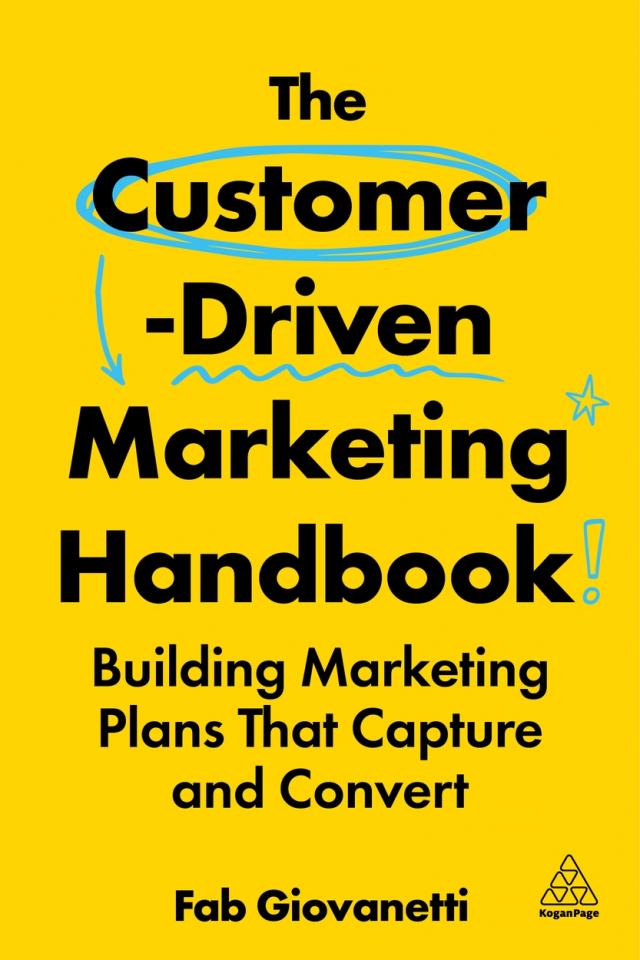 | Fab Giovanetti: Hello, I'm Fab Giovanetti, author of The Customer-Driven Marketing Handbook: Building Marketing Plans that Capture and Convert, published by Kogan Page. As a CEO and a teacher at Alt Marketing School, I've spent over 15 years helping marketers build strategies that put genuine customer relationships at the center of everything they do. In my book, I share practical frameworks for building trust, creating emotional connections, and turning customers into advocates, using real-world examples from brands like Gymshark, Headspace, and Notion. You'll learn how to identify customer pain points, design personalization that feels helpful rather than intrusive, and create shared rituals that transform one-time buyers into lifelong fans. As an IN CLEAR FOCUS listener, you can save 25% on The Customer-Driven Marketing Handbook when you order directly from KoganPage.com. Just enter the exclusive promo code BIGEYE25 at checkout. Shipping is always complimentary for customers in the US and the UK. I hope this handbook helps you create marketing plans that win hearts and deliver results. Thank you. |
Adrian Tennant: Welcome back. I'm talking with Henry DeVries, Chief Publicist at PersuadeWithAStory.com about how to tell more persuasive stories for business success. Henry, you've said the number one marketing tool is a book - and the number one sales strategy is talking about that book to a targeted niche. Now for independent consultants and agency leaders who are considering this path, what's the first thing they should clarify before they even think about writing a book?
Henry DeVries: I teach a monthly class on a book kickoff, and there's seven questions you have to answer before you write a book. Adrian, can I give $365 away?
Adrian Tennant: Sure!
Henry DeVries: Anybody who contacts me and uses your name, I will comp into that class. The only caveat is when it fills up, you go on the list to next month's class. The seven questions. Number one, precisely who is the book for? Really narrow down the niche (in America, 'niche' in Canada and Australia). You know, narrow that down, who it is, and then understand their problem. I challenge my authors, "You need to interview at least nine people who are in your target group about the problem. Record it and see what they say about the problem. Is that really a problem?" I know for my marketing with a book for agency owners, I did extensive research and I found that for two-thirds of small to mid-size agency owners, five to 200 employees, the number one problem for two-thirds of them was not enough right fit prospects in their sales pipeline. That's what keeps them up at night. And then 50%, their problem was not enough time for business development. So I attacked those two things. With a book, a book gives you the credibility. The book opens doors to get you on stages and on podcasts for people to write about you. Just showing up and saying, "Hey, I'd like to speak at your meeting because I need some more clients." That's not going to cut it. showing up and saying, "I have an important message for your audience that I put in this book, and I'm on a mission to share this important message with this group" will get you booked, and will get you on. And then speaking about the book is the number one way to get prospects. You're going to impact more people talking about the book than them actually reading the book, and that's okay.
Adrian Tennant: Got it. In 2024, after contributing 350-plus marketing columns for Forbes, you stepped away and launched Agency Owner News. Henry, what are you seeing in how professionals need to position themselves and tell their stories differently today than even, say, five years ago?
Henry DeVries: Well, let me tell you about the Forbes experience. Stephen Forbes, the publisher, once said to me that the difference between he and I was that he did a better job choosing his parents than I did. I thought, “You know, no matter how good a job I do here, they're never going to make me a Forbes. And I'm on rented land here.” Now, I switched over to the California Business Journal. I'm a senior staff writer there. I always have a storytelling journalism side hustle going on. But agency owner news was something I could own and something we could be relentlessly helpful. It's an idea we got from a friend, Susan Byer, who runs an advertising research company. So be relentlessly helpful. So we have stories about events that they want to know about, about money issues that come to their way, admin leadership issues. And the site is free. I don't charge anybody to place an article on the site. This is all just something we do because our brand is generosity. And the more generous we are, the luckier we get in business development.
Adrian Tennant: You've worked with hundreds of authors and ghostwritten more than 200 books. Henry, what's the most common mistake you see when someone tries to turn their expertise into a compelling narrative?
Henry DeVries: I got a call one day, and this person said, "Is this Henry DeVries?" I said, "Yes." "Henry DeVries, the ghostwriter?" I said, "Well, yes." He said, "Well, my story takes place on October 31st in an old mansion during a thunderstorm where a seance is being held to contact the spirit of the late owner." I said, "I have to stop you there." I'm not that kind of ghostwriter. I'm a business book ghostwriter, but I'm invisible. I interview as a journalist. I transcribe. I match their voice. I get people's voice in there. The biggest problem is people just want to educate. And you really need to do four great things in a business book. One, you do need to educate. You do need to teach. You need to make people think, and something new. Think about something new they hadn't thought about before. But that's only one. Two, you have to make them feel. Maybe bring a tear to their eye. The Bill Wooditch story, sometimes I tell that, and I get people all sad that our poor Bill hadn't found love in his life. This is a multimillionaire. I get people to feel sorry for a multimillionaire. So, the next thing is, you need to make people feel noble. And I find there's something noble in all work. I think independent consultants, agency owners, they do very noble work in helping people solve these problems. Matter of fact, I read a book by Rabbi Daniel Lapa, "The Business Secrets of the Bible," and it says we all have the same purpose in life. Now, we all have different faiths, I know, but it was God's purpose for you is to help his other children with your gift. Mine is creating books. What is yours? What do you do that helps people? That's your noble part. And then you need to make people laugh. You need to tickle the funny bone. You need to have some humor in the book. So you want them to feel all the emotions. It's what Hollywood does with a movie. You know, "You'll laugh, you'll cry, you'll kiss $20 goodbye." And Hollywood is the emotion picture capital of the world. It's to feel an emotion. So the same thing with your book. So that's the mistake I see people make is they think they can just give educational content or worse. Oh, I'll get AI to generate all this content. I'll clean it up and put it into a book. Let me tell you. AI is like your drunk uncle. Sometimes it says some good things, but a lot of times it hallucinates. And, you know, it's kind of poor on strategy, I think. It's long on regurgitation. So in case you were going to ask me, don't sugarcoat it, Henry, what do you really think about AI in books?
Adrian Tennant: I think we got that! Well, reflecting on the more than 200 business books across different industries that you've contributed to, have you noticed any patterns in which story archetypes work best for certain types of businesses? For example, do B2B technology companies naturally align with certain narratives while consumer brands align with others?
Henry DeVries: Well, for most part, the technology will not align with the monster story. Because for the most part, the problems they are solving are not life or death. Now, when I work with health authorities, many of these are life-or-death issues. You know, when we're dealing with, we're doing something now with forever chemicals, PFABS, the chemicals that are invisible threats that get into our supply. Okay, that can kill you. And that could kill all of us if we don't do something about it. Now, a lot of times, technology, it's a riddle, it's a puzzle, it's a mystery. And I find a lot for the technology people because they understand technology, but the people they're communicating with don't. It's a mystery to them. So if they can help crack the code, put the puzzle pieces together for them, you know, the combo lock so they can unturn, people like that a lot. Sometimes for consultants, it's a lot of the journey quest book. There's a prize that they want. That's what the consultant is in business for. And their book is about the journey, the road, the path, what they learned through a career. Those books tend to flow pretty naturally for them.
Adrian Tennant: You've described nine ways to write a business book, and I know one of them is not AI now, but you specifically recommend against what you call the misery approach of locking yourself in a cabin. Henry, what methods actually work for busy professionals?
Henry DeVries: Yeah, so number one way, work with a developmental editor. Warren Buffett said, "Don't ask a barber if you need a haircut." So I am a developmental editor. I'm a book architect. But I chose this career for a reason. You work with somebody who knows books, who helps you do a blueprint and spell it out and which approach to take. That really moves you along. There's also the take a workshop, a three-hour workshop that you've done and you refine through the years. You can turn that workshop into a book. That's one way. The other way is an interview. I'm a professional journalist. The other people who are my deputy editors are all professional journalists. We're covering professional business journalists. So we're here. But we know how to interview people, pull information out, organize content. That helps. You referred to the misery approach, that's the nickname after the Stephen King movie and novel. I've done that for people several times where I've locked myself, not usually in a cabin, I have. Usually I like resort hotels, but I'll stay there for three to six days until I come out with a book. If you think about it, that amount of time, people do it over six months, but they just spend an hour here, an hour there. Concentrated effort can produce a book in short order.
Adrian Tennant: Great conversation. Henry, if IN CLEAR FOCUS listeners would like to learn more about your storytelling frameworks or connect with you directly, what's the best way to do so?
Henry DeVries: I have two websites that you can go to. The first is Indie, I-N-D-I-E, books, B-O-O-K-S, I-N-T-L, short for international, dot com. And that has information on the events and a lot of information in our learning center about all this, a lot of videos that spell it all out. Again, our brand is generosity. We give it all away. The other is PersuadeWithAStory.com. That's my website about my books. I have a series of books on Persuade with a Story and the storytelling formats and how to do all these things and a lot of information on the website there.
Adrian Tennant: Thanks. And in case people missed it in the middle of our conversation, can you just repeat the details of your offer for listeners of In Clear Focus?
Henry DeVries: Certainly. On a monthly basis, I have a two-hour online class called The Book Kickoff Class, and it's seven questions you need to be able to answer before you write a book, or if you've written a book, before you promote a book. I know as a journalist, when I interview people about their books, frankly, they're horrible at it. You know, what's your book about? Well, there's so many things it's kind of hard to describe. No, your book is for a certain people. It solves a certain problem. It offers a certain message. There's a main message of what to do and how. So it offers a type of information. It's this new information, more information, better information, different information about the topic. So I really want to prepare people to present the book, but also to promote the book, because the author's job is to get other people to love their book.
Adrian Tennant: Henry, thank you very much for being our guest this week on In Clear Focus.
Henry DeVries: Adrian, it was so great to be with your audience today and stress that message, human brains are hardwired for stories.
Adrian Tennant: Thanks again to my guest this week, Henry DeVries, Chief Publicist at PersuadeWithAStory.com. As always, you'll find a complete transcript of our conversation with timestamps and links to the resources we discussed on the IN CLEAR FOCUS page at Bigeyeagency.com. Just select ‘Insights’ from the menu. Thank you for listening to IN CLEAR FOCUS, produced by Bigeye. I've been your host, Adrian Tennant. Until next week, goodbye.
Timestamps
00:00: Introduction to Storytelling in Marketing
00:21: The Power of Compelling Narratives
01:04: Meet Henry J. DeVries: Storytelling Expert
02:33: The Three Essential Characters in Business Stories
03:48: Why the Client Should Be the Hero
04:39: Choosing the Right Story Structure
06:50: Where to Use Your Stories in Marketing
08:25: Case Study: Bill Wooditch's Transformation
12:06: Using a Book as a Client Attraction Strategy
15:26: Positioning Yourself as an Authority
16:00: Clarifying Your Audience Before Writing a Book
18:21: The Launch of Agency Owner News
19:34: Common Mistakes in Crafting Business Narratives
22:58: Identifying Effective Story Archetypes for Different Industries
24:14: Methods for Busy Professionals to Write a Book
26:06: Connecting with Henry J. DeVries
27:51: Conclusion and Key Takeaways