/
How Storytelling Drives Behavior Change with Femi Corazon
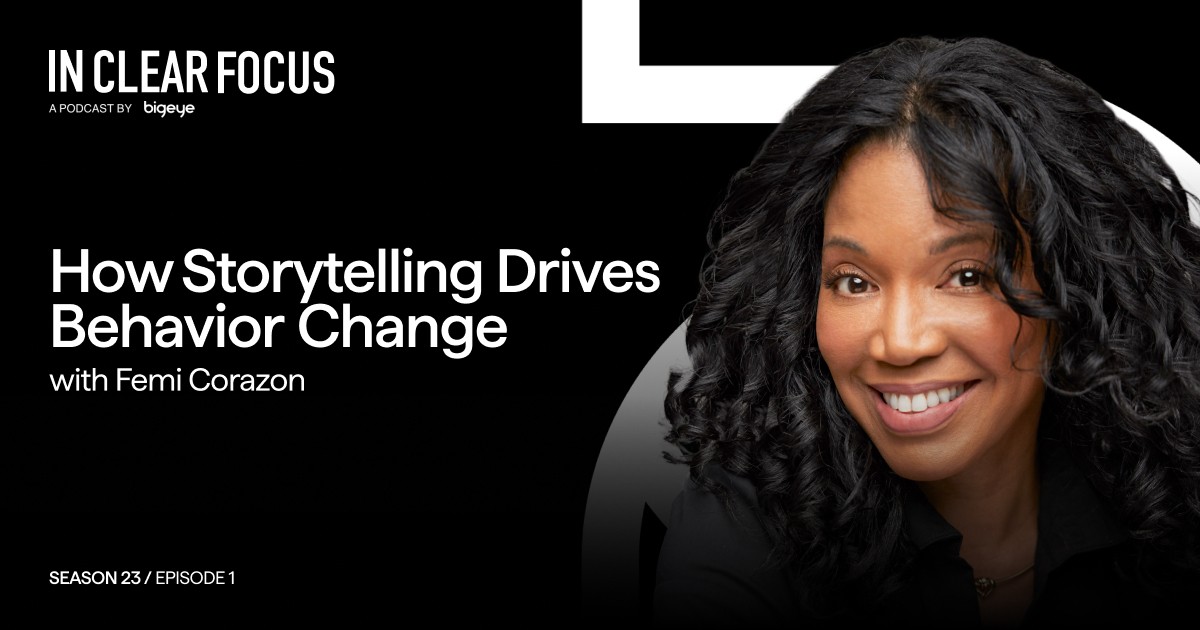
IN CLEAR FOCUS: For the first episode of our 23rd season, creative executive and brand strategist Femi Corazon reveals how storytelling drives behavior change. She explains why facts fail to change minds because people act on identity, not just information. Discover the three elements of effective narratives and how to build true cultural resonance by turning insights into action. Plus, learn how creative leaders can successfully navigate AI and deliberately design team resilience.
Episode Transcript
Adrian Tennant: Coming up in this episode of IN CLEAR FOCUS:
Femi Corazon: Behavior is not downstream of knowledge; it's downstream of identity. People do not act on what they know, they act on who they believe they are.
Adrian Tennant: You're listening to IN CLEAR FOCUS, fresh perspectives on marketing and advertising produced weekly by Bigeye, a strategy-led, full-service creative agency growing brands for clients globally. Hello, I'm your host, Adrian Tennant, Bigeye's Chief Strategy Officer. Thank you for joining us. We live in an era saturated with information, yet public health challenges persist, whether it's substance misuse, nutritional disease, or preventable illnesses. The problem isn't usually a shortage of data or even a shortage of budget. It's a failure of story. There's a meaningful difference between commercial marketing, which works to shift brand preference, and behavior change marketing, which asks people to stop doing something they enjoy, start something that feels hard, or believe something that contradicts what they already think. My guest today believes that distinction demands a fundamentally different creative strategy: one grounded not in persuasion as we usually think of it, but in empathy, narrative, and the deliberate design of a pathway to action. Femi Corazon is a creative executive and brand strategist whose career spans global advertising agencies and digital media companies, including Google, Disney, and Expedia. At NBCUniversal, she was part of the team responsible for the global rebrand of Universal Destinations and Experiences. Today, Femi serves as Executive Vice President and Executive Creative Director at Rescue, the Behavior Change Agency, a certified B Corporation that works with government agencies and nonprofits on behavior-change campaigns reaching over 170 million Americans. To discuss storytelling for behavior change, and what it takes to lead creative teams through uncertainty, I'm delighted that Femi is joining us today from Los Angeles, California. Femi, welcome to IN CLEAR FOCUS.
Femi Corazon: Hi, Adrian. Thank you so much. It's a pleasure to be here.
Adrian Tennant: Femi, your background is genuinely multinational. You grew up across the Philippines, Nigeria, and Iowa. How has that cross-cultural upbringing shaped the way you think about storytelling and creative strategy?
Femi Corazon: You know, that's an excellent question. I've had a lot of time to sit with this because in my work as a storyteller, I've wondered often how this has impacted my life, you know, kind of my origin story and how that fits with my life. And I learned very early on that there is no such thing as a universal story. There are only stories that travel well. So, you know, growing up between the Philippines, Nigeria, and Iowa, I was constantly translating. Essentially, you know, not just language, because actually, I spoke Tagalog as a child, and then when I moved to Nigeria, I had to speak English so I could communicate with my father and with my classmates. So it wasn't just language, but it was really values, what respect looks like, what authority sounds like, what humor signals, what people are trying to say out loud versus what they are carrying without words. So that changes how you approach strategy, you know, especially around storytelling. You stop asking, "What is that specific message?" And you start kind of thinking about "What does this actually mean in their world?" Because some words can land as 'care' in one culture and 'control' in another, right? That same visual that can feel very aspirational in one place can be extremely alienating in another. So my approach to storytelling based on my experience is less about crafting this perfect narrative and more about building something that can hold these different interpretations without falling apart. You know, if your story doesn't have cultural context, it's not really based on insight, it's an assumption.
Adrian Tennant: As I mentioned in the intro, you've worked across entertainment, digital media, and public health, each with a very different definition of what creative success looks like. Which professional context has stretched your thinking the most, would you say?
Femi Corazon: Ah, public health has stretched me the most, without question. Public health is the only context where you cannot hide behind brand love. With entertainment, success is attention. In brand, success can be looked at as affinity. But in public health, success is action, and action is pretty unforgiving. You know, no one changes their behavior because your idea was clever; they change their behavior because something in the story that you're telling intersected with their reality at exactly that right moment, right? Public health removes all those shortcuts. You cannot hide behind the aesthetics of a campaign. You cannot rely on aspirational ideas alone. You have to understand people at a very foundational level of habit, fear, identity, and their environment. So public health has forced me to become a different kind of creative leader, and I'm less focused on what looks pretty and what looks good, and I'm much more focused on what is effective.
Adrian Tennant: There's a pretty common assumption in marketing that if you give people accurate, compelling information, behavior will follow. Femi, I know you disagree with that, so what's wrong with that assumption?
Femi Corazon: We cannot operate on "If we give people information, behavior will follow." Information is not a behavior change strategy. It's a starting point where most campaigns mistake for a finish line. The assumption is that people just know the risks or know the benefits. And if they knew that, and they knew the facts, they would just act accordingly. And it really is one of the most expensive myths in marketing. Because behavior is not downstream of knowledge, it's downstream of identity. People do not act on what they know. They act on who they believe they are. I mean, let's think about it. Every smoker knows that smoking is dangerous. You know, every person knows that they should go to the hospital or to the doctor if something isn't feeling right, but they don't necessarily go. So knowing that information is really not the problem. You know, when we think of it in terms of story, the story that an individual is living inside is the problem we have to solve for. We have to understand how is that story influencing their current behavior and how can we change that story in a way that feels organic and relatable to them so that they actually move and take action. So the only way to change one story is a better story. Not a louder fact, not more facts, not more information. It won't move the needle. People need a reason and a path to do something different.
Adrian Tennant: So when you're building a behavior change campaign, what are the essential elements you found that make a story capable of actually driving action as opposed to simply building awareness of a problem?
Femi Corazon: There's so many different ways to tell stories, right? But when you're thinking specifically about behavior change, a story that actually changes behavior has to do three things. It has to transport you, meaning you forget briefly, however briefly, that you are being persuaded, because it goes beyond persuasion. It also has to mirror you. It has to feel recognizable. The person at the center of that story has to be recognizable enough and relatable enough that you can see yourself in that story. And most importantly, it has to shift something. Not just your opinion, but also your sense of what's possible for someone like you. You know, if I put myself in that story, do I see something possible for someone like me, something that I can do today to move my behavior to this other thing, to an outcome that is more desirable?
Adrian Tennant: Behavior change campaigns often need to reach audiences who are skeptical, disengaged, or actively resistant to the message. How do you build genuine cultural resonance into creative work so that it can actually break through to those difficult-to-reach audiences?
Femi Corazon: Resistance is a trust problem, and you can't solve a trust problem with a better headline. The audiences that are hardest to reach are usually the ones who have evidence or experience that institutions haven't been honest with them. And unfortunately, they're often right, especially when you think about the audiences that really could benefit from public health messaging. So the first thing that I think is important for us to consider is we have to stop trying to convince people of something and start trying to understand what story they're already in, right? Because the truth is resistant audiences are not irrational. And I think that sometimes is the assumption. They're perfectly rational inside the story that they're living in, but we didn't write. And we can't override that simply by writing better copy or having a better, cool, creative idea. Because cultural resonance, it's an acknowledgement that this audience has a worldview that deserves to be met. So the work that breaks through that is work that says, "I see you, we see you" not "Listen to us, we are an authority. Listen to us, we know better, we know what's good for you." It has to be, "I see you, I see your challenge, I see how we can help you solve that challenge. Here's a way, here's a path, here's one tiny little thing you can do today."
Adrian Tennant: How do you typically acclimate yourselves to these difficult to reach audiences? Is consumer insights research a part of that?
Femi Corazon: Absolutely. The agency that I work with, we do a lot of formative research. We dive deeply into what the challenge is to begin with. What is the public health problem we're trying to solve for? We also look at the stories that we're telling and run that through focus group testing. So we do get feedback one from the audiences themselves and what the challenges are that they're living through. And then we sit with that, obviously with insights and strategy, and formulate what exactly is that small behavior change that we can start to encourage, so that people can start to move towards that eventual outcome that we want them to get to.
Adrian Tennant: Hmm, makes sense. Well, marketers and agency professionals whose work isn't in public health probably sometimes assume that behavior change is a specialized niche with some pretty limited crossover. Femi, where do you see the most valuable applications of behavior change thinking in mainstream brand strategy?
Femi Corazon: You know, behavior change is literally the job, right? It's the foundation of all marketing. Every brand is trying to get someone to do something differently, whether it's try products, switch a service, pay more money, stay loyal to us. That is de facto behavior change. The thing about public health is that it makes it just much more explicit, and it raises the stakes, because we're talking about - in a lot of instances - we're talking about life or death decisions, life or death behavior change. But those same principles apply everywhere. You have to understand the barriers. You have to design for habits. You have to reduce friction. You have to create emotional relevance. And that opportunity in mainstream brand strategy to move beyond persuasion and into really thoughtful design around experiences, environments, and narratives that make that desired behavior the easiest choice is really something that marketing in all its forms could really benefit from.
Adrian Tennant: Let's take a short break. We'll be right back after this message.
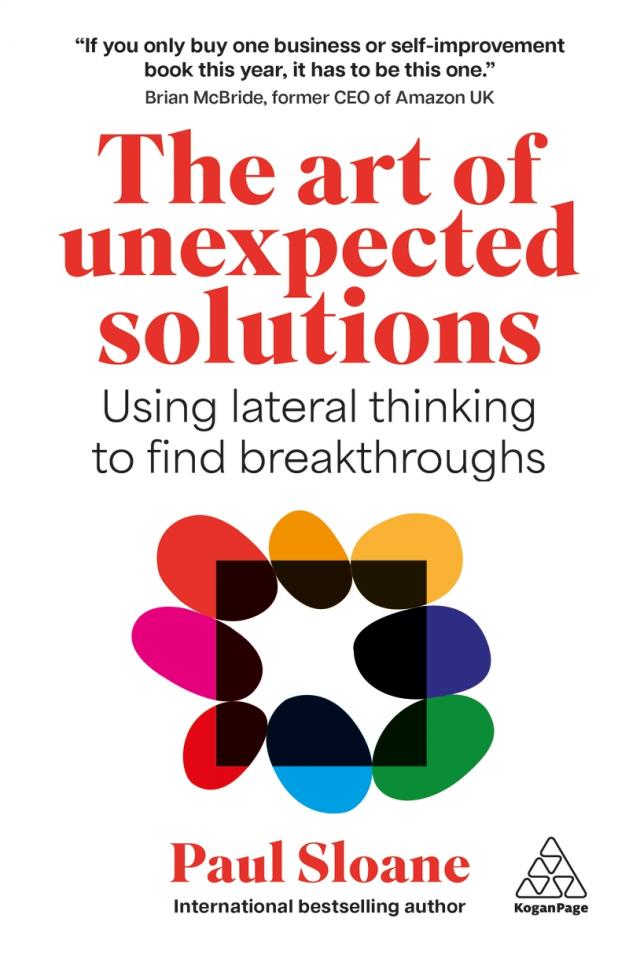 | Paul Sloane: Hello, I'm Paul Sloane, author of "The Art of Unexpected Solutions" published by Kogan Page and the Bigeye Book Club Selection for April. I've spent decades studying how the most transformative innovations in history arrived not from careful planning, but from unexpected discoveries, accidents, failed experiments, and chance encounters that only produced results because someone was curious enough to pay attention. In the book, I share practical techniques for challenging assumptions, cultivating serendipity, and finding solutions that others overlook, with examples drawn from business, science, sport, the arts, and many other fields. As an IN CLEAR FOCUS listener, you can save 25 percent on "The Art of Unexpected Solutions" when you order directly from KoganPage.com. Just enter the exclusive promo code BIGEYE25 at checkout. Shipping is always complimentary for customers in the US and the UK. I hope this book inspires you to approach your toughest challenges from a completely unexpected direction. Thank you. |
Adrian Tennant: Welcome back. I'm talking with Femi Corazon, creative executive and brand strategist about how storytelling can move people from awareness to action. Femi, there's a tension between a creative team's desire to push a concept as far as it will go, and a client's instinct to play it safe. Now, in behavior change work, where the stakes can be genuinely life or death, how do you navigate that tension?
Femi Corazon: I don't frame it as 'creative versus client.' I find that that framing is a bit too convenient and it doesn't necessarily guarantee a good outcome. I believe that the thing that behavior change thinking can do for a client is for us to think about what work works, what work is effective, and work that plays it safe doesn't work, right? So it's my job as a creative leader to make the argument for creative courage in the language of the outcomes, not in the language of the aesthetics. So it can't just be pretty. It has to be effective. It can't just look good. It has to move action. So I'm not asking the client to be brave because brave is cool. I'm asking the client to be brave because cautious work has a body count, right? And that's just not something that we want to mess with the public health. And so it's so important to be thinking about how this work will actually change behavior so that we can succeed in changing behavior for the better in the target audiences that we're trying to reach.
Adrian Tennant: Well, of course, artificial intelligence is creating real anxiety among many creative professionals about their roles, relevance, and the nature of their work. How are you thinking about artificial intelligence's place in creative leadership right now?
Femi Corazon: It's a leadership test. It's an interesting thing because, you know, I lead a creative team and I do have conversations with my team where it does appear that there's this general feeling, and I think this is really true for most creative teams, that AI is a creative threat. But I think it's more so a leadership test. I think it's important that we have to think about how we understand the work well enough to guide what AI can produce. Because it accelerates output, but it cannot replace judgment. So the role of a creative leader now is so much more important. We have to set the standard. We have to define what good looks like. We have to protect the integrity of the idea. And we have to manage the emotional reality of our teams. They're anxious. They're questioning their value. So part of leadership right now is creating clarity, trying to make it very clear where AI helps and where the human perspective matters more than ever. So AI can generate content and it can be a useful creative assist, but it simply cannot replace trust, conviction, and taste.
Adrian Tennant: Femi, based on your extensive experience, what are the conditions that make it possible for a creative team to do its best work consistently?
Femi Corazon: Clarity is first and foremost. Clarity is crucial. They have to understand what the task is, what's the problem we're trying to solve. And then you have to create systems that help them actually get their work done. You know, remove the friction from the environment as much as possible. And then courage. You have to set up a space and an environment where bold ideas can live. So I do think that clarity and systems and courage really make a big difference.
Adrian Tennant: If you had to identify one belief that most people in marketing probably hold about creativity that you think is simply wrong, what would it be?
Femi Corazon: You know, I've had many conversations with creative leaders, marketing leaders, and creative teams. I think that the belief that creativity is about originality is not necessarily accurate. It has to be about understanding and relevance. In fact, I think the most dangerous creative in a room is the one who is brilliant, but uncurious about people. So you have to understand people. You have to understand the audience you're speaking to, whether it's entertainment or advertising. Telling a story, you want to find resonance and a connection to your audience. You have to understand them. So the most original story is not going to land if it is not relevant. So when you think about behavior-change, an idea that is completely original could also be completely ineffective if it doesn't connect to something real in the audience that you are speaking to. So I value insight over novelty every single time. Original does not matter if it does not resonate.
Adrian Tennant: You've expressed an idea that resilience isn't a personal quality people either have or don't, but something that can be deliberately designed into how a team operates. Femi, what does that look like in practice?
Femi Corazon: You know, it's been a rough year in public health. I'm sure most of the United States has even tangentially heard about a lot of the funding cuts, et cetera, that sort of thing. And so obviously, when you're working in public health, when you're working in marketing public health messaging, there's going to be a ripple effect around that and how that can really destabilize a team. Resilience has to be designed within a team environment. And first and foremost, there is the idea of self-regulation and encouraging team members to separate what they can control from what they can't, and then operate within the parts of that paradigm that they can actually control. But when you think about resilience design as a team lead, as an organization, it also has to be about creating conditions that feel stable, that feel like there is some semblance of control and not chaos. And that's where the idea of systems comes back into play. And making sure that you are setting up systems that allow for courage and trust to live within that working environment. So, resilience as a design is, I think, more paramount than ever in an environment where we have so much turbulence with AI and just really the world right now. The world can feel a little bit like it's a dumpster fire. So there is so much going on that it's so important to be considerate of the conditions for resilience and encouraging that within your teams.
Adrian Tennant: As regular listeners know, we love case studies on IN CLEAR FOCUS. So Femi, is there a recent project that you've worked on that you feel illustrates some of the concepts we've discussed today?
Femi Corazon: Oh, I'd love to actually talk about this. We worked with a large organization that deals in toxic stress response in young children. And we did, you know, exactly the things that we've been talking about. We did some research with the target audiences and grew to understand that there's a through-line through generational trauma into current parenting mechanisms, current parenting habits that can cause conditions around toxic stress response to manifest and really continue to impact that individual as they get older. So we just recently completed a spot that very clearly tells that story. And I cannot wait for it to hit the market because I think it's going to be really impactful around illuminating the conditions in which toxic stress response actually begins to form and multiply unfortunate health conditions in an individual as they get older. So it's important to really start to tell a narrative that actually helps people see themselves in it. You know, illuminating an individual's experience from childhood and carrying that thread into their adulthood has been something that for this particular campaign is actually incredibly important because it starts to crack open the idea that "Actually, that could be me. That could be me and I should pay attention and I should make sure that I understand if in fact I am repeating some of those behaviors that can cause the same challenges in my children."
Adrian Tennant: Looking ahead, where do you see behavior change marketing going over the next few years as artificial intelligence tools reshape how creative content is made and how it reaches people?
Femi Corazon: You know, it's interesting, I've spoken a little bit about systems within a workplace, and now I actually think we have to think about systems at scale to operationalize production of content that actually feels relevant to individuals we're trying to reach. We're entering a period where our content is so abundant and so frictionless to create that getting attention can now be a pretty scary thing in terms of trying to get to actually grab attention and move people into action. So in this environment, the only thing that will cut through is genuine narrative resonance. And stories have to feel personal. They have to feel like they were made for you. And they can't just be stories that are coming at you, which can happen in a world of such copious content production. AI is going to get better. AI is going to get better at personalization. But what cannot ever change is that human insight that can make a story feel true. AI has never had its heart broken - I think I'm probably not the only person that says that, right? AI never got into trouble as a teenager. AI never did all those things. And so it's important for us, especially in behavior change work, to think about "What it is that makes someone who has lived something recognize themselves in a story?" They've lived something, led something, lost something, felt something. The stories that are going to resonate actually capture that. The agencies and brands that understand that story is the way forward, that story is the key to behavior change, that invest in strategic creative leadership, that understands this and maintains the humanity in the stories that they're telling, the same way that they're investing in technology, are the ones that are going to lead the charge.
Adrian Tennant: Femi, what is the responsibility of a creative leader right now?
Femi Corazon: The responsibility of a creative leader right now is about creating the right conditions to produce effective work. They have to be thinking about culture and clarity and resilience. We're asking creative teams these days to operate under constant pressure, constant change, and constant technological disruption. So leadership has to be thinking about how we build environments where people can do their best thinking and not just their fastest work. You know, creative excellence now is a byproduct of how you lead.
Adrian Tennant: Great conversation. Femi, if listeners would like to learn more about you or your work, what's the best way for them to connect with you?
Femi Corazon: Well, I am on LinkedIn at Femi Corazon, and I'm on Instagram @FemiCorazon, so that's probably the best way to reach me.
Adrian Tennant: Perfect. Femi, thank you so much for being our guest this week on IN CLEAR FOCUS.
Femi Corazon: Thank you. It's been such a pleasure.
Adrian Tennant: Thanks again to my guest this week, Femi Corazon, creative executive and brand strategist. As always, you'll find a complete transcript of our conversation with timestamps and links to the resources we discussed on the IN CLEAR FOCUS page at Bigeyeagency.com. Just select ‘Insights’ from the menu. Thank you for listening to IN CLEAR FOCUS, produced by Bigeye. I've been your host, Adrian Tennant. Until next week, goodbye.
Timestamps
00:00: Introduction to Behavior Change Marketing
02:30: Femi Corazon's Cross-Cultural Storytelling
04:36: The Unique Challenges of Public Health Marketing
06:01: The Myth of Information Leading to Action
08:06: Elements of Effective Behavior Change Stories
09:30: Building Cultural Resonance in Messaging
11:13: The Role of Consumer Insights Research
12:24: Behavior Change in Mainstream Brand Strategy
13:38: Navigating Creative Tensions in Public Health
16:32: AI's Impact on Creative Leadership