Bigeye, the Orlando consumer brand agency behind the National Pet Owners Study, surveyed 1,001 US pet owners and found the number that should shape every pet brand's plan this year: 69% have bought the same pet food brand since the day they brought their pet home. Loyalty in this category gets decided early and rarely gets revisited. The same Bigeye study found 97% of owners consider their pets family, and when inflation hit, owners were less likely to trade down for their pets (21%) than for themselves (30%). What follows is Bigeye's read on the 2026 trends that matter, from the team behind our pet marketing agency work.
The pet industry in 2026 is thriving, with spending projected to hit $165 billion by the end of the year. Despite economic challenges, pet owners remain committed to their pets, prioritizing health, wellness, and value. Key trends shaping the market include a growing focus on premium and budget-friendly products, demand for transparency, and the rise of short-form content and retail media. Here's what stands out:
Market Polarization: Consumers are choosing either premium, evidence-backed products or affordable private-label options, leaving mid-tier brands struggling.
Health & Wellness: Functional treats, supplements, and preventative care are now mainstream as 64% of pet owners prioritize their pets' health.
Retail Media & Social Platforms: Amazon, Chewy, and Walmart Connect dominate ad spend, while TikTok and Instagram drive engagement with 5%+ interaction rates for pet-focused creators.
Generational Shifts: Gen Z and Millennials lead spending, with Gen Z averaging $178/month on pet care, favoring social media for discovery.
Sustainability Matters: 78% of pet owners consider eco-consciousness a priority, with refillable packaging and clear labeling gaining traction.
AI in Marketing: Personalized content at scale, like breed-specific emails, boosts engagement by 22%.
To succeed, brands must focus on trust, clear value propositions, and targeted marketing tailored to each consumer segment. For pet brands, that means building a connected CPG marketing strategy that aligns research, positioning, creative, retail media, ecommerce, and analytics around how pet owners actually shop.
Introduction
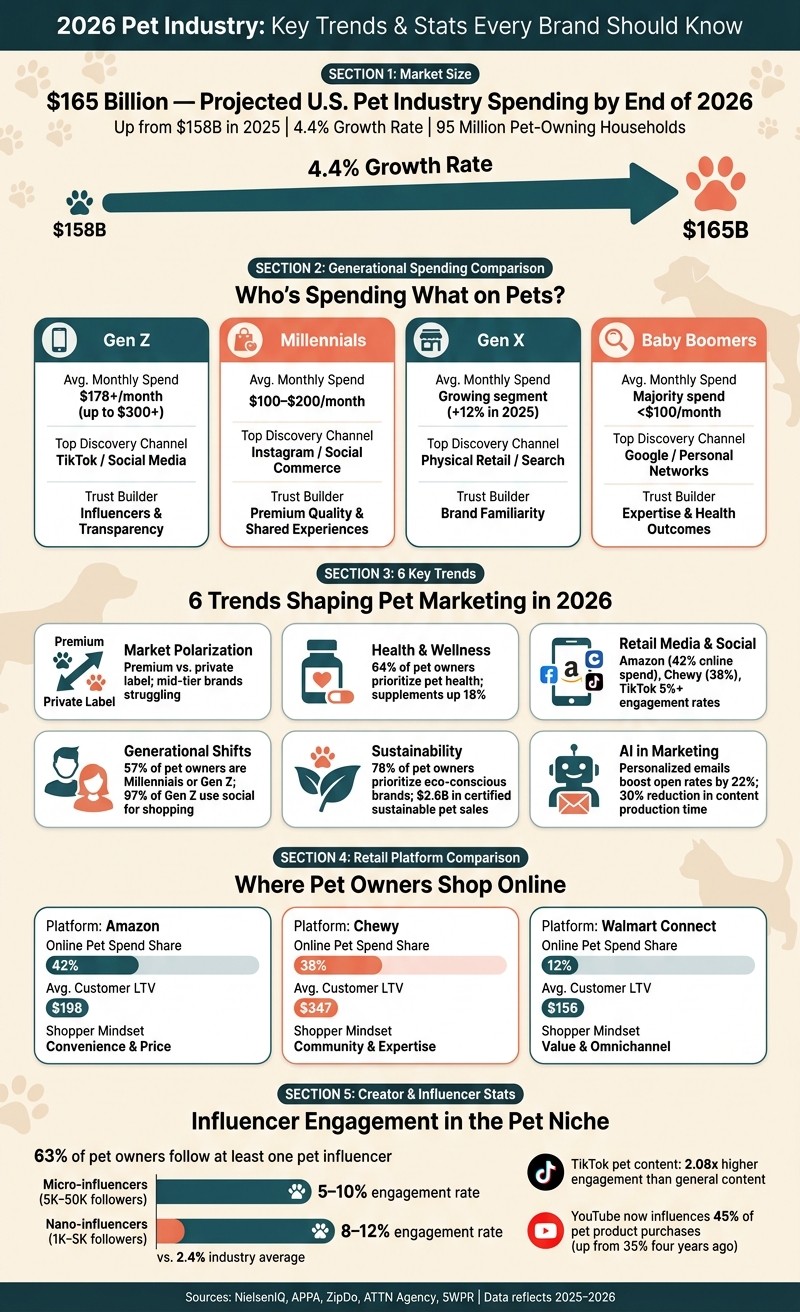
The U.S. pet industry is experiencing steady growth. Spending is projected to reach $165 billion by late 2026, up from $158 billion in 2025, reflecting a 4.4% growth rate, including 2% inflation. Even as overall consumer budgets tighten, the roughly 94 million pet-owning households in the U.S. continue to prioritize their pets, showcasing the resilience of this market.
This resilience marks a shift from the rapid growth of the pandemic years to a more intentional and measured pace. Pet owners remain deeply committed to their furry companions, but they are now more thoughtful about where and how they spend. This careful spending highlights a clear divide among consumer segments, which we’ll explore further.
"Today's pet parents are at a crossroads of quality and price. Their compassion for their pets has them hunting for the highest-quality products, yet the unpredictable economic environment leaves them searching for the best value." - Jorge Martínez, Global President, Pet Nutrition, ADM
The evolving economy is creating a split in spending habits. Higher-income households are leaning into premium products like advanced nutrition, smart health devices, and specialized care. Meanwhile, middle- and lower-income pet owners are opting for private-label alternatives or cutting back on non-essential purchases. This growing divide is forcing brands to focus on either delivering true premium value or offering budget-friendly options, as the middle ground continues to shrink.
Cultural changes are also reshaping the market. Factors like remote work, smaller living spaces in urban areas, and shifting generational values have driven an increase in pet ownership. Today, cats are found in 39% of U.S. households (about 53 million homes), while dogs are present in 53% (roughly 71 million homes). Younger generations, especially Millennials and Gen Z, treat pets as full-fledged family members, often applying the same "food as medicine" philosophy to their pets' diets. This shift is fueling demand for functional nutrition, supplements, and proactive wellness products, which are expected to dominate marketing strategies through 2026. These trends set the stage for the discussions ahead.
Market Context for 2026
The U.S. pet industry is undergoing a noticeable shift. Total spending reached $158 billion in 2025 and is expected to grow to $165 billion by the end of 2026, reflecting a 4.4% increase. However, it's important to note that roughly 2% of this growth is tied to inflation, meaning the actual volume increase is more modest than it appears. These numbers suggest changing consumer spending habits are reshaping the market.
Pet owners are adjusting how they spend. In 2025, 22% of pet owners reported cutting back on pet-related expenses - a notable jump from 12% in 2024. Despite this, the market hasn’t shrunk. Instead, spending is being redirected. Owners are prioritizing essentials like food and health products while scaling back on non-essentials such as toys and grooming extras. Private label pet care saw unit sales rise by 3.5% from 2024 to 2025, while national brands experienced a slight 0.6% decline. This trend highlights the growing pressure on household budgets and the need for brands to communicate clear value.
"Pet parents may be more cautious, but their commitment has not wavered. What's changing is how they define value, where they shop, and what they expect in return." - Andrea Binder, Vice President, NielsenIQ
Interestingly, the wellness and premium segments are proving more resilient than expected. Refrigerated and frozen dog food sales jumped 13.4%, even as overall dog food sales dipped slightly by 0.2%. Pet insurance enrollment also climbed by about 12% year-over-year as owners sought ways to handle veterinary costs, which have risen by approximately 7.8%. Meanwhile, the global market for eco-friendly pet products, valued at $43.65 billion in 2024, is projected to almost double to $85.9 billion by 2035. A growing 78% of U.S. pet owners now consider sustainability a key factor in their purchasing decisions.
For pet and CPG brands, the key takeaway is this: the middle of the market is shrinking. Consumers are either trading up for products with clear health benefits or trading down to private labels offering similar quality at lower prices. Brands that fail to stand out with a strong value proposition or premium positioning are at the greatest risk as 2026 progresses.
1. Generational Buying Shifts
Millennials and Gen Z now make up 57% of U.S. pet owners, and their expectations for brands go beyond products - they want the same emotional connection they share with their pets.
One major shift is how these generations view pets as family members. Nearly 48% of Gen Z pet owners say they see no difference between their pets and human children. This mindset, often described as "parental", directly shapes their spending habits, purchase decisions, and the type of messaging they respond to. This trend is driving a transformation in marketing strategies across the pet industry.
The way people spend on their pets reflects this emotional bond. Gen Z pet owners, for example, spend an average of $178 per month on pet care, with many in this group willing to spend $300 or more monthly. In contrast, most Baby Boomers tend to cap their monthly pet care budgets at $100 or less. These differences highlight the importance of tailoring messaging to align with each generation's values and priorities.
Generational differences extend to how people discover and shop for pet products. 97% of Gen Z consumers turn to social media for shopping inspiration, with platforms like TikTok Shop becoming key sales channels for pet brands. By early 2026, many pet brands have successfully used TikTok Shop to connect with younger audiences. On the other hand, Baby Boomers rely more on Google searches and personal recommendations.
Generation | Average Monthly Spend | Primary Discovery Channel | What Builds Trust |
|---|---|---|---|
Gen Z | $178+ average; highest $300+/mo | TikTok / Social Media | |
Millennials | $100-$200 per month | Instagram / Social Commerce | Premium quality & shared experiences |
Gen X | Growing segment (up 12% in 2025) | Physical Retail / Search | Brand familiarity |
Baby Boomers | Majority spend <$100 per month | Google / Personal Networks | Expertise & physical health outcomes |
These generational insights underline the need for targeted, audience-specific marketing in 2026. Research consistently shows that brands need to adapt their tone, channel strategies, and value propositions to resonate with each generation's unique relationship with their pets.
2. Premiumization Under Price Pressure
As generational preferences evolve and economic conditions tighten, premiumization in the pet market is encountering new challenges. The market is splitting into two distinct groups: affluent pet owners opting for high-end premium products and middle- to lower-income consumers gravitating toward private labels. This shift is causing the disappearance of the "middle consumer".
Reflecting this broader market divide, private label pet care unit sales grew by 3.5% between 2024 and 2025, while national brands saw a slight decline of 0.6%. Despite this, premium products remain resilient. In 2024, 41% of dog owners purchased premium dog food - a 5% jump from the previous year. However, for premium products to thrive, they need to convince consumers that their higher price is worth it.
To justify higher costs, brands are focusing on emotional messaging, tying premium products to outcomes like improved health and longevity for pets. Freshpet is a standout example: in Q1 2026, the company reported $297.6 million in net sales, up from $263.2 million in the same quarter the prior year, driven by its premium all-natural product lines.
Rather than offering direct discounts, brands are leaning on subscriptions and loyalty programs to maintain their premium image. Framing costs in terms of "cost per day" rather than a larger upfront price has proven effective in attracting budget-conscious shoppers without compromising premium positioning. This approach is paving the way for the "Affordable Premium" strategy that brands need to embrace in 2026.
Affordable Premium Is the Positioning to Own in 2026
The winning brands in today's market aren't choosing between premium and accessible - they're bridging the gap.
By combining science-backed claims, transparent labeling, and subscription-based savings, pet brands can maintain their premium identity while addressing consumers' financial concerns. The key is to position higher price points as smart, long-term investments in pet care.
3. Wellness and Functional Pet Care
Pet owners today are taking a more proactive approach to their pets' health, focusing on daily wellness rather than waiting for problems to arise. This shift has transformed the way products are developed, marketed, and sold in the pet care industry. The emphasis on prevention is now at the core of industry strategies.
Recent trends back this up: 53% of dog owners now provide their pets with vitamins or supplements, while functional diets featuring prebiotics and probiotics have grown by 18% in 2024. Additionally, search interest for "dog probiotics" has jumped by 46% within a year. These numbers highlight how proactive health management has become a routine part of pet ownership.
Premium pet products now include cutting-edge ingredients like Lion's Mane and Turkey Tail mushrooms, adaptogens, and probiotics. Brands are also embracing advanced tools like DNA testing and gut microbiome analysis to offer personalized nutrition plans for pets.
"Consumers want clinical-level, high-tech solutions as everyday wellness tools. Traditional routines are traded in for advanced therapies and precision products." - Euromonitor International
Outcome-Based Messaging Is the Strategy to Own in 2026
Pet parents aren't just buying supplements - they're investing in peace of mind.
The most effective wellness marketing focuses on clear, outcome-driven benefits: a dog that moves more easily, a cat that feels calmer, or simply more years of health and happiness together. Brands that combine veterinary-backed credibility, straightforward benefit claims, and accessible digital content will resonate with research-savvy pet owners. This outcome-focused approach will continue to shape the future of pet care marketing, as brands refine their messaging and targeting strategies to meet the evolving needs of pet parents.
4. Retail Media Strategies
Develop a Platform Portfolio
Retail media has become a major force in driving growth within the pet industry. It now operates as a connected, full-funnel ecosystem, integrating first-party data across platforms like connected TV, social media, and in-store apps. With U.S. ad spend in retail media expected to hit $70 billion by 2026, brands must adopt platform-specific strategies to stay competitive.
For pet brands, this means approaching platforms like Amazon, Chewy, and Walmart Connect as distinct opportunities rather than treating them as one-size-fits-all. Each platform attracts a unique audience with different priorities:
Platform | Online Pet Spend Share | Avg. Customer LTV | Primary Shopper Mindset |
|---|---|---|---|
Amazon | 42% | $198 | Convenience & price |
Chewy | 38% | $347 | Community & expertise |
Walmart Connect | 12% | $156 | Value & omnichannel |
These numbers underscore the importance of tailoring strategies to each platform. For example, Chewy’s customers have a higher lifetime value, averaging 4.2 years of purchase history, largely due to a 76% adoption rate of Autoship services. In contrast, Amazon’s Subscribe & Save adoption in the pet category sits at only 31%. For Chewy, converting first-time buyers to Autoship is a critical tactic for long-term success.
Platform-specific creative strategies are equally important. On Chewy, shoppers respond well to lifestyle imagery and community-driven testimonials, which align with their desire for reassurance and expertise. On Amazon, focusing on ingredient transparency and product utility resonates more with consumers.
"Pet parents spend 23% more time researching purchases than other categories. Your creative needs to build trust, not just drive clicks." - ATTN Agency
As a CPG marketing agency, Bigeye offers expertise across a wide range of retail media networks, including Amazon, Walmart, Target, Kroger, Instacart, and others. This allows pet brands to deliver consistent and coordinated messaging throughout the shopper journey, from discovery to repeat purchases.
5. AI-Assisted Content Creation
As brands focus more on connecting with consumers on a personal level, AI has become a powerful tool for creating tailored interactions across different platforms. Where personalized experiences build loyalty, AI helps brands deliver them at scale without needing to expand their teams.
Scale Personalization Without Scaling Headcount
The global AI in animal health market is projected to hit $2.01 billion by 2026. Pet brands are already tapping into this technology - not just for product innovation but also for day-to-day marketing.
One standout application is hyper-targeted email marketing. By integrating CRM data (like pet names, breeds, and ages) with AI design tools through APIs, brands can generate thousands of customized email headers in just minutes. For instance, emails featuring a pet's name and breed have been shown to boost open rates by 22% and click-through rates by 14%. Additionally, 66% of pet owners say personalized emails make them more engaged with pet brands.
"66% of pet owners report that personalized emails increase their engagement with pet brands." - ZipDo
But the personalization doesn't stop at emails. AI is also reshaping how pet brands appear in search results. AI Overviews now show up in 36.8% of pet-related search queries, and zero-click searches have risen from 56% to 69% of all Google searches. To stay visible, brands are adopting a strategy called Generative Engine Optimization (GEO), which involves using clear headers and direct answers to conversational queries. This approach ensures brands are featured prominently when pet owners turn to AI platforms like ChatGPT, Perplexity, or Google AI Overviews for recommendations. Bigeye offers generative engine optimization services to help brands earn these citations.
AI is also changing the shopping experience. AI shopping assistants provide real-time, personalized advice tailored to each pet's unique needs, streamlining the discovery and purchase process. These tools align with the broader trend of improving every stage of the customer journey.
Brands that adopt AI early see significant benefits, including a 30% reduction in production time and a 15% increase in click-through rates. These numbers highlight the tangible advantages of integrating AI into content creation workflows.
6. Trust and Transparency
Proof Over Promises
By 2026, pet owners have become meticulous label readers. With 53% of pet owners worldwide prioritizing ingredient composition when making purchases, vague claims like "premium" or "holistic" no longer hold weight. Instead, they’re demanding proof.
"The new 'premium' flex is transparency, nutrition adequacy, and brand accountability, not pretty packaging." - Pet Krewe
This shift is largely fueled by a consumer group researchers call "Curious Pragmatists" - individuals who prioritize independent reviews over brand messaging and research product ingredients before even considering marketing claims. Since pets are increasingly viewed as family members, these owners apply the same level of scrutiny to pet products as they do to their own health and wellness choices. This trend underscores the importance of transparency across every touchpoint with consumers.
True transparency goes beyond surface-level claims. Brands need to name their suppliers, provide behind-the-scenes glimpses of manufacturing facilities through short-form videos, and connect ingredients to tangible health benefits. For example, instead of saying "high protein", a brand could specify: "This particular protein source boosts energy in senior dogs." Transparency also means being upfront about recall histories and safety records, as consumers are already uncovering this information through online forums and communities.
"Transparency isn't just nice to have, it's expected." - Citruslabs
Brands that embrace clear communication - by sharing detailed policies, prominently displaying third-party certifications, and offering authentic behind-the-scenes content - build trust that turns first-time buyers into lifelong customers. This is especially important for CPG marketing, where packaging, product claims, retail content, and performance media all need to reinforce the same value proposition. This commitment to openness lays the groundwork for consumer-focused strategies that will continue to thrive in 2026.
7. Sustainability Efforts
Green Is No Longer Optional
Sustainability has shifted from being a nice-to-have to a must-have in the pet care industry. Certified sustainable pet care products have already generated $2.6 billion in sales, and a striking 78% of pet owners now prioritize sustainability when shopping for pet supplies. This shows that eco-consciousness is no longer a perk - it’s an expectation.
"Sustainability in pet care has moved beyond promise and positioning. It is now a proven growth lever, but only when done with clarity and care." - NielsenIQ
Almost 50% of pet owners evaluate a brand's environmental impact based on its manufacturing processes. They’re paying attention to how and where products are made, focusing on the environmental decisions at every stage of production.
Brands that rely on vague eco-friendly claims risk losing consumer trust. The leaders in this space are those simplifying packaging, earning third-party certifications, and sharing transparent progress reports with measurable results.
"Winning brands are not asking pet parents to choose between sustainability and affordability. They are making sustainability feel essential, intuitive, and worth it." - NielsenIQ
A standout trend in this area is refillable packaging, especially for grooming and liquid care products. This approach cuts down on single-use plastic waste while giving environmentally conscious shoppers a reason to return. Clear labeling and well-defined sustainability measures, like mono-material packaging and recycling instructions, not only build trust but also deepen customer loyalty. By making eco-friendly choices easy and accessible, brands can create a sustainability story that feels both genuine and impactful.
These efforts aren’t just about meeting consumer expectations - they also pave the way for fresh marketing opportunities and long-term growth in the pet care market.
8. Pet Services Marketing
Personalization Is the New Standard
In the world of pet services - spanning grooming, boarding, daycare, and veterinary care - the competitive edge often comes down to one thing: personalization. Something as simple as addressing pets by name can make a big difference in building trust and loyalty among pet owners.
For example, personalized SMS and email campaigns that include a pet's name boast open rates above 90%. Even better, these personalized emails lead to 6x higher transaction rates compared to generic ones. A grooming salon in New York demonstrated this in 2025 with a clever "Happy Birthday, [Pet Name]!" email campaign. By offering a free "pawdicure" add-on, they achieved a 17% increase in repeat bookings within just 90 days. It’s proof that small, personalized gestures can yield major results.
This challenge of visibility is especially pressing as younger pet owners increasingly turn to platforms like Instagram and TikTok instead of Google to find local pet services. Short-form videos - 10 to 30 seconds long - featuring grooming transformations or snippets of daycare life have become key tools for reaching new customers. A Chicago-based dog daycare tapped into this trend with a "Pet of the Month" contest on social media in 2025. The result? They doubled their organic reach and saw a 23% increase in new customer referrals within two months.
To stay ahead, pet service brands need a three-part marketing strategy: personalized outreach, trust-building content (like behind-the-scenes videos of staff training or safety protocols), and community-driven campaigns that turn satisfied customers into enthusiastic advocates. Using data from Bigeye's National Pet Owners Study, brands can build strategies rooted in what pet owners actually do, not what marketers assume.
9. Social Proof and Creator Influence
Micro-Creators Are Outperforming Celebrity Pets
Big-name influencer campaigns are losing their shine. In 2026, pet brands are seeing stronger results from smaller, more relatable creators - and the data proves it.
About 63% of pet owners follow at least one pet influencer on Instagram or TikTok. But having a massive follower count doesn’t guarantee sales. The real driver is engagement, and micro-influencers in the pet niche (those with 5,000-50,000 followers) are pulling in engagement rates of 5% to 10% per post - far above the average influencer rate of around 2.4%. Nano-influencers (1,000-5,000 followers) perform even better, often achieving 8% to 12% engagement.
"Pet owners scroll past celebrity pets hawking kibble they've never tasted, but when a micro-creator's rescue dog genuinely reacts to a new supplement, it captures their attention immediately." - 5WPR
Take Jinx, for example. In early 2026, the pet food brand launched a campaign called #JinxOneMonthTransformation, encouraging micro-petfluencers to showcase their pets' health improvements over 30 days. By documenting changes like shinier coats and increased energy, these creators produced authentic user-generated content (UGC) that Jinx repurposed for retargeting ads and product pages. The campaign’s success highlights the importance of choosing the right platforms for maximum engagement.
TikTok pet content generates 2.08 times higher engagement than general content on the platform. At the same time, YouTube has grown into a key discovery tool for pet products, now influencing 45% of purchases compared to 35% just four years ago. YouTube works particularly well for products that need in-depth explanations, making it ideal for higher-consideration purchases. To maximize returns, brands should allocate 60% of their influencer budgets to product gifting and performance-based bonuses for nano and micro-influencers, rather than spending heavily on macro-level deals. Long-term ambassador programs with clear tiers and conversion goals consistently outperform one-off posts in driving trust and ROI.
However, brands must tread carefully to maintain credibility. The FTC mandates clear, upfront disclosures on all sponsored content. On TikTok and Instagram, this means including #ad within the first three lines of a caption, while on YouTube, a verbal disclosure is required within the first 30 seconds. Skipping these rules can lead to legal trouble - and in an industry built on trust, that’s a risk pet brands can’t afford.
10. Experience-Led Spending
Pets Are Family - and Families Celebrate Together
The idea of pets as family members is changing the way brands interact with their customers. In Bigeye's National Pet Owners Study, 97% of pet owners said they see their pets as part of the family and 73% celebrate a pet's birthday or adoption anniversary. That emotional connection is driving a shift toward spending on experiences rather than just products.
This trend isn’t just about buying more pet supplies - it’s about creating special moments. Pet owners are celebrating birthdays, "gotcha days", Halloween costume contests, and other seasonal milestones with their furry companions. For example, 81% of Gen Z pet parents celebrate their pet's birthday. Brands that embrace these celebrations, such as through strategic social transformation, are seeing more loyal and engaged customers. By focusing on these experience-driven moments, companies are building stronger emotional ties, complementing the broader trends of wellness and personalization.
"People are now moving from moments and entertainment to meaningful experiences that make a lasting impact." - Leopard Co
The potential for brands here is huge. Picture themed celebration bundles - like a "Pet Birthday Fun Pack" that includes a treat, a toy, and a party hat. These bundles make it easier for pet owners to celebrate their pets and can be paired with in-store events like "yappy hours" or costume contests. These kinds of activities not only boost foot traffic but also encourage organic, shareable content. And the best part? They don’t need massive budgets - just relevance and a sense of community.
Another way to deepen connections is through local partnerships. When pet brands team up with neighborhood events or community groups, they tap into "proximity bias", the trust people naturally place in businesses that are active in their local area. This kind of trust is hard to achieve through ads but comes naturally through meaningful local engagement.
"Winners will be those brands who can stand out from the crowd and provide an authentic, frictionless experience that genuinely makes a simpler life seem attainable, authentic and healthier." - Leopard Co
Conclusion
By 2026, the pet industry is undergoing significant changes, rewarding brands that can adapt quickly and effectively. Interestingly, the companies experiencing the most growth aren't necessarily the biggest - they're the ones that adjust to evolving consumer expectations.
Pet owners today are more informed, deeply connected to their pets, and increasingly selective. They prioritize products and experiences that align with their values, whether that’s fresh, science-supported nutrition, authentic sustainability efforts, or a smooth mobile shopping experience.
These shifts demand that brands take bold, clear-cut approaches. The middle ground is disappearing as consumers make intentional choices. For instance, private label pet care saw unit sales rise by 3.5% between 2024 and 2025, while national brands experienced a 0.6% decline. This highlights a growing preference for brands that either deliver premium, transparent, expert-driven options or focus on value and loyalty. Trying to straddle both ends without a clear identity risks alienating consumers.
The trends point to a strategic path forward for pet brands and the broader CPG category. Brands should invest in first-party data to deliver personalized experiences at scale, establish meaningful creator partnerships, and justify premium pricing by emphasizing tangible outcomes and daily value. Convenience is key - make it simple for consumers to discover, purchase, and trust your products. This strategy ties directly to earlier themes of transparency, personalization, and trust.
As NielsenIQ aptly summarized:
"In 2026, the winners will be those who make it easier to buy, easier to trust, and easier to feel good about every decision they make for the pets they love."
If you want to know which of these trends your own customers actually care about, talk to Bigeye. Our pet marketing team can put your questions in front of real pet parents through EyeQ and have results back in about 72 hours.
FAQs
Here are answers to some pressing questions about the trends and concerns shaping the pet industry in 2026.
Q: How big is the U.S. pet industry in 2026?
By 2025, U.S. pet industry spending hit $158 billion, with 94 million households owning pets.
Q: Which generation is driving the most growth in pet spending?
Gen Z is leading the charge, with pet ownership growing by 43.5% recently. On average, Gen Z pet owners spend $178 per month on pet care - more than any other age group.
Q: Do "natural" or "organic" labels still work in marketing?
Not as much as before. Gen Z, in particular, finds these terms vague unless backed by clear, transparent evidence. Verified claims, like clinical studies or third-party certifications, resonate more with younger consumers.
Q: How can brands address price sensitivity without losing their premium appeal?
Reframing costs can help. Highlighting "cost per day" or "cost per meal" can make premium products seem more affordable. Offering subscription discounts of 5%-10% is another way to attract budget-conscious buyers while maintaining a premium image.
Q: What's fueling the growth of private label pet products?
Private label pet care sales rose 3.5% between 2024 and 2025, while national brands saw a 0.6% decline. Shoppers looking for value are turning to private labels, especially when national brands fail to establish a strong premium or trust-based identity.
Q: How important is social media for discovering pet products?
Social media plays a huge role, with 97% of Gen Z consumers relying on platforms like TikTok and Instagram for shopping inspiration. These platforms now directly drive sales.
Q: Are pet influencers effective?
Yes, they are. Pet influencers boast an average 5% engagement rate, far outperforming the general influencer benchmark of 2.4%. Over half of Gen Z consumers trust influencer recommendations more than traditional brand ads.
Q: How is AI transforming pet industry marketing?
AI is delivering tailored experiences at scale, such as breed-specific nutrition plans or age-focused meal suggestions. With 36.8% of pet-related Google searches now triggering AI Overviews, structured content and FAQ schema are becoming essential for visibility.
Q: What does sustainability mean for pet brands in 2026?
It’s about actions, not just claims. Consumers, especially younger ones, expect biodegradable packaging, ethically sourced ingredients, and transparent supply chains. Back every green claim with something a shopper can verify.
Q: How are pet owners redefining value?
Price isn’t the only factor. Pet parents are more cautious, but still committed. What’s changing is how they define value, where they shop, and what proof they expect in return.
Q: How loyal are pet owners to the brands they buy?
Very. In Bigeye's National Pet Owners Study of 1,001 US pet owners, 69% said they have always bought the same pet food brand since welcoming their pet, and 36% named a trusted, well-known brand as their top consideration when choosing food.
Related from Bigeye

Paid Media & Performance
Oct 7, 2026
A retail media strategy for 2027 in eight steps, with Bigeye shopper research and current data on Amazon, Walmart, Instacart and measurement.