/
The New Rules of Tech PR with Jackson Wightman

IN CLEAR FOCUS: Jackson Wightman, "Minister of Propaganda" at Proper Propaganda, explores the evolving landscape of tech PR. As AI and Large Language Models like ChatGPT replace traditional search, Jackson explains why performance marketing alone falls short. Discover how to optimize for Generative Engine Optimization (GEO), the rising importance of niche forums over tier-one media, and why brand building is critical for new market entry. Master the new rules of AI-driven reputation management.
Episode Transcript
Adrian Tennant: Coming up in this episode of IN CLEAR FOCUS. Jackson Wightman: Essentially, I think the LLM era allows for a new kind of attack that is an attack rooted in narrative and rooted in changing the narrative suddenly about a foe, or about a brand, or about a competitor.
Adrian Tennant: You're listening to IN CLEAR FOCUS, fresh perspectives on marketing and advertising, produced weekly by Bigeye, a strategy-led full-service creative agency growing brands for clients globally. Hello, I'm your host, Adrian Tennant, Bigeye's Chief Strategy Officer. Thank you for joining us. AI systems like ChatGPT, Perplexity, and Google's AI overviews are becoming the primary gateways to information online. The brands that win aren't just the ones with the best products; they're the ones that understand how to shape perception in an environment where large language models decide which companies are credible enough to recommend. And the stakes couldn't be higher. A recent Gartner forecast predicts that by 2027, the mass adoption of LLMs as a replacement for traditional search would drive a two-fold increase in PR and earned media budgets. As AI engines increasingly favor authoritative third-party validation over paid ads, the role of the PR professional is shifting from a nice-to-have to a business-critical survival tactic. Today's guest is Jackson Wightman, founder and CEO of Proper Propaganda, a Montreal-based tech PR agency specializing in bringing foreign brands into the North American market. He's co-author of the “Tech PR Playbook” and has been writing extensively about generative engine optimization and how brands can maintain visibility as AI becomes the discovery layer of the internet. To discuss what makes PR valuable for tech brands, the tension between brand building and performance marketing, and visibility in AI search, I'm delighted that Jackson is joining us today from Montreal, Canada. Jackson, welcome to IN CLEAR FOCUS!
Jackson Wightman: Thank you for having me.
Adrian Tennant: You run an agency specifically focused on tech PR, and much of your client work involves bringing foreign brands into the North American market. What makes PR especially valuable for tech companies trying to establish themselves in a new market?
Jackson Wightman: It's a very good question, and I think PR has a very specific role to play for new market entries. When you come to a new market, you are typically not really known. So competitors, customers don't even know that you exist, don't even know that you're out there in the market. I think the role of PR typically in new market entry is at least initially awareness. And from there, it is demand creation. So it's a very important early beachhead when we think about a new market entry. And if it's doing its job of following it doing its job, then you can crank up things like performance marketing.
Adrian Tennant: Well, you have a popular Substack, and you recently pushed back hard against the performance marketing-first mentality that dominates marketing culture in many countries, not just here in the US. Can you explain why focusing exclusively on bottom-of-funnel tactics is a strategic mistake?
Jackson Wightman: The analogy I would use is fishing in a specific pond. So if you go to a specific pond and you fish in that pond, you will eventually likely run out of fish if you don't either find a way to enlarge the pond or find new ponds to fish in. And this is fundamentally one of the problems with performance marketing or performance marketing-only approaches is that you end up neglecting demand creation, demand generation, and you end up targeting the same sets of customers over and over again. And so there's a declining efficiency to it, if it is not paired with top-of-funnel tactics. And I think the stat we usually hear in terms of spend breakdown, in aggregate, is 60% top-of-funnel, 40% bottom-of-funnel. I know there's other ideas on that. But that's the one that I've always heard. And it seems to be generally accepted. Of course, that matters. You know, you have to tailor spend to your particular situation and industry. But focusing only on performance marketing only on demand capture means that eventually you'll run out of demand.
Adrian Tennant: That 60/40 split you just mentioned, of course, came from Les Binet and Peter Field's study, “The Long and the Short of It,” which was published originally by the IPA in association with Thinkbox. I'll include a link to that in the show notes. You believe that today, quote, “PR should optimize for answer-oriented content that stretches information in ways engines can surface clearly,” end quote. Jackson, what does that actually look like in practice?
Jackson Wightman: So we are obviously in this new era. Everybody's talking about it. The whole PR business is kind of blowing its top at this new frontier of reputation and new opportunity, indeed, for PR and for companies. Whenever a brand puts out anything on the web or is written about or talked about, that now is fair game for the AI engines that people are querying for answers to questions they may have. Maybe it's what's the best set of travel earbuds, or the best keyboard, or whatever it is. You want to be in those answers. And one of the ways to get in those answers is to ensure that you are sending very clear signals where you can control your signals, to AI engines and to LLMs. And so when PR is doing its job, whether that's on the content creation side, say on owned media like a website or blog or a company podcast, or whether PR is doing its job in the context of media relations, say with a media outlet, it needs to focus on a clear consistent story and ensuring that story is easily digestible easily findable by lms because you don't want to send lms multiple signals about what you might do if you're a tire company you don't want them thinking that you make crayons for children or something. And I think signal clarity has always been important for brands, but now in the LLM era, it's taken on a slightly new facet and new importance because you need to be singing from the same proverbial hymn book.
Adrian Tennant: In a recent Substack article, you explored how Edward Bernays, the father of modern PR, would approach reputation warfare in the large language model era. What was the thinking behind that article?
Jackson Wightman: So some of your listeners may know of Bernays. Bernays was a really interesting cat in the sense that much of his work involves subterfuge. Much of his work involved redefining a narrative in a subtle, non-direct way. He used to work through proxies. He is the reason that many women started smoking cigarettes, for example. He did a range of things and he did these things in a subtle, not necessarily overt or obtuse way. And I think in the LLM era, he would have quickly understood that the LLM era we're in really allows for slow, subtle subterfuge. And I think what he would have done vis-à-vis a competitor that he was perhaps trying to mess with on behalf of a client, would have been to kind of reframe the narrative of that competitor. So if a competitor was, say, a premium brand and wanted to be known as a premium brand, he would have found proxies to go on sites like Reddit or edit Wikipedia entries to suggest that this was a value brand or that it was a brand that competed on price, things that were not necessarily premium. Essentially, I think the LLM era allows for a new kind of attack that is an attack rooted in narrative and rooted in changing the narrative subtly about a foe, about a brand, or about a competitor. Bernays being Mr. Subtle, Mr. Work Through Proxy, Mr. Subterfuge would have, I think, recognized this and probably done a hell of a job. I wouldn't want it to go up against him in this era if he was working for a competitor of mine, I can tell you.
Adrian Tennant: Well, it sounds like a great idea for a prompt. “What would Bernays do?”
Jackson Wightman: I agree. I actually didn't do that when I wrote the article, so I probably should have.
Adrian Tennant: Jackson, you've identified specific platforms like Reddit, Quora, and niche forums as critical surfaces where LLMs learn, even though they may not be high-traffic channels for humans. So, Jackson, why do you believe these matter more now than traditional Tier 1 media placements?
Jackson Wightman: It's a wonderful question, and it's a question that we spend a lot of time right now these days in our practice trying to educate our clients on this. And I don't expect the average client to understand this, the average PR client to understand this. But traditionally, we're a tech agency. People have said, “Okay, get me in the New York Times Wirecutter,” or “get me in Forbes,” or “get me in Engadget or The Verge,” or whatever it is. Those outlets are still very worthwhile. Those outlets have a lot of value. And indeed, in some instances, those outlets are very scraped by LLMs in answers. However, there's this new category of outlet or place that seems to be rising rapidly in importance because it is scraped by LLMs. And I'll use a client example without naming the client. We have a client who makes computing peripherals. And they're the third biggest computing peripherals company in the world. They've had a lot of press over the years. They're a bit of a media darling. The most scraped site for them on ChatGPT is a site called artings.com. In 25 years in PR, no CEO, no founder has ever told me to put them in archings.com. One of the second or third most scraped sites is a site called docuniverse.com. I encourage your listeners to go check out docuniverse.com. I can tell you it is a site that I don't think many humans have ever encountered, and no one's asked us again to put us there. It's highly optimized for LLM sites. So what we're seeing in this world is these big Tier-1s; of course, they're still important. But we're also seeing from the data, and we use a program called Scrunch to monitor LLM presence. It's a very good program. If people haven't checked it out, I would say do it. I'm not paid by them. But we see from the data in Scrunch that small sites, sites that may not have a ton of traffic, but for some reason are either optimized or highly trusted by LLMs, are very, very scraped and rising in prominence, and in some instances, worse than more in an AI search optimization context than your traditional big name outlets that have been around for years.
Adrian Tennant: So interesting.
Jackson Wightman: It's fascinating, and it's fascinating to have that conversation with a client where you're like, you don't need the Forbes today. You need Doc Universe, or you need some weird thing that you never thought you needed. Adrian Tennant: Well, as I mentioned in the introduction, Gartner recently predicted that PR and earned media budgets will need to double by 2027 just to maintain visibility in an AI-driven search landscape. They also found a significant AI literacy gap among chief marketing officers. Jackson, in your experience, are brand leaders prepared to reallocate paid search budgets into the kind of earned and answer-oriented content you advocate for? Or is the performance marketing mindset still just too strong a hurdle?
Jackson Wightman: It's a wonderful question. And my answer is, of course, going to be entirely speculative and based on my own anecdotal experience. But I do think there's a way to go in terms of agencies, agents, entities like yours or mine, educating client-side CMOs, CEOs about this. Because I think the performance marketing industrial complex, if I can call it that, has deep tentacles that are dug in deep. I think that Google and Facebook and some of the bigger tech companies have educated an entire generation of marketers on the notion that every single dollar can be attributable. And that's obviously very problematic in the context of what we're dealing with now. And many of those people who kind of started out, you know, when performance marketing was on the rise, those people are now in positions of power, and they just haven't been so exposed to top-of-funnel spends that are more aimed at demand generation. So I think we are looking at a fairly Herculean education project here. Do I think it's accomplishable? I absolutely do, because I think as we move forward, probably there's going to be new metrics for assessing what does it means to be recommended as the best lamp maker by ChatGPT? Or a mattress, or whatever it is? So things are going to come, but we are facing a daunting task, I think, in terms of education.
Adrian Tennant: Let's take a short break. We'll be right back after this message.
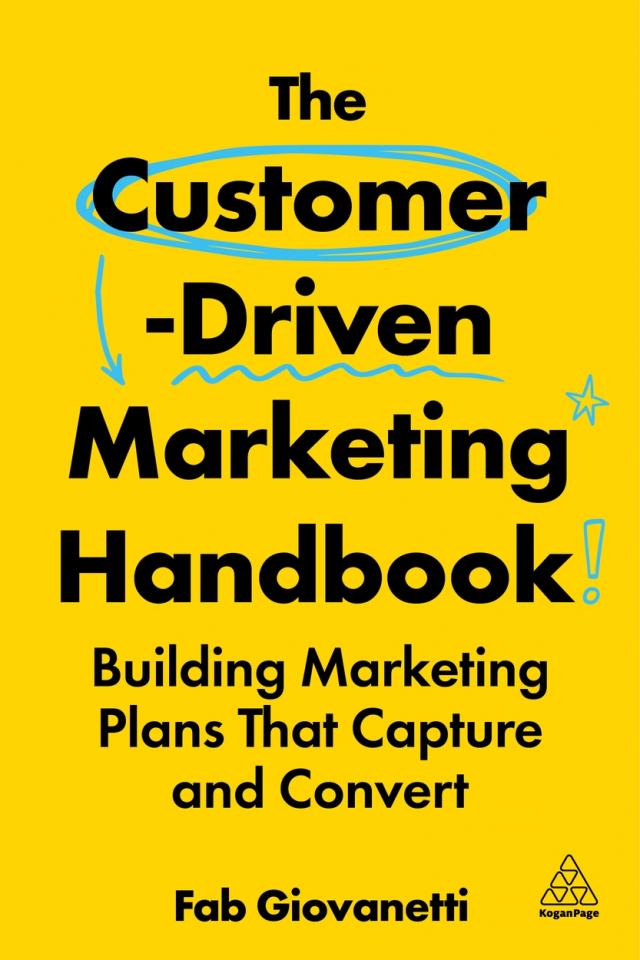 | Fab Giovanetti: Hello, I'm Fab Giovanetti, author of The Customer-Driven Marketing Handbook: Building Marketing Plans that Capture and Convert, published by Kogan Page. As a CEO and a teacher at Alt Marketing School, I've spent over 15 years helping marketers build strategies that put genuine customer relationships at the center of everything they do. In my book, I share practical frameworks for building trust, creating emotional connections, and turning customers into advocates, using real-world examples from brands like Gymshark, Headspace, and Notion. You'll learn how to identify customer pain points, design personalization that feels helpful rather than intrusive, and create shared rituals that transform one-time buyers into lifelong fans. As an IN CLEAR FOCUS listener, you can save 25% on The Customer-Driven Marketing Handbook when you order directly from KoganPage.com. Just enter the exclusive promo code BIGEYE25 at checkout. Shipping is always complimentary for customers in the US and the UK. I hope this handbook helps you create marketing plans that win hearts and deliver results. Thank you. |
Adrian Tennant: Welcome back. I'm talking with Jackson Wightman, founder and CEO of Proper Propaganda, about the evolving landscape of tech PR and AI-powered search. Jackson, your agency released a comprehensive GEO blueprint and even ran your own visibility program as a case study. What did you learn from applying these tactics to your own brand?
Jackson Wightman: We learned that it was very hard to do this. But a number of interesting things that I think are generalizable or at least testable by members of your audience. So we are a PR agency, as you said. We are in an industry that does not generate reams and reams of press from really large, widely read media outlets, obviously. What that has meant for us is that owned media, specifically content on our blog and content that we would call anchor content, so that's longer-form content that we put on our resources page, has been extremely important. So I would encourage people who are maybe in quote-unquote “boring” B2B businesses that don't necessarily get tons of press, to consider that and to consider the role of owned content that is optimized for LLMs as a source and as a way to grow presence. That's the first thing that I would say. The second thing we've learned is that a range of smaller, less important sites and places matter. We were talking about that earlier, obviously, but that's definitely been one of the main learnings. And then the other thing that we've seen is that you have to take a long view of this so we are benchmarking I believe across about 700 prompts at this point so that's quite a lot of prompts there are versions of things within that broad set of prompts and there are important subsets so It took us about four months to go from zero to anywhere. And I think that's important because as with traditional SEO, as with PR, as with a range of marketing channels, this takes a while. And so patience is the order of the day. And I know in some organizations, in some business cultures, patience with marketing is not always an easy thing. We've worked with a lot of companies from Asia, and Chinese companies in particular, are very, impatient because they kind of come from a tradition of speed and things like that. So it takes a while with GEO. It takes a while to run a program and you have to be patient with it. Those are the three main things that I would say that I think are generalizable. We've certainly seen some other things in terms of our own presence. Things vary a lot week to week. You want to look at a window that is longer. The window I look at is typically a 12-week window to kind of gather trends. LLMs are still kind of, I think, figuring out what they like and what they want to read and what is authoritative. So when you look at things week to week, you're like, wow, this is a yo-yo, you know. But the 12-week window tends to be one that we found more effective. So those are the main things I would say, Adrian.
Adrian Tennant: Well, as you just mentioned, you've worked extensively with Israeli, Japanese, Singaporean, and Chinese tech brands all entering the US. Are there common misconceptions these companies have about how American consumers or the media here evaluate brands?
Jackson Wightman: There certainly are, and I'll list a couple of the commonalities across all of the countries you've mentioned. The first one is, in a lot of these places, consumers are buying the products that we rep, not necessarily luxury brands and fashion products and things like that, but the products we rep, they're buying them a little more on price than on brand. And I think there's reams and reams of data about the importance of brand to American consumers. That's something that a lot of our foreign clients need to be educated on. The other thing that we see, particularly if I think about companies from Israel and in certain parts of Asia, is that there's a real emphasis on speed, whether that's speed in terms of iterating on a software program or whether that's speed in manufacturing and efficiency. Those things are great in those realms. They don't always really transport well or port well to the top of funnel and to top of funnel marketing. You have to be very patient with top of funnel marketing. It takes a while to build a brand. So I think there's generally misconceptions about the US consumer and about brand and how important that is to the U.S. consumer. And then there's the sort of speed trap, I'll call it, that they fall into sometimes and the sort of impatience which, frankly, sometimes it's a bit frustrating for our team, but it's the cultures that they're coming from. And when we think about it, when we sit down and take a breath, it's normal that that would be the case. You just have to be kind of patient and educate the client on that a little bit.
Adrian Tennant: In your "Tech PR Playbook," you describe 10 types of tech stories that journalists actually care about, from mega-rounds to thought leadership pieces. Jackson, how should a brand decide which story type to lead with?
Jackson Wightman: It's a great question. I would say that story types generally kind of tie to business goals. So when you're entering a new market and no one knows you, I'm going to just use a consumer tech example because that's the realm I know very well. It's great if you are, say, a massive brand in Scandinavia, let's say. But if you want to come to the US and you haven't sold in the US before, the first thing the American consumer is going to need to understand is that you can actually make a product that's good. So we're not going to go and pitch a story about your CEO's vision for design and how you embody and imbue the Scandinavian design ethic or something. We're going to say, here's the coffee maker. Go test the coffee maker, make sure it makes decent coffee, and write a piece about that. And we're going to establish credibility that way. Eventually, a year, two years, three years down the road after there's been more stories about your products, more stories and sort of people talking about the fact that you do a good job with things that you make cool things, we may have a chance then to pitch a story about your beautiful vision for Scandinavian design or something, whatever it is something a little more philosophical, but usually we want to start with a kind of, I don't want to call it a more pedestrian story, but it's a less ethereal story. It's less a, hey, let me tell you about my philosophy, and more like, let's prove we know how to do what we say we do. There are myriad other types of stories. As I said, in tech, we usually see the same 10 or sometimes 11 stories repeating. Almost every story that runs in tech media can be categorized as such. But when we enter a market, we want to start with really simple stuff proving that we are able to do what we say we want to do.
Adrian Tennant: When we were preparing for this podcast, you said that the “Tech PR Playbook” was actually shipped to publishers in late 2022, right when ChatGPT launched. If you were writing that book today, what chapter would you add?
Jackson Wightman: I mean, we'd have to add an AI chapter. It's been the most egregious missing piece, I think. And we think about that, talk about that every day.
Jackson Wightman: So it's definitely something where we know what was missing, but we were shipped early. I actually think, though, the AI and PR book chapter section, whatever it is, could literally be its own book, effectively. It could be something that's, you know, its own book. My only concern would be that in the time you shipped it to an editor, it won't be a date by the time it hits the shelves.
Adrian Tennant: Absolutely. Well, we're an agency, you're an agency, you've built proper propaganda with a unique billing model that includes a variable component tied to media placement and a hard cap on monthly fees. Jackson, why move away from the traditional retainer structure?
Jackson Wightman: A couple of reasons. First, we service the US market, but many of our labor costs are in Canadian dollars. So we are in a position where we have a little bit of a currency gain advantage, I'll call it. And it's allowed us to kind of play around with billing models that I think an agency in lower Manhattan or Silicon Valley might not be able to do. So we have a little competitive advantage, and we want to take advantage of that. The thing I think with PR is it is such a variable channel outcomes are so not guaranteed. And clients, particularly tech clients, seem to appreciate it if you want to de-risk their position or share risk with them or whatever we want to call that, and our billing model does that. The other thing in addition to de-risking that I think the model does, is it permits a degree of candor. Everybody who's from an agency listening has been part of a meeting where a client walks in and says, “You know, my five-year-old had a great idea last night. We should pursue that.” We, with this model, have the ability to say, “Well, little Johnny is a very bright five-year-old, but we're not going to listen to his ideas today because our dollars are on the line here.” And that has, I think, been useful for us in terms of candor, some client outcomes.
Adrian Tennant: Great conversation. Jackson, if IN CLEAR FOCUS listeners would like to learn more about Proper Propaganda, that GEO blueprint we discussed, or any of your writing on GEO, what's the best way to connect?
Jackson Wightman: So I'm on LinkedIn, Jackson Whiteman, W-I-G-H-T-M-A-N. Email is jackson@properpropaganda.net. The website is properpropaganda.net. And I am on Substack as well. So find me at Jackson's Proper Substack.
Adrian Tennant: Jackson, thank you very much for being our guest this week on IN CLEAR FOCUS.
Jackson Wightman: Pleasure. Thank you.
Adrian Tennant: Thanks again to my guest this week, Jackson Wightman, founder and CEO of Proper Propaganda. As always, you'll find a complete transcript of our conversation with timestamps and links to the resources we discussed on the IN CLEAR FOCUS page at Bigeyeagency.com. Just select ‘Insights’ from the menu. Thank you for listening to IN CLEAR FOCUS, produced by Bigeye. I've been your host, Adrian Tennant. Until next week, goodbye.
Timestamps
00:00: Introduction to the LLM Era and PR's Role
00:20: The Importance of PR for Tech Brands
02:35: The Pitfalls of Performance Marketing
03:36: Balancing Top and Bottom Funnel Tactics
05:16: Optimizing PR for AI and LLMs
07:08: Edward Bernays and Reputation Warfare
09:21: The Rise of Niche Platforms in PR
12:33: Challenges in Reallocating Marketing Budgets
15:13: Case Study: Implementing GEO Tactics
18:46: Cultural Misconceptions in Tech Brand Marketing
20:39: Choosing the Right Story Type for PR
22:54: The Need for an AI Chapter in the “Tech PR Playbook”
23:44: Innovative Billing Models in PR Agencies
25:23: Connecting with Jackson Wightman
25:51: Conclusion and Resources