/
The Art of Unexpected Solutions with Paul Sloane
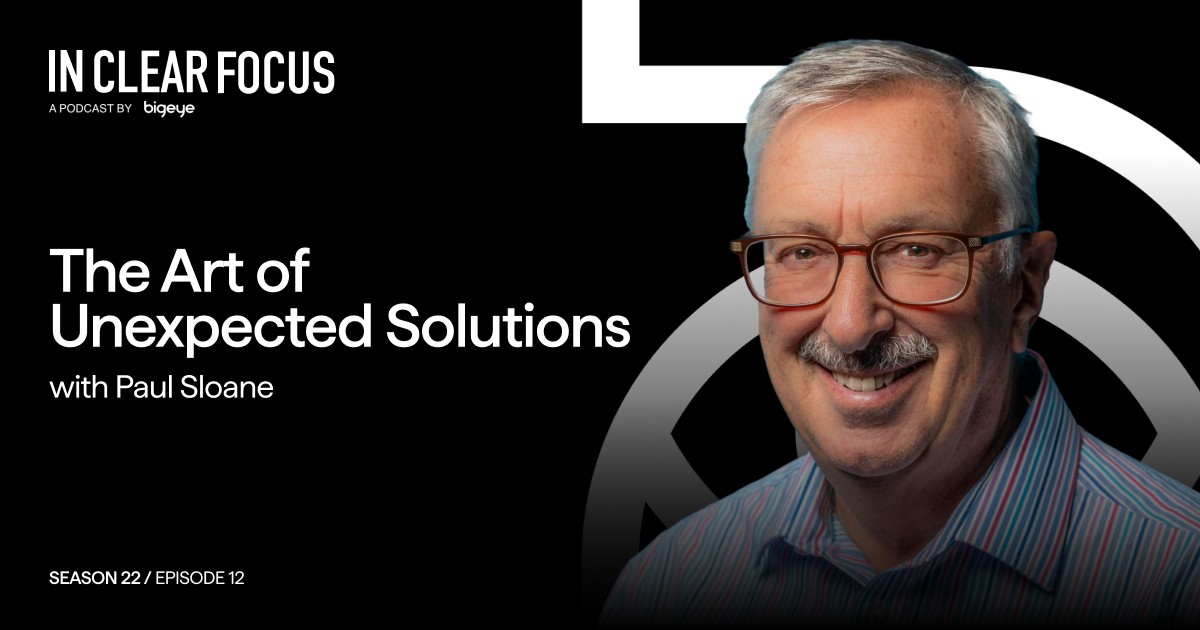
IN CLEAR FOCUS: Innovation expert Paul Sloane returns to discuss his new book, "The Art of Unexpected Solutions." He explains why our obsession with certainty stifles creativity and how embracing serendipity sparks breakthroughs. Learn how to use lateral thinking to challenge assumptions, leverage "topical mischief" for PR wins, and identify outlier customers. Discover practical ways to break out of routine, experiment fearlessly, and even harness AI to generate truly unexpected ideas.
Episode Transcript
Adrian Tennant: Coming up in this episode of IN CLEAR FOCUS:
Paul Sloane: A very important dimension of marketing is the ability to do something which is bizarre, which is left-field, which is outrageous sometimes, and which can alter the whole game. And that's what's so exciting about marketing, is that sometimes really inexpensive things can change the whole picture.
Adrian Tennant: You're listening to IN CLEAR FOCUS: fresh perspectives on marketing and advertising produced weekly by Bigeye, a strategy-led, full-service creative agency growing brands for clients globally. Hello, I'm your host, Adrian Tennant, Bigeye's Chief Strategy Officer. Thank you for joining us. History's most transformative innovations rarely came from following the playbook. Penicillin was discovered on a contaminated Petri dish. Post-it notes were born from a failed adhesive. Netflix emerged from a man who was annoyed about a late fee. What these breakthroughs have in common isn't genius, it's a particular kind of thinking. The willingness to see unexpected results not as problems to dismiss, but as opportunities to investigate. Our guest today has spent decades studying exactly this phenomenon. Paul Sloane is an internationally recognized authority on innovation and lateral thinking. Described by The Independent as the king of lateral thinking puzzles, he is the founder of Destination Innovation and has delivered keynote speeches and workshops for clients including IBM, Microsoft, Nike, Unilever, and 3M. Paul is the author of more than 30 books on creativity, leadership, and problem solving, with over 2 million copies sold worldwide. Regular IN CLEAR FOCUS listeners may recall Paul was a guest previously when we discussed his book "Lateral Thinking for Every Day." Well, he's back today to discuss his newest title, also published by Kogan Page, "The Art of Unexpected Solutions: Using Lateral Thinking to Find Breakthroughs." The book reveals how openness to surprise can spark innovation in any business, and how you can deliberately create the conditions for it. To discuss how marketers and creative leaders can learn to harness serendipity and generate ideas that others simply overlook, I'm delighted that Paul is joining us again today from his office in Camberley, England. Paul, welcome back to IN CLEAR FOCUS!
Paul Sloane: Great to be here, Adrian.
Adrian Tennant: Paul, you were with us a couple of years ago to discuss “Lateral Thinking for Every Day.” So, what prompted this new book, and how does it build on that earlier work?
Paul Sloane: Well, it does build on the earlier work, "Lateral Thinking for Every Day", which was examples of lateral thinking in many different fields and tips and hints on how to use lateral thinking in a very generic way. And one aspect of the whole thing which I investigated, which was of interest to me, was how chance, serendipity, things happening out of the blue can be very, very powerful. And at first, I just started to investigate this in a business context and the book started out very much as a business book. But the more I delved into it, the more I realized that the unexpected changes our lives and shapes society and history in so many ways. And when I'm giving a talk on this, I always start by asking the audience, "Can you think of any examples where something unexpected happened, something came out of the blue and changed the course of your life, either for the better or for the worse?" And most people can immediately think of several important examples where they met someone, something happened, there was some kind of accident, they were made redundant, they bumped into someone, something occurred which altered the trajectory of their career or their life in often a very positive way, occasionally in a very negative way. And it applies to all of us. In business, in life, and in society. And that's what got me interested in developing the book into what it is today.
Adrian Tennant: You open the book with a striking assertion that our obsession with certainty and control is actually one of the biggest obstacles to innovation. So, for marketing leaders who are judged on usually predictable results, how do you help them reframe that tension?
Paul Sloane: Well, I was in marketing for many years and I loved marketing because it's such a combination of skills. To be a really good marketer, you need to be analytical and be able to analyze the numbers and see what works and what doesn't, and creative. And the more bizarre sometimes and creative you can be, the better the results. So you have to use both sides of the brain, to use this old left brain, right brain metaphor, which used to be popular and it's gone out of fashion a little now. But you've got to use logic and creativity, and you can get immersed in the logic. You can look at the numbers, and you can analyze what worked and what didn't, and what return you got, and market share, and percentage of voice, and all of these things. You can be immersed in the numbers, and you can think that marketing is logical and predictable, and to some extent it is. But if you do that, you're missing out on a very important dimension of marketing, which is the ability to do something which is bizarre, which is left-field, which is outrageous sometimes, and which can alter the whole game. And that's what's so exciting about marketing, is that sometimes really inexpensive things can change the whole picture, and you can do something unexpected. And a lot of the book is about how the unexpected happens to you. But in marketing, you can generate the unexpected. You can catch your competition and your customers unawares by coming up with something unexpected. And one of the things I blog about is a concept called "topical mischief" in marketing, where you deliberately do something mischievous, which is topical and relevant and in the news. And very often you'll get coverage for it. And it's an inexpensive way of really getting a lot of PR. There was a football match in the European Championships and England played Portugal in the semifinal. It was 2004, I think. And Sol Campbell, playing for England, scored a perfectly good goal, which the Swiss referee disallowed because he saw some infringements that hadn't happened. And England were knocked out on penalties, and all of the pundits were outraged about this and all the fans were absolutely outraged. It was on the news that evening. It happened late in the evening and people were horrified that this shocking thing had happened and knocked England out of the European Championship. The next morning, Asda Opticians sent out a press release, first thing in the morning, eight o'clock, offering free eye tests to Swiss nationals in the UK. They could come in anywhere and get a free eye test. And this got on the national news, it got on the daily news, in every newspaper, because it was a spoof. It was deliberately mischievous. But some marketing executive watching that program that evening, had that idea. And he phoned his or her marketing director and said, "Can we get away with this? Do we have to take it up through legal and compliance?" And somebody made a courageous decision and said, "No, we'll do it." And they put out the press release first thing in the morning. Now, when I'm working with marketing agencies and marketing companies, marketing executives, I say, "Could you do something like that in your business? Could you come up with an idea at midnight and implement it by 8 a.m. the next morning?" Most people say they couldn't, but that's what they did. And that's to be topical and mischievous. Sometimes you have to be very quick off the mark because if they'd waited a week, it wouldn't have worked.
Adrian Tennant: Great example.
Paul Sloane: Yeah, and another example, Paddy Power, and Paddy Power have a Director of Mischief, whose job it is to come up with mischievous ideas. And there was a terrible scandal in the UK when horse meat was detected in the food chain. It was coming from Eastern Europe, and it was various meat products, which were supposed to be minced beef, but actually contained horse meat. And this horrified a lot of English consumers, who are very sniffy about horse meat. I mean, it's eaten on the continent by the French all the time, but the British are horrified at the thought you'd eat horse meat. And Paddy Power released, with their annual results, a cookery book of recipes for how to cook horse meat. And it was called "From Stable to Table." And it was deliberately the best recipes for cooking horse meat! And it got a lot of coverage because it was deliberately mischievous and set out to upset some people, as it did, but to get a lot of coverage. And in that, it succeeded.
Adrian Tennant: I think for our American listeners, they're now scratching their heads over the British sense of humor, but we'll proceed.
Paul Sloane: I'll give you one from America, which was on April the 1st, I think it was about 1998, Burger King announced the left-handed hamburger. And they had adverts in USA Today, full-page adverts, and they said, "We're releasing today the left-handed hamburger. All of the condiments and the materials have been rotated by 180 degrees to make the hamburger ideal for left-handed people. You can still order the normal right-handed hamburger if you want, but from today, if you want to, you can order a left-handed hamburger." And people went into Burger King and said, "I'd like to try the left-handed hamburger." And it got coverage. And of course, it was a spoof. It was an April Fool's Day prank, one of the most famous April Fool's Day pranks, the left-handed hamburger, but it got them a lot of coverage. And once again, I asked them, "Could you do something cheeky and outrageous like that?" And most of them say, "No, we would struggle to do that."
Adrian Tennant: Serendipity is a central theme throughout the book, but you don't treat it as something that simply happens to people. You say we can actively cultivate conditions that make it more likely. What does that look like in practice?
Paul Sloane: Deliberately meeting people you don't normally meet. Deliberately reading media that you don't normally read. Deliberately going to places you don't normally go. Deliberately introducing the random. More random, more chance into your life. So we tend to do the same thing every day, predictable things, and we've got a routine which is safe, and we're comfortable in that routine. And we operate well in that routine and things go for normal and so on. But routine is dull. And if you have a routine life, you're not a very interesting person, I would argue. And if you want to meet somebody new, then you've got to go to somewhere different. I said to my wife, I said, "I met someone random at the golf club today. It was very interesting." And she said, "Let me ask, is he about your age?" I said, "Yes." She said, "Is he middle class?" I said, "Yes." She said, "Is he white?” I said, "Yeah." She said, "Does he play golf?" I said, "Yes." She said, "He's not random. He's just like you." And she was right. And when I meet my friends at the golf club, we talk about the same things every week and it's very comfortable. It's a lot of fun. But then last week I went out and we wandered into an art gallery. We met the director of the art gallery, who's an immigrant. He'd come in from South Africa. He had a very interesting life. So I started speaking to him. And he had a different view of the world. I learned things. And it's only when you meet different people that you see different opportunities. And then if you keep reading the same media every day, if you go to the same newspapers, the same websites, you get the same sort of views from the same sort of people. And it doesn't alter your view. So if you normally read The Daily Telegraph or the Daily Mail in the UK, then read something like Private Eye, which is an anti-establishment organ which makes fun of the establishment. If you normally watch CNN, watch Al Jazeera. It will give you a different view of the world. And it's this sort of approach which introduces more of the random, more of the unexpected, and therefore, you are more likely to have a serendipitous outcome. You're more likely to have something happen. seem more likely to spot an unexpected opportunity which other people would miss.
Adrian Tennant: Paul, you describe assumptions as invisible prisons, and you argue that most teams don't even realize when they're inside one. So, what techniques work best for helping people notice the assumptions that they've previously been unconsciously making?
Paul Sloane: It's really hard. There's an old story, two young fish were swimming along one day and an old fish came by and said to them, "Hello boys, how's the water today?" And one little fish turned to the other and said, "What's water?" And of course, they don't realize because they're just in it. And it's like that with our businesses. We're in a framework and we've got a view of that framework and we've got a set of assumptions about that framework, which we think are the way the world is. And it's very difficult to challenge that. And very often, it's only an outsider that comes in and can challenge it. So no taxi company would have thought of Uber. No taxi company, if they'd had a brainstorm meeting, if somebody said, "Let's get rid of all our taxis and taxi drivers and just pay people who want to give somebody a lift and put them in touch with somebody who wants a lift. And let's create an app." Uber is an app. It's a taxi company that doesn't own a single taxi. But nobody working in a taxi company could have conceived that. Nobody working in Marriott or Hilton marketing department could have conceived of Uber because it was totally outside of their frame of reference. They were thinking of all sorts of clever ways to build new hotels and have clever promotions in the lobby and these things. They never thought of harnessing all of the people who are quite happy to rent out a room to somebody who needs accommodation for a night. And if you'd been working for Encyclopedia Britannica in 1995, and you said, "Hey, there's this new thing called the internet. Let's redesign our whole product so that instead of paying experts and carefully editing and curating every entry, we get volunteers to enter all of the data in the encyclopedia, and we put it out there pretty much for free, unchecked, and see how it goes." That would have been a career-ending proposition. It would have been so unorthodox, so radical, that nobody would have considered it. And yet, that's what Wikipedia was. And Wikipedia, of course, destroyed Encyclopedia Britannica. So with the question, how do you challenge assumptions? You can sit down and list them all, which is something I did. Very often, it's good to get an outsider in. Somebody who is completely different will ask, "Why do we do it this way? What are we trying to achieve here? What's the fundamental goal of our marketing? What is the problem we solve? Is there a better way to solve that problem for customers?" And typically there's always a better way to solve the customer problem than the way you're currently using, the way you're currently doing things.
Adrian Tennant: Let's take a short break. We'll be right back after this message.
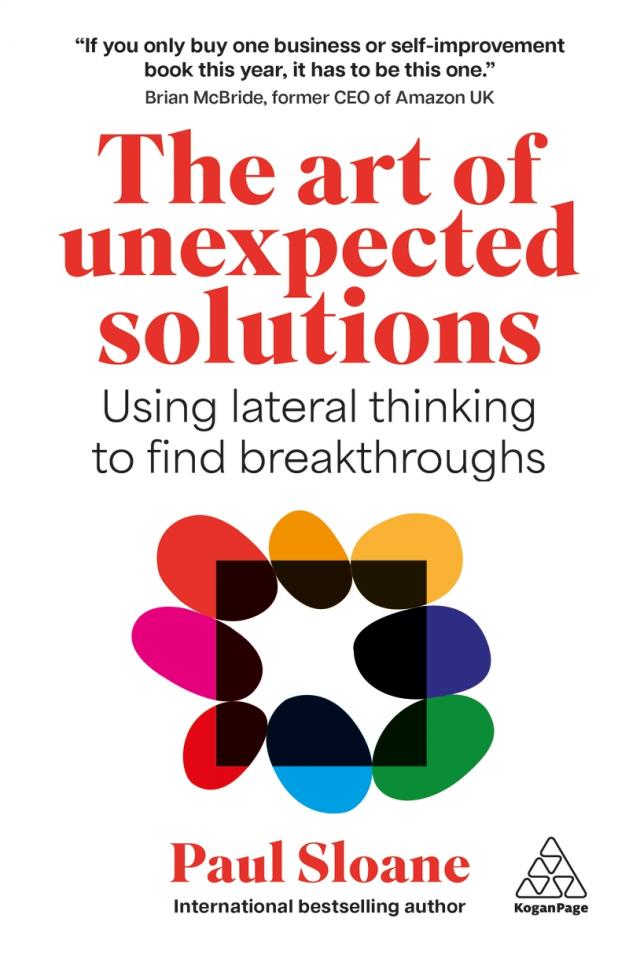 | Paul Sloane: Hello, I'm Paul Sloane, author of "The Art of Unexpected Solutions" published by Kogan Page and the Bigeye Book Club Selection for April. I've spent decades studying how the most transformative innovations in history arrived not from careful planning, but from unexpected discoveries, accidents, failed experiments, and chance encounters that only produced results because someone was curious enough to pay attention. In the book, I share practical techniques for challenging assumptions, cultivating serendipity, and finding solutions that others overlook, with examples drawn from business, science, sport, the arts, and many other fields. As an IN CLEAR FOCUS listener, you can save 25 percent on "The Art of Unexpected Solutions" when you order directly from KoganPage.com. Just enter the exclusive promo code BIGEYE25 at checkout. Shipping is always complimentary for customers in the US and the UK. I hope this book inspires you to approach your toughest challenges from a completely unexpected direction. Thank you. |
Adrian Tennant: Welcome back. I'm talking with Paul Sloane, author of the Bigeye Book Club selection for April, "The Art of Unexpected Solutions: Using Lateral Thinking to Find Breakthroughs," published by Kogan Page. Paul, Chapter 10 of your book introduces the idea of positive deviants: outlier customers who are doing something unexpected with a product. How can marketers identify those outliers and what should they do with whatever they find?
Paul Sloane: You know, there's an old saying, "The future has already arrived. It's just unevenly distributed." And some of your customers are doing things with your products, which lots of people will be doing in the future. And your job is to find them. So very often the top executives in a company will visit their most important customers, their largest customers, the ones who are spending the most money with them. But what you should do and what some companies do is they target the most advanced, the most creative users, the ones who are doing something really unusual. So when Levi's observed their customers, they saw that some customers were taking their jeans, going in the bath and deliberately shrinking the jeans down. So they produced pre-shrunk jeans. Other people were stone dyeing them, tying them with stones and dyeing them a lighter color. So they observed those customers and then they brought those new product variations into the market with great success. So don't watch your average customer, watch your most innovative customer, and see the creative ways they're using your product. If you watch customers and you see what difficulties they have, you know, the customers are very poor at indicating innovations. They'll give you a lot of incremental ideas. So if you were making spectacles in the 1950s and you said to your customers, "How can we make our product better?" They might've said, "Well, a lighter frame would be good. A flexible frame would be good. Scratch-proof lenses would be good. Repeat prescriptions would be good. Shaded lenses would be good." They'd have come up with a whole bunch of incremental ideas. Not one customer would have said, "I want you to invent a piece of glass that I stick on my eyeball every morning to enable me to see without spectacles." Not one would have said, "I want you to use laser beams to change the geometry of my eyeball so that I can see better." None. And yet contact lenses and laser eye surgery were two major competitors for spectacles. So it's very, very difficult to ask customers what they want. They'll give you a whole bunch of ideas, which you should listen to. "We want your product to be easier to use." "We want it in green." "We want it available on Tuesday." "We want it available in German." Whatever it is they'll say. And that's all fair. But in terms of a taxi customer saying he wants Uber, it's very, very unlikely they'll ever do that.
Adrian Tennant: There's also a chapter in your book about building a culture of experimentation, and you quote Jeff Bezos: "If you think it's going to work, it's not an experiment." What does that culture require from leaders beyond just saying it's okay to fail?
Paul Sloane: Well, if you look at someone like booking.com, they run tens of thousands of experiments every year, and they let people experiment on the live site sometimes. They're constantly A-B testing new ideas, new approaches, new page designs on the website, new offers, and everything is a learning experience. So, provided you learn something, no experiment is a failure, because it's useful. It's giving you data. It's giving you something you didn't know before. Customers don't like this. Customers prefer this to this. And customer trends are changing all the time. What worked last year might not work this year or next year. So you've got to be on the lookout all the time for what's happening. The best way to do that is to test. You're permanently in beta mode, really. Remember this idea you've got a beta product, it's not the final version. You're testing it, you're refining it before you get to the perfect version. Well, you're always in beta nowadays because there are always new things you can try. And the really innovative companies understand this and the leaders say, let's keep trying things, provided we share the learnings. It's okay for people to try things. Even things that fail and even things that waste money that don't work, that's fine. Provided we're learning, provided we're sharing the learnings, that's what we want.
Adrian Tennant: Well, Paul, a big change since the last time we spoke is that artificial intelligence is now embedded in most marketing workflows. I'm curious, what role do you see lateral thinking playing as more and more analysis gets automated?
Paul Sloane: Well, a lot of things are automated and AI is taking over in a lot of areas. And I regret to inform you that AI can be used for creative tasks as well as analytical tasks. And you can harness AI in all sorts of creative ways. One of the most lateral techniques I use in my workshops is the random word where you take a challenge, "How can we sell more product? How can we break into this market?" And then you take a random noun from the dictionary and you try and generate ideas from that noun. And because you're starting in an entirely different place, it forces you to come up with radical ideas. And amazingly, it works with AI too. You can go into Gemini or ChatGPT or Copilot or Claude and you can say, "Give me ideas for how we can market our product more effectively to older people using the word 'knapsack' or using the word 'sandwich' or using the word 'tree stump' or something. So you take a word at random, and believe it or not, the AI machine will come up with a whole bunch of them. Many of them are silly. Many of them are bizarre or slightly bonkers because it's forcing this, but some of them are really, really clever. And it works. So you should be using AI, not just to refine scripts, not just to check your press releases and things like that. You can actually use it to generate creative ideas and then test them.
Adrian Tennant: Yeah, I love that. Well, across all the techniques and frameworks in your book, if a marketing professional took away one habit and practiced it every day, what would you recommend and why?
Paul Sloane: I've got lots of advice to marketing people. Let me start with this one. My basic advice for all marketing people is this: analyze your marketing as best you can, and then do more of what works, eliminate what doesn't work, and try something new. Every month, every quarter, you look back at the previous quarter and say, "What worked well? Right. Let's put more of our budget. Let's try more of that. What didn't work?" Some things are moderate. They fly in the middle. You keep doing that. "What didn't work? Well, we tried this direct mail campaign. Didn't work. We tried email campaign. Didn't work. We tried Google ads." Right. Ditch those. Somebody's suggesting a TikTok campaign. "Well, let's try that. Let's try something." So every month, every quarter, try something new, just experiment, see what works and what doesn't, see what we can learn. So you've got to keep moving forward with marketing. And the other thing I would say is keep asking the same question, "What problem do we solve for customers?" And the necessary question is "Is there a better way to solve that problem?" Your product is not being bought because it's a product, it's being built because it's a solution to a problem that the customer has. And that customer is changing in its nature, and the ways to solve that problem are changing in nature too. So keep asking the question, what problem are we trying to solve, and is there a better way to solve that problem?
Adrian Tennant: Excellent advice. Well, your book draws examples from science, sport, the arts, and business. For marketers who want to develop their lateral thinking skills beyond reading your book, what resources would you point them toward?
Paul Sloane: Well, obviously pointing towards my previous book, "Lateral Thinking for Every Day", which I think is good. I think just play more games, be more playful, be more curious, ask more questions, challenge assumptions, be more of a maverick. The day you started working in the business that you were, you asked a whole bunch of questions. "Why do we do this? What's the purpose of this? What's the added value for the customer here? Why do we need to do this report?" I bet you've stopped asking those kinds of questions. And somebody new in, a consultant, who would charge you a lot of money, would come in and ask all of those very basic questions. And your job is to keep asking those questions. "What are we trying to achieve here? What's the customer getting out of this? What's the value added here in this? What's the effect of this?" And B, ask fundamental questions and keep challenging assumptions.
Adrian Tennant: Excellent. Great conversation. Paul, if IN CLEAR FOCUS listeners would like to learn more about you, your books, or your speaking and workshops, where should they go?
Paul Sloane: Well, they can go to my website, which is destination-innovation.com. They can see me on LinkedIn. I'm on X as well. So Paul Sloane in either of those, you'll find me. I'm on YouTube. I'm on TikTok. I'm on a lot of social media and I have a range of online courses on Udemy and LinkedIn learning. So I'm all over the place and I often communicate with people who get the books and ask questions and link with me on LinkedIn. I have my own LinkedIn group Lateral Thinking in Business, where we share ideas and examples of lateral thinking in business, and I love doing that.
Adrian Tennant: And a reminder that listeners can save 25 percent on "The Art of Unexpected Solutions" when you order directly from koganpage.com. Just use the promo code BIGEYE25 at checkout. Paul, thank you very much for being our guest this week on IN CLEAR FOCUS.
Paul Sloane: I really enjoyed it, Adrian. Thank you.
Adrian Tennant: Thanks again to my guest this week, Paul Sloane, innovation expert and author of "The Art of Unexpected Solutions: Using Lateral Thinking to Find Breakthroughs." As always, you'll find a complete transcript of our conversation with timestamps and links to the resources we discussed on the IN CLEAR FOCUS page at Bigeyeagency.com. Just select ‘Insights’ from the menu. Thank you for listening to IN CLEAR FOCUS, produced by Bigeye. I've been your host, Adrian Tennant. Until next week, goodbye.
Timestamps
00:00: Introduction to IN CLEAR FOCUS
00:23: The Power of Unexpected Innovations
00:45: Guest Introduction: Paul Sloane
02:00: Building on Lateral Thinking
02:53: The Obsession with Certainty in Marketing
04:15: Harnessing the Unexpected in Marketing
06:01: Topical Mischief in Marketing
08:00: Examples of Mischievous Marketing
09:53: Cultivating Serendipity
10:10: Breaking Out of Routine
12:10: Challenging Assumptions
15:03: The Role of Outsiders in Innovation
16:05: Identifying Positive Deviants
16:37: Learning from Outlier Customers
19:14: Building a Culture of Experimentation
20:29: The Impact of AI on Creativity
22:12: Daily Habits for Marketers
23:44: Resources for Developing Lateral Thinking
24:53: Conclusion and Guest Information