/
Demystifying Marketing Efficiency Ratio (MER) with Adam Ortman
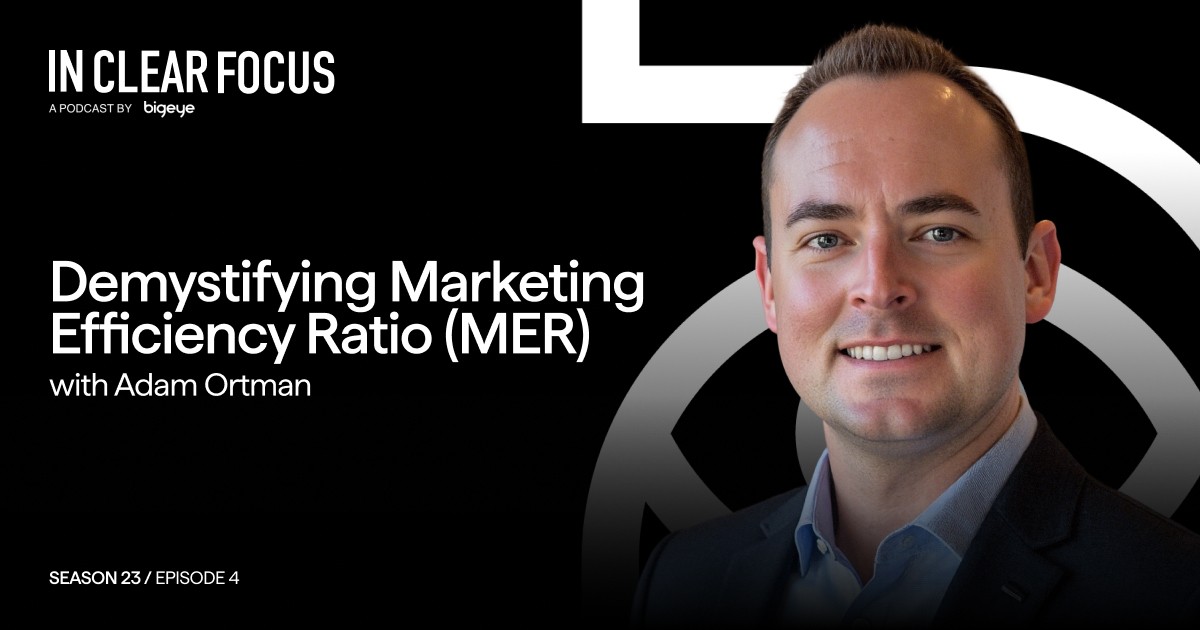
IN CLEAR FOCUS: Adam Ortman, founder of Kinetic319, explains why traditional media attribution is struggling in a fragmented world. He introduces the Marketing Efficiency Ratio (MER) as a powerful solution. Learn how comparing total business revenue against marketing spend provides a clearer view of overall health. Discover how to build "analytical surround sound" and use MER to confidently justify upper-funnel marketing investments to your executive team.
Episode Transcript
Adrian Tennant: Coming up in this episode of IN CLEAR FOCUS:
Adam Ortman: The MER allows you to understand if we spend more in marketing, is our overall business increasing alongside of it. So that correlative relationship is really what you're looking for with a MER.
Adrian Tennant: You're listening to IN CLEAR FOCUS. Fresh perspectives on marketing and advertising, produced weekly by Bigeye, a strategy-led, full-service creative agency growing brands for clients globally. Hello, I'm your host, Adrian Tennant, Bigeye's Chief Strategy Officer. Thank you for joining us. Today's marketers have access to more data than ever, from platform analytics and CRM systems to retail media networks and third-party audience tools. The problem certainly isn't a lack of information; it's that the numbers don't always agree. Attribution models tell one story, platform dashboards tell another, and the CFO's spreadsheet tells a third. So how do you make confident budget decisions when your data sources are pulling in different directions? My guest today has the answer. Adam Ortman is a consumer psychologist and the founder and CEO of Kinetic319, a Denver-based marketing agency that fuses consumer psychology with media strategy. Adam's career spans more than 15 years and includes more than $1 billion in media planned and managed across 500-plus brands, including Nike, American Express, and Kellogg. He holds a Master's degree in Advertising and Consumer Psychology from California State University, Fullerton, and is a fourth-generation business owner, plus a member of the Forbes Agency Council. To discuss why traditional attribution is broken, what practical frameworks teams can use to make better budget decisions, and how one ratio offers brand managers a clearer view of total business health, I'm delighted that Adam is joining us today from Denver, Colorado. Adam, welcome to IN CLEAR FOCUS.
Adam Ortman: Thank you very much Adrian. I'm really happy to be here.
Adrian Tennant: Adam, you trained as a consumer psychologist. Now, in my experience, people with a psychology background who end up in our industry tend to gravitate toward research or strategic planning, not founding and running an entire agency. What's the story behind how consumer psychology became the operating system for Kinetic319 first and foremost?
Adam Ortman: Adrian, don't worry, I'm not profiling you in this moment. Don't feel like you have to change your dialogue or personality. For me, I have always been fascinated by the science of consumer psychology. Why people think the way that they do, why do they purchase in the way that they do. And marketing as an avenue in an industry really lended itself as a natural expression of that interest of mine, but also added in the tidbits of data and creativity and strategic thinking. So it was really a fantastic home for me, given all of my interests. But I do get to flex my mental muscles a lot differently, which I'm really excited about in my career today.
Adrian Tennant: I'm curious, what's the story behind Your agency name, Kinetic319?
Adam Ortman: Kinetic319 is a very fun story that I am deeply in love with, mostly because it's my baby. 319 is actually the number of years between the start of my agency and the first advertisement published in North America in 1704. So it's 319 years. It's really paying homage to advertising and marketing in North America and U.S. culture. And then it's really this forward, very active, energetic, kinetic view of the future. Because businesses, if you are not moving, you're dying, unfortunately. So you have to constantly be innovating, constantly be evolving, testing, listening, acting. And without that kinetic energy, businesses fall behind.
Adrian Tennant: You're also a fourth-generation business owner. How has growing up in a family with that kind of entrepreneurial lineage shaped the way you think about running a business?
Adam Ortman: This is a fantastic question because if you were to have asked me 10 years ago, 15 years ago, you come from a family of business owners, will you own a business? I would tell you straight to your face, absolutely not. No, I would never. In my life today, being the owner of Kinetic319 obviously did not pan out, as my, crystal ball told me. So growing up in an entrepreneurial family, you do get a sense of what the rigor takes. There is no clocking in, clocking out. There is no singular job description. So you are basically the owner and the captain and the janitor and the maintenance man and the trainer. Growing up, my mom owned private schools, so she owned two childcare facilities in the city that we were growing up in. And it was fascinating to see her operate again from my young adolescent lens of saying, “God, I never want to do this.” But I look back at those years very fondly and see how she ran the business. And her mother before her actually owned the business as well, which she was a bridal shop owner. So she designed wedding dresses and before her was one of the very first financial trading entities to exercise with Wall Street. And even before them, it was a shopkeeper. So I do inherently look at the skills that I have today in mind, upbringing, and those that surrounded me, and I give them a lot of credit for how I run my business today. One of the areas that I kind of carry that into Kinetic319 is one of our pillars, is we attempt to know your business better than any other agency team. And the reason why that is is because I come from running and being within agencies my entire career. And I have seen firsthand agency teams that are just clicking buttons. They have no idea who they're working for, with, or for, or why that business exists. Or why does that founder get up every day and really do the hustle? Right. Not the dance, but the work. And so that's really important for us. And that's part of our onboarding where we actually interview the CEOs, we interview the founders of the company. But it gives our team a layer of understanding of the business of saying “Let's contextualize this a bit more rather than just chasing clicks, rather than just chasing sales.” Yeah. So no day is ever the same. And I love that. Sometimes I hate that. But I look forward to the continued growth ahead.
Adrian Tennant: Well, let's set the scene for our listeners. A few years ago, a brand manager could open a dashboard and see a fairly clear picture of what was driving results. Today, that same person is looking at modeled conversions, estimated data, and platform-reported numbers that don't always reconcile. Adam, from your perspective, what broke and why are so many teams still struggling to adapt?
Adam Ortman: I don't think anything broke. I think we, as consumers of media, have become more complex. Let's actually go back even further. I know that we're talking about a few years ago, but even further, really, all you had were billboards. You had radio, you had newspaper, you had TV. These are the days of Mad Men. You spent dollars on these channels because that's all that existed at the time. You knew that they worked because it was the only ones that you could invest in. In today's day and age, the actual consumption of media, you're touching five, six plus devices in a day, let alone applications, websites, physical businesses, et cetera. So your touch points can be in the hundreds per day. So what was a very clear “I spend on this channel, I show my ad on this channel and it works or it doesn't work” was really only an example because that was the only channel available. And so we, as consumers of media, but also just a techie generation in general, and we also have the attention span of a narcoleptic goldfish. We are constantly looking at different devices, different applications, and different areas. Opportunity for brands to interject their message. So the complexity inherently is the reason why our attribution and analytics is no longer as clear as it once was. To continue beyond that topic is this idea of privacy. So not only are we consuming media across various devices, across various digital properties, a lot of the Adam, his mobile ID or his IP address entered from the website from this source and this source that is now being completely removed from the scenario. So I would say that it's really twofold. I would say that having privacy increase over the years, as well as increased complexity in how we're consuming media, is really why we are now having a much different view of analytics today than we were maybe five to seven years ago.
Adrian Tennant: Marketing Mix Modeling has been positioned as one answer to deal with the complexities of a fragmented media environment. And when we were preparing for this interview, you described getting organizational buy-in for MMM as being like joining a new religion. So Adam, why is MMM so hard to sell, do you think? Even when the methodology itself is sound?
Adam Ortman: I will preface this in saying I am not starting a cult, I am in no way starting a religious organization. I actually do very much so relate the two. Anytime that you are moving away from directly attributable analytics to more of this statistical modeling type of analytics, which is multi-touch attribution (MMA), there's a lot that's happening in that space right now, and for ourselves as well. We are also piloting a lot of these different attribution systems. And historically you have been able to say “branded Google Ads generated this much of our revenue.” That's easy because that's very easy for a team to understand. “They clicked here and then they came to the website and then they bought the shoes” or whatever it is. Where the faith comes in and where the math comes in is understanding all of the different touch points in the complexity that we were just referencing all of the different touch points that led to that branded Google Ads for the pair of shoes ad click that then resulted in the sale. And so there's a lot of math. And that one sale, which is recorded as 1, the number 1, is then fractionalized over 2 to 10 different touch points over that specific customer's journey. And where that faith comes in is that amount that we are attributing four or five steps before the actual sale occurs. Is that the right attribution we should be giving? And that answer is not a solid “yes,” and it's not a solid “no.” So you do have to have a bit of faith when it comes to your statistical models. And I honestly do, in my experience, do see this as this is a short-lived, sensation. Right? Because you're taking that leap of faith, and everybody's holding hands about being excited about a new attribution model or statistical model, and then really time using that model will show you, is it working or not working and are we confident enough? We're not confident, how do we change it? And so I do think that kind of leap of faith is short lived because you're going to start to integrate it into your ongoing analytics. The proof will really be in the time in that regard.
Adrian Tennant: Well, in addition to MMM, of course, there's Multi-Touch Attribution or MTA, which was supposed to solve the “who gets credit” problem. Adam, where does MTA fit – or not fit – in the measurement toolkit today, especially for brands who are dealing with smaller budgets and fewer resources?
Adam Ortman: This is a fantastic question because I think that a lot of companies are struggling with this today because gone are the days of being able to fully invest your small businesses marketing budget in just Google Ads or maybe just meta ads, because you obviously want to show your ads to where your customers are and that might not necessarily be one platform any longer, or that one platform may be much more expensive than it was three to five years ago. So because of that, even small businesses are now having to further differentiate or diversify their marketing mix around different platforms. And they have the same answers as multibillion-dollar companies have, right? Which is what's working, what's not working? Small mom and pop shop selling pizza on Google Ads and Meta; Fortune 5 UnitedHealthcare, they have the exact same question, which is “which ads are driving my sales?” And so this idea of Multi-Touch Attribution modeling, which again attributes sales weight through an entire marketing journey rather than just your last interaction point, that type of methodology has historically only been reserved for very large companies because you have these attribution modeling organizations that are frankly charging $10,000 to $17,000 a month just for the reporting, just for the math. Small mom and pops or even mid-sized businesses can't afford something like that to help them tell their story.
Adrian Tennant: So if enterprise-grade attribution platforms are out of reach for most mid-market brands, what's emerging as a more accessible alternative?
Adam Ortman: So, what I'm finding and what is really interesting to see is that this space is now starting to leverage AI in a very interesting way. So rather than looking at the person and their interaction points and their visitation to the websites, etc., and their multiple IDs that are just sewn together with magic math, the AI models are actually taking the person out of the equation, and they're actually looking at the probabilistic way of specific ad being present during a specific time and how did that impact sales from a business perspective? So the more data that we have, years of data in the past would be ideal because the AI is actually doing thousands of different modeling scenarios you're talking about in minutes. And it will say that “this ad or this platform being active at this time has a confidence of 9.92 – 92% confidence – that it generated this much incremental sales.” So without that ad you can assume that these sales did not occur again. That's a very faith-based statement, and trust me, I press my analytics team to prove it to me every single day because my clients will ask the same question. But anyway, that's really the dynamic that's happening right now is you have mid-sized businesses asking louder than ever the same types of questions that billion-dollar businesses have. You have a much more obscure view of person by person level of attribution modeling. And now you have AI bringing interesting and new models and opportunities to this topic. There's a lot going on here, Adrian!
Adrian Tennant: Super interesting. Let's take a short break. We'll be right back after this message.
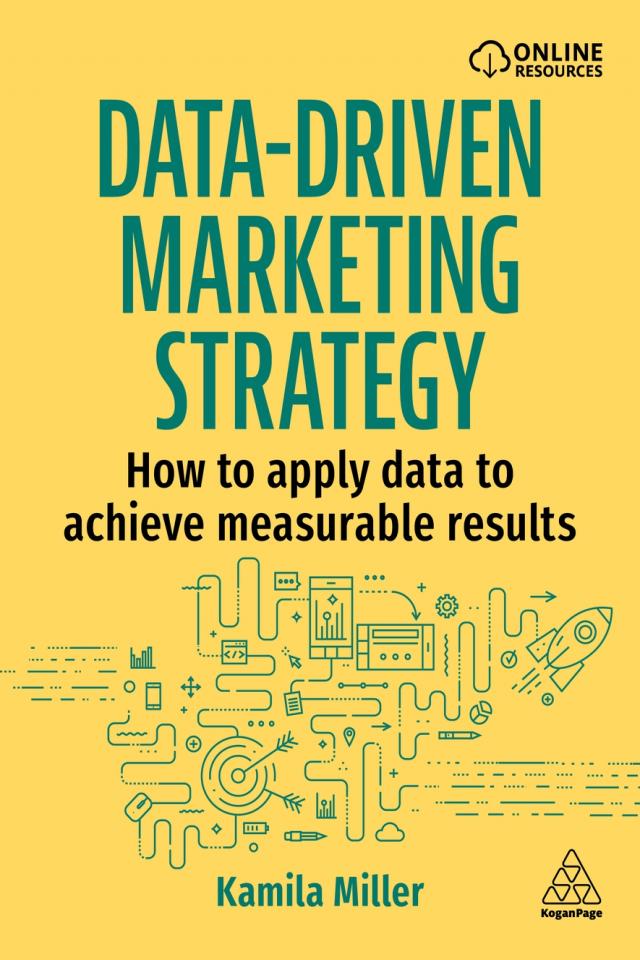 | Kamila Miller: Hello, I'm Kamila Miller, the author of Data-Driven Marketing Strategy, published by Kogan Page. As a charter marketer and lecturer in marketing across several prestigious UK universities, I've seen firsthand the gap between collecting data and actually using it to make better decisions. In my book, I share practical frameworks for turning data into creative, evidence-based strategies, from building actionable personas to leveraging AI for personalization at scale. With real-world examples from brands including Pepsi, Netflix, and HubSpot, you will learn how to move beyond dashboards and reporting to develop strategies where creativity and analytics work together. As an IN CLEAR FOCUS listener, you can save 25% on Data-Driven Marketing Strategy when you order directly from koganpage.com. Just enter the exclusive promo code BIGEYE25 at checkout. I hope this book helps you turn your data into strategies that deliver measurable results. Thank you. |
Adrian Tennant: Welcome back. I'm talking with Adam Ortman, the founder and CEO of Kinetic319, about rebuilding marketing measurement in a low-signal world. Adam, let's get into MER: the Marketing Efficiency Ratio. Now, for listeners who haven't encountered it, can you walk us through what MER actually is, how it's calculated, and why it's different from something like ROAS?
Adam Ortman: Yeah, MER is a great metric that we bake into all of our dashboards and all of our reporting because it does allow us to have an additional metric from a different perspective. And so in Kinetic319, we always try to have what we call an “analytical surround sound.” So you want to see how your marketing is doing from multiple perspectives. And so what marketing efficiency ratio is or MER is basically your total business's revenue divided by your marketing spend. So just to clarify, this is your total business's revenue, not just the revenue attributed to your marketing campaigns. And the difference there is that you're looking at your total marketing expenditure versus your total business health. Where in the ROAS example, that's when you're looking at your one-to-one, your marketing attributed revenue versus your marketing expense. So the MER allows you to understand “If we spend more in marketing is our overall business increasing alongside of it?” So that correlative relationship is really what you're looking for with an MER. In an MER usually you're going to get a score between 5 and 10. Really, the higher the better. With this metric, anything that's less than a four, that's something that you should be really considering, “Maybe my marketing expense is too high” or “Maybe we're investing in marketing channels that are not doing what we want them to do for the business.” So this is a great piece of surround sound, as I mentioned, for analytics because not only are you using your in-platform metrics, so “this campaign spent this much, it generated this much sales” in the eyes of that platform. You may also have an attribution layer to this that we were just discussing with multi-touch attribution modeling. MER adds an additional layer to this to understand overall businesses relationship with marketing. And so what this multiple perspective allows you to do, and it is especially great when you are working with very complex media mixes. So think we have digital running. So let's just say we have CTV, we have Meta ads, we have billboards, we have print – a complex model that is difficult to attribute. MER allows you to have a higher-level perspective to understand. Let's see how the overall business is doing because there will always inherently be “I saw this billboard three days later. I went and bought that handbag I saw.” And so that is not attributable in a way that is direct. So MER allows you to have a larger, higher-level perspective of your marketing expenditure. As in another piece of advice here is that if you do have the ability with your business's revenue you can start to slice and dice the MER a little bit deeper. So think rather than looking at maybe your national MER, maybe you have a regional MER and that regional MER could also dictate or align with specific marketing tests or marketing executions within those regions. So there's a few different, more advanced ways to think about MER. But again, if you're looking at MER from a national perspective, you're actually at a very good space, because you're looking at the relationship between your marketing expense, as well as your overall business revenue.
Adrian Tennant: A lot of our listeners are being asked to do more with less: fewer people, tighter budgets, and landed costs for goods that seem to change from week to week. Adam, how does MER help a marketer in that situation make a more persuasive case to their CFO or their leadership team about marketing's actual contribution to the business?
Adam Ortman: Yeah, I do want to clarify that this type of metric will not directly say Meta ads is where we should be spending our dollars. That is not what this metric is for. That multi-touch attribution modeling statistics, what we were talking about before, that would lend itself to more of this is what's working per our math. MER though, does allow us to understand. For CFOs specifically, I've had a lot of these types of conversations: “When we spend more, we get more.” What I have been hearing or seeing specifically in the last 10 years is that a lot of marketers are pulling dollars from their upper funnel and just packing all of their marketing dollars into lower funnel tactics, ones that are easily attributable and ones that obviously have a direct correlation to sales conversion rate ROAS. But what I do see as well is that tactic usually only works for about six to 10 months because you are harvesting all of the awareness and consideration that you have generated in the past. And so you start to dry up anyone that is new or potential new customers. And that also will definitely help your ability to penetrate a new market.
Adrian Tennant: So how does MER specifically help frame that upper funnel investment?
Adam Ortman: For a CFO who's focused on attributable returns, the justification of pulling dollars up into the funnel of you know, moving more video, moving more TV, moving digital out of home, going more trade show support, something that is a little higher in the funnel where awareness and consideration would be really the tactic. The MER is a great exercise for aiding CFOs specifically to have that conversation. Because CFOs rightfully so, they get in the weeds, they want to know what we're spending, where we're spending it, and "what did it result in? And MER allows them to have a little bit of a different perspective of “Hey, this was a larger awareness driving play during this period, during this region. And our overall sales as a business increased, not just those attributed to marketing.” That's a very productive conversation to have with a C-suite financial individual.
Adrian Tennant: Well, one of the things I find interesting about MER is that it doesn't try to assign credit to individual channels. But that can also feel uncomfortable for teams who are used to saying “We spent X on Meta and it returned Y.”
Adam Ortman: Wildly uncomfortable!
Adrian Tennant: Adam, how do you coach clients through that shift in mindset from channel-level attribution to a blended efficiency view?
Adam Ortman: Yeah, MER should not be the only metric you look at. And so that's why having an analytical surround sound is so critically important, because they are all important for their own reasons. Having channel-by-channel reporting, incredibly important. Having a more attribution or multi-touch view, incredibly important. Having an MER just as a good high level business health barometer. Fantastic. So I definitely do not want to urge marketers today to say, you know, “Let's throw Google Ads and our programmatic spend out the window” or “that reporting out the window and let's go full MER.” It might work. I wouldn't do it. But adding MER to your larger analytics portfolio is the recommendation here.
Adrian Tennant: Got it. If a brand manager listening right now wanted to start using MER as a framework, what does the first 30 days look like? What data do they need to pull together to get started?
Adam Ortman: The more data, the better in this regard because you want to start to see a trend throughout your business's history. So typically in those 30 days, if you're just starting out with this topic, I would try to pull the reports that you have. So basically all of your monthly marketing expenses for the last, you know, as far back as you can get, and then basically aligning that in the same graph chart, reporting with your overall business's total revenue that can come from a lot of different places in a lot of different companies. So aggregating that data is going to be really important, and then putting that into a view and it's going to actually start to show some interesting curves. You're going to start to see “Is my marketing budget increasing at a higher rate than my sales? And “If what was happening back then, what then?” That's it's going to point to some questions. So give yourself that time to aggregate the data, look at it, and then ask some questions internally. It happens every single time we do this, by the way, because it's going to be an interesting exercise. And so your most current MER is what you have the ability to understand now because those marketing campaigns are typically in market as we speak. And so let's just say, you've pulled two years of data. In this exercise, you can start to look at an average. So currently are you above that average or are you below that average? And there might be some external factors, macro environmental factors that could be impacting your business in certain ways. Those are the things that you should consider. But put this into your ongoing reporting. I would say check it on a monthly or quarterly basis, and to ensure that you're moving in the right direction from that high-level point. But again, do not ignore your more granulated pieces of reporting. Add this to your larger reporting portfolio so that you can start to see a larger business impact rather than sitting in a silo of just marketing.
Adrian Tennant: Great advice Adam. I know you work with brands at very different scales, from mid-market companies to Fortune 500 organizations. Does MER work the same way regardless of size or are you noticing differences in how a smaller brand versus a larger enterprise should think about and apply it?
Adam Ortman: I absolutely do see differences, and I see differences in the data, and there's a lot of different reasons behind that. But the calculation is the same. So it doesn't matter if you're a $25,000-a-year company, or if you are a $6 billion a year company in revenue, the calculation is the same. And so having your ratio exist allows you to really hone in on that metric to add to your analytics portfolio that we've been talking about. What I do see, interestingly, is that more mature brands tend to have a larger ratio, so a larger MER and that's because more people are aware of them. They have to do less introduction into their overall business or from a customer perspective. And they also have a lot more repeat purchase, because also take into consideration that this is total revenue. This is not just new prospective customers. Usually, the older the brands that we see or even the ones that have been participating in more awareness-driving or consideration-driving media, we do see more healthy MERs from them. But that is a factor of a lot of different items. But one that I was just referencing is just their age. So keep that into consideration as well that your MER and year two is probably going to be very different than in year 12.
Adrian Tennant: Great conversation. Adam, for IN CLEAR FOCUS listeners who'd like to learn more about your work at Kinetic319 or connect with you directly, what's the best way for them to do that?
Adam Ortman: Yeah, kinetic319.com is where you can find our website. We do a lot of work on this website. It is really a workhorse for us. We post a lot of great blogs. We do a lot of our own first-party research that we post. So if you do have specific industry questions, we are surveying at least twice a year large swaths of customers. Our socials are also great. So find us on our socials. Obviously. Connect with me on my personal LinkedIn, Adam Ortman, and I look forward to hearing from all of you.
Adrian Tennant: Adam, thank you so much for being our guest this week on IN CLEAR FOCUS.
Adam Ortman: Thank you very much Adrian for the time.
Adrian Tennant: Thanks again to my guest this week, Adam Ortman, founder and CEO of Kinetic319. As always, you'll find a complete transcript of our conversation with timestamps and links to the resources we discussed on the IN CLEAR FOCUS page at bigeyeagency.com. Thank you for listening to IN CLEAR FOCUS, produced by Bigeye. I've been your host, Adrian Tennant. Until next week, goodbye.
Timestamps
00:00: Introduction to IN CLEAR FOCUS
00:30: The Data Dilemma in Marketing
01:13: Meet Adam Ortman
02:06: The Story Behind Kinetic319
03:27: Growing Up in an Entrepreneurial Family
04:25: The Evolution of Media Consumption
07:03: The Complexity of Attribution Models
09:24: Challenges of Marketing Mix Modeling (MMM)
12:00: Multi-Touch Attribution (MTA) Explained
14:00: Emerging Alternatives for Smaller Brands
15:47: Introduction to Marketing Efficiency Ratio (MER)
17:21: Understanding MER vs. ROAS
20:39: Using MER to Persuade CFOs
22:25: Shifting Mindsets: From Channel Attribution to MER
24:36: Getting Started with MER
26:49: Differences in MER Application by Brand Size
28:09: Connecting with Adam Ortman and Kinetic319
29:00: Conclusion and Farewell