From Naming to Launch: A 2026 Brand Strategy Checklist for Baby Products
A baby brand strategy checklist matters more in 2026 because parents want proof fast, not just pretty packaging. With the U.S. baby product market projected at $16 billion, more brands are fighting for the same trust. I’d use this checklist to cut guesswork before launch, line up safety proof, and make sure the brand is easy for parents to understand and buy.
TL;DR
I’d start with the parent, the problem, and the success metric before I name or design anything.
I’d test the brand name for recall, spelling, legal risk, and language issues before I spend on packaging.
I’d build positioning from parent interviews, pricing checks, and proof that supports safety claims.
I’d make packaging, website copy, email flows, and retail listings say the same thing across each channel.
I’d track launch in stages: first traffic and conversion, then reviews and customer response, then repeat purchase and branded demand.
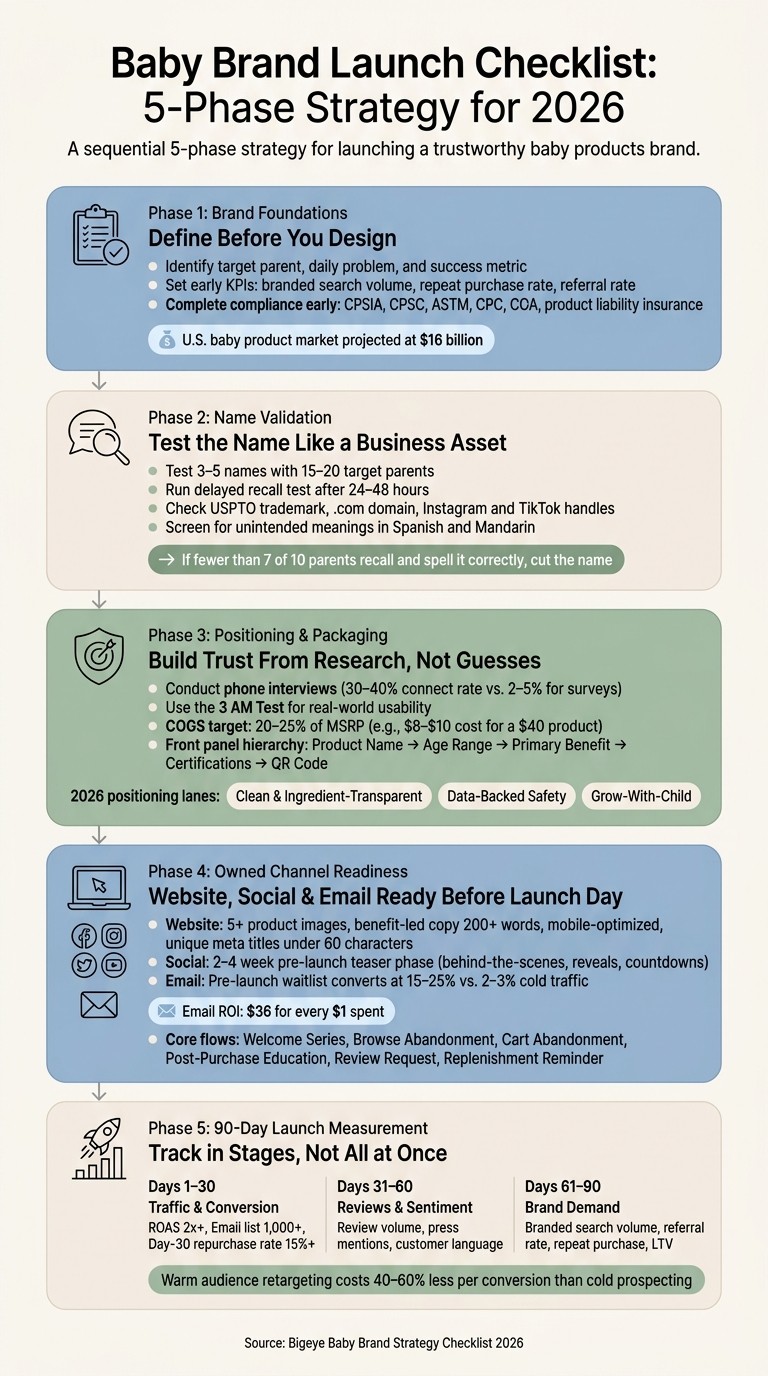
Baby Brand Launch Checklist: 5-Phase Strategy for 2026
What should come first in a baby brand launch?
I’d put positioning before identity.
That means I would first define:
who the brand serves
what daily problem it solves
how I’ll know the launch is working
The article makes one point very clear: a cute name and polished logo are not enough. If parents cannot tell what the product is for, why it is safer, or why it is worth the price, the brand starts with friction.
I’d also set a few early numbers before launch, such as:
branded search volume
repeat purchase rate
referral rate
Those metrics tell me whether parents remember the brand, come back, and tell other people about it.
Why does compliance need to happen early?
I would not treat compliance as a last-step task.
For U.S. baby products, the article points to items like:
CPSIA chemical testing
CPSC toy rules
ASTM standards
product liability insurance
Children’s Product Certificate (CPC)
Certificates of Analysis (COA)
If I were pitching retail buyers, I’d want all of that ready before outreach. The same goes for batch codes, lot records, and a digital folder with insurance and testing files.
That matters for two reasons:
It helps retailer talks move without delays.
It gives parents proof instead of broad claims like “safe” or “gentle.”
I’d also avoid names or claims that hint at medical results unless they can be supported.
How would I choose a baby brand name in 2026?
I’d keep the naming process simple and strict.
The article’s core idea is that a baby brand name should be:
easy to say
easy to spell
easy to remember
legally protectable
safe to use across key languages
I’d test each name with target parents, not friends. A short process could look like this:
Show 3–5 names to 15–20 target parents.
Ask what each name makes them think of.
Ask whether they would trust a brand with that name.
Run a delayed recall test after 24–48 hours.
Check trademark, domain, and social handles.
The article also points out that sound affects perception. Softer sounds may feel more gentle, while harder sounds may feel more exact or active.
If a name is hard to recall or spell, I’d cut it. If it creates legal or language issues, I’d cut it faster.
What makes baby brand positioning work with modern parents?
I’d build positioning from direct parent input, not internal guesses.
The article highlights a few ways to do that well:
phone interviews instead of only surveys
the “3 AM test” for one-handed, tired-parent use
interviews with parents whose children have already aged out of the stage
a quote bank with exact parent language
That helps me find the gap between what I think matters and what parents say matters.
I’d also check price fit early. The article notes a common target where cost of goods sold lands around 20%–25% of MSRP. If I want to sell a product for $40, I should know whether the product cost and the brand promise line up.
For positioning, I’d answer four plain questions:
Who is this for?
What category is it in?
What makes it different?
What is the price-to-value promise?
The article says three lanes are drawing parent interest in 2026:
clean and ingredient-transparent
data-backed safety
grow-with-child products
I’d choose one lead lane, then let the others support it.
How should packaging and visual identity build trust?
I’d treat packaging as a proof tool, not just a design surface.
The article says the pack has to do three jobs at once:
show trust fast
help parents scan quickly
survive shipping and retail handling
So I’d make sure the front panel quickly answers:
What is it?
What age is it for?
What is the main benefit?
Then I’d support that with proof such as:
certifications
safety warnings
QR codes to documents or care videos
traceability details like batch codes
I’d also keep the visual system tight across:
logo
small marks
typography
color palette
mobile and marketplace thumbnails
If a shopper sees the brand on TikTok, Amazon, and a shelf, it should feel like the same company each time.
What owned channels should be ready before launch day?
I’d want three owned channels ready before launch:
website
social
email
For the website, I’d make sure each product page includes:
at least five images
clear benefit-led copy
mobile-first layout
proof elements like testing or certification details
search-ready title tags and meta descriptions
For social, I’d run a 2–4 week pre-launch phase with:
behind-the-scenes posts
product reveals
countdown content
platform-specific posts for Instagram, TikTok, and Pinterest
For email, I’d put these flows in place early:
pre-launch waitlist
teaser sequence
welcome series
browse abandonment
cart abandonment
post-purchase education
review request
replenishment reminder
One detail I’d copy from the article: collect a baby’s due date or birth date when possible. That helps send stage-based messages that fit the parent’s current needs.
What should a baby brand track in the first 90 days?
I’d split launch measurement into three phases.
Days 1–30
I’d watch:
traffic
conversion
launch-week ROAS
email list growth
day-30 repurchase rate
The article points to markers like:
ROAS of 2x+
email list growth of 1,000+
day-30 repurchase rate of 15%+
Days 31–60
I’d shift to:
review volume
press mentions
customer sentiment
This is where the market starts telling me what it likes, what is confusing, and what language parents use on their own.
Days 61–90
Then I’d focus on:
branded search volume
referral rate
repeat purchase
LTV
At that point, I’d know whether the launch created memory and repeat demand, not just one-time orders.
FAQ
What is the first step in a baby brand strategy checklist?
I’d start by defining the parent, the problem, and the success metric. That gives the rest of the launch a clear direction.
How do I validate a baby brand name?
I’d test recall, spelling, trust, trademark risk, domain availability, and language issues with target parents before I approve the name.
What compliance documents should a baby brand have before launch?
At minimum, I’d have testing files, a CPC, COAs, insurance, batch records, and label files ready in one place.
How long should a baby brand warm up owned channels before launch?
The article suggests a 2–4 week pre-launch period for social and email so the audience is not cold on day one.
What should I put on baby product packaging first?
I’d lead with the product name, age range, and main benefit, then support that with warnings, certifications, and QR-based proof.
TL;DR Summary
I’d start with brand direction before visual work. That means choosing the parent, the problem, and the metrics before naming or packaging begins.
I’d validate the name like a business asset, not a taste choice. If parents cannot recall it or if legal risk is high, I would not move forward.
I’d base positioning on direct parent research and price checks. That helps the message match what parents want and what they will pay.
I’d use packaging and owned channels to repeat the same proof. The website, email, social, and retail listings should all match the product promise.
I’d treat the first 90 days as a test period with stage-based tracking. Early numbers show whether the launch is getting traffic, trust, and repeat demand.
Work With Bigeye Before You Launch
If I were getting a baby product to market, I’d want outside help before optimizing spend goes live. **Bigeye’s launch
What Should a Baby Brand Define Before Launch to Succeed in the 2026 U.S. Market?
Before launch, a baby brand needs to lock down three things: the parent, the problem, and the success metric. Those choices shape everything that follows, from naming and packaging to pricing and channel strategy. Start with the customer and the problem first. The name comes later.
Brand Foundations Checklist
The first job is to map daily use cases like sleep, play, tummy time, or nursery setup. A brand built around a specific moment speaks more clearly, guides product decisions better, and gives the business a position that is harder to copy.
Beyond the use case, founders need to define brand behavior and parent response. In plain terms, that means setting early success metrics that go past awareness alone. Branded search volume, repeat purchase rate, and unprompted referral rate show whether the brand is starting to earn trust.
Metric | What It Signals |
|---|---|
Branded search volume | Parents are actively seeking the brand by name |
Repeat purchase rate | Product delivers on its promise after first use |
Referral rate | Parents trust the brand enough to recommend it |
Compliance belongs on this checklist too, and it should not sit at the bottom of the page. For the U.S. market, CPSIA chemical testing, CPSC toy requirements, and ASTM standards need to be checked before pitching any retailer. Product liability insurance is often required by retailers, not a nice-to-have. That paperwork should be ready before naming and packaging start.
Once the audience and success metrics are set, the next step is to define how far the brand needs to go.
Category and Growth Scope Checklist
Before naming, decide whether the brand will use one master name across categories or separate names by product line. That one call shapes how far the name and positioning need to stretch.
Founders also need to decide whether the brand is entering an existing category or trying to change the category story. That affects the competitive set, the price tier, and the retail placement discussion. Making that call before naming helps avoid costly pivots later.
How to Choose and Validate a Baby Brand Name for U.S. Parents in 2026
A baby brand name shapes parent perception before they ever read the product page, and a weak name often forces you to explain too much later. Once your scope is set, the next job is to narrow your list to names that fit the audience, the product category, and the brand’s long-term path.
Naming Criteria Checklist
Choose names that fit the audience and product scope you already defined. In baby products, sound matters more than many founders expect. Soft sounds like m, l, s, and f often signal gentleness and comfort, while harder consonants like k, t, and b can feel more exact and energetic.
Before you move ahead, each name should pass five practical checks:
Pronunciation and spelling: Use the phone test. Say the name out loud once, then run a 24-hour recall test with 10 target parents. If fewer than 7 can recall and spell it right, the name is too hard to remember or repeat.
USPTO trademark screening: Run a professional trademark search before you lock in any name.
Domain and social handle availability: Secure a .com domain and check Instagram and TikTok handles first.
Implied medical claims: Stay away from names that suggest unproven health or safety benefits, since that creates regulatory risk.
Linguistic screening: Check for unintended meanings in Spanish and Mandarin, both major markets for U.S.-based baby brands.
Name Validation Checklist
Validation is where founders often save the most money later. The goal is to measure trust, recall, and purchase intent with target parents, not friends or coworkers.
A simple validation flow works in three steps. Start by showing 3–5 shortlisted names to 15–20 target parents. Ask, "What does this make you think of?" and "Would you trust a brand with this name?" Then run a delayed recall test. Ask people to remember the name 48 hours after they saw it, not right away. Last, plug the name into the sentence "We help [parents] do [result] through [brand name]." If that line sounds stiff or unclear, the name may be too technical or too vague to carry the brand.
Once a name passes legal and language checks, test whether parents can remember it, trust it, and say it back with ease.
Baby Brand Name Directions With Examples
Three naming paths show up again and again in the baby category, and each comes with a trade-off.
Invented names offer the best trademark protection and the most room for domain availability, but they usually need more budget to build meaning from scratch. In 2026, the early childhood brand Arcalis used a compound name tied to "arc" (growth) and "alis" (wing/flight) to signal balance and innocence to parents of children ages 3 months to 4 years.
Evocative or metaphorical names sit in the middle. They bring emotional pull and give you a better mix of distinction and human warmth. As one branding perspective puts it:
"The further you move from descriptive words, the more human your connection with people becomes."
Descriptive names are the easiest for parents to understand on the spot, but they are the hardest to protect legally and the weakest for SEO.
Name Type | Trademark Strength | Domain Availability | Instant Meaning |
|---|---|---|---|
Invented | Strongest | High | None |
Evocative | Strong | Moderate | Metaphorical |
Descriptive | Weakest | Very Low | Immediate |
The best path is the one that balances legal protection, clarity, and parent appeal.
How to Position a Baby Product Brand for Modern Parents in 2026
Positioning can make or break a baby product brand in 2026. If parents can’t tell, at a glance, why your product fits their life better than the next option, you’ve already lost ground. Positioning gives your brand a clear place in a parent’s mind. It shapes what they notice, what they remember, and what they trust. As the market grows more crowded, broad messaging falls flat. Your position needs to be tight, plainspoken, and built around what modern parents care about most.
Parent Research Checklist
Start with direct parent conversations. You need to hear problems in parents’ own words, not your team’s polished version of them. Phone calls tend to deliver 30–40% connect rates, compared with just 2–5% for standard surveys. That gap matters. A live conversation gives you tone, hesitation, frustration, and the small details that often point to the actual problem.
Two research methods stand out in 2026. The first is the "3 AM Test": observe or ask how your product works at 3:00 a.m., not when everything is calm and set up just right. That late-night setting exposes design and usability issues that polished focus groups can miss entirely. A bottle warmer, swaddle, monitor, or changing setup may look fine in a demo. It’s a different story when a tired parent is using it one-handed in the dark.
The second is past-stage interviews. Talk with parents whose kids have already aged out of your target range. They can tell you what ended up mattering, what they wasted money on, and what they misunderstood before becoming parents. That hindsight is gold. It helps you sort passing wants from the features that stick.
As feedback comes in, build a parent quote bank. Save the exact phrases parents use, especially when they’re annoyed, tired, or trying to explain what made a product hard to use. Those raw lines often do more work than polished brand language. They can shape headlines, product page copy, ad hooks, and packaging claims. That’s often the line between copy that lands and copy that sounds like a press release.
You should also test willingness to pay before you lock in your brand position. A common 2026 target is cost of goods sold at 20–25% of MSRP, or about $8–$10 to make a product that sells for $40. That benchmark helps you avoid a painful mismatch: a premium story attached to a value-level price, or a mass-market story trying to carry a premium margin. If parents won’t pay the amount your position calls for, fix that early. Then turn their exact language and price expectations into your positioning statement.
Positioning Statement Checklist
Before you write website copy, ad copy, or packaging text, your positioning statement should answer four basic questions: Who is this for? What category is it in? What makes it different? What is the price-value promise?
That sounds simple, but many new products miss the mark here. Research shows that 25–40% of new products fail because the market can’t tell how they relate to what’s already out there. Parents may not know where the product fits, what problem it solves, or why it deserves a spot in their routine. When that happens, confusion kills momentum.
One fix is to define your category entry point with care. Don’t stop at naming the product type. Show what it is replacing, improving, or making easier in daily life. Instead of entering the market as just another baby clothing brand, for example, you might frame the offer as “the safer, simpler nursery choice.” That puts the brand in a parent-value lane instead of dropping it into a packed shelf category.
In 2026, three positioning lanes are gaining traction with U.S. parents: ultra-clean and ingredient-transparent, data-backed safety, and grow-with-child products. Each one speaks to a different kind of concern. Some parents want to know exactly what touches their child’s skin. Others want proof, test data, and documented safety standards. Others want products that last beyond one short stage and feel worth the spend.
The key is focus. Pick one lane as the lead. Let the other ideas support it, not compete with it. If you try to lead with clean ingredients, test-backed safety, long-term use, low price, luxury design, and convenience all at once, the brand starts to blur. Parents won’t know what your brand stands for, and when that happens, they usually move on.
A strong positioning statement should then guide your proof points, package design, and page copy. It should show up in the way the product is named, how benefits are ordered on the box, and which claims you push first on your site. In other words, your position should not sit in a brand doc no one looks at. It should shape the full buying experience.
Safety and Trust Messaging Checklist
Safety messaging is one of the fastest ways for a baby brand to gain trust or lose it. In 2026, broad claims like “eco-friendly,” “safe,” or “gentle” don’t do much on their own. Parents and retail buyers want proof they can check.
Your brand should be ready to provide a Children's Product Certificate (CPC) and Certificates of Analysis (COA) for lead, phthalates, and flammability under CPSIA and ASTM standards as soon as a retail buyer asks for them. This isn’t a “nice to have.” It’s part of showing that your claims hold up under review.
Third-party certifications matter more than self-reported claims. OEKO-TEX can help support claims around fillings and fabrics. GOTS can support organic textile claims. FSC-certified cardboard can back up packaging claims. These markers give buyers and parents something firmer to hold onto than a brand promise on its own.
Packaging can help here too. Add QR codes that link straight to safety documents or third-party test results. That move cuts friction. It tells shoppers, “Here’s the proof,” instead of asking them to take your word for it. For multi-stage products, be clear that safety testing covered every setup, not only the main use case. If a product shifts from infant mode to toddler mode, parents need to know each setup was tested, not just the one shown in the hero image.
If the product includes a tech feature, be specific. Sensor-based products need sensor accuracy documents, not vague comfort language. Parents are often willing to trust data, but only when the brand shows where that data comes from and what it means in plain English.
It also pays to put your systems in place before launch. Add batch codes and lot records early. Keep a digital compliance folder with COAs, product liability insurance, and traceability data so you can send it right away when a buyer, retailer, or partner asks. That kind of readiness signals that your brand takes safety claims seriously.
Use these proof signals both on-pack and on-site. A safety story shouldn’t live in only one place. A parent might first see your product on a shelf, then check your site, then read an Amazon listing, then ask customer support a question. The same trust markers should show up across each touchpoint so the message feels steady and believable.
How Should a Baby Brand's Visual Identity and Packaging Build Parent Trust in 2026?
Visual identity and packaging are where brand strategy turns into proof a parent can see, hold, and judge in seconds. For baby products, the pack has to handle three jobs at once: signal trust, help shoppers scan fast at retail, and hold up through fulfillment. In 2026, that system has to read cleanly on shelf, in marketplace thumbnails, and in the parent’s hand once the box arrives.
Visual Identity Checklist
A baby brand needs more than a logo to look steady across channels. You need a primary logo, a submark, and a favicon so the brand still reads well on mobile screens, marketplace thumbnails, and small packaging.
Keep the type system tight. Two or three legible typefaces are enough. Your color palette should work just as well on a screen as it does in print, and the same system should show up across logo, color, and typography. That consistency matters because parents often meet a brand in pieces: an Instagram ad, an Amazon tile, a diaper box on shelf, a shipping carton at home.
A simple internal test can tell you if the identity system is doing its job: remove the logo from an asset and ask whether the brand is still easy to spot by color, type, and layout alone. If the answer is no, the system needs to be tightened.
Packaging Structure Checklist
Once the identity system is set, the package has to carry those same trust signals through shipping, stocking, and store display.
Packaging structure shapes both parent choice and retailer economics. In 2026, buyers are looking at pallet density and cube utilization along with shelf appeal. That means carton dimensions should be built with freight cost in mind, not just looks. A pack can be pretty and still cost too much to move. That tradeoff hits margins fast.
Material choices matter too, but the claim has to match the proof. Use mono-material PE pouches, FSC cardboard, and soy inks when they support recyclability and backed-up sustainability claims. On-pack language should be specific and verifiable.
Visible product-integrity cues also do a lot of quiet work. Tamper-evident features like shrink bands, peelable foil seals, breakaway closures, and one-way spout valves help show that the item is sealed and intact. Add batch codes as well for traceability and recall readiness. For parents, that can be the difference between “maybe” and “okay, this feels safe.”
On-Pack Communication Checklist
The front panel should be built for fast parent scanning, not for saying everything at once. Product name, age range, and primary benefit should sit at the top of the hierarchy. Everything else needs to support those three items instead of fighting for attention.
Communication Element | Priority | Purpose |
|---|---|---|
Product Name & Category | Primary | Immediate identification |
Age Grading Icon | Primary | Quick verification of fit |
Safety Warnings / CPSC | Primary | Legal compliance and trust |
Primary Benefit / RTB | Secondary | Differentiation |
Usage steps / QR | Secondary | Practical guidance without clutter |
Sustainability proof | Tertiary | Alignment with parent values |
Parents should be able to identify the product, confirm that it fits their child, and check the proof at a glance.
Certifications work best as supporting proof, not headline copy. A small QR code that links straight to safety documents, third-party COAs, or care videos removes friction and gives parents an easy path to proof without crowding the front panel. The same rule applies to sustainability messaging. Use exact language like "Box made from 100% recycled fibers" instead of broad claims that need backup.
Warnings and usage steps should stay plain and easy to scan. If the product comes in more than one configuration, say so clearly and make sure safety compliance and testing are documented for each version. In practice, that usually means keeping the front panel clean, then moving deeper proof and instructions to the QR destination.
Next, carry these same cues into the website and PDP.
What Owned Channels Should a Baby Brand Have Ready Before Launch Day?
Owned channels can make or break launch week. If your baby brand sparks interest but your site, social, and email setup aren't ready, that attention fades fast. The goal is simple: carry the same name, promise, and proof from your positioning and packaging into every owned channel so parents see a clear, steady story from first impression to first order.
Your website should match what parents saw on the package and make purchase decisions easy.
Your social channels should warm up demand before launch instead of going quiet until day one.
Your email setup should turn signups into buyers with timed, stage-based messages.
When these pieces are ready before launch, your team can spend launch day driving traffic, improving conversion, and tracking results.
Website and PDP Checklist
Your product detail page, or PDP, should echo the proof parents already saw on pack. If the package talks about safety, materials, or testing, the PDP should back that up right away.
Each product should include at least five professional images: a hero shot, alternate angles, detail close-ups, lifestyle photos that show real use, and a size reference. That mix gives parents what they need to judge fit, scale, and day-to-day use without guessing.
Copy matters too. Write 200+ words of benefit-led product copy that explains materials or ingredients, use cases, and common objections. Think about the questions a parent might ask in the last few seconds before buying: Is this safe? Is it easy to use? Will it work for my child’s age or stage? Good PDP copy should answer those questions without making the shopper dig.
You’ll also want to mirror on-pack proof on the PDP with a safety page, COAs, certifications, and a QR link. That kind of support helps turn claims into proof. And before launch, every product needs a unique meta title under 60 characters and a unique meta description under 160 characters.
One more thing: make sure the site is fully mobile-optimized. Most parents shop on their phones, often in short bursts between other tasks. If the mobile experience feels clunky, they’ll bounce.
Image alt text example: baby product PDP with safety certifications
Organic Social Content Checklist
A blank social feed on launch week is a missed shot. Run a 2–4 week pre-launch teaser phase with behind-the-scenes content, product reveals, and countdowns. That gives people time to notice the brand, get curious, and come back.
A simple way to shape content is around three pillars: education, emotional storytelling, and UGC. Education helps answer practical questions. Emotional storytelling gives the brand a human side. UGC adds proof from actual use and makes the feed feel less polished in a good way.
Don’t post the exact same asset everywhere. Tailor content for Instagram, TikTok, and Pinterest instead of cross-posting identical assets. Each platform has its own rhythm, and parents use them in different ways. Instagram may carry polished updates and community comments, TikTok can show product use in motion, and Pinterest can support saving and planning behavior.
Branded templates help keep things consistent without forcing duplication. That way, each platform stays on-brand while still feeling native.
Image alt text example: baby brand organic social content for Instagram TikTok Pinterest
Email and Lifecycle Checklist
Email is one of the strongest owned channels a baby brand can build early. In this category, email delivers $36 for every $1 spent. That’s a big reason to get flows in place before launch, not after.
Start with a pre-launch waitlist. Gamified pop-ups or early-access offers can help lift signups. More importantly, pre-launch waitlists convert at 15–25%, compared with 2–3% for cold traffic. That gap is hard to ignore.
Once people join, warm them up with a teaser sequence of 3–5 emails over 2–4 weeks. Use that sequence to tell the brand story, reveal products, and offer VIP early access. Done well, this primes the list to buy on day one instead of just opening and forgetting.
After launch, build five core lifecycle flows: a 5–7 email welcome series, browse and cart abandonment triggers, a post-purchase education sequence, and a review request sent 10–14 days after delivery. These flows do different jobs, but together they move a parent from interest to purchase to repeat behavior.
A smart move in the welcome flow is to collect the baby's due date or birth date. That single data point makes stage-based automation possible and drives 14.31% higher open rates than untargeted campaigns. For a baby brand, timing matters. A message about newborn use sent to the parent of a 10-month-old is just noise.
Automation Flow | Trigger / Timing | Primary Goal |
|---|---|---|
Welcome Series | Immediate signup | Collect due date; build trust |
Teaser Sequence | 2–4 weeks pre-launch | Build waitlist and anticipation |
Browse Abandonment | Viewed product, no cart add | Address safety or fit hesitations |
Post-Purchase Education | Shipping confirmation and usage/safety guidance | Reduce returns; build confidence |
Review Request | 10–14 days post-delivery | Collect social proof and UGC |
Replenishment Reminder | Based on product lifespan | Drive recurring revenue |
These channels should work together before day one
The website, social presence, and email flows shouldn’t feel like separate projects. They should support the same promise and proof across each touchpoint. A parent might first see a teaser on TikTok, land on a mobile PDP, leave, join the list, and come back through an early-access email. If those steps feel disconnected, trust drops.
That’s why prep work matters. When your website is polished, your social content is active, and your lifecycle emails are live, launch-day work gets much simpler. At that point, the focus can stay where it belongs: traffic, conversion, and measurement.
FAQ
What should a baby brand website include before launch?
At a minimum, the site should have strong PDPs, mobile optimization, proof elements like safety pages and certifications, and unique meta titles and meta descriptions for each product.
How long should a baby brand run pre-launch social content?
A 2–4 week teaser window is a good starting point. During that time, use behind-the-scenes posts, product reveals, and countdown content to build interest.
Why is a pre-launch email waitlist so important?
Because waitlists tend to convert at 15–25%, while cold traffic converts at 2–3%. That makes the list one of the strongest groups to target on launch day.
What email flows should be set up before launch?
The core setup includes a welcome series, teaser sequence, browse abandonment, post-purchase education, review request, and replenishment reminder. These flows help support trust, conversion, and repeat orders.
TL;DR Summary
Your website should match the promise on the package and remove buying friction. That means strong PDP images, clear copy, proof points, and a smooth mobile experience.
Your social channels should build demand before launch. A 2–4 week teaser plan helps warm up the audience and gives each platform a job to do.
Your email setup should be ready early, not added later. Waitlists, teaser emails, and lifecycle flows can turn launch interest into first purchases.
Stage-based data matters in the baby category. Collecting a due date or birth date helps send more relevant messages and improves engagement.
Need help getting launch-ready? Bigeye can help your team tighten site messaging, map lifecycle email flows, and plan channel rollout before day one. If you’re getting a baby brand ready for market, ask Bigeye for a launch-readiness audit focused on conversion, retention, and channel setup.
How to Launch a Baby Brand With Confidence and Measurable Results
A baby brand launch can stall fast if operations, channel messaging, and measurement aren’t locked in before day one. A strong debut starts with launch-ready systems, clear and matching brand language across every sales channel, and a plan to track what happens once products hit the market. At this stage, the work shifts from setup to execution: inventory, product listings, pricing, and performance tracking all need to hold together under real demand.
TL;DR
A baby brand launch works best when inventory, compliance, and launch assets are ready before launch day.
Parents should see the same product promise, safety language, and brand story on every sales channel.
Early measurement should focus first on traffic and conversion, then reviews and customer response, then repeat purchase and brand demand.
Pre-launch audience building can lower early conversion costs and speed up review growth after launch.
Launch Readiness Checklist
Before launch day, make sure your inventory buffer covers 30–60 days of expected sales for your best-selling SKUs. That buffer gives you room to handle early demand without running out just as momentum starts to build. It also helps if one channel moves faster than expected.
Pair that buffer with inventory software that syncs stock levels across both DTC and wholesale channels. If your numbers don’t match across systems, problems show up fast: overselling, delayed shipments, and retailer friction. For a baby brand, that kind of slip can hurt trust right away.
You’ll also want a launch-ready compliance folder in place. Keep COAs, SOPs, batch records, insurance, and label files in one organized location. When a retailer, marketplace, or partner asks for proof, you shouldn’t be digging through email threads five minutes before a deadline.
Finalize launch assets before launch week, not during it. That includes final product photography, a 60-second demo video, and packaging files. If these pieces are still in motion at the last minute, your team ends up patching holes instead of focusing on the launch itself.
Retail and Marketplace Checklist
Once operations are set, every selling channel needs to tell the same story. Keep titles, safety claims, and brand story language identical across Amazon, Target, Walmart, and DTC pages so the same promise and proof show up wherever parents shop.
That consistency matters more than many teams expect. A parent might first see your product on Amazon, check your site later, and then compare pricing on Walmart or Target. If the wording shifts from one place to the next, doubt creeps in. For baby products, even small gaps in claims or product details can make shoppers hesitate.
Register UPCs early and use a MAP policy to protect pricing consistency. Price swings across channels can make a new brand look disorganized, and that’s not the first impression you want. Early registration also helps avoid setup delays once retail or marketplace listings begin to move.
Your line sheet should include product photos, certifications, and traceability data so you’re ready for recall-related questions and buyer reviews. Think of it as your grab-and-go sales file. When a buyer wants details fast, having that material ready keeps the process moving.
Measurement and Optimization Checklist
After launch assets go live, the focus shifts from readiness to performance. This is where the launch starts to show what’s working, what’s weak, and what needs to change first.
Phase | Primary Focus | Key Metrics |
|---|---|---|
Days 1–30 | Traffic and Conversion | Launch-week ROAS 2x+, email list growth 1,000+, day-30 repurchase rate 15%+ |
Days 31–60 | Reviews and Customer Response | Review volume, press mentions, customer sentiment |
Days 61–90 | Controlled Expansion | Branded search volume, referral rate, repeat purchase, LTV |
In days 1–30, the goal is simple: get qualified traffic in and turn it into sales. Watch launch-week ROAS of 2x+, email list growth of 1,000+, and a day-30 repurchase rate of 15%+. Those numbers give you an early read on both demand and the strength of your post-purchase path.
Retargeting a warm pre-launch audience costs 40–60% less per conversion than cold prospecting. That’s a big reason pre-launch list building matters. It gives you a lower-cost audience to reach first, and it often brings in buyers who already know why your product exists.
In days 31–60, pay close attention to review volume, press mentions, and customer sentiment. This is the point where the market starts talking back. Reviews tell you what customers value, what they don’t understand, and what language they use when they describe your product in their own words.
In days 61–90, shift toward branded search volume, referral rate, repeat purchase, and LTV. By then, you’re no longer just asking whether launch traffic converted. You’re looking at whether the brand is building memory, word-of-mouth, and repeat demand.
Trigger a review request at day 14 and a follow-up incentive, such as 10% off a next purchase, at day 21 to build review density fast. That timing gives customers a chance to use the product before you ask for feedback, while still keeping the experience fresh in mind.
At the 30-day mark, brief your creative team to cut new ad assets using real customer language and UGC collected during the first month. This is where the market starts writing part of the ad copy for you. If customers keep using the same phrase to describe a benefit, that phrase belongs in the next round of paid and organic content.
TL;DR Summary
A baby brand launch works best when inventory, compliance, and launch assets are ready before launch day. That means holding a 30–60 day stock buffer for top SKUs, syncing inventory across channels, and keeping files like COAs and label records close at hand.
Parents should see the same product promise, safety language, and brand story on every sales channel. Matching language across Amazon, Target, Walmart, and DTC pages helps build trust and keeps your offer clear.
Early measurement should focus first on traffic and conversion, then reviews and customer response, then repeat purchase and brand demand. The first 90 days should move from launch-week ROAS and email growth to sentiment, referrals, and LTV.
Pre-launch audience building can lower early conversion costs and speed up review growth after launch. Warm audience retargeting costs 40–60% less per conversion than cold prospecting, and timed review asks help build social proof early.
The Complete Baby Product Brand Checklist for 2026
Baby product brand checklist work done before launch can make or break the first year. In 2026, baby brands win when brand strategy, compliance, packaging, and channel setup are locked in before day one. The checklist below works as a final launch gate, not a nice-to-have. Roughly 25–40% of new products fail because the market cannot place them clearly. That kind of miss gets expensive fast, especially once paid media and retail setup begin.
TL;DR
A baby product brand checklist helps teams catch weak spots before launch money is spent.
Your brand name should be easy to remember, easy to spell, and legally protectable.
Positioning should come from parent research, not guesses about what safety-minded buyers want.
Compliance, packaging, and measurement all need to be ready before retailer outreach and launch day.
If one of the five core areas is not done, pause the launch and fix it first.
The sequence is simple: validate the name, ground positioning in parent research, build trust into packaging, and prepare owned channels before launch. The strongest brands in this category pair clear brand direction with deep parent insight and operational readiness. A checklist-led process lowers risk because it forces the hard calls before money moves into paid media or retail setup.
Key Takeaways
If any one of these five areas is incomplete, delay launch.
Choose a name that is easy to recall, spell, and protect.
Ground positioning in actual parent research, not assumptions about what safety-conscious buyers want.
Organize every compliance document before your first retailer conversation.
Build visual identity and packaging to do trust-building work on the shelf without requiring explanation.
Have your measurement plan live before launch day.
TL;DR Summary
A baby product brand checklist gives launch teams a last clear filter before execution starts. It helps stop avoidable errors while changes are still cheaper to make.
Naming matters more than many founders think. If parents cannot remember it, spell it, or find it again, the brand starts with friction.
Parent research should shape your market position. What teams assume parents care about and what parents say in research are not always the same thing.
Compliance and packaging carry a lot of weight in the baby aisle. One keeps retailer talks moving, and the other helps earn trust at a glance.
Measurement should be live before launch, not added after the fact. If tracking starts late, the first wave of data is often messy or lost.
Work With Bigeye on Your Baby Brand Launch
Bigeye can help with consumer research, naming validation, packaging strategy, lifecycle email, and launch-readiness audits. If you're entering the baby category in 2026 and want a brand strategy grounded in parent insight and built for measurable results, connect with the Bigeye team to start the conversation.

Pet Industry
Sep 13, 2026
Amazon PPC for pet brands: separate intent, set bids by margin & reorder value, and stop wasted spend with a 90‑day audit.