/
Sustainability Storytelling with Mike Hower

IN CLEAR FOCUS: Mike Hower, author of "Sustainability Storytelling: Communicate Trust, Brand Value, and Better Business," explains why silence costs brands. He reveals how companies can overcome "greenhushing" and navigate the risks of greenwashing. Discover Mike's Four C's framework (context, compelling, credible, and compliant) to align legal and marketing teams, and learn how radical transparency and treating sustainability as a core strategy can communicate trust and drive value.
Episode Transcript
Adrian Tennant: Coming up in this episode of IN CLEAR FOCUS
Mike Hower: These issues should not be political. Like, we all want clean air, we all want a stable climate. That's the issue. And so I think when it comes to communicating this stuff, it's really focusing on that. And we're talking about how do we build a world that we all want to live in? Like, I'm about to have my first kid, and I want my daughter to live in a habitable planet. We all want that. I don't think anyone would disagree that we want to be alive, right, and live well.
Adrian Tennant: You're listening to IN CLEAR FOCUS, fresh perspectives on marketing and advertising, produced weekly by Bigeye, a strategy-led, full-service creative agency growing brands for clients globally. Hello, I'm your host, Adrian Tennant, Bigeye's Chief Strategy Officer. Thank you for joining us. Marketers and sustainability leaders face a difficult communication puzzle. Investors, employees, customers and regulators continue to expect environmental and social responsibility. Yet with greenwashing lawsuits on the rise and political headwinds shifting, many companies have decided that silence is safer than speaking up. That silence has its own name now: Greenhushing. So how do brands tell sustainability stories that are honest, useful and built to last? Our guest today has spent nearly two decades on both sides of that question. Mike Hower is a sustainability communications expert and the founder of Hower Impact, a consultancy helping Fortune 500 brands turn complex sustainability strategies into clear, credible narratives. A former senior editor at Greenbiz, Mike has worked with global brands including Mars, The North Face, HP and Berry Global. He also hosts the Sustainability Communicator podcast. Mike's new book, published by Kogan Page, is "Sustainability Storytelling: Communicate Trust, Brand Value and Better Business," and it's the Bigeye Book Club selection for July. To explore how brand marketers can tell sustainability stories that earn trust and hold up to scrutiny, I'm delighted that Mike is joining us today from Sacramento, California. Mike, welcome to IN CLEAR FOCUS.
Mike Hower: It's great to be here today. Thanks for having me.
Adrian Tennant: Congratulations on the publication of "Sustainability Storytelling." What prompted you to write the book now?
Mike Hower: Yeah, so this is a question I've been getting a lot. And I would say there's a couple reasons. So, first reason is I've always wanted to write a book. Every journalist says they're going to write a book one day. When I was a kid, I remember I pictured my life being as “I just want to be an author” whatever that meant. And then also, I just realized that the time was now to write a book about sustainability communication because we're in this era of greenwashing and greenhushing. Especially in the United States right now, a lot of companies are just, you know, they might still be doing the work quietly. Many companies have definitely rolled back to some of their goals and strategies. But even those that are still doing the work, they're being very quiet about it for many reasons. And it turns out it's more relevant than ever a year after starting to write it, probably more so. And so beyond that piece, I also think the longer term, you know, political pendulum swings back and forth. And even though we're in a downturn right now, even when things are quote-unquote “good.” So I talk about in the book, the period between 2020 and 2023 was what I call the ESG Golden Age. So, that was right around when BlackRock CEO, Larry Fink put out his famous letter to CEOs basically equating climate risk with investor risk. And that spurred this whole influx of companies all of a sudden caring about sustainability. And at the time, I was at an agency that did reporting. And so we were just getting constant emails and calls from companies asking for help. And a lot of them hadn't been doing much sustainability work, but still wanted to talk about it. And so anyway, long story short, over the years, I've just kind of seen, you know, both as a journalist where people used to pitch me about stuff that was not necessarily robust or worth talking about. And now, on the other side, as an advisor to these companies, seeing how many just don't know where to start. And so as one of those kind of rare professionals, it's sort of both where I straddle both sustainability world and communication marketing world. I thought this book could really be a bridge for both sustainability people, and comms people, and also legal people, or really anybody that's involved with communicating sustainability at big companies. And yeah, I didn't do it alone. I brought in insights from tons of people in my network who are doing this work day to day. I got to interview one of my favorite interviews is actually Dennis Hayes, who's the first organizer of Earth Day, which is really cool. To talk to him, especially from there's a chapter on the history of corporate sustainability and comms and how it evolved, which I'm a big history nerd. And I was like, “You can't really understand what to do today if you don't know how we got here.” But yeah, just the book really, it's meant to serve that need of both something that's practical. So it's not meant to just be like a handbook, but it can be used like that. But it's also kind of like a clarion call and a kind of a motivational piece reminding us how we got here, how corporate sustainability storytelling has evolved over the last 150 or so years. And what do we do now?
Adrian Tennant: Well, your career does have an unusual arc. Nearly a decade as a sustainability journalist at Greenbiz, then a move into strategic advisory at Edelman, and of course then founding your own consultancy. How does having sat in both chairs influence the way you advise companies on what to say?
Mike Hower: Yeah, I think, first of all, it's not as unusual as you think. There's actually quite a few sustainability communicators that I know. Actually, one of my friends, Aman Singh, who's at Kenview, I had her on my podcast recently, and she was in my book. She actually has almost the exact same arc as me, where she was a journalist, and then she was at Edelman, and now she's in-house as a sustainability communicator. So you're seeing, actually, a lot more former journalists become comms people for a lot of reasons. One is just because there's just no money in journalism, and there's fewer jobs there. But also, I think it does, the modern corporate communications in marketing, the traditional old school way of doing it doesn't work anymore. And there's a term that I did not coin this, but I really like it. It's called “Radical Transparency,” where companies really just need to show all their cards because you might as well because it's going to come out eventually anyway. Companies no longer control their narratives for a multitude of reasons. 25 years ago a company would put out a press release say “Here's what we're doing,” and that was really the only way you would get any insights into what was happening at that corporation. And in the modern era, everybody's got a supercomputer in their pocket and can document anything. If you have slavery in your supply chain someone could literally just flip out their camera and document it and call you out on it. Social media allows these things to be amplified. I touch a little bit on AI in the book but not a ton, because I this was kind of emerging as I was writing the book, but AI is making a whole other layer of difficulty of information can spread instantly but also misinformation can. And so that's a long way of saying that I feel like being a former journalist really helps me advise my clients because I'm not just there to tell them what they want to hear. And I think to be radically transparent, you kind of have to have a journalist mindset of, “Is this believable? Where's the evidence?” And stuff that's very basic stuff, right? If you're going to say something, if you're going to make a claim, have evidence to back it up. But as we know, a lot of communicators and marketers don't always do that, especially in the sustainability world where we've seen this. Because I think a lot of comms people treat sustainability maybe as a cute thing that's an offshoot of corporate philanthropy, and not a core business strategy. They might be okay with making like fluffy claims or give example would be like clichés like, you know, “We're building a beautiful, better future” or “A greener world.” Like things that don't really mean anything and it's just like it's just like filler. And when modern sustainability communication really needs to be about like “Yeah, we were here because we're trying to build a better world, but that's not going to move people today, we want to talk about true problems.” Like we're talking about risk, we're talking about things that are happening right now and what the companies are doing about that. So I think because my first kind of jobs were really about getting pitched a lot by these PR people who were trying to make things sound good. And I'd have to sift through that to be like, “Okay. Is there actually a story here? What are you really trying to say? Can you back anything up?” And so, now that I'm on the other side of things, and I'm not doing so much media relations these days, but I think it's more around shaping corporate comms and reporting. But it's really thinking about, “Okay, could someone poke holes in this? Could a stakeholder call us out on this for claiming something that we have no evidence to support?” I do think all communicators need to start thinking like journalists.
Adrian Tennant: Well, earlier you mentioned the term Greenhushing: companies that have made real sustainability progress choosing to say nothing about it for fear of legal exposure or political backlash. Mike, what does that silence cost a brand?
Mike Hower: Well, increasingly, we're seeing that it's costing quite a bit. I have a PowerPoint I've been sharing a lot, but there's increasing proof points that I've uncovered around the stakeholders that still care about sustainability information. So even though the federal government might say, “Oh, we don't want you to talk about DEI,” if your investors care about that, your employees care about that, if you're not talking about that, then you're letting them down, and that's going to hurt you. And so the majority of investors still report using ESG information in their decisions. So that's still happening, despite all the media around that. This is more anecdotal, but I've seen this, and I've soft-sounded it through some big networks like the Trellis Network, where a lot of people have agreed with me on this. B2B businesses are increasingly getting questions around sustainability in RFPs. So if you're trying to win a project or win a bid and they're asking you to disclose your human rights policy and you don't have one, you might lose it. Or if they're expecting a net-zero goal and you don't have one, or you haven't clearly articulated it, or even if your salesperson doesn't realize you're doing this work and you're not getting credit for it, that could translate into real dollar loss. And then 3BL Media did a study last year, and I included this in the book: 70% of consumers are still curious about sustainability information from the brands they do business with. And that's not even talking about employees and Gen Z. But Millennials and Gen Z, we all say that we want to work for companies that matter and align with our values. And so there's a whole chapter in the book where I talk about the business case and how to communicate it. But greenhushing is essentially like taking that short-term calculation of like “Okay, if we keep our heads down now maybe in the long run we'll survive.” But it's really not the case, because when the political spectrum swings back and it's going to companies are going to come out of the woodwork and all of a sudden be like “Oh yeah, we've been doing this all along. We really care.” But it's not going to seem authentic because it won't be, because true character is forged in the fires of difficulty, right? So, you know, if you only stand behind your principles when it's convenient, then it means nothing. And so the companies that were quiet right now during this period, and then all of a sudden later, they try to act like they cared all along. It's not going to build trust, and that's going to look really bad for you.
Adrian Tennant: Mike, the backbone of the book is your Four C's Framework: Context, Compelling, Credible, and Compliant. Let's start with context. What does reading the context before you communicate actually involve in practice?
Mike Hower: And it's so interesting. Context was actually a late addition to the framework. It used to be the Three C's framework for a good chunk of the book. And so I like to call context the silent C, because it's the C that most people don't think about when they're dealing with communication, right? Like we tend to think of like, “Okay, develop a Comm strategy, develop your messaging, do your campaigns, get out into the world.” But we don't think about that we're not operating in a vacuum. So if you're a global company and you're putting out a climate communication piece in California, that's going to resonate differently than it might in rural Alabama. Or DEI initiatives in New York are going to apply differently than maybe in Russia, right? Most corporations are global, and they have to deal with these local contexts. So that part of context is thinking about, “Okay, we can't just have a one-size-fit-all.” But just thinking about that as you're communicating sustainability is important, and also thinking in terms of not all cultures understand the concept of climate change the same way that we might in the West or in other countries. So, just being aware of those differences is important. Another piece of context is just the fact that when you put out a message into the world, it's again, like your, unless your business is brand new, you have baggage, right? So if you're in an industry that's known for being dirty, let's just do the easy one. Let's say you're in a fossil fuel company. I do talk a lot about that. I'm still expecting maybe an angry letter from Exxon's lawyers after they read this book! If you're from the fossil fuel industry and you're putting out communications around climate action, you're going to have a lot more skepticism around what you're saying. Likewise, if you're working in a plastics company or whatever. Understanding that your industry has baggage and reputation that impacts how your message is received is important. And then the final piece of context I talked about in the book is the brand levels. Brand reputation really makes an impact on how you're perceived. And it's very interesting, I talk about this in the book, that brands that are kind of perceived as being beloved by consumers, for example, they just assume that you're just good all around, even if you're not. And so there's a phenomenon called the halo effect. I didn't make this up. This is just a thing that exists already. It's this idea that if your brand is perceived as being quote-unquote “good,” you might get away with not having the most advanced sustainability strategy or not doing a ton. On the flip side, there's the horn effect, which is if your brand reputation isn't very good, then even if you're doing good stuff, they might not believe you. And so what I talk about in the book too is a lot of times that your company's perception of sustainability might not be aligned with its actual performance. So let's say that you have a positive perception for just being a good brand and company and your stakeholders just think you're doing a good job on sustainability, and you're not really doing anything or not doing enough. Eventually that truth will come out, and then that's going to disappoint them, and that's going to actually be worse for your reputation. So it's just kind of level-setting of like, “Okay,” like “what's public perception around what we're doing versus what are we actually doing and how can we make sure that we're communicating clearly about what's happening so that there isn't that misconception?”
Adrian Tennant: Let's take a short break. We'll be right back after this message.
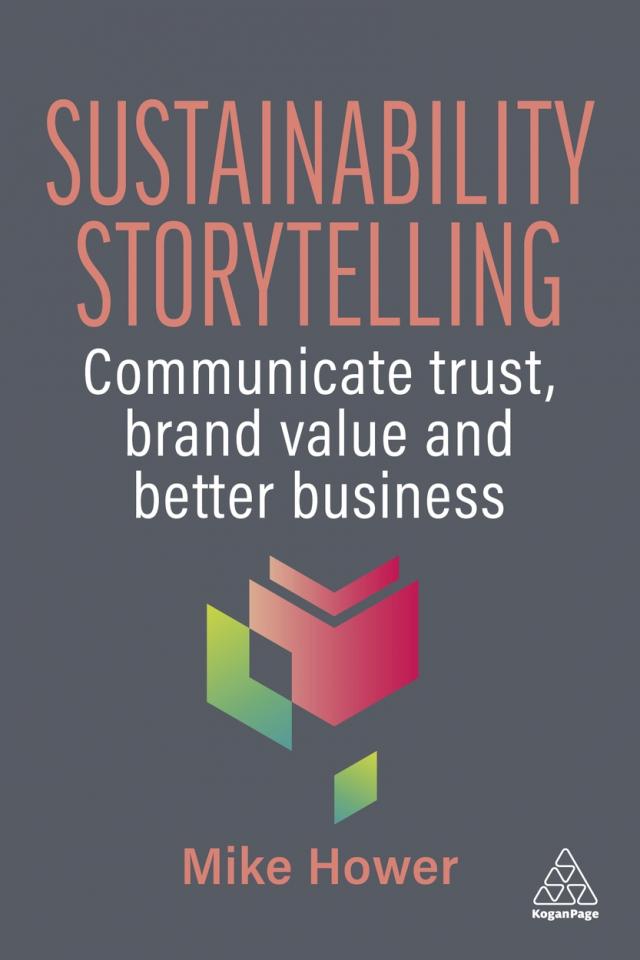
Mike Hower: Hey there, I'm Mike Hower, author of "Sustainability Storytelling: Communicate Trust, Brand Value, and Better Business," published by Kogan Page. I've spent nearly two decades on both sides of sustainability communication.
In my new book, I introduce a framework called the Four Cs of Effective Sustainability Storytelling: Context, compelling, credible, and compliant. Four areas that turn complex sustainability initiatives into stories that build trust, manage risk, and deliver real business value.
You'll find practical tools for avoiding greenwashing, navigating evolving regulations, and aligning your sustainability, communications, marketing, and legal teams around a single coherent narrative.
As an IN CLEAR FOCUS listener, you can save 25% on "Sustainability Storytelling" when you order directly from koganpage.com. Just enter the exclusive promo code BIGEYE25, that's B-I-G-E-Y-E-25, at checkout.
Shipping is always complimentary for customers in the US and the UK. I hope my book helps you tell sustainability stories that resonate, hold up to scrutiny, and move business and sustainability goals forward. Thank you.
Adrian Tennant: Welcome back. I'm talking with Mike Hower, author of the Bigeye Book Club's July selection, "Sustainability Storytelling: Communicate Trust, Brand Value, and Better Business." Compliant is probably the C that brand and creative teams understand the least. Mike, for a mid-sized consumer brand without a full legal team sitting in on every campaign brief, what does compliance look like in the day-to-day?
Mike Hower: Yeah, so compliant, it's a tough one. And this is the one where a lot of the companies that I work with, they're thinking about this a lot, especially in the US with the constantly changing regulatory environment. Also, obviously, a lot of European-based companies are dealing with a constant change in regulation, especially around reporting and disclosures. And I guess most of the companies I work with are big enough where they have pretty big legal teams. But let's say you're a smaller company or a mid-sized company, this can be challenging because a lot of times, like maybe let's say you have a Chief Legal Officer or maybe you're outsourcing your counsel to a law firm. They don't always have the expertise to understand these issues. The same challenge with just like marketing comms people, right? And so lawyers tend to be, they're very small ‘c’ conservative, where their job is to protect the brand and make sure you don't get sued or get in trouble with any compliance issues. And so what happens is there's a tug-of-war between the three key functions around sustainability comms: sustainability teams, whose job is to really make sure you're doing the work, setting goals, and following through on them. Comms marketing, their job is to try to make the story compelling and making sure that what you're communicating is interesting to your stakeholders. And then the legal team, their job is to protect you from legal risk and regulatory risk. And a lot of companies fall into this trap where whoever's dealing with legal at their company is faced with. Let's say we want to make an announcement around climate commitment or some environmental commitment or social commitment. They may just be very risk averse and say, “Okay, we're going to add a bunch of legalese to this to make sure we don't get in trouble or we're not, let's just say, nothing.” And that leads to a lot of greenhushing. And so what I talk about in the book is to really do a good job with compliant, you really gotta build that relationship with your legal team, or if it's just one person, your legal person, before you need to work with them on something. Let's say you're working on a sustainability-focused press release, don't wait until you send it to them for review to have this conversation. I like to say the best thing you can do like right now to improve your sustainability comms is to try to get your legal sustainability and comms people in the same room and just like before you're actually doing any major campaigns just to like level-set and build that relationship so that you can build that mutual respect and rapport that will make it easier to address these as you move along.
Adrian Tennant: Well, you draw a careful distinction between compelling and credible. A story can be one without the other, and the consequences are very different. Mike, what goes wrong when marketers chase compelling at the expense of credible?
Mike Hower: Yeah, so it's interesting. So when I entered sustainability about almost 20 years ago, this was right around the history of sustainability. This was the era of like, cause marketing actually emerged in the 80s before I was even, probably before I was born, honestly. This was the era where there was a lot of like big aspirational commitments being made and like the aughts and then 2010s, when companies were just kind of setting huge commitments. This was before Net Zero, but like, “We're going to reduce our carbon emissions. We're going to address human rights.” And a lot of modern corporate sustainability kind of emerged out of the issues of the nineties, like, you know, Nike getting called out by NGOs for having, you know, child labor. And so the early 2000s and 2010s was really about companies treating sustainability as kind of an offshoot of cause marketing or CSR, which still exists today, but it wasn't seen as like a strategic function of the business as much. And so you just got a lot more of this fluffy language, like, “Yeah,” like “we're going to build a better future.” Like, you know, “We're going green.” You know, “We're making sure everybody feels good,” or whatever. And that, again, that language doesn't mean anything. And it's, I think it's because at the time there was no metrics because they had just set out to say, “We're going to do stuff. Let's just do 20%.” Like it was literally, that's how they were setting goals. Again, compelling is important. That's not to undersell the point. That's why it's still a pillar. You still need your sustainability messaging to resonate and connect with your stakeholders and make them actually care. And that's what compelling is about. So that's making it interesting. You could talk a big game and make it sound really cool, but then have nothing. If it doesn't mean anything, then at the end of the day, it's not going to drive action, but eventually you're going to lose your credibility. And then the compelling piece doesn't really have an effect, right. And so credible, it's basically just ensuring that you're just doing what you're saying you're doing. It's really as simple as that. If you're putting out a message that says that you're doing something, just prove that you did it. And it sounds simple, but as we know, a lot of communications can be aspirational. And there's nothing wrong with a little bit of that. A little aspiration is okay, but I think that sustainability communications in general got a little bit too extreme with that for a long time where it was very aspirational. You go to these conferences and people will just be talking a big game about “Here's what we're gonna do, blah blah blah.” But then they didn't really back it up or when things got bad they got cut and a lot of times this wasn't the communicators fault the cease we just lost interest or deprioritized it. And I do talk about that in the book how that's a big problem. But if you want to simplify it, compelling would be the domain of your comms marketing team. Credible would be the domain of the sustainability team. The problem with credible though, is that if you're going too far to prove what you're doing is true, then you get, you're risking getting overly technical or jargony where then nobody's going to care. Like I could show you a whole data table of here's what we're doing, but, and it might be accurate, but if it's not compelling, nobody's going to read it or care or act on it. So they go together. It doesn't mean so, and again, I think it's a tug-of-war. So I think for a while, compelling was kind of out of control. And then the last several years, I think there's been, because of that, because of the greenwashing risk generated by compelling, we were moving too far in towards credible, which was like, “Let's just get more data and information out there, and that'll solve it.” But now we have more information than ever. And business cases are a great example. Most CEOs, when they're surveyed, will say, “Yeah, I get it. Sustainability makes business sense.” But they still don't act on it. Even CFOs are saying this. And so they have the information, but they don't act on it. And there's a lot of reasons why, that some are systemic, but one reason is that it's not compelling them to act. And so, and because we're about psychology, like humans, we like to think of ourselves as rational actors, but we're not, we're not. We're not just emotional, but we're, if we were only making rational decisions all day, the world would look very different. And so that's where storytelling and comms comes into play. And it's not about manipulating us, but it's about finding that balance of what actually moves us as humans.
Adrian Tennant: Got it. Sustainability communication has to land across very different audiences: investors, employees, consumers and regulators. How should brand teams think about sequencing those audiences when they launch a story?
Mike Hower: Yeah, so I do talk about in the book about how you can prioritize your sustainability comms in general. There's a process I developed for the book called The Sustainability Storytelling Assessment, which is like a play on materiality assessment, where it's essentially thinking about, “Okay, there's a whole universe of sustainability topics that we could communicate about. Which of these are actually relevant to us or material to us?” And yeah, you can focus on your actual material issues, which is where you should start. But even then, you still might not have anything to say about a material issue yet. So, maybe that's not the focus of your storytelling yet. But I have some clients where, for sustainability purposes, investors are their number one concern. So, it's like, “We want to improve our ratings and rankings so that investors will invest in us,” is the outcome they want. Some others, like when I worked with Mars, like they're a consumer-facing brand, but they don't have investors in the traditional sense. So for them, it's consumers. “How do we drive our consumers to want to do business with us?” And so I think it's, again, it's about being strategic about what, first of all, what are your business goals in general, and not thinking of that as separate from sustainability. So I think this is, again, a problem a lot of companies fall into is they still see sustainability as just a side hustle or corporate philanthropy. And that's not what it is. It is a core part of your business strategy. Again this is why I also talk about in the book too, your comms team really needs to be in partnership with your sustainability team to understand what the priorities are. Because sustainability teams are generally focused on long-term outcomes. Comms marketing are driving sales or short-term KPIs. And so by meeting with them, you can kind of figure out, “Okay, who are core audiences that we're trying to achieve, trying to reach right now with our sustainability communication and why?” And this might change. It might change depending on what's happening in the world and whatnot. So there's not like an easy “This should always be the sequence.” But I think the takeaway is that there should always be a conversation. You should always be iterating, and taking in new information, and then adjusting as needed.
Adrian Tennant: Mike, your book closes with a forward-looking argument that companies that use the current period of political headwinds to build genuine substance and tell honest stories will be best positioned when the pendulum swings back. In today's landscape, what does it signify for a brand to prioritize storytelling as a strategy for resilience rather than merely a tactic for reputation management?
Mike Hower: Yeah, I think that's a big question. So the political headwind in this piece. So I have a chapter on aligning government affairs with sustainability storytelling, which is one of my favorite chapters to write, because this is a chapter that's often left out of books like this. And it's something that I encountered working with a lot of companies in the past, where they might be leading on sustainability strategy and storytelling around it. And they put out a great sustainability report, even do some really good comms around it. But then when you follow what they're doing on the public affairs front, you'd be like, “Wait a minute. Like you're literally undermining climate policy in the United States. So, how can you say that you have a Net Zero goal while undermining policies that are going to make that possible?” And a lot of it has to do, and I get this in the chapter, where there's just, there's a lot of siloed stuff happening at these big corporations where government affairs is not talking to sustainability. And it's fairly complex around who you give money to, especially in the US. I do mention a little bit about European politics. This is also happening in the EU too, where a lot of the green policies there are being undermined by certain interest groups. But in the US, money talks. And so a lot of companies, their number one government affairs kind of strategy is maximizing their tax benefits. Unfortunately, a lot of the representatives in the United States that might be amenable to having lower taxes are also the ones that are anti-climate or opposing climate legislation. And so it becomes challenging, because they're like, “Okay, if we agree with like 90% of what they're doing, but 10% we disagree with,” they kind of have to make a call. And so I talk about that in the book, that that's important. But there's this term called corporate political responsibility, which is a term, I think it was University of Michigan came up with it, where it's this idea that you need to align your corporate sustainability values with how you're acting politically and where you're giving and things like that. That aside, your question was more around sustainability. So I just think that's all tied together. So I think you can't just be like, “We're putting out a press release about Net Zero. Maybe we're even, you know, decarbonizing somehow.” And then not being willing to back that up in the political arena to me is another form of greenwashing. And it's in the U.S. particularly where we're increasingly polarized, it gets more and more complex because it's like, “Whose side are you on?” It didn't used to be like this. This climate was more, not always a bipartisan issue, but environmentalism was a bipartisan issue when the first Earth Day happened. And that's something I talk about in the book as well. Again, like, I know the people that work at these companies and I've worked with these people a lot of times and sometimes I am that person. So I understand that it's not as simple to just be like, “Let's just do everything the right way and always back the right horses.” But what I try to talk about in the book is like, I know it's messy. It's never going to be perfect, but we can't just ignore it. You need to at least like, factor that in. And then that's the only way that we're going to somehow address this, like, versus ignoring it. And that's kind of my personality. Like, I come from a blue-collar background, and my dad was a mechanic. And I'm very just like, “Say it how it is. Don't beat around the bush. And let's just get to the solutions.” But again, I think, and this is bigger than any company can address, is that these issues should not be political. Like, we all want clean air. We all want a stable climate. That's the issue. And so I think when it comes to communicating this stuff, It's really focusing on that. We're not talking about taking things away from people. We're talking about how do we build a world that we all want to live in? I'm about to have my first kid, and I want my daughter to live in a habitable planet. We all want that. I don't think anyone would disagree that we want to be alive and live well. And so I think it's getting back to that common narrative that we have more in common than what divides us. And I think companies are in a good position to be like, yeah. We're trying to create value for everybody, not just a small group of people.
Adrian Tennant: Great conversation. Mike, if listeners would like to learn more about you, your work, or your book, "Sustainability Storytelling," what's the best way of doing so?
Mike Hower: Yeah. Well you can find the book pretty much anywhere. It's on Kogan Page's website. If you, I mean, if you Google it, it'll pop up, go to the Hower Impact website. I also have a newsletter called The Sustainability Story. That's a free Substack newsletter that I try to put out at least a couple of times a month. Definitely subscribe to that and follow me on LinkedIn. I'm always putting stuff out on LinkedIn around my thoughts on this topic. And really my goal as a professional is to really elevate how we communicate sustainability communication overall. So I'm singularly focused on that. So if you're interested in those topics, just follow me.
Adrian Tennant: And a reminder that IN CLEAR FOCUS listeners can save 25% on "Sustainability Storytelling" when you order directly from KoganPage.com using the promo code BIGEYE25 at checkout. Mike, thank you very much for being our guest this week on IN CLEAR FOCUS.
Mike Hower: Thank you so much for having me.
Adrian Tennant: Thanks again to my guest this week, Mike Hower, author of "Sustainability Storytelling: Communicate Trust, Brand Value, and Better Business." As always, you'll find a complete transcript of our conversation with timestamps and links to the resources we discussed on the IN CLEAR FOCUS page at bigeyeagency.com. Thank you for listening to IN CLEAR FOCUS, produced by Bigeye. I've been your host, Adrian Tennant. Until next week, goodbye.
Timestamps
00:00: Introduction to Sustainability Communication
00:39: The Challenge of Greenwashing and Greenhushing
02:39: Motivation Behind Writing the Book
05:23: Mike's Career Journey in Sustainability
08:44: The Cost of Greenhushing for Brands
11:13: Understanding the Four C's Framework
14:25: Context: The Silent C in Communication
15:58: Compliance: Navigating Legal Challenges
18:12: Distinguishing Compelling from Credible
22:30: Sequencing Audiences for Effective Storytelling
24:46: Political Headwinds and Corporate Responsibility
29:07: Conclusion and Resources for Further Learning